I’m going to be upfront with you: I don’t like auction or bidding mechanisms in games. I don’t like the feeling of having your entire game in the hands of the other players, and maybe I’m just not business-savvy or cutthroat enough to know when to undercut someone. So why would I take on a game like Container, which at its core is a bidding/auction game? Why would someone who actively avoids these types of games take a look?
I’m not really sure. Maybe it’s because of the hype around our gaming group about the remake. Maybe it’s the group of people I’ve been playing with. Maybe I just want to be stubborn and prove to myself that I truly hate these games, and finally show the world why. I guess we will see...
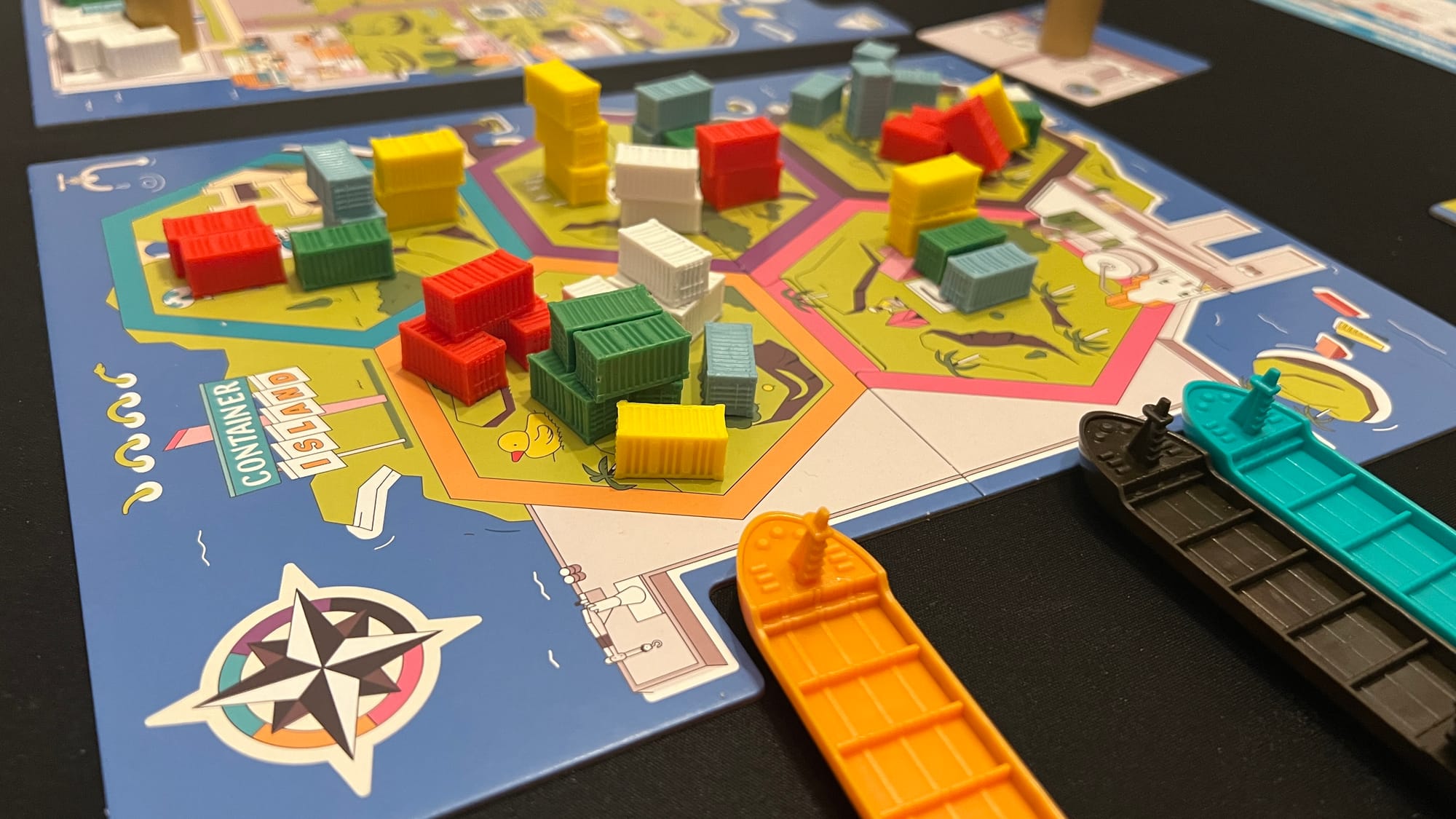
Container is the 2026 reboot of the 2007 original edition, with new artwork and reworked rules from publisher Allplay and designs from Franz-Benno Delonge, Thomas Ewert, and Kevin Nesbitt. In Container, players run shipping companies, manufacturing, buying, selling, and manipulating the container market. On their turn, players will take a variety of actions to earn money and try to get containers onto their space on Container Island. At the end of the game, players evaluate their containers for cash, and the player with the most money wins.
Container is an incredibly interactive game, and almost everything you do is influenced by the people sitting around the table. You’ll manufacture containers and decide how much you want to charge for them. Other players can then purchase those containers and move them to their harbor, where they once again set the price. Eventually, ships arrive and purchase those containers before heading out to Container Island.
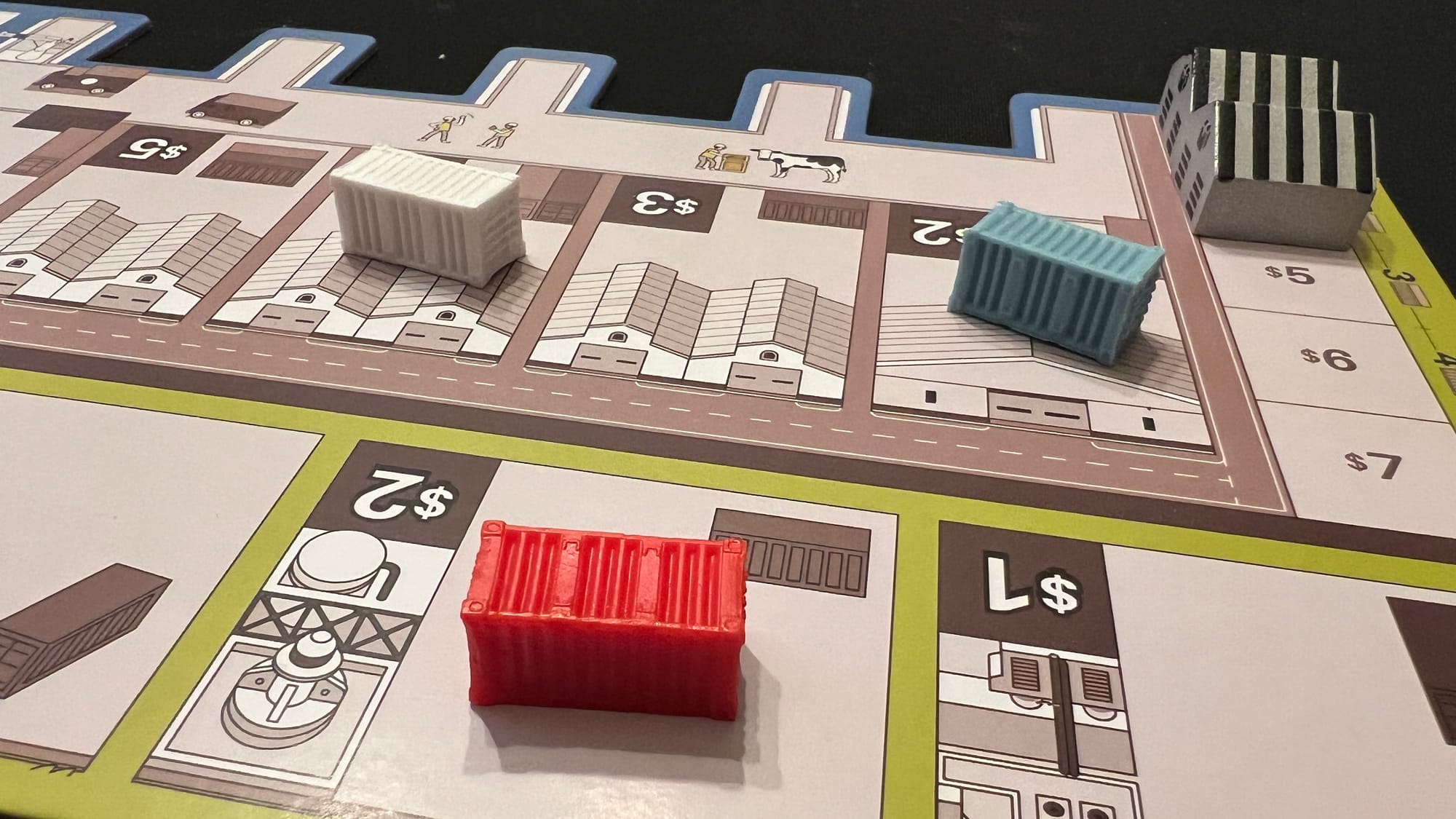
The catch is that you can’t simply buy your own stuff. That means you have to make what you’re offering desirable enough that another player actually wants it. Set your prices too high, and they may happily go somewhere else. Go too low, and you might move a bunch of product but watch someone else make significantly more money from it later. It creates a constant balancing act between what colors are available, what other players need, how much money everyone has, and where the market might be heading.
One thing I noticed is that we rarely used some of the higher-cost spaces on our boards. There were exceptions, especially in the five-player game when certain containers became scarce, but players still needed them to advance their game. Suddenly, prices that seemed ridiculous earlier weren't quite so ridiculous anymore.
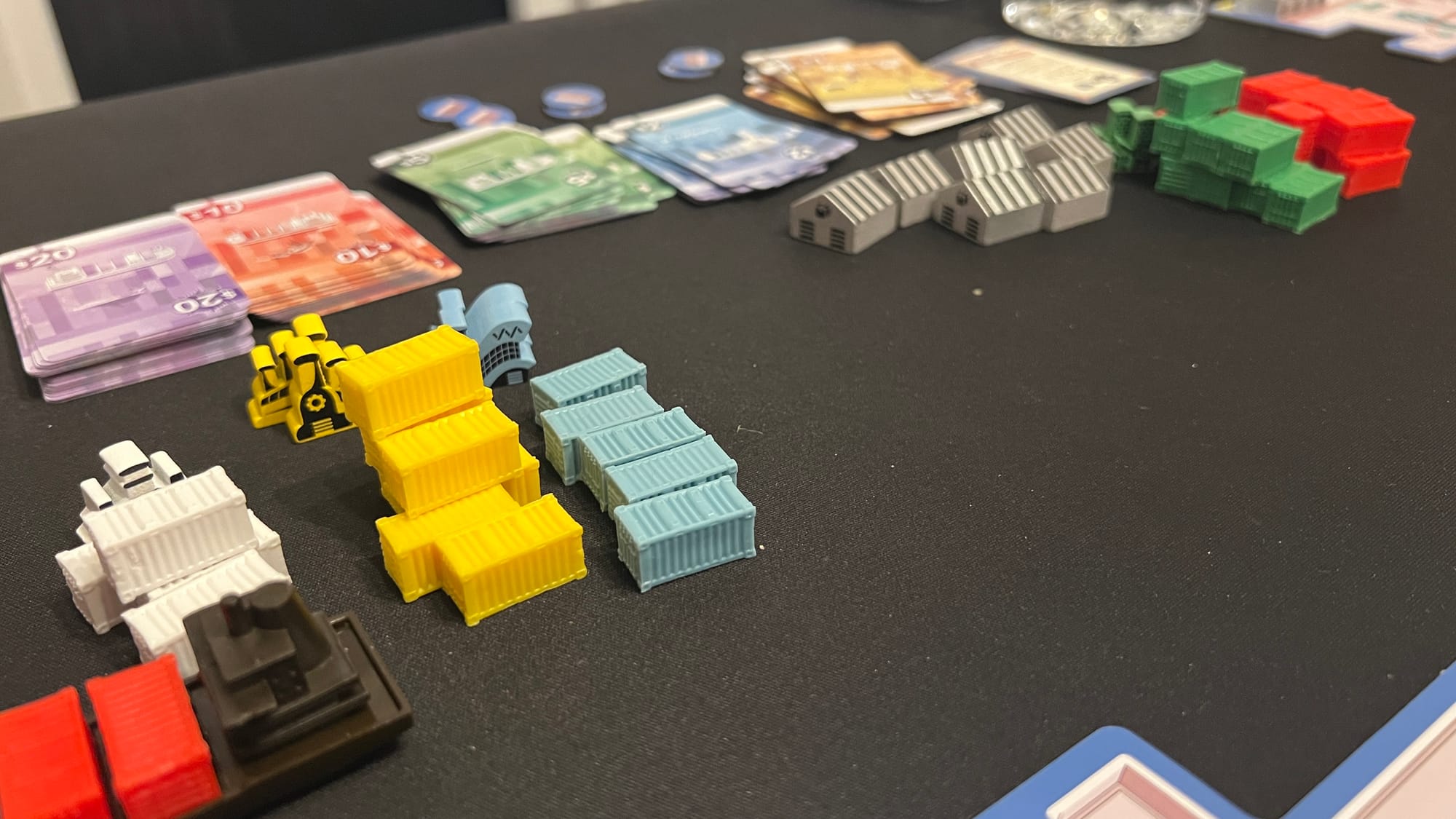
That player count made a difference in general. I enjoyed Container at three, but I thought it was better with five. There were more containers moving around, more opportunities to buy and sell, and a more dynamic market to try to read. And that's really where I think Container shines.
The rules themselves are pretty straightforward. The hard part is figuring out when to make your move. What containers are being produced? Who is buying them? When is someone going to force an auction? Should I spend my money now or wait? Is it worth taking a loan? Those questions start almost immediately. Do I invest in factories and start pumping product into the market? Do I let everyone else manufacture and instead build up my harbor so I can buy their containers? Even if I have a plan, turn order matters because the players ahead of me might completely change the market before I get another chance to act. There are a lot of good questions to ponder, and very few have an obvious answer.
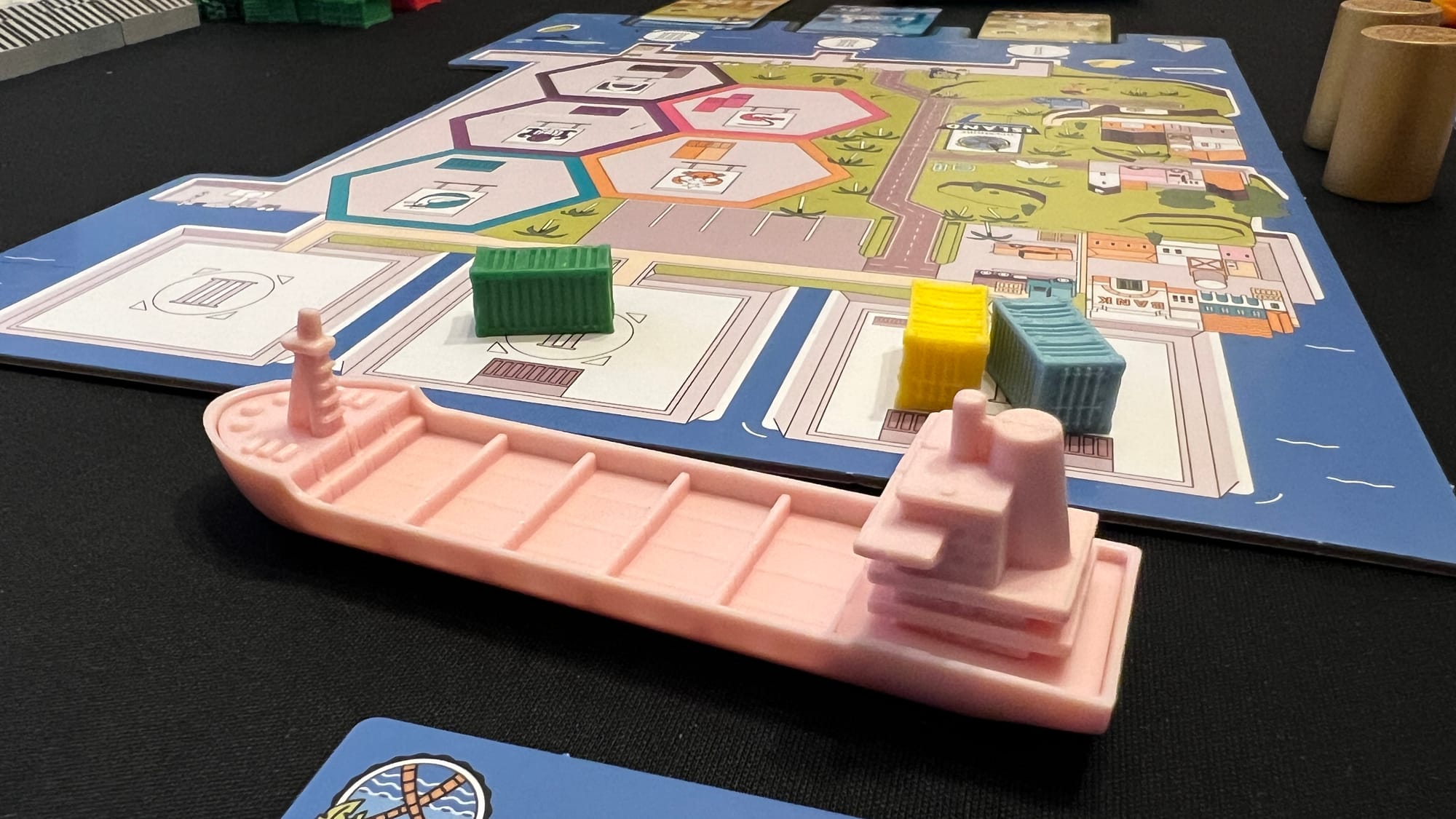
Eventually, ships will take their containers to Container Island, and that's when the auctions begin. Everyone except the player who brought the ship to the island secretly bids for the entire shipment. The two dummy cards add a fun little bluffing element because you can make it look like you're putting considerably more money into the auction than you actually are. That makes flipping those bids one of my favorite moments in the game. Did someone actually go big, or were they trying to scare everyone else away?
Even winning the auction doesn't necessarily mean you've won anything yet. The player who brought the ship to the island has a decision to make. They can accept the winning bid, along with additional money from the bank, and hand over the containers. Or they can pay the winning bid themselves and keep those containers. That creates some fantastic tension. Maybe you just put half your stack into an auction because you desperately wanted those containers. Now you're staring at the ship owner wondering whether they're actually going to let you have them. If they do, you may have just given them a massive payday. If they don't, you showed everyone exactly how much you were willing to spend and walk away without the containers.
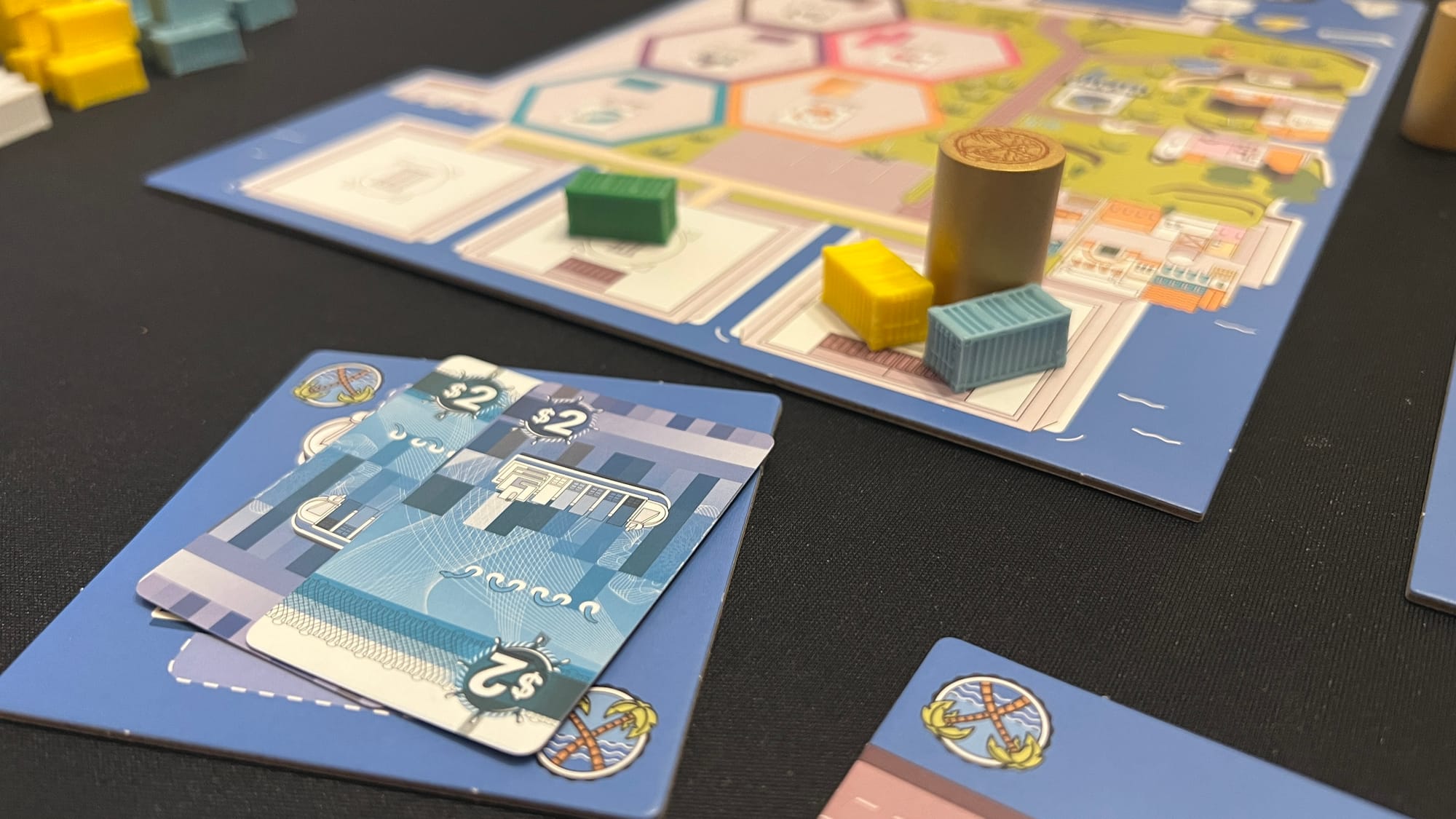
It's those interactions that made the auctions work for me. I don't know that Container changed my opinion of auction games in general. I still don't think they're something I'm naturally drawn toward. But I really enjoyed the auctions here, especially with the groups I played with. There was plenty of discussion, bluffing, reading the other players, and trying to figure out exactly what everyone was attempting to do. That being said, I also think the group matters. I played with friends, and those existing relationships heightened the experience. I'm not sure this is a game I'd be nearly as excited to sit down and play with a table full of random people. Container wants players who are willing to interact with each other and play the market rather than simply focus on their own boards.
Getting containers onto Container Island is important, but simply piling up as many as possible isn't necessarily going to win you the game. Each player has a unique scoring card that determines how much the different colors are worth to them, but there's a great little twist: whichever color you have the most of doesn't score at all. If you collect all five colors, your second-tier container becomes worth 10 instead, adding another wrinkle to what you want to collect. That scoring system changes how you approach the auctions. You need containers, but you don't necessarily want too many of the same thing. You might desperately want a color someone else doesn't care about, or find yourself bidding on something simply because it helps balance what you've already accumulated.
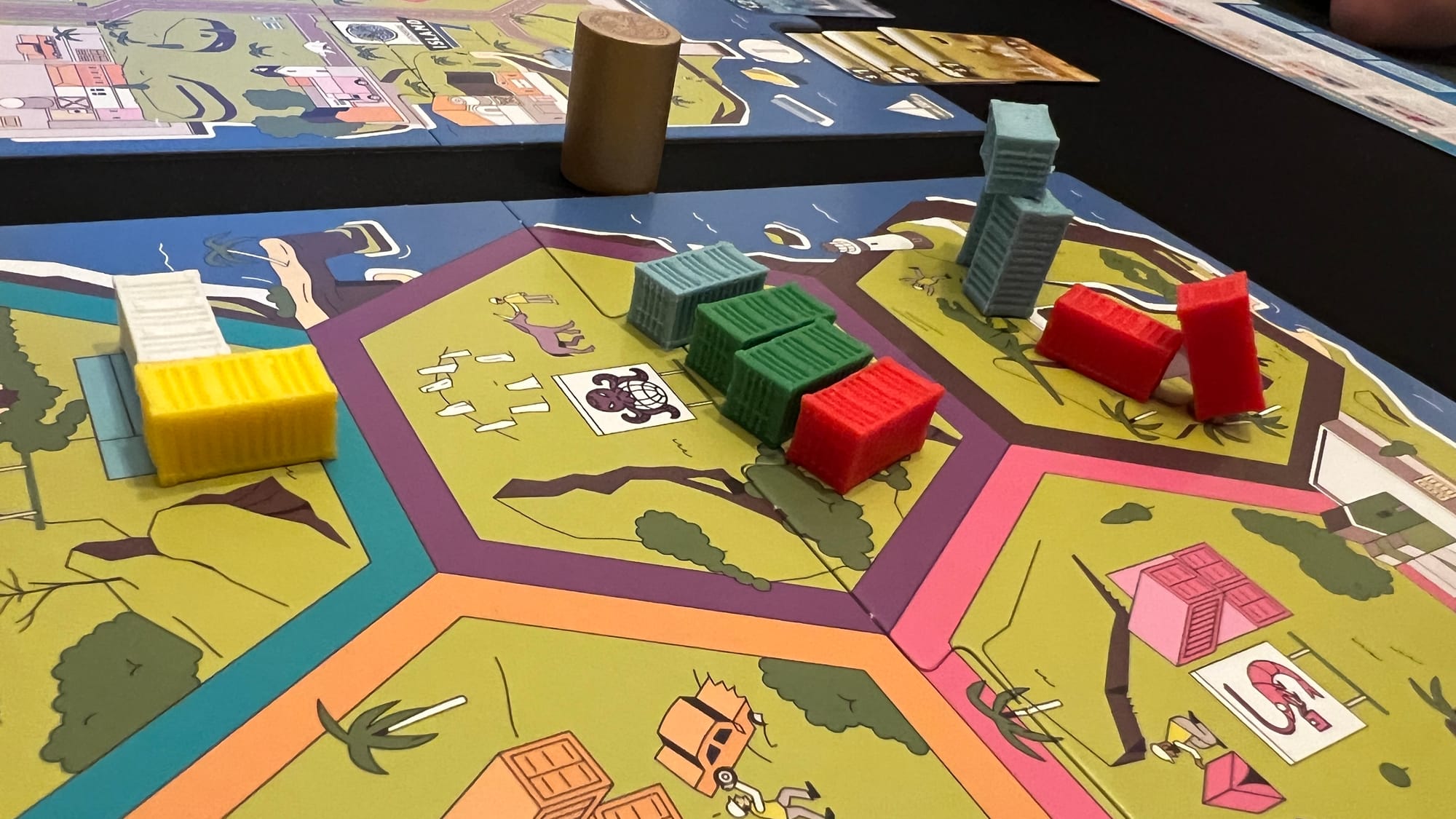
In my three-player game, I ended up losing to someone who had way fewer containers on the island than I did. They simply made bigger, better plays by putting desirable shipments up for auction and making money from the market. Having more stuff didn't mean I had played the better game.
One of the things I usually dislike about auction games is the feeling that once someone gets ahead, they're able to use that advantage to keep everyone else down. Think about the big stack in poker. Once someone has a massive pile of chips, they have the freedom to throw that weight around while everyone else has to be more conservative. I never really felt that way in Container. There always seemed to be some avenue available to make a move. In a five-player game, I took a risk by taking out a loan, winning a bid on a better shipment, and putting together a desirable shipment of my own. That gamble paid off when the ship went to auction and I made enough money that I wasn't sitting in debt for very long.
That's probably one of the biggest reasons I'm intrigued by Container. I feel like there's a way to succeed no matter where I am in the game. I never really feel stuck. The Offshore Bank contributes to that by providing another way to auction containers for money or money for containers. How useful it was varied quite a bit between our games. We barely touched it at three players, while having both bank auctions available with five gave us more opportunities to dig ourselves out of a hole. I could probably see the Offshore Bank being cut if you wanted a more streamlined experience. At the same time, I understand why it's there, especially when someone needs another avenue to get their economy moving again.
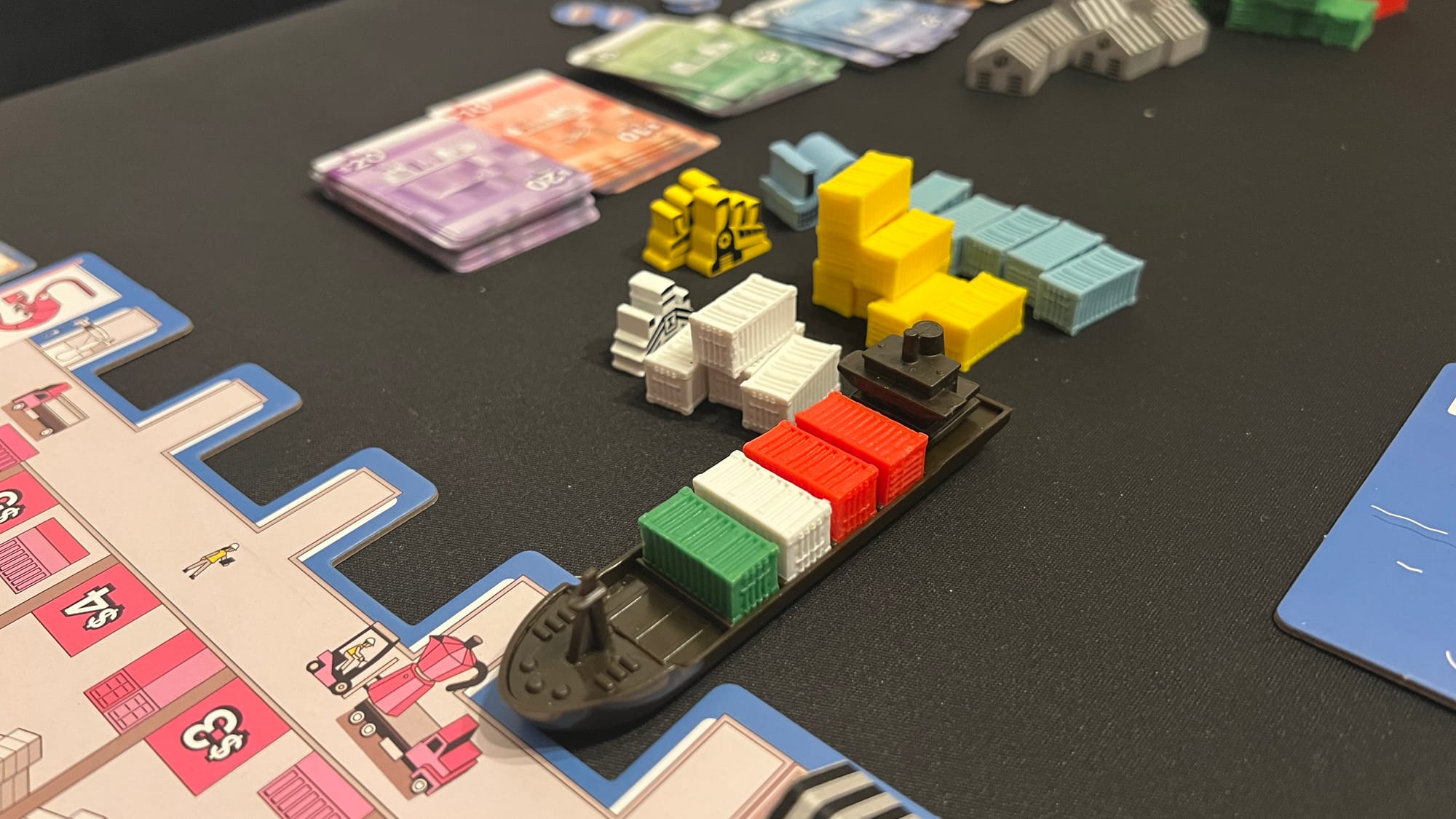
Container has an interesting look. The artwork is playful, with some fun hidden Easter eggs scattered around for players to find, but the overall presentation is relatively muted. That's occasionally at odds with the bright primary colors of the containers themselves. The vibrant plastic containers can clash a little with the more subdued colors used throughout the rest of the game. Thankfully, there's also a more muted version of the artwork available if you find the standard side too distracting, which is a nice option. The cardboard and cards are nice quality, while the plastic ships and containers are fairly light. After playing with them, I can definitely understand the allure of the deluxe metal version that's also available. There's nothing wrong with the standard components, but this is one of those games where the extra weight of metal containers seems like it would fit the experience particularly well.
This new edition also includes the classic rules for players who want to experience Container closer to its original form. I didn't get a chance to try those, so I can't speak to how the two versions compare, but I appreciate having the option included.
Container is for people who enjoy highly interactive games and aren't afraid to have their plans disrupted by the people around them. You need to enjoy reading the board, watching the other players, and deciding when it's time to push. The game state can shift quickly, and something that seemed like a great idea might look completely different by the time your turn comes back around. If you want a game where you can quietly build your own engine without worrying too much about everyone else, this probably isn't it. And if you don't like auction and bidding games? Well, apparently you still might want to give Container a shot.
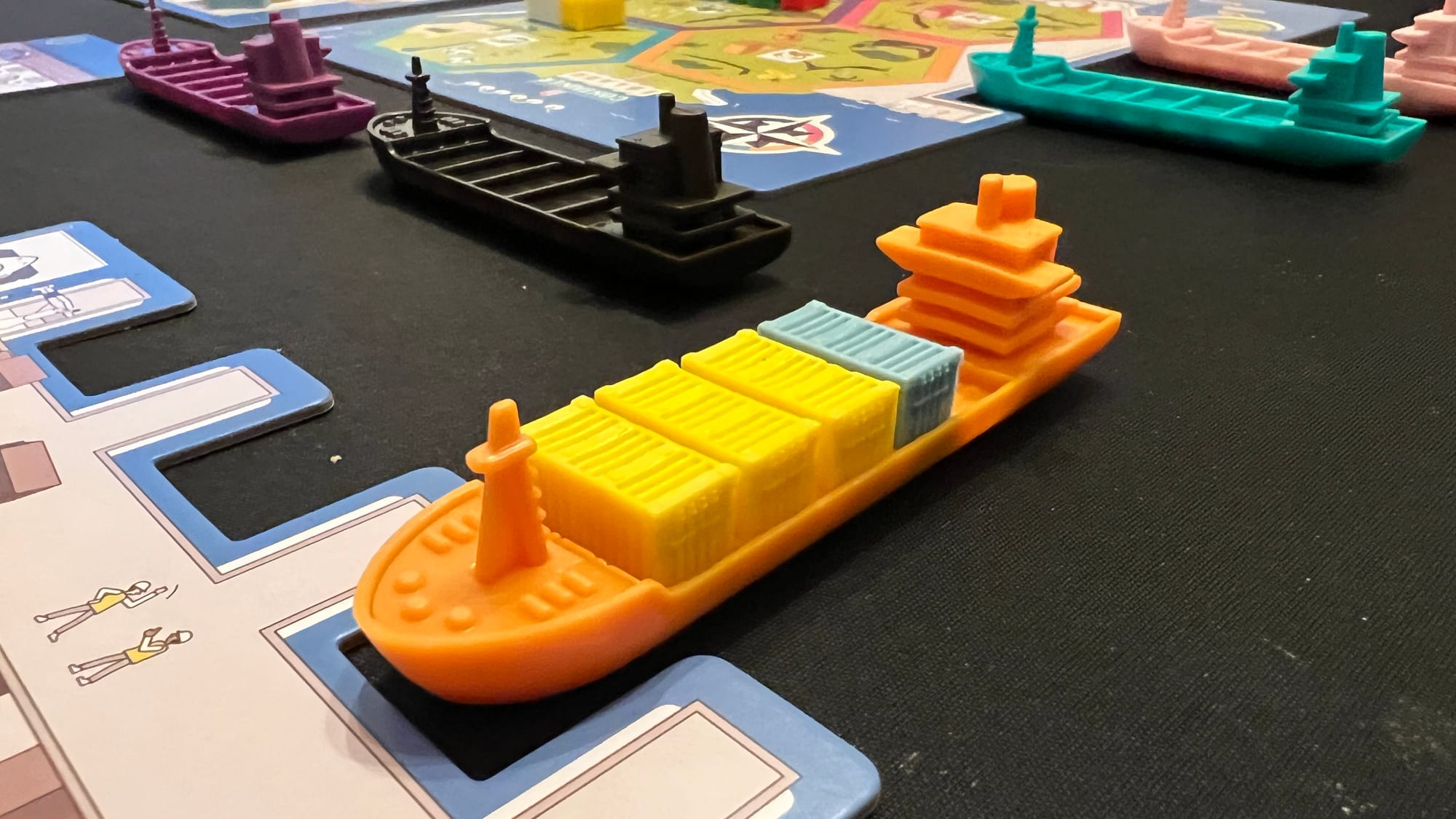
I don't think Container suddenly made me an auction-game fan. Put another bidding game in front of me tomorrow, and I'm probably still going to be skeptical. But Container gave me enough control around those auctions that I never felt like my entire game came down to whether I could outbid everyone else. I could manufacture, manipulate prices, buy from other players, take loans, change my strategy, put together a desirable shipment, and look for an opportunity to make my move.
Sometimes that meant laying back and letting everyone else spend their money. Other times it meant taking on debt, buying a bigger ship, and hoping I could turn it into a payday. And sometimes it meant putting half my money into an auction and hoping the person across the table didn't decide they wanted those containers more than I did.
Maybe I still don't like auction games, but I think I like Container.
Container
Great
Container is a highly interactive economic game built around manufacturing, buying, selling, and auctioning goods in a constantly shifting player-driven market. Simple rules give way to tough decisions as players balance supply and demand, manage their money, and determine when to play conservatively or take a big risk.
Pros
- Highly interactive, player-driven economy
- Auctions create great tension and bluffing
- Multiple paths to success and recovery
Cons
- Better at higher player counts
- Experience heavily depends on the group
- Offshore Bank can be hit or miss
This review is based on a retail copy provided by the publisher.
More Containers
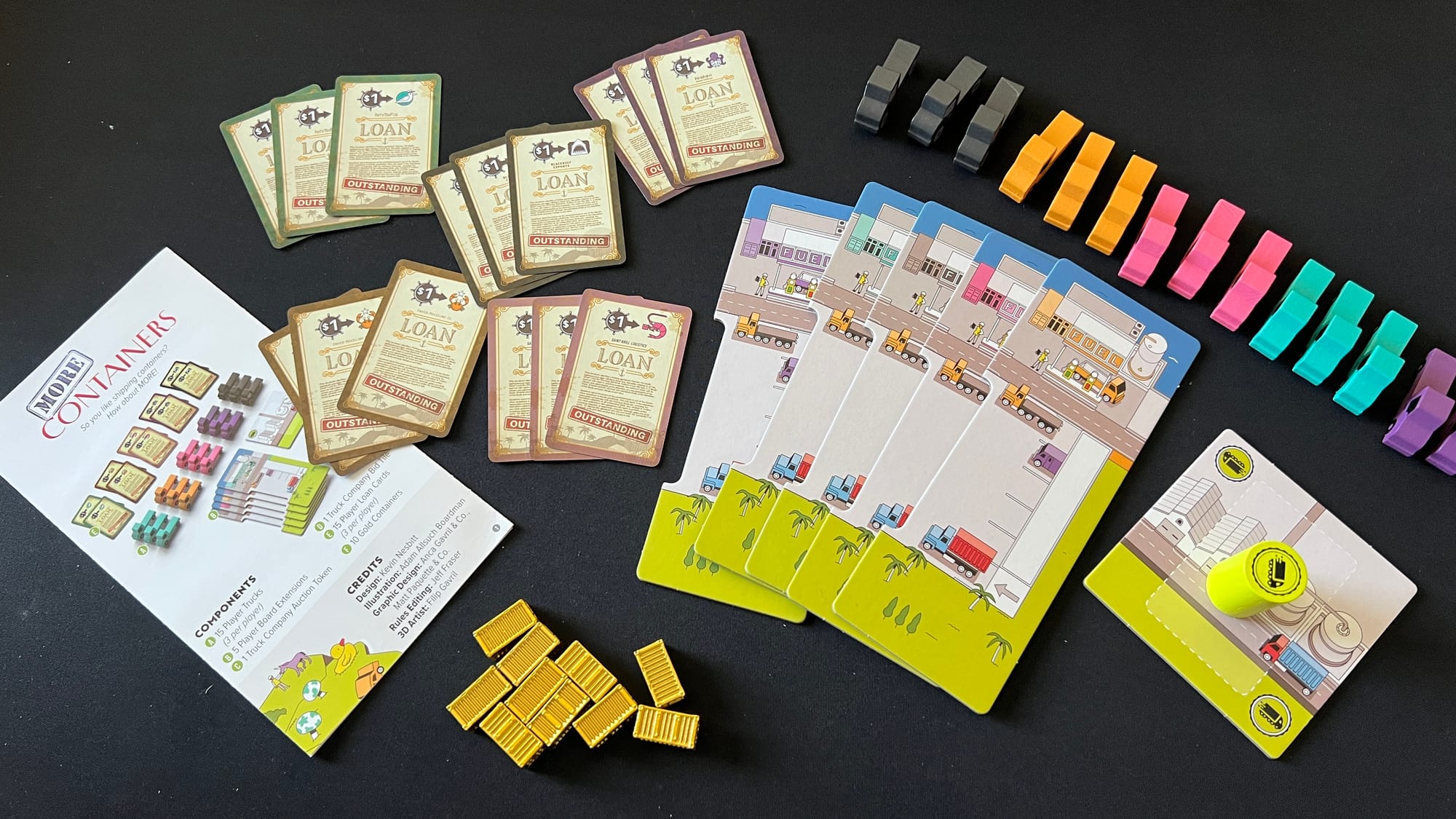
More Containers adds three optional modules that can be mixed and matched with the base game: Luxury Containers, Truck Companies, and Player Loans. The gold Luxury Containers are the highlight, adding some welcome flexibility to the market and endgame scoring, while the other modules add new ways for players to interact with each other's businesses and money.
For me, the gold Luxury Containers are easily the best addition. Being able to turn two containers into gold gives you some extra flexibility, especially when you're trying to navigate the unique scoring cards at the end of the game. Gold containers can count as another color during final scoring, but they can also become part of the color you have to discard if you aren't careful. It adds another decision to consider without getting in the way of what already makes Container work.
I was less impressed with the Truck Companies. Container already has plenty of economic layers to keep track of, and adding ownership of trucking companies and freight fees felt like one more thing that didn't really need to be there. Instead of making the economy more interesting, it felt like it overcomplicated something that was already working well.
Player Loans had almost the opposite problem. Rather than adding too much, we mostly forgot they were there. We only saw one used during our plays, and money is already tight enough that nobody seemed particularly interested in handing $10 over to another player. I like the idea of players becoming the bank and potentially making money off someone else's desperation, but it just didn't come into play enough for us to make much of an impact.
Thankfully, More Containers is modular, so you don't have to use everything. I'll happily bring the gold containers into future games while probably leaving the other two modules in the box. There's some interesting stuff here, but I'm not convinced Container needed much more Container.
More Containers Expansion
Good
More Containers adds three optional modules—Luxury Containers, Truck Companies, and Player Loans—that can be mixed and matched with the base game. The gold Luxury Containers add more flexibility to the market and endgame scoring, while Truck Companies and Player Loans introduce additional ways for players to interact with each other’s businesses and money.
Pros
- Gold containers add meaningful scoring flexibility
- Modular format lets you pick what works
Cons
- Truck Companies add unnecessary complexity
- Player Loans were easy to forget
This review is based on a retail copy provided by the publisher.