A fun and light tabletop game can be just the remedy after a long day at work or in class, or just whenever, and WizKids has another offering to bring to the table. WizKids is mainly known for their lineup of Dungeons & Dragons products, from play mats to dice sets to plushies, and more, so it came as a surprise to me when Featherlight came floating onto my desk with the iconic WizKids logo. This game takes strategy and management and puts it into a package that even your kids could enjoy.
Pauly the Patoo bird, who we see in beautiful watercolor detail on the packaging and the back of the cards, has fallen out of his nest, and his collection of feathers is now scattered around him. The feathers he’s collected come in a variety of colors with different features and attributes, and he needs help gathering them all up and returning them safely to the nest.
A Patoo bird, in case you’re curious (and even if you’re not), is a nocturnal insectivore, meaning they eat bugs and hunt at night. They are primarily found in the southern parts of Central America as well as much of South America.
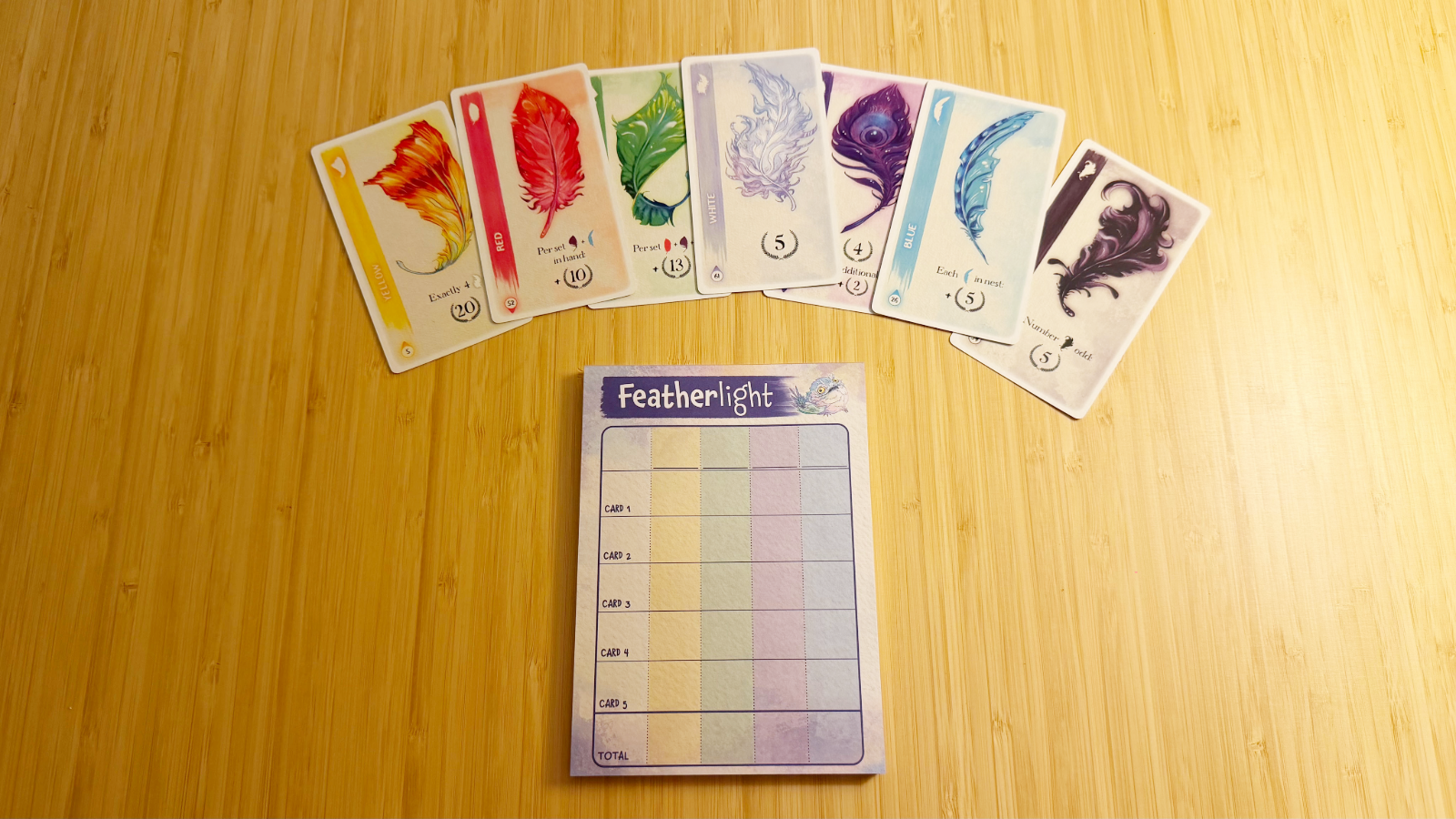
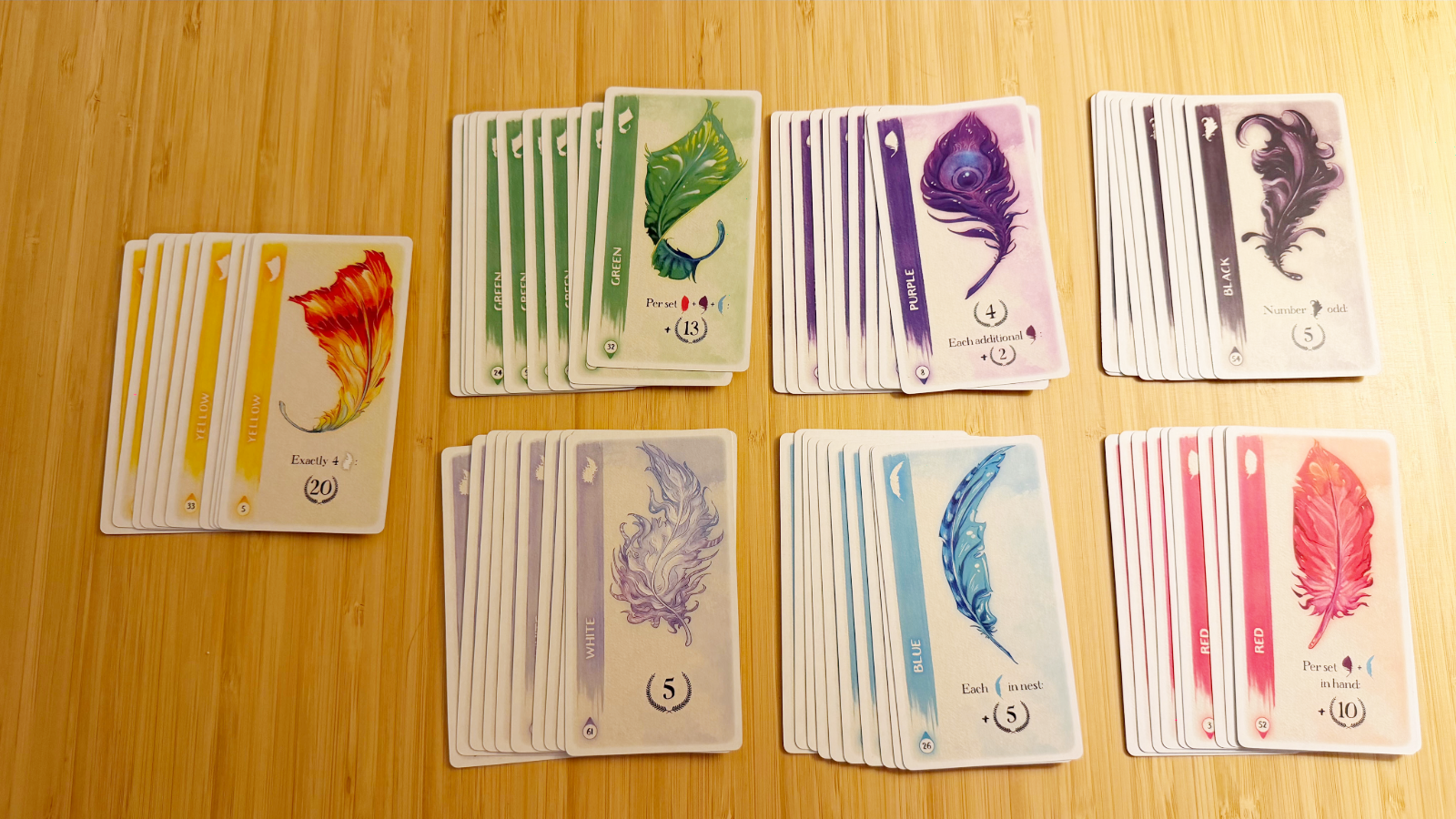
So, how much does the backstory play into the game itself? At first glance, not a whole lot. As Pauly’s friends, you’re just trying to help him recollect his feathers, but, to make it interesting, you make a little game out of it — who can collect the best set of feathers? Featherlight is a hand management game for ages 8 and up, supporting 2 to 4 players. The feather cards get shuffled, and then a number of cards are removed from play depending on how many players there are; 8 cards for 2 players, 7 cards for 3 players, and 4 cards for 4 players. There’s no real rhyme or reason given as to why the cards are removed, but it does throw a twist at players if they’ve played multiple games of Featherlight and have become familiarized with the better cards. We’ll get to more of that later.
After discarding the appropriate number of cards, each player is then dealt 5 cards facing down. Six more cards are then drawn and placed face up in the center of the table, creating the nest. The remaining cards are split into equal stacks and serve as the draw piles. Once all the cards have been dealt and placed, play begins.
Players will take turns either swapping a card in their hand with a card in the nest or drawing a card from either draw pile and then placing a card into the nest. Players are not allowed to skip or forego, they must take and complete a full action every turn. There are 7 different card colors with 10 cards per color. Each card has an identification number in the bottom left corner as well as an indicator of how many points the card has the potential to score based on conditions printed on the card. Many cards will have identical conditions, however there are limitations to prevent stacking of the same conditions, so collecting cards with the same conditions isn’t recommended. If the conditions printed on the card are not met, then the card scores no points.
If a player chooses to draw a card from a draw pile, they’ll take that card into their hand and then determine which card will be sent to the nest based on which cards they think they can score best from. The card they drew can be sent to the nest if they don’t want to keep it. If they choose to swap with a card in the nest, a card has to be placed back into the nest, but it can’t be the card that was taken from the nest. If the card taken from the nest leaves a hole, meaning there’s only 5 face-up nest cards left, then the card being placed into the nest must fill the empty spot. Otherwise, the discarded card can be placed on top of any of the 6 nest cards. The game ends when either of the two draw piles is depleted. The player who draws the final card from one of the stacks must complete their turn by discarding a card to the nest. Once they’ve sent a card to the nest, everyone tallies up their points, and the person with the highest number wins.
The instructions may seem a little confusing at first, but I promise the game is actually very simple and you’ll get the hang of it after a few turns. Players must keep their cards a secret from other players, however they are encouraged to make requests of other players, such as where in the nest a discarded card should be placed, which can either be fulfilled or denied.
The scoring conditions on each card can be as simple as being granted a set number of points for simply possessing the card but get as complicated as trying to complete a set or even trying to avoid certain cards from being in the nest. Attempting to sway what another player does on top of trying to sabotage their strategies makes for an interesting showdown of poker faces in the fight for the best collection.
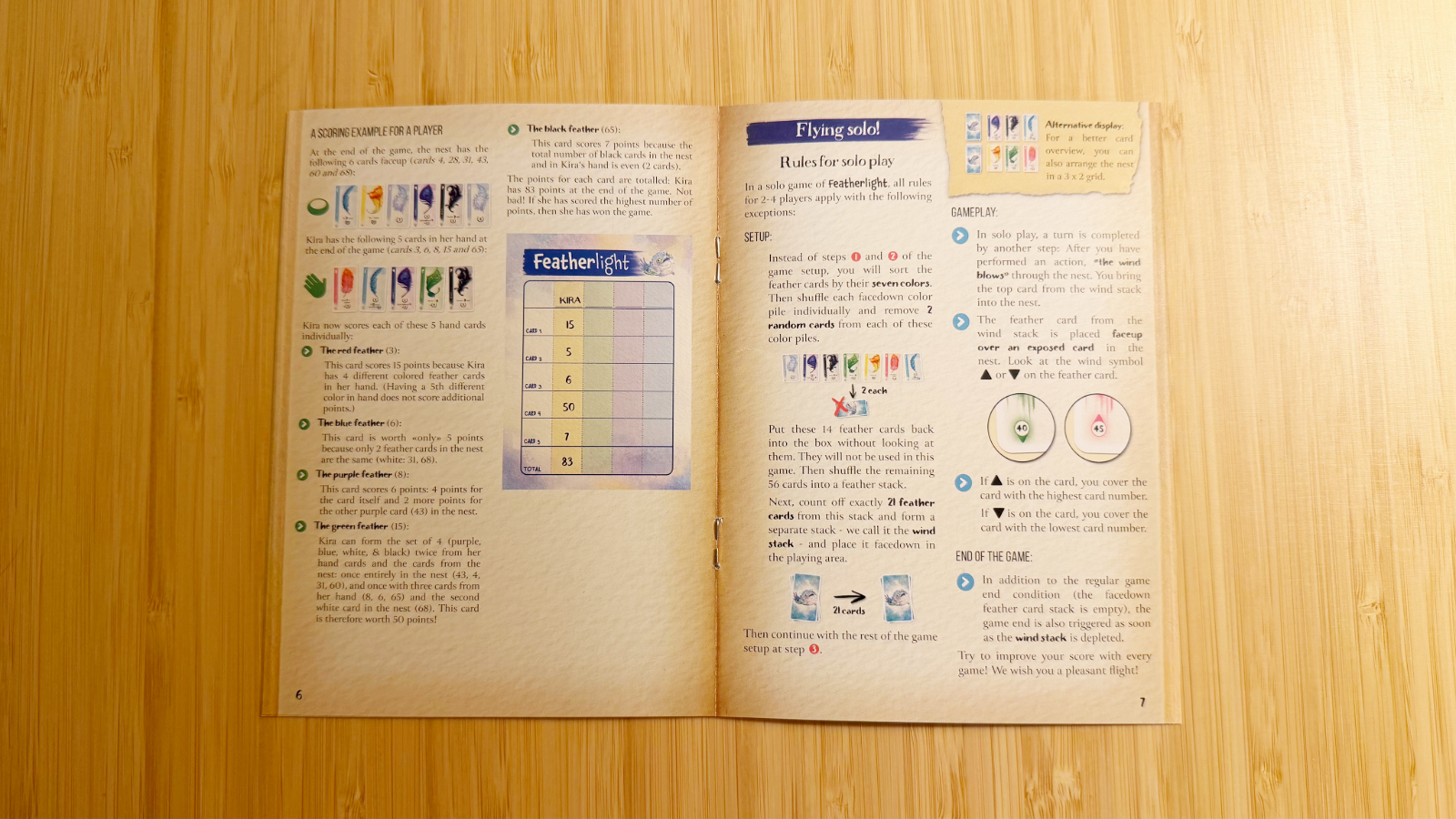
There is also a way to play solo. Setup is a bit different when playing alone. Cards are sorted by color and then each color stack is shuffled and placed face down. Two cards from each color stack are removed from play and then all cards are shuffled back together. 21 cards are set aside as the Wind stack and then the player draws 5 cards and places the 6 nest cards. The remaining cards act as the draw stack.
For the most part, gameplay from here remains largely the same with the player either swapping a card from their hand with a card in the nest or drawing a card from the draw stack and discarding a card into the nest. However, at the end of each turn, the wind blows and a card from the wind stack is added to the nest. Where to place the card in the nest is determined by whether the arrow is above or below the identification number in the bottom left of the card. If the arrow is pointing up, the wind card is placed on the nest card with the highest ID number. If the arrow is pointing down, the wind card is placed on the nest card with the lowest ID number. This helps to create the unpredictability of play that would otherwise take place as other players are taking their turns. The game ends when either the wind stack or the draw stack is depleted. When playing solo, your objective is to simply beat your best score. I somehow managed to get a worse score with each solo game played.
The cards are made of the typical material of a deck of cards, though they are a little longer, being a little over 4 inches long. Pauly the Patoo bird is on the back of each card, and each color has a different style of feather to make it easier to tell them apart (white almost looks like it could be a very light blue and purple and black are both pretty dark). The scoring conditions are at the bottom of the card below the feather, but if you are having trouble determining what the conditions mean, there’s a Feather Dictionary in the back of the rule book to break it down for you.
Every card is listed in the Feather Dictionary, though, like I mentioned before, some cards will have the same scoring condition as others. In the Dictionary, the description will simply say “Card effect identical to card #”. Initially I thought this was a little lazy on the design side, but in reality it’s nice that there’s some duplicates as it’s easier to keep track of and understand each card. However, they do make small changes by switching out which colors are part of the score condition so they aren’t literally identical.
The rulebook is very easy to follow and understand, providing a very detailed walkthrough of each step of the game. The text is a bit small, but it’s a little tight for space unless they decide to add more pages. The overall design and aesthetic of Featherlight is simple and the artwork is pretty with the watercoloring. There’s a notepad of scoring cards included so players can keep track of their points from game to game and to compare final scores. Everything is packed into a small box that has a little insert that holds the cards somewhat in place so they don’t get scattered and tossed around inside too much. Each game takes around 20 minutes to play with another 5-ish minutes added for prep and setup.
Featherlight
Great
Featherlight is a pleasant and light hand management game where you have to help Pauly the Patoo bird collect his feathers. The game is very easy to set up and get right into and is perfect for a family game night or a solo challenge.
Pros
- Short games means you can go multiple rounds
- Easy to setup and jump right into
- Pretty watercolor design with an adorable mascot
Cons
- Text in the rulebook is small, could’ve used more pages to spread it out
This review is based on a retail copy provided by the publisher.