The Séance of Blake Manor is, unfortunately, the lesser of the two narrative-driven mystery period piece deduction games set predominantly in a large estate that involve unique time-based mechanics to have released within the past year. I almost wish I hadn’t played The Incident at Galley House just a month or so before picking up the console release of The Séance of Blake Manor; perhaps then I wouldn’t have had such a superior version of a similar concept so fresh in my mind to subconsciously compare it to. Spooky Doorway’s Blake Manor is not without merit, nor is it without passion, but its flaws build to an unignorable level of frustration.
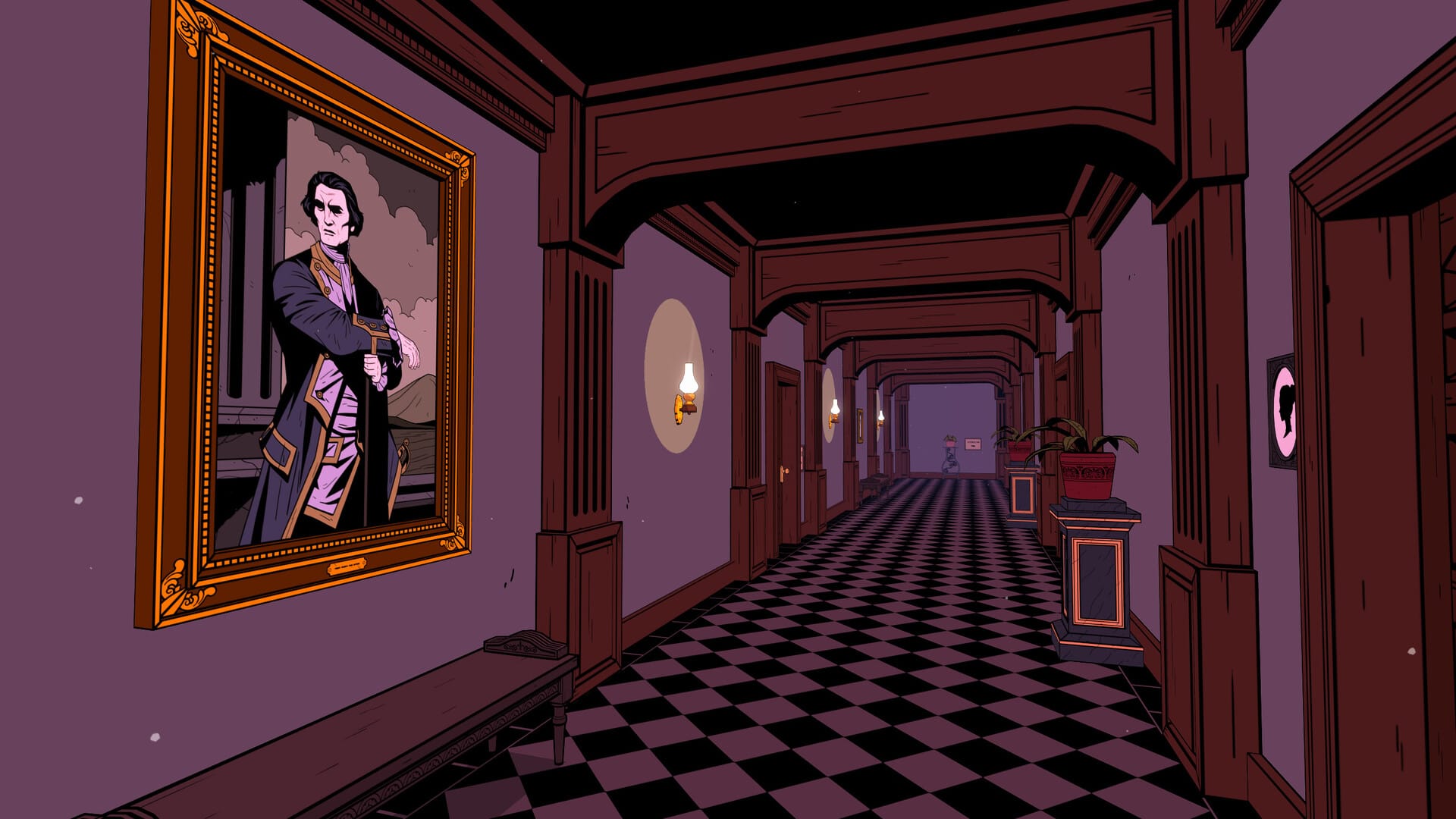
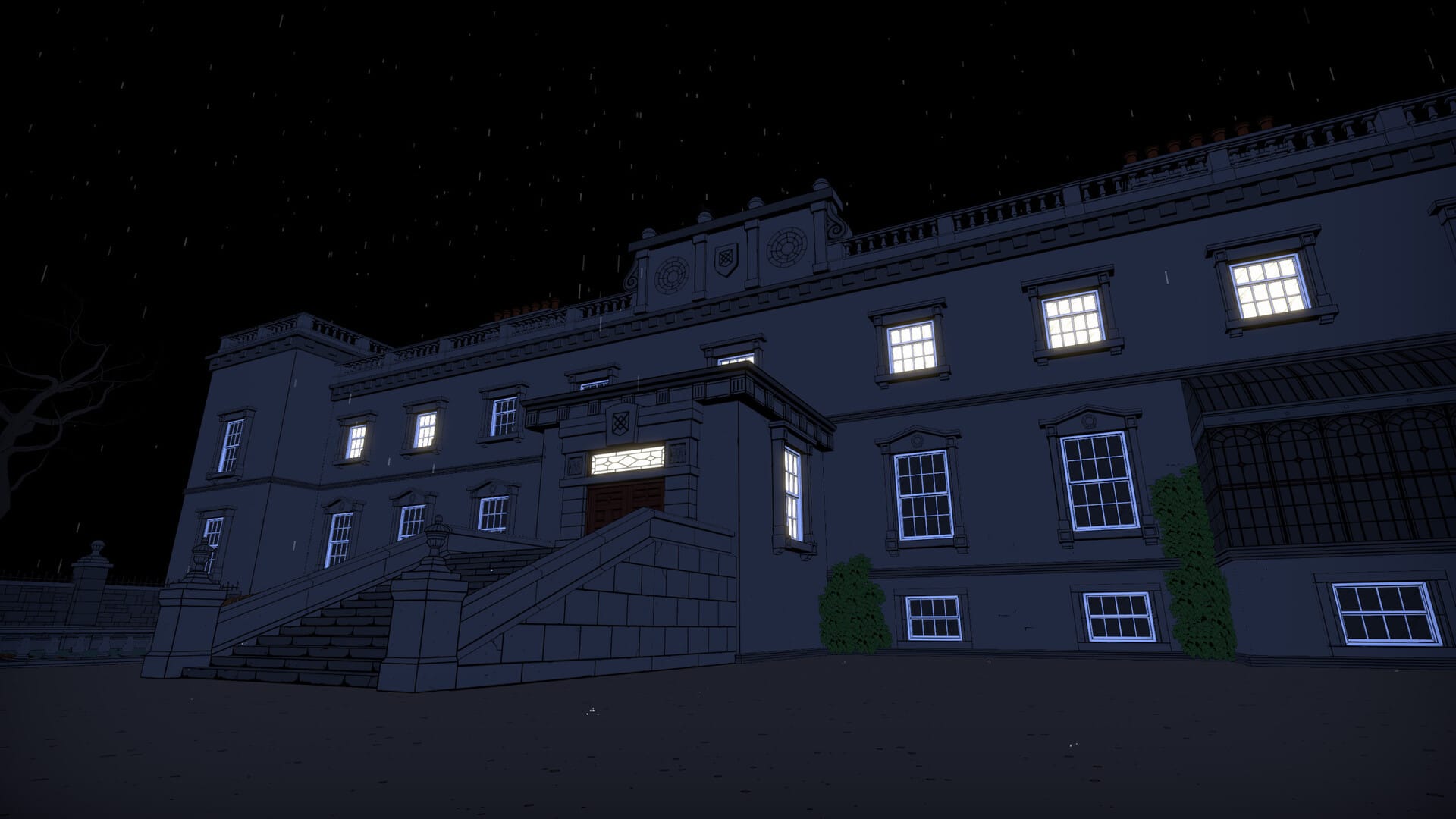
It’s October 29, 1897, just about 48 hours before the veil between the living and the dead is at its thinnest. 24 guests and staff have gathered at Blake Manor for a séance performed by famed medium Carmela Montavari, eager to witness her perform a never-before-seen communion in which a ghost will speak not through a surrogate, but for themselves. The game spends little time dawdling in the is magic real? of it all, making it immediately clear that — despite the apparent normalcy of the rest of the world — Blake Manor is about to become a hotbed of supernatural activity. As PI Declan Ward, you’ve been sent to solve the disappearance of one Evelyn Deane, an enigmatic young woman who went missing somewhere within the manor just days prior.
It’s a promising setup with, at least for me, a major question mark: can a detective mystery story function in a magic-infused setting? In an Agatha Christie novel, we take for granted the fact that the rules of reality are already established; the reader is presumably well versed enough in the laws of physics to know what the killer can and cannot realistically do. Magic, then, throws everything off, allowing for outlandish explanations for murderous misdeeds. If the magic system is consistent and properly explained, it’s possible (if still difficult) to pull this off. Blake Manor almost gets there, but in the end, the game’s nebulous magic proves too unwieldy and murky to make for a satisfying grand reveal.
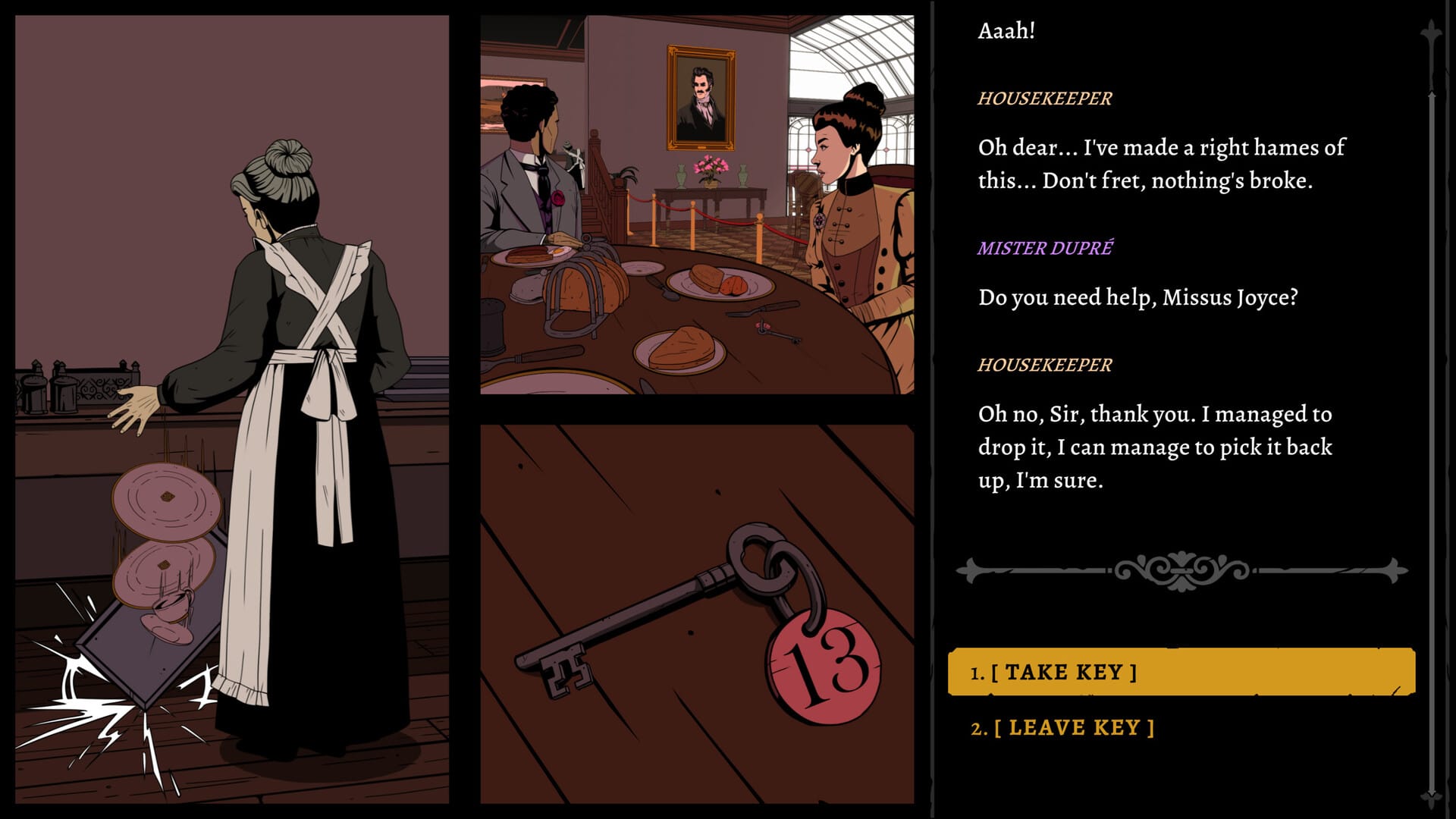
With 24 guests and just a day and a half or so to solve the crime, Declan has his work cut out for him. It doesn’t help that every action he takes has a set duration associated with it, be that looking at a chair or interrogating a suspect. Most actions take just a (in-game, not real life) minute, while more meaty in-game events can be upwards of 30, making time management a necessary balance. Each hour, the attendees will shift about the house, forcing you to keep track of their movements by asking them their schedule or breaking into their rooms and finding their agenda. It’s a clever mechanic, forcing the player to consider whether they really need to investigate every inch of the manor’s numerous nooks and crannies, and gives the mystery an anxiety-inducing sense of urgency without the dread of a more traditional ticking clock.
Light spoilers ahead
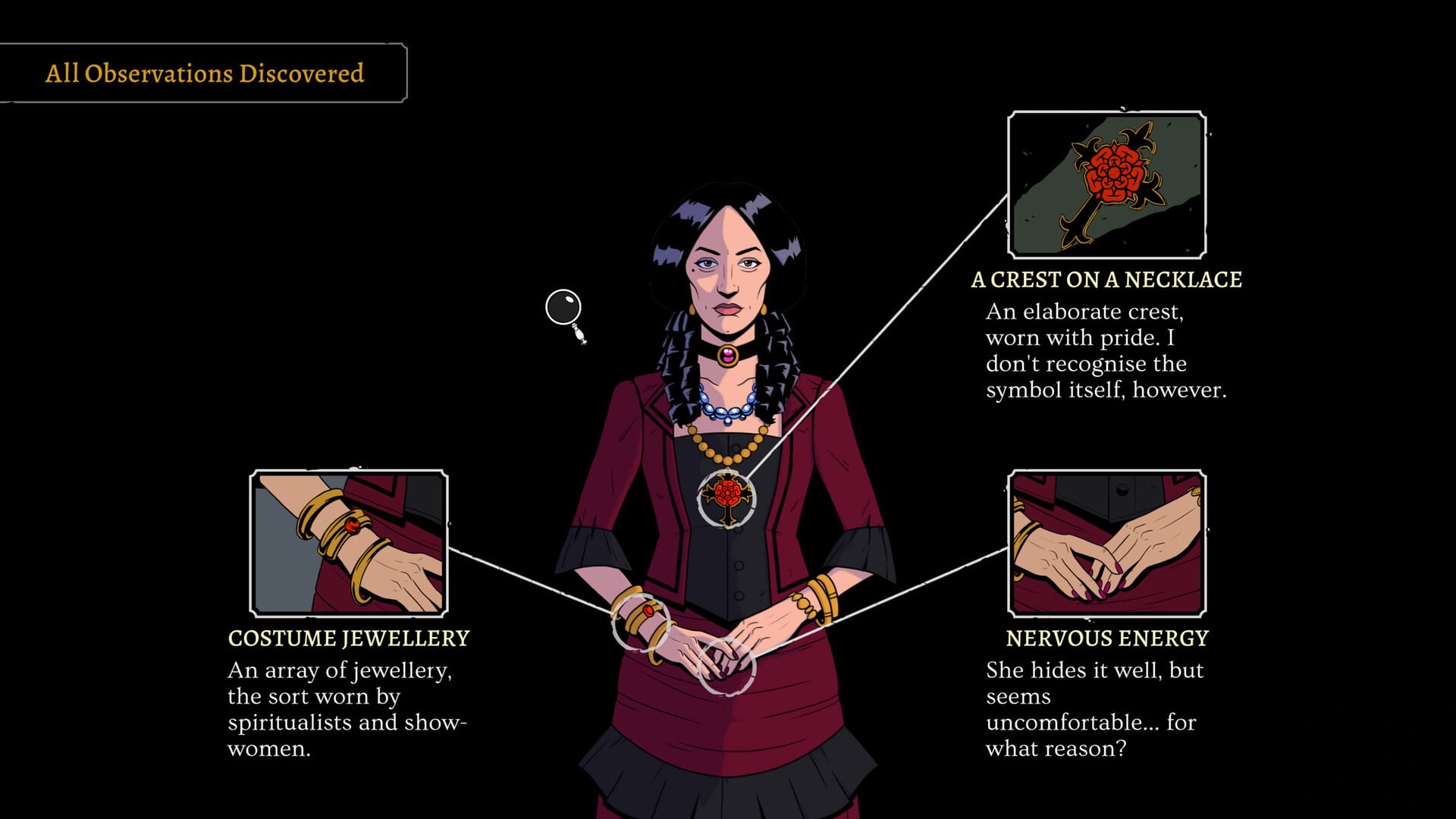
The first day had me hooked. I loved introducing myself to such a vast and diverse cast of characters, each with their own entirely optional secrets to uncover. If I ever lost track of a character, I would simply move onto a new one, digging into their past until another snooping opportunity arose. The characters are decently written for the most part, establishing their strong personalities while concealing their true intentions. Some characters have darker subplots than others, ranging from a doctor who wants to escape the shadow of his aunt, to a phony medium who wants to drug and steal the heart of a magically-abled person so that she can snatch their powers for her own. The more maliciously-inclined guests have their bleak intentions dampened by the fact that the manor is affecting the guests’ minds, making them more impulsive and likely to debase themselves than they otherwise would be. As soon as they’re accused, each suspect seems to snap out of their trance and immediately see the error of their ways; it’s a little cheap, and Declan is always a little too willing to help out despite what he’s just uncovered.
Some guest mysteries are uncomfortable, feeling like characters get away with behaviour that is far more questionable than the game seems to suggest. Olivia D’Arcy came to the manor with plans to murder Deane for having an affair with her husband. Declan is able to talk her out of that, which is all fine and dandy except that D’Arcy has already murdered her husband, and her side quest revolves around finding a way to stop him from haunting her. She shows no remorse, nor does Declan ever question the justification for her actions. Look, I get it, the husband sucks, but did he really deserve to die? Don’t worry, it gets worse. The solution is to trap the spirit of her husband in a ring, which she ends up throwing into the ocean. This poor dude is doomed to an eternity of watery hell, all for cheating on his wife? And the player is expected to not only be fine with this but to actively aid her? It’s simplistic writing in a situation where nuance is necessary.
This simplicity pervades Blake Manor. Save for a few early optional mysteries, most characters have a simple problem with a simple solution solved, well, simply. With 24 characters, all with their own (occasionally interconnected) mysteries to solve, they can’t all be winners...but I wish far more of them were. It's this but unironically. I respect the ambition of Spooky Doorway, and I see the vision they had, but the game is too long and gets bogged down by the sheer volume of supposedly optional content. The Incident at Galley House, while being only a little shorter, presents you with less than half the number of characters, allowing you to become far more intimately familiar with each of them. The writing in Blake Manor can be excellent and hard-hitting on a line-by-line basis, but struggles to build characters that stick with you.
The manor itself is rather large. Not open world large, but big enough that by the time I was travelling from the atrium to the hedge maze for the hundredth time, I was exhausted and, frankly, bored. This is almost entirely due to the egregious loading screens that plague the manor, far more insidious than any supernatural entity. Each door will stop you in your tracks for 3-5 seconds, which doesn’t seem like much until you realize just how much time you spend walking from one place to another, often with a significant number of doors between you and your destination. I’m no game developer, not by a long shot, so please, correct me if I’m way off here — why in the world can this game not be one contiguous, uninterrupted location in the year of our lord 2026? Is the comic book-esque art style more demanding than I think it is? There has to have been a better solution; I think my brain has screen burn-in from that sinister spiral loading symbol. It wasn’t a problem at first, but in the later parts of the game when I had specific places I wanted to be and wasn’t freely exploring anymore, it was downright immersion-breaking.
Aside from that major complaint, the manor itself is quite the feat. Calling it a manor doesn’t even do it justice; the massive building has been converted into a hotel spacious enough that there are a couple unoccupied rooms despite the séance’s high turnout. Each guest room is brimming with clues and secrets, from notes to forbidden lovers to crucially important shoe sizes. The hotel’s event spaces and winding hallways are equally impressive, covered in paintings of Blake family members both living and long dead (and non-existent but we’ll get there).
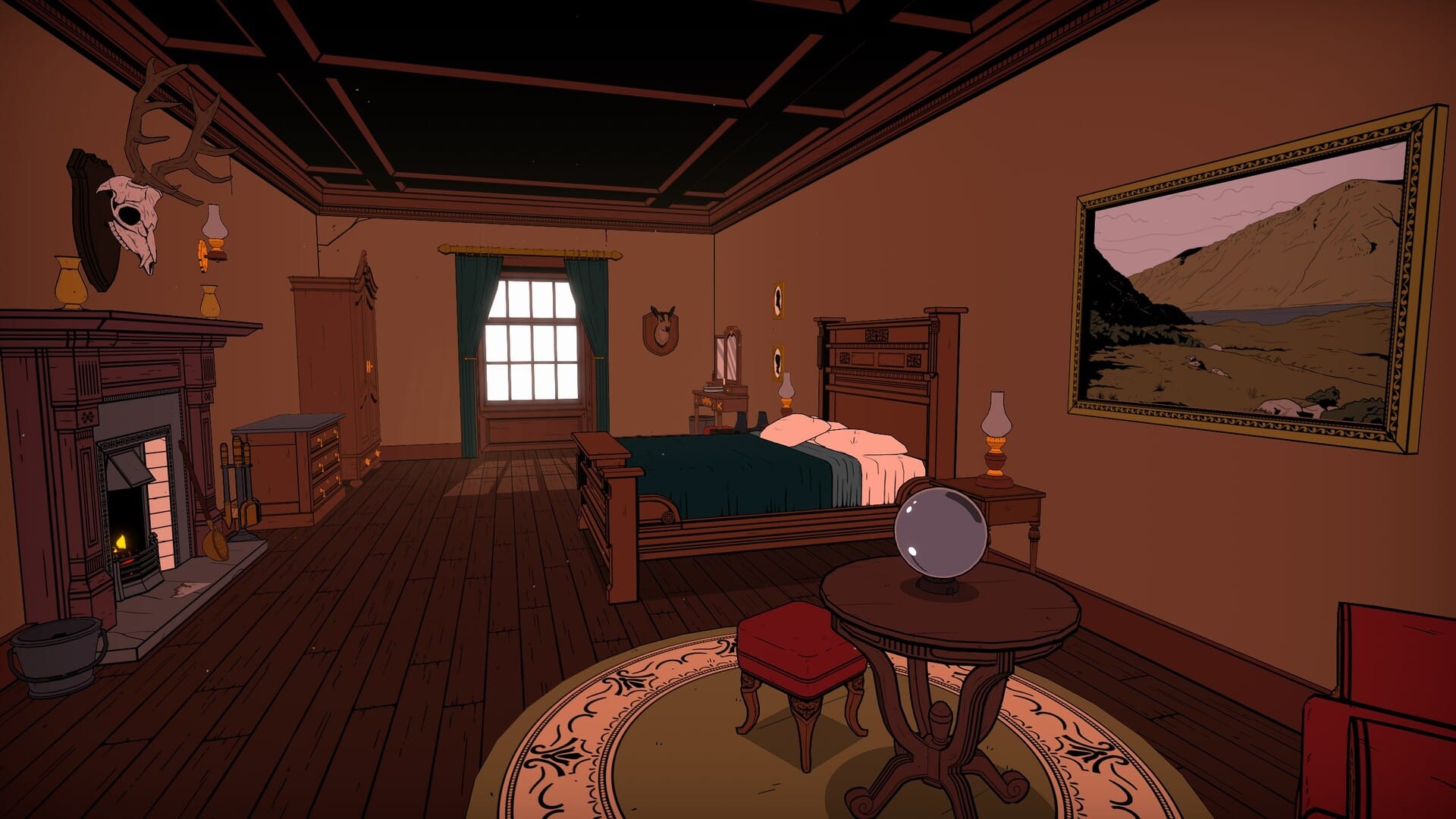
The library is the best room in the entire estate. Here, you’re able to research an unbelievable breadth of topics, some tying into the game’s central mystery, and others just there for a quick history lesson. At times, Blake Manor can feel strangely didactic, invested greatly in teaching the player about Irish history and folklore. Each day has a handful of talks given by the guests, all of them entirely optional and having barely any bearing on the narrative. They’re there if the player would like to learn a little more about the lesser-known pantheon of Irish gods and tales of strange creatures, their legends warped by time (and Catholicism). In these moments, Blake Manor shines brightest.
I’ve avoided discussing the central mystery much — really, there’s just not that much to say. The things you learn about Deane make her rather unlikeable (on top of the aforementioned affair, she’s also blackmailing an innocent young lesbian couple?), and solving her disappearance often seems like something happening in the background. This isn’t helped by the fact that a dark, otherworldly presence has something to do with her whereabouts, and I couldn’t reconcile that with what’s obviously supposed to be a whodunnit. Could she be locked in a cellar, or is she hidden in some parallel dimension? The existence of magic creates too many possibilities, making the mystery completely impossible to solve on your own. By the end, even one of the game’s core mechanics seems like a throwaway: you’re crossing off names of potential culprits the entire game, but as you find out more and more information, you realize how little the “who” of it all actually matters.
Click here for ending spoilers
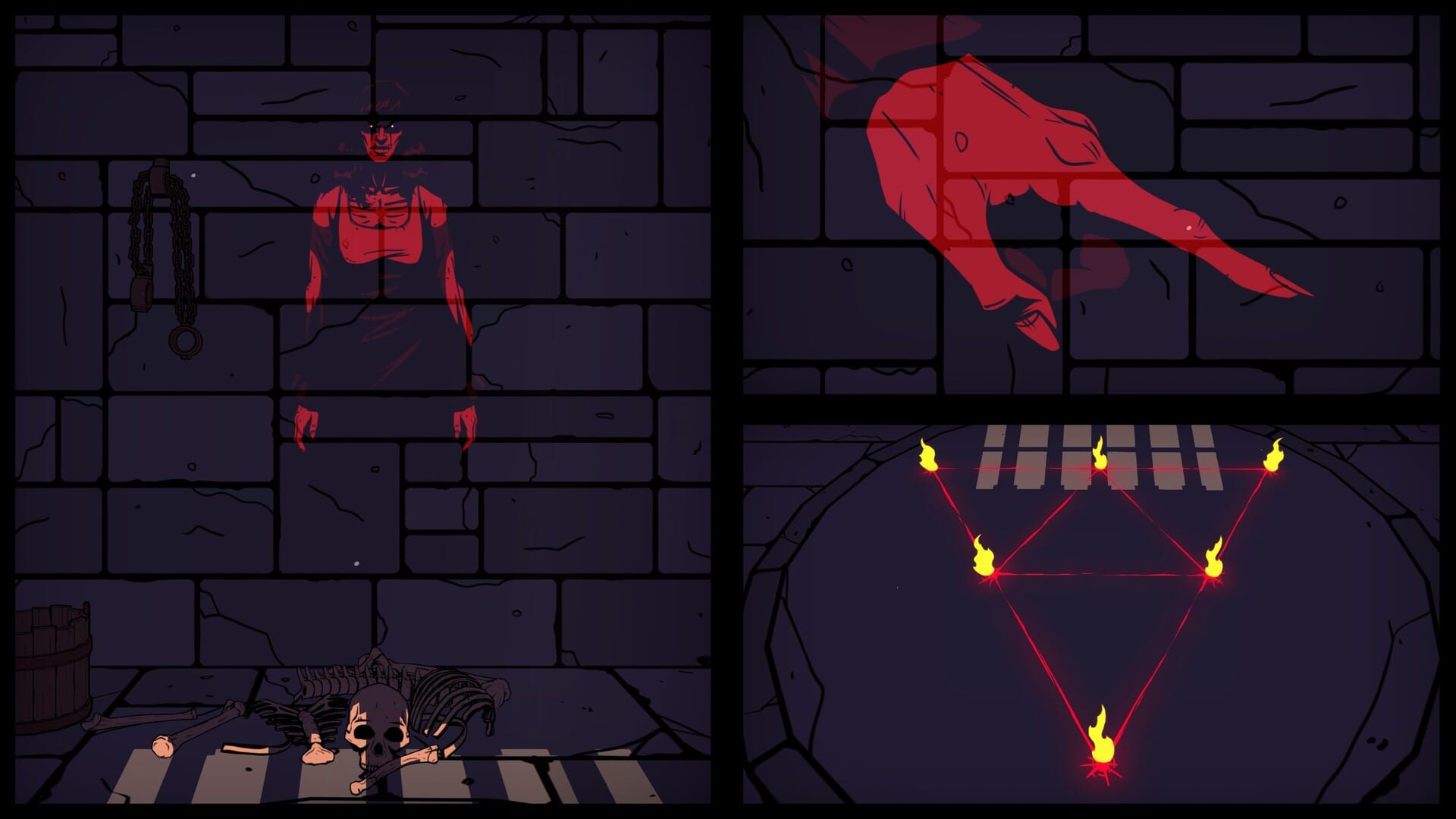
The “who” is the nervous dude without an optional side quest; who would’ve thought? Your only way to discover the culprit is by process of elimination, which is unsatisfying in so many ways. You know he’s shady, but there is nothing (that I could find, anyway) to suggest a what, a why, or even another who, since he isn’t even the man he claims to be. During the game’s home stretch, you’re asked to identify the culprit and only then are you told, through a lengthy exposition dump, what actually happened. And what actually happened is, to put it lightly, batshit insane, involving a magical fake child and a long-imprisoned ancient god being revived through the magical energy of the séance. I won’t sugarcoat it: this ending sucks. It mostly comes out of nowhere, and involves characters you've barely gotten to know. Deane herself feels like an afterthought. If you choose the good ending, you’re treated to a laughably lengthy sequence of “where are they now?” still images of all the characters spared from the deadly séance, each with a single line of text to conclude their storylines. It’s the perfect representation of how wide but shallow Blake Manor can be.
Despite my numerous complaints, I didn’t dislike Blake Manor. In fact, I loved the first half of the game, when everything was fresh and innovative and I was still making constant new discoveries. Once I could see the game’s structure for what it was, though, it started to fall apart. This project needed to be tighter, it needed to be centered around a more coherent mystery, and (perhaps this is asking for an entirely different game, but) it needed to cut way down on the magic. Spooky Door has the spooky skeleton bones of an excellent game, but a 15-20 hour long game needs some more muscle. And skin. And, dare I say, brains.
The Séance of Blake Manor
Alright
Some rookie writing mistakes and late game frustrations get in the way of what could have been a compelling deduction game.
Pros
- A gorgeous late 1800s mansion to explore
- The odd bit of great writing here and there
- An intriguing mystery…
Cons
- …with an awful payoff
- Too many characters, not enough depth
- Doors with loading screens — what is this, Resident Evil?
This review is based on a retail PS5 copy provided by the publisher.