As you start up The Sinking City 2, Frogwares doesn’t shy away from the fact that they’re a Ukrainian team facing immeasurable hardship in recent years. You’d be forgiven for thinking that it’s highlighted up front to explain away some of the rougher edges in the game (which there no doubt are). Instead, I think it should ultimately be a badge of honour, as I find the game pretty remarkable given the circumstances, and the general scale of the ambition realized here. Unlike its predecessor, The Sinking City 2 is a full blown survival horror game à la Resident Evil. Those are certainly lofty expectations to set nowadays, and it’s a pleasure to let you know that it sticks the landing in many key regards. This is Lovecraft in its most approachable, impressive, and exhilarating form yet.
All the tenants of survival horror are here: exploring, gathering resources, puzzle solving, backtracking/shortcut-unlocking, inventory management, safe rooms - the whole nine yards. Though it's well-worn territory and the game doesn’t break new ground in any regard, it walks the line deftly in keeping things relatively novel throughout, and never lingers on one thing/one place long enough that boredom enters the equation. It doesn’t fully live up to the quality of those it’s attempting to brush shoulders with, but The Sinking City 2 is an impressive shift for the franchise.
While continuing its deep dive into Lovecraftian mythos, the game forgoes a number of more complex mechanics from the first; namely dialogue choices and moral decisions. In exchange, a greater focus is placed on combat, rewarding exploration, and upgrading Calvin (the player character). It’s not just mechanics that are left behind in the sequel; this is an entirely new standalone story so existing fans and newcomers alike can jump in without fear of needing a recap or lacking narrative context. The removal of moral choices also allows for the tension to come from the atmosphere and gameplay itself, as opposed to personal quandaries and moral dilemmas I faced trying to achieve the “best” ending in the original; though fans of the first game might feel irked at their omission.
The narrative here is serviceable, but acts as more of a backdrop to color your playthrough rather than being what actively drives it onward. Ambiguity is par for the course with all Lovecraftian content so it’s not too big of a detraction per say, but the game chucks you in with little context outside of a failed ritual, and only much *much* later does the picture become clear. As a result, it’s difficult to emotionally invest in the characters or the objective. Once the bread crumbs start to come together in the latter half, a sense of urgency should be present that unfortunately felt entirely absent, with the actual stakes not materially felt until the credits roll.
The lack of truly compelling character arcs or general sense of forward momentum until late in the game may prove a sticking point for more narratively-inclined players, though Lovecraft fans are continually well-served as revelations occur. The trade-off of personal agency from the first game for a focused streamlined narrative here doesn’t knock it out of the park enough that I can comfortably say the sacrifice was fully worth it. What I can say is that exploring the flooded city of Arkham (no, not that one) and its surrounding regions to find the next container to ransack or conundrum to solve was far more motivating than the plight of Calvin and his cosmically endangered girlfriend Faye.
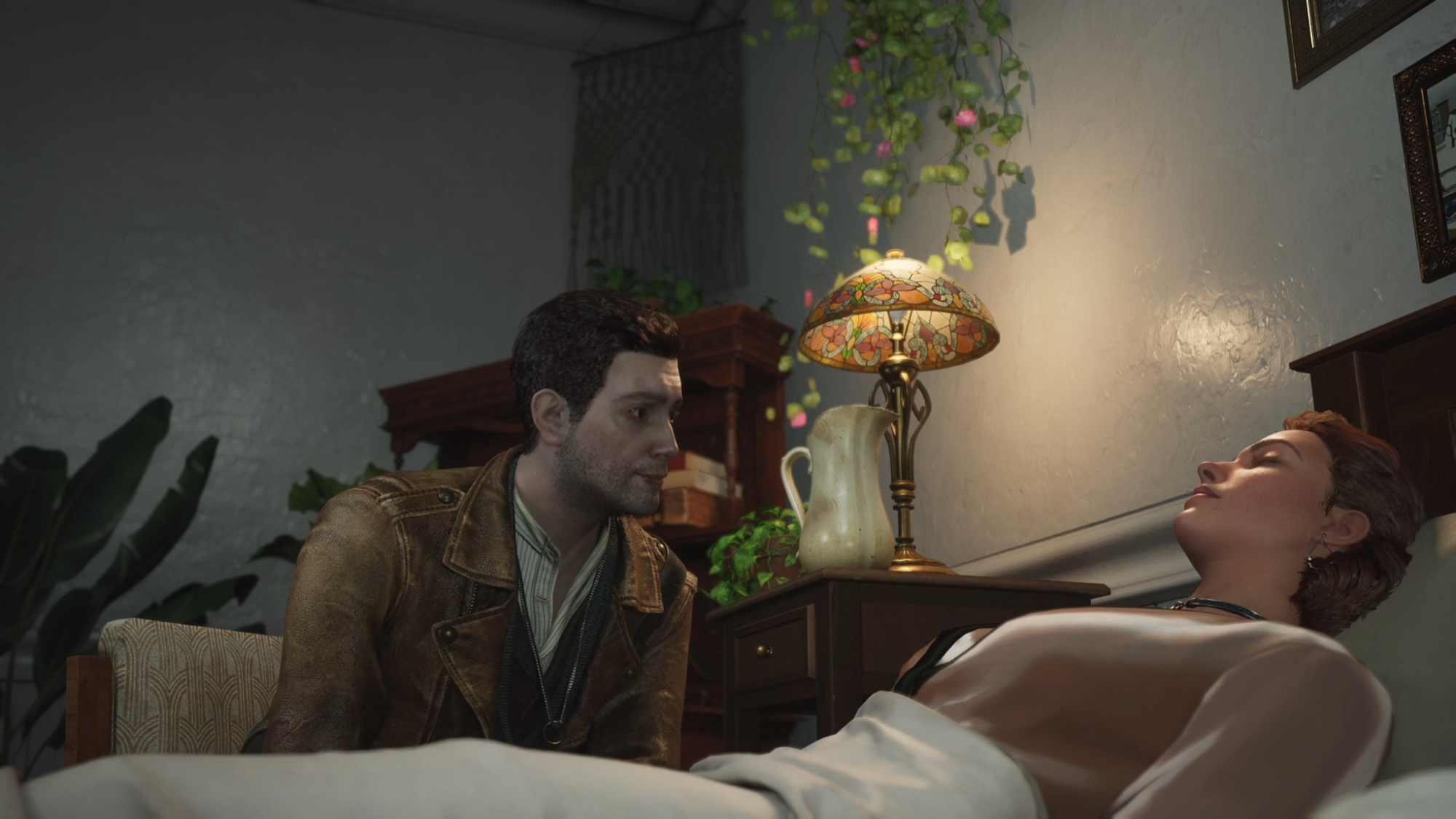
Something that didn’t aid in this narrative disconnect issue were the voice performances of the main cast. While they’re far from wooden and definitely have their moments, there was an undeniable distance to Calvin and Faye - not in the ethereally vacant Lovecraftian way either; more like neither went full throttle with their line reads, almost as if they were concerned about disturbing someone in the next room. Cutscenes visually impress and ramp up dramatically, so it’s a shame that some of the acting doesn’t always live up to the moment, particularly during more tense or emotional scenes.
The game makes exploration as frictionless as possible with QoL features like changing the color of a cleared room on the map, though the lack of objective markers means you’ll largely be relying on intuition, deduction and memory to prevent aimless wandering around between objectives. While an immersion-increasing positive for me, it’s notable that frustration *can* subjectively arise - particularly in a couple of labyrinthine areas later in the game.
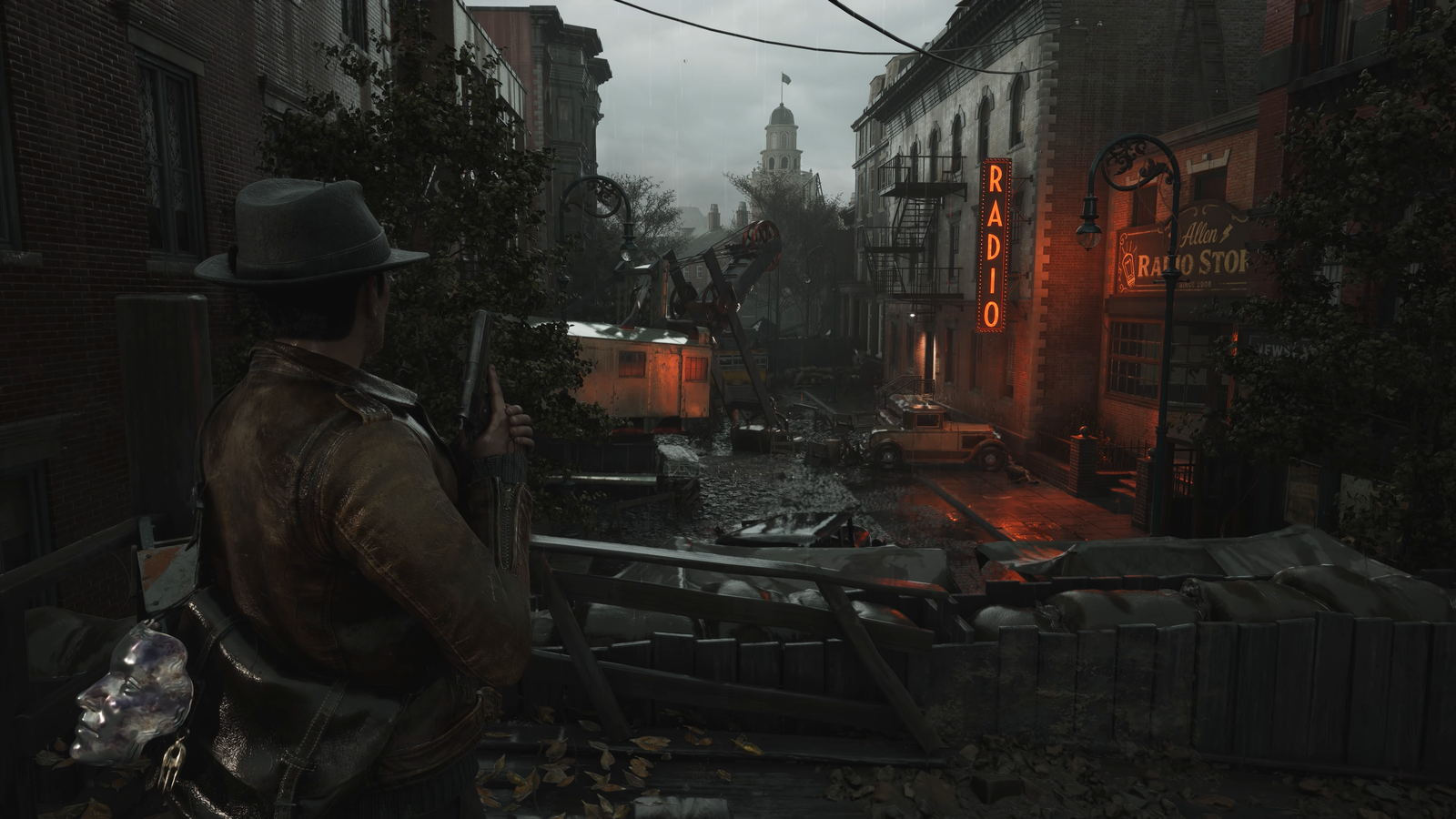
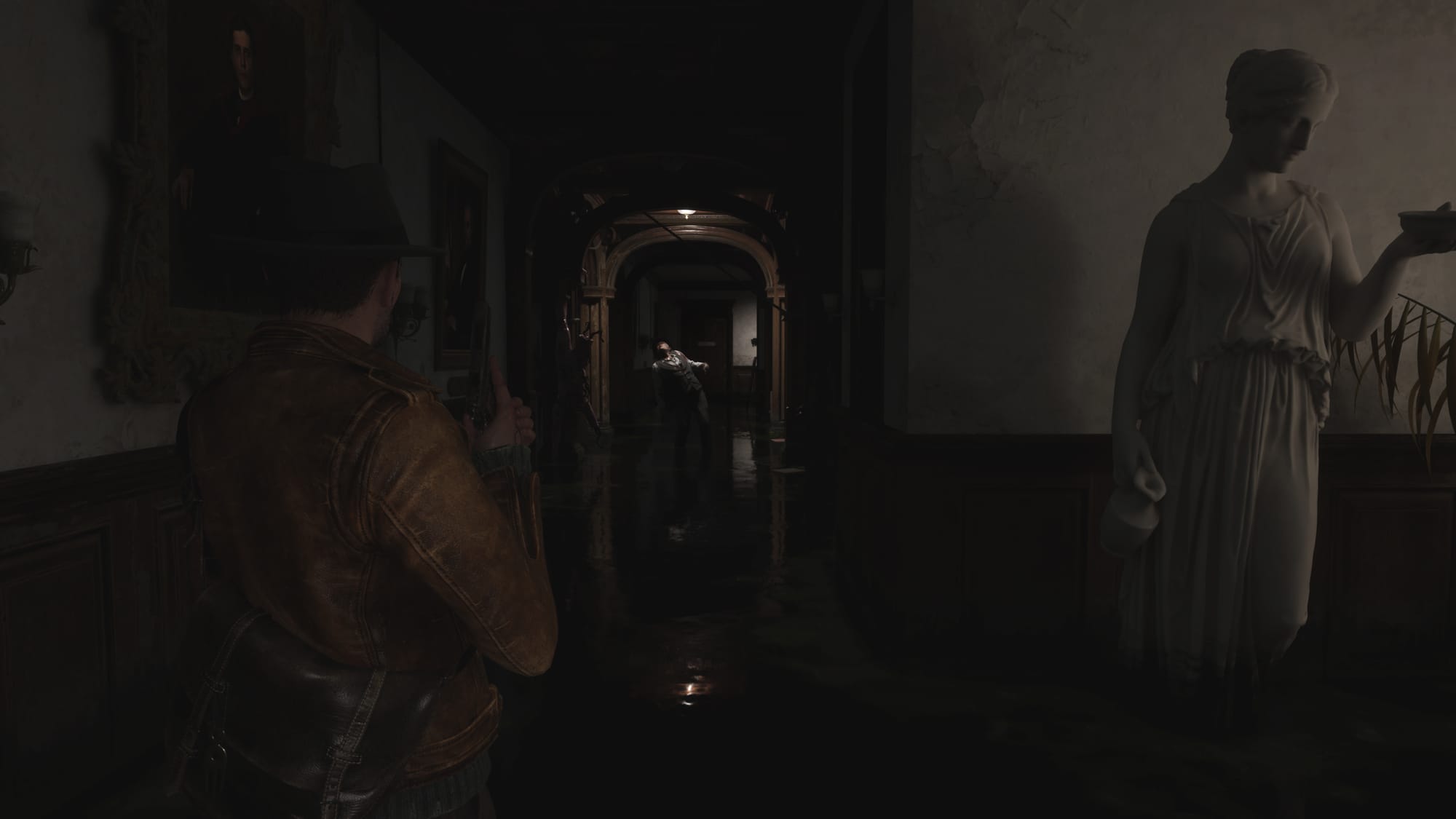
Each section of Arkham and its surrounding zones look hauntingly good; helped even more by a subtle, morose score and spine-chilling soundscape reminiscent of Silent Hill. Being split into multiple wide-linear maps full of twists and turns, the game is also well designed from a pacing perspective; remaining comprehensive enough that I never got fully lost, while also allowing worthwhile optional areas to pop up more often than you might think.
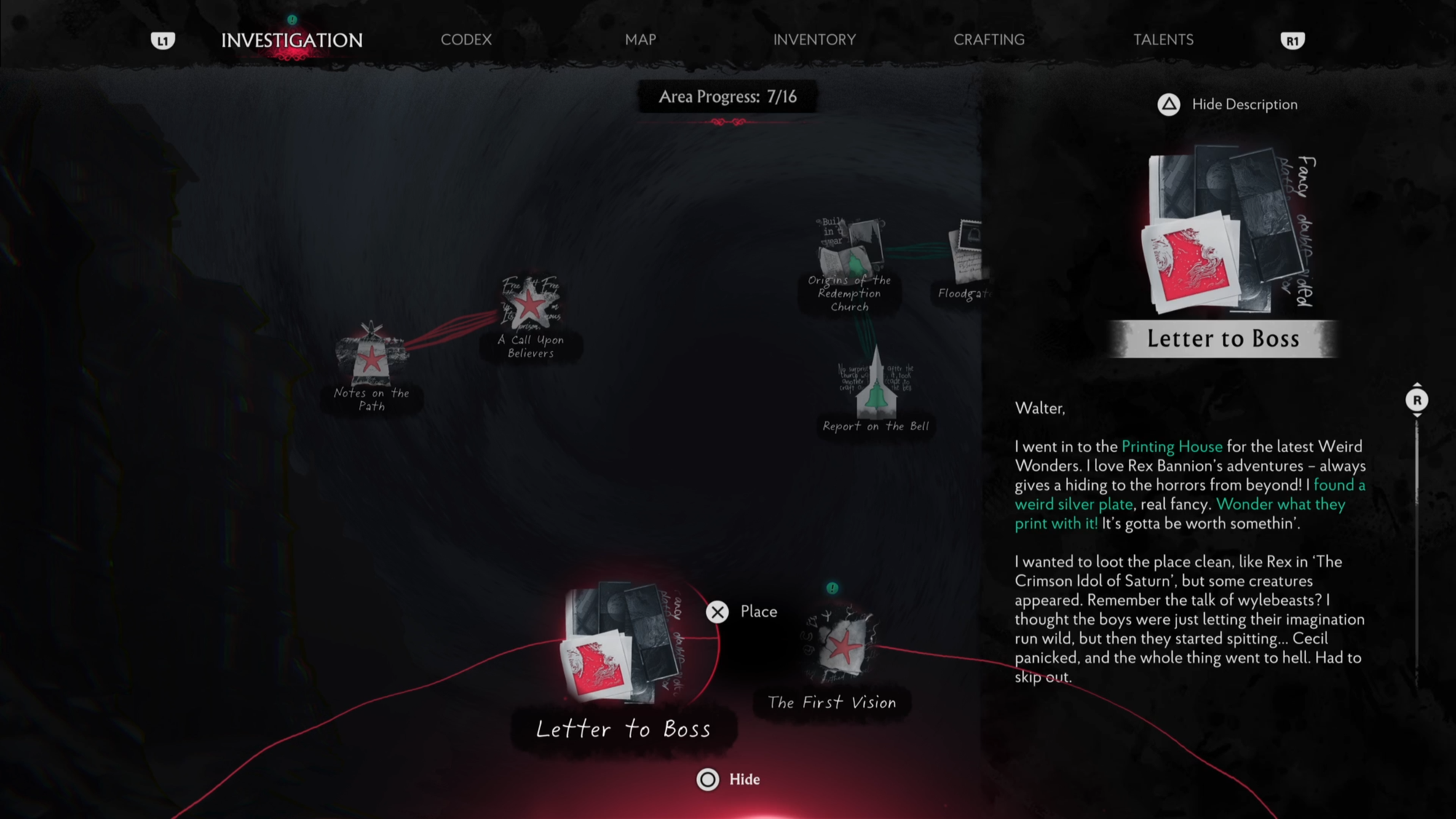
Speaking of optional content, you’ll have the ability to access the Investigation Space at any time (think Alan Wake 2’s Mind Place) in which you link key evidence and information you find. This almost entirely optional mechanic helps to provide additional insight, contextual clues, and answers to guide you on both the main path and with optional investigations. It’s welcome to see that Frogwares didn’t fully leave behind their puzzling roots here, and its mechanical reframing as icing on the exploration cake rather than a compulsory barrier to the main story is a well executed one. Each and every puzzle left me pondering just long enough to put the pieces together without it feeling mindless, nor frustratingly complex.
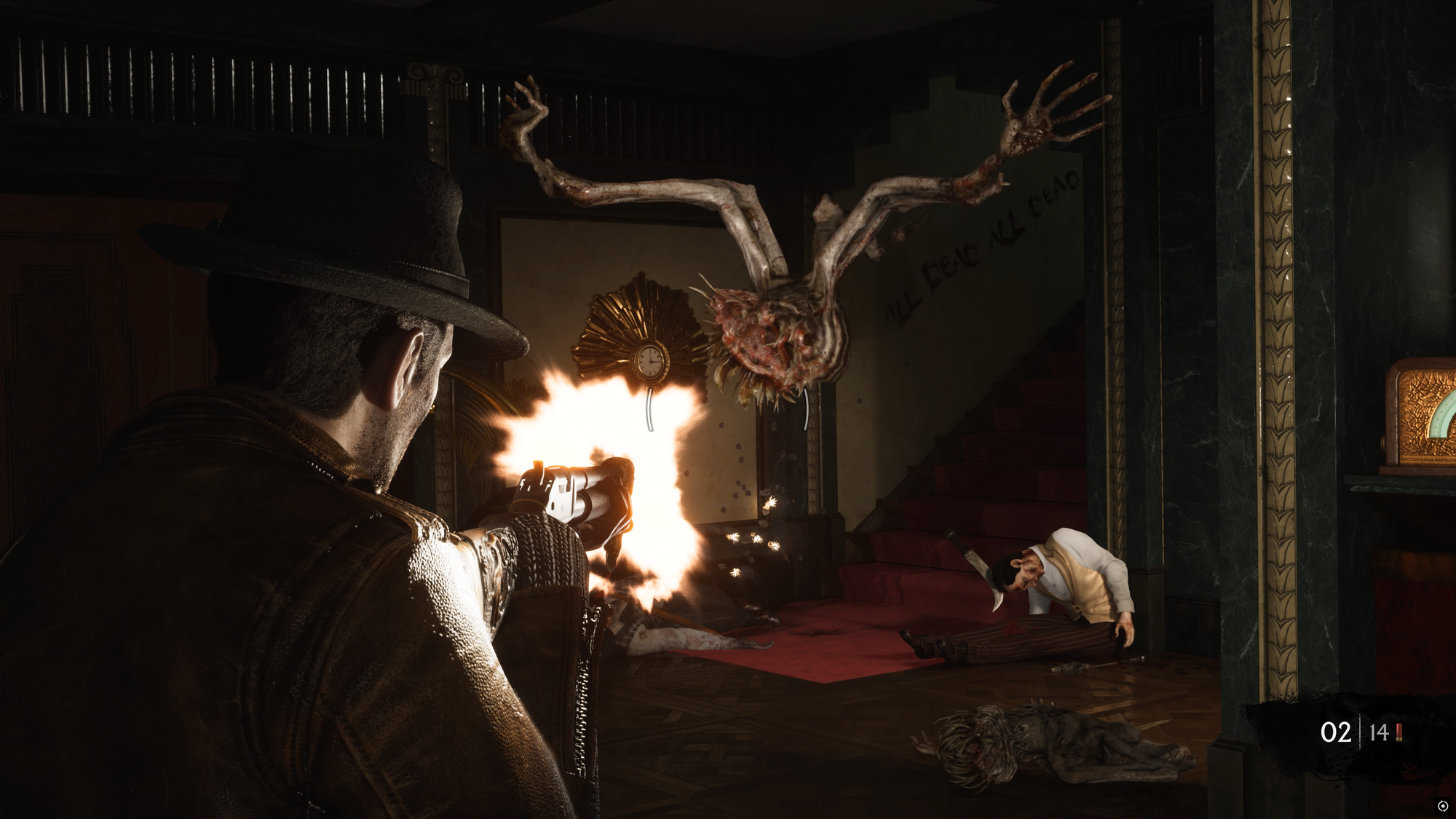
Gunplay generally feels very good, with each new weapon packing a powerful punch and adding something meaningful to your arsenal. Weapon parts you find can be applied to upgrade them, and they’re worth seeking out for their bonuses even if their material impact in combat isn’t quite as potent as I’d hoped. Melee is a mixed bag, with a floaty punch that was inconsistent in terms of connecting with an enemy, and a stomp that felt good (and is essential to prevent some Slither enemies from reviving) but never felt quite as crunchy as slamming down on a Necromorph in Dead Space. It’s framed as a last resort in combat, but even still the lack of weight and inconsistent enemy reactions left me wanting.
With regards to the enemies, the Slither, the variety on display is quite impressive. Each type fills a different role in encounters with melee, ranged, brute-type and ankle biter nuisances. Pseudo boss encounters were very few and far between, but their narrative implementation was appropriate and their mechanics novel. I was definitely left a tad underwhelmed at their attacks though. Each enemy has two unique attacks (which is fine), but every single one is trivially easy to dodge. To offset this advantage, you’ll often be swarmed by enemies in very tight spaces which can lead to damage being taken in a way that frequently feels out of your control.
In survival horror, you want to be on the back foot no doubt, but frequently it felt as though there were two or three more enemies than was necessary, and they often were directly in my way - leaving me no option but to tank some hits and push through in an attempt to conserve what little ammo I had. This is a difficult tight rope to walk, and I can’t guarantee fewer enemies would have been a *solution*, but I couldn’t escape the feeling that encounter balancing wasn’t always quite right. Thankfully, what the enemies lack in individual difficulty they make up for in visual design; each one looking more grotesque than the last, satiating my desire for fleshy eldritch horrors and fellow humans corrupted by unknowable forces.
Speaking of the eldritch, you’ll accrue Dream Essence throughout the game by completing investigations and looting specific containers. This can then be spent in the Safe Rooms to add Talents to the Nightshade Mask on your back - essentially passive traits/buffs that assist your offensive and defensive capabilities. Even fully upgraded, the Mask has very few slots and thus ends up feeling like an afterthought, particularly as you’ll only be able to unlock all Talents on New Game+ runs. Granted, it meant I had to be far more definitive in what upgrades I pursued and synergies I could conjure, but an extra slot or two would have given you a better shot at feeling truly stronger than you did at the beginning. The Nightshade Mask itself doubles as a rechargeable revive tool should you be downed in combat, but I ended up needing it far less than anticipated and thus the resource it requires felt disappointing to stumble across when I always needed almost anything else.
There were occasional frame drops and visual glitches during my playthrough, but nothing that was too egregious or persisted long enough that it diminished my enjoyment. I also fully expect these minor technical issues to be patched after launch, but it’s something to keep in mind.
The game comes with two graphical modes: Performance targeting 60 fps and Quality targeting 30 fps. Though I tend to prefer higher frame rates in most of my games, I did notice the visual fidelity looks much more blurry and soft on Performance mode. Alongside these are 4 difficulty options ranging from Sweet Dreams to Sleep Demon, the former of which you can even toggle invulnerability. These can be changed at any time in the settings menu, which I appreciate as an accessibility option. Once you beat the game, you can exchange Eldritch Points for post-game goodies like infinite ammo or extra outfits, a staple of any survival horror experience these days - incentivising a New Game+ run or two.
The Sinking City 2
Great
The Sinking City 2 is a thoroughly enjoyable descent into indulgent Lovecraftian goodness that occasionally genuinely impresses. In spite of some narrative and gameplay snags, it is a notable improvement over its predecessor in every regard. It scratches a Lovecraft x Resident Evil-shaped itch I’ve had for nearly two decades, and is an experience well worth sinking your time into.
Pros
- Captivating presentation, music and sound
- Satisfying and well-paced exploration/puzzle solving
- Well executed genre shift
Cons
- Underwhelming narrative hook and performances
- Minor technical and visual issues
This review is based on an early PS5 copy provided by the publisher. The Sinking City 2 comes out on August 18, 2026.