I never read the works of Jaroslav Foglar, but I grew up reading adventure novels of a similar style, so the world of Severton still had a bit of familiar nostalgia to it. This cooperative game for 1-5 players is set in a single city, which is also the source of the game’s title. Playing as a group of kids known as the Rapid Arrows, you’ll all have to fight, talk, and sneak your way through the thuggish Vonts to save… the local area? Definitely a handful of other kids. The Rapid Arrows slip into Severton, but I’m not sure how much events in the city affect anything outside it. But anyway, Severton (the game, not the city) features some solid cooperative gameplay with a few elements to help with replayability.
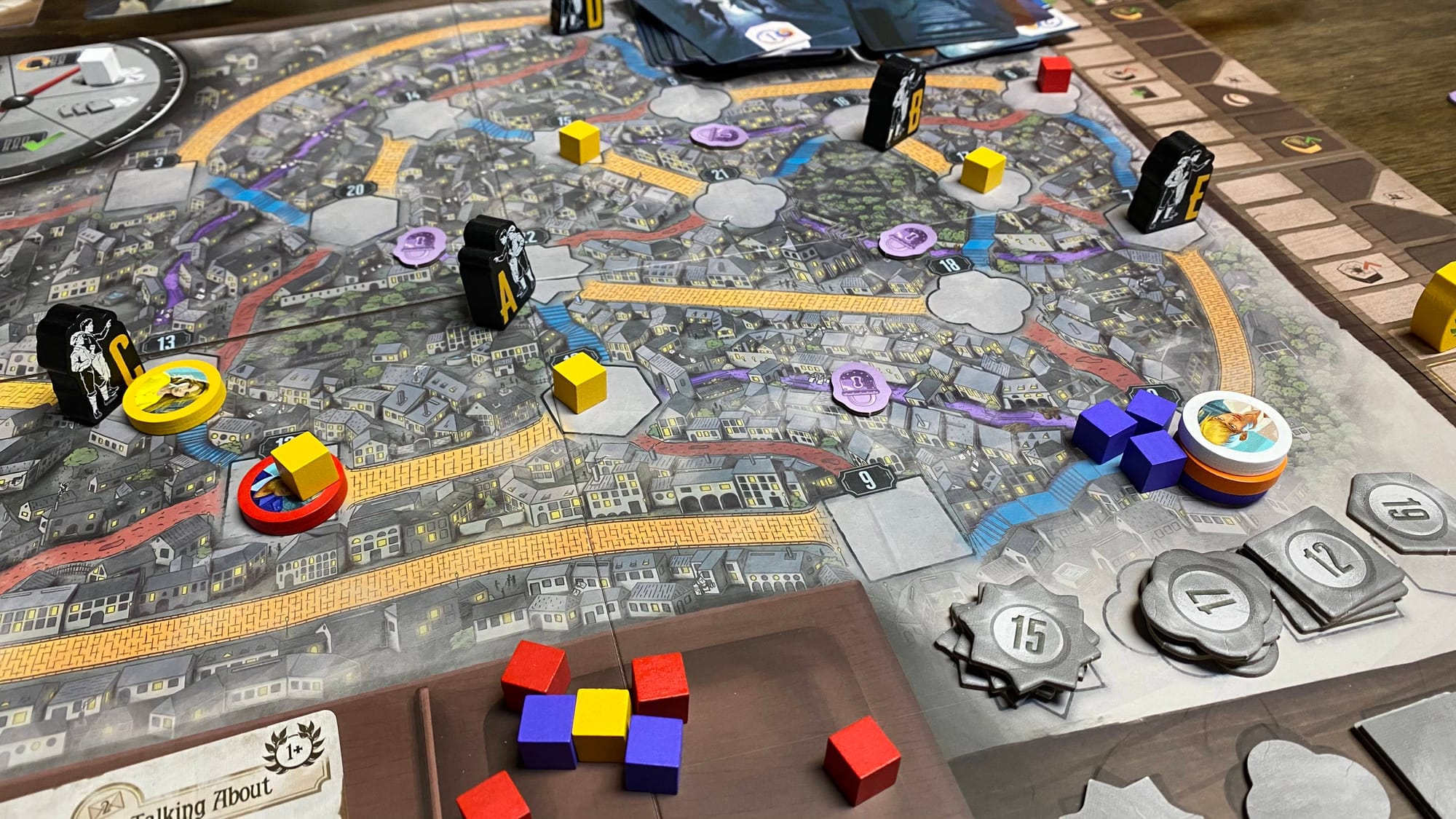
Rules & Components
The rulebook does a fine job teaching the game and has advanced concepts that don’t show up in the initial learning scenario in a separate section. This lets you get into the game itself a bit quicker without needing to learn anything that won’t come up until game two. The scenario book is similarly easy to parse even when it introduces unique rules and concepts.
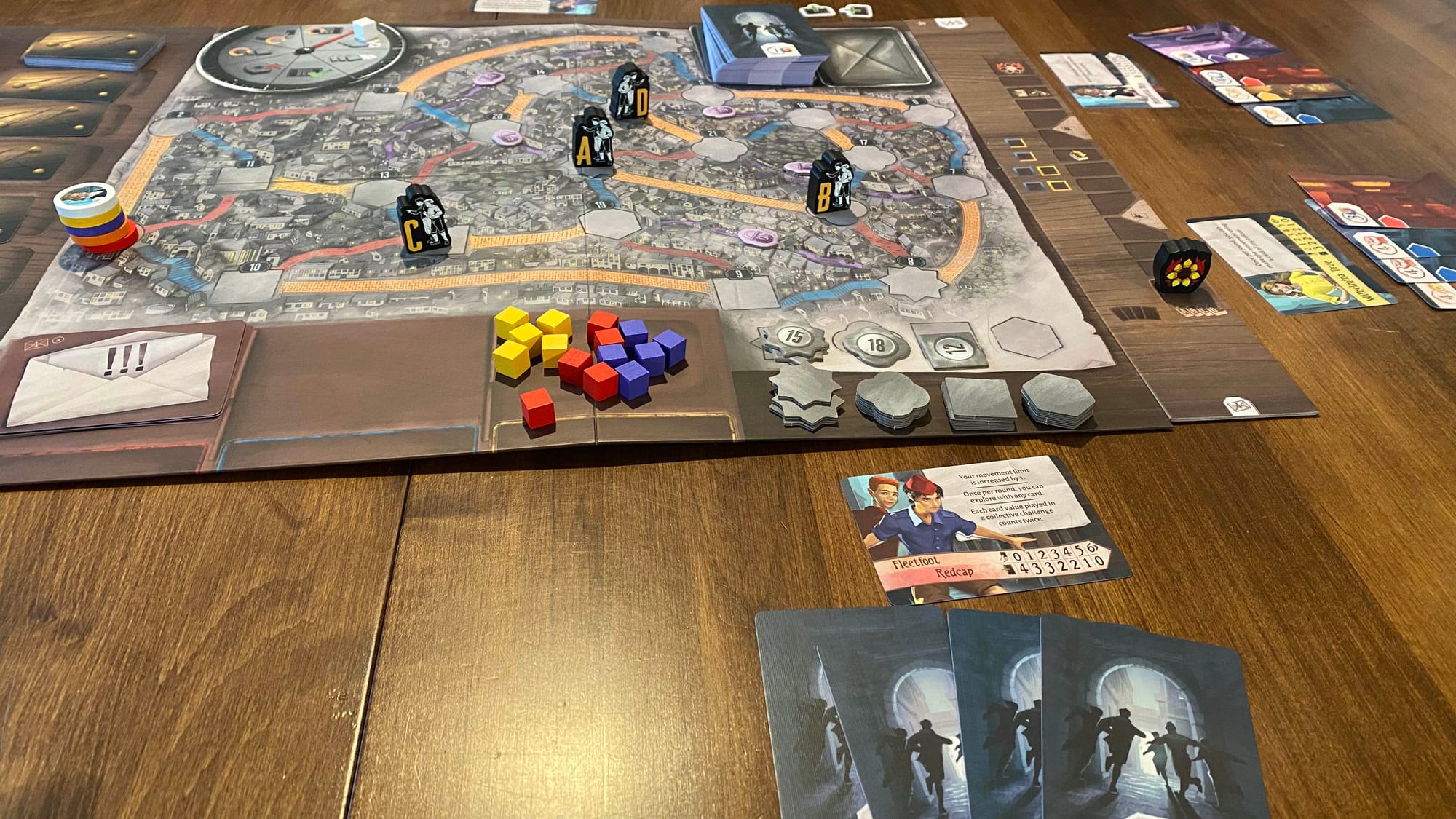
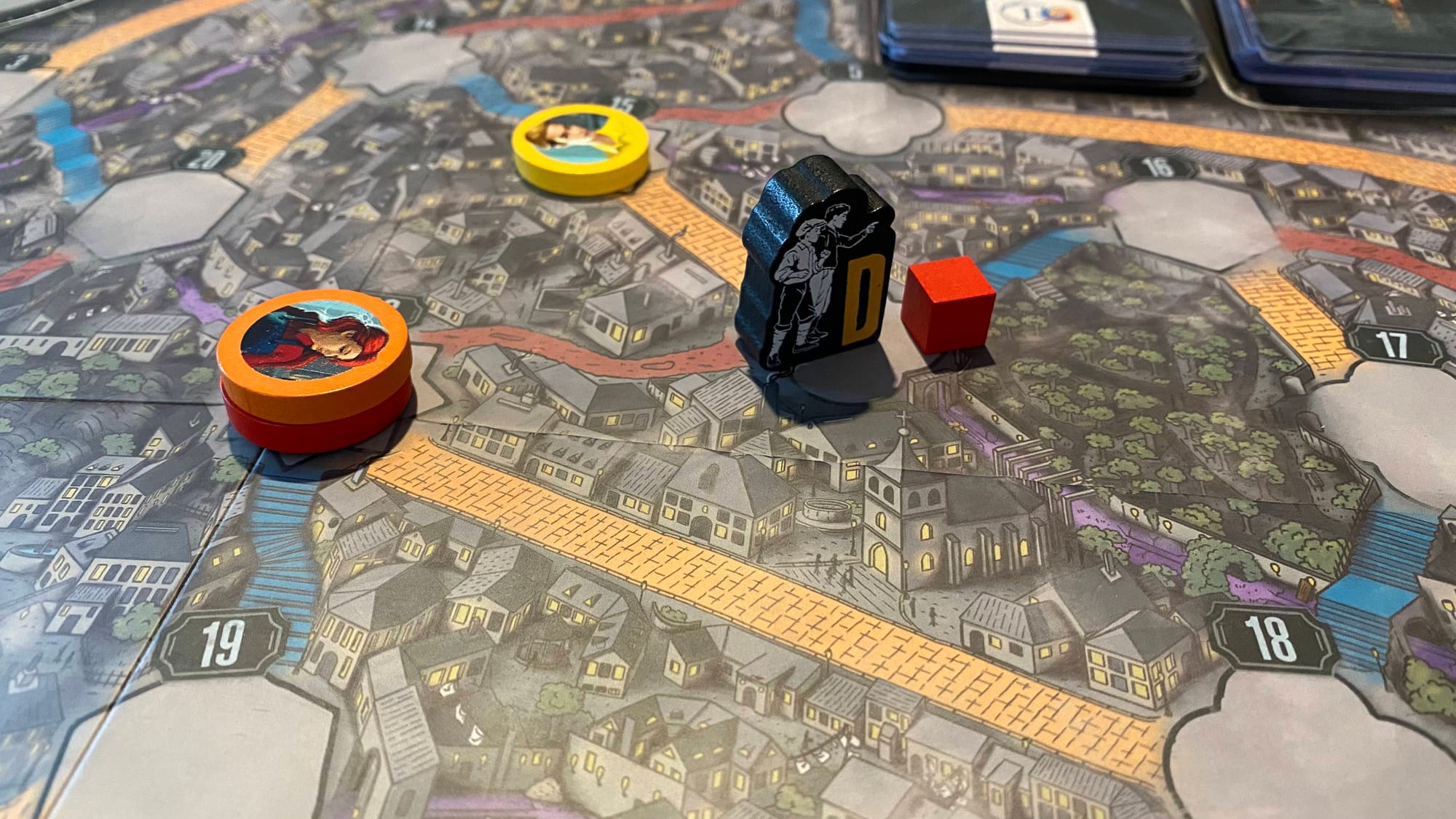
The components are all nice, with quality linen cards and adequately chunky wooden bits. While the players are only disks compared to the Vonts’ upright tokens, this does make it easier to stack players when they share spaces. It’s also worth noting that each character card and token is double-sided, so you can play as either a boy or a girl. This is kinda significant, since, like a lot of similar literature at the time, the source material was entirely boy-centric. It’s a little touch that helps modernize the setting.
Tiny complaint: the round phase tracker is depicted as a compass with a little arrow on it. I would have loved it if the arrow were a little dial that I could spin to point to the current phase, rather than something just printed on the board. Or if the tracking token were the separate arrow rather than a plain white wooden cube. Since the rest of the board is represented as a diegetic table and map, it would have been nice to incorporate that into the physical components a bit more.
Gameplay
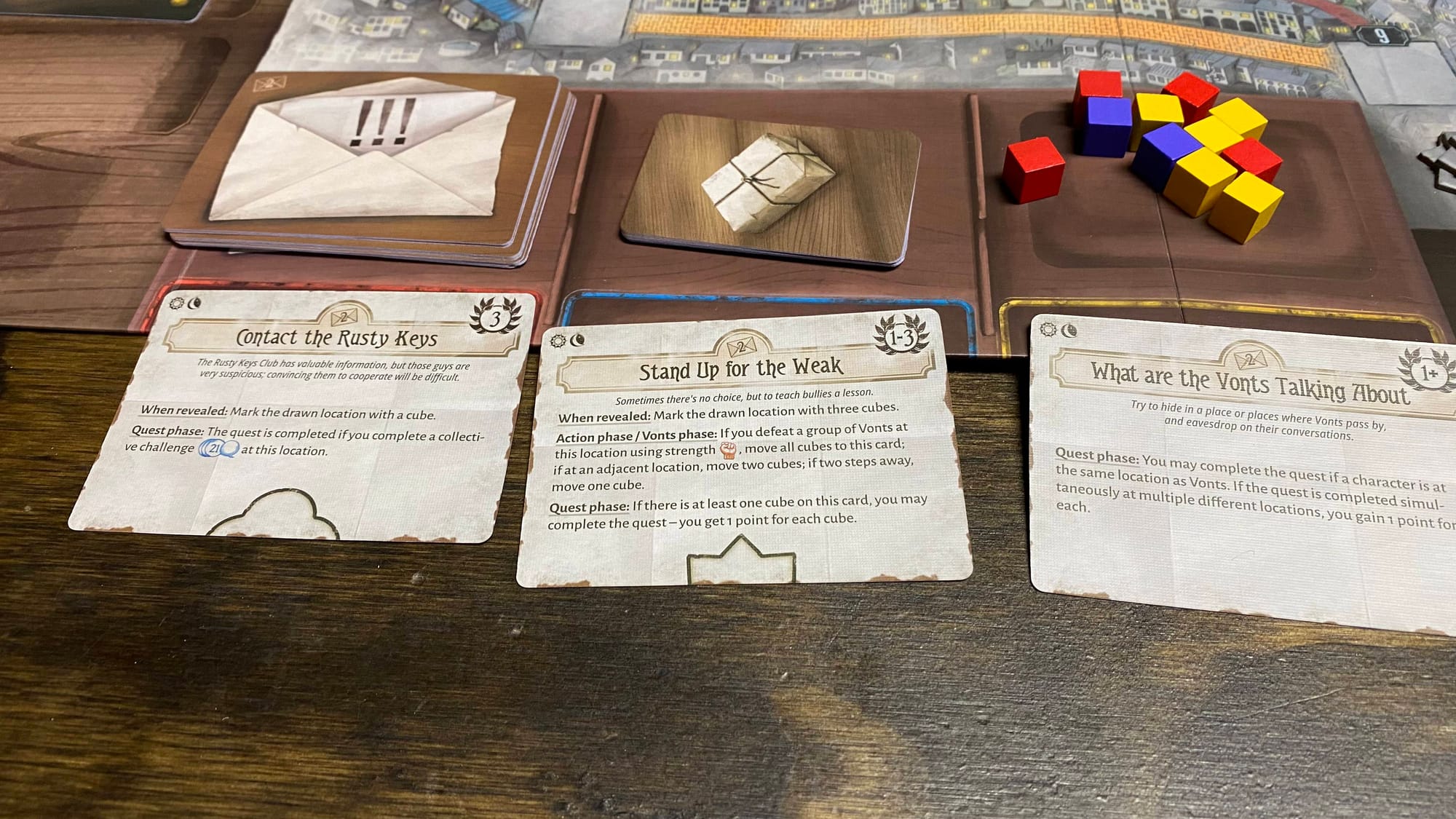
Severton is a scenario-based game, with five included scenarios, including the tutorial. While that might not seem like a lot, only the first and third are considered “scripted” with the rest featuring a fair amount of randomization, primarily with the shuffled Quest deck. You can also customize the difficulty of each game by flipping either or both halves of the progress track over, which will change a few effects as the game progresses or require the players to do more in order to win.
While I wouldn’t replay the first two scenarios much, as they’re primarily there to get players used to the mechanics, the others are interesting enough to keep players engaged even after playing them before. The third adds a few special rules as the players race to save their dog, while the fourth is really just the “full” game, and the fifth acts as a sort of “boss fight” finale meant to test players while they catch the wily Scirocco.
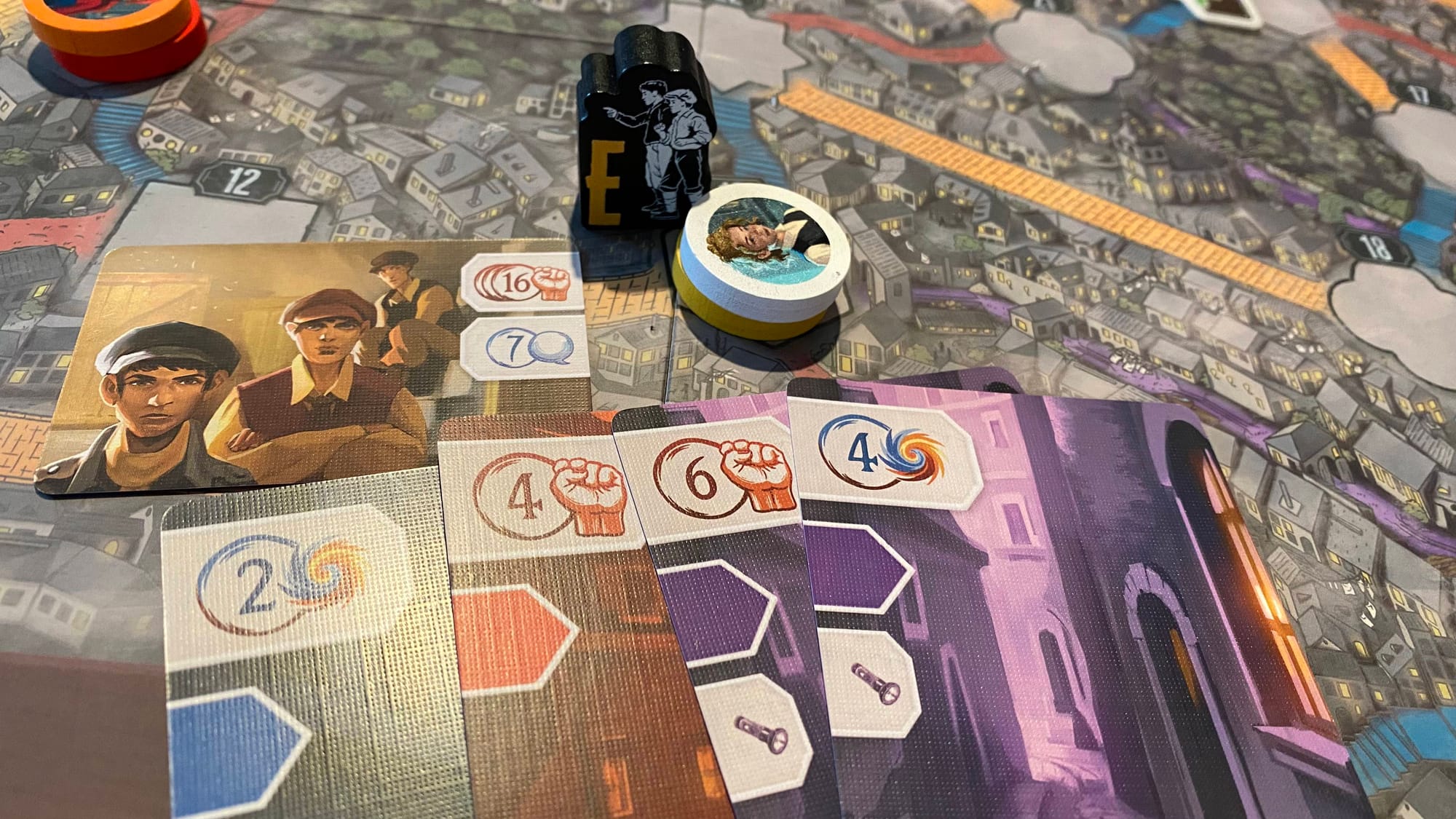
The gameplay itself is pretty simple, with players’ actions entirely driven by cards. Movement around the map requires cards matching the path’s color, but the cards are also the source of stats for skill checks. Successfully fighting/talking/hiding means discarding enough of those points to beat the Vonts’ score. You can also use the cards to reveal a nearby Vonts Group’s stats—which is important because many can’t be dealt with in one of the three methods, such as being too numerous to fight or too cautious to hide from—or how they’ll be moving this round.
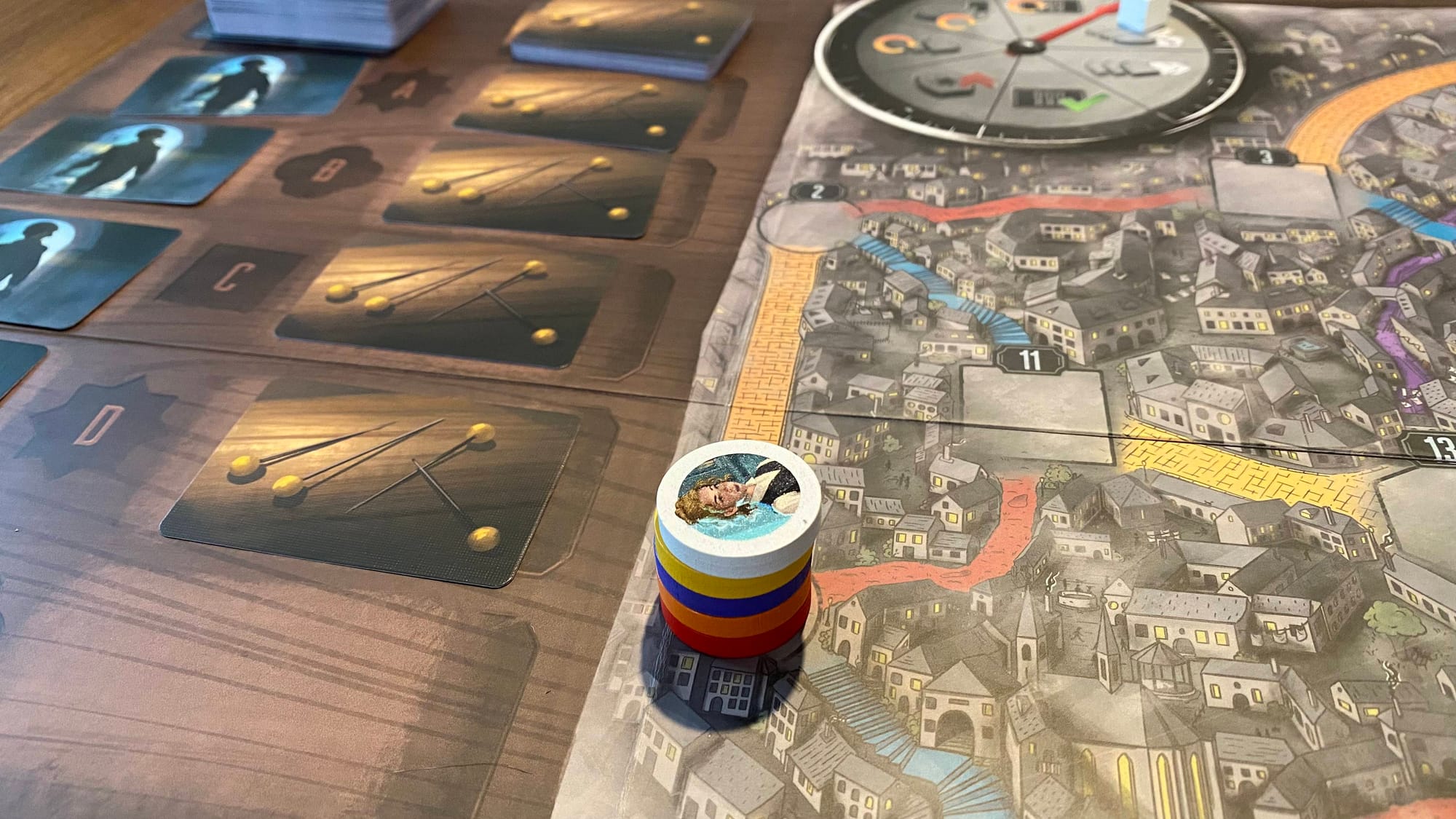
These mechanics really help the game lean into forcing the players to constantly think about whether it’d be better to stick together or if they should split up. Sticking together is pretty easy since you can follow another player’s movement by discarding any card, and it means they can pool resources for fighting or pick the best among them for talking; but hiding still needs to be done individually, and larger groups tend to attract the Vonts’ attention. Splitting up lets the players cover more ground for Quests but leaves them vulnerable when caught by Vonts they don’t have the right cards for.
This was my favorite aspect about the game, as we constantly had talk on the table about how best to tackle our Quests while also trying to manipulate the various Vonts on the board so they don’t mess with our plans. One Quest had us tailing a group of Vonts, which ended up being pretty tricky since their movement phase comes after the players’. So we had to keep their movement card revealed every round and plan around being near where they’re going but without being caught by them. At the same time, the other half of our team was trying to get themselves to multiple specific locations in the same round, without being assaulted by Vonts afterward, so they could complete a skill test in the subsequent Quest phase. There was a lot of coordination involved in making sure everything was set up correctly so we could finish our Quests and advance the Rapid Arrows token up its track before the Unrest token ends the game.
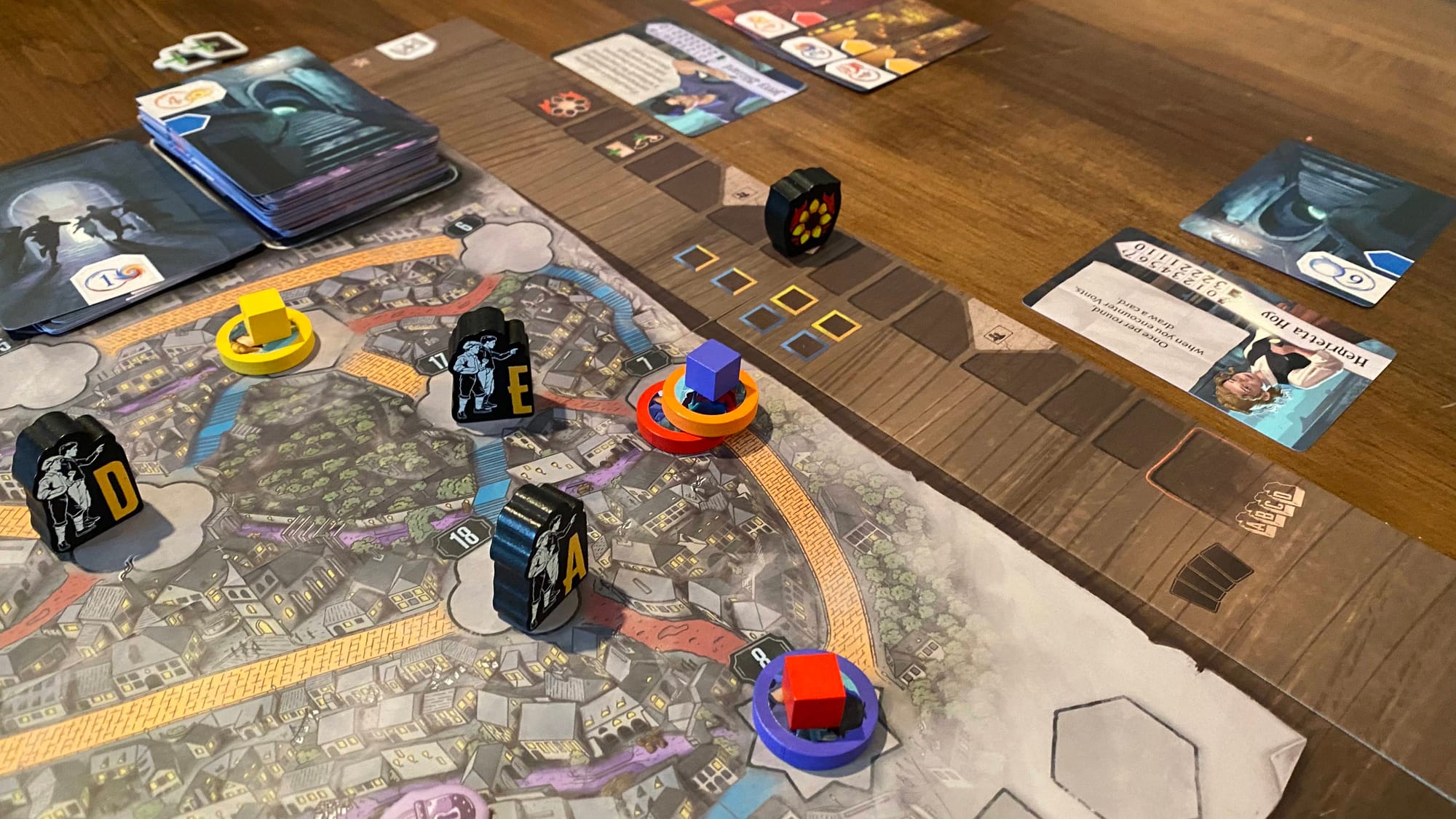
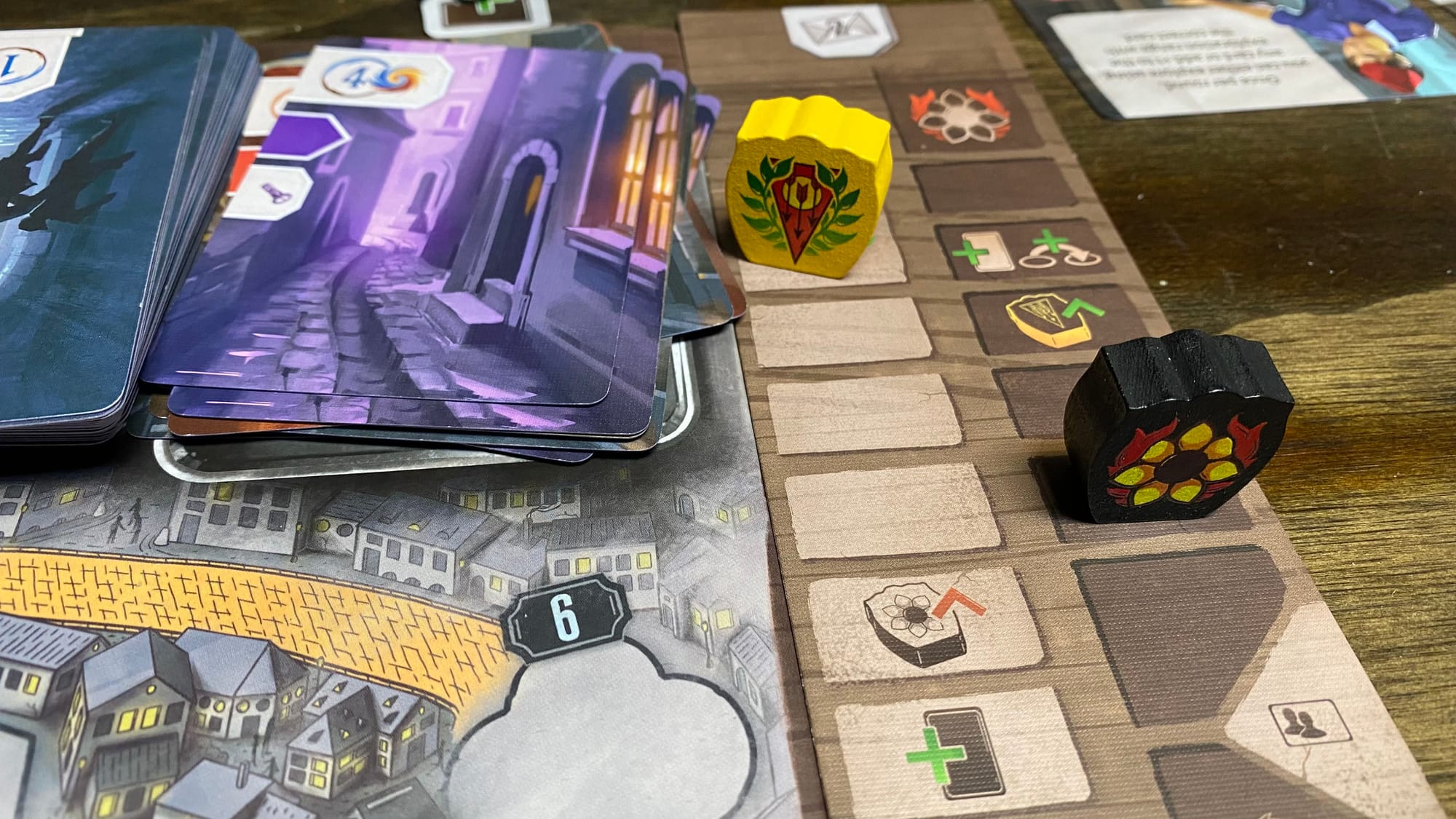
Most of the game ends up feeling like a puzzle, which you have to complete in a certain number of rounds. Whether it's a replayable scenario where your goal is to just advance the Rapid Arrows track or a narrative one with its own unique goals, you’re always racing to finish before the Unrest token reaches the end of its track (these are the tracks you can flip to adjust the difficulty). And solving that puzzle boils down to getting pieces, both players and Vonts, where they need to be and hoping that players can draw the right cards. We had a close game once simply due to the players in need not drawing anything for blue movement (not even any wilds), leaving us waiting for a round and hoping our next draw was a bit better.
With that being said, Severton feels like a “safe” cooperative game. It’s a puzzle with several moving pieces, yes, but the mechanics themselves are relatively simple. Unless you don’t or can’t investigate the Vonts, there aren’t going to be any surprises during a round. While there was some mild concern about whether people would draw the cards they need, it never felt like there was any actual risk, and thus no tension—much like children’s adventure novels, so I suppose that it fits the theme. But from a gameplay perspective, even Pandemic’s Infection cards held more suspense than anything I found in Severton. You can increase the difficulty by flipping the progress boards, but that just makes the puzzle a bit more complex by requiring you to accomplish more in less time or adding Vonts.
Severton
Good
Severton is a nice puzzle of a cooperative game, offering a few different scenarios to play through. The core of the game is identifying how best to manipulate or evade the Vonts on the board while you accomplish various Quests, which can require some creative thinking. But once you get the hang of it, and as long as you aren’t crippled by bad card draws, it can feel like you’re just going through the motions for a good chunk of the game. Even if time is running out, either the math of your turns lines up, or it doesn’t; there’s not a lot you can do if you were just too slow earlier in the game.
Pros
- Randomized Quests all feel very different and change how you play each game
- Multiple scenarios give decent replayability
- Managing player and enemy movement provides interesting puzzles
Cons
- Only four non-tutorial scenarios, and two of those are non-randomized narrative ones
- Gameplay tends to lack real tension
This review is based on a retail copy provided by the publisher.