I used to maintain several freshwater fish tanks, so I’m generally interested in any game about fishkeeping. Doubly so when the game incorporates some of the lesser-known aspects, like managing microflora or utilizing wool filters in the case of Aquaria. Now, Aquaria is still very much a Eurogame, so don’t expect the theming to go much more than skin-deep. Just be glad you don’t have to deal with your lionfish eating whatever fits in its mouth.
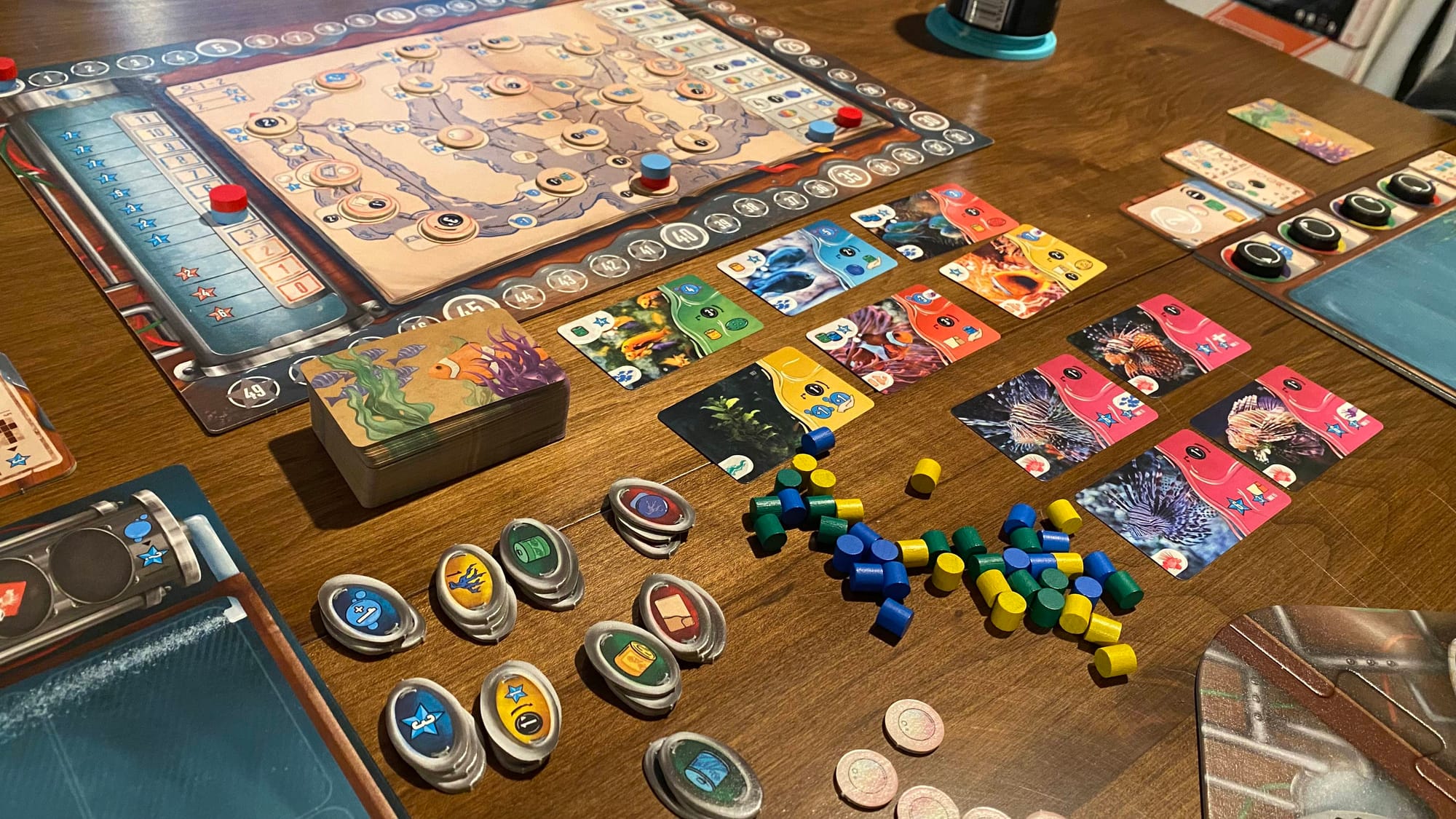
Rules & Components
The rules are fine. I learned the game without any issue, but some rules are in odd places, which can make it difficult to answer questions later. This isn’t a super egregious problem, but I would expect better out of a modern game from a known publisher.
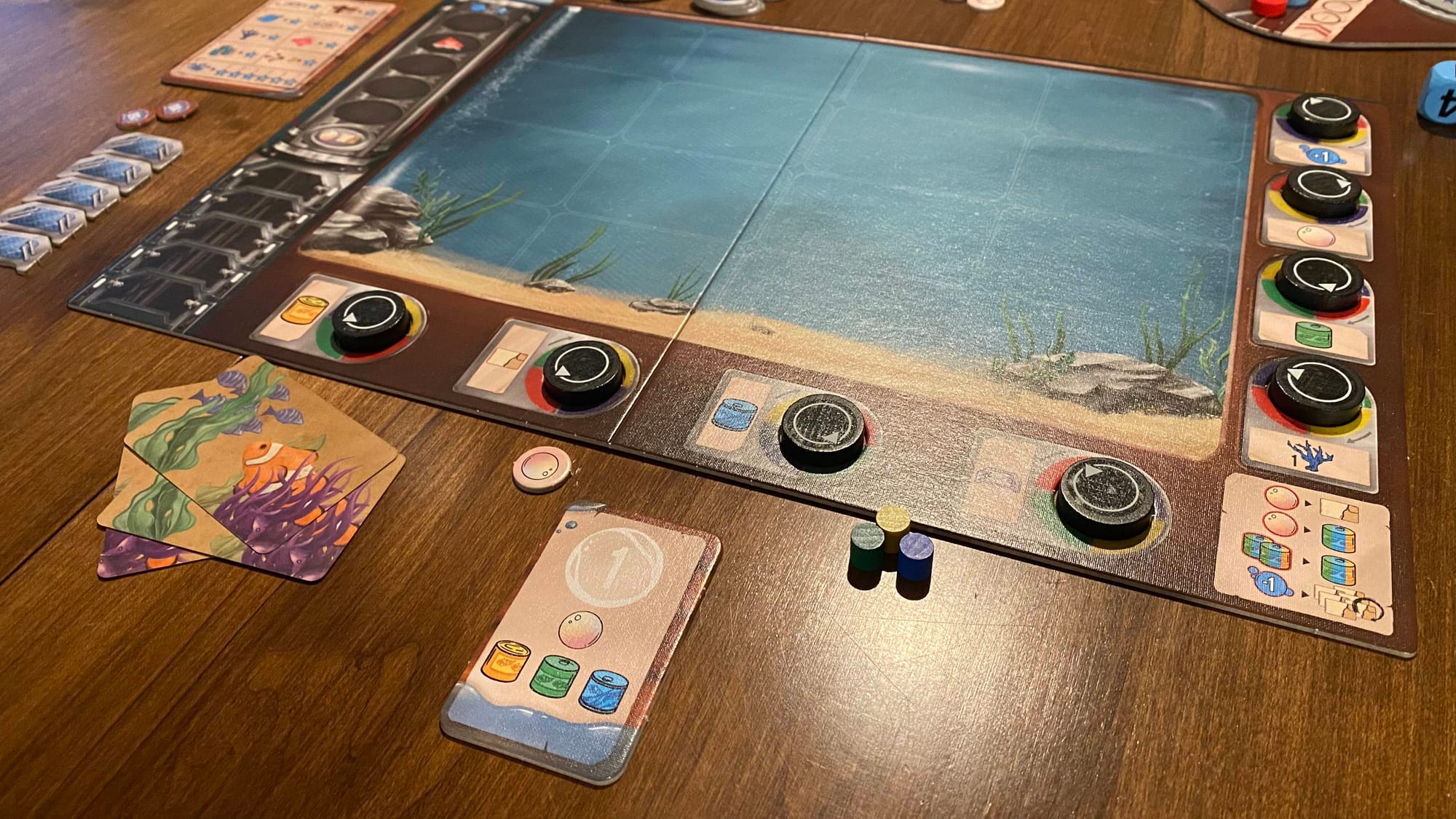
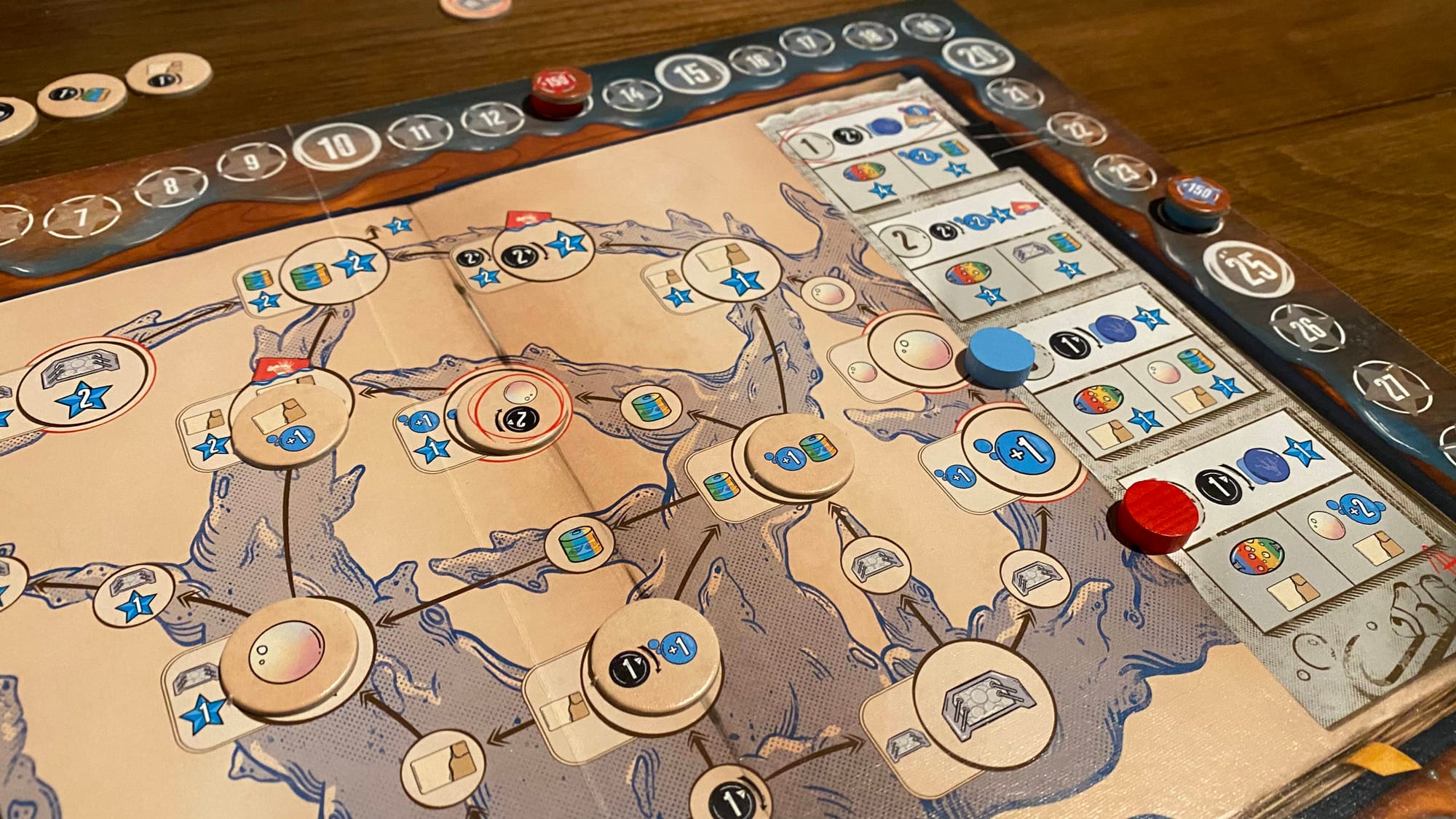
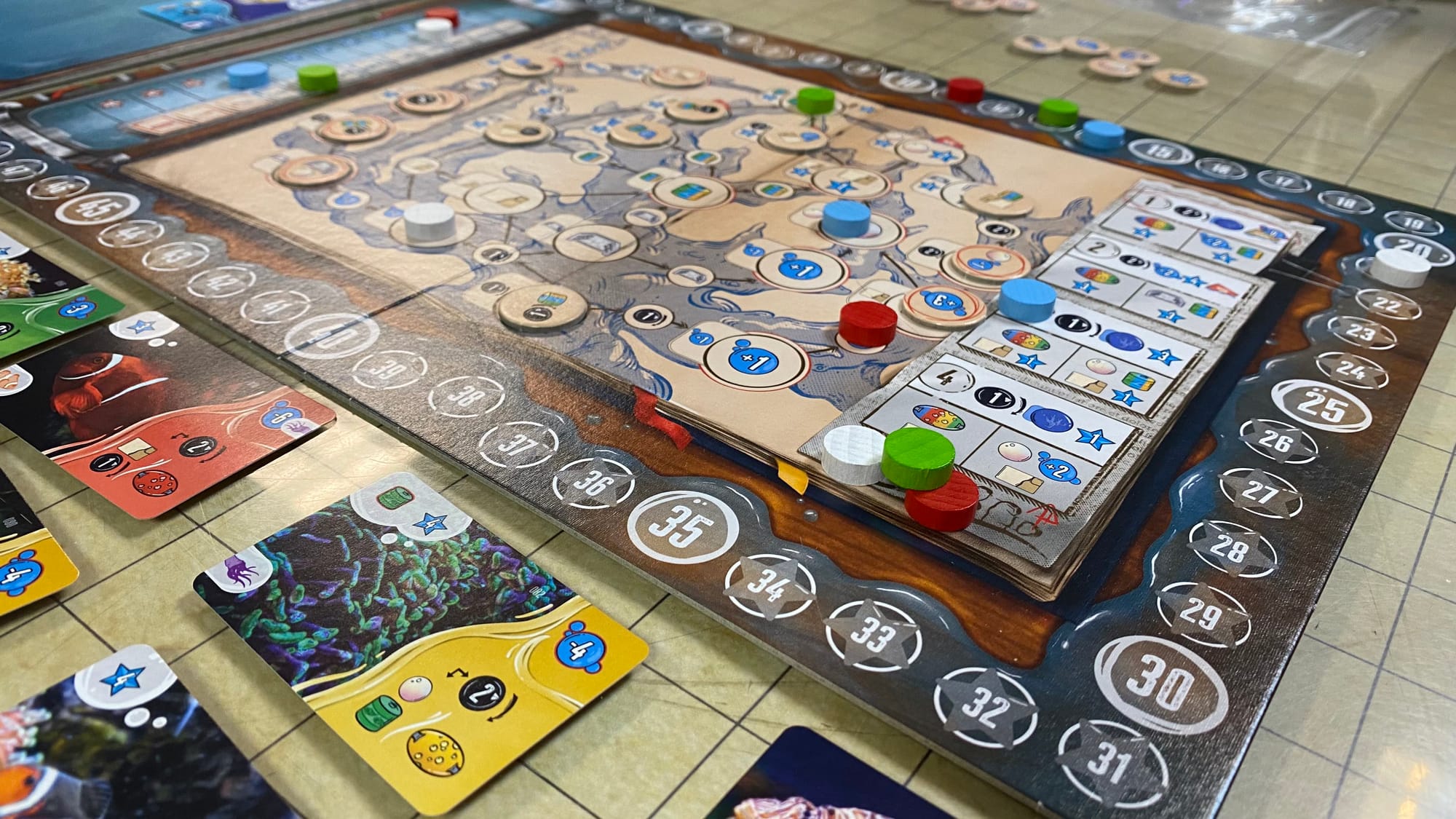
The components are similarly fine; nothing is wrong with their quality, but they're nothing to write home about. While the color scheme on the boards and cards is very reminiscent of the style of aquarium products from this time, they don’t make for a particularly attractive board. The Encyclopedia board is the worst offender, and mostly looks like a jumbled mess (on top of not being clear thematically with what we’re actually doing there or on the Pet Shop track).
I did experience an actual problem while playing at four, which is the amount of food tokens. We ran out in the third of four rounds, which is pretty early to have an issue like this. The rules didn’t say one way or another if the food should be component-limited, so we used proxies until the feeding phase. Then we unsurprisingly ran out again in the final round. If a food shortage is an intentional design feature (which would be very out of place in this type of game), then it really oughta be in the rules. And if they just didn’t include enough tokens, then they really should have included more. Nothing’s more annoying than having to get out a second game’s bits just to keep playing the first.
Gameplay
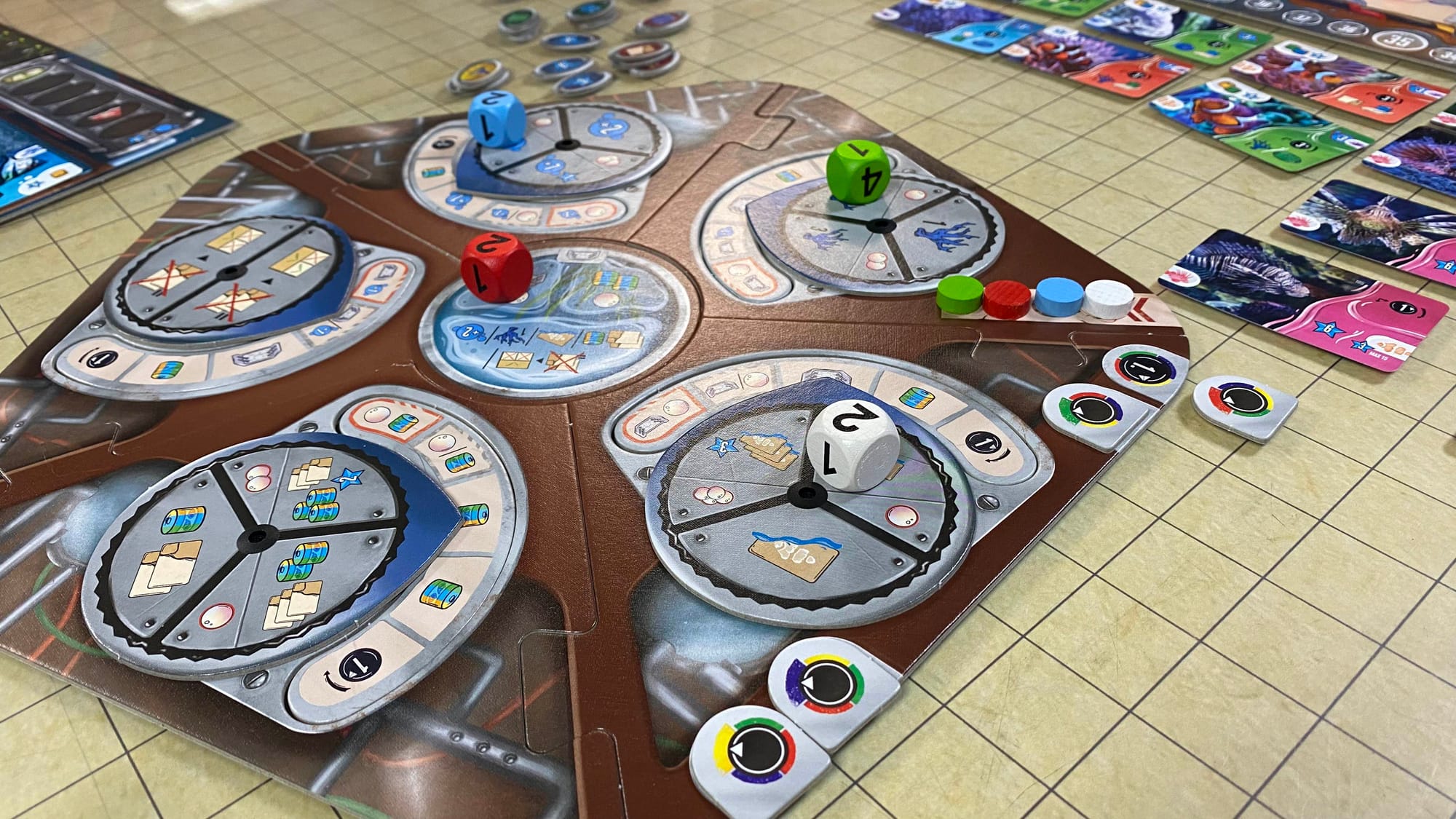
While Aquaria’s main mechanic is the set collection and tile placement that fills out your aquarium, what really caught my attention was the main board driving all these actions. On your turn, you’ll move your action die—which isn’t rolled; it just shows how many actions you’ve taken this round—to any of the action circles. But moving to one connected to your current one gives you a bonus, so the placement of each relative to each other can be pretty important. Since both their placements and the associated bonuses are randomized each game, it gives each game a slightly different feel whenever you play. Not enough to cause any drastic changes in your strategy, most likely, but at least it keeps things a bit interesting beyond just the shuffled aquarium deck.
A lot of Eurogames more or less ask the question “Which player can do this one thing faster/more efficiently than anyone else?” Even in more point salad-y games, everyone’s still doing pretty much the same thing. Aquaria feels like it has enough different point levers to divert players’ attention that there isn’t quite so much overlap between everyone. For example, I had a game with three players all scoring pretty close together with drastically different final boards. One focused on the Pet Shop and building a strong filter they consistently triggered, while another had a stuffed aquarium full of plants and schooling fish. Still another had focused on a checkerboard of clownfish and anemones. Rather than each player simply focusing on a different color or thing to collect, everyone had completely different goals. It’s a bit like a Eurogame sandbox.
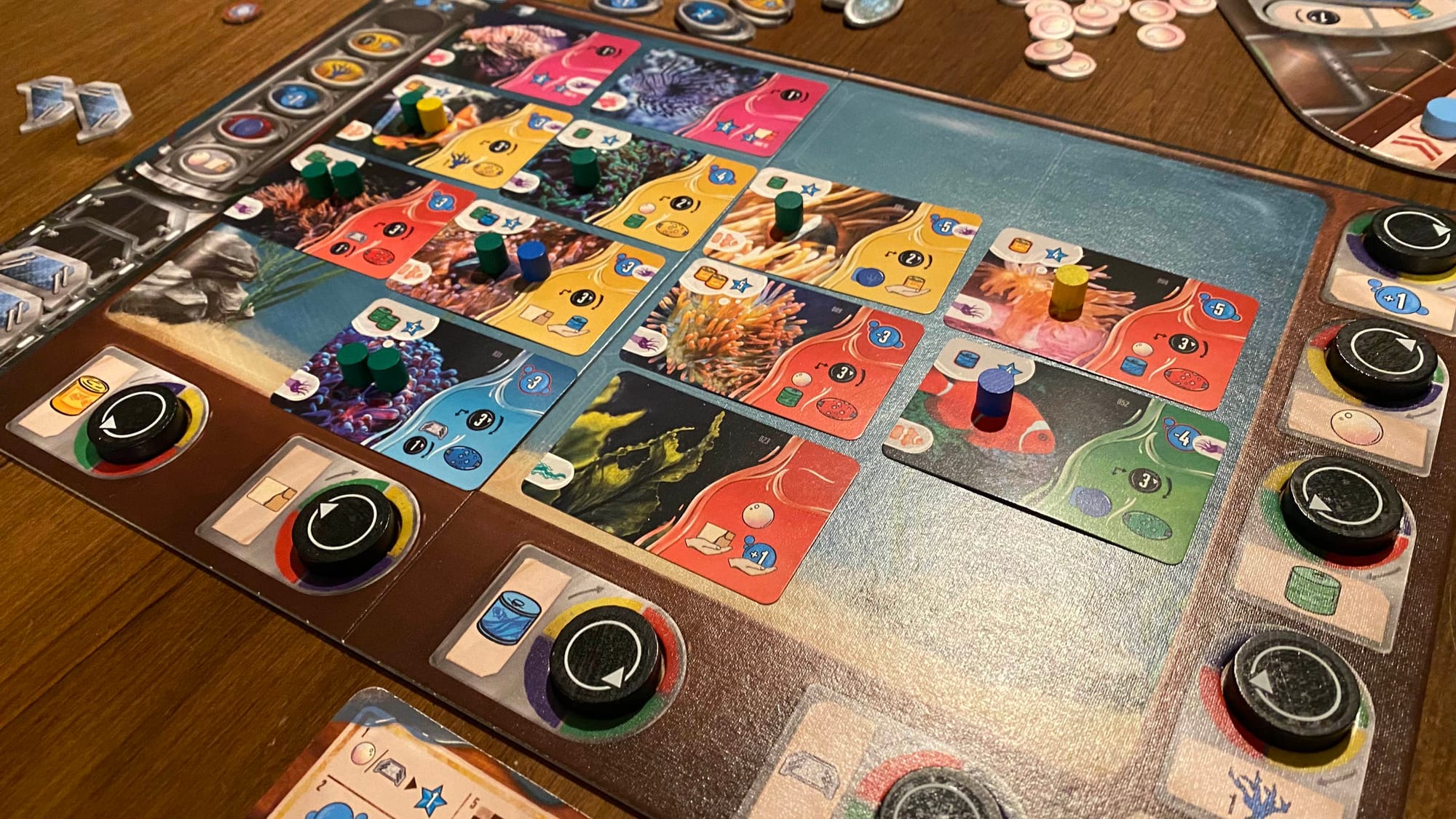
Unfortunately, the lack of overlapping gameplay means that there isn’t a ton of player interaction. Someone might take a card you wanted before you got the chance, but you can always pay to sweep the card market, so you’re never really hurting. The action bonuses get worse the more people use them, so you may miss out on something nice like a pearl, but the difference between prime choice and the leftovers never seemed completely game-changing. And while the Encyclopedia board’s bonus tokens are first-come, first-served, there are enough branching paths that you really don’t need to compete with others if you don’t want to. For some, this is a good thing as it lets you focus on just doing your own thing, but I prefer at least a bit of friction at the table so I don’t feel like it’s just a solo game.
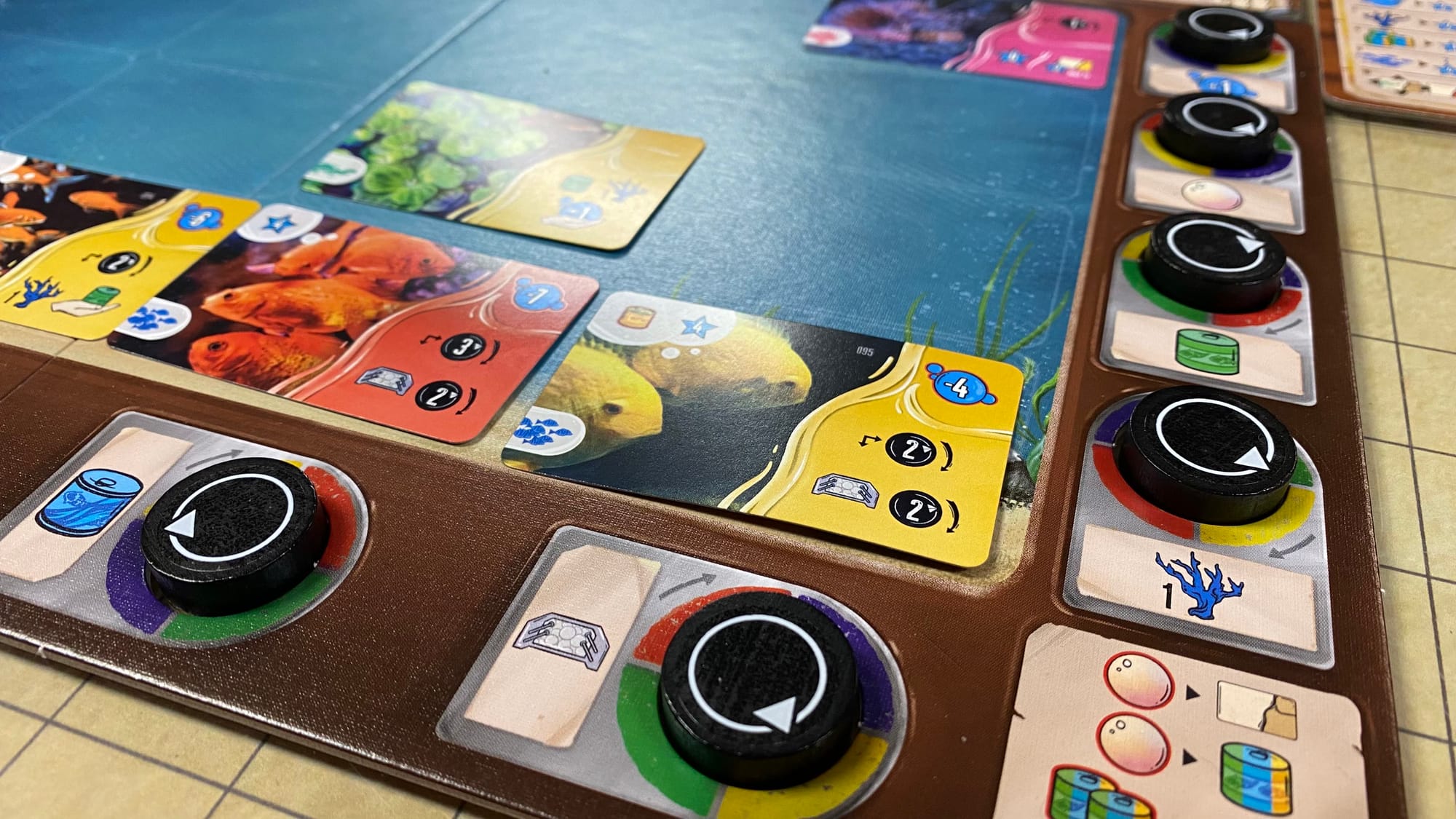
I mentioned that the food cans had run out for the four-player table, but that was entirely due to the player count. On an individual basis, the resources are tight, especially in the early game. The first game I played, I regularly had several fish starving each round (and one or two that I didn’t feed the entire game). Mostly, that was due to it being a learning experience, since you really want to feed the fish and gain their rewards, but it’s still something you need to balance. Just because you can afford the fish, it may not be worth adding to your tank just yet if you won’t be able to sustain it. I like games that add some balancing factor to your point engine so it isn’t just a collect-a-thon.
In a similar vein, while oxygen is your main currency for placing cards, you need to regularly keep it topped up. Every time you trigger the Wool Filter bonus, by earning enough tiles to fill your track, the very last step is to gain or lose points based on the oxygen you have. As a result, you’re heavily disincentivized to actually spend all your money. Or at least to ensure you aren’t broke for long. Especially since the upgrades you place on the filter can make it a good source of income.
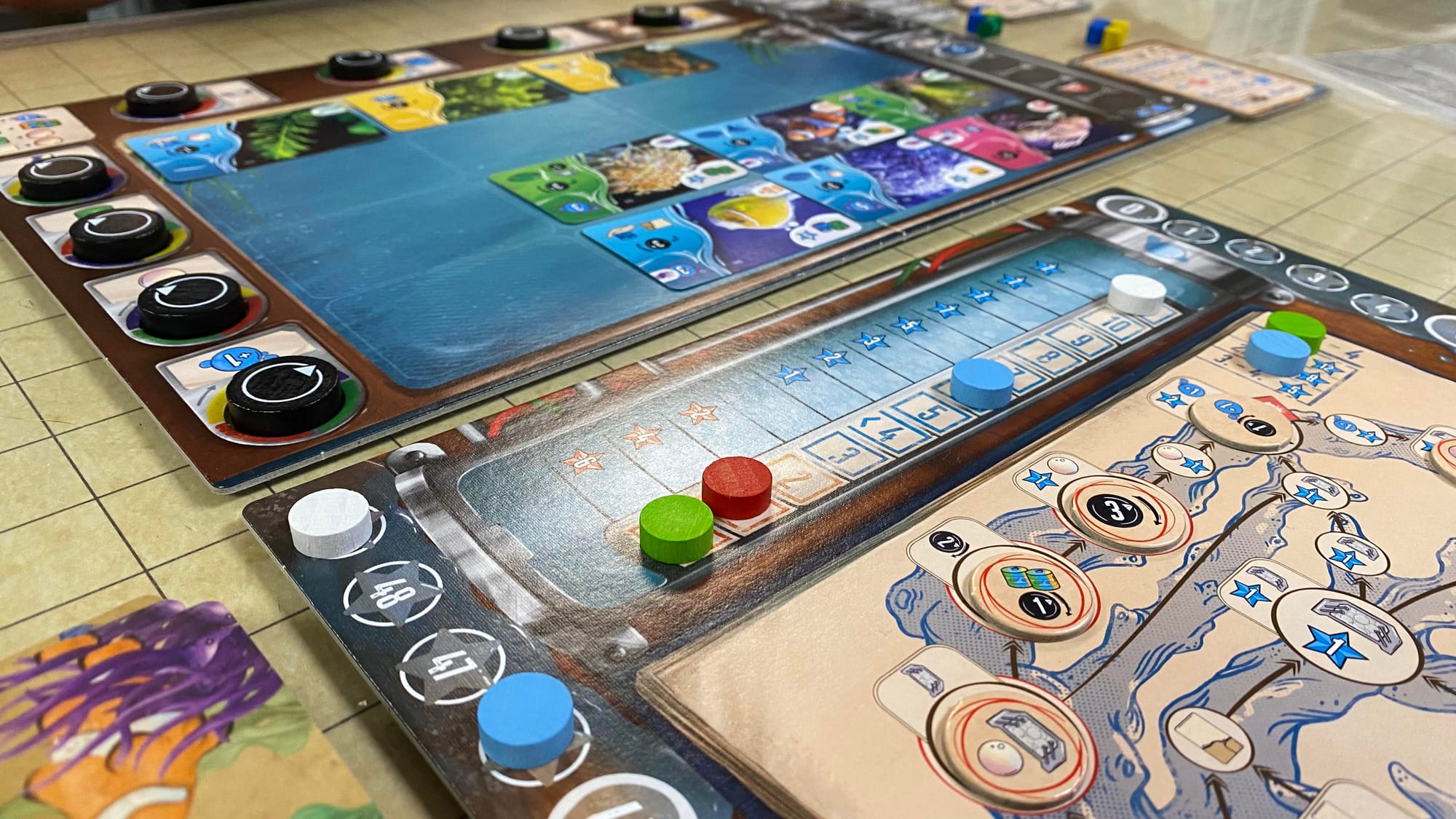
This last note isn’t really something good or bad about the game, just a note. The rules include both “Basic Scoring” and “Advanced Scoring”. These aren’t different game modes, as there are no rule changes between them. The latter just adjusts the scoring and adds one for aquatic plants so that the placement of cards in your aquarium carries a bit more weight. I’m not really sure why these both exist, rather than just leaving the Advanced scoring as the default. I’ve taught people with the Advanced from the beginning without any issue, but I suppose your mileage may vary.
Aquaria
Good
Aquaria is a pretty solid Eurogame that has some interesting action selection on top of a tableau that needs feeding in order to see it pay off. While I didn’t care for the minimal player interaction, I know that others may enjoy the more “multiplayer solitaire” feel of the game. However, nobody will enjoy the insufficient food tokens when playing at a full table.
Pros
- Variable action board for extra replayability
- Multiple valid playstyles
- Tight resource management leads to interesting decisions
Cons
- Not enough food for four players
- Not very visually appealing
- Low player interaction
This review is based on a retail copy provided by the publisher.