I don’t think I’ve ever seen so much potential squandered so horrendously. Despite the promise of the show’s own premise, source material, production design, sound design, acting, and cinematography, the story for Blade Runner 2099 is an unforgivable mess, and a blemish on the entire endeavor. Amazon needs to learn that no amount of money in the world can help a show if none of it goes to the writer’s room. Slogging through its 8 episodes is an exercise in frustration I can’t recommend unless you have enough drugs on hand that you’ll notice the visuals and sound without taking in any of the actual dialogue. The fact that series creator Silka Luisa’s last major project was the Halo show should tell you a lot.
To get the good out of the way, it looks and sounds nice. The futuristic city-scapes beset with rain and colors show a grandeur rarely seen since Metropolis, and its ponderous, dreamy electronic score helps create a wonderful atmosphere. The shot composition is more than competent, and many actors at the peak of their game are working hard with a script that gives them nothing to do. Their emotionless delivery is out of place; seemingly a staple of Blade Runner, it’s inappropriate here given the actual context of the scenes and story. Look, you can’t just pull out a slow saxophone and longing expression as if it makes up for a bad script. Atmosphere only carries you so far.
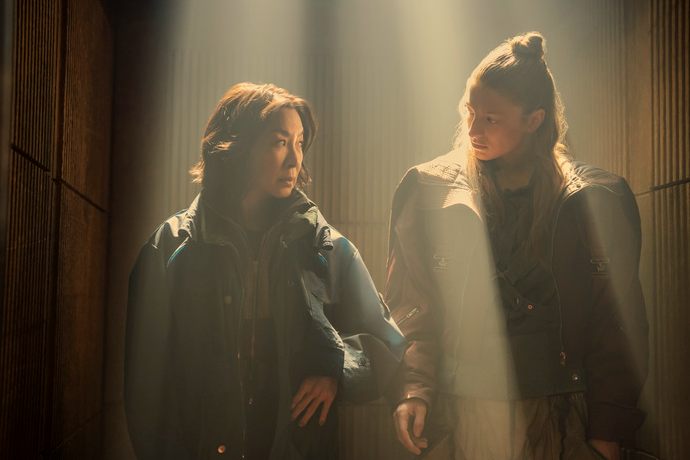
For some personal context, I’m as receptive an audience member as you could possibly get. I’ve seen every cut of Blade Runner and recently wrote a feature on a fan edit which digs deeper into the original script. I saw 2049 in theaters and have shown my physical copy to many people. I’m not some gormless chud either, trying to snidely conceal hatred of its diverse casting. Michele Yeoh’s career speaks for itself, Star Trek notwithstanding. I raved trans-headed The People’s Joker, and I’ll be doing the same for Teenage Sex and Death at Camp Miasma soon. The fact is that Michele Yeoh and Hunter Schafer are both talented performers who are completely wasted in this series. Everything is, from the setting of Blade Runner to the work of many talented artists on sets and sound and visuals, all built around a story with nothing to say. Worse, the things it has to say contain disturbing implications that feel entirely unintentional, due to the thoughtlessness of these scripts.
The series begins with a fascinating premise: the replicant revolution teased for so long has come and gone, with humans now the oppressed underclass. Hunter Schafer’s lead character is a human disguising herself as a replicant who hunts her own kind, and has to maintain cover as she uncovers another, deeply moronic mystery. Michele Yeoh is her replicant partner, soon to die from the end of her in-built life expectancy. Think of how much one could say and how many stories write themselves from those few sentences. There’s so much to dig into that the show doesn’t even try to approach, and the story it does tell is deeply incoherent.
For starters, the societal upheaval at hand means…nothing at all for some reason? Yes the humans are oppressed, but this and the conflicts it engenders are a minor afterthought for the series. Nominally the driving force of the story, it’s fairly absent as a real mechanism until right at the end of the series. Worst of all is the lack of any understanding of replicant society or government. These former slaves are now in control, and we get no idea at all how they see themselves, or what their goals even are.
In the prior films, we understood that society was like ours but in the future. Replicants are not like us, as the show works hard to remind us. They have greater physical capabilities, some have a pre-built death sentence, and they recently won a war against their creators and oppressors. So how does their rule actually work out? No idea, and the show doesn’t say. Oh, they corral the humans and have a few methods of ferreting them out, but we don’t actually know anything about what they’re doing or trying to achieve. They seem to have no concern for their own kind dying of the life expectancy date, and them turning around to be exactly the oppressors they liberated themselves from is a curious decision.
The message here is that the replicants actually do need to be oppressed, for our own good and theirs. It implies the people you oppress are no better than you and will recreate those repressive structures exactly as they exist now without learning anything. The human hunters call themselves Blade Runners after all, apparently fine with taking the moniker of the people tasked with gunning them down like animals.
In BR 2099, replicants are shown to be anti-social, directionless, violent sociopaths almost without exception. They actively preach that empathy is a weakness they don’t possess, and if they teach anything else or have any other kind of philosophy, we don’t know what it is. Those close to death have a place to go for their final minutes, but no kind of ceremony or celebration from those close to them who can see what’s about to happen. Abused turned abuser does have historical precedent, which I’m sure Silka isn’t aware of.
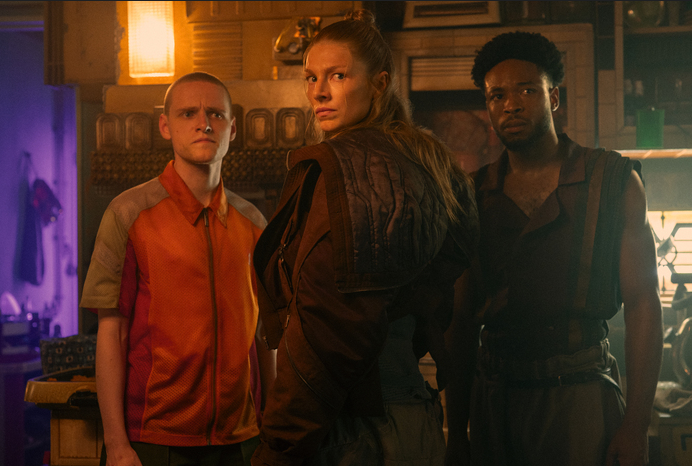
This is genuinely disturbing, but wholly unsurprising from Amazon. The corpo-villain strawman who later shows his head is less detrimental to society than what Jeff Bezos is actually doing right now. Moreover, they’re incompetent. We still have the same advertisements for offworld colonies that were playing in the first movie. You mean to tell me that 80 years later the replicants have taken over all of society and yet they can’t figure out how to change the billboard ads? There’s a lot one could make out of analogues to Rwanda or Punjab, but this story doesn’t even attempt it. The two attempts at showing replicant culture are interesting but ultimately minor events, and one has an unforgivable problem at its heart.
The first takes place at a special facility where replicants can temporarily wear human-like skin, allowing them to feel what it’s like to grow old or get pregnant. Hunter Schafer is in this scene, and it might be interesting for the show to try to say something about adopting new body types with a trans actress on screen, but that assumes a storyteller with thoughts, curiosity, and something to say. Amazon doesn’t hire those people. FAR worse is a brief scene at a replicant fashion show. Apparently these amoral killing machines with no discernable government have a fashion industry. At this show, they applaud the appearance of the last Joi, here to grace them all after being liberated.
Hold on a minute. What? Joi? Joi is present to comfort the liberated? This is all the proof I need that the writers did not understand Blade Runner 2049, if the interns they set to watching them even did that job. Joi is a symbol, nay a tool, of oppression. She is not a replicant, she is not conscious, she was explicitly made a tool to corral and mollify the replicants while they were slaves. K wanting NOT to be like Joi is the major motivating force of Blade Runner 2049. It’s the entire point of the fucking movie. Joi’s presence at this fashion show is like if the national NAACP convention opened with an Al Jolson impersonator. It’s offensive and betrays a lack of interest in 2049 and everything it set out to say.
Does this scene read as empowering to you?
As for the actual story, it’s not much better. First of all, Hunter Schafer being able to maintain cover for longer than five minutes makes the replicants look suicidally incompetent. Other than one clever interchange during a Voight Kampff test, which I grant was a great bit of dialogue, EVERY SINGLE THING she does for the first three episodes is suspicious. She acts wrong, says the wrong thing, has contradictory and provably false explanations for her many strange maneuvers, and does something in the first episode that should see her killed on the spot. The fact that the Blade Runners, whose only job is catching undercover humans, can’t call her out immediately implies that replicant society should not be able to function. (All of this rests on the idea that they don’t have recording devices in their interrogation rooms, which I would have thought is half the point of an interrogation room, but whatever.)
Blade Runner is known for deliberate pacing, but even so the plodding slog of a plot that follows is impressive in its blandness. Despite having ~8 hours to tell its story, we get less in terms of character, plot, and setting than the previous two movies combined. The detective work that should be driving the narrative is almost exclusively delivered in people just telling Michelle and Hunter the clues they need to proceed. They show none of the intelligence or curiosity that Deckard and K needed to get anywhere, and the underlying mystery itself is drowning in nonsensical facts.
The prior Blade Runner movies were about searching for people, who were significant because of what they were capable of and what they believed in. BR 2099’s characters are looking out for a McGuffin that probably can’t exist, and even if it could is only a callback to the first film. I won’t spoil my reasoning, but all of it requires you ignoring most of what you’ve seen in Blade Runner 2049. Suffice it to say, the writers of this show don’t know how replicants have changed since then, even assuming the Big Revelation™ of that movie remained completely hidden. (Despite people who are motivated to use that fact already being aware of it and now seemingly in charge of the government.)
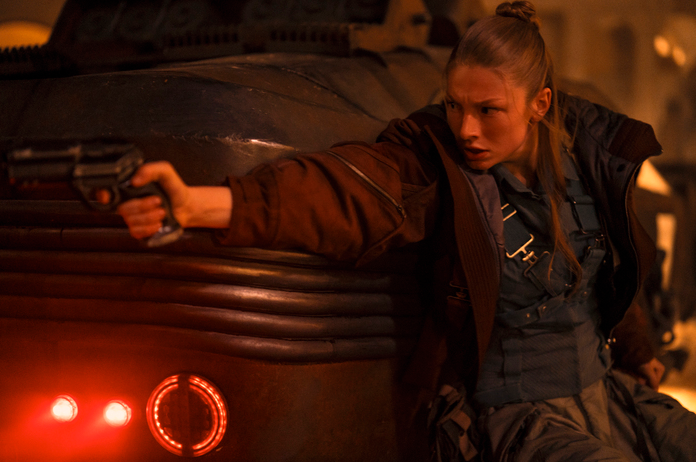
It would be a bigger spoiler to explain exactly why the McGuffin in question shouldn’t exist and that the changes it brings shouldn’t be possible, but worse is the structure of this story. As noir detective tales, the prior movies did great work with isolated protagonists making their way in the world. BR 2099’s espionage story can’t work that way, because its subject is something that would be too interesting to too many people. The entire government and society of the setting should be invested in this thing and bringing it to light, but for that to happen the writers would have to have some idea of what the society actually is.
There is an explanation for this, i.e. a party working on their own who wants to use the MacGuffin for their own ends, but even if the villain is successful it would mean great things for everyone involved, at a cost that it seems like they would need to incur anyway. I wish I could give more details here, but I can allude to the fact that the thing the villain wants is to make money, which would still be changing hands if they weren’t involved. It may sound gauche to say, but making things happen means exchanging money. Resources have to go somewhere for things to happen, right? If replicant society is some exception that doesn’t rely on money or has some collectivist bent, that fact is never established in the show.
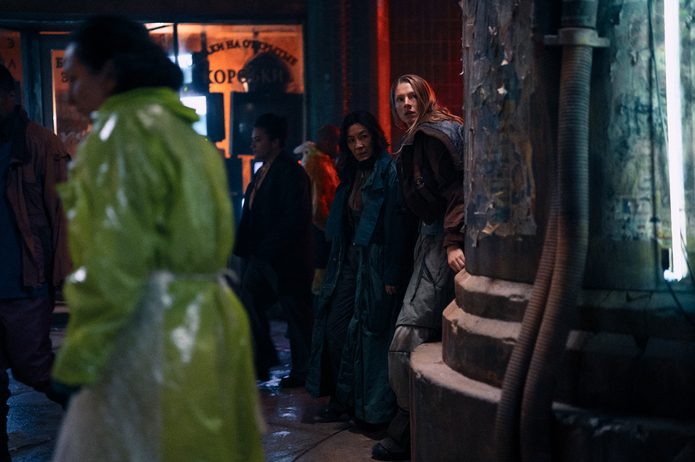
All this is besides a shoe-horned reveal of how Hunter Schafer is secretly tied into all of these events. This would seem like a trope of Blade Runner to someone who hasn’t seen the movies, but skimmed through their interns’ notes on the movies. Whatever bones people make about Deckard maybe being a replicant (he wasn’t), the story was not about him at all. He was just a functionary doing his job and seeking out the actual protagonist of the story, Roy Batty. K’s suspicion of his own importance (minor spoilers for 2049 ahead) turns out to be completely wrong. It’s his decisions that make him significant, which are fueled by the fake promises he realizes Joi can never satisfy.
Despite its expensive visual design and a team of actors doing their best, this dull and nonsensical script simply can’t justify its 8 hour runtime. It steals moments, lines, even entire scenes from the prior movies, but without any of the context or thoughtfulness that would make them actually function.
If you’re a fan of Blade Runner and you have a functioning brainstem, you will not enjoy this show. If you aren’t a fan of Blade Runner, go watch the first two movies and have the greatest time of your life.