Captain America’s impact on the Marvel universe cannot be understated. He was an integral member of the Avengers, leading them against some of the greatest threats the Earth has ever known. He’s been a beacon of hope for countless people, helping to steer an ever changing world towards a brighter tomorrow no matter how many obstacles he comes up against. And he’s been a steadfast ally and inspiration for so many heroes, even those he may not always agree with. It’s difficult to imagine what the world would look like had the original Avengers not found him frozen in a block of ice. But in What If…? Captain America #1, writer Marc Guggenheim shows us exactly the kind of world that would await Captain Rogers if his revival had occurred not during the modern age of heroes, but in the distant future of 2099. Needless to say, Cap isn’t a fan of what he finds…
*Mild spoilers ahead for What If…? Captain America (2026) #1*
We all know the story. Captain America, valiant hero of World War II, lies frozen in the arctic, sleeping away the decades following the horrific conflict. In the main Marvel timeline, he would eventually be found by the early Avengers, who would go on to bring him into the team. From there, decades of heroic adventures would ensue as the Sentinel of Liberty fought a seemingly neverending fight against the forces of evil, helping to solidify the Age of Heroes that would define the Marvel universe.
But what if his revival were delayed by several decades?
Flash forward to the year 2099, where an anti-pollution corporation submarine comes upon the slumbering Captain Rogers. As before, they revive him,whereupon he is brought up to speed about the state of the world by the heroes of 2099. Some things are the same as the main universe timeline, of course. The Allies won World War II, and as evil rose to threaten the world, heroes emerged to challenge it, bringing about the Age of Heroes we’re familiar with. What’s different in this timeline is that what happens when the Superhero Registration Act triggers the superhero civil war.
In the original Civil War, Captain America leads the fight against Iron Man’s forces until eventually he sees the collateral damage that the conflict is bringing. At this point he surrenders, ending the conflict in a relatively peaceful manner that would allow the superhero community to heal and maintain the peoples’ trust.
Here, however, that wasn’t the case. While we’re not shown exactly what happened, it’s stated that after the conflict the Age of Heroes ended, suggesting that either the war continued until most or all of the heroes were killed, or that its escalations caused the public to lose faith in their former defenders. The specifics of what happened aren’t truly important to the story at hand, though, but rather what the key difference was: Captain America wasn’t there.
Is it perhaps a bit too much to place the survival of the Age of Heroes on the shoulders of one man? Possibly. After all, there are plenty of other characters who have arguably made just as large of a mark within the hero community, and could have easily risen to become the inspiration and voice of reason Cap was in the main timeline. Spider-Man is one that comes to mind quickly. At the same time, it could perhaps be argued that many of these others might not have followed the same path without Captain America there to guide them. This seems to be the train of thought Guggenheim is presenting to us, both by showing us what happened in Cap’s absence and by what comes next.
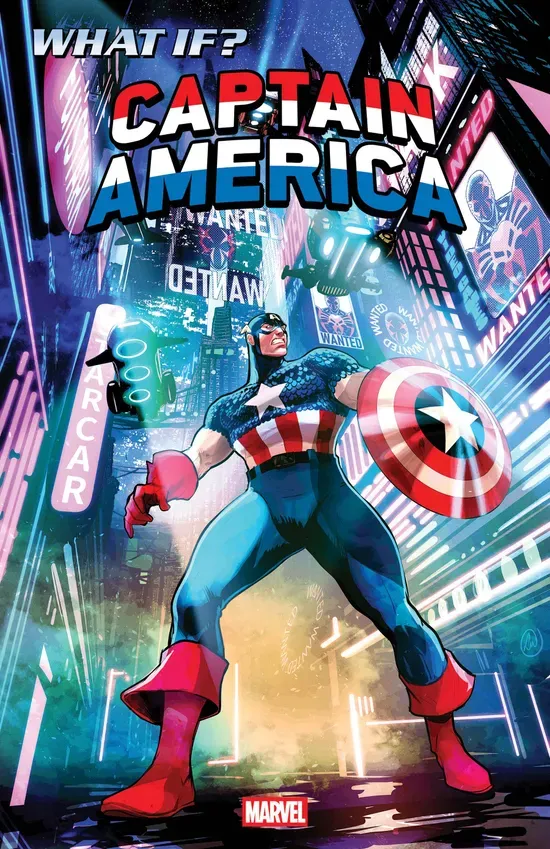
The world in which Captain America awakens in this timeline is a much different place than the one from the main timeline. Here, the United States has become an oligarchy/police state, run by powerful corporations that seek only to increase the fortunes of their shareholders while rounding up anyone they see as different in the name of national security.
Sound a bit familiar?
While I appreciate the analogy for the horrific real world events currently ongoing, it’s a bit on the nose at times, if I’m being honest. This largely stems from the rushed pacing of the issue, which tends to be a common thing with “What If…?” stories since they’re usually limited to a single issue. As a result, so many of the things Guggenheim puts into the book come across less as elements meant to evoke thoughtful comparisons with the real world and more like a montage to show how bad this world is before charging into a revolution that feels equally as rushed. I know this isn’t necessarily a fault on Guggenheim so much as it is on the limitations of the book, but it still causes the events that play out to have less impact than they might have if the story had been spread over several issues. If nothing else, it would have made the reveal at the climax feel a bit more earned, even if it still would have been somewhat expected.
The inclusion of the 2099 heroes also honestly felt forced, with most feeling more like glorified cameos than the actual characters. Again, this can largely be blamed on the single issue restrictions, but even with that in mind, the characters don’t read like they normally would. One could make the argument that the differences in their personalities could be chalked up to the changes in the timeline caused by Cap not being revived until now, but that doesn’t excuse the 2099 heroes from coming across so flat and unremarkable. The text boxes from them could have been swapped around and I likely wouldn’t have noticed a difference because they all feel like the same character in different costumes. Admittedly, I may be being a bit too critical of this, given that this is a Captain America book rather than a designated 2099 comic, but it’s something that kept me from being able to be fully immersed into the story.
Given how critical I’ve been so far, you would be forgiven for concluding there are no good qualities to the book, but there are definitely some shiny moments. For starters, the overall concept is plenty compelling despite the limitations hampering it, and Guggenheim uses it well to highlight one of Steve Roger’s most enduring traits: his unyielding resolve to stand up for what he believes is right, no matter the odds or obstacles. Cap’s inner dialogue in the final battle is also quite poignant, and while some elements of the scene make little attempt at subtlety, it’s the lack of subtlety that makes his commentary work so well.
Overall, What If…? Captain America (2026) #1 is an interesting premise hampered by rushed pacing. It’s far from a perfect story, but it’s an entertaining one that highlights the impact of a good man who has never been afraid to stand up to injustice, forever running into the fray as the beacon of hope the world needs.
What If…? Captain America (2026) #1 is available now from Marvel Comics.
What if…? Captain America (2026) #1
Good
Exploring the idea of what would happen if Captain America wasn’t revived until 2099, “What If…? Captain America (2026) #1” flings the Sentinel of Liberty into a dystopian future to lead a new group of heroes against an all-too-relatable evil. While a bit rushed due to the single issue format of the series, writer Marc Guggenheim delivers an interesting story that, while a tad on the nose at times, showcases the character of Steve Rogers and the impact he’s had on the Marvel Universe.
Pros
- Presentation of Captain America
- Overall premise
Cons
- Rushed pacing
- Reveal at the end felt forced
This review is based on a retail copy provided by the publisher.