Randy, Alec, and Ronn had the pleasure of meeting with Jordan Cuffie at Adepticon 2026 this year, one of many highlights from the convention. Recently, we followed up with Jordan and learned a great deal about the genius behind the talent with Skull Forge Studios.

Alec discovered Jordan's work back in April 2020, at the peak of COVID times where staying inside and working on miniature painting became a mainstay of his hobby career. Seeking to find some Rogue One miniatures to use with Star Wars: Legion, he unknowingly began his 3D printing obsession and printing up some of Jordan's first-ever 3D sculpts. Since then, he's been following, watching, and printing many of Jordan's creations. Over the years, it has become very clear that, as a prominent pillar and leader in the independent tabletop and miniature world, Jordan has cultivated a large and loving community for his minis and games while simultaneously managing his art, work, and family life.
So, how did it all begin for Jordan and what's coming down the line for Skull Forge Studios? Check out our interview with Jordan!
(*Questions and answers edited for quality and clarity)
Gaming Trend (GT): When did you first start doing digital design, and where did you learn how to do it?
Jordan Cuffie (JC): I got my start way back in college where I attended the School the Art Institute of Chicago from 2005 to 2009. I initially planned on getting a BFA with a focus on traditional animation, however the writing was on the wall with the direction of that industry so I switched to learning 3D modeling and animation. After graduating, I worked at a small video game studio, Synapse Games. The company was pretty lean, only growing to maybe 20-25 employees, and the art department grew to a maximum of 4 artists. Because we were so small, we had to learn how to be as efficient as possible, and with our focus on CCG’s and mobile games, we were constantly pushing out card art and assets for new titles. I owe a lot of my current workflow and output flexibility to my 11 years at Synapse. I didn’t do much digital sculpting until later in my tenure at Synapse, working on a TMNT game that required a more traditional high poly to low poly pipeline, so as the Senior Artist I had to pivot from a largely illustrative and low poly workflow to digital sculpting fairly quickly.
GT: What was the first model you ever sculpted? Do you still have it?
JC: The first model I sculpted was probably some sort of Batman figurine made from PlayDoh. I can only assume it was smooshed back into a grey blob haha! The first model I digitally sculpted with the intention of tabletop use was a hairless Tabaxi rogue used for a D&D campaign, back when Shapeways was my primary source for 3D printed miniatures. This was right before home printing became viable.
GT: Was your goal/dream digital design, or game design?
JC: I think the dream was always game design. However, child-Jordan thought that all game design entailed was imagining cool ideas for Megaman levels, or hypothesizing the next adventure for Samus. As I grew older I discovered, as most people do, that ideas alone are worthless, and it's about the execution of the idea or concept; the intention to fully realize it into something greater than idea iswhat matters. For a time, I thought my career was going to just be an artist for games, as illustration and sculpting were always my area of expertise, and before SkullForge took off, I was just making minis as a hobby for RPG’s I enjoyed. It wasn’t until my close friend showed me Relic Blade that a light bulb went off. I saw Sean Sutter's work, and thought “Oh damn, this is one person, doing everything. I want to do that”. Looking at Relic Blade, I saw the full vision, complete intention: these are the minis that someone made for their game.
GT: What are some of your favorite board and miniature games?
JC: I may sound like a bit of a fair weather fan, but I think X-Wing Miniatures Game is top tier; collectively as a set of minis, amazing ruleset, and its supportive community. It was the golden triangle of tabletop games. Relic Blade stands out as an amazing project and product, the fact that it continues to grow is incredibly inspiring. I’m a big fan of Arena Rex, too, as they have some of the most beautiful miniatures out there. I would be remiss not to mention Hobgoblin and Greathelm, as both games set out to make you play with minis you have (miniature agnostic) and both games excel at making table top wargaming incredibly accessible and, more importantly, enjoyable shared experiences .I don’t play as many board games nowadays as I would like to, but I have many fond memories playing Imperial 2030, and occasionally I can get in a quick game of The Duke or Onitama.
GT: You are a business owner and, as a entrepreneur, have built Skull Forge Studios (SFS) from the ground up. Tell us about your journey. What have been some barriers? What have been some triumphs?
JC: SFS really grew from the personal need to see the members of Rogue One on the table top. As a product I always knew it would happen in an official capacity but I was rather impatient. My first foray was sculpting K2SO and Cassian Andor. I shared the model on a few Facebook groups and they garnered a huge positive response. So, as one does, I kept sculpting more and found myself among a small group of other like-minded sculptors who wanted to have the entire Galaxy represented on the table top. The biggest hurdle and risk was quitting my full time job as a Senior Artist; losing benefits, stable income, dedicated workspace, etc. While having dual incomes was great financially, I couldn’t burn the candle at both ends, so I had to decide to risk it all and do the thing that brought me the most joy. Most of the barriers I encounter are self-inflicted. Working from home for the past 5 years makes it very easy to become complacent with hyper focusing on sculpting and forget to attend to the day-to-day administrative tasks that come with running a business, answering emails, writing up contracts, etc.
As far as triumphs, I’m still dumbfounded that I was able to provide the Luke Skywalker sculpt for Adam Savage’s (Mythbusters, Tested) AT-AT build, and all of the work I’ve done for the Dimension 20 show. They really have the best production design of any roleplay show and I’m honored to have collaborated with them. I think the biggest triumph however has been being able to pivot from sculptor to actualized game designer. I owe a lot of that to Greg Horton at Electi Studio, the publisher of Arsenal. Greg has been instrumental in prodding me up to get on my own feet and get the games I want to make out to the world.
GT: Tell us about Arsenal. Where did the idea come from? What are the inspirations for it?
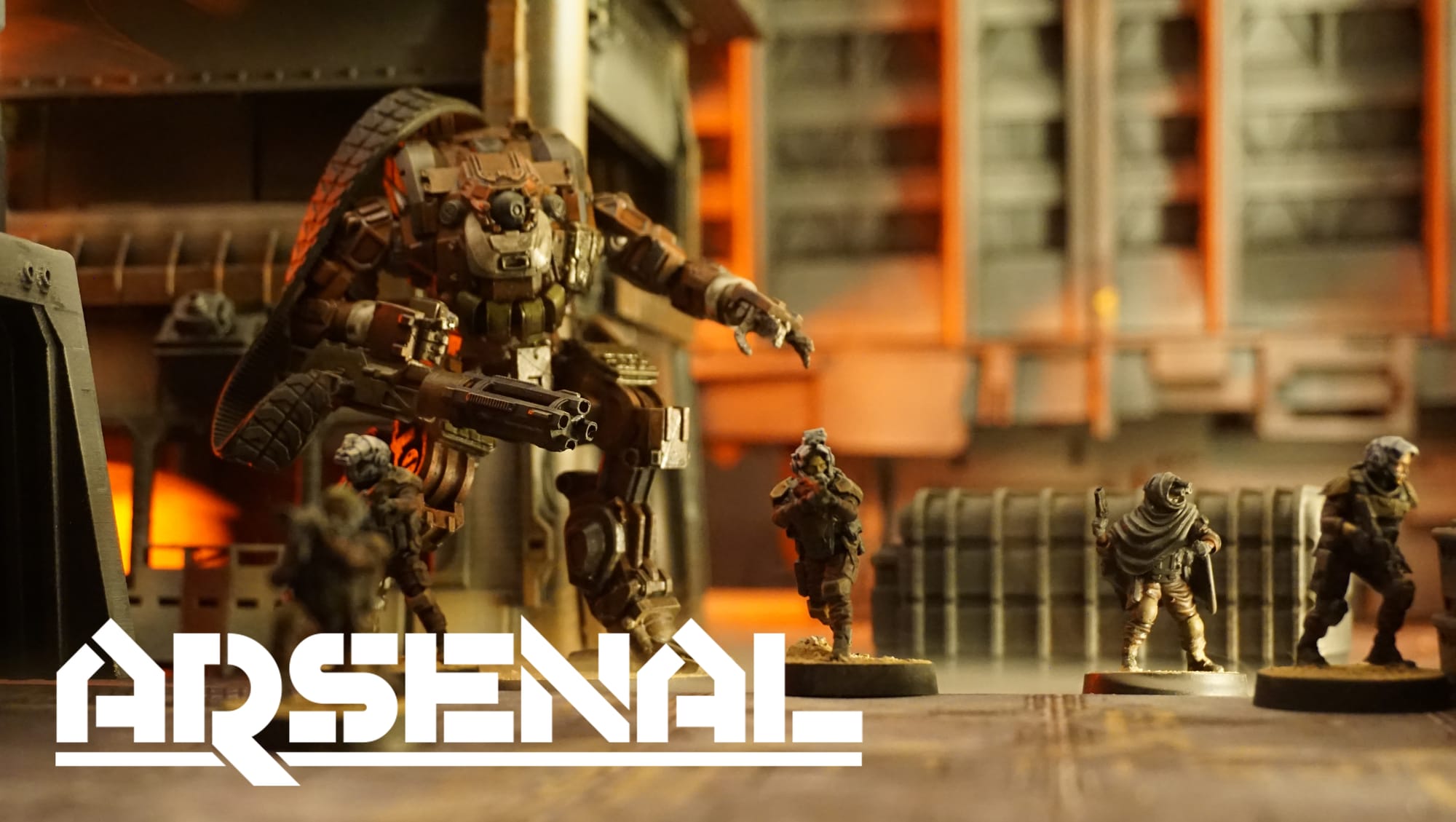
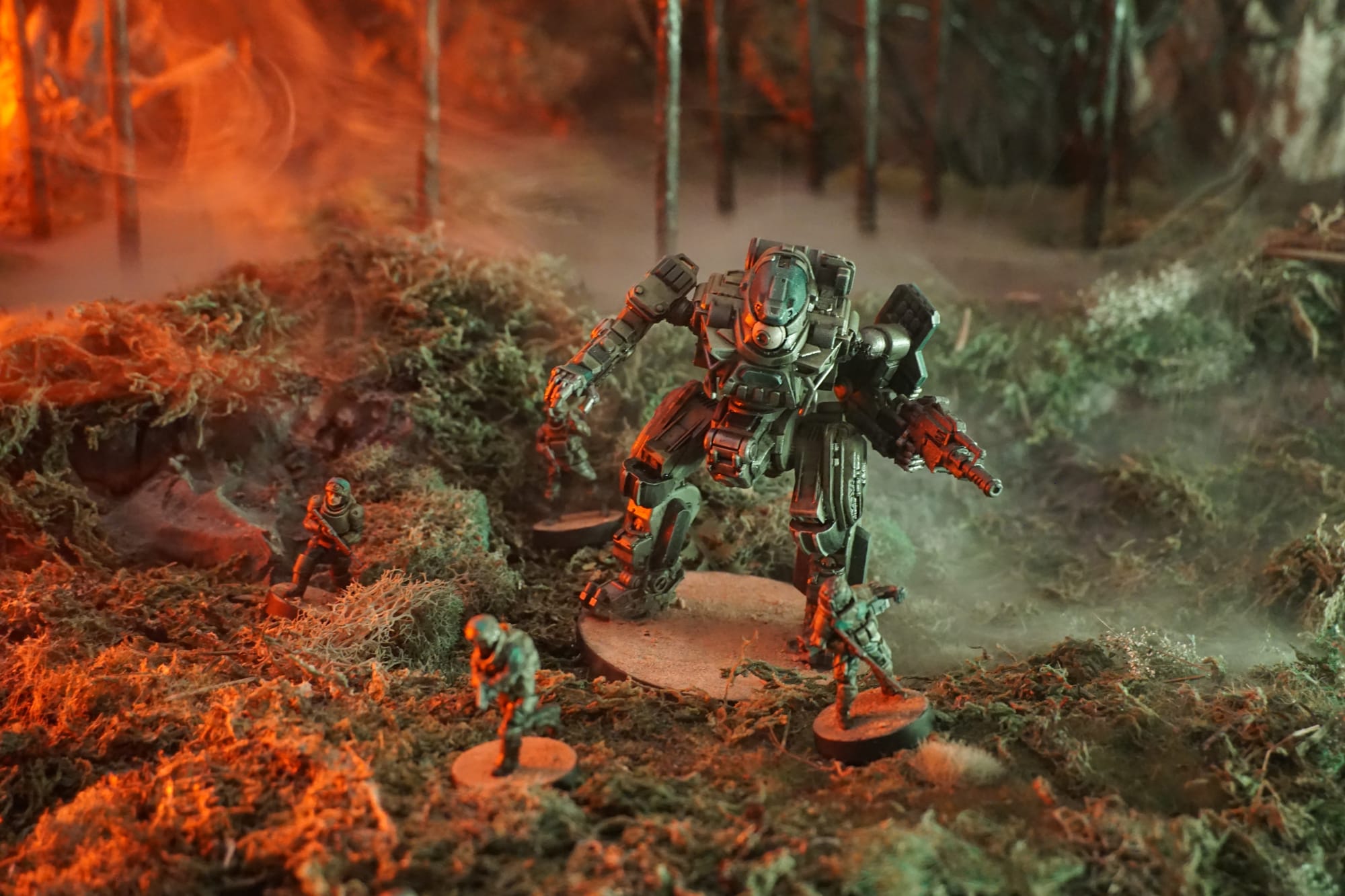
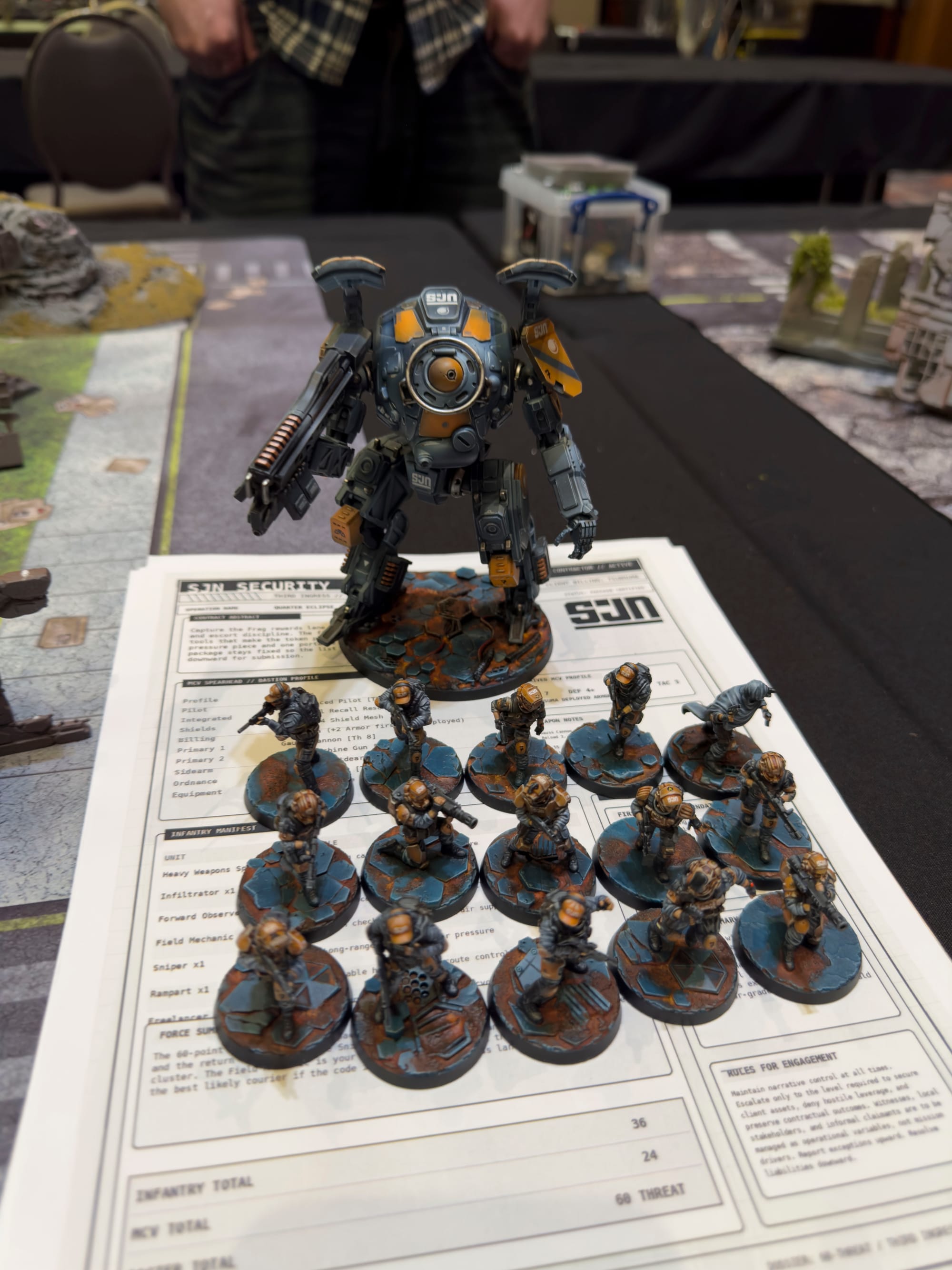
JC: I’ve always loved all things mechs and, when I have downtime, I’m either sketching mechs and/or modeling mechs. One of the shortcomings I saw in table top gaming was the lack of mech-focused games at the 28-32mm scale. We have games that feature big mechs, however the models themselves are small (Battletech, Heavy Gear, etc.). While there are 32mm games where mechs are involved, they are certainly not the focus, and so they are relegated to heavy support units. With Arsenal, your Mechanized Cavalry Vehicle (MCV) is the focus, and you build your fireteam around how your mech operates. I’ve jokingly called Arsenal, table top Titanfall but essentially, it’s really my love letter to Titanfall (and the longing for a proper Titanfall 3). The roughly 20-foot tall Titans feel very tangible; less like a walking tank and more like an Eva or a Gundam, which are very dynamic. The size difference between infantry and mech is very important, too. The MCV’s in Arsenal are large enough to reasonably be piloted by a person, but small enough to maneuver the battlefield with ease in pace with infantry.
 Skip to Content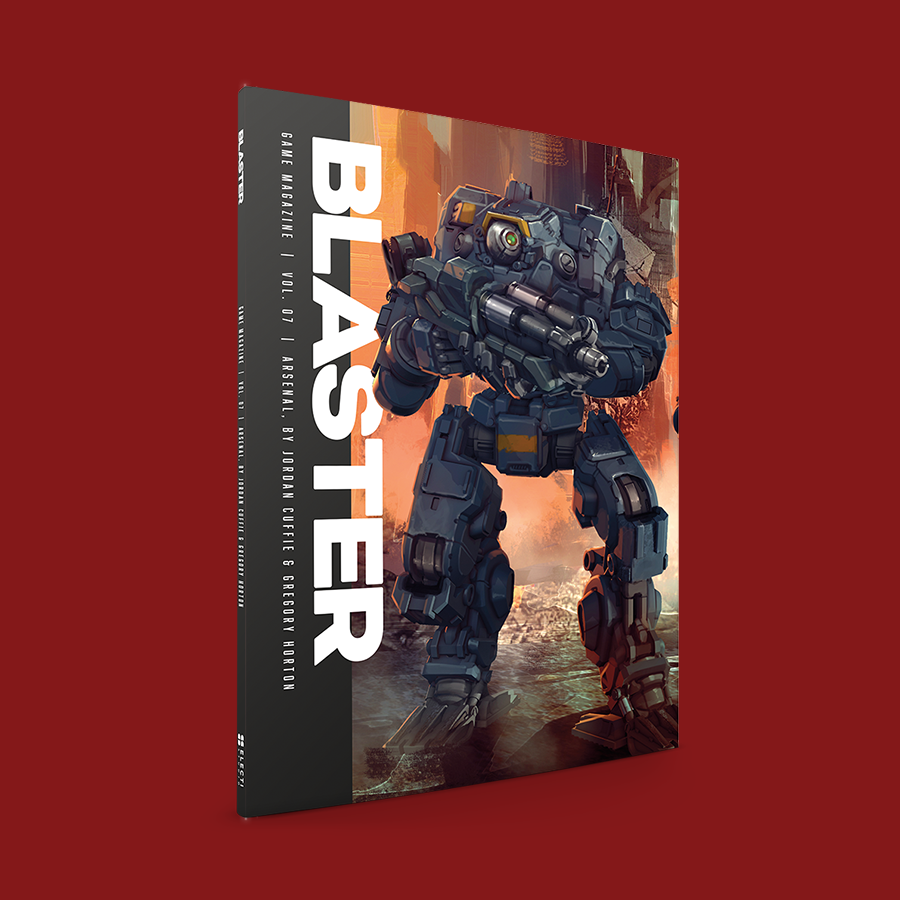
GT: What is Firmament?
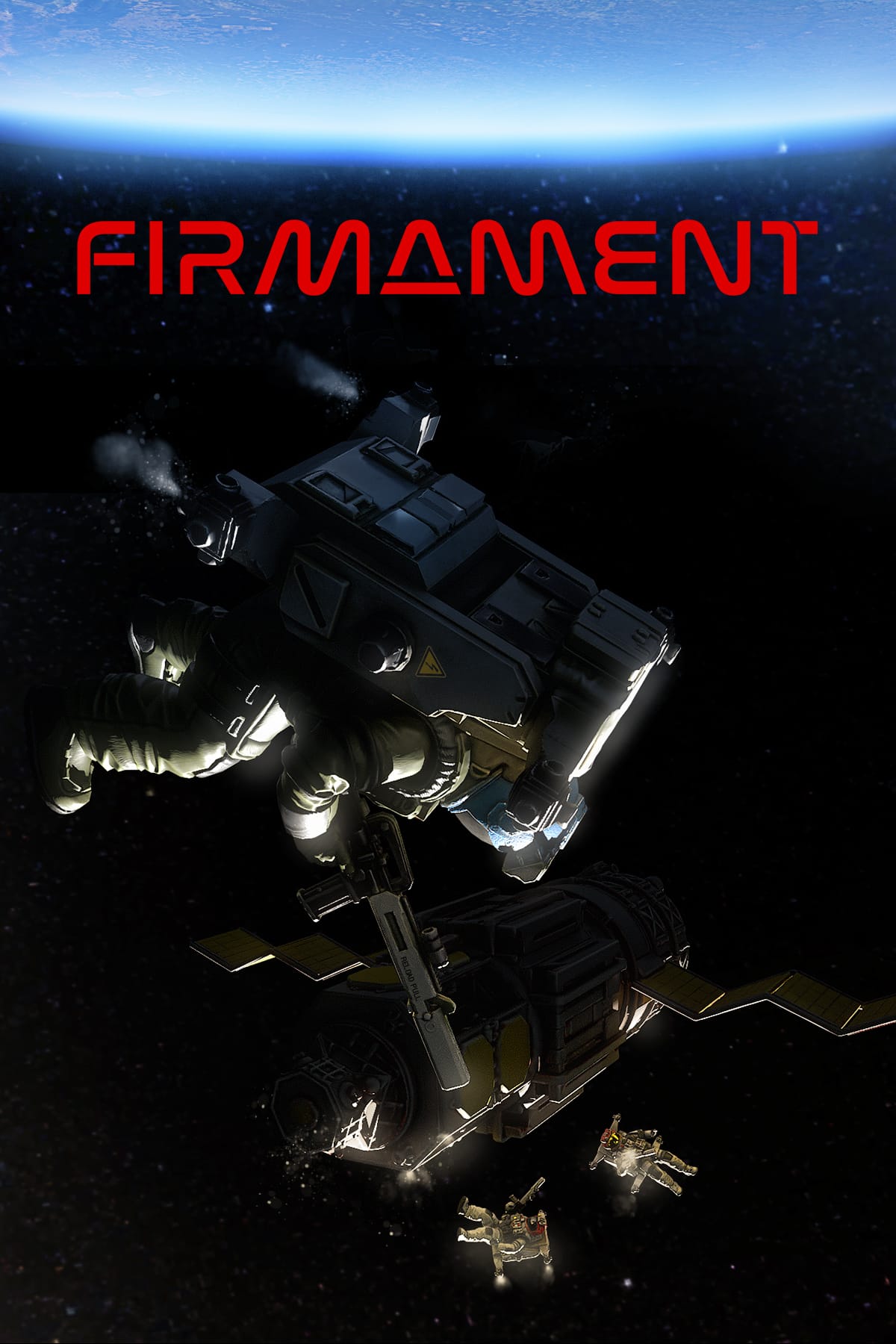
JC: Firmament is a near-future, three-dimensional skirmish game that takes place in Earth’s orbit. You play as a team of orbit ‘operators’ vying for control of valuable salvage after the collapse of ‘The Spire;’ humanities largest space elevator and life line for hundreds of high orbit stations surrounding Earth. Now, most games are three dimensional in nature given that they are physical objects, however most games are played in two dimensions - flat, on a tabletop. Firmament flips the script by allowing players to easily maneuver their models both on the horizontal plane and vertical plane using a standard tape measure. We showed a small demo of how the game works at Adepticon 2026 and it was definitely a showstopper.
GT: What about Skate 28?
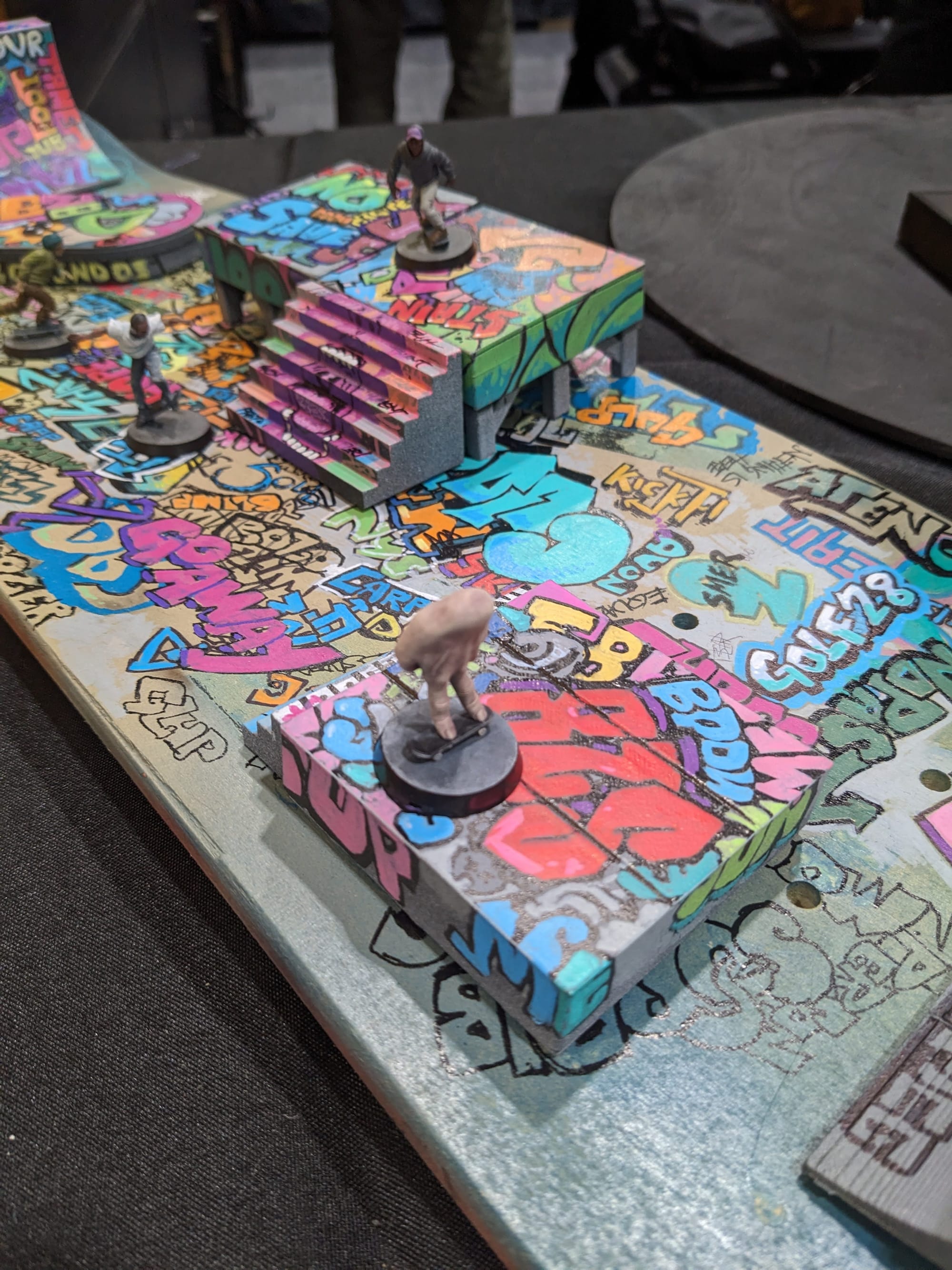
JC: SKATE 28 is the skateboarding minis game! Up to four players skate around the streets or skatepark, performing tricks in increasing difficulty, all while trying to maintain your flow state, avoiding security guards, ambivalent kids on scooters (and their helicopter parents), and corporate suits, all of whom are bent on trying to stop you from just chilling and skating. Players collect the letter of SKATE, taunting rival skates, and level up their own skater as they gain and spend flow points.
SKATE 28 has two goals. The first is to take something that we all have a deep nostalgia for, skating around with friends, playing Tony Hawk Pro Skater, reading THRASHER magazine, and distill that onto the tabletop. The other is to make a game that is inherently not interwoven with combat which the genre title of ‘wargaming’ instills. There is a growing space for non-combat tabletop games and I’m looking forward to SKATE 28 being one of them.
GT: Tell us a little bit about Blade of the Nomad: RONIN?
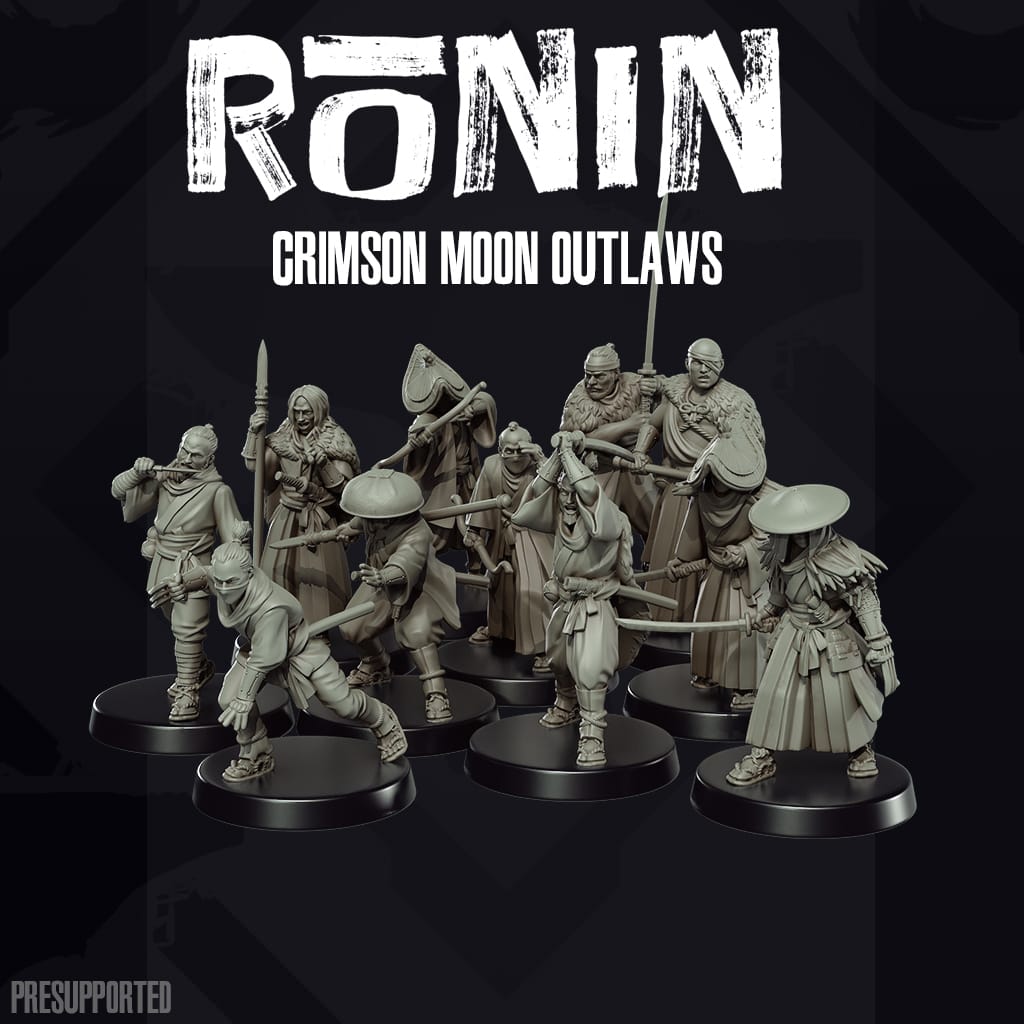
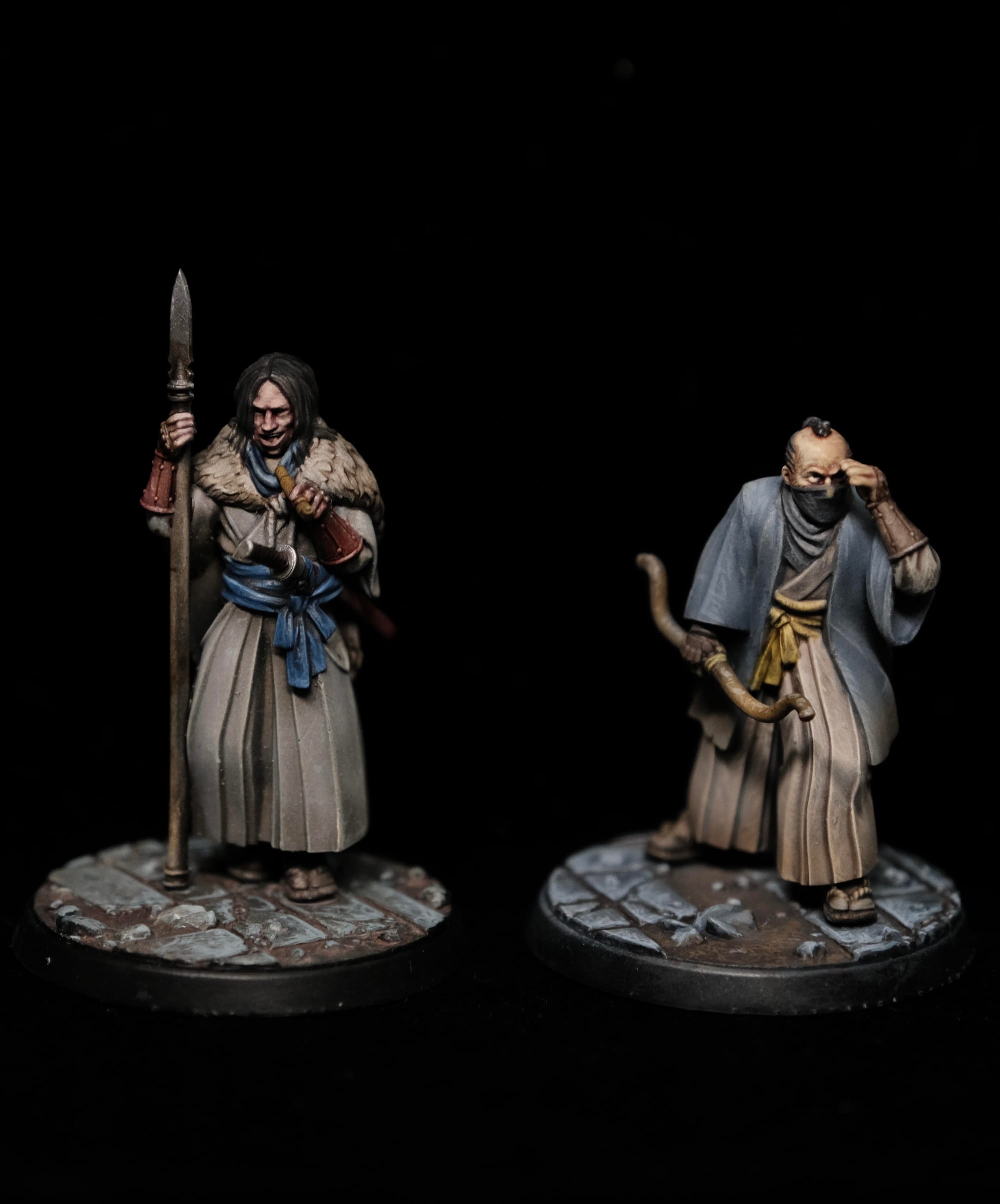
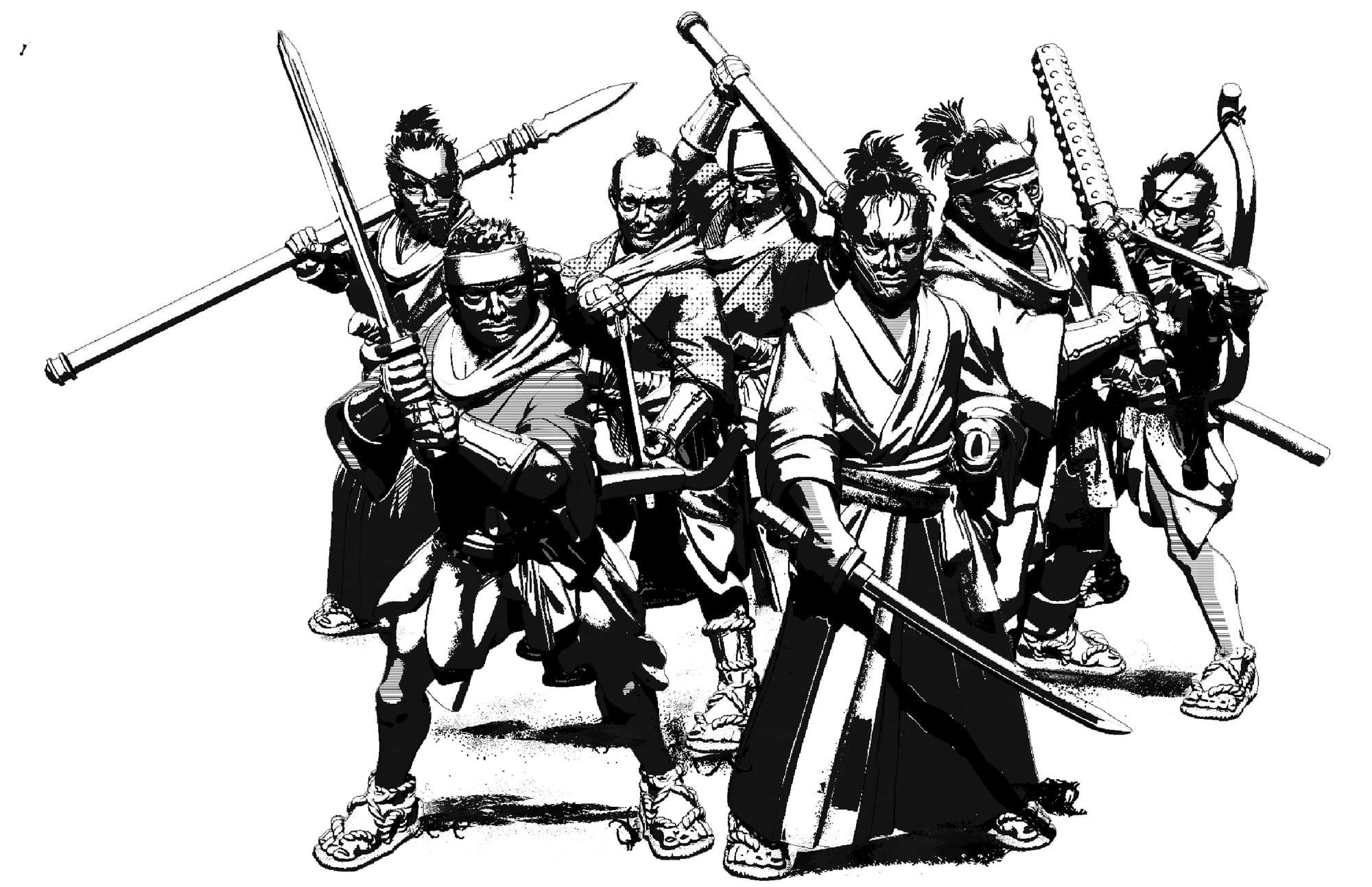
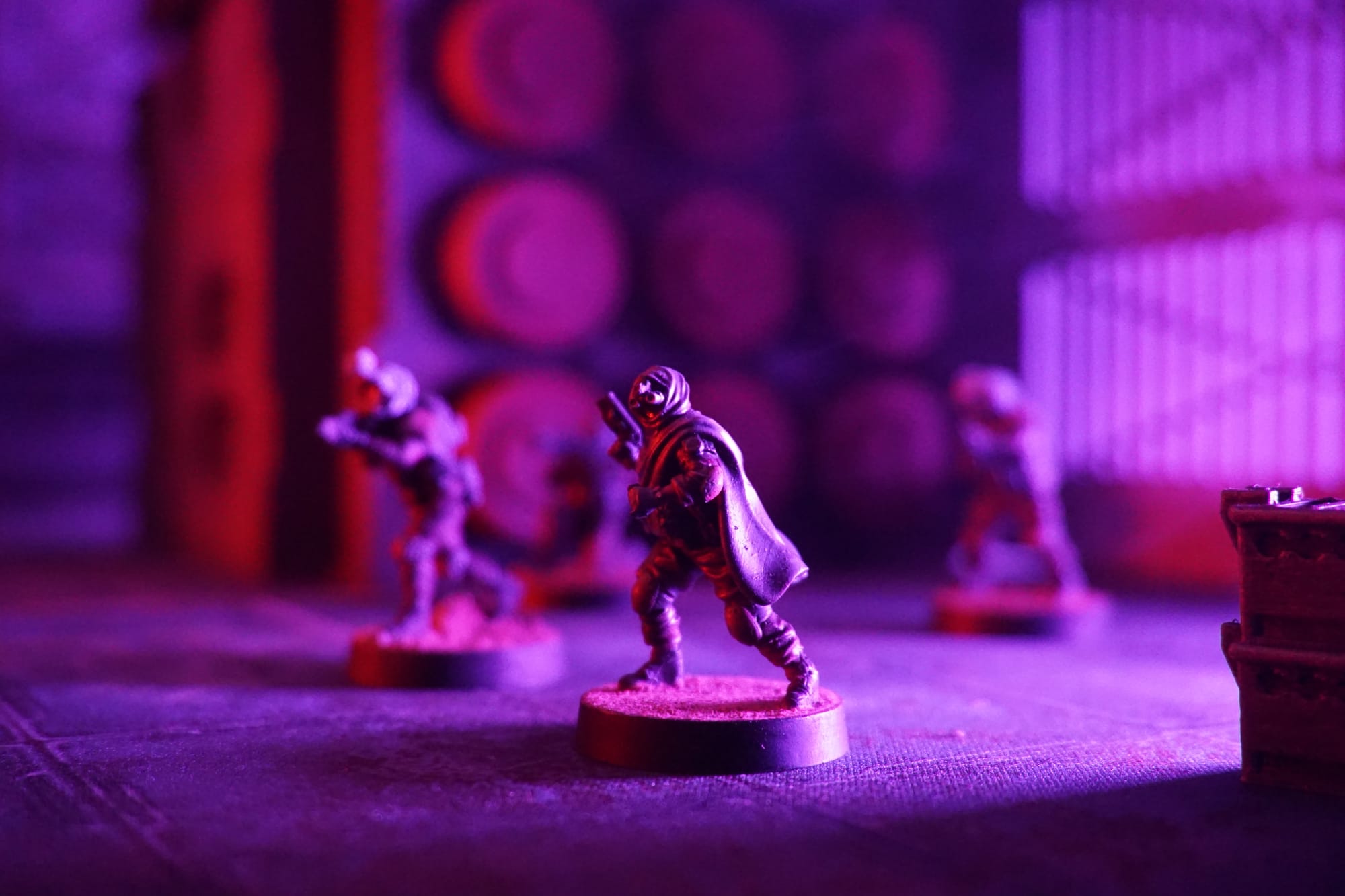
JC: BotN: RONIN is a chanbarra style skirmish game that pits one player operating a single Ronin miniature facing off against another player who takes control of seven outlaw minis, hellbent on cutting down the Ronin. The game plays on a 12”x12” square and was designed to mirror scenes from Yojimbo and samurai champloo.
GT: With all of these games and models you've designed and created, what are you excited to bring to the community, and what are you excited about seeing come out of the community?
JC: Coming from a video gaming design mindset, I inherently think about games differently. Most table top wargames essentially boil down to turn based strategy games. There’s nothing inherently wrong with that, it is a medium based on conversation and observation, and the strategic aspect is inherent to the foundation of the genre. However, the types of games we make on the tabletop also mirror what is in the video gaming space, like with turn-based strategy games, RNG (random number generation) is largely dice based and combat is a largely assumed component.
By contrast, in the video gaming space, there are so many different games that thrive on putting players in different perspectives, like farming simulations, dating games, fighting games, cover shooters, etc. How do those genres interact within the constraints of the physical table top? Oftentimes, it’s easier to abstract those mechanics into a board game. But, since I love minis, when there is a will there is a way. So, largely for me it’s looking at ways to bring unconventional ideas to what ‘The Fundamentals of Tabletop Miniatures Game Design’ terms “non-discrete miniatures” games.
I see a creative space that has been so co-opted by Games Workshop that even those who exist on the periphery of the hobby still rely on the pillars of grim-dark and dakka nostalgia to garner attention. It seems like the media focus on the newest edition of 40k, and which brush is best for painting yet another space marine. All this attention casts a shadow on what miniature gaming could be and pushes us (gamers) away from the huge amount of potential for new types of games and interactions. I think there are a lot more shining lights in the indie sphere than there were a few years ago. To be honest, a non-GW mindset is growing, though still in its infancy, and I’m seeing more and more people in the hobby nurture it. Take a look at Death Ray Designs, Black Site Studio, Buer Games, Planet Smasher Games, Metal King Studios, Electi Studio, Orc the Brand, Malev, Hardware Studios, the list goes on. There are a lot more indie creatives now than there ever have been in the hobby and I'm excited to see them flourish.
GT: How do you balance designing proxy models for various games, like Star Wars Legion, vs. independent creations? Do you find that the community is interested in one over the other? Have you seen a surge in interest in a particular series of models?
JC: It took a long time and a lot of work to get people to trust my aesthetic sensibilities when it comes to original content. For a long time, I was just the Star Wars proxy guy, and, in some respects, I still am. I will never disavow that title but I do know that I personally thrive (business wise) on my own original sculpts, and the games that are derived from them provide way more than any proxy sculpt ever could. I find that now, more than ever, people are more engaged with my original content, and a large part of that is having an actual game published. An actual proof of concept that my ideas have some sort of validity. Being able to show off upcoming games at Adepticon has only garnered more interest in my creative endeavors outside of proxy models.
There is a lot of social clout that is built from making the hot new thing from a game or film, and so I make it a point to use that to my advantage. It brings people in the door, and, hopefully, when they enter, they see a few things they've never seen before but know they want to paint. If they can see I put in the hard work to make their dreams come true, showing them a mini from their favorite film for example, one can only imagine the hard work I can put into an original sculpt or game I’m working on.
GT: What does a day-in-the-life look like for you, with miniature design, Patreon management, game design, etc.?
JC: I would love to say that my time is balanced between all three, but primarily I’m in Zbrush 9-6, then finding time after my children go to bed to manage my patreon and work on writing/designing games.
GT: What’s the hardest part of designing independent games? How do you balance your initial design vs. your changes vs. community feedback for gaming?
JC: Largely, the hardest part is being your own boss and pushing yourself to bring your best efforts to the table. Being both sculptor and designer, I feel there is an inherent need to make the rules as good as sculpts and vice versa. If I’m going to spend a week sculpting a set of terrain for SKATE 28, I have to put in a week of writing to make sure all that terrain is viable rules wise for the game. If I spend a week on a set of Edo era outlaws for BotN RONIN, I sure as hell better make sure they interact well within the game. The worst thing that could happen is to have someone see a cool mini, paint it up, and then not enjoy the context (game) it was created for. That’s wasted effort on their part, and a failure on my end to not deliver the fullest experience.
I’ve found that over the course of designing tabletop games that my initial idea is only 25-30% of what the game will end up being. Firmament was always “Astronauts with guns” But it sat for a long time until the revelation of the vertical tape measure came in, and then I went through three to four versions of how movement and combat work. It wasn’t until I showed the game to Mike Hutchinson (Gas Lands, Hobgoblin, Space Gits) and I detailed my ongoing combat issues when he suggested “what if you just guessed the distances between targets?”
For me, the balance of initial design vs. changes/feedback is heavily, heavily weighted on being willing to listen to feedback. Not all feedback needs to be addressed, however, being willing to listen regardless is very important. After all, I’m not the one playing my game, the audience is.
GT: Who are some artists that inspire you? Digital, physical, musical, etc.
JC: Frank Zappa, Robert Fripp, Steve Reich, the Locust, Genesis, Gentle Giant, Miles Davis, Lighting Bolt, Jorge Luis Borges, Max Ernst, Ashley Wood, Zdzisław Beksiński, Yoji Shinkawa, Amano, Simon Roy, Ron Cobb, Doug Chiang, Moebius.
GT: What recommendations do you have for game designs/digital sculptors who are just starting out?
JC: From the sculpting side of things, here's what I have to say:
Good Vibes Advice: Don’t pretend to be a big studio, and just behave like a solo artist. Show your love for what you make, be earnest, be honest. It is very hard to shine bright right now, especially when 3D printing gets bigger and bigger year after year. However, if you want to sculpt minis, think about what you want to see on the table top, and just make it.
Honest Advice: Tap into the zeitgeist and think about what minis will give you the most exposure. You are not going to make the best Space Marine miniature; the world has enough of those. You cannot put a rifle on a knight and call it ‘Trench Crusade;' you need to have a stronger, foundational concept. Don't get me wrong, Trench Crusade is amazing, but we have enough proxy New Antioch to last three life times. MyMiniFactory is a social media platform with a store, except that you're competing within the 3D printing niche and run the risk of cannibalizing your sales with far too many similar types of minis. A drop of water in the desert is a miracle, a drop of water in a lake is a ripple. If you are looking to do freelance work, know your turnaround time and rates: single minis, squad, large creature/vehicle, everything.
When I’m looking through portfolios, I’m looking for two things: miniature sculpts and genre variety. I do not want to see the fan art statue sculpt you spent four weeks on. I want to see the RPG character you sculpted and printed. You need to print what you sculpt. Not all the time, but enough to gather a foundational understanding of how thin is too thin for fingers and hair, or how far you need to push details on your sculpt so they still look good at 32mm and proper attention to crevasses so that they hold onto paint and washes. A sculpt that looks great on the computer but is virtually unpaintable is still a good sculpt, but it is also a bad miniature.
GT: What's your favorite “guilty pleasure” game - something flawed, but still fun? If you could update it, make it a 2nd edition, what would you do?
JC: I need to be careful not to yuck anyone's yum, but I would redesign Heavy Gear from the ground up in a heart beat. I was introduced to Heavy Gear via the 2 PC games, and similar to the MechWarrior to Battletech pipeline, and I found the tabletop experience not quite as compelling. Now, of course, part of this is the transition from a video game that has to dangle a carrot every 5 minutes to a table top game that requires you to remain tactically attentive for a few hours. But I think Heavy Gear could operate well as a more contained skirmish experience. Each player gets a small fireteam of Gears, no tanks, no aerial vehicles, etc. Pump up the scale to a proper 15mm game so we have a bit more real estate to paint…. and now I have an idea for a new game, haha!
GT: Last, but most importantly, who is your favorite Glup Shitto*
The reptilian protagonist of the music video for Billy Ocean’s 1984 hit “Loverboy.”
GT: Where can people find you, follow you, and support you and buy all of your amazing work?
JC: Follow me on Instagram - @skull_forge_studios
If you join my Patreon, you get roughly 70+ miniatures a month at a price point that confuses all economics majors.
https://www.patreon.com/skullforgestudios
You can also pick up sets and individual miniature .stl files (released after the are on Patreon) at skullforgestudios.gumroad.com
Stay tuned to GamingTrend for more tabletop news, reviews, paint tutorials, and interviews!