Fantasy stories have come a long way since the days of being restricted to simple fairy tales. From the groundbreaking works of Tolkien to more recent notable franchises such as A Song of Ice and Fire or Vox Machina, the genre has continued to evolve while maintaining the familiar elements that captivated readers all those years ago.
Empiria, the new title by David K. Wilson, continues that trend, taking the familiar tropes and elements that readers have come to expect from fantasy stories and adding his own unique spin to create a world that is as dark as it is colorful, as real as it is magical, and as entertaining as it is enthralling. It’s a fun ride, whether you’re a hardcore fantasy lover or someone who just enjoys a good story. Don’t believe me? Read on, fearless adventurer.
*Mild spoilers ahead for Empiria #1-3*
Welcome to Empiria, a fantasy kingdom ruled by a benevolent elven king who unified the land and brought equality to all. Or, at least that’s how the monarchy likes to present it. Beneath the shining visage of a magical utopia cultivated by the ruling elite lies a gritty world in which tensions between races continue to simmer, waiting for the right moment to erupt.
Presenting a more “modern times” take on a fantasy world, Empiria feels like our own. There’s electricity, cars, even cable TV. Of course, being a fantasy story, there’s magic, though that has become less of a rare skill available only to a select few gifted and more of an everyday commodity thanks to a recent development: magic crystals. These allow everyday people to use magic for a variety of things without any training whatsoever. As you can imagine, this stands to create more issues than it solves.
The world is inhabited by several different races: elves, humans, dragons, unicorns, goblins, boar men, dog men, and mermaids, to name a few.
The elves are the ruling class, and as such are given preferential treatment in society. Something the humans of the world are quickly coming to resent, as the two came from the same place and humans served an integral role in securing power for the elves when they first arrived, only to be treated like second-class citizens while receiving endless empty promises. These tensions are only growing stronger in light of the mysterious “gloom” that’s afflicting the land, causing crops to fail and putting many humans out of work. Between this inequality and the ever-growing greed and apathy of King Wilmet, it’s only a matter of time before some kind of revolution sparks, and with magic now obtainable by anyone, it could very quickly get out of hand.
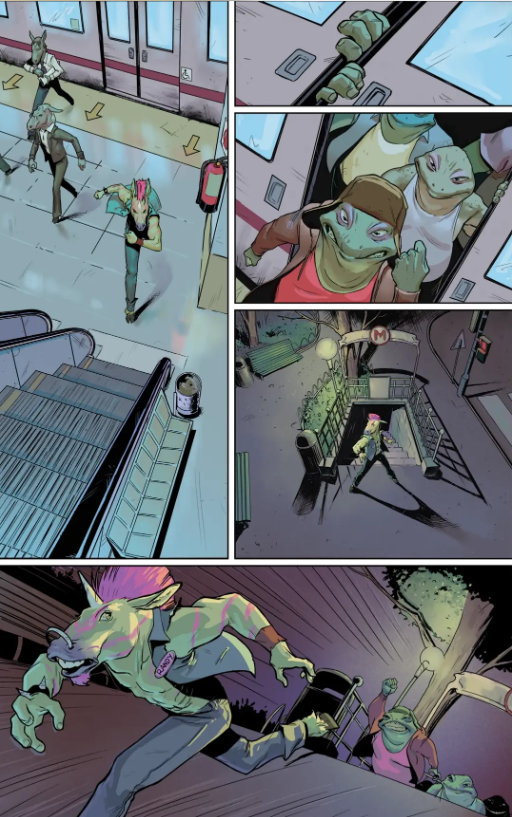
To the north of the elven capital lies the site of the other major racial tensions in the world, that being the dragons and the unicorns. The two groups have hated each other for countless generations, with the dragons having oppressed the unicorns until the elves took power. Now, the two groups live in an uneasy equality, at least as far as the law is concerned. In reality, the dragons (who in this world resemble less flying, fire-breathing lizards and more gigantic, bloated toads) still oppress the unicorns with little (if any) repercussions. At least, as far as legal consequences go, as an unfortunate group of dragons is about to discover following such an incident.
Using tensions between various fantasy races has long been a method of calling out real-world inequality, and this is no exception. If anything, by placing the story in a more modern-feeling world, it actually gets the point across a bit more firmly, if a bit bluntly at times. But then, perhaps such bluntness is needed these days. Regardless, it makes for a compelling set of storylines.
What are the storylines, you ask? Well, let me dive into it.
Hundreds of years have passed since King Wilmet arrived in Empiria, leading an army of elves and humans to conquer it. Since then, he has ruled the land in ways that have served primarily to further his own power and wealth. Sound familiar?
Wilmet has two children: a son, Andor, a fun-loving prince who is fully on board with his father’s goals, and a daughter, Mae, a skilled sorceress who stands in strict opposition to Wilmet’s greed. Of the family, Mae is the only one who sees how wrong things are in their society, something she is very vocal about, much to her family’s growing frustration. She sees the rising tensions and is desperate to find a solution before things escalate.
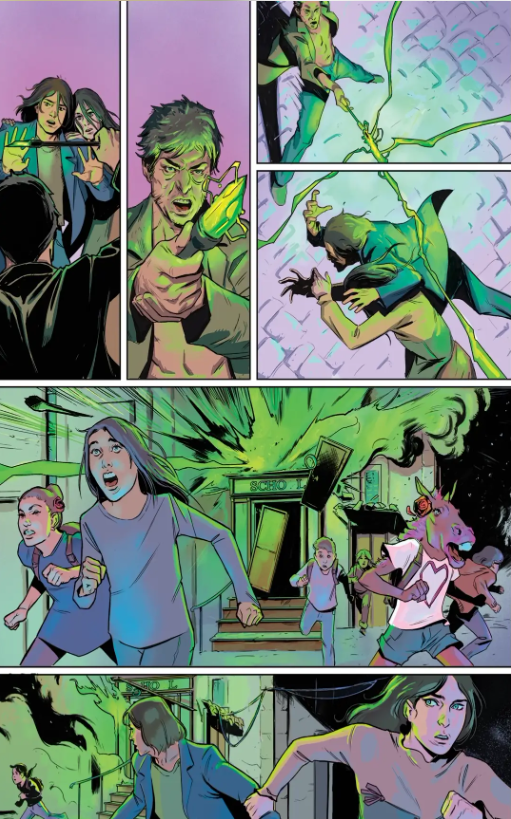
Meanwhile, Justin is a down-on-his-luck human. A farmer until the mysterious gloom settled upon the land, he now spends his days drinking and watching TV, only vaguely aware of the anger growing in his heart. That is, until a human woman named Petra invites him to a gathering that enflames that anger, turning the festering embers into an inferno that screams out for change, no matter what it takes.
Finally, there’s Randy, who is perhaps my favorite of the characters. A “punk rock” unicorn, Randy is part of the first generation of unicorns to be able to keep his horn, something denied to his predecessors, as the dragons would cut them off to gain magic. Randy has a lot of anger towards the world, particularly the dragons, who continue to bully the unicorns despite their supposed equality. Things come to a head for Randy when he finds himself on the wrong side of a gang of younger dragons. I won’t say what exactly happens to him, but it sets Randy on a John Wick-style quest for vengeance against those who so grievously wronged him.
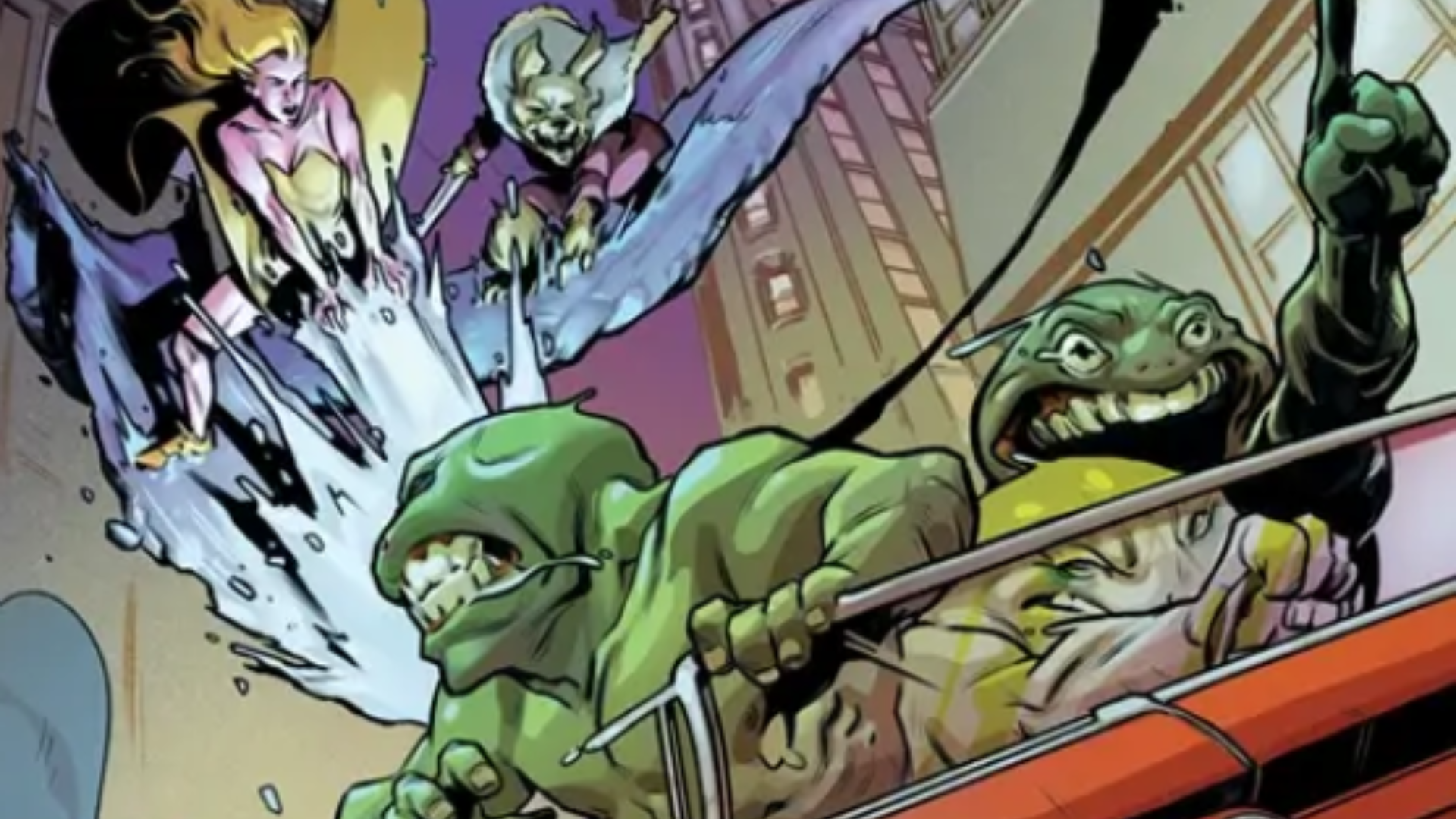
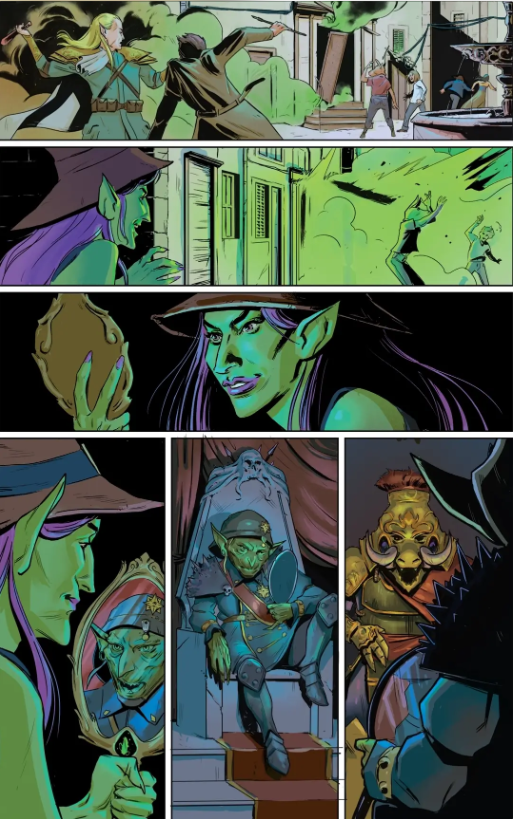
Meanwhile, looming on the horizon is a still-unknown enemy with plans of their own to bring down the monarchy. They’ve already begun to put their plans in motion, working in the shadows to fuel the flames of resentment for the royal family growing in the hearts of much of the populace. We’re still early in the story, so we don’t know much about them yet other than that it appears to be led by a goblin. What’s interesting is the manner in which we see them go about their plans. One major one is through TV broadcasts in which one of their agents (a boar man named Tusker) spreads hateful rhetoric across the land, very reminiscent of modern media. Another appears to be manufactured terrorist attacks, though it remains to be seen if this will be a recurring thing or a standalone incident.
The story feels very promising. It’s fast-paced without feeling rushed, and jumps between the three storylines neatly without feeling abrupt. I’m curious how the three will intersect, though it feels like we’re still a ways off from that.
In addition to the story of the comics, the comic also serves as an RPG, with each issue containing information about the various races and how to play them. This is a cool addition that presents the opportunity for greater immersion into the world than just reading a comic. Especially since the comic stresses that you can implement them into any TTRPG you would like rather than creating a strict TTRPG exclusively for this IP.
Overall, Empiria promises great things and is absolutely worth checking out whether you’re a hardcore fantasy lover, a gamer, or just someone interested in a fun story.
Empiria issues 1-3 are available now from Rocketship Entertainment. Issue 4 will be available October 8, 2026.
Empiria #1-3
Great
Set in a “modern times” fantasy world in which tensions are quickly rising, Empiria offers a fun new take on the fantasy genre that promises to be an exciting ride for hardcore fantasy lovers and casual readers alike. With three compelling storylines and the added option to immerse yourself into the world through a built-in TTRPG, there is a lot to love about it.
Pros
- Modern setting provides an interesting change from most fantasy stories
- Storylines are all compelling
- Opportunity to play the world as a TTPRG
Cons
- None
This review is based on a retail copy provided by the publisher.