The world of Ethera is vast and different. Over the centuries the ordained bloodline of Numa Sera has expanded their empire across the continent. The politics and tactics of ruling such a vast empire are not so black and white, and not all people can easily submit to the rule of another. The knights of Dena Vale are used to the cold and harsh conditions of the mountains and believe in honor and truth. The “cat people” of Meran have built their small kingdom and adapted their abilities to adapt to anything the world throws at them. The clans of the Siaan De’e take what they need and destroy anything that stands in their way. Who will rise up and claim control of Ethera when the war is over? In The Winds of Numa Sera board game, to the victor, goes the spoils.
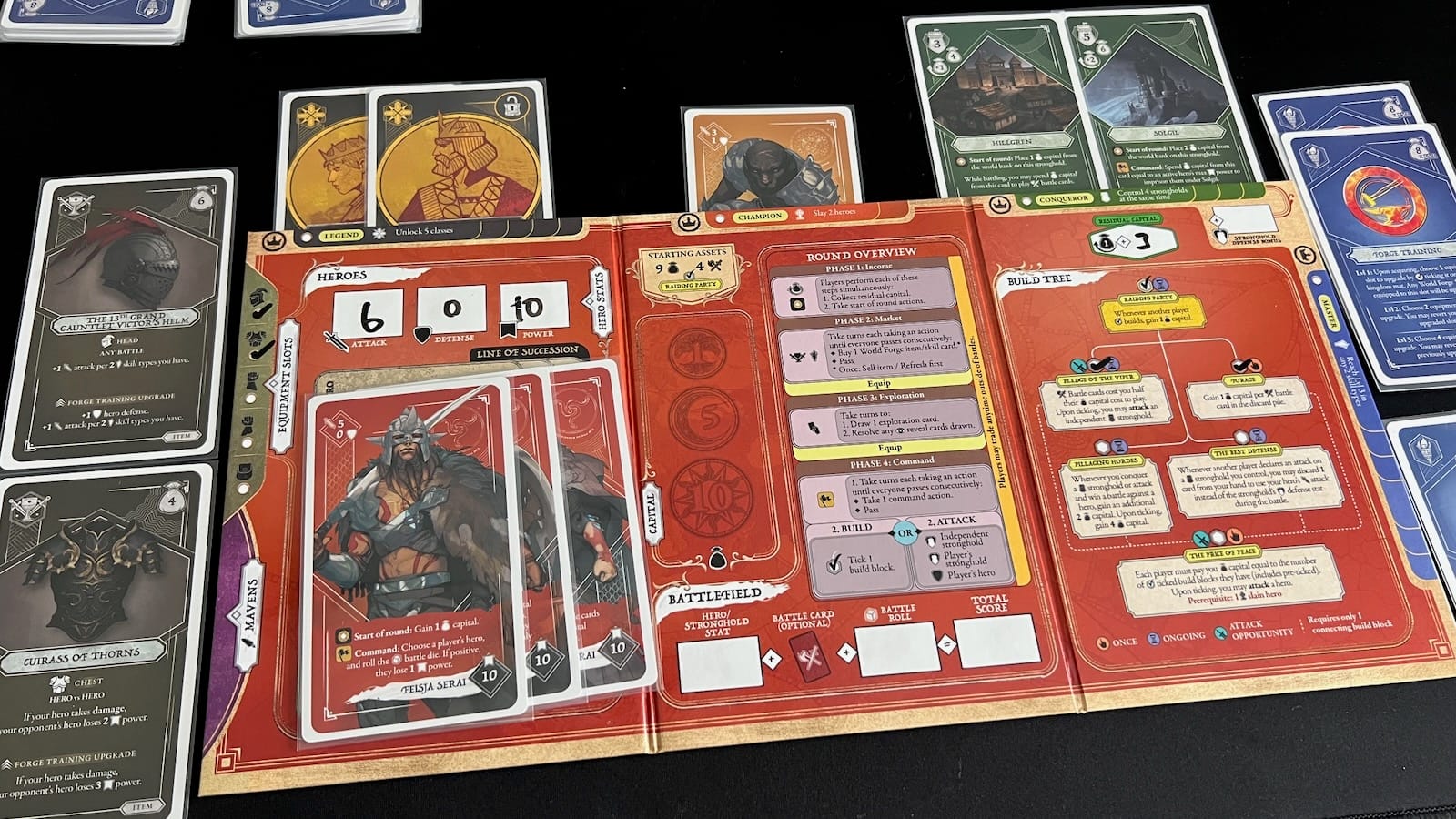
The world of Winds of Numa Sera was introduced in a crowdfunded graphic novel published in June of 2022 by creators Morgan Rosenblum and Jonny Handler. The board game, crowdfunded in 2024 and delivered to backers in late 2025, is now available for retail release. Numa Sera has players controlling one of four kingdoms trying to gain influence over the world. As players exert their kingdom specialties, they will vie for four different win conditions, with the player who reaches two of these conditions first winning the game!
WIN CONDITIONS
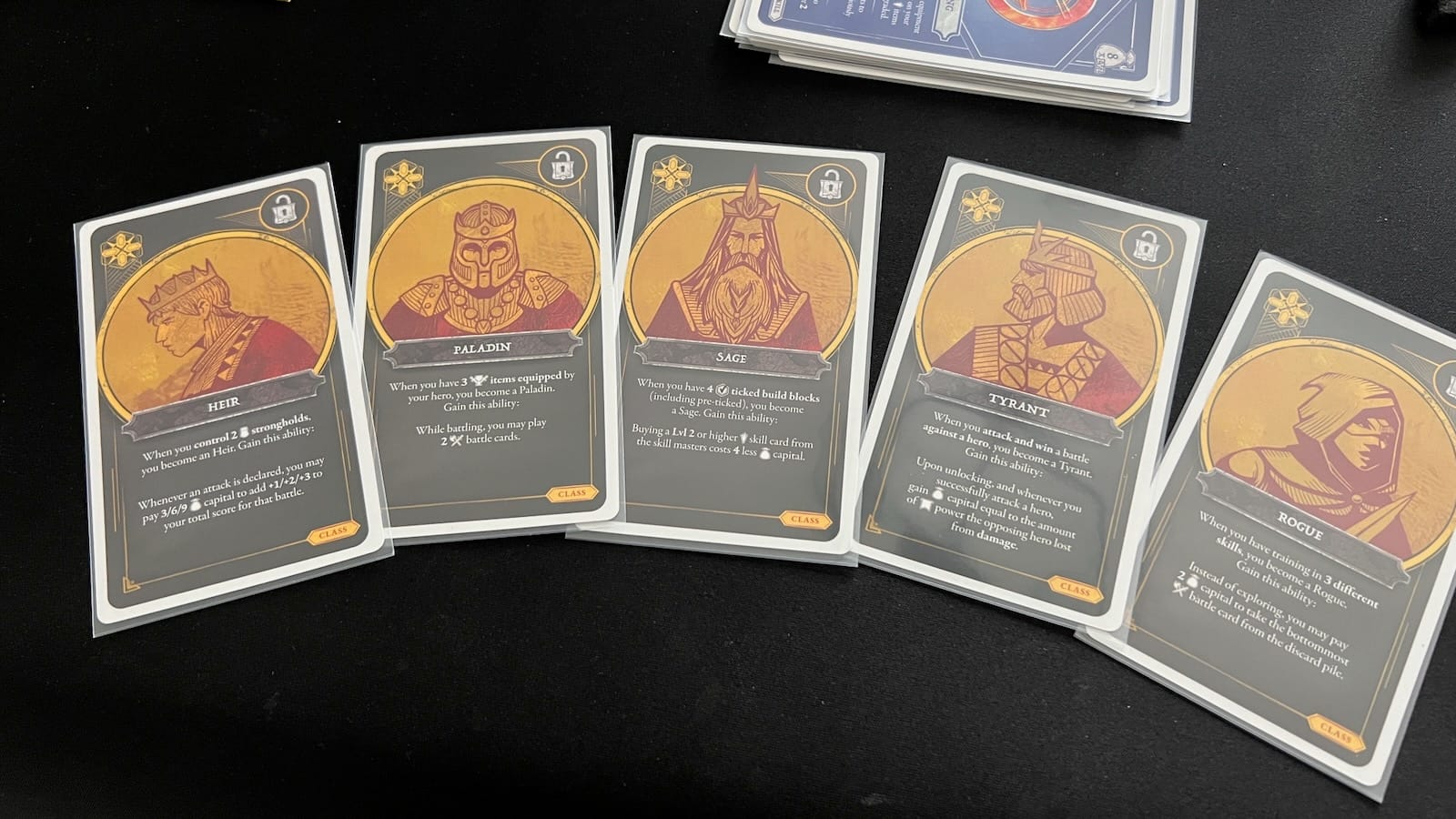
There are four unique win conditions, with players needing to attain two to win the game.
Master Victory: reach level three in two of the five skill types. Players will spend money to acquire skills that give bonus stats to specific actions in the game.
Conqueror Victory: control four strongholds at once. Littered throughout the continent are numerous strongholds. Controlling them helps increase a player’s income and gives them special upgrades throughout the game.
Champion Victory: slay two enemy heroes from one or different players. Heroes can have a big influence on the game’s flow, so taking out an enemy can help level the playing field.
Legend Victory: unlock all five different ruler classes. As players achieve different milestones in the game, they will unlock titles that grant different bonuses in different situations
KINGDOMS
Each of the four kingdoms in the game has its own player board, three unique hero cards, and a specialty geared towards one of the win conditions. Each of the hero cards outlines the specific hero’s attack, defense, and health statistics and an unique ability tailored to the clan’s preferred strategy. At the beginning of the game, players will choose a line of succession for their heroes. If one is killed, the new one steps up and takes its place.
Each player board has the player’s starting resources and a unique upgrade tree that helps players throughout the game. When unlocked, these trees provide one time, ongoing, and repeatable upgrades.
NUMA SERA
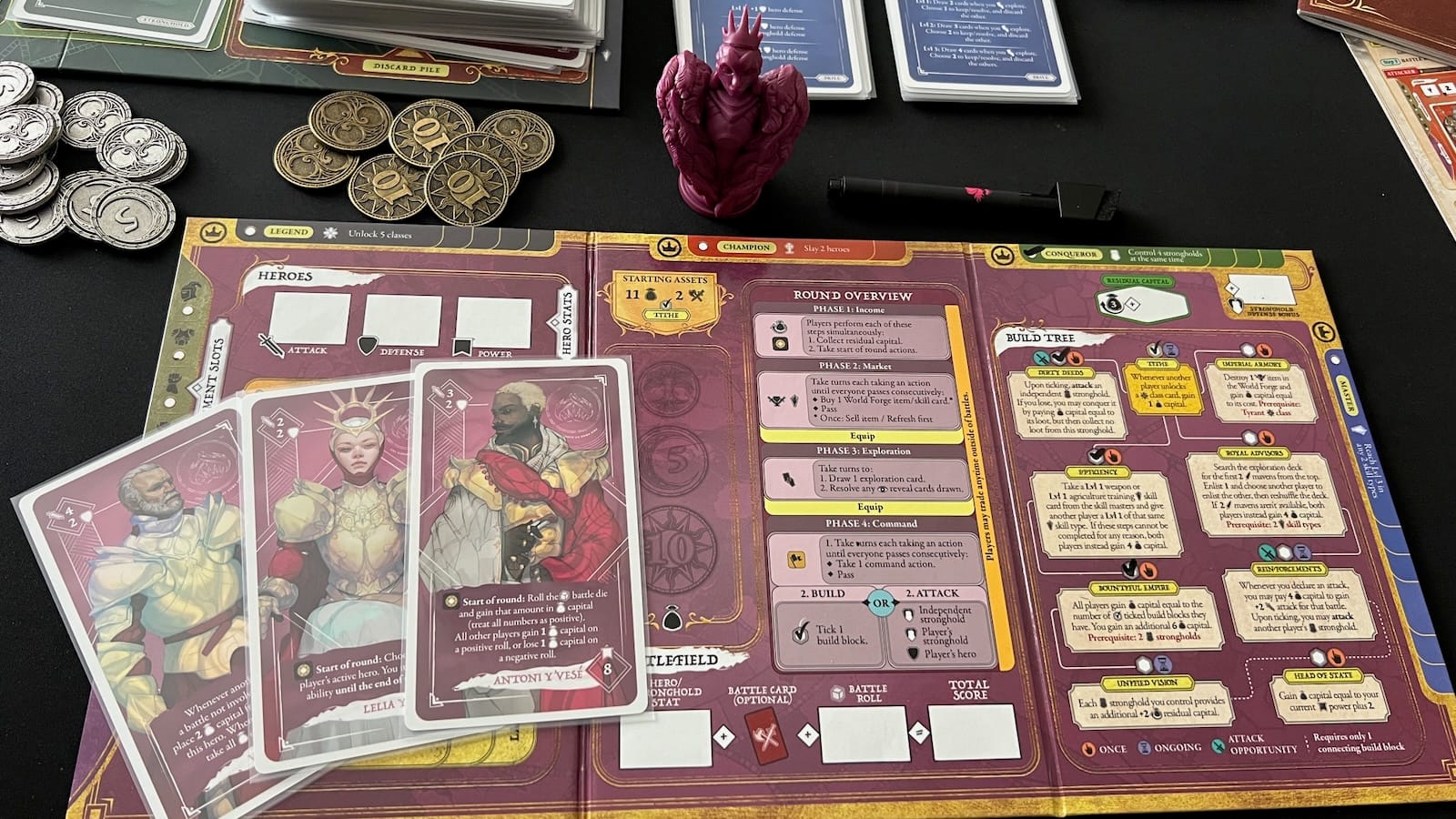
The Numa Serans are the ruling empire of the continent and occupy the far east of the continent. They can amass capital quickly, gearing them towards the Master Victory, which requires the purchasing of highly priced skill cards.
MERAN
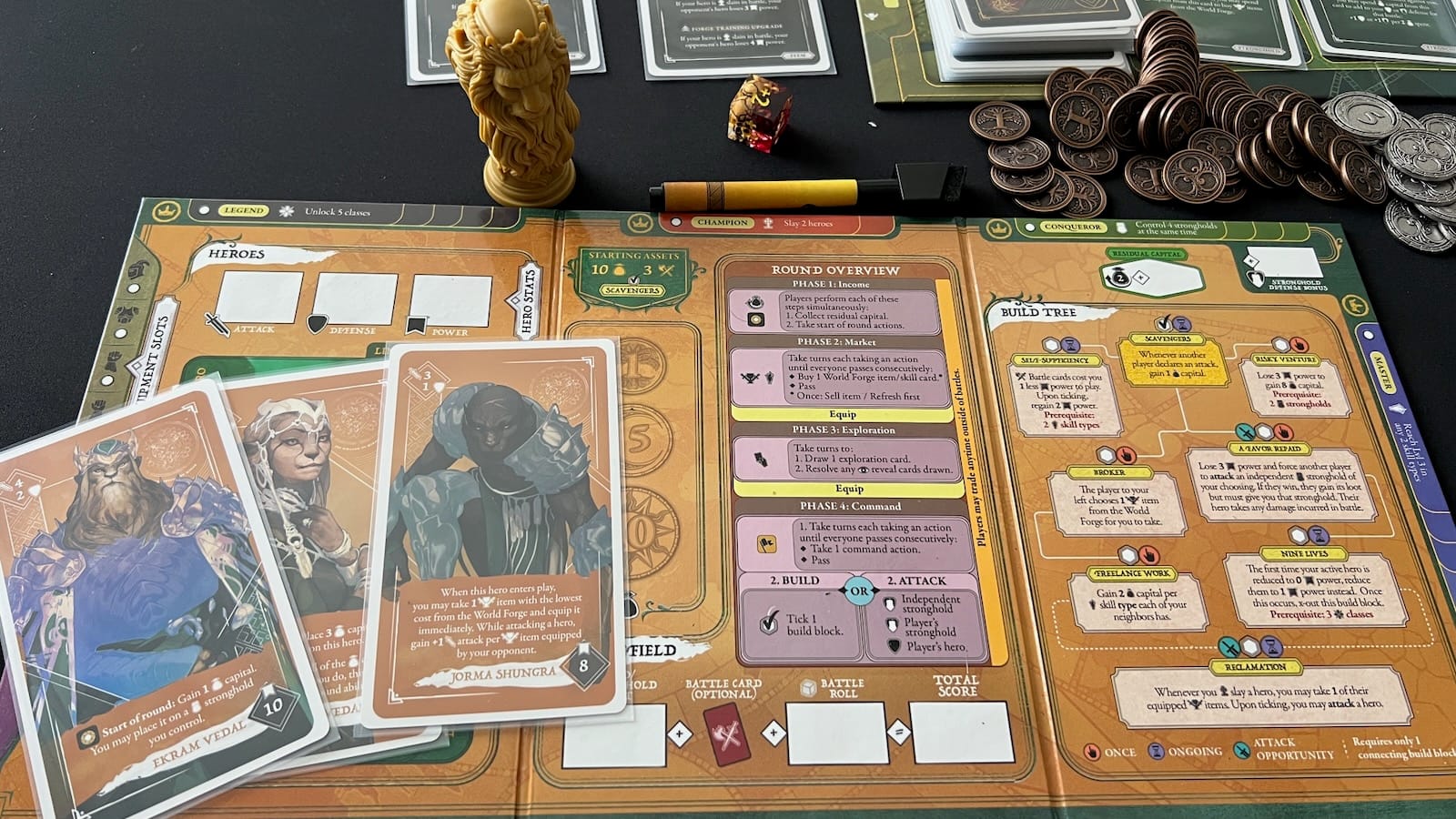
The cat people of Meran are adept at many different skills and can use the actions of others for their benefit. This makes them geared toward the Legend victory as they can dabble in many different areas.
SIAA DE’E
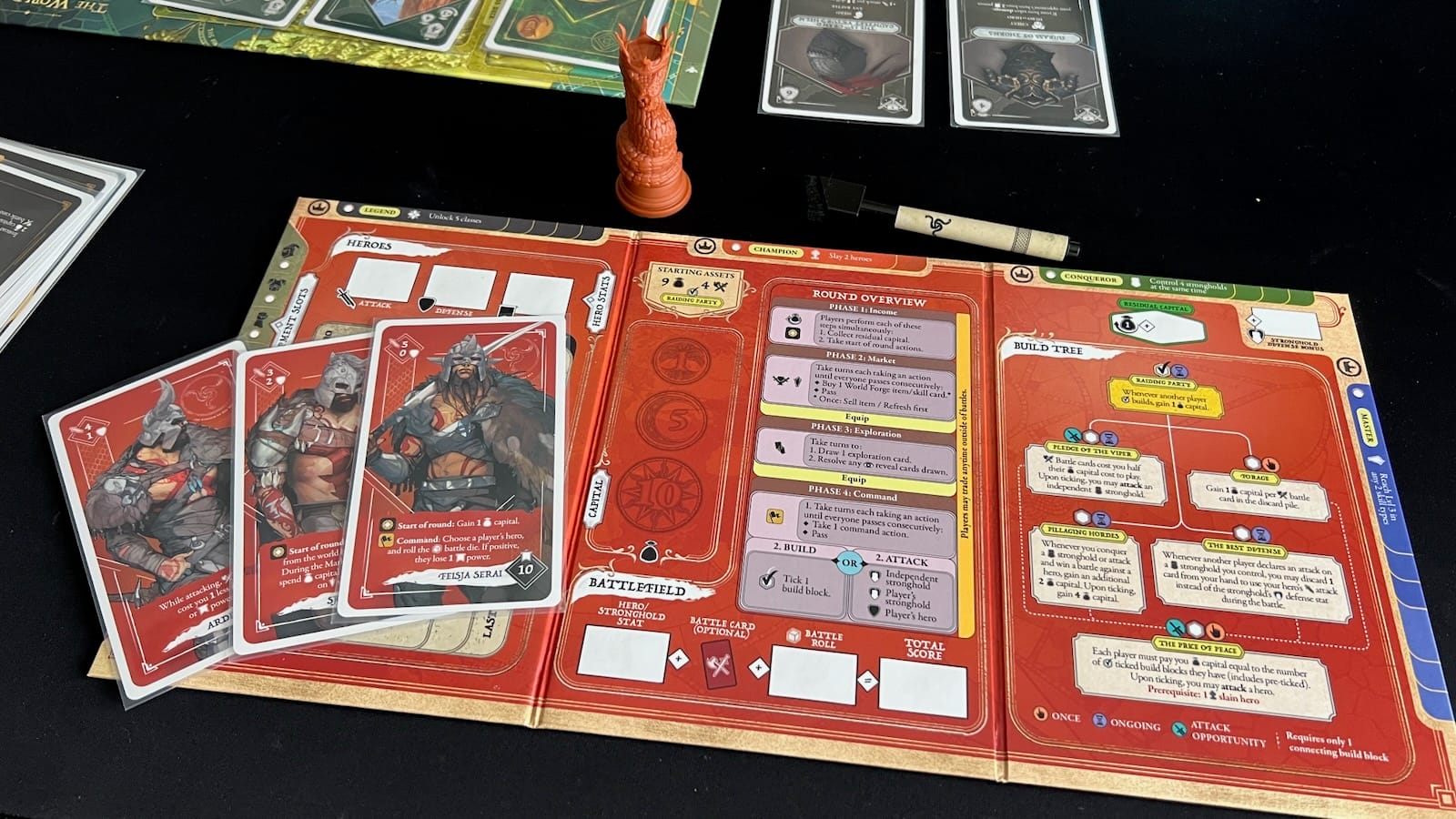
The barbarians of Siaa De’e are brutal and aggressive making them suited for the Champion Victory. Their ability to get battle cards out easily and incentives for attacking make them a very offensive faction.
DENA VALE
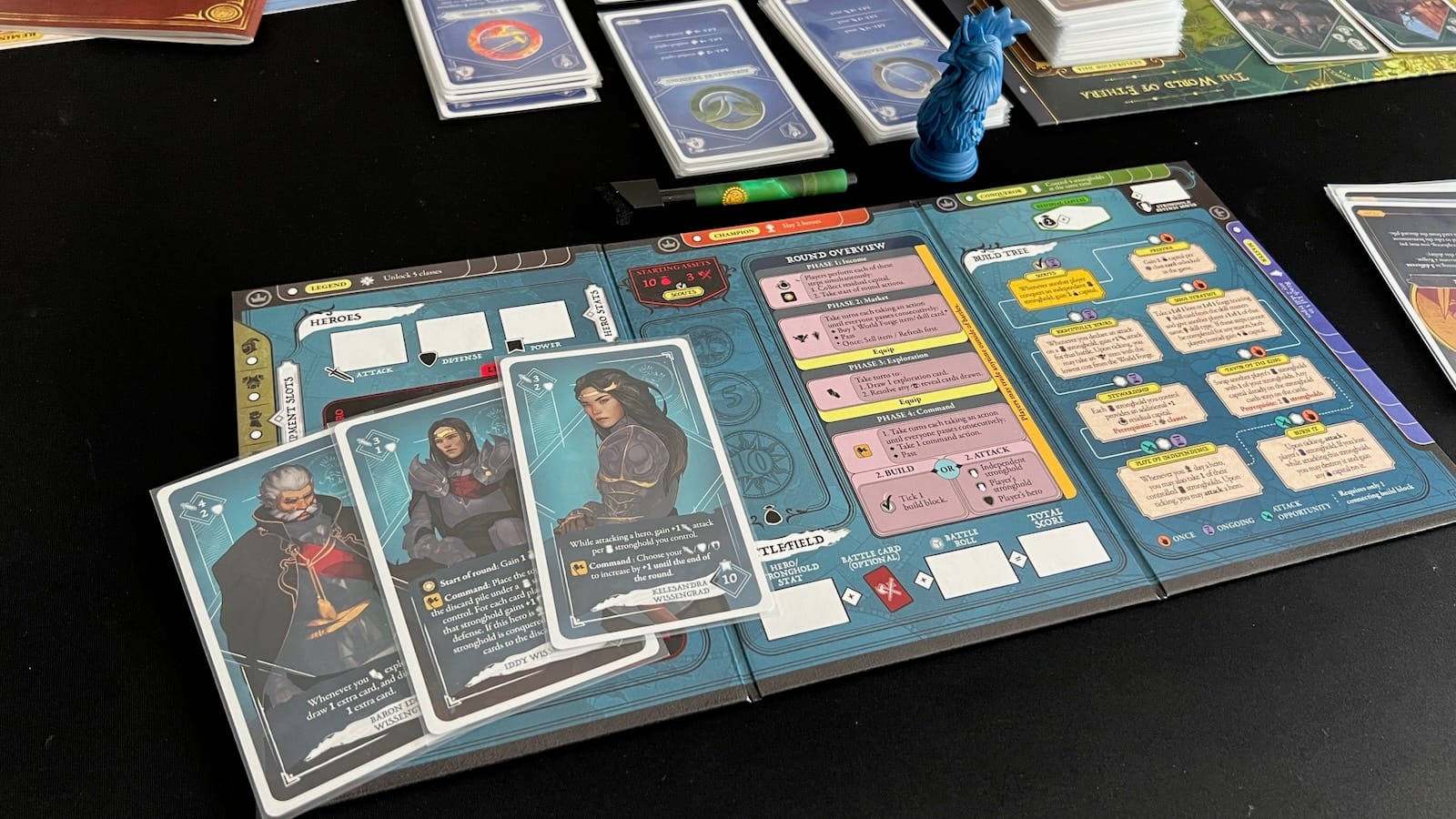
Tough and hardy knights of the North, Dena Valeans are good at taking strongholds and defending them, making them suited for the Conqueror Victory.
THE GAME
The game progresses, player to player, in a series of rounds until someone has met the victory condition limit.
Phase I - Income
In the first phase, players will earn their accrued residual income and activate any start of round bonuses from icons on their cards simultaneously.
Phase II - Market
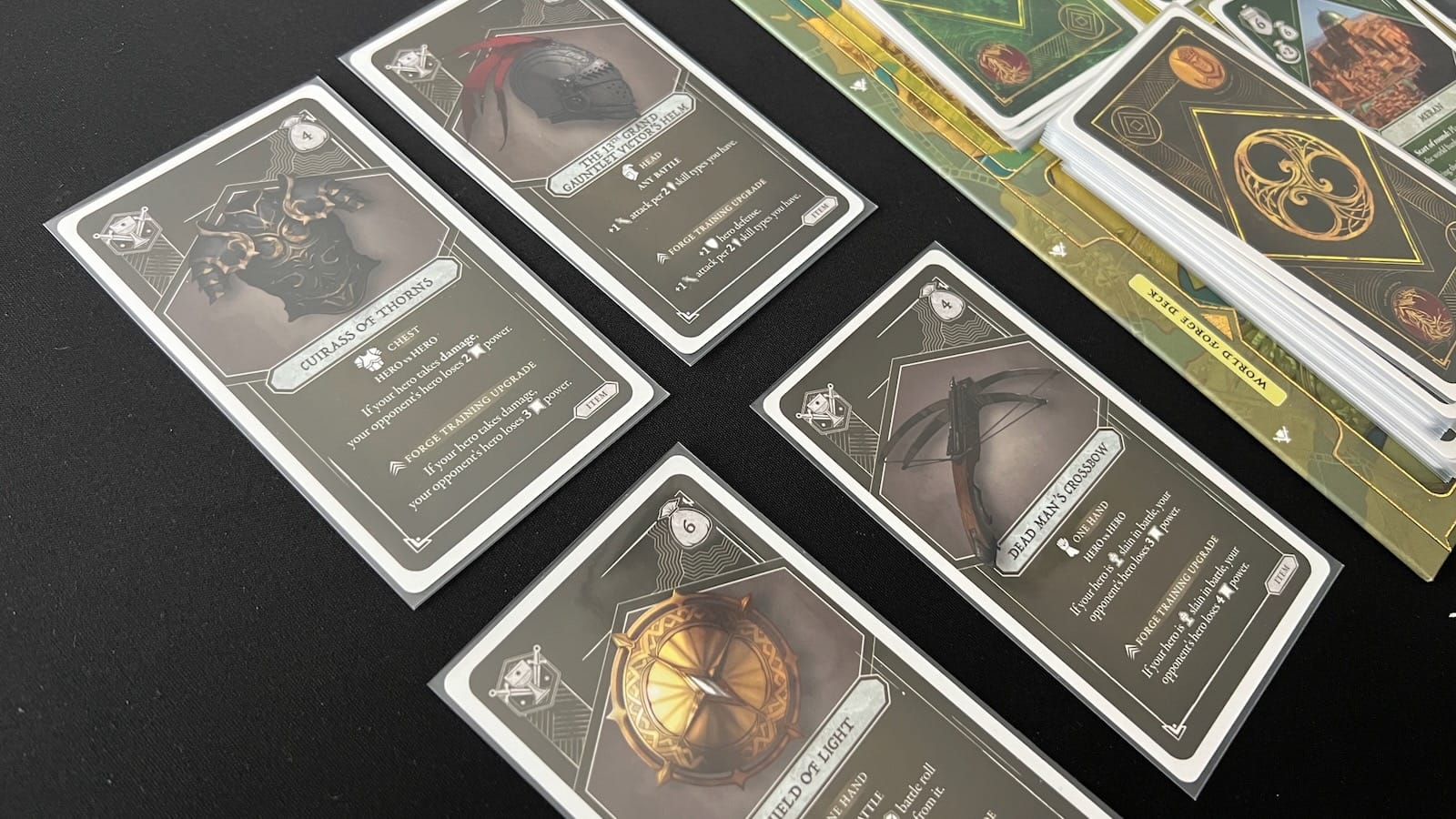
In this phase, players can either buy from one of the two markets or pass. The World Forge Market offers up different items that you can buy and into your hand of cards. Items often boost abilities needed in different phases of the game. Players can alternatively purchase skill cards from one of the five skill colleges. Each skill college offers three levels of upgrades to your player’s abilities. A card costs ten capital per level, making a Level I card 10 capital and a Level III card 30 capital to purchase. Players can also sell one non-mythic item before purchasing for half of its cost. Players also have the ability to swap out gear by equipping items stored in their hand between Phases II and III and III and IV.
Trading is another element of the game that allows items, money and skills to pass around the table and can happen at any time. Immediate trades are binding but any trades for future promises always have a chance to be broken.
Phase III – Explore
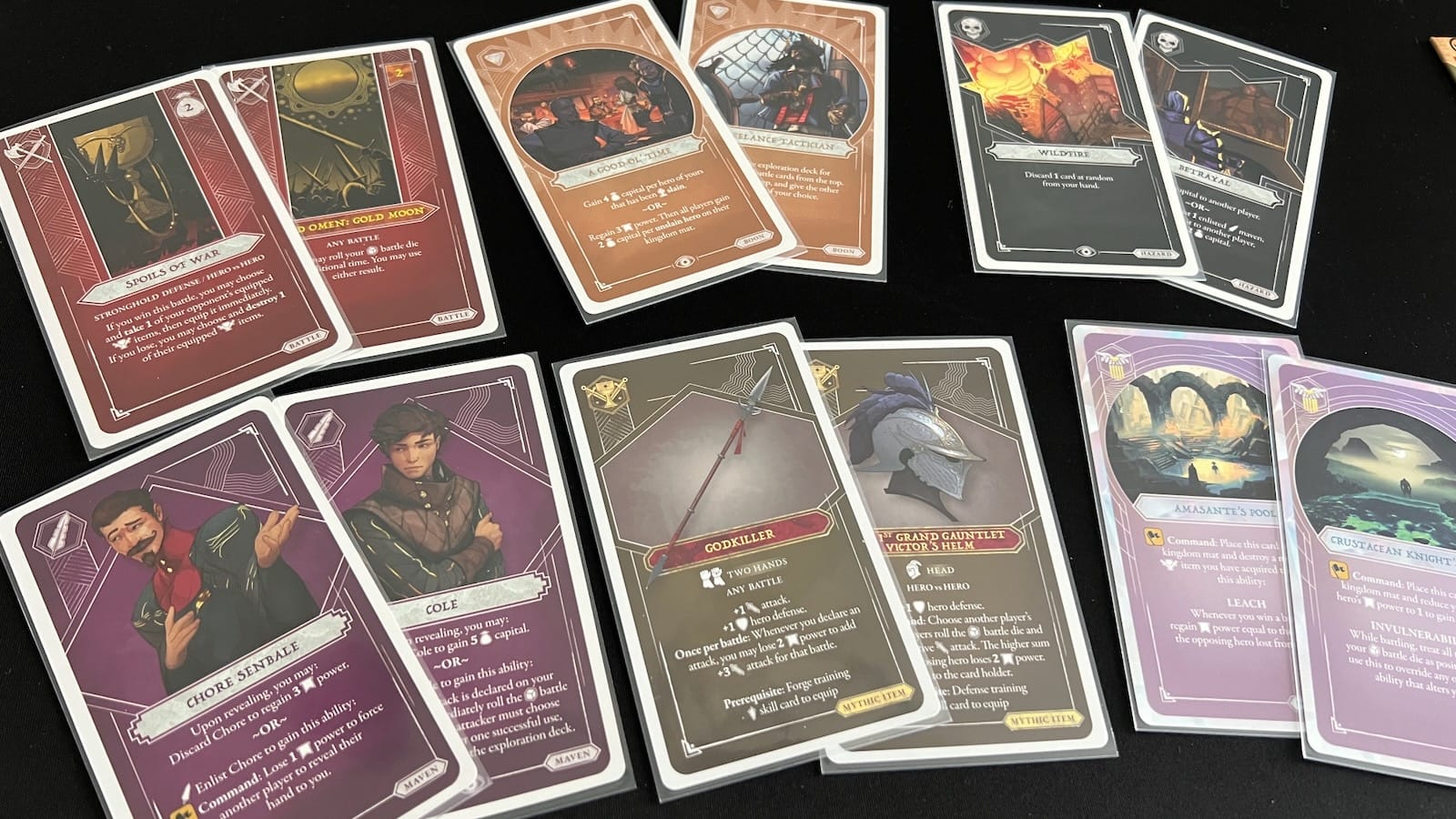
During this phase, players draw a card, in turn order, from the exploration deck. In this deck, players will encounter a number of different cards that can be kept secret and added to a players hand or must be revealed to all players if an eye symbol is located at the bottom.
Boon Cards: These cards are revealed to give players a choice between two positive options. Usually, a player can be selfish for a smaller reward or choose a bigger reward that helps other players as well.
Hazard Cards: These cards are revealed and show some of the negative effects of exploring the land. Effects included losing power or health, discarding cards, or losing equipment or skills.
Maven Cards: These revealed cards are advisors and experts that can help a kingdom with special abilities. Players are given a one-time bonus or can choose to keep up to three mavens for an ongoing boost.
Battle Cards: These cards are kept in player hands and can be used to different effect in battles initiated in phase 2 of a player turn. They will cost capital, or money, or power to play in battle.
Mythic Items: A few mythical items are littered throughout the deck that can be equipped if a player has a prerequisite skill.
Pool of Essence Cards: These mythical bodies of energy test players to gain their bounties. If a player passes the test, their current hero is blessed with a special ability that lasts until the hero is defeated. Your new hero must pass the test in order to gain the pool’s abilities.
Phase IV – Command
This phase is broken into two parts. The first part allows players to take a command action from one of their cards or pass. These command actions usually come from one their face up heroes or one of the strongholds. Play will keep moving from player to player until everyone has passed.
Players have a choice when entering part two of the command phase to build or attack, and it can be a tough choice as you progress through the game.
Build
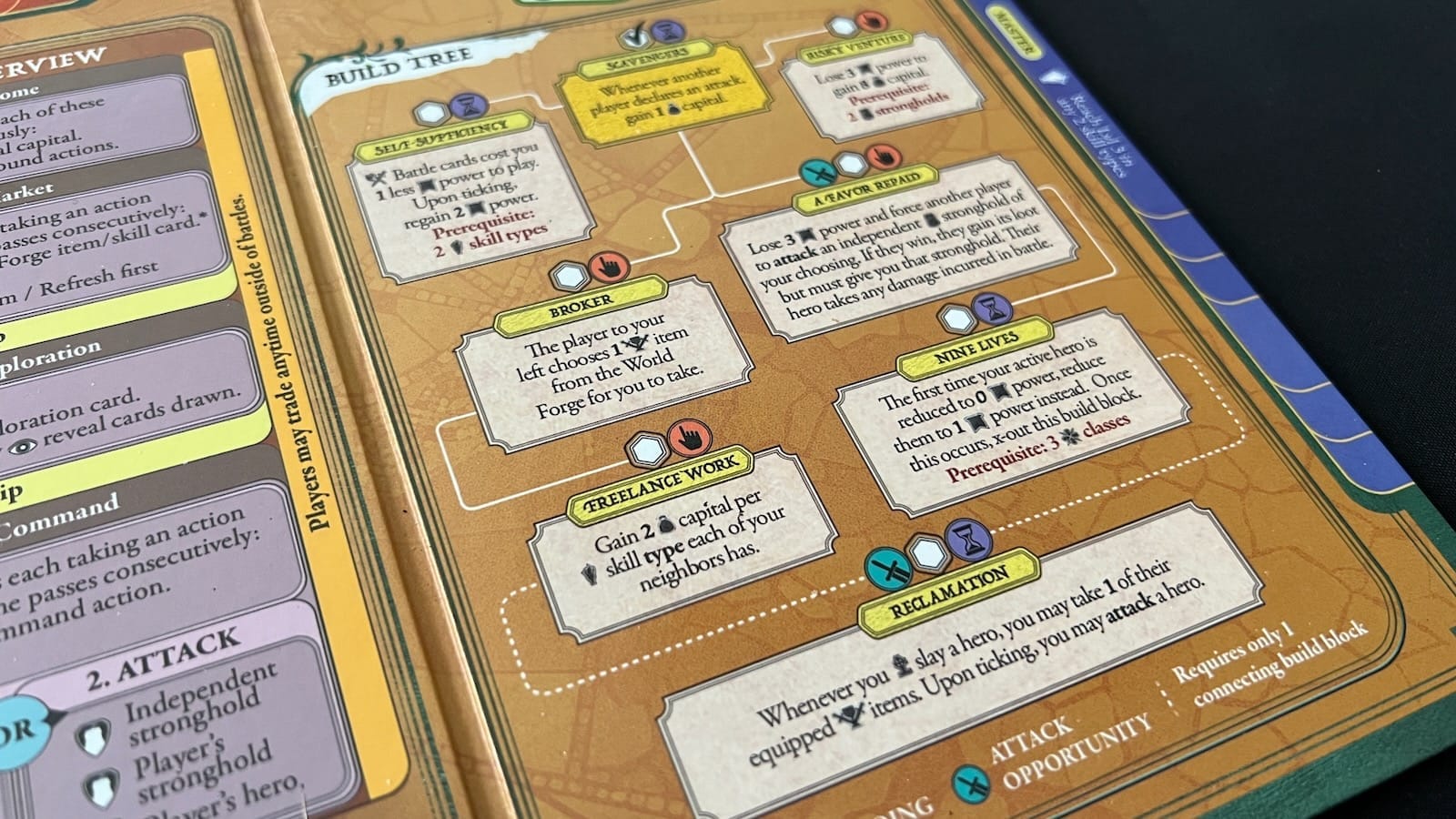
When building, the player will mark off the next block of a their individual tree. Players must follow the flow of the tree from top to bottom, having previous boxes checked before they can check off a lower box. These blocks may give ongoing or immediate bonuses, and can also trigger an attack.
Attacking
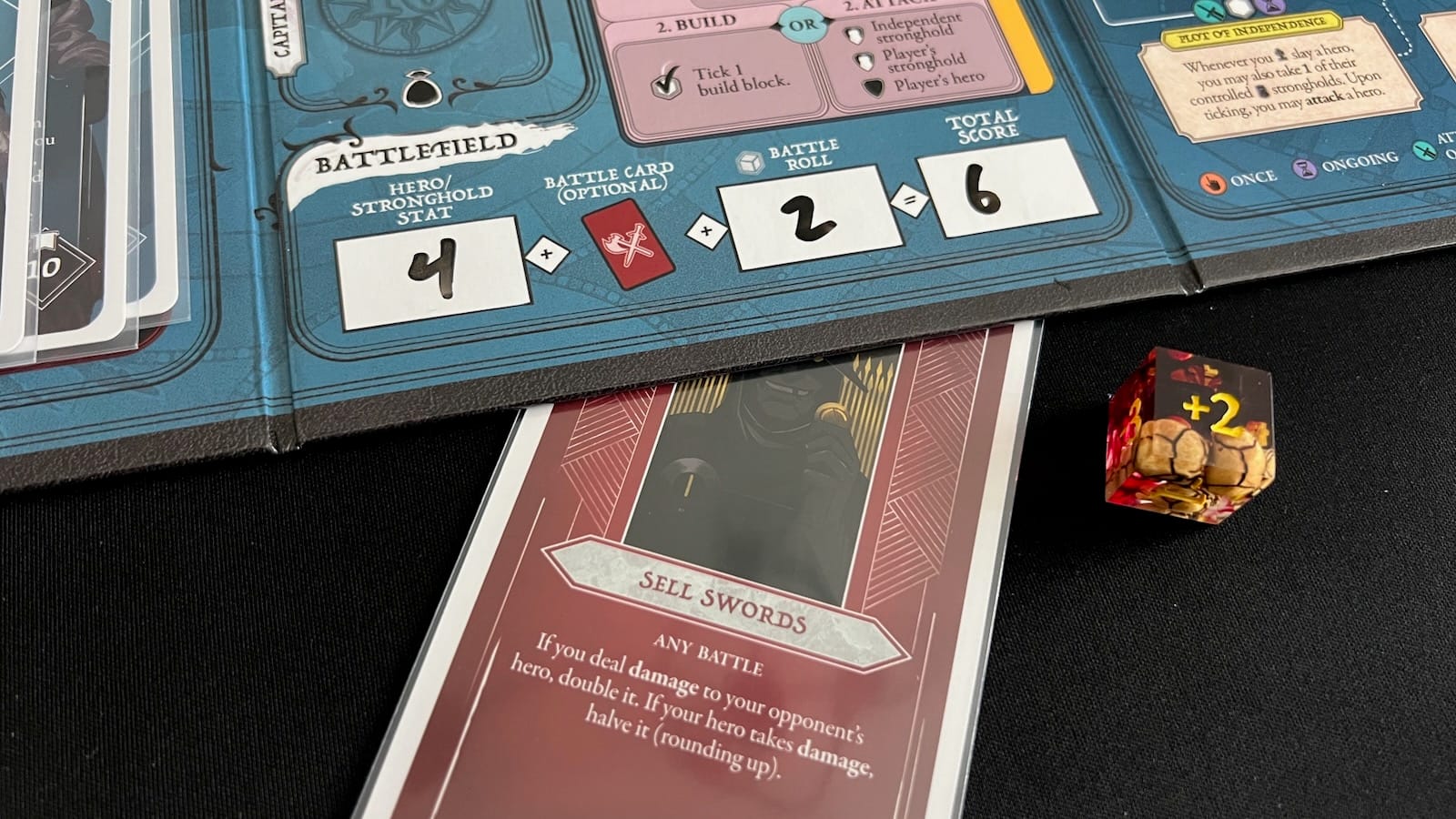
When taking an attack action, players can target one of three things
Independent Strongholds: These strongholds are located on the main world board and represent unconquered strongholds. Each stronghold has a defense stat that players must overcome. If a player successfully conquers a stronghold, they will gain a capital reward from the bank and increase their residual income capital score.
Player Heroes: Players will target a hero from another kingdom. If they can reduce that hero’s power down to zero by the end of the battle, they will claim the hero’s card toward their Champion Victory goal.
Player Strongholds: Similar to Player and Independent battles, players try to take control of strongholds from another player. Winning another player’s stronghold gives them any capital on the card and control.
A battle takes place over four steps. First, the player determines their battlefield and what they are attacking. Players will determine their hero or stronghold stat depending on if they are attacking or defending in the battle and place the value in the designated box on their player board. Attacking players, and defending players if a hero or player stronghold joins the battle, can then play one battle card from their hand face down to their board. Players will reveal their cards at the same time to determine any battle effects. Step three has each player rolling a battle die with different positive and negative values. Players will determine if any of their abilities affect the dice roll and write their die value in the second battle box. The last step is to determine their total battle score. Attackers will win if their total score is larger than their target’s defense score. Defending heroes will take damage equal to the difference in these scores, and strongholds will be conquered by the attacker. If the defender wins, the attacker will take damage. Ties will always go to the attacker
Players will continue taking turns, exerting their abilities, collecting skills and items, and determining the best strategy forward until a player hits the two victory conditions to win the game.
Final Prototype Thoughts
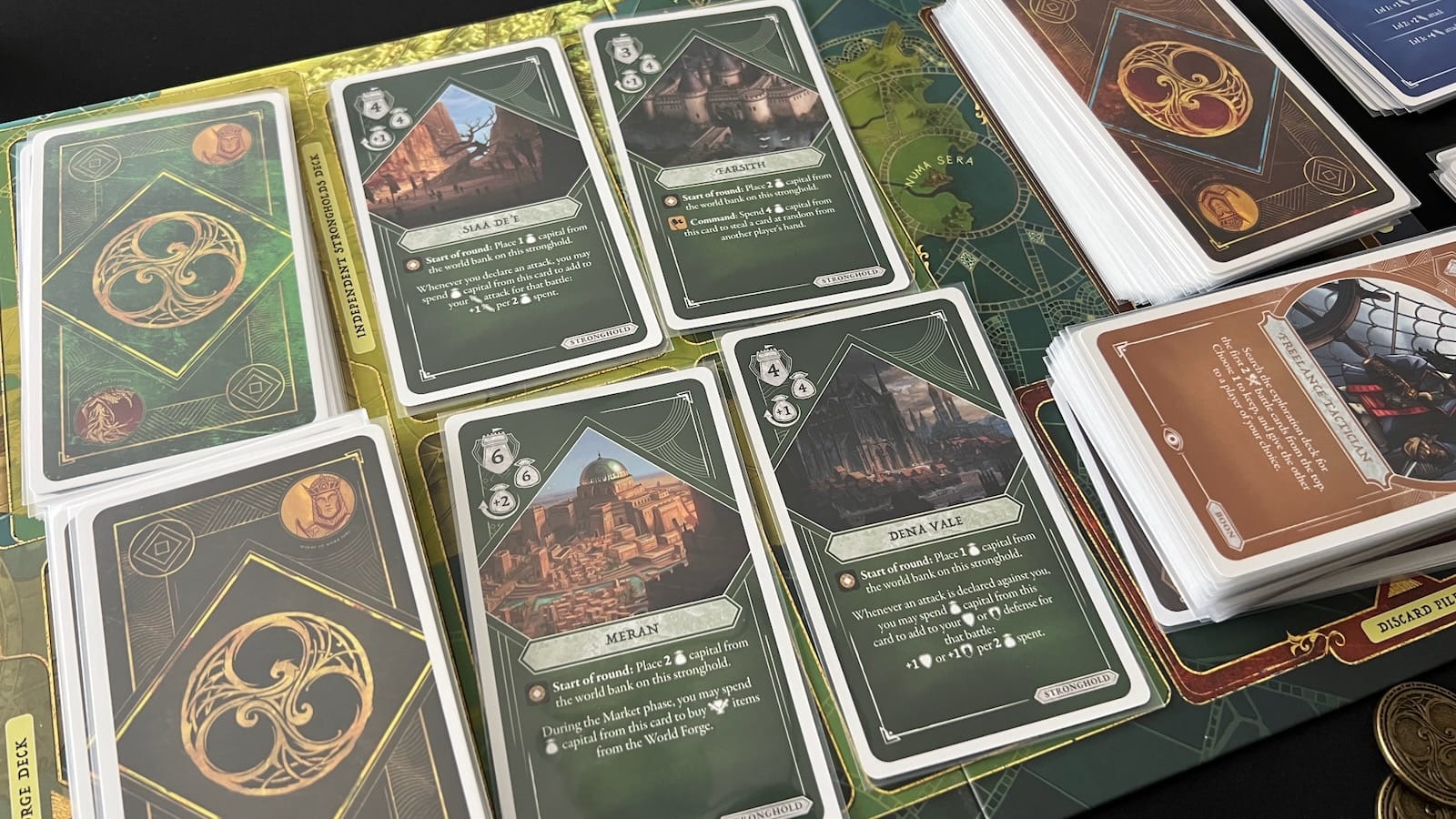
We were able to play a deluxe version of the game, and I have to say, the production quality is fantastic. Having a graphic novel that is designed to be a visual medium as the jumping off point makes the transition to the design of the game much easier. The artwork throughout is vibrant and full of depth. The cards being different colors allow for easy clean up and sorting throughout the game. The flavor text on the cards helps draw you into the story, even if you haven’t read the graphic novel. If you have read the graphic novel, you can see some of the touches that the designers took to make the heroes match their personalities in the graphic novel. For example, Lelia, the empress of Numa Sera, gets stronger as she builds her tree mirroring her growth in the graphic novel.
The player and world board designs are fantastic as well. Everything in this game has a home. The individual player boards walk players through the turn structure and are uniquely designed for each kingdom in the game. The finish that allows players to use the dry erase markers to keep live stats throughout the game is a excellent touch as well. The dry erase mechanics are functional and help reduce other counters that would be needed to track power and health stats. Each of the build trees is very well balanced to the kingdom it represents. Numa Sera builds up their economy and gains capital in a variety of different ways. Dena Vale will build up its strength based on the strongholds they control.
The gameplay is highly interactive and only gets better the more players you add to the game. Both the two and four player games gave great experiences and great moments, but the game truly shines at four. With two players, you don’t really have the option to use the trade action because you don’t want to give your sole opponent something they want. At four players, gaining a temporary ally against another opponent opens more opportunities to advance your own kingdom. Our four player match up was played with a few other GamingTrend writers and we all left the table with smiles on our faces. Throughout the game, we were engaged with what was going down between two other kingdoms to determine if the outcome of a battle or a trade would affect our own turns. We laughed at crazy combos of battle cards and dice rolls, and all enjoyed when a combination of equipped items took out the attacker on his deathbed. We all loved the multiple paths to victory and never really feeling out of the game. All of us were ready to trade kingdoms and start another game after the first play through.
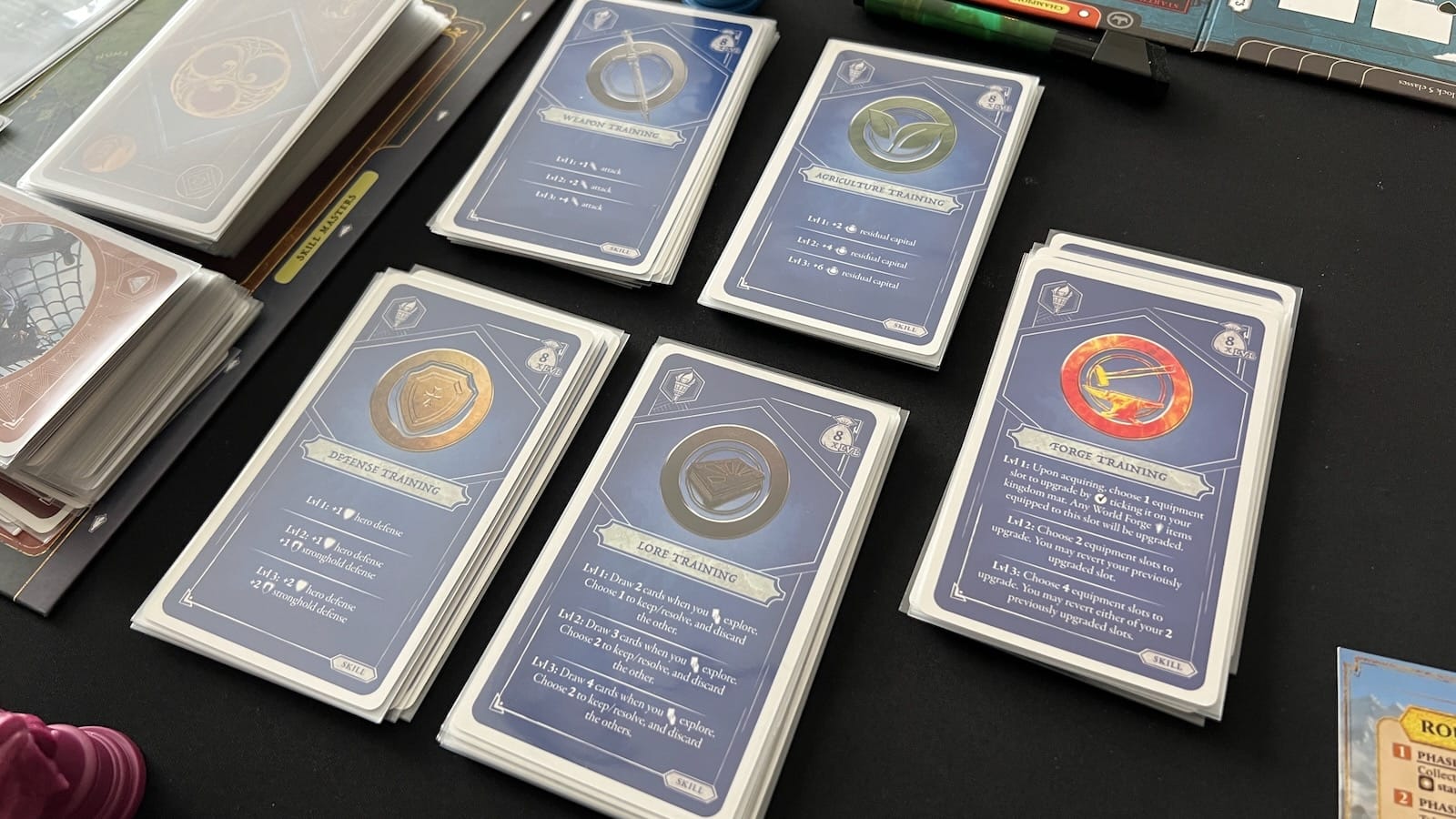
The one downside to this game is that it needs some space! Having large cards placed around the player board and the edges of the world board mean you need some playing room. My two player games took up a large portion of the table, and the four player game needs to be spread down a long table. Some of the cards will be able to be hidden under the boards more as you memorize the abilities in future plays, but for new players and most needing to scan cards for abilities constantly, it’s definitely a hog. One other small thing would be making sure all mechanics scale to player count. Currently, skill college cards are limited by player count, but this may need to be applied to strongholds available as well. Finding some ways for players to interact with a non-player trader in the land could also bring some more functionality to the 2–player game.
I was able to sit down and chat with Morgan Rosenblum, co-creator of the graphic novel and the game, and hear a little about the design process of the game. As graphic artists, they started with art and wanted to make sure the game looked beautiful, which they definitely achieved. Like many games, this game went through many different iterations and play tests, but the game was also critiqued and molded by the community of fans of the project and long-time board gamers. The designers used multiple feedback loops for each iteration of the game, preserving the parts that players loved and taking the rough patches back to the drawing board. Over time, the design evolved from a straight player elimination game into the immersive and thematic multiple win condition game that it is today.
A Second Look after retail
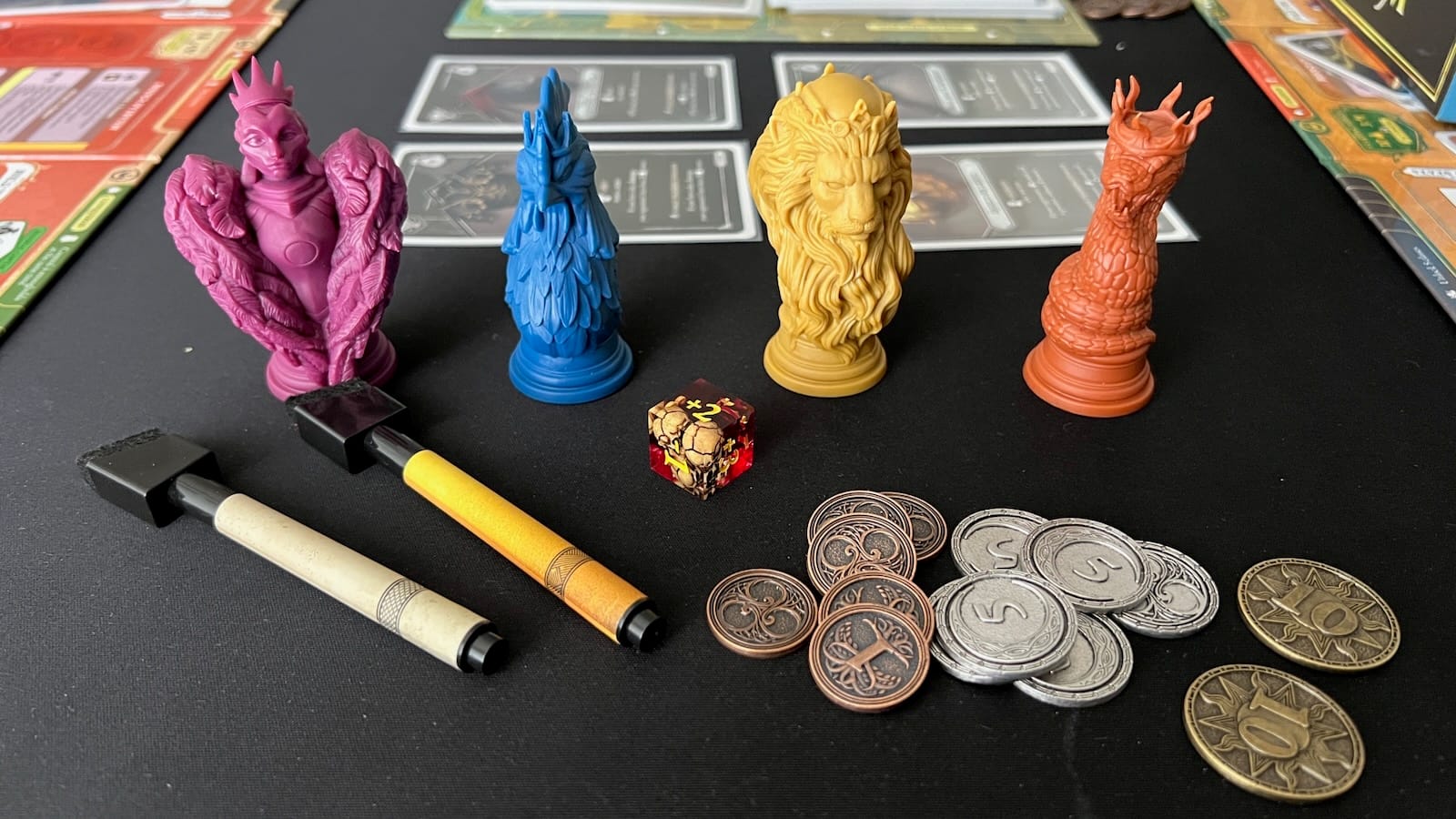
When I first got Winds of Numa Sera to the table, I was able to check out an almost completed prototype copy before the publisher's crowdfunding campaign. As a fan the first go around, I went ahead and backed my own copy of the game. Almost two years after my initial experience with the game, it still holds up to my initial reactions.
For any game, the path to final publishing is a constant cycle of play-throughs and feedback. Two of the biggest, but welcome changes came in the tightening and shifting of the player boards and the rule book. The rule book dropped multiple game modes requiring different numbers of win conditions. The game also dropped the "2-player" reference from the box because any players of the game know that you need at least three to fully get the player interaction needed. The rules also clarify the game phases, which are neatly shown on the updated boards. Player boards have also been shifted a bit for better functionality. Hero stats are now displayed above the active hero, and the battle tracker has been shifted to the bottom of the boards. The build trees have also been tweaked, with some adding a bonus attack action when activated. The player boards have also moved all card collections to three edges of the player board so the board isn't surrounded on all sides.
I've also been able to get the game to the table a few times with both veteran and rookie players of the game. The veterans agree that the game hits on all levels. The interactions between players is fantastic, and the more you know the game, the more you can lean into the table talk, trading, and conspiring against other players. Working your allies can benefit you against a common foe, but also come back to bite you if not taking care of your own interests. The rookie team loved their experience but noted that they learned a lot for their next game after their first play. Things you learn from actually getting into the intertwining nuances of the different factions and phases of the game are necessary to go up against those who have played a few times. Knowing when and what to upgrade and when to attack are bits that come from experiencing the machinations of Numa Sera.
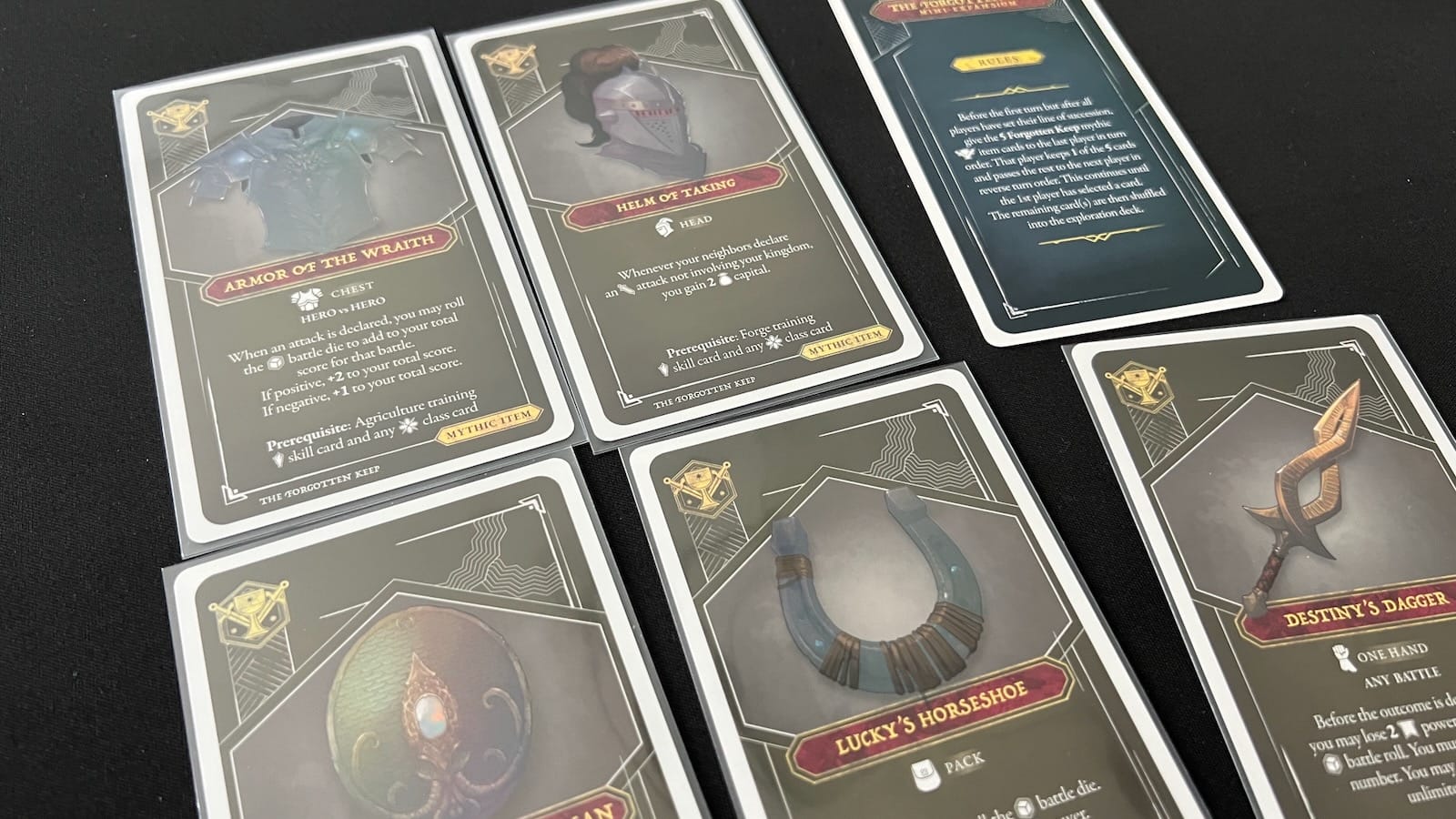
The game also came with a Forgotten Keep mini expansion. This allows players to draft a mythic weapon with unique abilities into their hand at the beginning of the game. Once the special condition is met on the weapon later in the game, players will be able to utilize it to meet their goals.
So do I still recommend the game? Absolutely! Winds of Numa Sera feels different and unique in the ever expanding pool that is tabletop. It brings in the flavor of role playing by being able to level up your character for the road of head. It gives the flavor of tactics when getting your warriors and support cards equipped for the battles. There are also flavors of engine building, hand management, and a little "take that" in how you interact with other players. Its the mixture of all these flavors that truly makes a delicious gameplay experience.
Want to get your hands on all things Winds of Numa Sera? Visit the Darkrose Studios store here.
Winds of Numa Sera
Excellent
Winds of Numa Sera is an immersive and gorgeous empire building game that shines the more people you can get to the table. The individualized character options and multiple paths to victory make it a fresh and engaging game each time it gets to the table. The attention to detail and the story elements infused throughout the game make you want to read the graphic novel that immerses you even further into this world. The game has an old school adventure feel that shines with its easy instructions, high player interactivity, and thematic moments throughout your gameplay.
Pros
- Beautiful artwork that flows off of every card and player board
- Easy to learn and a lot of fun paths to victory
- Some great thematic gameplay moments throughout
Cons
- Takes up some space on the table
- Higher player counts a must for best experience
This review is based on a retail copy provided by the publisher.