Starting in the ‘80s, the Empire Builder series of pickup-and-deliver “crayon rail” games has withstood the test of time—various iterations still see regular play with my family, at least. Every few decades, the games get a fresh coat of polish for modern audiences to enjoy, while the gameplay itself remains largely unchanged (see my review of Nippon Rails for an example of what the game looked like in 2011). Empire Builder: Europe marks the latest franchise reboot, offering a deluxified version of Eurorails. And let me tell you, the folks over at Mayfair & Darwin’s Toys went above and beyond in making this whole box feel deluxe.
Rules & Components
The rulebook is chock-full of images, examples, notes, and callouts to make learning the game as seamless as possible. For returning players, there’s a blurb right at the beginning going over all the changes from the 2009 edition of the game (which is the one I grew up with). For new players, there’s an optional “Basic Game” which tweaks a couple of numbers and rules to make the game more forgiving and allow it to move a bit faster. Notably, there is not a separate rulebook with all the Europe-specific stuff, as had previously been the case. Everything you need is in this one rulebook. “Need” being the key word there, since there is a separate booklet with solo and variant rules, but I’m perfectly fine with those being kept out of the way.
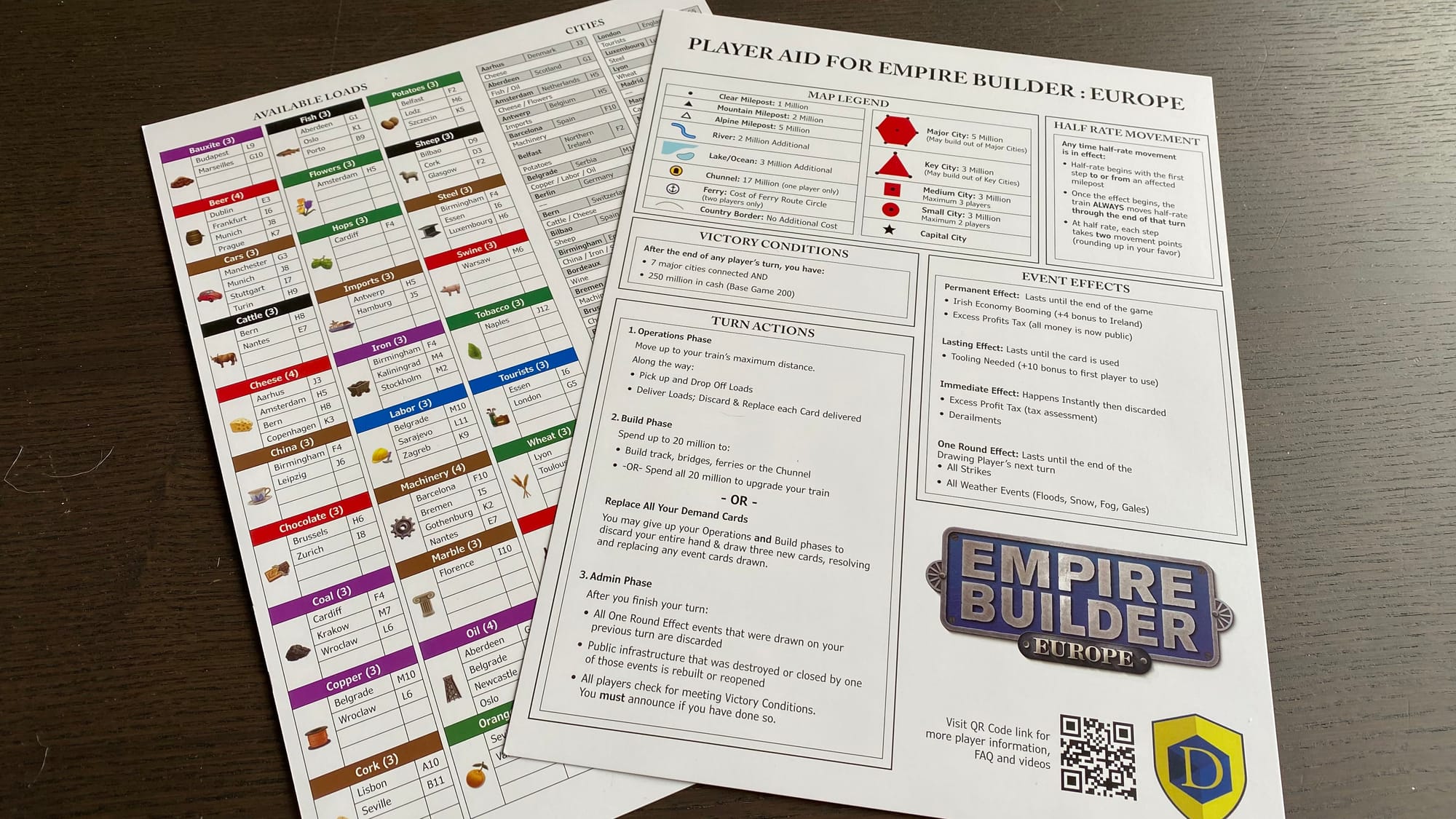
The player aids have been revamped, with one side containing the traditional charts of the various loads and where you can find them (or the cities and what loads they offer), and the other showing a reference for pretty much everything else in the game. Map icons, turn overview, half-rate movement rules, and even event effects—it’s all there.
Now, the components. A word of warning: my ramblings about all of the components will probably take up most of this review. They’ve changed quite a bit more than any of the gameplay has, variants aside.
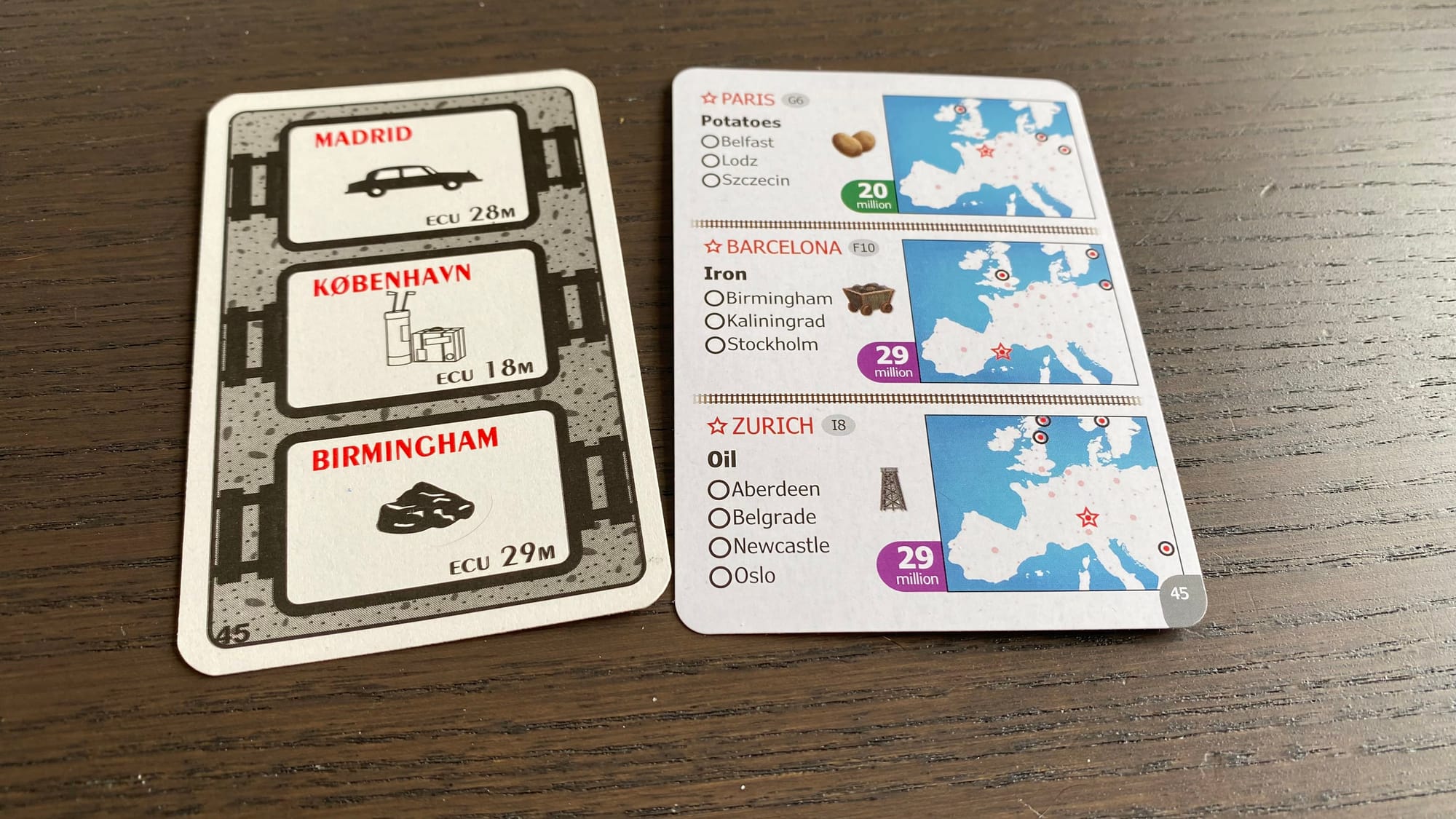
First and foremost, the demand cards. I cannot overstate how much I love them. In the past, these cards would just list the desired load and its destination. Finding that location on the map, and even finding where to collect that load, were problems for the player. Now, not only are the possible pick-up locations listed, but there’s a mini-map next to each delivery highlighting the drop-off and all the potential pick-ups. No longer will my route-building turns take extra long due to my terrible geography. Event cards have received a similar treatment, now indicating how long the event lasts at the top of each card, with a highlighted map on the bottom for any events impacting a particular region. The only downside is how much I miss them when playing older Empire Builder games.
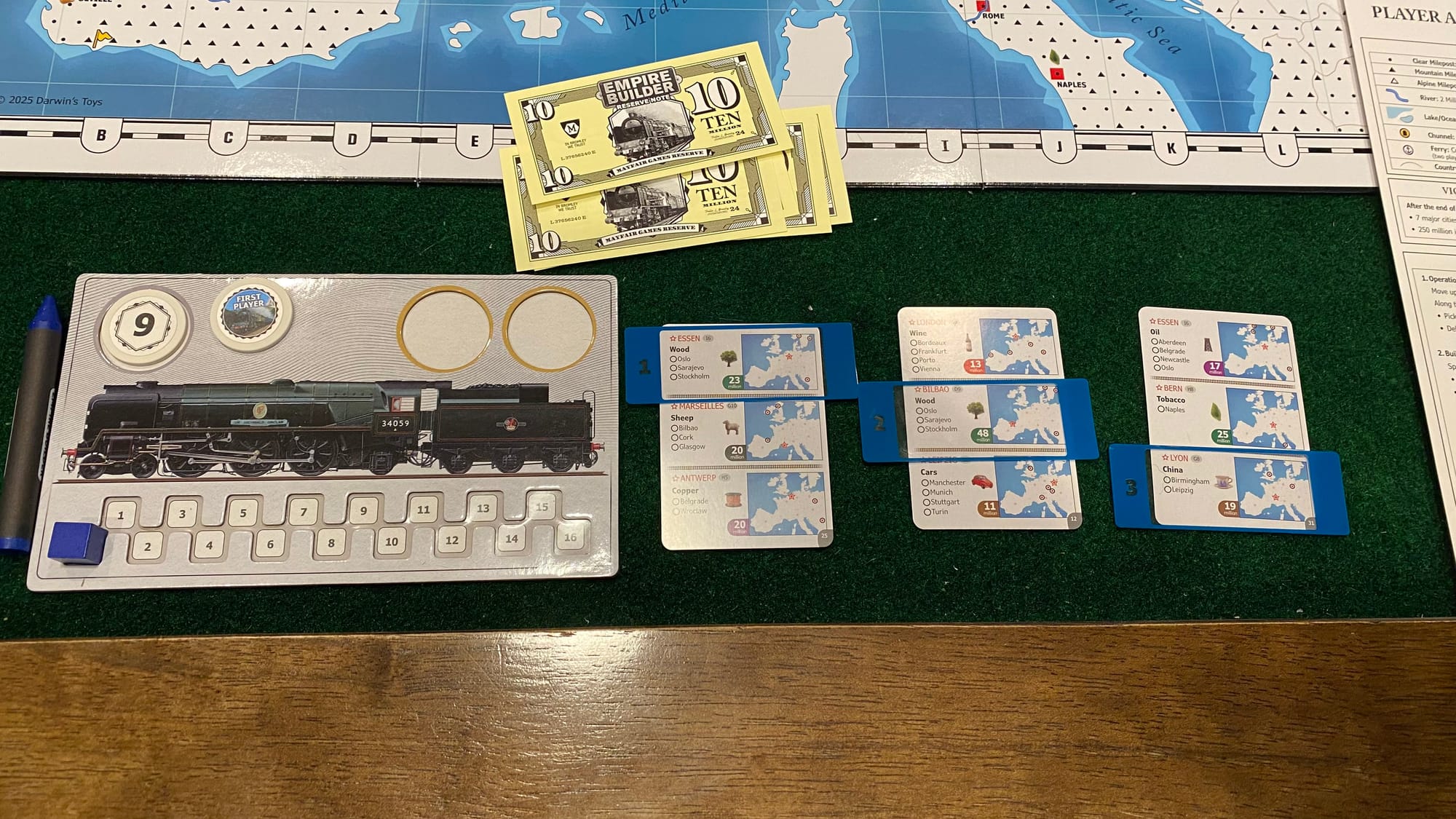
Once you’ve decided which delivery on a card you want to make (or, more often than not, which one you’ll settle for making with a disgruntled sigh), there are plastic “load frames” that can be laid over the cards to indicate for your future self which demand you plan on fulfilling. It’s a nice little touch, especially when players of past editions would use whatever they had on hand to indicate something similar.
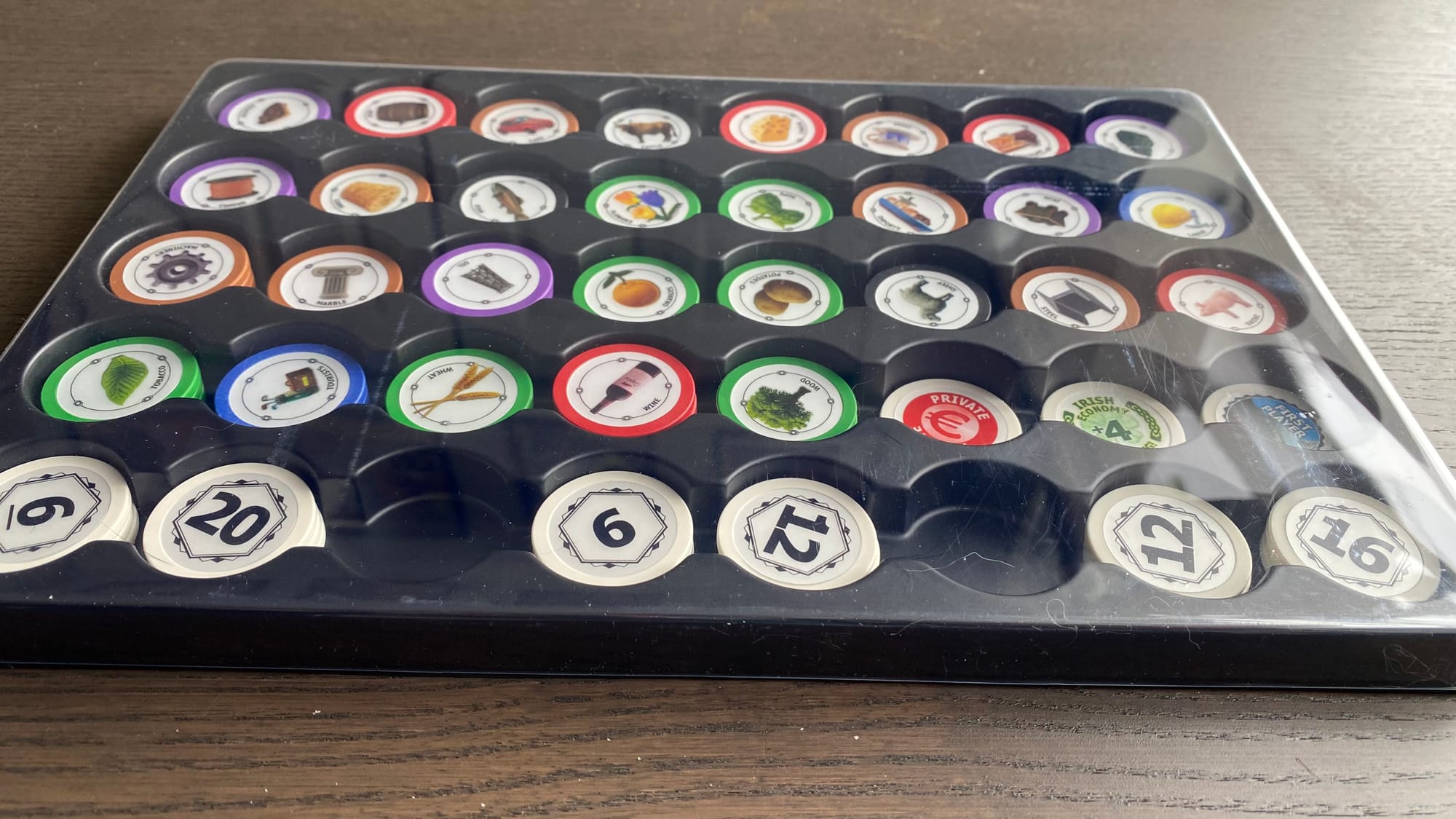
The loads themselves have seen a bit of an upgrade, moving from little plastic chits to nicer poker-style chips with full-color art (rather than the old monochrome or the even older black-and-white components). There are even a few “reference” chips added to indicate First Player, whether players’ money has been made public yet, and one for the Irish Booming Economy event. The nice tactile feel of these larger, heavier chips does a lot for making this game feel more modern.
The train boards are another great quality-of-life improvement. A speed chip replaces the value formerly printed on the train cards, so upgrading your train is as simple as flipping/swapping that chip or flipping your board for more load slots. More importantly, there’s a movement tracker at the bottom of each board. If you’ve ever played an Empire Builder game before, you’ll immediately recognize how nice that is. For everyone else, you’ll often interrupt your movement to make a delivery, which may result in a new demand card that changes your plans or an event that messes with things. In either case, it can be easy to forget how much you’ve already moved in a turn. I used to just write my current movement in some empty part of the board, but this cube track is much nicer.
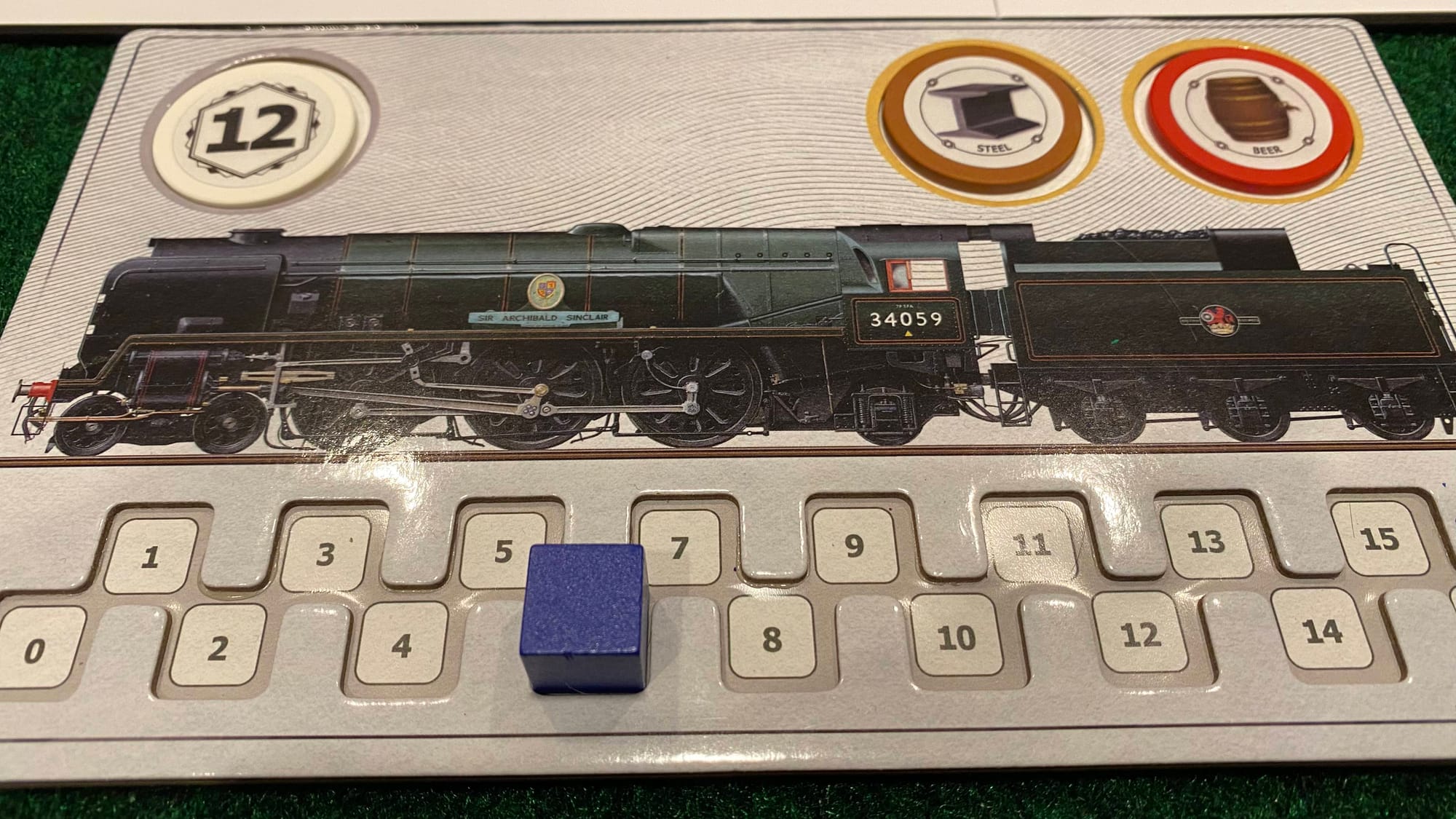
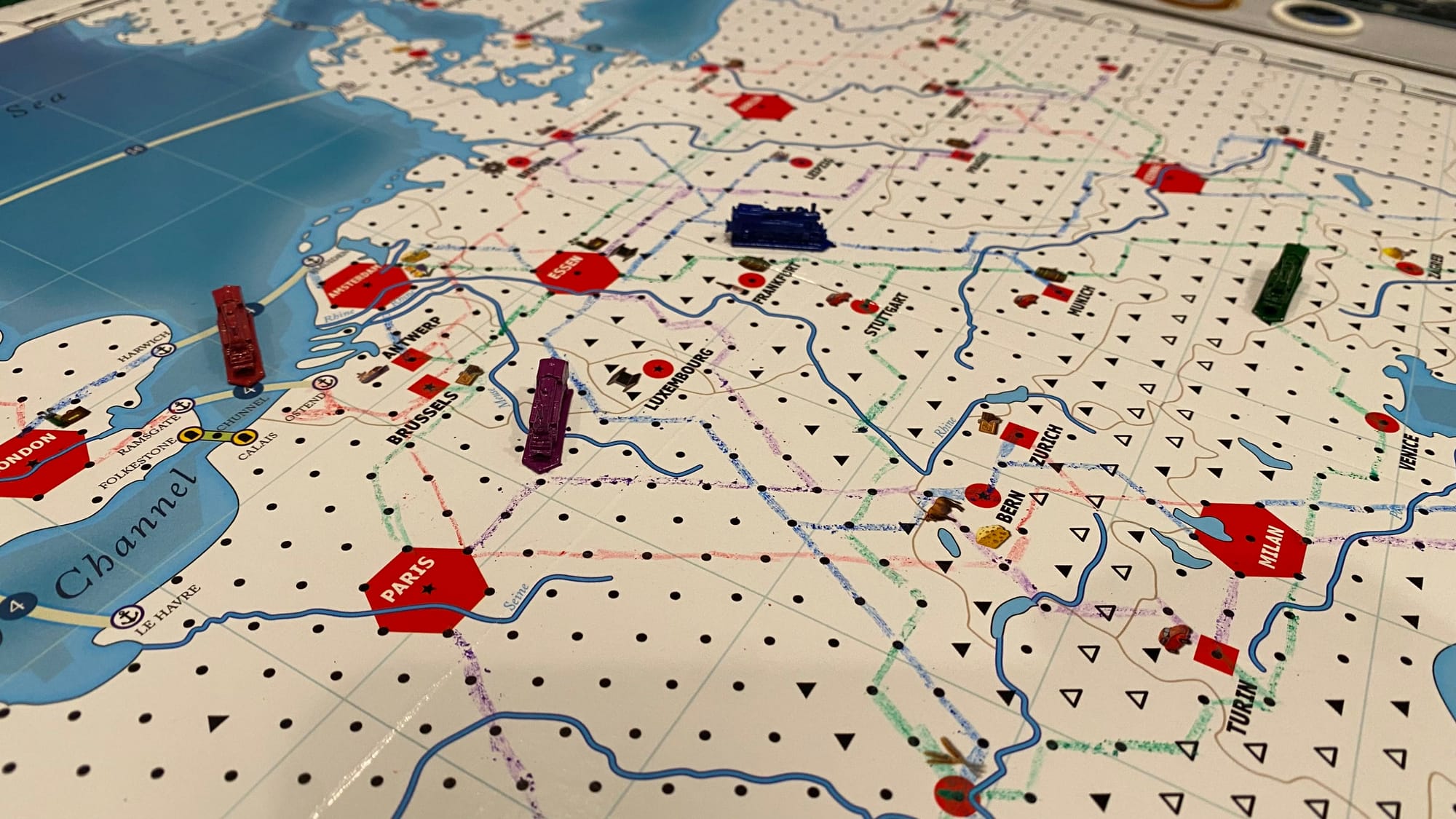
The only point of contention at my table was a minor one, but the nice metal train pieces take up multiple mileposts and are just too large to move along your track like the old-style pawns. Sometimes in more tangled sections or when multiple players’ trains are operating in the same area, you’ll have to move them around a bit so that it’s clear where everybody is and which direction they’re going. I can’t really fault anyone for this, though, since the trains would have to be prohibitively small to fit and the classic-style pawns are also included if you prefer them. (The pawns have also been plussed-up, with a little arrow on them to better track which way your train is going.)
Gameplay
All Empire Builder games are incredibly relaxing, somewhat ponderous experiences—much like a freight train. Do they hold up against modern tightly-balanced, snappy-playing Eurogames? Not by any means, no. But they don’t need to. These are basically giant sandboxes for players who enjoy building routes as cheaply and efficiently as possible, then running random pickup-and-deliver trips across them. For anyone who wants to know more about the gameplay in a 36-year-old game, there are plenty of discussions out there (my Nippon Rails touches a bit more on the core gameplay), but I’m mostly going to focus on what’s new here compared to Eurorails.
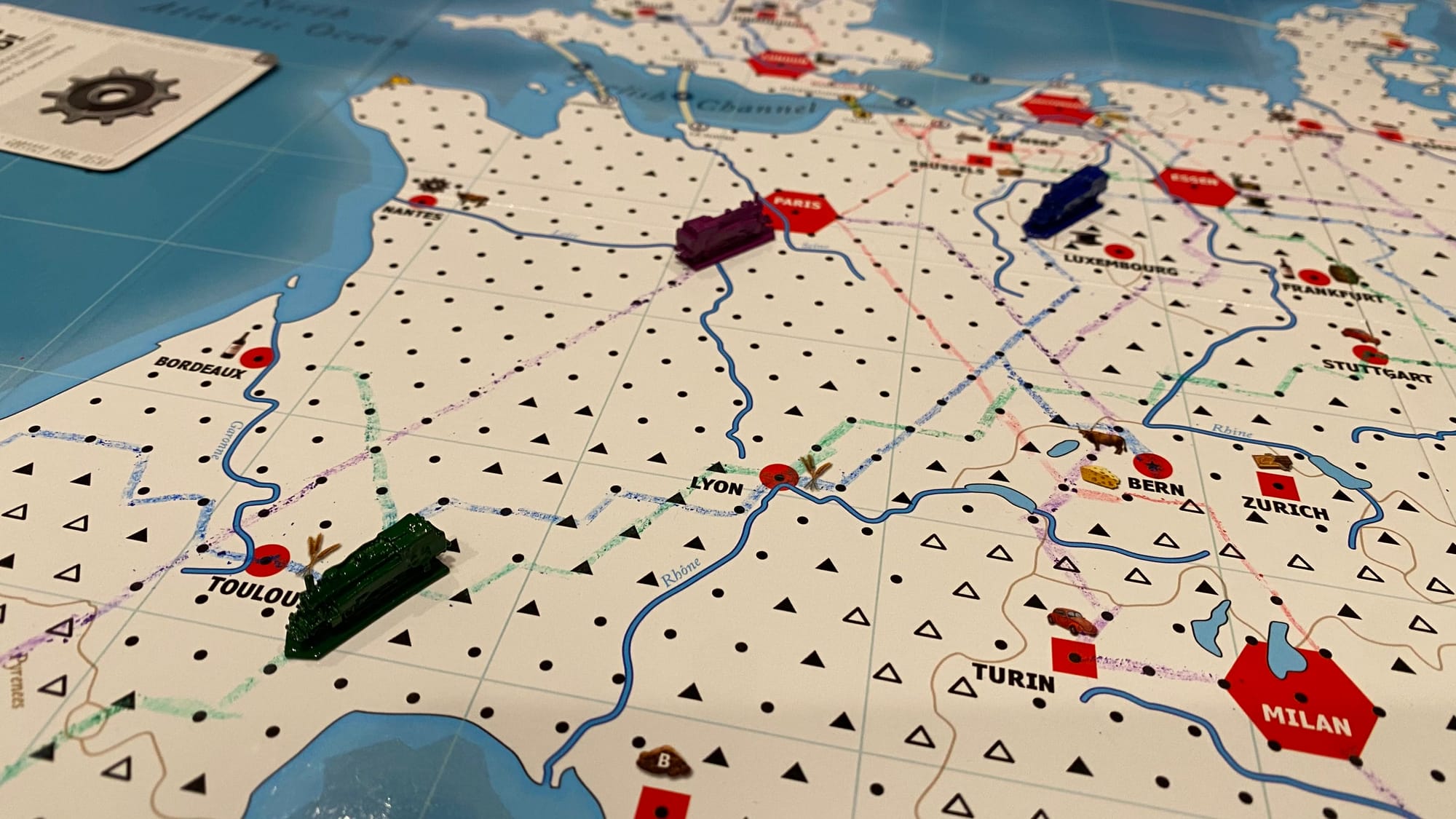
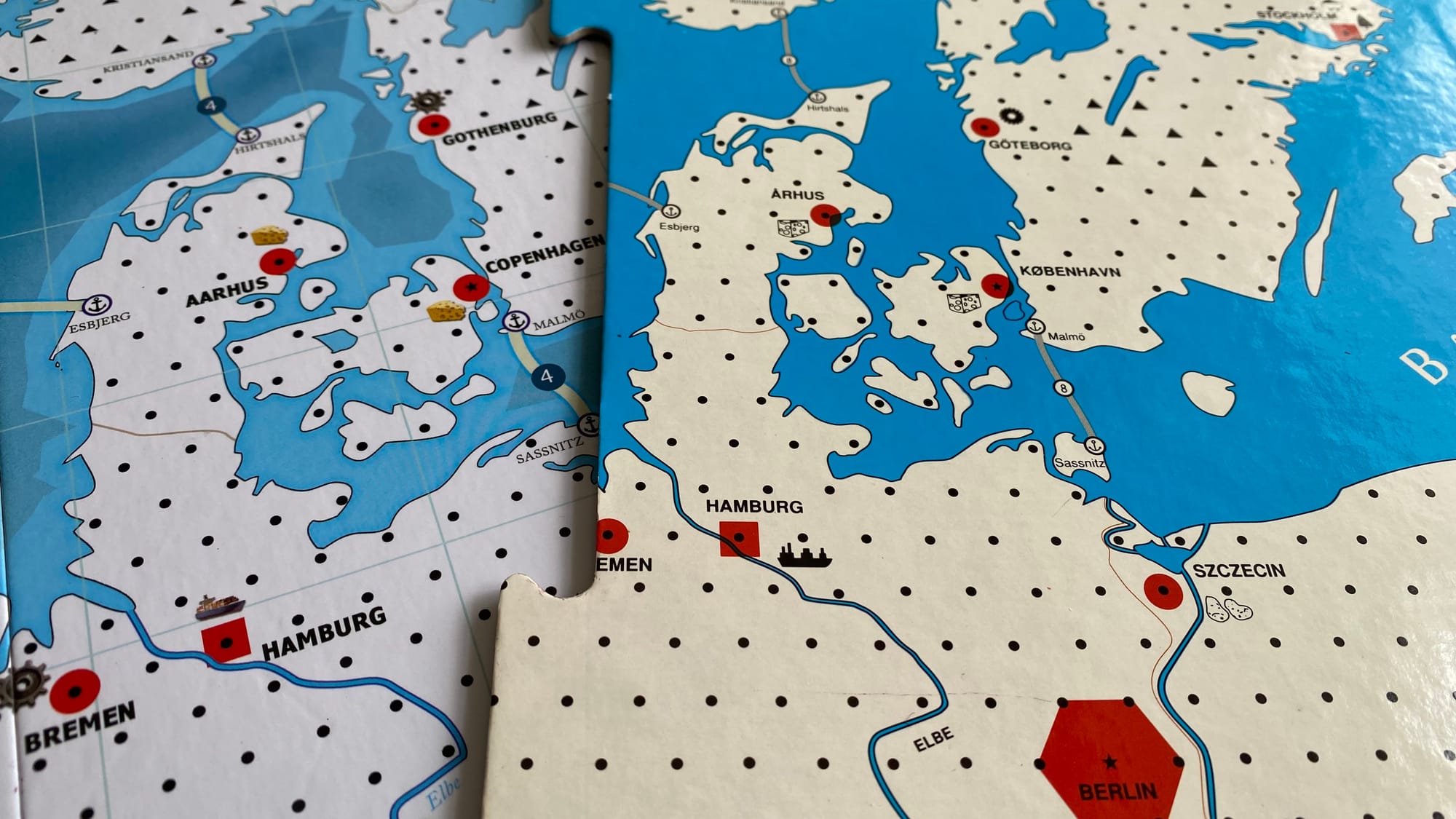
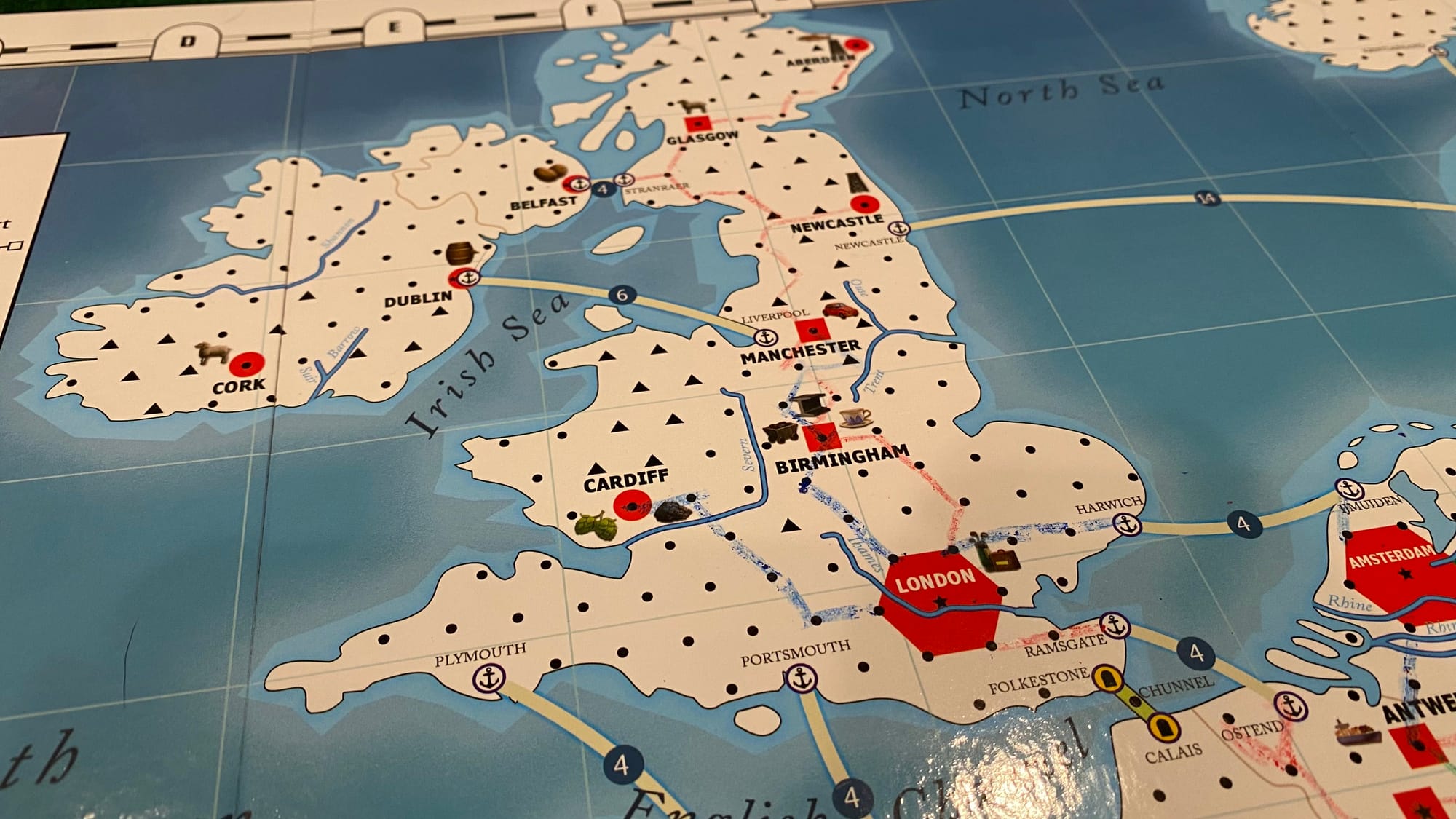
There’s been a sweeping set of balancing changes, like small changes to the map to make Scandinavia easier to access and the Chunnel actually viable (costing 3 million less, so you can connect to it and build the thing itself on the same turn, plus it no longer requires an upgraded train to use). The demand cards themselves are also touched up, with payouts being adjusted and certain deliveries getting redistributed. These changes can be a bit subtle, but even after one game it felt a bit different, with some options feeling more worthwhile than they had in the past.
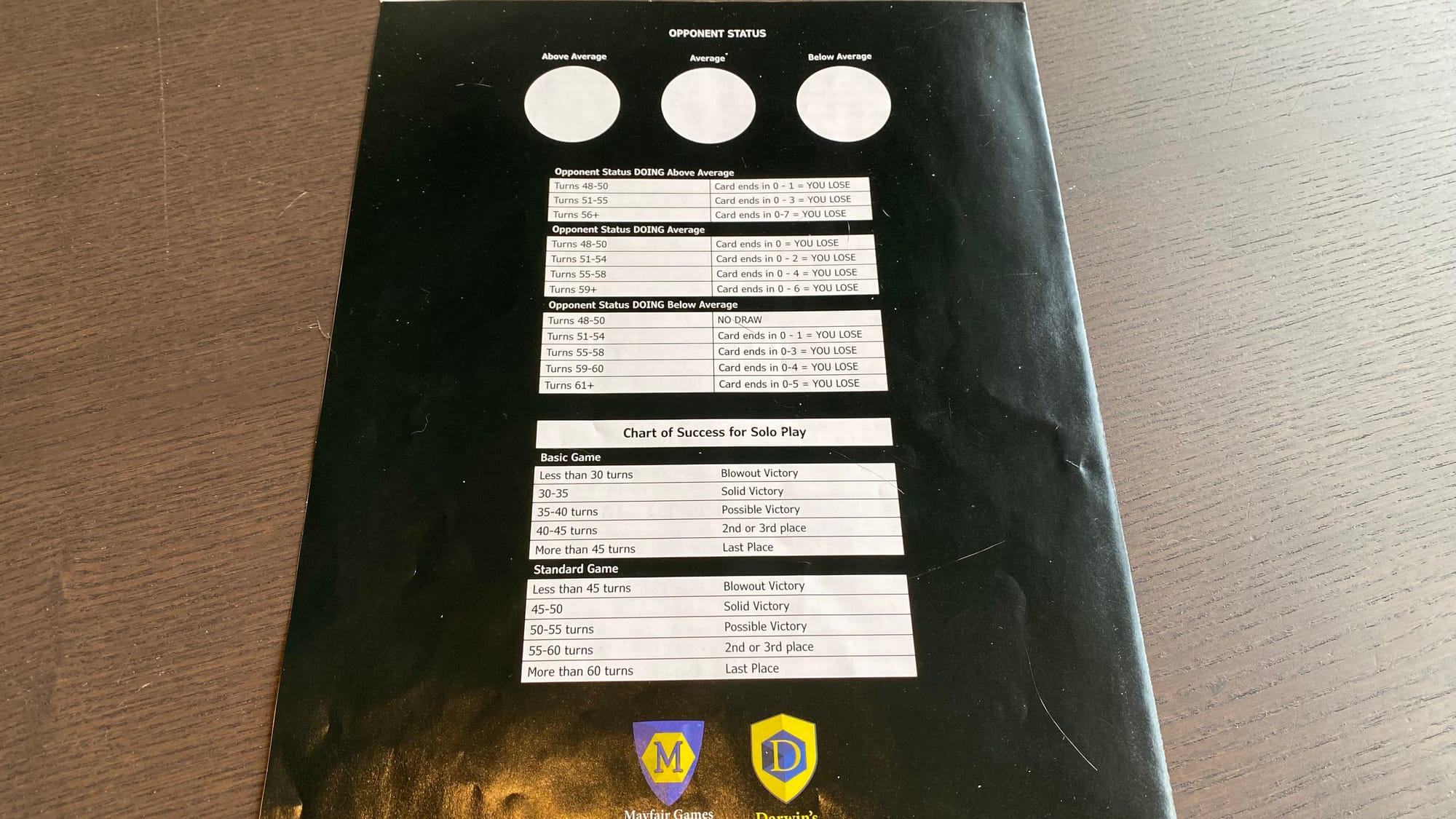
The solo mode is actually pretty interesting. There are technically a few variants included, but my eyes were drawn to the simulated players. In the basic version, it will randomly draw track out of cities and hold loads hostage until you make a delivery yourself. The track it draws isn’t very long, only three mileposts in any given direction, but that’s close enough to the “meaningful” parts of other real players’ track blocking your access to a given city. On the other hand, there’s an advanced simulation where you draw the full track for these players, potentially using up access to ferries or the Chunnel as well. Personally, I preferred the basic one for its simplicity, as I dislike needing to “think” for simulated players in any solo mode. I would also recommend using the “simulated win/loss” rules, since I don’t really care for “high score” solo games (or, in this case, fewest turns).
Some of the other variants are a bit familiar, but the notable ones are focused on making the game even faster. Ramping trains from 12/16 speed in the Basic Game (which is already up from the 9/12 in Standard) all the way to 16/20 speed for the Fast Game. If that wasn’t enough, you could change how ferries work, ignore derailments, and even adjust the turn order so you build then operate. For nostalgic reasons, I’m partial to playing the classic Standard Game—though I may allow another speed upgrade, so it’s 9/12/16 (mostly because I miss the Viking from Martian Rails). But it is nice to have these all available and make it clear to players that they’re free to adjust the game to their liking.
There was one variant from the older games that I was sad to see this version left out: the travelling circus. The traveling circus was a special load that wasn’t tied to any particular city; wherever a player dropped or delivered it was where it remained until picked up again. It was a nice idea, but the older methods of incorporating it were that demand cards with ID numbers divisible by 10 replaced their bottom delivery with $20 million for the circus. Which was… annoying to remember and track. It would have been remarkably easy for the new edition to simply print a little icon (ideally with a $20 somewhere nearby) on the relevant demands to indicate that they should be replaced when using the circus. I can only hope that future entries in the Empire Builder reboot actually do include the travelling performers.
And I certainly hope there will be more of these remakes coming soon. Not only are all the components here phenomenal, but the rebalancing also shows that the designers are willing to improve on the originals without compromising their identity. This whole game is clearly a labor of love. My biggest complaint is that now my other Empire Builder games feel incredibly lackluster by comparison, and they all feel like they could use a similar upgrade.
Empire Builder: Europe
Excellent
Empire Builder: Europe is the pinnacle of crayon-rail games, featuring plenty of modern quality-of-life improvements on the original. Deluxification aside, the rebalancing of the map and demands make it impossible to go back to the classic Eurorails. My only disappointment comes from the lack of the travelling circus, but that’s more of a personal issue than a mar on the game itself.
Pros
- Improvements on every component
- Rebalanced game makes every region feel more viable
- Maps on cards, movement tracker on train boards, and load trackers are huge leaps in QoL compared to the classic games
- Decent solo mode
- Plenty of extra variants to customize your game
Cons
- No flying circus
- Fancy (and optional) metal train pieces’ size sometimes gets in the way
- Multi-hour pickup-and-deliver still isn’t for everyone (weirdos)
- Makes your other Empire Builder games feel old-fashioned (more than they already were)
This review is based on a retail copy provided by the publisher.