I love a good “what if?” story. When done right, it’s fun to see how one little change in a familiar character’s history or in a well-known storyline can drastically change everything. This works especially well when done in standalone issues, as Marvel has done countless times over the years in their What If…? comics (and more recently in the Disney+ show of the same name), allowing writers to concoct all manner of crazy stories without the pressure of remaining consistent to an ongoing story.
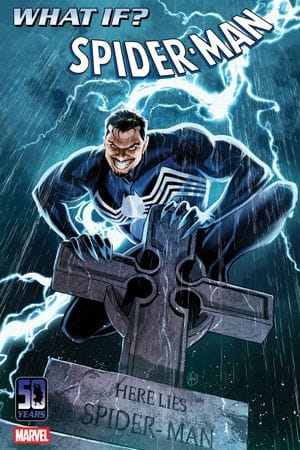
In the newest addition to the ongoing series, writer J.M Matteis takes us back to 1987 to revisit his legendary Spider-Man story “Kraven’s Last Hunt.” Only this time, things will play out a little differently. This time, the Hunter will survive.
*Mild spoilers ahead for What If…? Spider-Man (2026) #1*
We begin with a recap of the events of the original story. For those unfamiliar with it, Kraven the Hunter had captured Spider-Man before shooting him with what was later revealed to be a tranquilizer. He then buried the webslinger alive and donned his nemesis’s identity to prove himself superior as a hero. Eventually, Spider-Man broke free, clawing his way out of his grave to set things right. He confronts Kraven, who releases a savage murderer known as Vermin upon him. Kraven then kills himself, finding peace in his “victory.”
This time, however, the story plays out differently. Spider-Man pulls himself from the grave, but what emerges is not a triumphant hero, but a man broken by the horrific ordeal he has just endured. Two weeks in the dark, imprisoned within the nightmares in the depths of his mind, prove to be too much for his mind to handle. And so it is, when Kraven pulls the mask from the face of his defeated foe as he lies helpless in the mud and rain, the Hunter finds neither peace nor victory, but rather shame. For staring up at him are not the eyes of the supernatural foe that haunted his dreams, but the terrified gaze of a man broken possibly beyond repair.
Horrified by the realization, Kraven returns Peter to his home, where Mary Jane finds him and admits him to a mental asylum.Kraven also returns home, where he frees Vermin before brutally murdering him. Upon death, the creature reverts to a human form, further fueling Kraven’s shame. Faced with the truth that it was he who was the monster all along, Kraven retreats into himself, his mind wandering along the edge of madness as he searches for a way to atone for his sins.
Of course, he’s not the only one with a tough journey ahead. Thanks to Kraven, Peter now finds himself lost in the darkest shadows of his mind. Shadows that won’t release him willingly, and threaten to turn him into the very monster Kraven once believed him to be…
The way DeMatteis explores the psyche of Kraven the Hunter in this story is phenomenal. In the original story Kraven found peace in “overcoming” his foe, allowing him to end his life with a satisfaction he’d been longing for. By robbing him of that here, DeMatteis creates the perfect catalyst to force Kraven to examine himself with honest eyes for perhaps the first time. Through journal-like text boxes that read like a final confession note, we experience his journey firsthand, from his initial recognition of the monstrous nature of his actions to his efforts at redemption and finding purpose once more.
Make no mistake, however. This isn’t a story of how Kraven suddenly sees the error of his ways, turns himself into the police, and then begins intense therapy to become an upstanding member of society once more. While he may seek to atone for his sins and shame, he’s going to go about it in his own, flawed manner. As you’d expect, this makes for quite the entertaining ride.
One thing I did find interesting was what led up to the catalyst for the story’s change. Rather than immediately seek out Mary Jane as he did in the original story, Spider-Man instead goes immediately after Kraven. Whether this was done intentionally to hint at what his time buried alive had done to him or was just a way to get the story to where it needed to be faster, I can’t say, but it felt worth mentioning either way.
Then there’s the way DeMatteis explores Peter’s damaged psyche. I won’t go into much detail here for the sake of avoiding spoilers, though I will say Kraven’s not the only one to experience a transformation whilst attempting to contend with their respective demons. In Peter’s case, DeMatteis takes this in a direction that has been explored before, though he manages to put a unique spin on it that I found quite interesting.
Does the altered story hold up to the original? No, but neither does it need to. While bound to the original story by its core concept, What If…? Spider-Man (2026) #1 creates a new narrative that succeeds in its own ways. The original delved deep into the psyche of the villain, exploring the motives behind his actions. This one arguably delves even deeper by forcing him to contend with those actions with honest eyes that no longer can defend or ignore their heinous nature. The original showcased the darkness of Peter's mind and his battle to break free from it. What If…? shows us what happens if he loses that battle, succumbing to his demons and reminding us it is a human being behind the iconic mask, with all the fragility that comes with that.
There are some flaws, sure, such as pacing at times and some moments that might have been a bit cooler had they been handled a slightly different way. But overall, it’s an interesting story that is well worth a read whether you’ve read the original or not.
What If…? Spider-Man (2026) #1 is available now from Marvel Comics.
What If…? Spider-Man (2026) #1
Great
What If…? Spider-Man (2026) #1 brings J.M. DeMatteis back to tackle the formidable challenge of retelling his legendary 1987 story “Kraven’s Last Hunt” with a twist that changes the story drastically. While not as strong as the original tale, the altered story succeeds in its right, building off of the original to create something interesting and fun.
Pros
- DeMatteis’s exploration of Kraven’s psyche in a new light
- Peter’s struggle with the darkness of his mind
Cons
- Pacing felt rushed at times
- A few moments could have benefited from a delayed reveal
This review is based on a retail copy provided by the publisher.