A quick glance down reveals that, once again, I'm wearing a Cthulhu shirt. That happens on most days that end in Y, so it's no surprise that when Cthulhu: The Cosmic Horror was announced, I happily volunteered my own sanity to our Eldritch gods to play it. I've been waiting for a game that doesn't rely on shock, and instead understands that true horror is about subtlety.
There are movies that understand how horror works best. In the original Alien, it's a full 45 minutes before you see the titular creature, building tension to a fever pitch, and almost 20 minutes before Brett meets his end with only a brief look at the Xenomorph. It's not until the end of the movie before you see the creature in all of its terrible glory. Sticking with that example, the game Alien: Isolation pulls the same trick, with the creature dropping onto a desk almost silently in front of you and without any warning whatsoever. Horror should surprise you, without resorting to jump scares. It creates a pervasive dread where you suddenly realize that things are too quiet, right before it's too late. It subverts your expectations with its restraint. It's with this analogy in mind that I'm very happy to report that Cthulhu: The Cosmic Abyss understood the homework perfectly.
The year is 2053, which is already a massive departure from the norm as most Eldritch horror games focus on the same era as H.P. Lovecraft's stories — the 20s and 30s. You play as Noah. You and your friend Else head out on the Miskatonic River to check on your friend and fellow researcher Mei. The area has flooded for the third time in recent memory thanks to extreme rain, and nobody has heard from Mei in a while. Her house is a complete wreck, but upon the most cursory inspection, you'll notice that not all of it is from the storm.
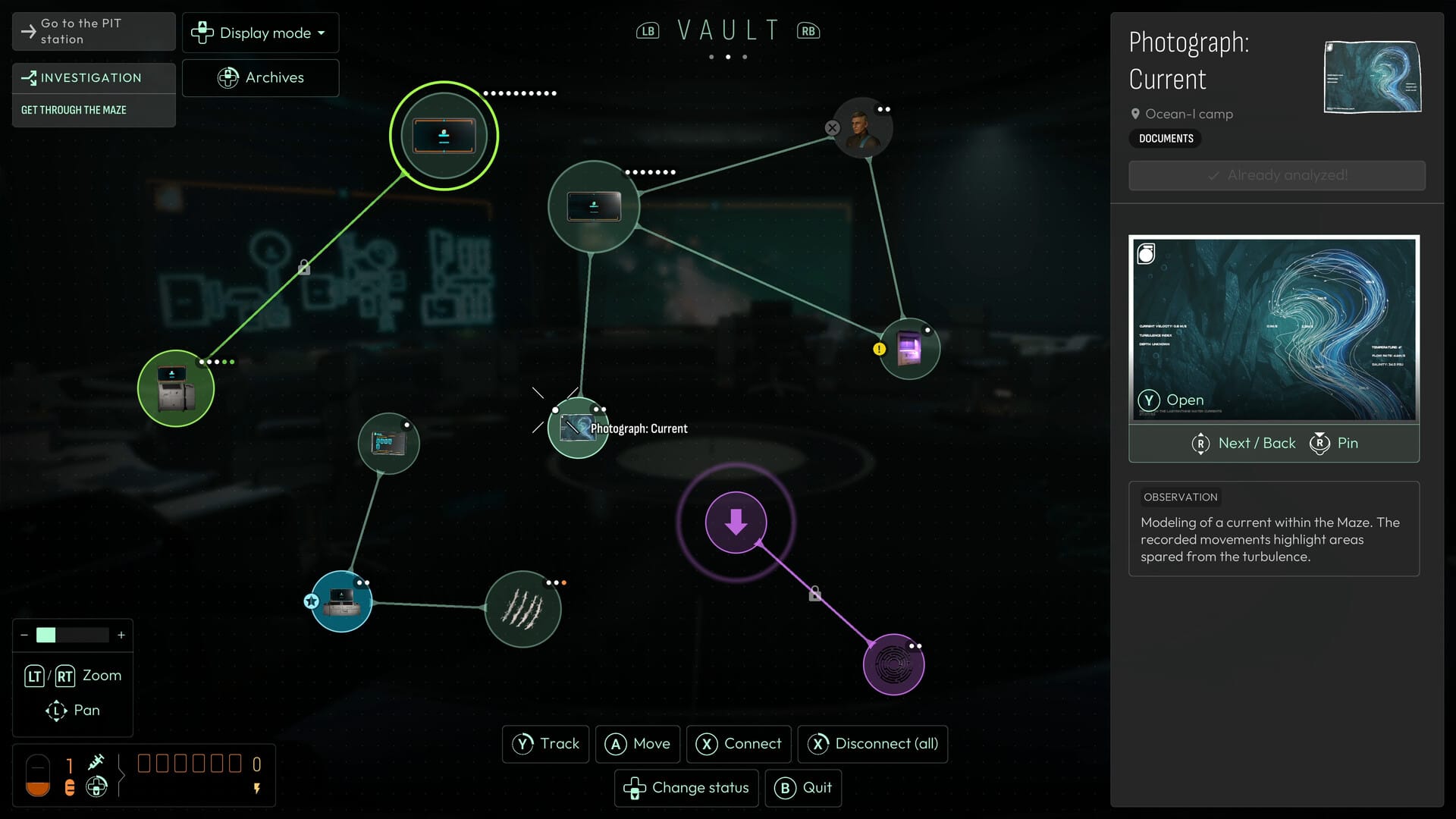
Noah has an AI assistant named "Key" that can help him analyze various bits of information. When you start the game, you'll pick between Investigation or Exploration difficulty modes. This game isn't about combat, but is instead more of a narrative detective game, told in first person. It focuses on providing you with the tools and clues, and then letting you draw them together to see where that takes you next. As such, it has two difficulty levels that dictate how much hand holding you get in the game's underpinned mechanics. On Investigation (the default), you will get less pointers to help you connect the dots, literally. As you discover various bits of information, they're logged in a sort of mind vault. It's up to you to connect them together and then ultimately tie them to various suppositions and questions. You don't technically have to answer these questions, but keep this in mind for a moment — we'll get back to it. If you played The Sinking City (which I highly recommend), you'll recognize this system as a variant of the Mind Palace, though Cthulhu: The Cosmic Abyss takes it further. On Exploration mode, you'll get a bit more advice from Key on how to solve some of the game's more challenging puzzles and then tie the information together. These start off pretty simple, with fairly straightforward solutions, but once the training wheels come off, failing to draw conclusions can have seriously deleterious effects on your sanity.
One of Key's most helpful tools is her sonar system. Picking up a new material and analyzing it allows you to then use her sonar to locate other examples of that material in the nearby environment. It starts off simple, finding simple things such as paper or minerals. Combining them, however, might lead you to other compound structures or objects. Using a simple example, you'll find that the underwater structure has had an effect on laptop batteries. Finding a burst one, you'll discover frequencies for lithium and potassium hydroxide, separately. Combine those two frequencies, however, and you'll find batteries that have those two mixed — a good battery that hasn't burst, leaking out one or the other. As the chapters progress, you'll use more of these combinations, and the puzzles will become more complex. Your radar, and the clues you scan, will guide you.
In the beginning of the game, Key will only be able to perform so many analysis actions before you've run out of energy to do so. Further analysis will cause corruption, just like drawing wrong conclusions. These corruptions will not only cause you to start to see things that may or may not be there, but will lead to some nasty eventual outcomes. Drawing energy from odd lichen structures in the environment and then injecting them into the port in your wrist will restore your energy, but let's take a moment to talk about what all of this is doing to your brain.
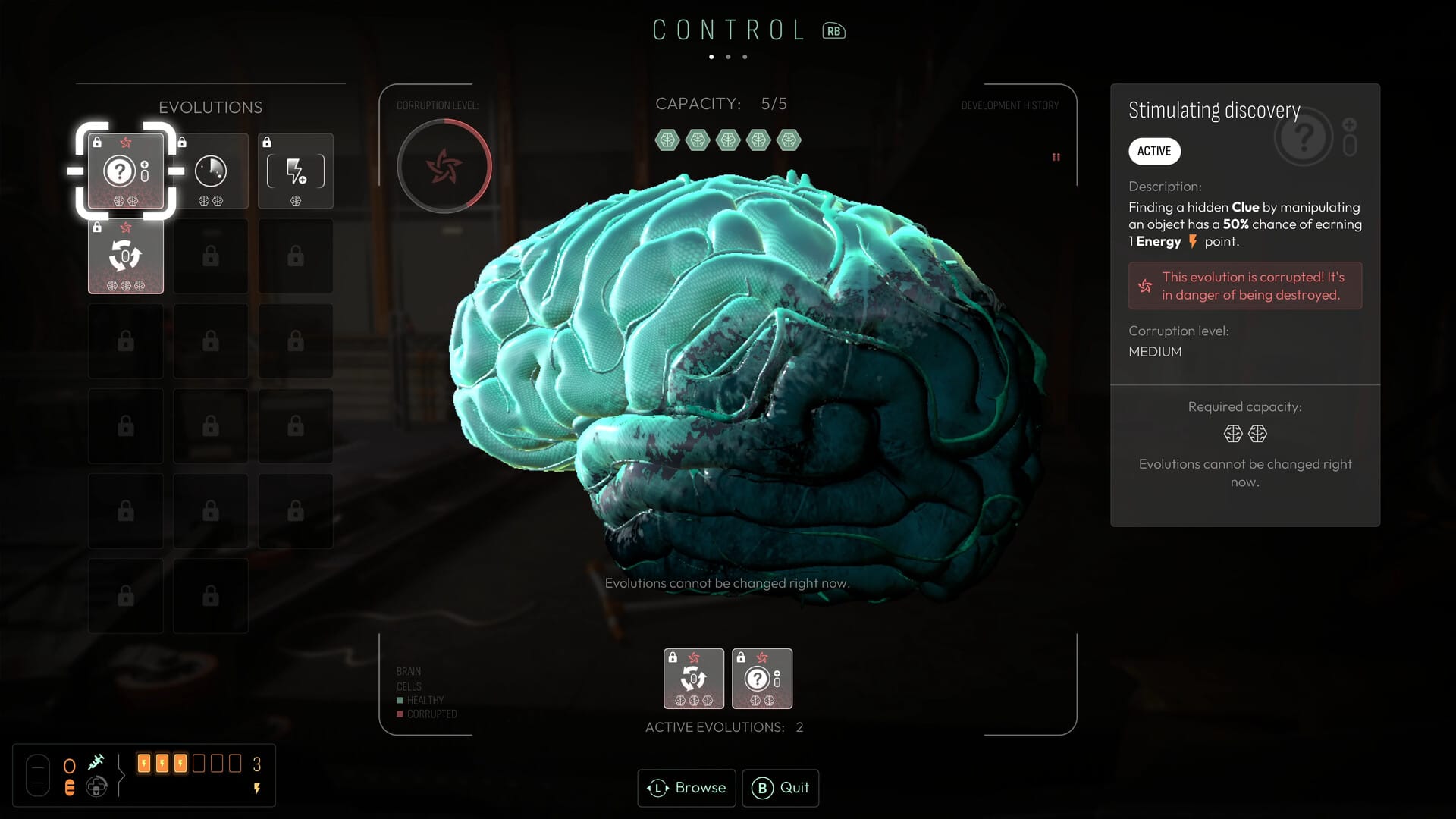
Lovecraft describes the otherworldly creatures in his books and stories as being so far beyond human comprehension as to drive people mad at the mere sight of them. We simply cannot process them in our tiny feeble minds. Great for literature, but hard to portray in games. Others have done a good job of this, including classics like Call of Cthulhu and Eternal Darkness, where what you see isn't necessarily real. Here, it's portrayed as a blurring effect when you try to stare into some of these oddities, culminating in hallucinations, voices, and worse that I won't spoil. To help combat these influences, you'll discover ways to expand your mind, granting more skills for Kay, additional energy capacity, and other advancements. These evolutions (there are 17 in all) can then also be combined to expand your capabilities. To keep spoilers low, I'll give you an early example where you can use amplified sonar to increase the reach of your scans to find elements and clues. You won't likely find all of them in a single playthrough, and even if you did, your mental stability is not enough to equip them all. Each has a cost (e.g. 2 dots, 3 dots, etc.) and your pool of stability starts off at just 4. You can't change these at will either, only when you find the next expansion opportunity, so you won't be mixing and matching often — choose wisely.
As you combine all of your hypothesis, collected data, observations, suppositions, and other inputs and interconnect them, you'll drag them together and the bubble will turn green when you get it right. If you're right, it will reduce the influence of the Great Old Ones and reduce your overall corruption. If you botch the conclusion, or don't answer it all, then the influence of the Great Old Ones is strengthened and your corruption deepens. What happens when your corruption gets too high? That's where the fun begins.
You're going to want to beat this game at least twice. At roughly 15 hours, that's not a huge ask, but there is a low sanity and high sanity ending, and four others in between. They're all worthwhile, which is something I can't often say about games with multiple endings. Beyond just endings, this corruption can destroy your mental stability, thus reducing the number of evolutions you have at your mental fingertips, making the game harder as a result. What, did you think mental breakdowns would give you more power?
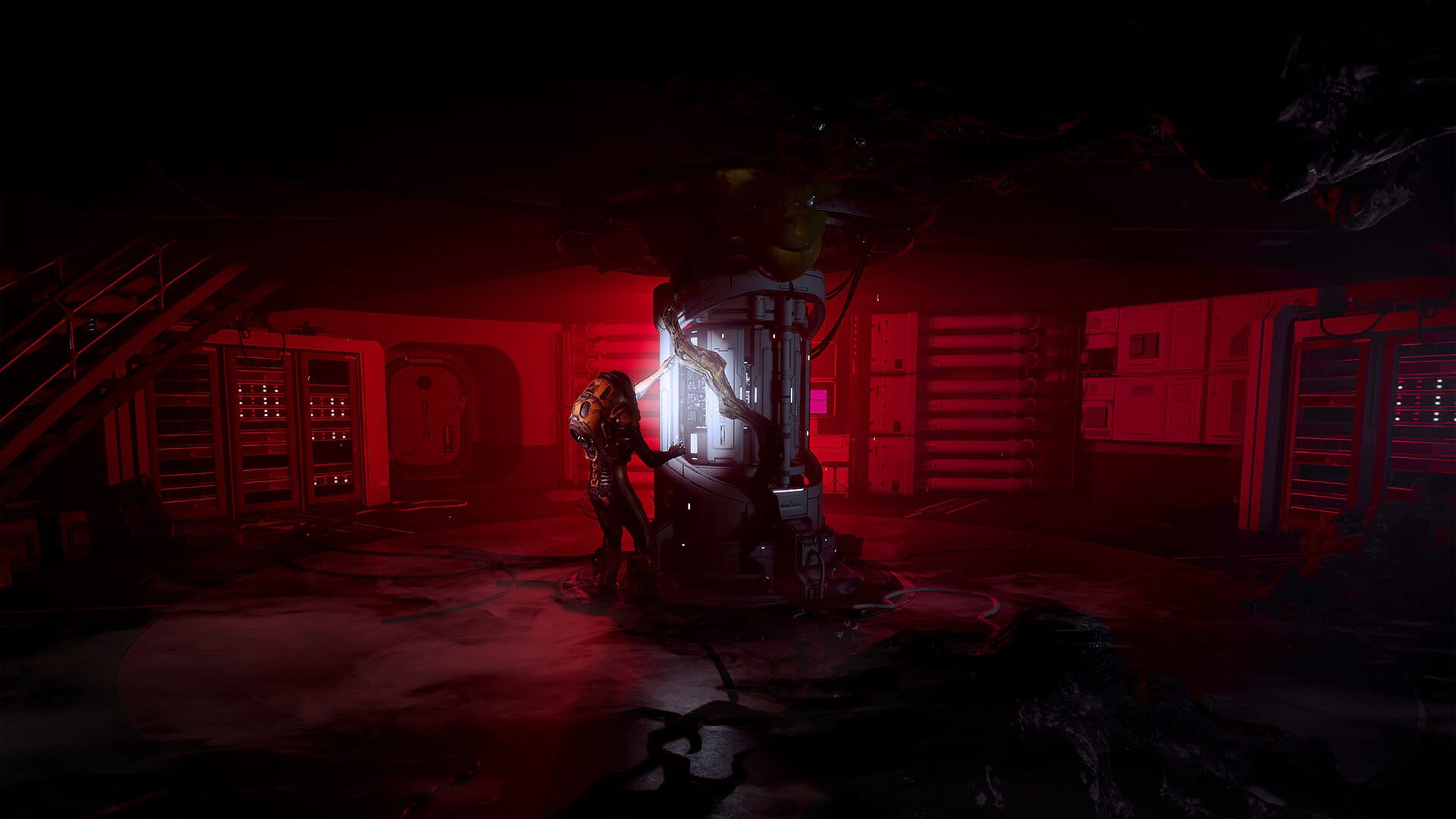
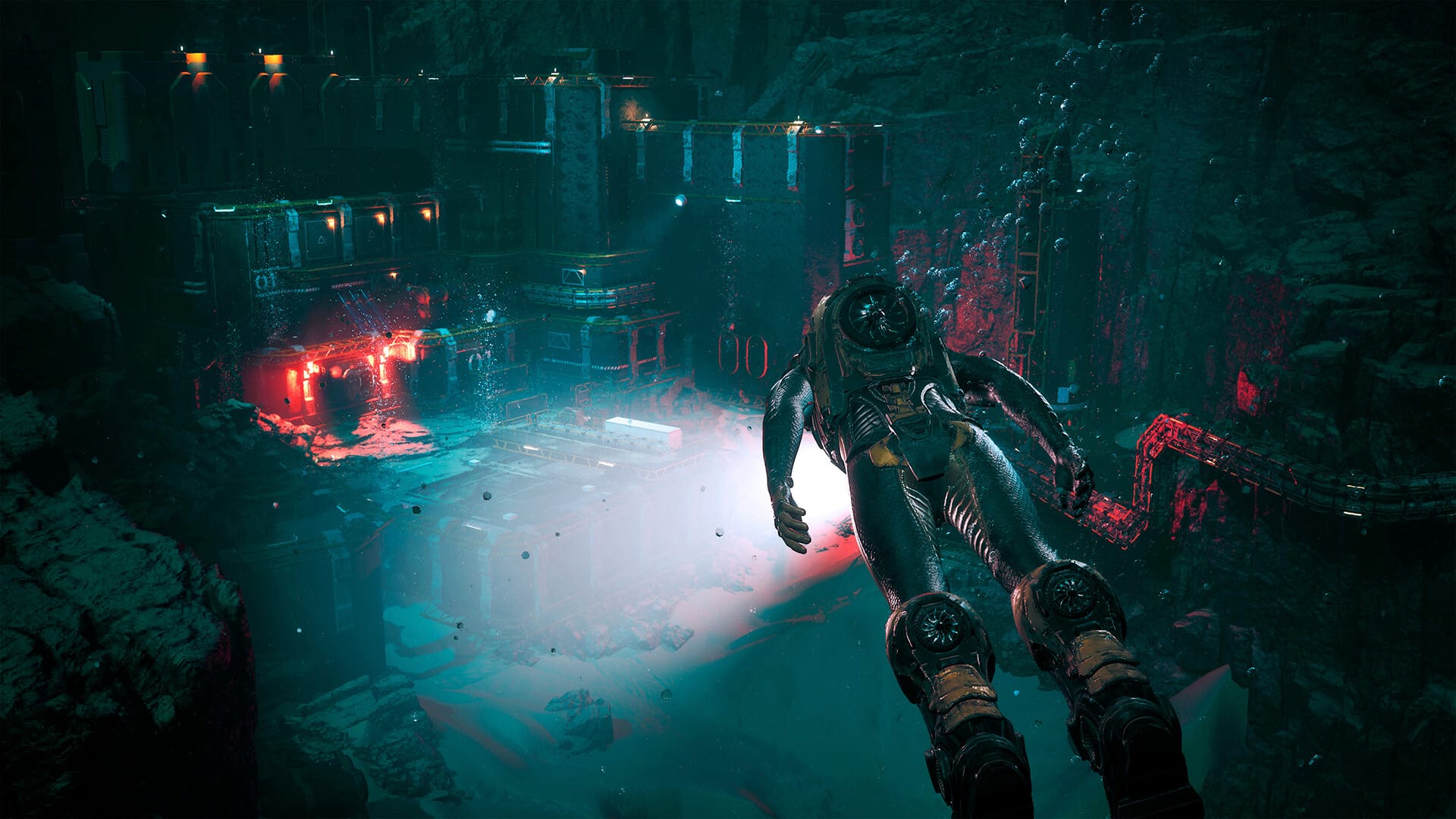
The world of Eldritch Horror is often described as...well, indescribable. How do you bring that to life on the big screen? Well, developer Big Bad Wolf Studio clearly thought long and hard about that very topic. I'm going to be somewhat vague about what lies ahead as frankly, it's something you'll want to have unfold before your eyes to truly understand the horror and impossibility of it. What I will say, however, is that it's downright gorgeous. Built in Unreal Engine 5, the otherworldly environments of places like R’lyeh, the ancient sunken city where dread Cthulhu lies, sleeping, look absolutely magnificent. Better still, it's not just the big splashy moments that look the part, but the darkest moments as well. Just an early example is when you're swimming up to the space station, the lights in the darkness resemble a massive sea creature's eyes, with the glare of the light against the inky darkness giving them an almost squinting appearance. Thankfully, the graphics are supported by the excellent writing.
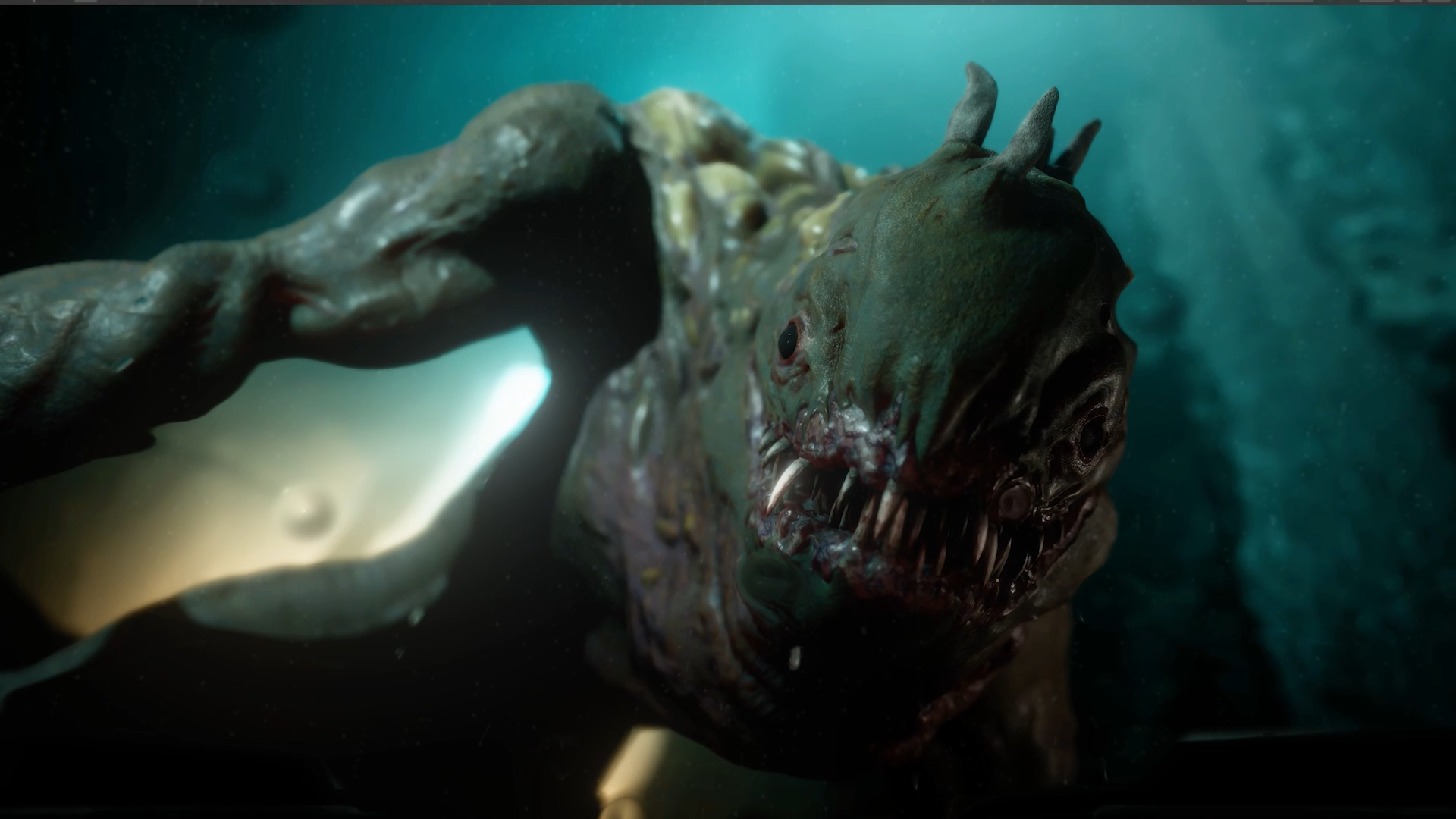
Cthulhu: The Comic Abyss throws some very heady concepts at you pretty early on. The maze you encounter is a non-Euclidean space (named after the "father of geometry", Euclid of Alexandria) in which some of the basic rules of geometry break. Euclid postulated that some of his own rules (e.g. concepts like all of the angles on a triangle adding up to 180 degrees, or parallel lines never meeting and always remaining parallel) break completely when pulled from their flat planes and onto a curved surface. Euclid's parallel postulate becomes false when applied to, say, a sphere where the interior angles of a triangle surface stretched over the outside or across the inside may add up to be more or less than 180 degrees. Those same otherwise parallel angles may also curve towards each other and will suddenly always intersect. The concepts in the game are thankfully surface level enough to remain entertaining, but explain things like how a maze can somehow be infinite and never ending — space and time have been curved, trapping those inside without some central pillar to guide them through. I have to tip my hat to the team for giving us otherworldly concepts without grinding the gameplay to a halt to explain them.
Cthulhu: The Cosmic Abyss is split across 7 chapters – again, roughly 15 hours to complete, depending on how smoothly you navigate the logic in the investigative pieces of the game, but it rarely relies on the same trick twice. You'll use scanning to find various clues and objects in all of the chapters, but beyond that there's always a trick or two that makes each chapter slightly different from the one before it. The underwater base is certainly odd, deserted, and covered with a slimy muck in places, but it's not that odd. Its inhabitants could have just as easily ended up with cabin fever to explain cutting on themselves and others, rather than an otherworldly presence. The next chapter takes exploration a little deeper, literally, finding things that suddenly beggar belief. Every chapter after that is so far beyond normal that down becomes up, occasionally literally as you deal with inverted gravity and other impossibilities that are now your reality. Again — these are best to discover for yourself, but I'm happy to say that it stays fresh through the entire run, and without resorting to early point-and-click adventure games' illogical leaps to do it.
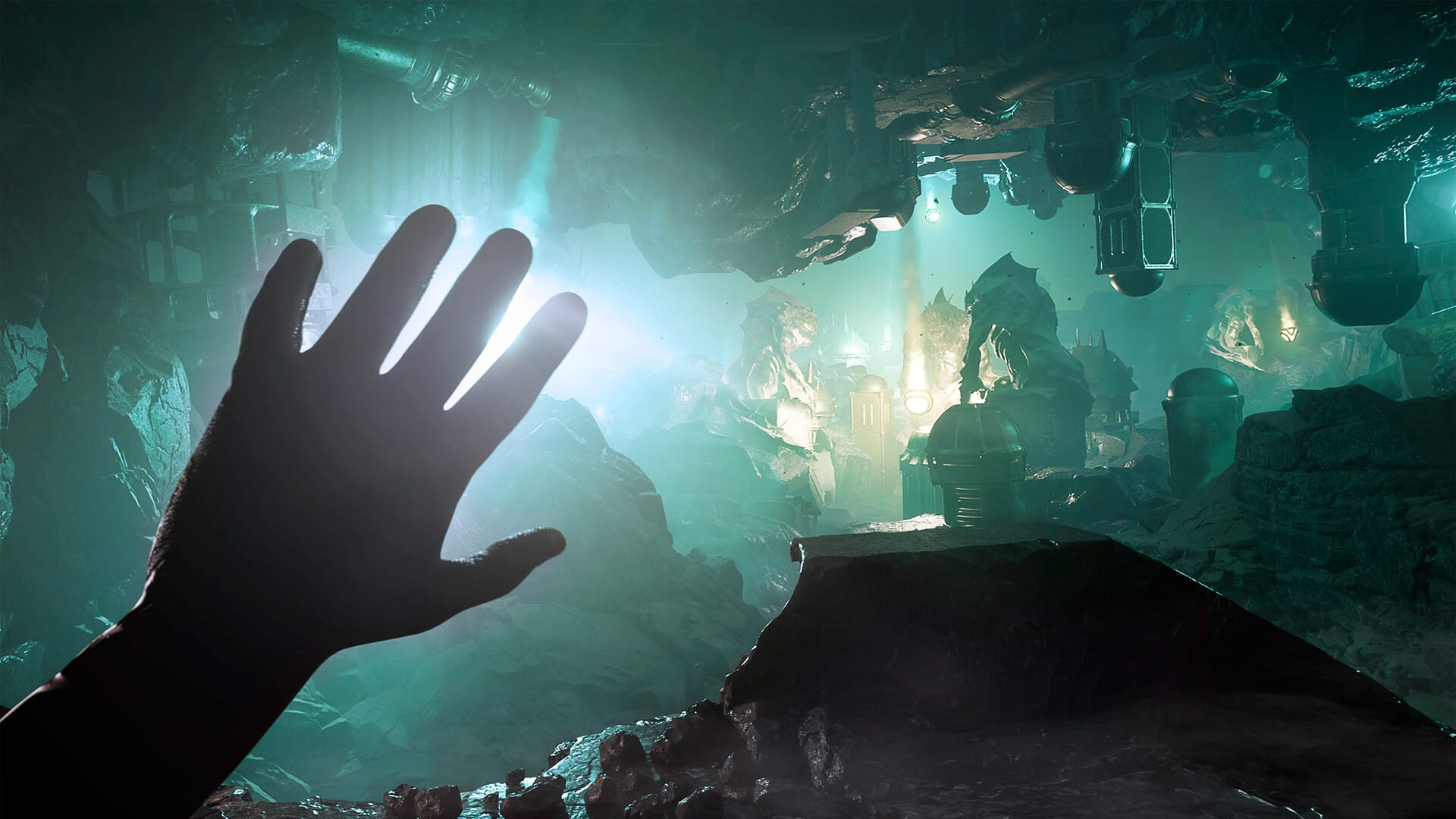
The team has clearly taken note of some of the quality of life items that are missing, even from greats like Bioshock. For example, you'll often find recordings of various team members. You aren't locked in place to listen to those, instead allowing you to play them as you continue to roam around. Similarly, small checkmarks are tagged on objects you've already observed, and you don't have to look at every single piece of that materials to have "examined it". If you find one without a checkmark, it should be of interest as it hides something new. After all, if you've seen one bulbous, pulsing, vile green pustule, you've seen them all, right?
One of my favorite parts of this game is that it's chock full of Easter eggs for those who are deep into this lore, but don't leave those who aren't in the dark in any way. For example, and without ruining anything, Andrew Marsh is the CEO of the owner of the underwater research base, Ocean-I. His predecessor was Obed Marsh, his father. Obed Marsh is also the central antagonist of H.P. Lovecraft's story, "The Shadow over Innsmouth". As a wealthy owner of a local cannery in the town of Innsmouth, he helps support and lead the town, but is also surreptitiously establishing the Esoteric Order of Dagon and brokering the pact with the Deep Ones and the Old Golds to save this town of Innsmouth from economic ruin, albeit at the cost of their lives and souls. None of that is important to know to fully enjoy Cthulhu: The Cosmic Abyss, but it's a great nod if you do.
I did run into a handful of minor bugs during my playthrough. Occasionally, I lost the ability to jump, or to climb out of the water, and a few times the game would not register that I'd already looked at an object. To resolve the first two, it was a simple reload to fix it, but the latter would often only get fixed when I'd ran around aimlessly for a while and then went back and touched everything — the second contact getting the game to register that I'd done it. These are thankfully minor, with no performance or serious bugs rearing their head in the final version.
I really enjoyed this game because it kept me thinking throughout. It asks you to know a bit about constellations, do some pattern recognition, perform a whole lot of deductive reasoning, and to face your fears of the unknown. Yes, you can brute force your way through some puzzles, but often with a corruptive outcome that you'll pay for later. It emphasizes solid puzzle work and exploration over combat and jump scares, and it fully embraces the most bizarre and indescribable parts of Lovecraft's mythos. It's the kind of game I've been waiting a very long time to play, and it's one that earns my most hearty recommendation.
Cthulhu: The Cosmic Abyss
Excellent
A wonderfully deep (ha!) puzzle detective game, Cthulhu: The Cosmic Abyss treads a fantastic line of respecting the source material, updating it in a fresh way, and delivering some deliciously restrained horror.
Pros
- Well-paced horror beats
- Gorgeously alien and gross
- Solid puzzle work without being illogical
- Deep connection to the source materials
Cons
- A handful of bugs remain
- Subsequent playthroughs are still mostly linear
This review is based on a retail PC copy provided by the publisher.