There are all sorts of fears: fear of the dark, fear of forgone conclusions, fear of failure, and fear of public speaking, for example. There is one fear that grips people the tightest. It's the most irrational, and unfortunately, the most powerful — fear of the unknown. When something exists outside of our comprehension, when it defies all that we know and understand, it creates a primal fear that penetrates to the very core of a person. It's that fear that the best horror movies and games are rooted in, and Saros, Housemarque's newest breakneck, bullet ballet, sci-fi shooter delivers. More than just dying and returning stronger, it once again delivers the sort of dread that seeps into your soul when you gaze into the unknown and you feel nothing you can understand staring back. Let me tell you why Saros is far more than Returnal, far more than a roguelite, and the winner of our prestigious Editor's Choice Award.
Housemarque's previous game, Returnal, is as much a masterpiece as it is obtuse. The story was told in fragments as the protagonist slowly revealed it to herself through the slow restoration of her own memories through both progression and death. Saros uses similar techniques, but there is a significant, coherent story thread throughout.
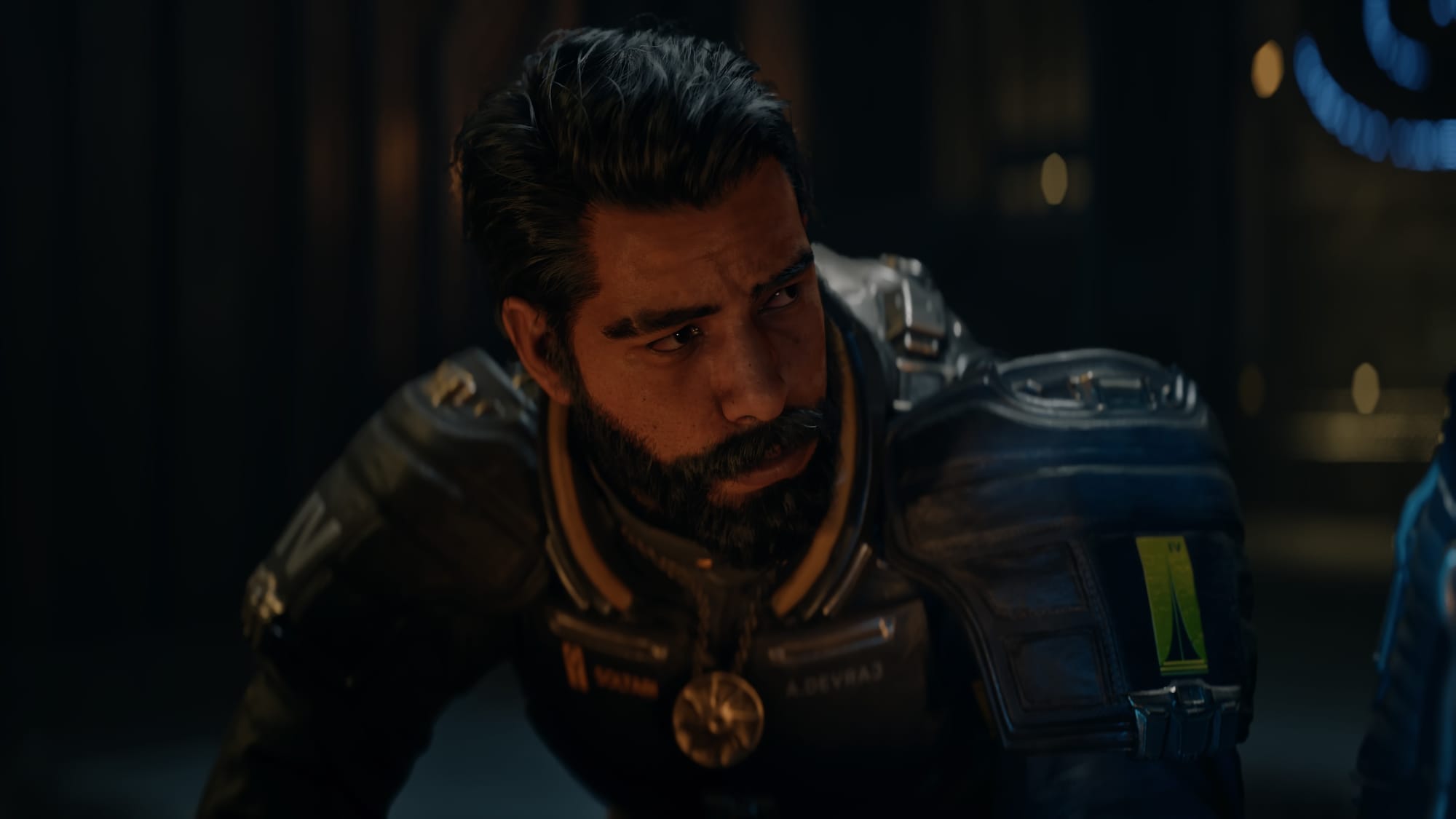
Your character, Arjun Devraj, is an Enforcer for the Soltari Corporation. He is dispatched as part of a fourth expedition to a mysterious planet called Carcosa, which is rich in a mineral called Lucenite. This mysterious mineral, even in small quantities, has the capability to power equipment and devices for years, with massive improvements to power output and efficiency. This makes it not only valuable, but so vital that it renders all personnel effectively expendable! Arj's significant other was part of a previous expedition, so his motivations are far more personal than just figuring out how to recover this mysterious mineral as the colony has lost contact with the Echelon I, II, and III expeditions. The likely source hangs ominous in the sky — frequent and unexplainable solar eclipses.
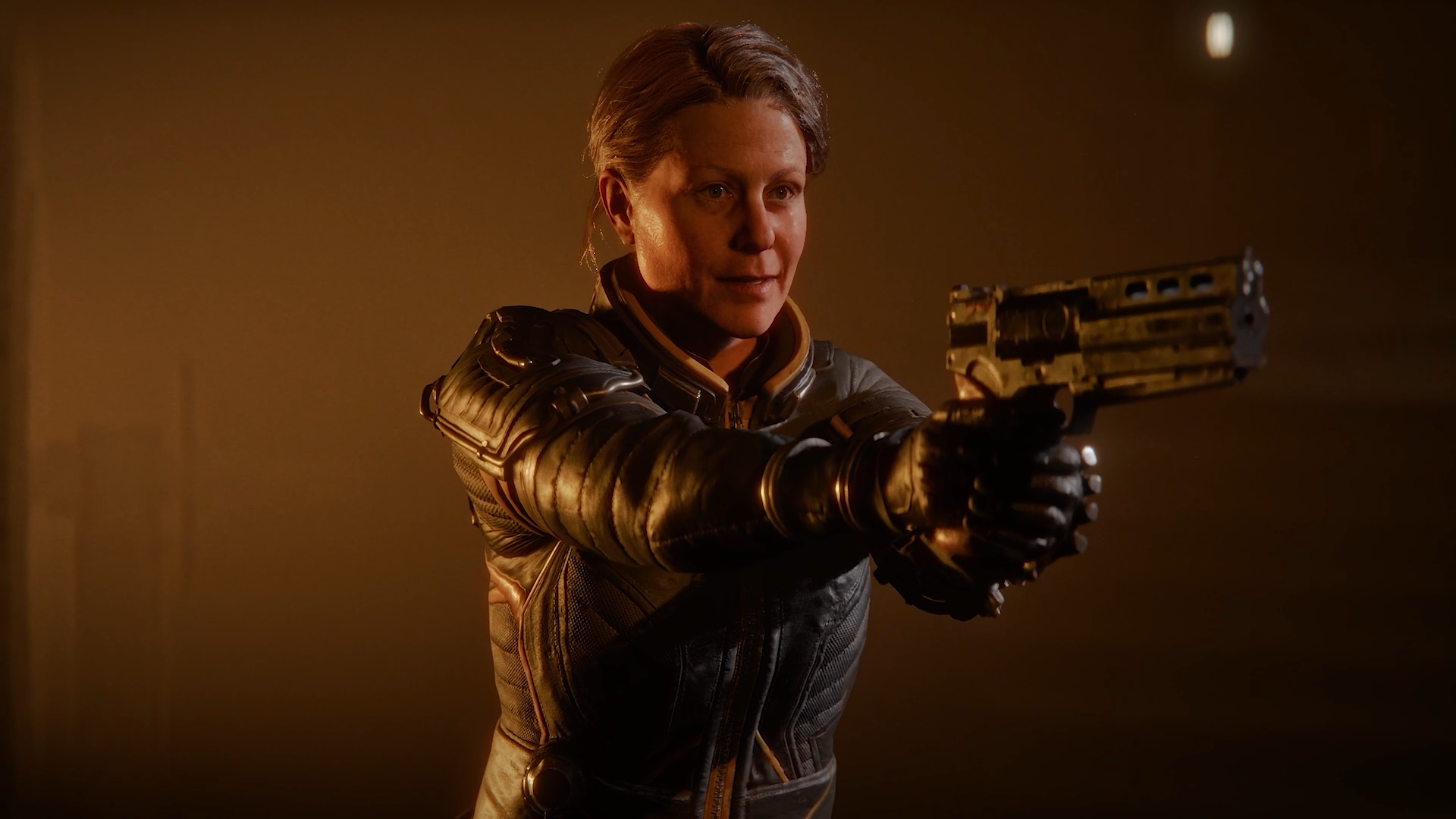
Overseeing the expedition is your commander, Sheridan. She's a 30-year veteran of the Soltari program, and would do anything to prove she's capable of running this mission without overriding supervision. That said, due to the incredible wealth and human advancement potential of Lucenite, the Soltari Corporation has deployed an AI called Primary that can override her whenever needed to ensure mission success. Alongside Primary and Sheridan, Arjun is joined by a large cast of characters that are deployed as part of Echelon IV. It's a stark contrast to the completely isolated feeling you had in Returnal, and it gives the Housemarque team ample opportunity to tell this fascinating and bizarre story.
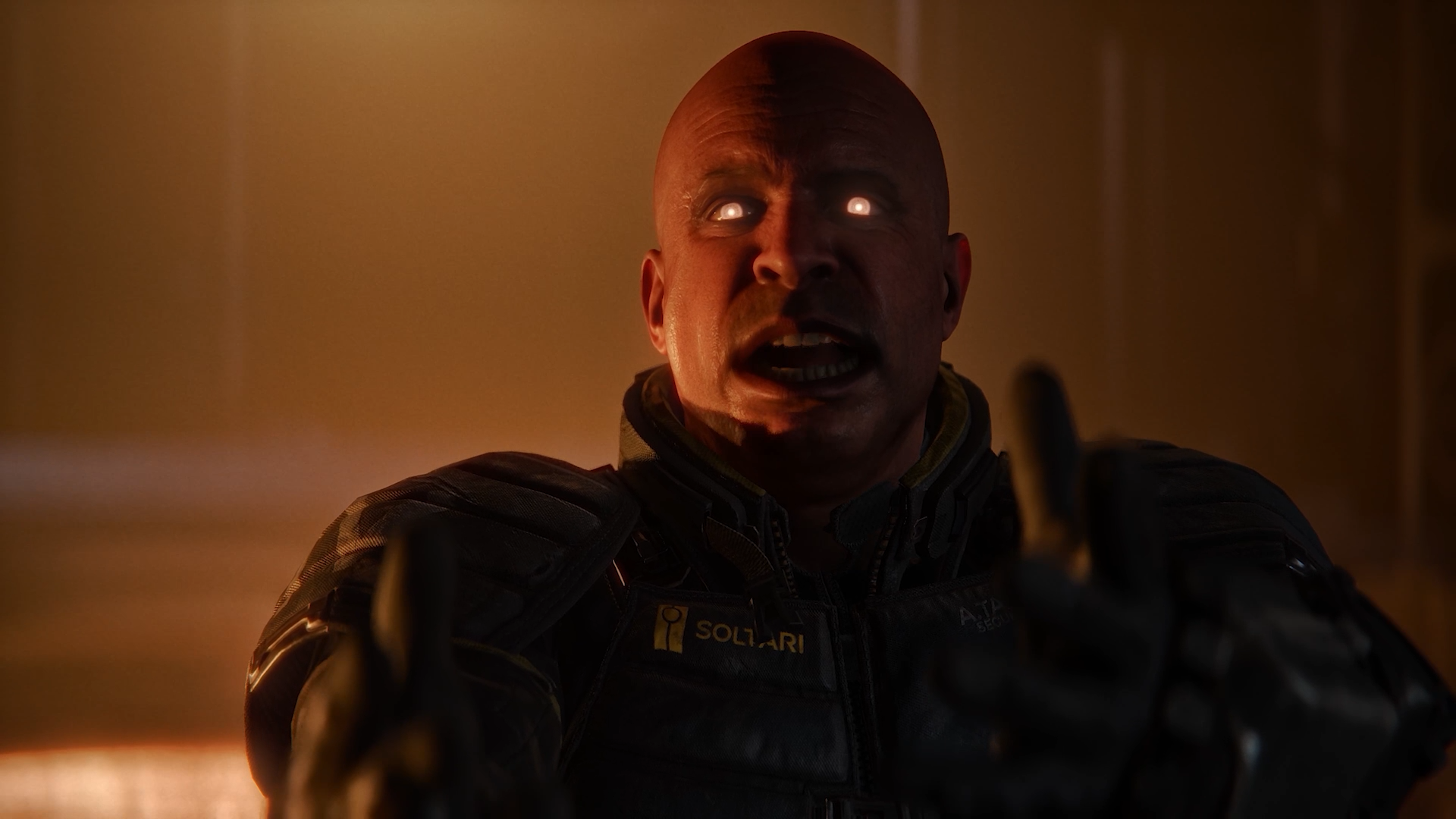
Back on the planet's surface, Arjun witnesses frequent and pervasive eclipses of the Carcosan sun. This irregular eclipse has a profound physiological effect on not only the team, but also the creatures that inhabit the planet. For the team members, I was immediately reminded of the movie Event Horizon, as many of them have taken to staring directly into the sun until their eyes burn out of their skulls. Some of the crew have resorted to cutting on themselves as they slowly go mad. Others have turned to worship of the sun and various Alpha entities that dwell on the planet's surface. Prolonged exposure is sure to have a profoundly negative effect, so it needs to be limited. Despite all this, Arjun is determined to find out what happened to those who came before.
If you're familiar with Philip Eisner's Event Horizon or Alex Garland's Sunshine, you'll have a pretty good idea of what's going on here. The crew is facing an enemy beyond their comprehension, faceless and unknowable. The folks made of sterner stuff resist it for longer, but those of weaker constitutions suffer greatly before enduring painful and violent ends. In much the way Returnal was told with flashes and suggestion, Saros has a similar presentation. It asks much of the viewer, showing them sights beyond their ability to process, leaving a great deal to interpretation – the sort of visceral fear that is made far worse when filtered through the human mind's ability to fill in the blanks. The problem for Arjun, however, is that so much of it is very, very real.


Ultimately, the story is a vehicle for gameplay. While there is more of it here than there was in Returnal, it still leaves a great deal for you to work out. Given that nearly every square inch of the biomes you explore have countless hidden skippable side paths, you almost have to actively seek out the horror at times. Don't get us wrong — there's plenty of visual delights to dance in your head, but don't expect it to make a great deal of sense until the end, and even then, that's debatable. One thing is for certain — you'll understand Arjun's compulsion. This game scratches the "I can get just a little further this time... I can do better" itch in a way that's not unlike Arjun's own obsession with his goals. Before you realize it, you've played nearly two dozen hours and there's still so much more to uncover. Is it satisfying? You bet it is. Is it confusing? In equal parts, yes. At any rate, it's certainly compelling.
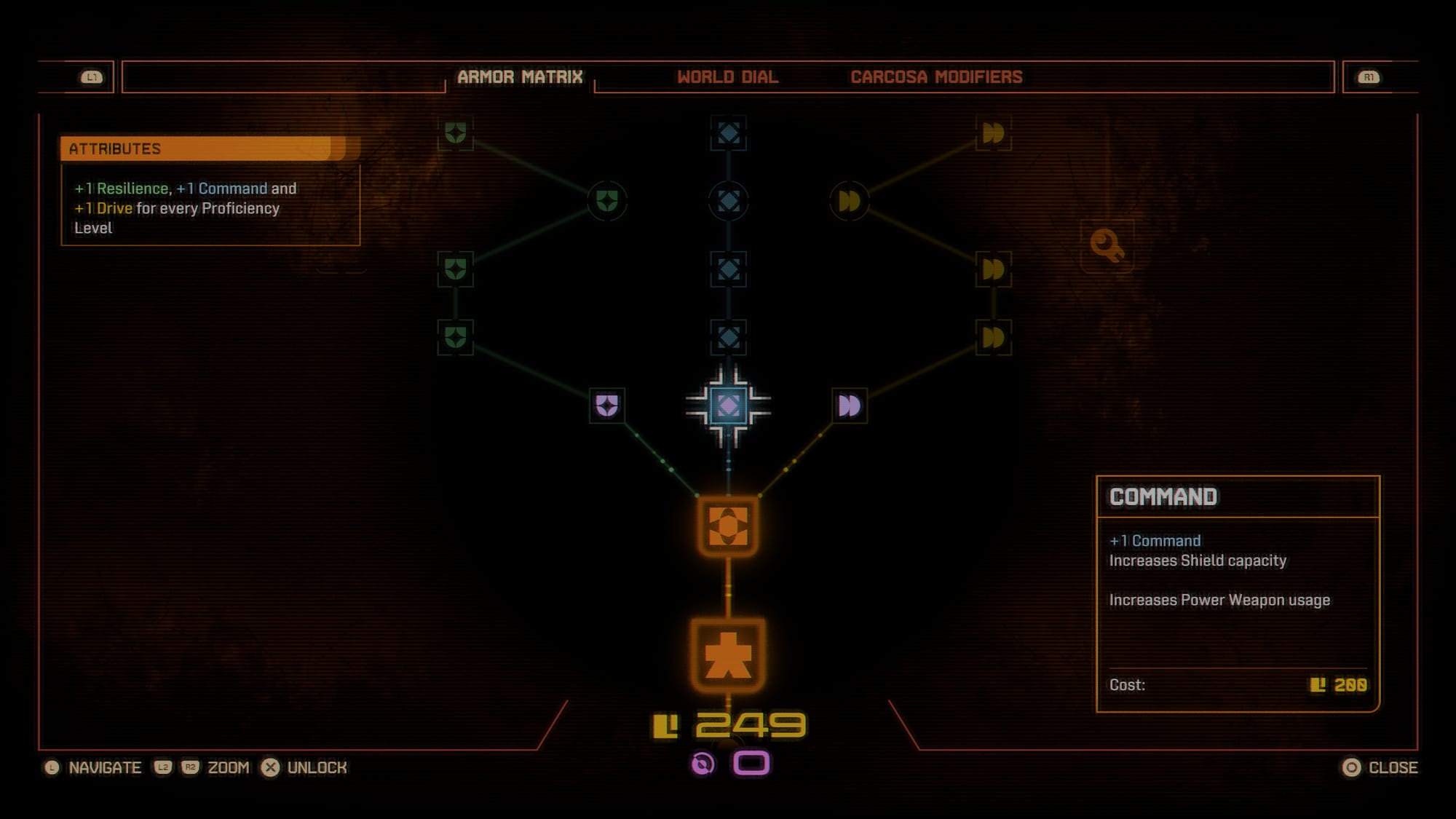
Mechanically, Saros has a great deal in common with Returnal, but it stands completely alone once you dig just below the surface. Where Returnal had minimal progression, Saros introduces a skill tree that allows you to spend Lucenite and another precious substance called Halcyon to upgrade Arjun's skills and stats. His primary skills are split between Resilience (the ability to withstand damage — your health), Command (your overall weapon and suit power for shields), and Drive (how effective you are at gathering Lucenite). As this game is roguelite (more on that in a moment), you'll need to gather as many resources as you can to survive the boss battles that gate Carcosa's various biomes.
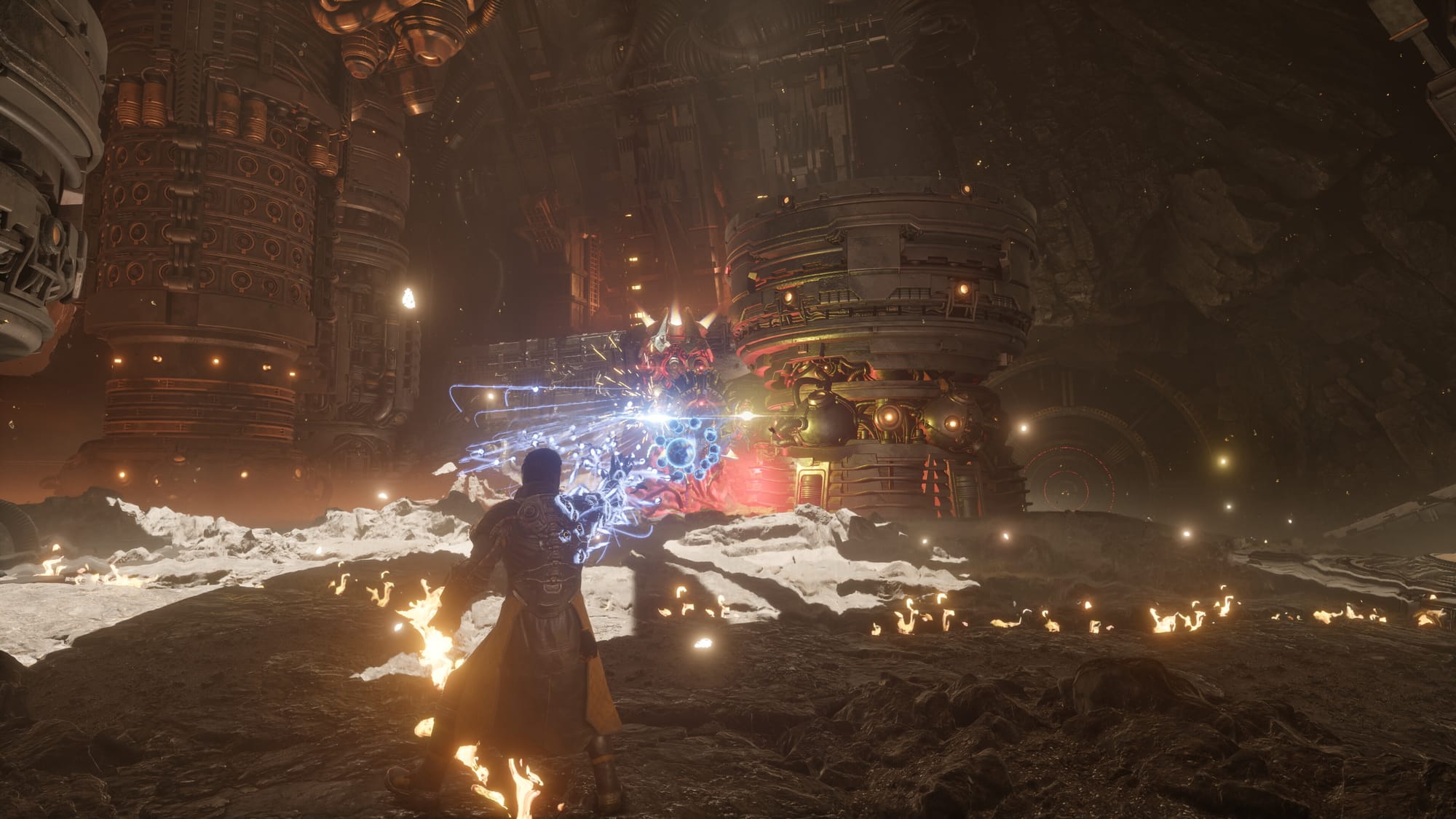
This is where artifacts come into play. Similar to the parasites you'd find in Returnal, these buffs (and eventually nerfs, which we'll get to in the eclipse section) are usually contained in a color-coded monolith. You'll click on them, smash them with your fist, or use a key to unlock them depending on said color, and they have improvements wrapped around the trio of attributes (Resilience, Command, and Drive) that keep you alive and doing damage. I've seen things as simple as an attribute boost, or as intensive as healing my integrity through damage or kills. All of these powers have a limited number of artifact spots to fill, so choose wisely and pass them up if you aren't sure they'll be useful to your build.
When you die, and you will frequently die, you'll be resurrected in a sort of Lazarus pit that reconstitutes your body. You'll pay a penalty that takes some of your Lucenite in the bargain. Alongside that, you'll lose all the artifacts, power-ups, and items you found along the way, but you retain a lower-level version of the last weapon you used. Lucenite recovered on your last run can be spent on upgrades in the Armor Matrix, a sort of power-up tree that allows you to bump up things like health, weapon damage, weapon power, shield capacity and effectiveness, artifact slots, and so much more.
It also allows you to upgrade your Proficiency Enhancement, which means you'll see higher-level weapon drops sooner in your run, effectively "leveling up" Arjun in a game with no XP. It's essentially the grinding portion of a roguelite, but without the friction. You always get the sense you're making some progress without feeling like you have to keep beating your head against the wall. If you died, you probably haven't spent enough time putting resources into the Armor Matrix. This is a new trick in Saros, and I think it's one that folks who wanted to love Returnal and couldn't will appreciate.
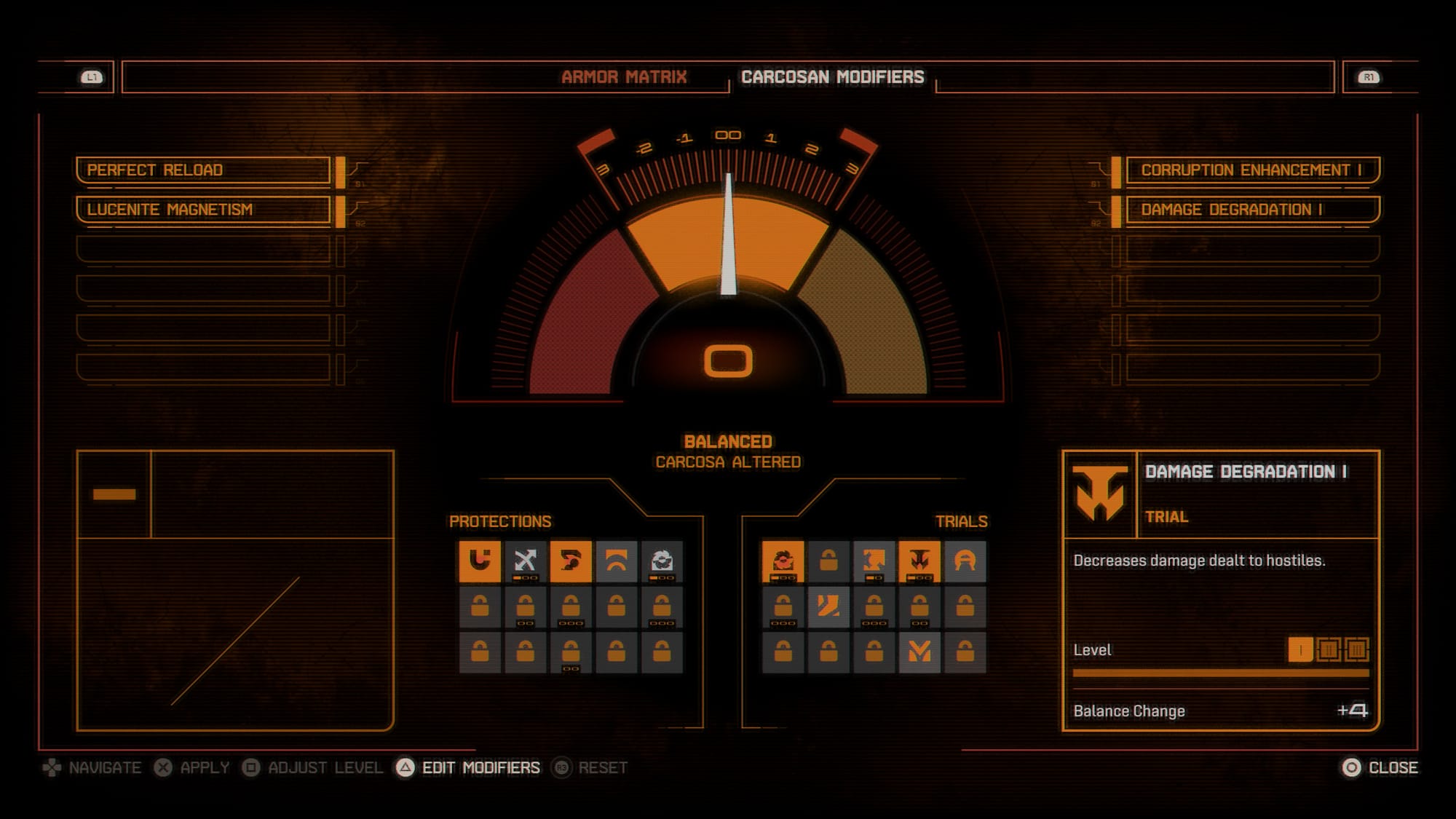
To help ensure you have the experience you want, there is a new mechanic called the Carcosan Modifier. This is a dial measuring the way the world is currently tilted to be more or less difficult. On the right are things that limit your overall effectiveness. Examples include corruption accumulation, reducing the amount of Lucenite retained after death, decreased damage to hostiles, or even destroying a random artifact when you reach a new biome!
Each of these change the balance by anywhere from +1 to +10, with the needle moving to the corresponding side as each level is activated. To counterbalance it, on the left, you have positive traits. Examples here include dispatching an Overlord to restore your Second Chance skill, increased power accumulation when blocking blue projectiles with your shield, increased damage, and decreased incoming damage.
Just as before, these move the needle the other direction, and you have to balance it out to be between +3 and -3. You can't just pick these at will, either — you'll have to find each level of them in the world and pass their trial to unlock them. It allows you to set up runs where you don't see Halcyon but maybe get significantly more Lucenite, or you're more prepared for a boss that throws specific types of projectiles. Whatever the case, the levers are in your hand to pull. Best of all, if you don't want to tinker with this, just leave it as is and it'll be perfectly balanced, as all things should be.
Saros performs a pretty neat trick to prevent you from sitting back and using smart rifles to snipe your foes. Yes, you can do that, and it will work, but any Lucenite they drop hovers in the air for a short period of time. If you don't get to it in time, it'll suddenly zip up towards the sky, lost forever. This ensures you stay in the mix and engaged to ensure you can pay for those valuable upgrades. I found myself taking risks I wouldn't have otherwise to ensure I scooped up the little bit of reward I'd earned for my combat prowess.
In combat, Saros teaches you through repetition. Your fighting skills are basic in the beginning, allowing you to use a shield to absorb incoming blue projectiles, which can then be used with the Power Weapon attached to your arm. You have a main weapon, usually a pistol, rifle, or shotgun that has a normal fire mode and an aimed mode by pulling the trigger partially. The weapons have a variety of artifacts attached to them that grant things like firing an extra homing projectile that phases through terrain, increased clip size, or a faster reload. Similarly, the Power Weapon can have Homing Missiles that seek, Grape Missiles that release additional projectiles, or another that unleashes a black hole at the target, siphoning in all projectiles they might fire while allowing yours to pass and do damage.
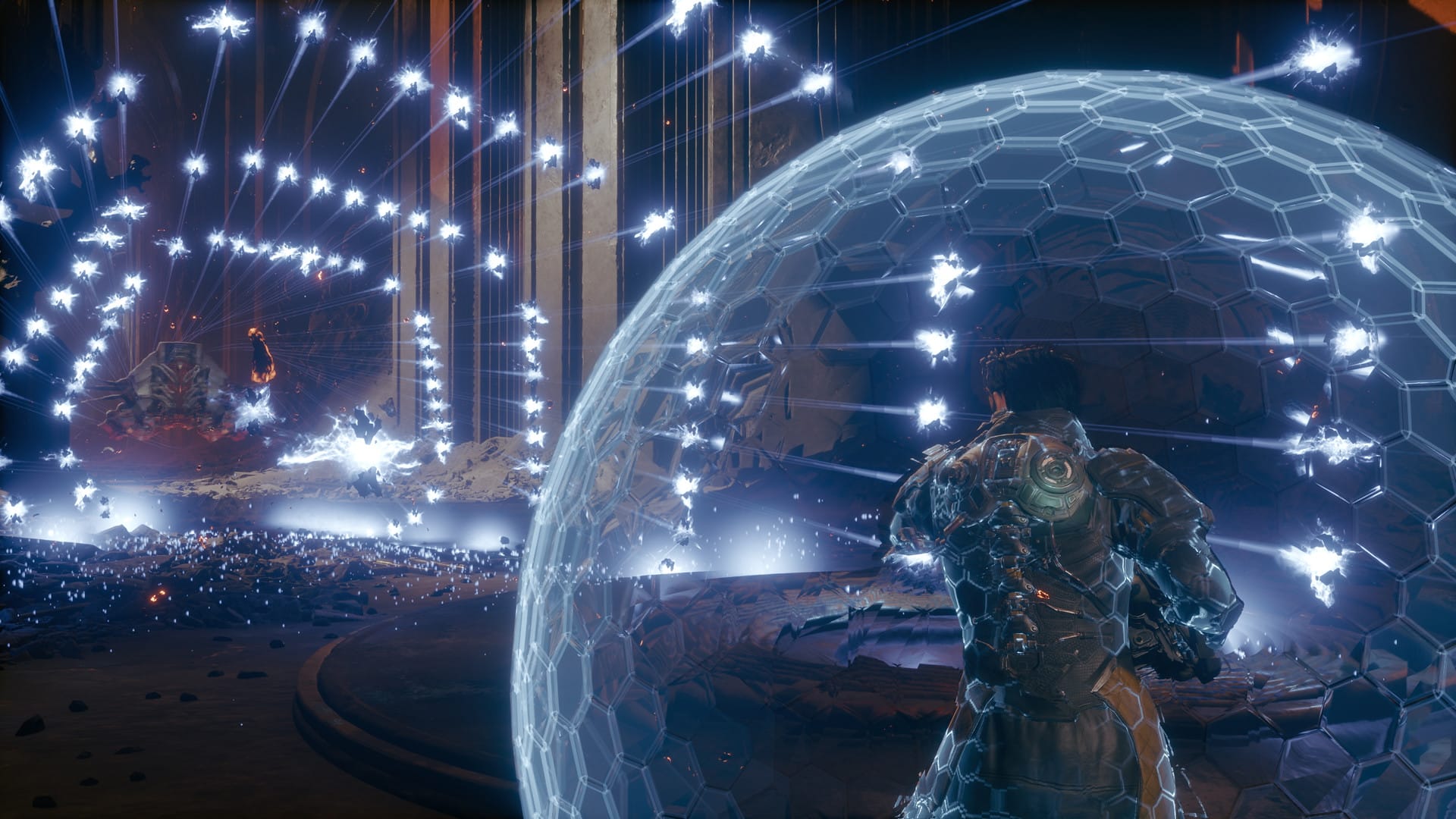
Once you've finally figured out the best combination for your playstyle, everything really starts humming. Returnal's action was frantic, and while Saros is close, Arj's style is a tad slower. Even so, it feels amazing to get into your flow state, hitting a dash, beaming an enemy out of the sky, parrying a set of red projectiles back at a turret, zipping up to it with your grapple, and finishing it off with your power weapon. Satisfying doesn't begin to describe Saros' gameplay loop; it's a near religious experience.
Saros is entirely randomized, and to a great extent. Every time you step foot onto the surface of Carcosa, it changes. Ultimately, the game stitches together various chunks of level into a cohesive world that keeps things interesting. After a dozen hours, you'll know the first two areas very well, but there always seems to be a doorway, hook point, or some other thing stopping you from exploring those areas fully until later. It's a great way to keep things familiar but fresh, while encouraging you to revisit areas to explore and uncover Carcosa's secrets. What might be most impressive is how seamless it is; Returnal's arenas felt cordoned off, Saros feels open, even with the changes.
As you enter each new biome, you'll uncover a portal that allows Primary to open the twin portal back at base to return at will. It ends your current run if you go back home, but this was missing in Returnal. Adding the ability to either get out with what Lucenite I've collected or start a run where I please is a tremendous inclusion that opens up how you can play Saros, and makes it friendlier to players in the process.
While exploring Carcosa, you'll find a number of collectibles beyond power-ups and artifacts. Audio logs of previous Echelon members or colonists can be found in the world, with a quality of life bonus that you can listen to these as you continue to move. Text logs aren't overly long, but you'll find those too. Holo Logs are holographic representations of these previous crew members, enacting a scene rather than just doing it over audio. All of these are creepy as people talk about "their last day as flesh" or how they laughed as they shot that coworker they loved so much. It's the right sort of existential dread that I love about some of the movies I've mentioned, and Saros captured it perfectly.
Fighting through the world of Saros, you'll eventually happen upon a strange and foreboding looking sort of cave opening called a Nightmare Strand. Nightmare Strands are mysterious challenge spaces that will push your timing, preparation, and understanding of your skills, tools, and weapons to their limits. There's often a severe modifier that will make the high risk area even more challenging, such as having the main weapon attributes decay through usage. Surviving a Nightmare Strand will grant you lucrative rewards, and will also restore your Second Chance (the instant revival power that lets you rise once more if you're struck down). These optional areas are brutal, but rewarding in both resources and that "Hell yes!" feeling you get when you conquer something beyond tough.
As you can see from the video version and screenshots in this review, this game is a looker. Unreal Engine 5 makes Saros look absolutely gorgeous — possibly the best looking UE5 game we've seen so far, allowing the team to bring actors like Rahul Kohli (Arjun Devraj), Jane Perry (Sheridan Bouchard, your Commander), David DeSantos (Sebastian), Shunori Ramanathan (Nitya Chandran), Ben Prendergast (Jerome Jackson) and more to life. Yes, I left some of those very intentionally vague as you'll want to uncover their story yourself.
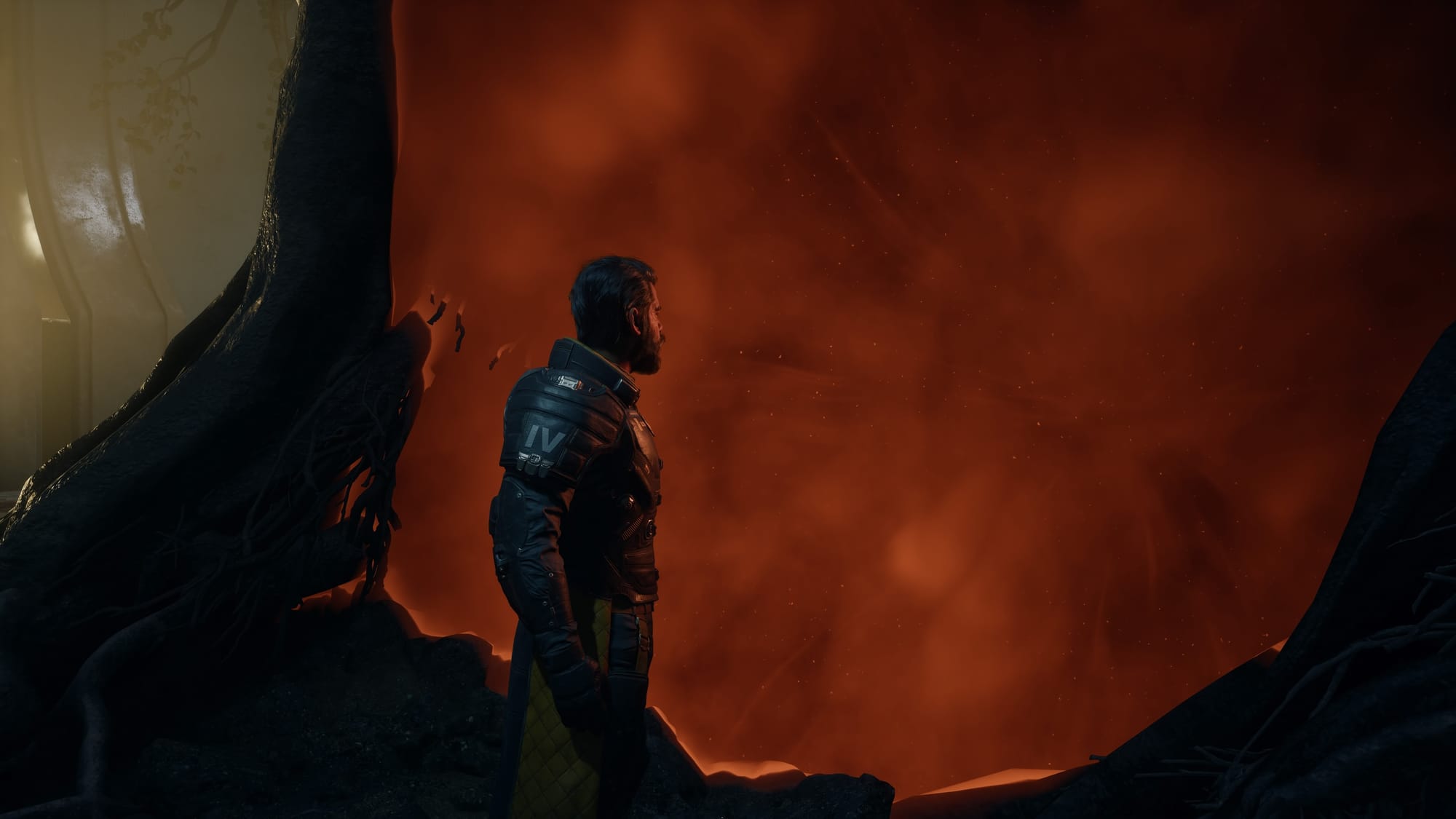
Environments look phenomenal, with the twisted underground of the Ancient Depths being massive corridors that somehow feel bio-mechanical, or the bizarre remains of the city structures of Shattered Rise being real standouts. The art team really stretched their legs on this one, creating an alien world that can look beautiful, yet completely hostile and foreign simultaneously. Again, the fact that these are puzzle pieces — arenas that move around in the biome — is incredibly impressive, especially since they fit without jagged edges.
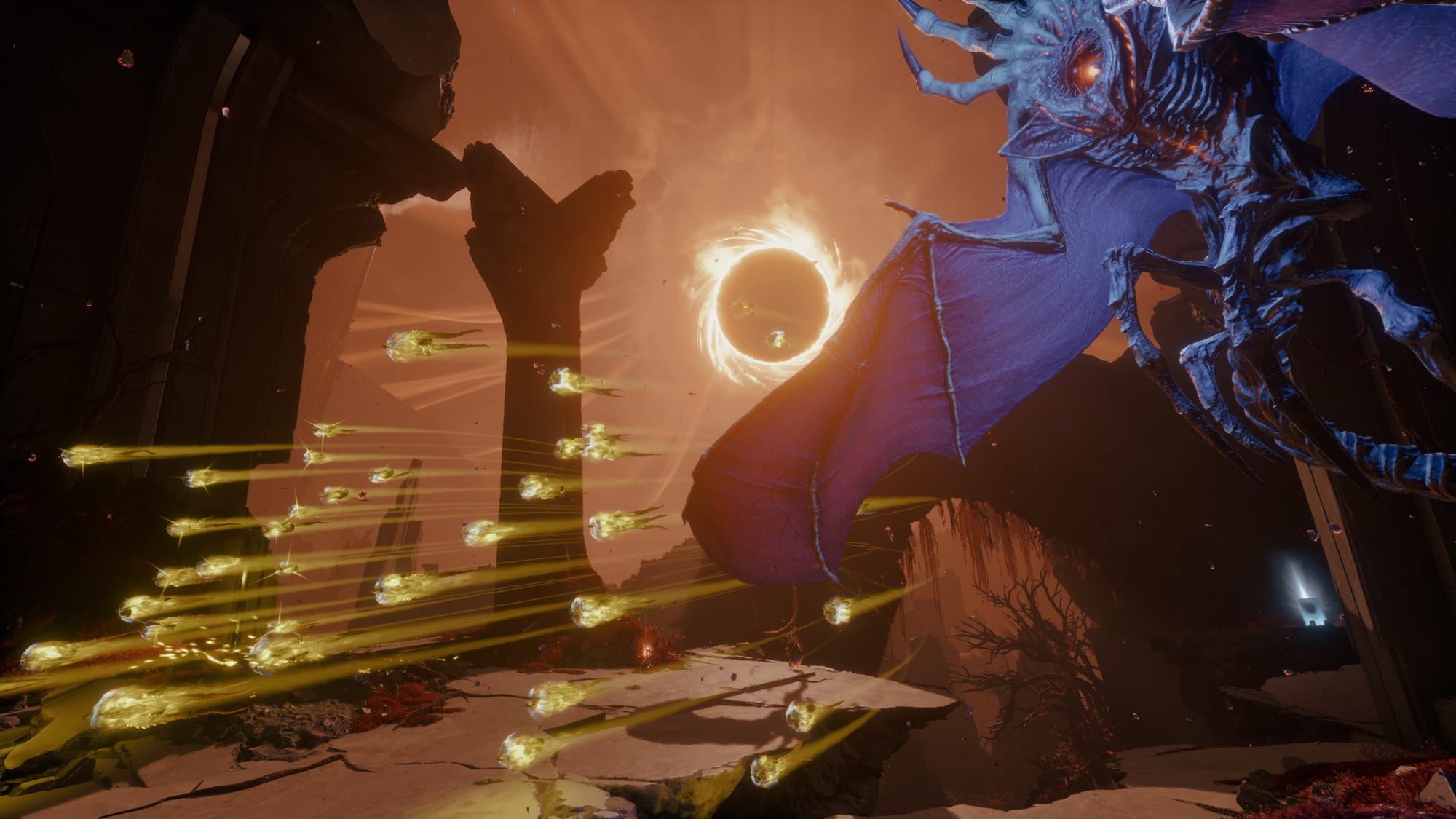
The creature design very much reminds me of the mimics in Live, Die, Repeat mixed with the Sentinels of The Matrix movies. Semi-adjacent to creatures from our own planet, but with massive tentacles or tubing running throughout their bodies. They're joined by bizarre and fantastical floating ships that launch barrages of projectiles in all directions, ones that chase you and slam the ground to spew even more bullets, and twisted snake-like creatures that sprout from the floors and walls to shoot even more bullets into the space. When they say "bullet hell", they mean this. Like the environments, these creatures are masterfully familiar but foreign, conveying their alien nature while also letting you know that they are quite hostile.
As the eclipse engulfs the planet, things begin to change. Enemies do significantly more damage, some also inflicting corruption that prevents you from healing fully. Those monoliths that once had valuable and safe artifacts now drop corrupted ones. These corrupted artifacts usually have some sort of awful trade off for whatever good they provide, but you do need the power-ups, so it becomes a juggling act of deciding how much pain you can endure and still survive.
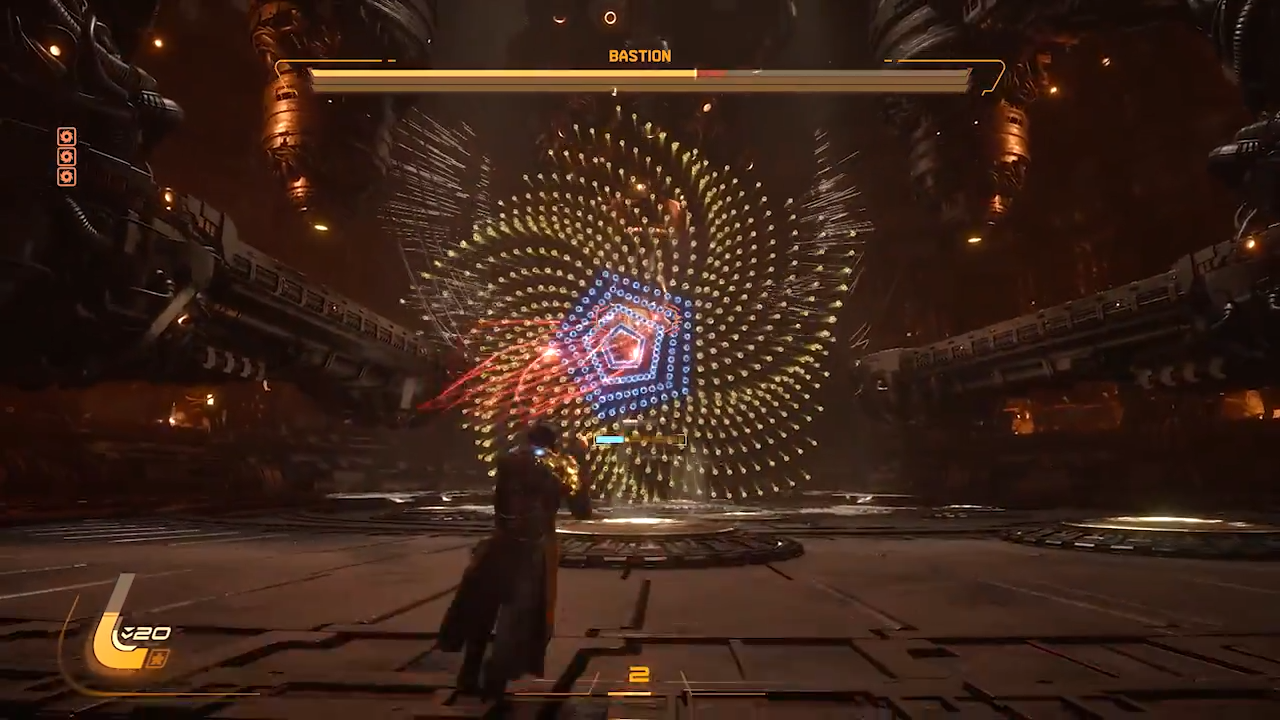
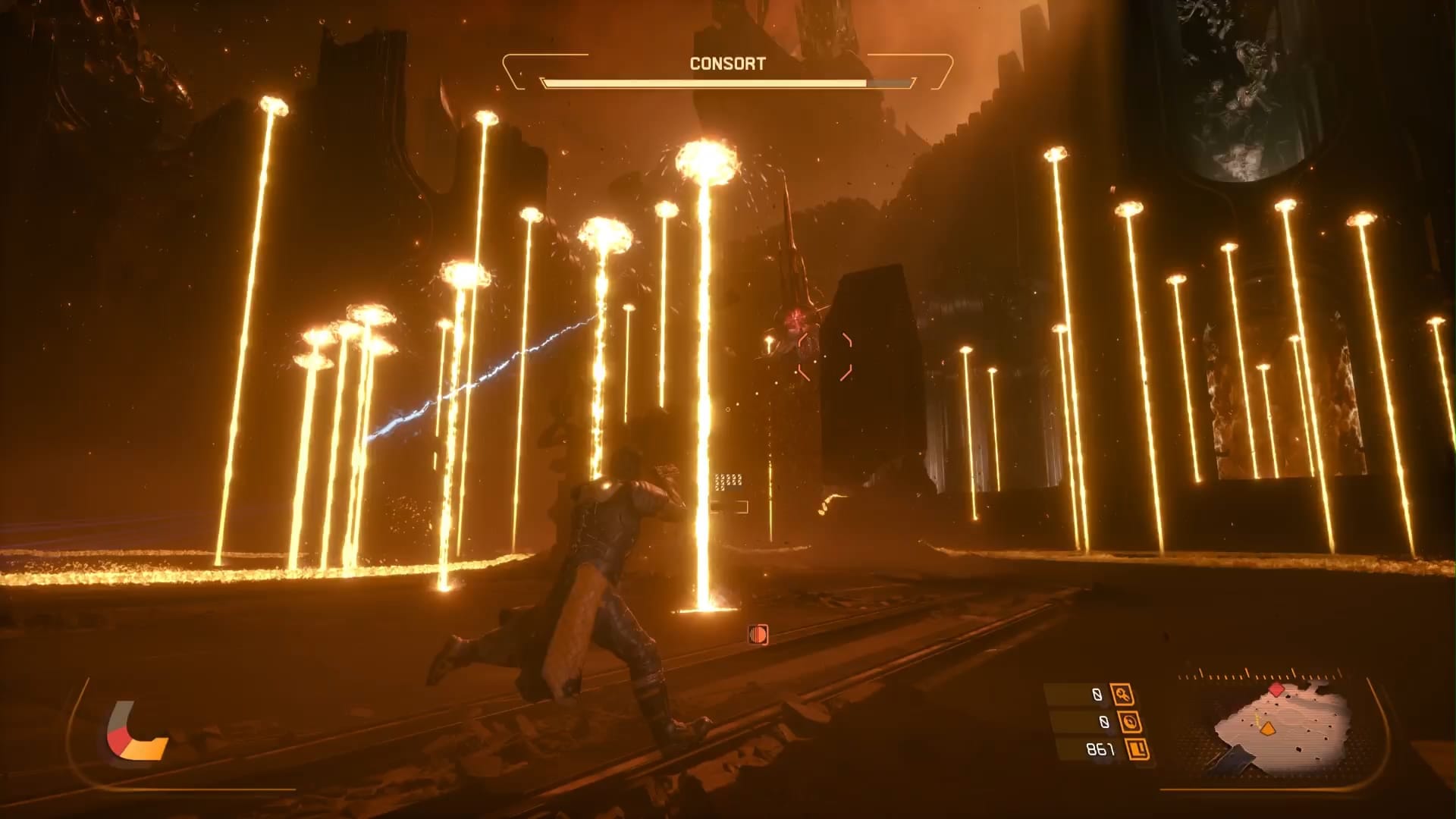
Each biome in Saros, just like Returnal, culminates in a boss encounter. Unlike the absolutely brutal fight with Phrike, they feel balanced and fair, albeit no less dangerous. The first boss here took me two attempts, where the second boss probably cost me a dozen. In both instances, I regrouped, gathered up more Lucenite and Halcyon for upgrades, and set about learning their patterns and preparing. I'm not saying the game is easier — it's not, but I am saying it's more fair and approachable. Also like Returnal, these bosses are memorable and visually striking. I won't ruin a single one of these as they are a real treat, but they are easily on par with the bizarre, piano-playing Hyperion from Returnal in quality and style.
I'd be remiss if I didn't mention the masterful use of haptics in the DualSense controller for Saros. Here, we see equal amounts of tactile fidelity, with the pip of projectiles slamming into your shield being felt in multiple quadrants of your hand, or a powerful thud as your fist slams into a shielded target. Equally outstanding are the adaptive triggers, with the half-pull enabling your alt-fire like in Returnal with pinpoint tension. It's hard to describe, other than to say that it's easily their best work yet, which is saying something when you're already at the top of that pile. Housemarque understands the DualSense like no other studio does, and uses it to their advantage.
The game's voiceover work is just as good as its haptics. I've already mentioned the wonderful cast by name, and each provides excellent voice work to bring this story to life. It sounds natural and never forced, with the right amount of panic as they realize just how wrong this planet truly is. It's also wild to hear your team come apart thanks to staring too long at the eclipse, drawing on the walls, and quoting some bizarre and unknowable scripture as they descend into madness. There are a few moments where the characters' facial animation doesn't do the dread in their voices justice, but that's just a nitpick. Hats off to the team on the voice direction — it's sublime and appreciated.
Continuing the sound conversation, it's clear that Housemarque headed into the symphony hall for this one. Bombastic bassoons and bass saxophones are flanked by shrill stringed instruments like violins to deliver the kind of soundtrack that sets your teeth on edge and prickles the back of your neck. When the eclipse happens, you get music that would sound at home in the best sci-fi horror movies — as discordant as it is disquieting. I absolutely love the way it unnerves the soul. It's masterful, and I applaud the team for it.
Sound effects in Saros are equally haunting. Lasers sound powerful and slightly out of tune, pulsing as they slam the ground. Projectiles whoosh past, giving you the sense that you just literally dodged a bullet. The whoosh of Arjun's dash has an emphatic subtle thump to it, letting you know this is more than just moving quickly — something beyond that is happening with your suit. Weapons rip off round after round, often accelerating to a fever pitch. PlayStation's Tempest 3D audio may be the star, but the team has optimized it to add immersion to your experience. Again, I have to commend Housemarque, as they have clearly spent a great deal of time agonizing over these two aspects of Saros.
Saros, at least at launch, is not a completely flawless package. Even on a PS5 Pro, I saw the occasional performance hit where frame rates would dip. It was never detrimental to the action, but you could absolutely see the engine struggle to keep up with what I believe to be loading sequences happening in the background. It was never about the amount of enemies on the screen, in fact happening more often when I came back to an area that had been transformed by the eclipse. I imagine this could be something the team patches in the future (and even could come day one), but until then, it's worth pointing out.
Saros
Excellent
Saros is Housemarque's ultimate creation; the culmination of years of hard work and experimentation. Returnal is Game of the Year quality, no doubt. But Saros has taken what Returnal offered and refined it, only adding to the formula until the end result is Housemarque's finest release yet. In a sea of great April games, Saros' excellence stands out as another Game of the Year contender.
Pros
- A more approachable roguelite with a sense of progression
- Thrilling and rewarding fast-paced combat
- Wealth of mechanics and systems
- Brilliant world that rotates flawlessly around you
- Outstanding sensory devices (sound design, color palettes, DualSense haptics and triggers)
Cons
- A few bugs
This review is based on an early PS5 copy provided by the publisher. Saros comes out on April 30, 2026.