Has childhood media ever haunted your memories, beckoning you with sweet promises of more innocent times? The PlayStation’s Rugrats: Search for Reptar is one such personal example: as a youngin’ who religiously followed Nickelodeon’s famous tots in cartoon, movie, and comic form, I played the living binkies outta that game, the disc scratched up to the point where certain scenarios straight up wouldn’t play. With said disc eventually going missing, I’ve since longed for those days of popping Mirrorland balloons, busting up mobs of Mr. Friend robots, and playing rounds of mini-golf down at Ice Cream Mountain.
Now, here’s a more sobering question: have you ever endured the melancholy of said childhood media not holding up to the rigors of adulthood? I’m referring not to classic Rugrats, mind – the show’s sweet-spot in its earlier seasons remain some of the finest children’s programming in all television, melding the inviting curiosity of childhood with parental cynicism to alchemize what Steven Spielberg once championed as 90’s Peanuts. But while Search for Reptar’s typically hailed as the finest Rugrats game, its grand reenactments of the Nicktoon’s finest episodes now feel basic and rudimentary. Talk about being too big for diapers.
It’s one of the many disappointments courtesy of Rugrats: Retro Rewind Collection: nostalgic millennials curious to relive their childhoods with this collection will quickly find they’ve outgrown its playpen delights, packed with too little stimuli for grown-ups. (Or, as the Rugrats would say, “growed-ups”) It’s not that kid-centric video games are bad in themselves—their methods of executive functioning simply present more approachable building blocks to entertain kids too intimidated by Mario’s circus acts. Yet it’s not just how none of these games capture Rugrats’ magic in appealing to all ages: it’s that most of them are as wonky as Stu Pickles’ inventions.
Putting it this way: they’re not very, well, good.
The collection features six different games from the turn of the millennium: Rugrats: Search for Reptar (PlayStation), The Rugrats Movie (Game Boy Color), Rugrats: Studio Tour (PlayStation) Rugrats: Time Travelers (Game Boy Color), Rugrats in Paris (Nintendo 64/PlayStation and Game Boy Color) and Rugrats Castle Capers (Game Boy Advance). Each one is framed within the Rugrats’ familiar kindergarten problems, host to oversized imaginations and unintentional chaos wrought by adventurous babies. Their respective soundscapes are dead ringers for the show, the voice cast cheerfully espousing mispronunciations and itty-bitty ruminations to familiar arrangements of Mark Mothersbaugh’s score: their dreamy recorders and babbling chorus mirroring the characters’ ever-growing curiosity. The handheld games are all tepid platformers, whereas the 3D games present mini-games and bite-sized adventures of all sorts.
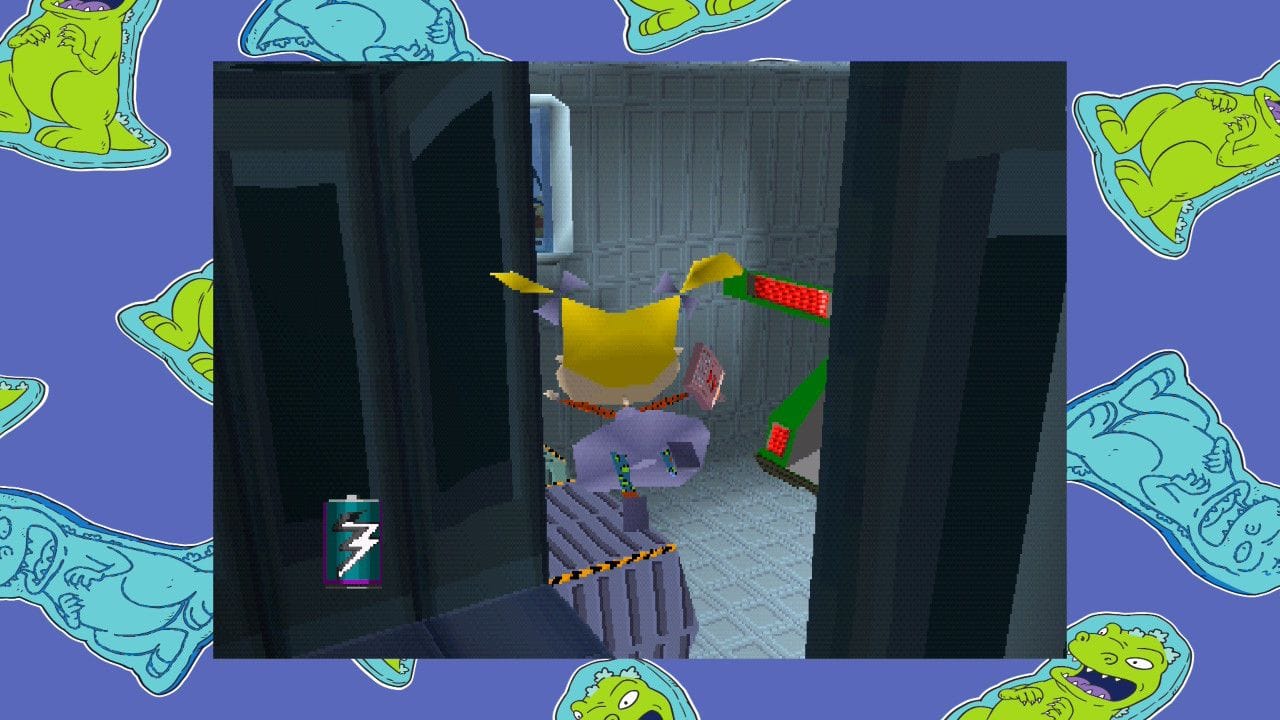
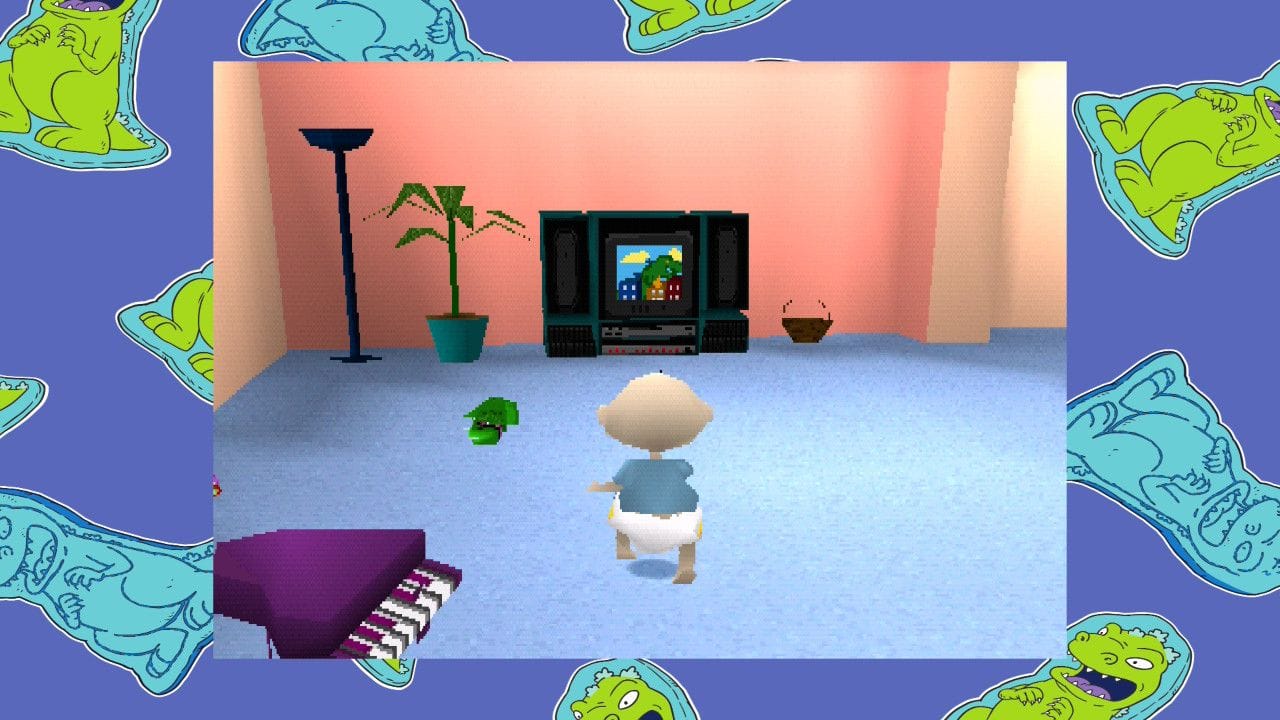
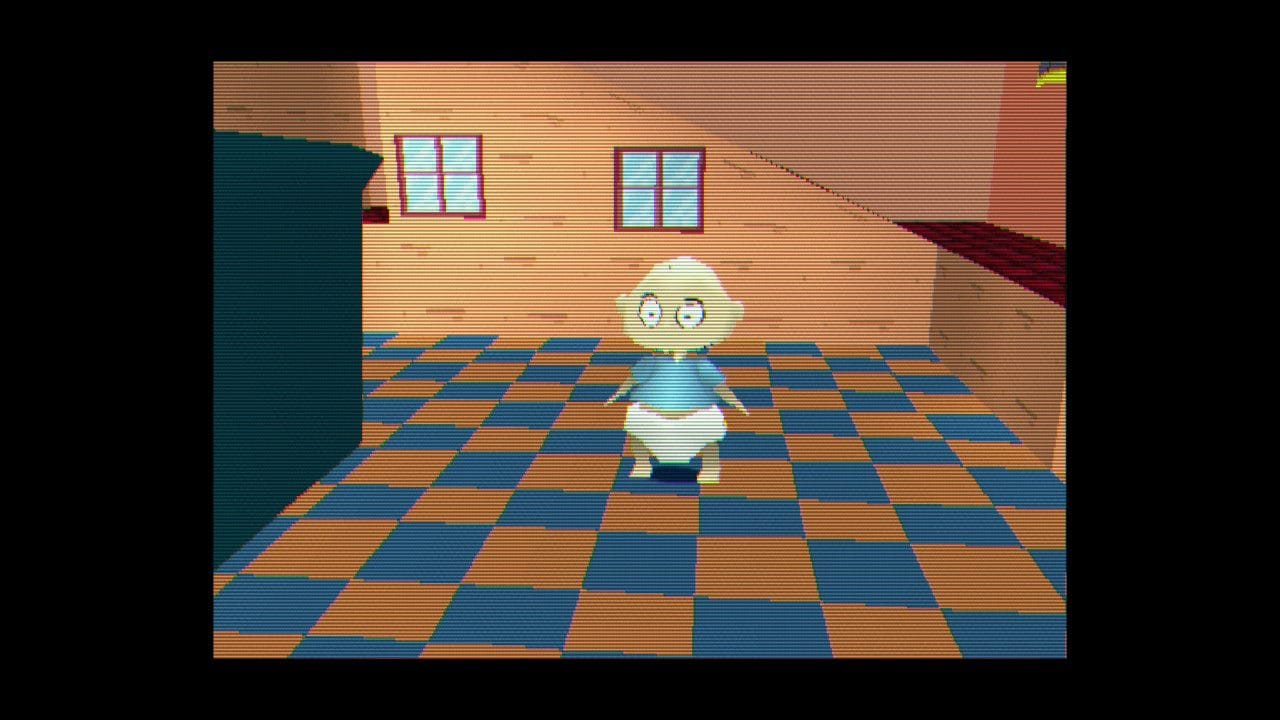
The Retro Rewind Collection knows Search for Reptar is the fan-favorite: it proudly opens with its janky recreation of the famous opening and plays its twenty-second menu theme loop on the, well, menu. Revisiting it today as a world-weary growed-up, it’s easy to see why it captivated me: the Pickles household is a compact little sandbox, its open-ended mission of finding the lost Reptar puzzle pieces perfect for lazy afternoons and frequent replays with its two-hour length. Most every level reinterprets classic Rugrats episodes into separate gaming genres: “Incident in Aisle Seven” is a straight-up action platformer where Tommy slips on ice and throws projectiles at snippy lobsters, while “Let There Be Light” is an age-appropriate survival-horror with spooky ghosts hounding Tommy throughout the house, fended off only with your ever-depleting flashlight. (Sorry, YouTube memers: there’s no mini-game depicting Stu’s existential crisis at 4 AM while whipping up chocolate pudding)
As a Rugrats-obsessed tyke, it’s a veritable interactive theme park inviting us day after day; as a grown adult who fondly reminisces on the show, it’s akin to digging up that jigsaw puzzle that stumped you at four years old. Search for Reptar frames itself as a Rugrats-themed Super Mario 64 in its hub design and open gameplay, but while the advertised difficulties for each level imply otherwise, the game never subscribes to the “easy to play, hard to master” philosophy so emblematic of Nintendo’s catalog. The platforming is simple and effortless, its host of collectathons present zero friction, and the finicky camera impedes our movement more than several times. We might occasionally concentrate to clear mini-golf courses or even smile at conquering old nightmares like Toy Palace’s Thorg animatronic, but the magic’s long since dissipated.
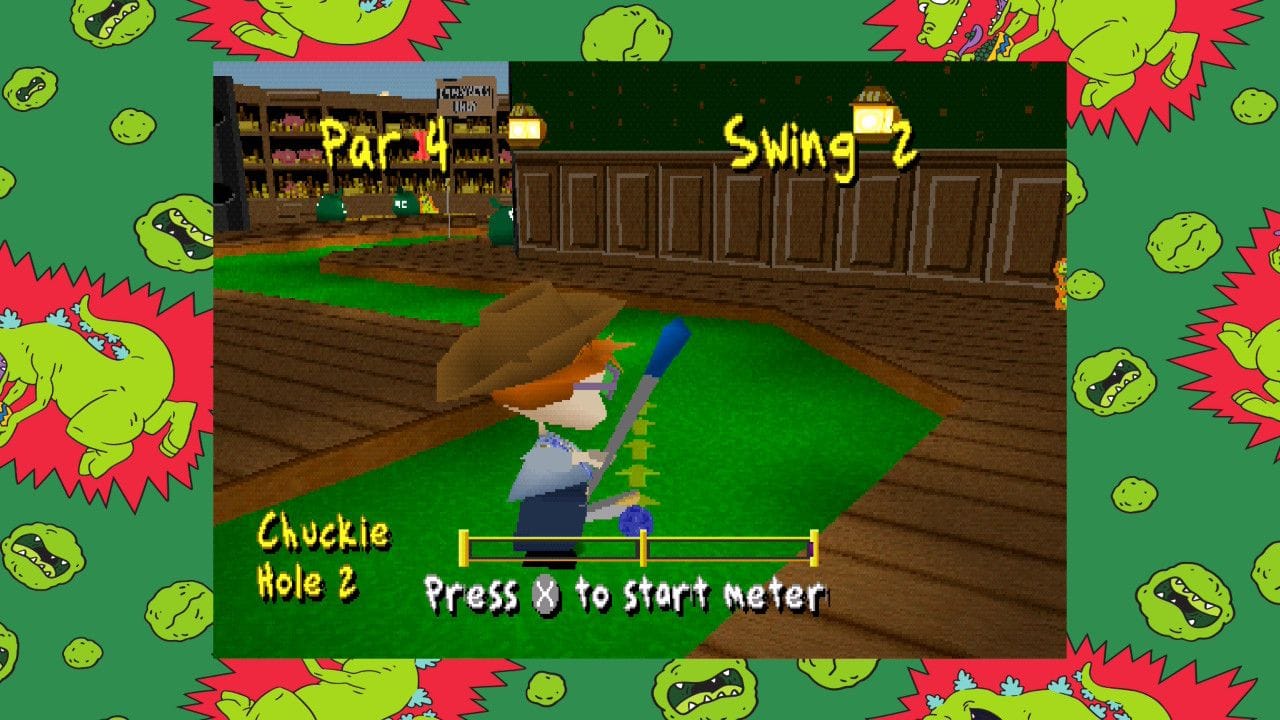
The others suffer in more evident ways: Studio Tour may intrigue with its themed segments, but when it’s not busy regurgitating Search for Reptar mini-games, it repeats concepts old and new to the point of exhaustion. Meanwhile, Rugrats in Paris employs familiar vices from the N64/PS1 era in oversized hubs and needless collecting, forcing players to aimlessly run around its numerous theme parks for the game’s currency in tickets. Did I mention how the babies run slow as molasses, or how enjoying our hard-won trinkets requires running all over the park to stand on their respective emblems? (And that's supposing they're of any worth--a toy scope yielded nothing but watching a clipart slideshow) Paris’ host of attractions may entertain in small doses, but the overall fatigue persists.
The handheld games are particularly stymieing: it’s one thing to design games exclusively for young children, but The Rugrats Movie adaption confounded me back when I rented it from Blockbuster and couldn’t escape the opening basement level, and it—alongside its siblings—confounds me now. The Game Boy Color entries present unimaginative use of the Rugrats license, plopping the babies into stock platformers that gate off aspiring players in droppable mandated collectibles (thank goodness for rewinds!) and maze-like level design to the ticking of an impending clock. Both The Rugrats Movie and Time Travelers are indistinguishable in their confusing geography, and Rugrats in Paris’ puzzle-based levels are simply too opaque for a young audience. (Or adults, really; actually, it was the one game I didn’t bother completing)
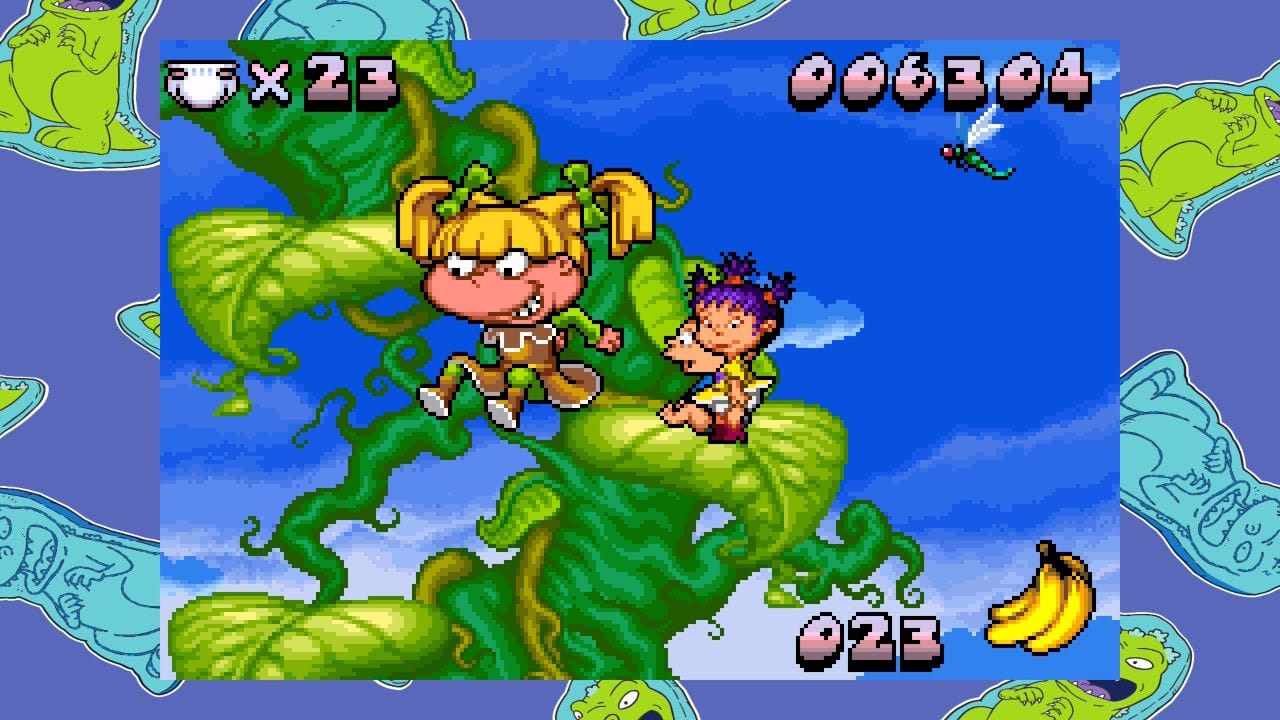
Only the lone Game Boy Advance title in Castle Capers is remotely approachable in mimicking the show’s bright colors and group-based camaraderie, yet its routine failures in indecipherable gameplay renders it an abject mess. Why am I throwing food-based projectiles, and why don’t they take out enemies? What is the objective behind these sudden Angelica boss fights, and why are they taking so long? The answers do not comply with any standard gaming conventions or clear visual cues, all problems compounded upon by the lack of any solid foundation: collectibles are merely a formality, and the follower system’s potential is squandered in its limited use. It is a game with no describable purpose, “designed” only to distract the very young with flashing lights and familiar mascots.
As the Retro Rewind Collection is a Limited Run Games-based preservation, you might be curious as to the emulation quality. While the rewind and save state features are appreciated, the PS1 games’ sound pops and rewinding bizarrely silos characters’ cutscene dialogue into distracting echoes. Moreover, the display filters vary in quality: the GBC games feature superb pixel-perfect filters, but the PS1 games are tarnished with pasty lighting, and Castle Capers’ darker display only brings back bad memories of the pitch-black GBA screen. We can only hope there’ll be future patches to smooth out the rough edges, but in the meantime, I’m left wondering who filled in the scanned manuals’ Notes sections. (What, they didn’t have any clean copies lying around?)
Grandpa Lou once concluded a Rugrats episode by opining there’s no use reflecting on the past when you have so much good going on now. Rugrats was hardly a show left wanting for poignancy—the titular babies’ existentialist ponderings on death, parenthood, and everyday appliances proved an identifiable counterbalance against the day-to-day struggles of their neurotic parents—but this piece of gentle wisdom teaches us the art of the letting go, even with things that once brought us joy. Any tyke today growing up with reruns of Tommy Pickles and the gang may enjoy (some) of these time capsules just fine, but us growed-ups should let memories be memories.
Rugrats: Retro Rewind Collection
Mediocre
Rugrats: Retro Rewind Collection may have a redeeming game or two, but their Dr. Lipschitz-inspired design miss what makes the medium entertaining for children. Fun as Search for Reptar and others may’ve been in our youth, it’s well past time to put our nostalgia to bed. Catch some Rugrats reruns instead if you’re able: I recommend “I Remember Melville”, “Grandpa’s Date”, and “Mother’s Day”.
Pros
- Search for Reptar is still decent.
Cons
- Too rudimentary for veteran gamers.
- Portable games are just straight up bad.
- Not the best emulation.
This review is based on an early Nintendo Switch 2 copy provided by the publisher. Rugrats: Retro Rewind Collection comes out on May 22, 2026.