Weird Heroes of Public Access looks and feels like something out of a bygone age. This helps lend to the theme a great deal: as the staff of Fairhaven’s public access channel, your team will investigate the strange, sometimes horrific secrets peaking out from within the static. What began as a zine in August of 2021 has been supplemented with dozens of more additions that it’s inspired over the years. More zines are in process and ready to go to print, some by the team at Get Haunted Industries and others from third parties. The game itself is simplistic to what may be a fault, with very much the feel of a package of zines rather than a true core book.
Presentation and Organization
There’s a clear throughline of inspiration at the heart of WHPA, as there must be for something so niche to exist at all. Do public access channels even exist in the modern age? Has all of that low-budget government programming gone to YouTube, or is it a lost relic of the past? I can’t answer that question, but I can tell you that the mysterious, lost feeling it evokes helps sell the game’s overall weirdness. A more modern reference point would be something like Late Night With the Devil, which you should ignore so that you can watch 1992’s Ghost Watch, the earlier, smarter, more effective implementation of a similar idea, which features no use of generative AI at all.
WHPA, the book is a slim 110-page hardback with a lining of eerie yellow 70s wallpaper. There’s little consistency with the font or layout, owing (I think) to its origin as a series of supplements. Much of this is purposeful. Often, the black and white typeface feels like it comes out of a typewriter right from the studio. Many of the other adventure seeds or setting details are styled like ads in pulp magazines or TV guides, with gloomy and grainy pictures a half step away from reality.

Along with inventive and eerie adventure seeds, the overall presentation does great work to meld horror and humor. The endeavor successfully melds that feeling of familiarity, but eeriness that public access often holds. Something like Channel Zero’s first season, where the same charm that makes the work close to home conceals a veiled yet ever-present threat. The off-green cloth bookmark and binding work make this a step above the bound zine that it might otherwise have been.
WHPA’s many adventure seeds and setting details are similarly filled with suggestive, imaginative potential. Where they leave something to be desired is in the follow-through. It’s incredible to read a page about the mysteries of Fairhaven, like the ever-shifting Time Hut, the manifestations from the flickering static, or the lost underground prohibition-era Tunnels of Amantillado. Using them in-game requires a few more steps than I would like. These seeds of adventure sometimes have more going on. The Tunnels, for instance, take up a few pages along with NPCs and a secret to uncover. Far more often, you’ll find nothing more than a page or paragraph of suggested weirdness, leaving the rest to the GM to work into an adventure.
All that belies a larger reality, which is a general lack of organization. Their book features no index or table of contents whatsoever. Beyond the opening pages of rules text, the many adventure seeds that follow are packaged in with one another, with nothing in the way of organization or navigational assistance. The work is good and features plenty of standout art pieces, but it remains very much the set of zines that it began as.
Rules & Mechanics
Players are Hosts, and the GM is your Ref in this game, where off-kilter public access staff make their way around Fairhaven’s strange and horrible mysteries. Basic resolution involves rolling 1d6 for each relevant Skill Point you have in a Core Skill. Any 5 or 6 results in a success. Rolls containing only 1’s reduce your Hope Points, while all 6’s grant a Supernatural Point to power abilities.
The Core Skills would be more traditionally considered Attributes in another game. These consist of Mind, Mouth, Body, and Soul, and are more than a little muddied in their distribution. See below for more information. You’ll see that Mouth, for instance, includes Persuasion and Intimidation, but Soul is Leadership, De-escalation, and Charisma. I fail to see where the dividing line is between these ideas. To me, charisma and persuasion are very much interlinked. Mind and Body are more distinct, but for the fact that translation comes from the Mouth and not the Mind, the more academically attuned of the skills.

Character creation involves first deciding your niche programming focus, then distributing a few skill points, determining your day job (funny, you wouldn’t be paid enough to work the TV station full-time), getting some money/gear, making connections to local people or factions, and coming up with a supernatural ability. Each programming focus, like the Monster Movie host or Variety talk-show staff, has bonus skill points and special abilities to help you along your way. These could be special connections, access to better equipment, or weirder offshoots like healing touch. The supernatural abilities unlock once you roll all 6’s, have essentially no rules behind them, and are meant to be used only once an adventure, until you level up and increase your capacity.
Everyone begins with 6 Hope Points, which decrease with bad rolls or the very minimal combat rules, which you can see below.
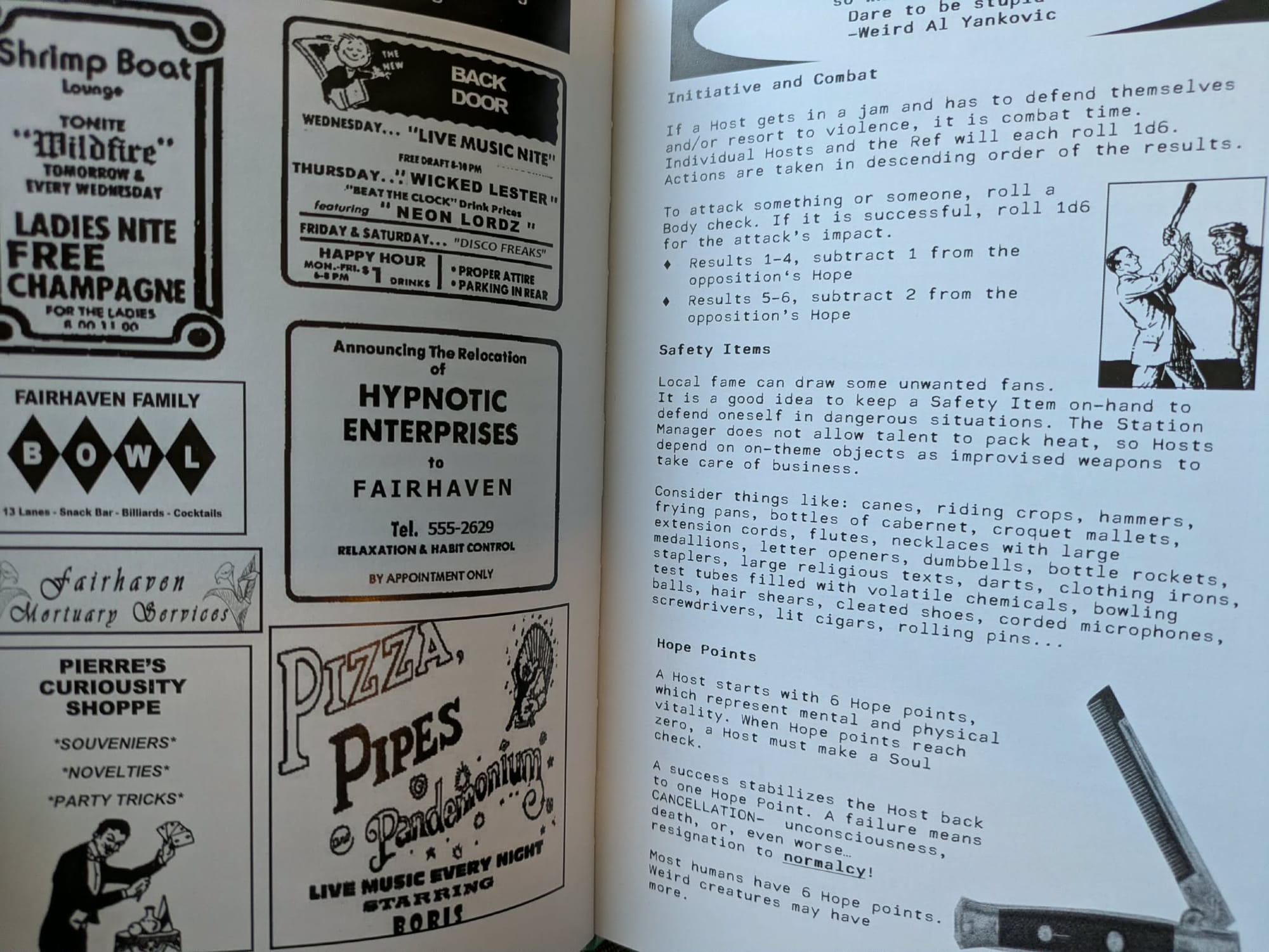
There you have the entirety of the rules. A supplement later in the book gives a little more texture to supernatural abilities, but not enough that I could call them real, meaty mechanics. Is that a bad thing? It’s complicated.
WHPA is looking for quick, dirty, and strange adventures. It achieves that. The rules aren’t bad as as they are virtually nonexistent. I do have some problems with them, such as the distribution of core skills, but it’s clear that they are meant as a basic framing to serve the greater functions of wacky, off-the-wall shenanigans. This is a light-weight package that feels a mite steep at $35; its uncoordinated energy is as much an asset as a liability.
Conclusion
There’s a lot to love about Weird Heroes of Public Access, but maybe not as much to like. This is clearly a work of passion seeking a niche audience, so I could by no means call it a failure. If you’re willing to dig into the strangeness on display and add a good helping of elbow grease to the palpable vibes brought out by this game’s ideas, you can get past the minimal rules and adventure advice. I don’t know if I’ll be running this any time soon, but I can already say that I’ve found it a worthy source of inspiration for a small-town horror series I’ve been writing in my off time.
If you want more information, you can look through this resource of links, the Get Haunted Industries sales page, or their Drivethrurpg catalogue.
Weird Heroes of Public Access
Alright
Weird Heroes of Public Access succeeds less as a tightly constructed roleplaying game and more as an evocative artifact: a lovingly strange, nostalgia-soaked collection of ideas that perfectly captures the eerie charm of public access horror. Its presentation, art, and adventure seeds drip with personality and imagination, blending humor and unease in a way that feels both familiar and unsettling, even if the lack of organization and navigational tools makes it harder to use at the table than it should be. The rules and adventure text are sparse enough to detract from the overall quality at times. Ultimately, WHPA is best approached not as a complete, ready-to-run system, but as a passion project and idea engine: imperfect, messy, and brimming with inspiration for those willing to meet it halfway.
Pros
- Strong, distinctive atmosphere that nails nostalgic public-access horror
- Evocative art and presentation full of imaginative adventure seeds
- Lightweight rules that support fast, weird, low-prep play
Cons
- Lack of organization, with no index or table of contents
- Extremely thin mechanics that push too much work onto the GM
- Many ideas lack sufficient follow-through for easy table use
This review is based on a copy provided by GamingTrend.