Untamed Worlds’ vision of corporatized, military science fiction has a lot to say in its 288 pages. The game is set as humanity expands its influence among the stars by means of genetically engineered grunt soldiers; myriad races of animal-human hybrids with superhuman abilities but sub-human rights are tasked with taming these new worlds and settling disputes between their many factions. Jack Norris’ writing is full of inventive, thematic grit that could easily support fantastic novels if he set his hand to them. Unfortunately, he wrote a game instead. That game has flaws great and small which keep me from being able to recommend it, as much as its background sets my mind alight with ideas.
The Book
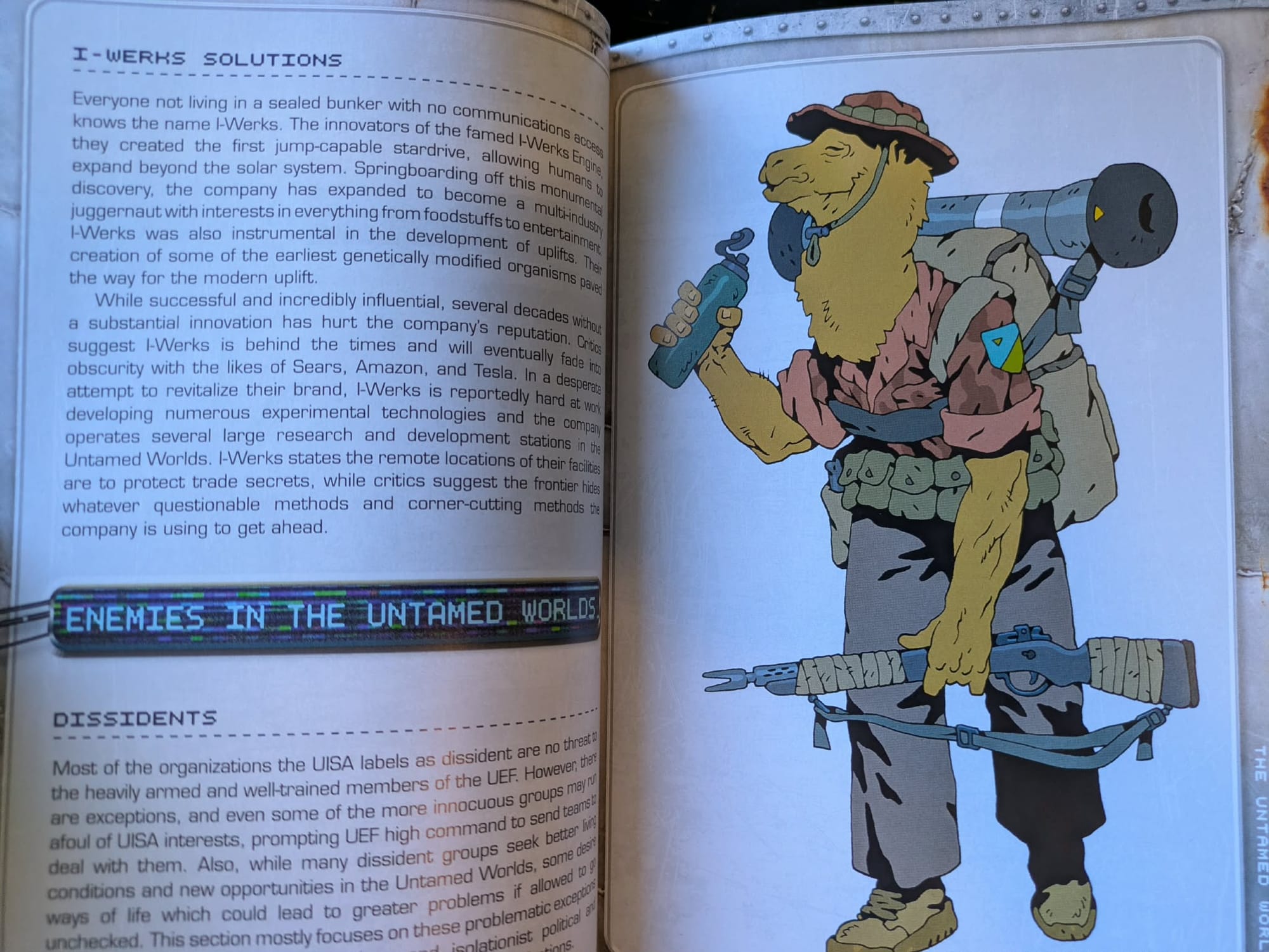
I have issues with this RPG in both micro and macro, but I’ll start with the high level problems and deal with the mechanics themselves later on: lack of organization or thoughtful presentation of information. Most of the book is just blocks of text, one after the other. These are broken up with the occasional header, but the book as a whole neither directs your attention nor paces its information in a way that would make it easy to navigate. There is no index to speak of, but I do credit that the table of contents is comprehensive and features a great summary of character creation specifically.
The structure opens with 58 pages or so of setting before discussing any game terms, which is a huge amount of information to dump on the reader. It’s generally interesting, and I like Norris’ talent for spinning this galaxy up, but it’s rough to read through and worse to use at the table. The writing features a level of detail that just isn’t conducive to use as a game. Mixed in with broad discussion of power dynamics and technology are so many details on enlisted ranks and dissident factions that I don’t expect most GMs to track it in any useful way.
After the setting information we get the base mechanics and combat chapter. This is full of references to character information that you won’t be familiar with yet, tasking you to flip forward into the book to find context for information it’s presenting to you. This combat chapter is not organized in any way that makes it coherent. As an example, it tells you about the following concepts in order: Turn Order & Action Points, basic task resolution, enemy mobs, hit points, Situations (effectively rules for non-combat encounters), and only after all of this concludes is Character Creation.
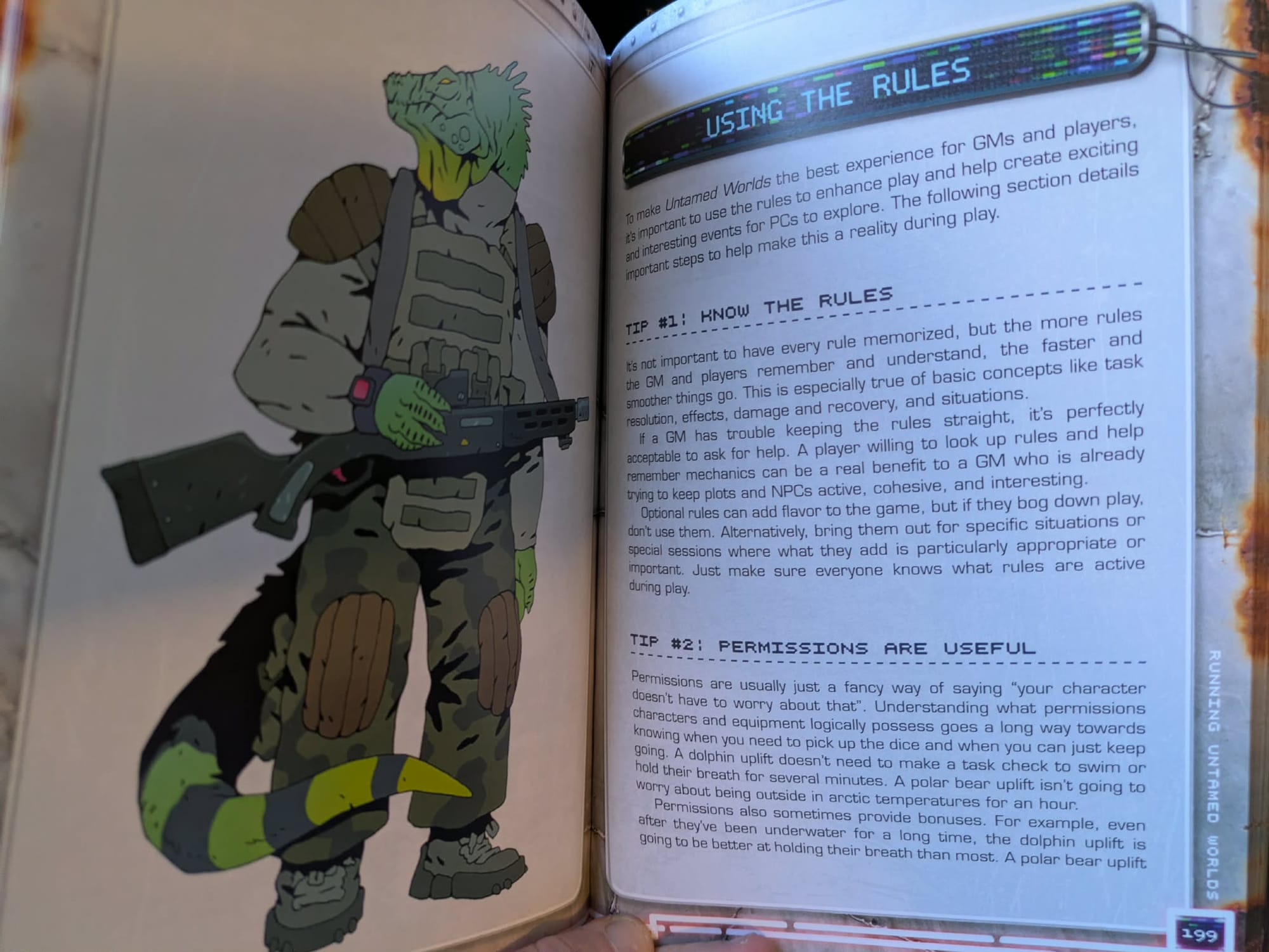
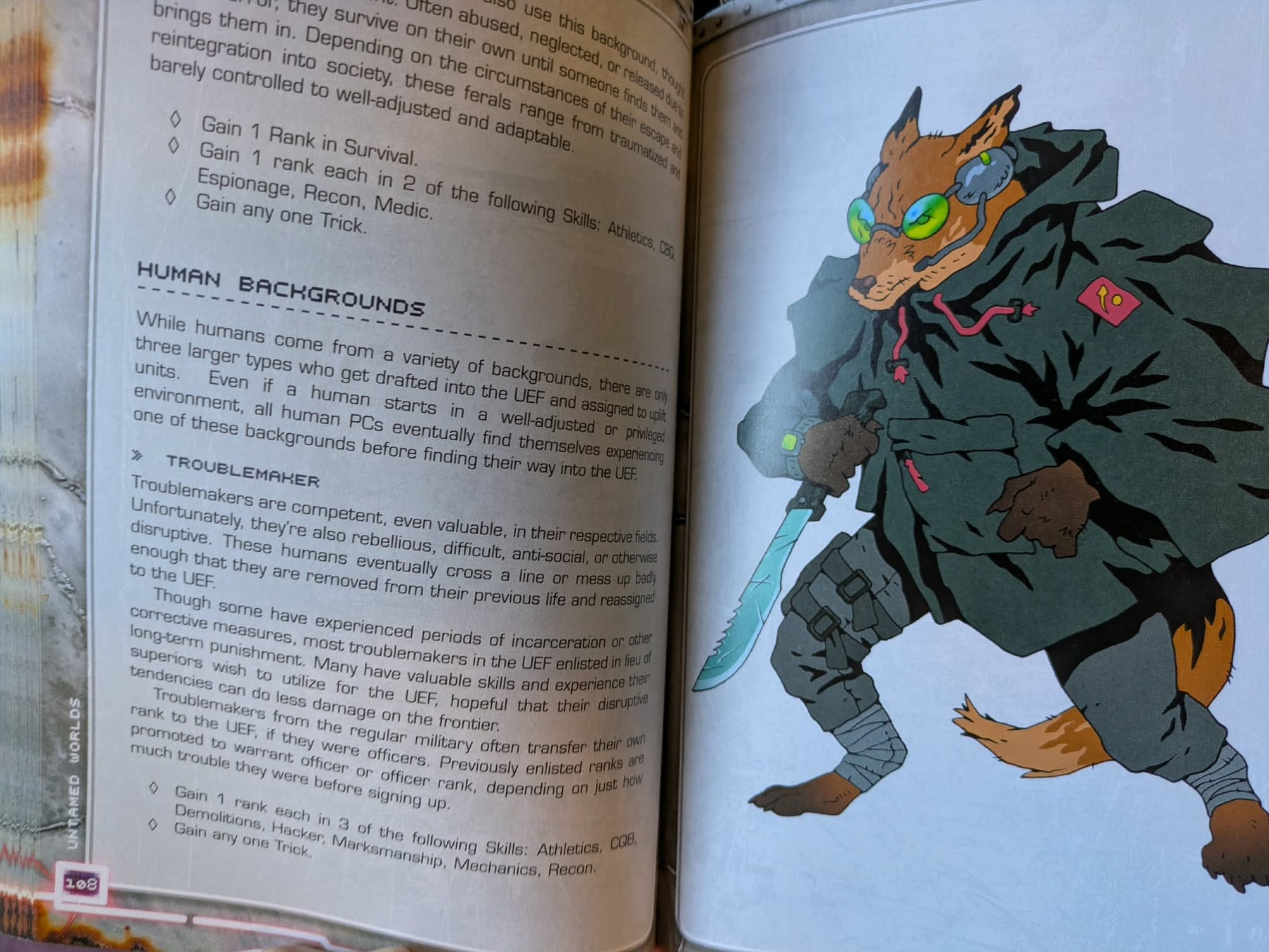
The layout does this no favors, everything muddled in a gunmetal gray with black text. Ideas begin and end with little concern for the reader, sometimes spilling onto new pages without sensible breaking points. The art is sparse and unrelated to any given section you’ll be reading through. Apart from some depictions of the animal soldiers, some equipment thrown in at odd pages, and a one page cut of the cover itself, there is no art in this book. Each of those pieces are dripping with detail, and show a lot of care put into both the overall design and depictions themselves. If illustrator Logan Stahl had been given more room to flex his skills, I might be left with something memorable that I could meaningfully compliment.
The moment to moment writing is also inconsistent. As nearly 300 pages of pure text, there’s quite a lot of it, but it conveys neither the tone nor succinctness I would expect of a grimy, military-focused RPG book. Just as one example, take a gander at the page below.
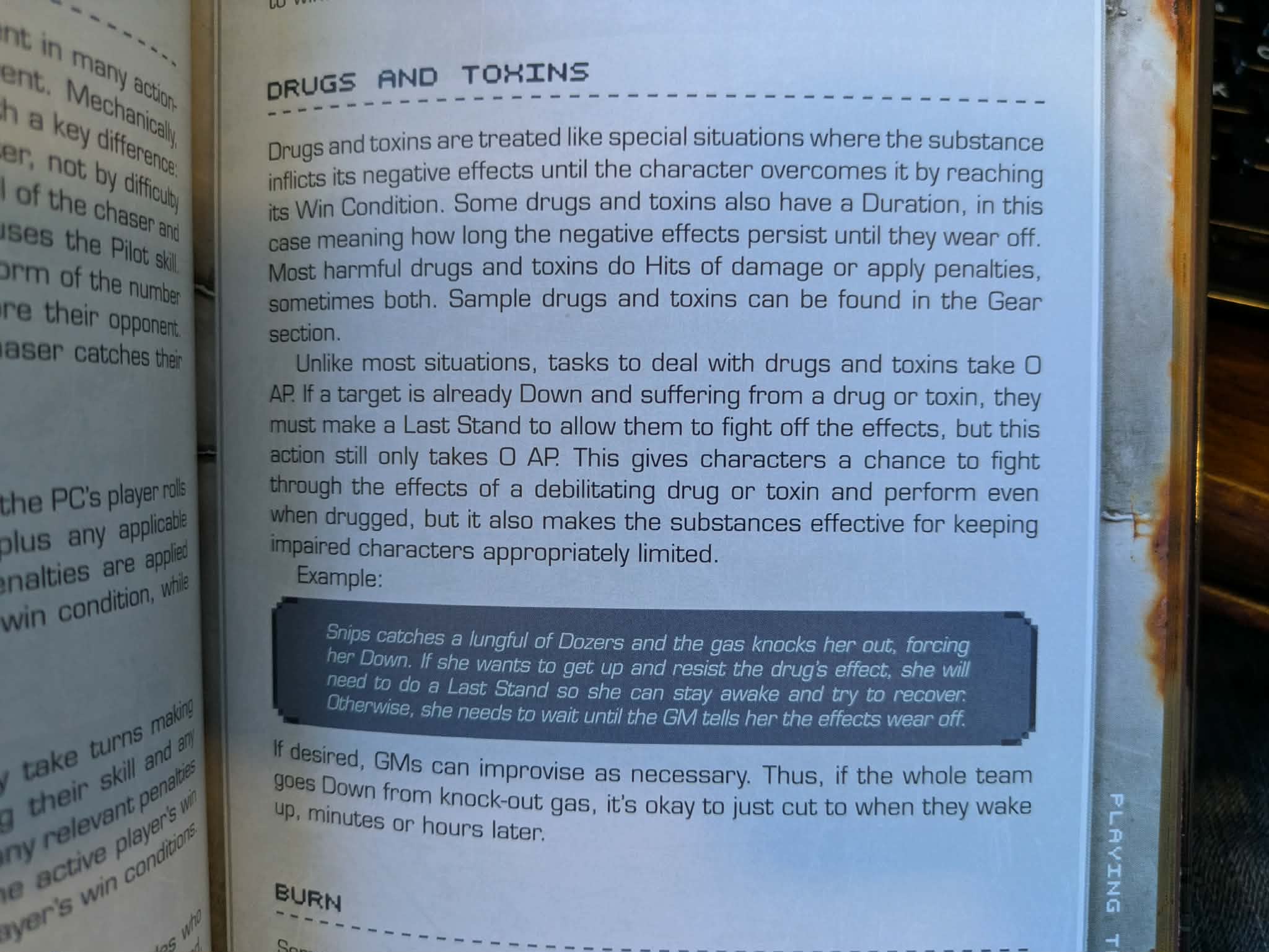
I understand what this is meant to convey, but why is it written that way? My take on the same text would read as: Drugs inflict negative effects until their Duration runs out or a player successfully completes its Win Condition, such as rolling a successful number of Athletics checks.
Worse still is the fact that these rules are NOWHERE NEAR the section of the game that actually includes any drugs. That is a full 76 pages later, under the Special Gear section, which is not labelled in the Table of Contents, and which contains only a SINGLE drug example. That drug, by the way, has problems as well. It takes 5 successful checks to clear, and inflicts cumulative penalties to all actions which require coordination or focus. There’s a skill list but the book isn’t inclined to even suggest which ones could be relevant here. The Dozer gas takes different time to dissipate depending on whether you’re in an open space or enclosed room, but you only get a vague suggestion of how long this might be. More than inconvenient or not thought through, this is actively bad. In just this one example, of which I can assure you there are many, we see the problems of the book crystallize: poor writing and poor organization make way for rules that aren’t that thought out, well presented, or even necessary in the first place.
To do my due diligence as a critic, I’ll break down more of the rules themselves. As I’m sure won’t surprise you, they failed to leave me with positive feelings.
The Rules
The basic mechanic is a 2d6 roll, plus your relevant skill value (of which characters have 13 to choose from) minus the difficulty of the task. All tasks have at least a difficulty of 1, so on even a basic task you’ll subtract 1 from your roll. Rolls of 7 or above succeed, granting additional Effects depending on how high you rolled, with Bad effects coming in with rolls of 6 or fewer. The introduction to that based mechanic is separated by several pages and sections from the Effects section, because Untamed Worlds doesn’t want you to understand how to play it. I suspect this is a kind of subtle warning to save you time.
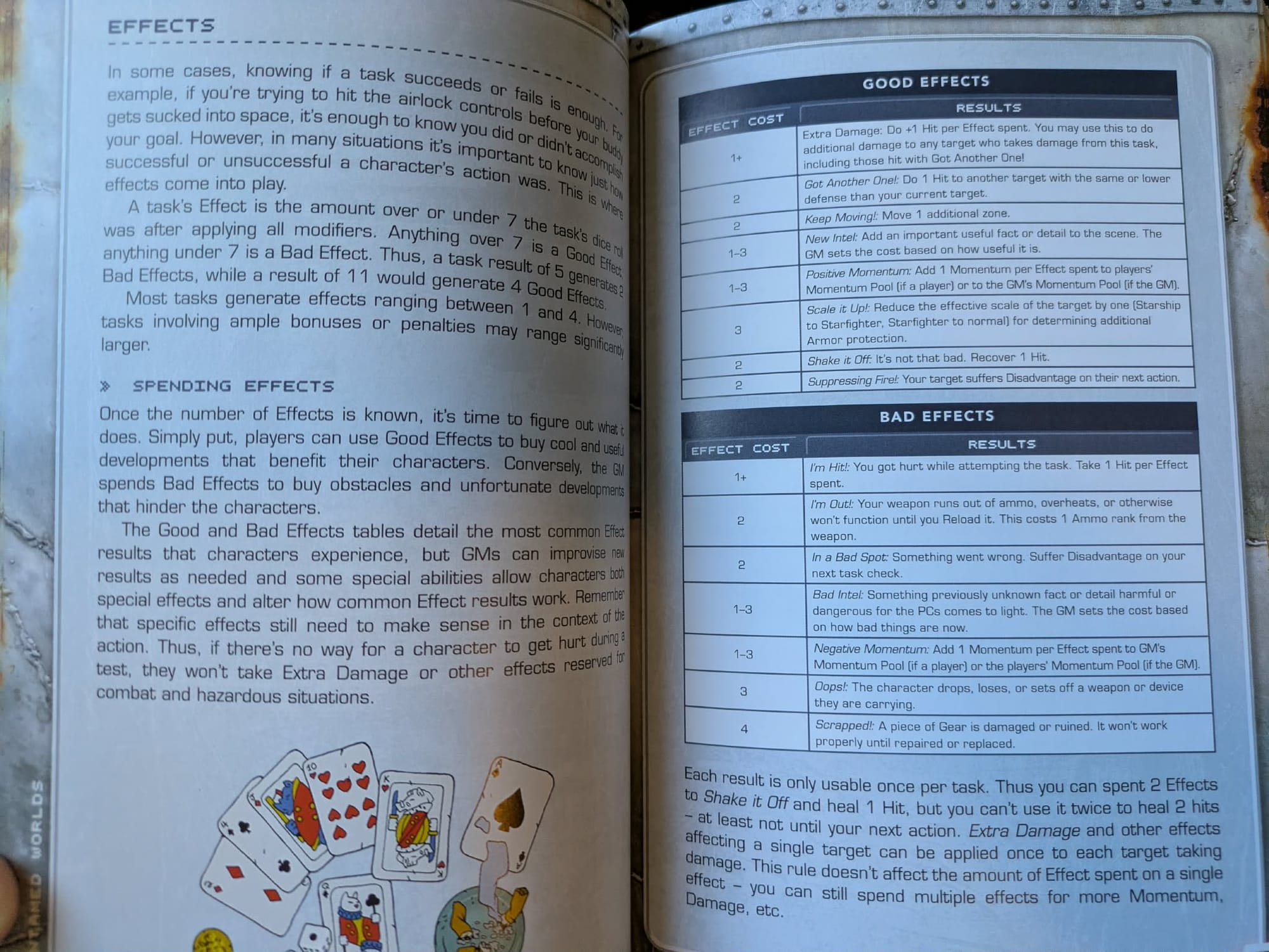
To make a character, you start by choosing a Heritage, i.e. what type of uplifted animal you are. These will grant you increases to certain skills and access to specific Tricks, essentially feats. Each Heritage also has Permissions. Equipment also has permissions, a word the book subs in for Abilities, to make sure it isn’t too easy to teach or understand. Along those lines, the main combat skill is CQB for Close Quarters Battle. The author thought something like Melee or Weaponry would be too familiar to RPG players, and wants them to do extra work to understand one of the primary significant skills of the game. Permissions in the context of Heritages give you broad abilities that are important but criminally under-defined. Amphibious characters are not actually amphibious, as nothing says they can breathe underwater. It does say they are “adapted to land and aquatic operation”, but not what this actually means. They can “cling to various surfaces” but you don’t know which ones or how this works.
All of the Heritage Permissions are like this. Many have superhuman senses, but no rules text attached to tell you what this means. Some can fly, but there are no rules for flying. Actually, that’s not entirely true. Most of the features like senses or flight or underwater breathing are captured in the Tricks section. So why are we bothering with Permissions at all? Maybe it’s because some of the Permissions aren’t contained within Tricks, so you have more useless fluff text. These are also confusing and contradictory. The Flier trick doesn’t let you fly, it gives you an advantage when flying with a jetpack or similar. Some Heritages can fly in low gravity, but there aren’t gravity rules. You also pick Backgrounds, which grant skill points and maybe a Trick, and Specialties, which grant skill points.
From there on out are rules for Gear, Vehicles/space combat, and a decently usable set of GM advice. Everything rounds out with a section on sample adventures, enemies, and more details on the setting. Some of this advice and detail is nice to see, and well thought out. The random tables and rules references at the end are particularly useful. I do have to give some credit to the combat as it plays out. The interplay between action economy and the gear at your disposal starts to suggest that there is fun to be had here. As a miniatures skirmish game I could respect what Untamed Worlds brings to the table, but as I’ve referenced before, this is an RPG.
Conclusion
Untamed Worlds has some nice ideas and some interesting rules, but they’re buried under less than thoughtful implementation. The work it would take to love this game is far less than it would be to just play something different with similar themes.
Untamed Worlds
Below Average
Untamed Worlds’ imagination far outpaces its execution. Jack Norris has created a vivid, thematically rich military sci-fi setting that begs to be explored, but the RPG built to host it is hobbled by poor organization, inconsistent writing, and underdeveloped or contradictory rules. The book’s dense, poorly paced presentation makes it difficult to read and actively frustrating to use at the table, while key mechanics, abilities, and concepts are scattered, ambiguously defined, or left unfinished. In the end, Untamed Worlds offers plenty of ideas worth admiring, but not enough functional clarity or cohesion for me to comfortably recommend it.
Pros
- A setting with powerful humanist themes waiting to be developed
- Thematic, evocative art, what little of it there is
Cons
- Poor organization and layout confuses important information
- Rules are functional, but fail to communicate tone
- More than occasionally awkward writing
This review is based on a copy provided by GamingTrend.