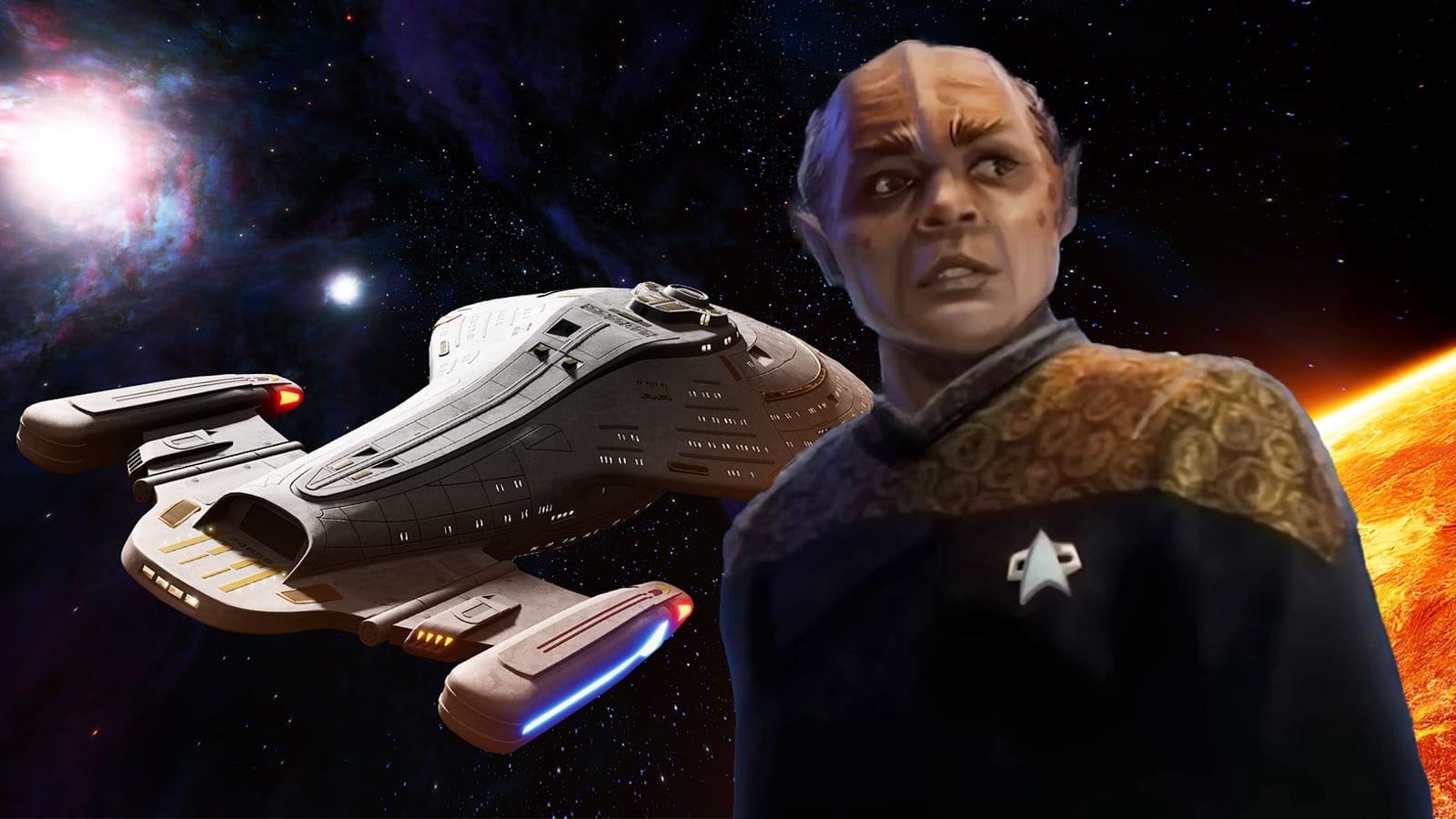
If you're a Star Trek: Voyager fan, then you know those first few episodes like the back of your hand. What if they could be different? That's precisely what Star Trek: Voyager – Across the Unknown gives you the power to do—change the story. Part survival game, part strategy, and part choose-your-own-adventure, Star Trek: Voyager – Across the Unknown isn't without its "Threshold" moments, but it also has precisely the mixture of interesting elements that should put a smile on a Trekkie's face. Let's dig in.
First 90 minutes of gameplay for Star Trek Voyager Across the Unknown
My very first run mirrored the show's critical plot. I rescued Neelix, I rescued Kes and met the Kazon, inadvertently making them an enemy, I recruited the Maquis and brought Chakotay, B'Elanna Torres, and the rest of the Maquis and brought them aboard as officers and crew. I rescued Tom Paris and Tuvok and bloodied the nose of the Kazon for the first time. So far, it's the story we know. We met The Caretaker, and we ended up facing the choice from the show—destroy the Caretaker's Array, or take the chance to escape back to the Alpha quadrant. In the show's canon, Janeway destroys the Array with only a moment's hesitation, easily deciding that dooming the Ocampans to some seemingly awful fate under the thumb of the Kazon is not in keeping with the good traditions of Starfleet. I went a different way. Facing that same choice, I decided to leap both Voyager, her crew, and the Maquis back to the Alpha quadrant. I thanked the Maquis for their service and set them free, violating Starfleet Regulation, and headed back to Headquarters to debrief on what I'd seen. This hidden ending doesn't make the Maquis happy and leaves the Ocampans to an uncertain fate, but it gets all of Voyager's crew home safely. Is it a win? Arguably yes, for some. Is it the right choice? The game doesn't judge. It's one possible ending out of what looks to be quite a few.
Back on the rails, and with the Array destroyed, Voyager is now stranded 75,000 light years away from home, and in a heavily damaged state. There's a bit of an unstated tutorial that wraps up at the end of the first chapter, The Caretaker. From there, you'll know everything you need to make effective command decisions to get your crew home. How you do that is almost entirely yours to decide.
First and foremost, you'll need to power up the warp core as it has fallen into Gray Mode—the bare minimum to keep the crew breathing and the ship at Impulse. Collecting Deuterium, the fuel needed to run Voyager, I was able to power up the ship to its lowest level, providing enough juice to bring up life support, a handful of emergency bunks, and eventually phasers, torpedoes, and shields. Just about tapped of power, it was time to make some choices.
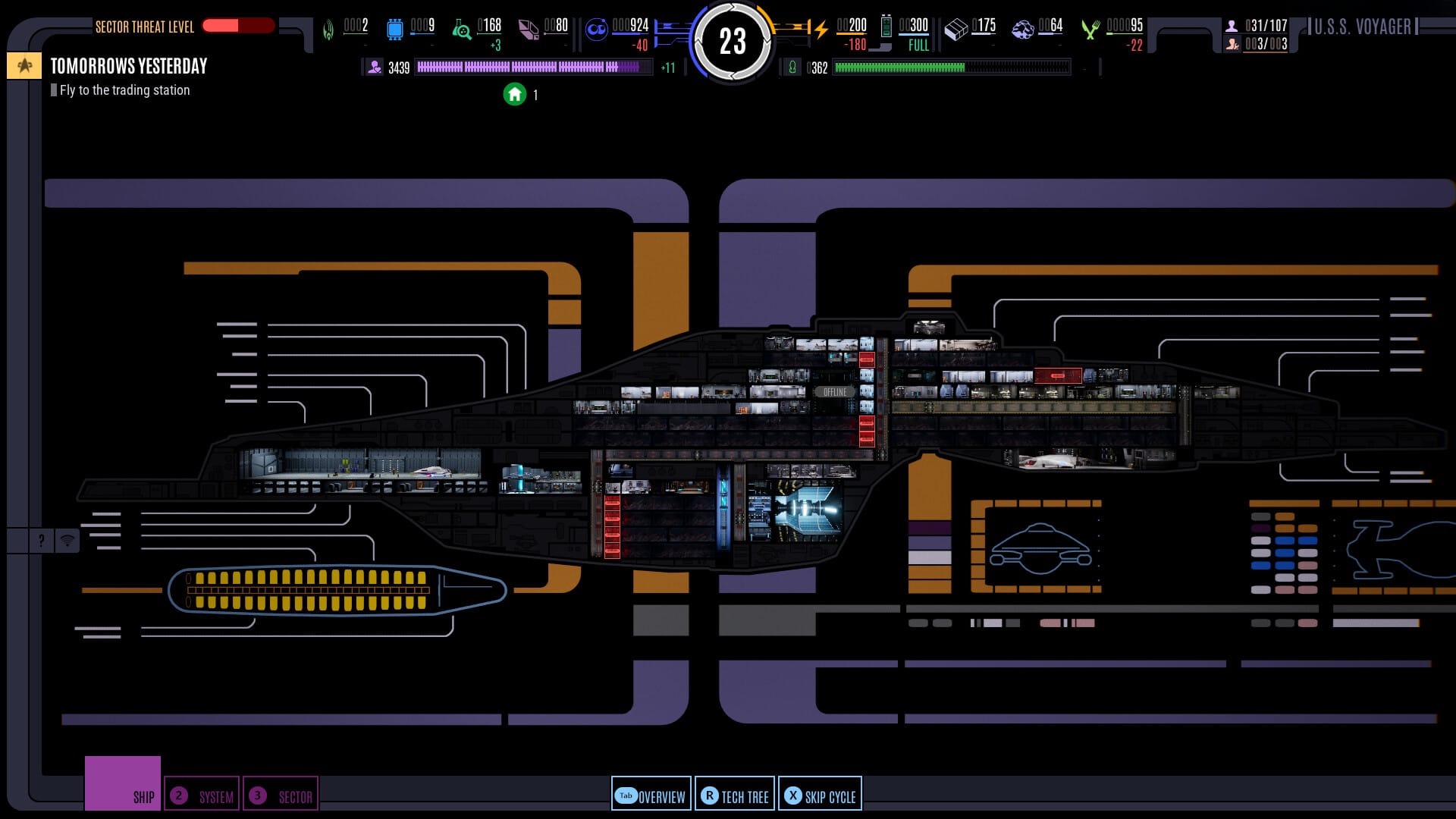
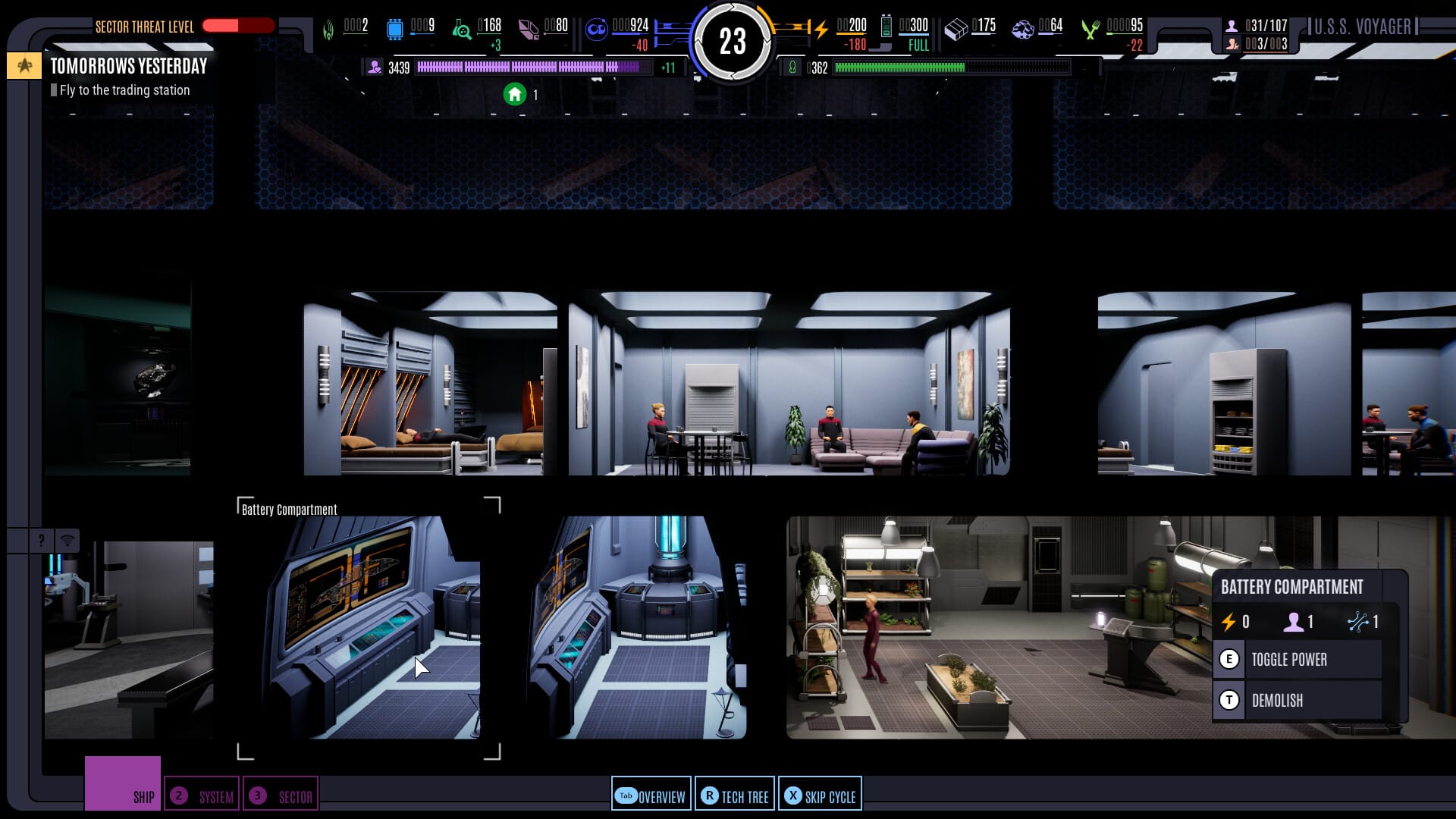
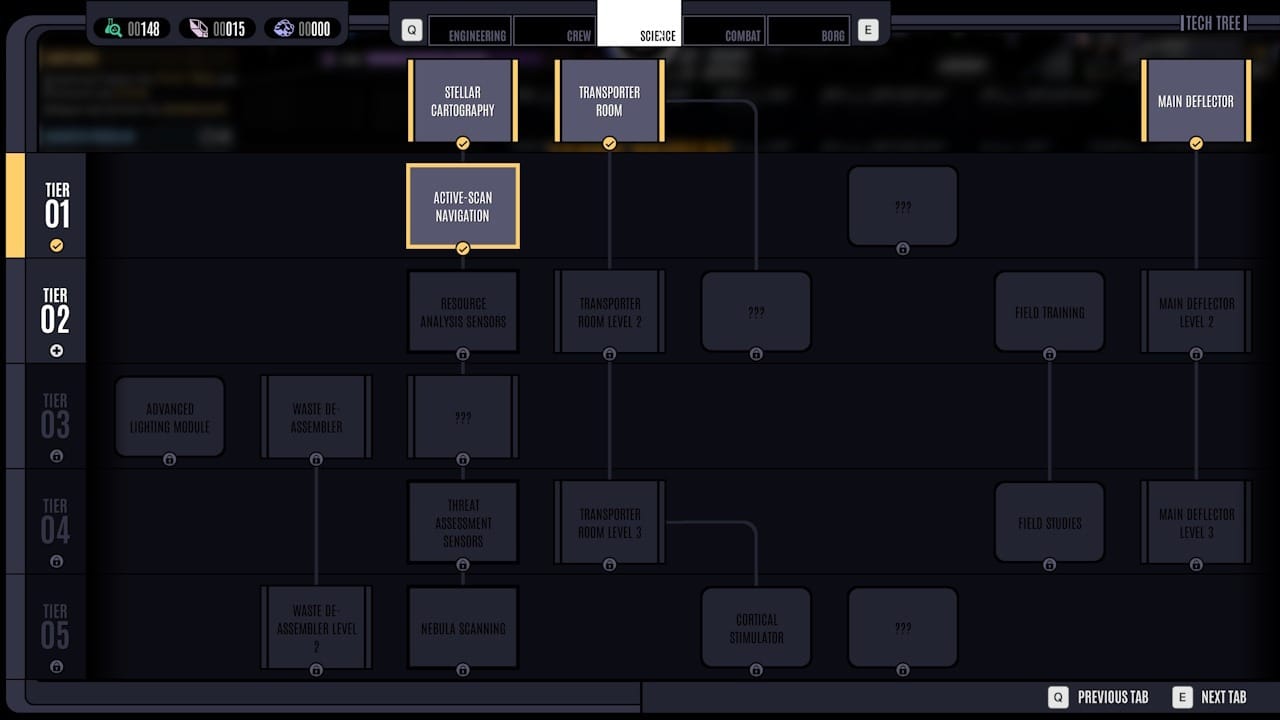
Much of the time on the ship plays out in a side view slice of Voyager, not unlike what you'd find in Engineering. A solid recreation of the LCARS, the GUI used on starships and Starfleet equipment from The Next Generation onward. It has hints of XCOM 2's base building functions, and with much of the same challenges. Each floor or room requires specific resources to unlock, you have a limited number of crews to do the work, those rooms and floors take a certain amount of power to operate, and you'll need to research your way into the tech you want to employ. What's different here is what makes it uniquely Star Trek and, in this case, special.
Star Trek is at its heart, a romanticized look at the universe. The world is more often than not black and white, you know who the good guys are, and the bad guys are often obvious enough to be comical. Voyager turned that on its head a bit. Janeway committed upwards of 32 violations of the Prime Directive ("Starfleet cannot interfere with the natural development of a non-Federation culture"—destroying the Array to kick things off), the Temporal Prime Directive ("Strictly forbids direct interference with past events and requires maintaining the established timeline"—accepting technology from her future self to bring Voyager home early), General Order 10 ("Before engaging alien species in battle, any and all attempts to make first contact and achieve nonmilitary resolution must be made"—failing to seek a non-military solution with the Undine in the episode "Scorpion"), and that doesn't even begin to cover the actions with the Borg. This is not the "by-the-book" Trek as established prior nor as developed since. It's better for it, frankly, and so is this game. Let's talk about choices.
Throughout Star Trek: Voyager – Across the Unknown, you'll be presented with decisions. In the beginning, they look binary, it's obvious; which is the best choice, and you can almost always succeed. The further you get into the game's 15-20 hour runtime, the tougher the choices. Let's talk about away missions since you'll be doing that plenty.
Away missions play out in a choose-your-own-adventure style, with the action being delivered through images and text. The choices are skill-based, and depend on who you brought with you. Surprisingly, the game tells you what sort of skill checks you'll be facing, and if you'll see an opportunity for a special dialogue choice should you bring the requisite person with you. You'll then look at your crew roster, see who you might bring that can tick those boxes, and set off.
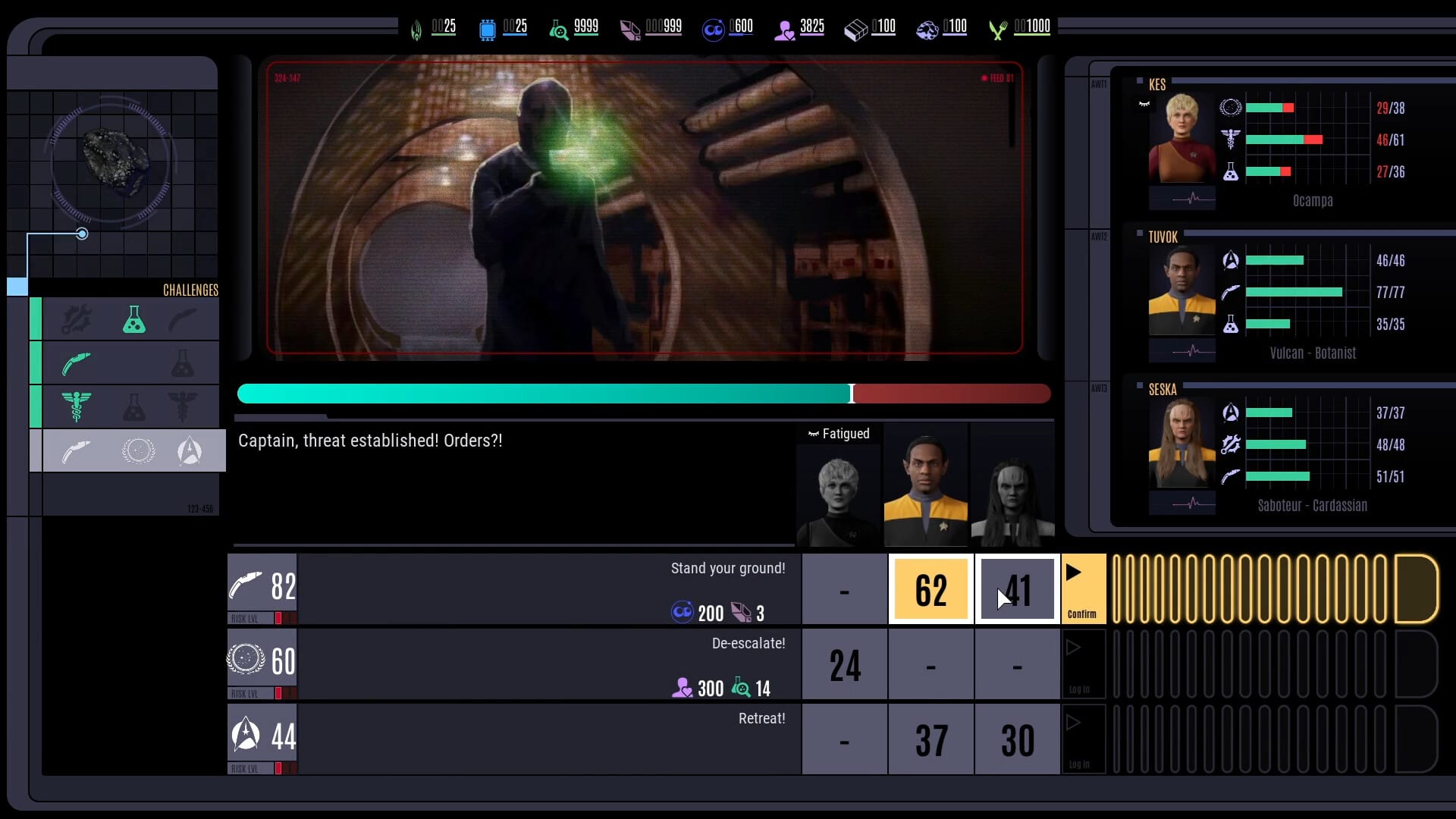
The missions play out with choices to be made. You'll get a skill check against that decision, with the person carrying off that action becoming fatigued regardless of their success. Further actions by that person will be less likely to succeed. You can employ more than one person to raise the odds, but as you'd expect, that'll make two or even three people fatigued at that point. Success will open up additional choices, be it dialogue, items, or other goodies, as well as rewarding those that did the doing. This will raise their chance of success.
There is an added bonus to the choose-your-own-adventure approach—it encourages replayability. When you deploy, these missions will play out based on your skill levels, what equipment you have, and what technologies you've brought to the fight. These are exposed so you can see what options you don't have based on the previous choices you've made or unlocks you have. It encourages you to try again with different choices from what you did the last time. That said, the pool of these scenarios can repeat a bit, so you might get a chance to try something different before long anyway.
One of the things that I imagine will be polarizing, but I appreciate, is the team's apparent approach to progress. It'd be easy to go down the path of forcing the player to restart when they've made a poor decision, but instead, the team worked hard to provide consequences for choices. If you accidentally get a key member killed or incapacitated, run the ship out of fuel, or other failure conditions, you might be able to recover, but your road home might be a lot harder. The game uses a single save that updates constantly, so there is no save-scumming your way backwards. While the choices are benign and safe in the beginning, after a while, you might face some real consequences for your choices—I appreciate that.
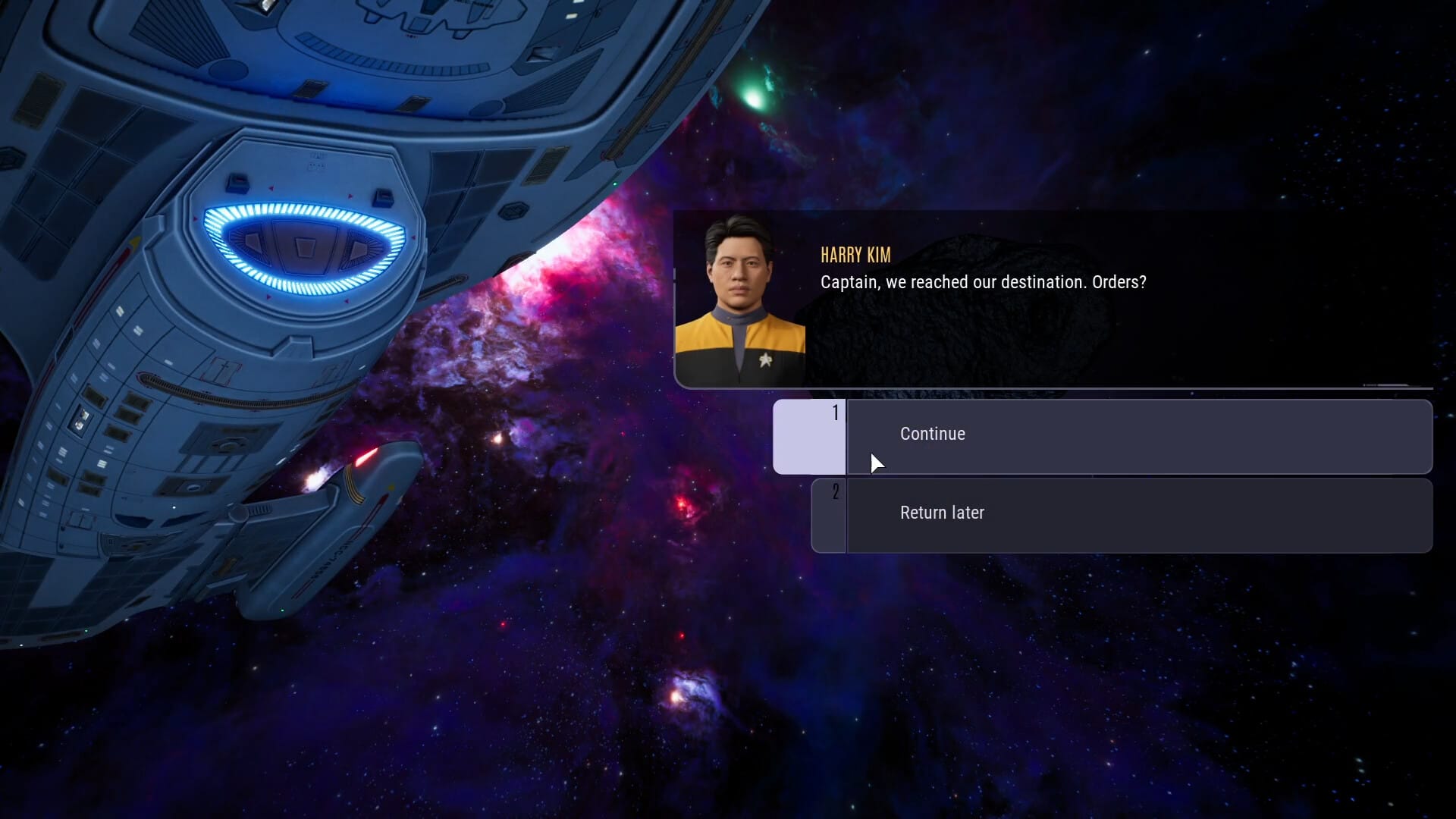
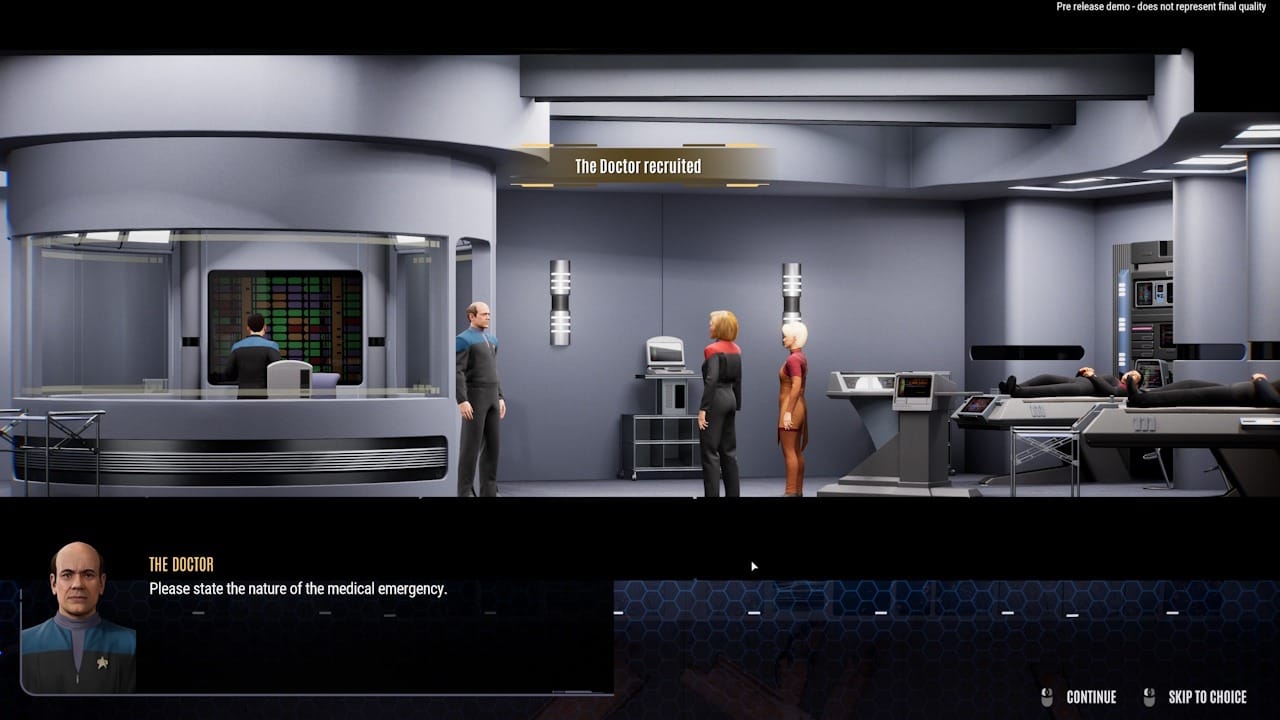
Just as it is in the show, Voyager itself is practically its own character. As such, you'll find opportunities based on the ship's condition and what resources you've unlocked on occasion. As an example, you might encounter a specific alien race that is in distress. If you've unlocked the med bay, and it's powered at the time the opportunity would present itself, you might be able to employ the Doctor (the EMH or Emergency Medical Hologram) to help. If you've got somebody from that same race, you might also find they have some information to add to the choice that could turn the tide. Unlike the away missions that tend to spell out in advance what or whom you might want to bring with you, there are plenty of random encounters that might catch you off guard. Frankly, I prefer that as it adds unpredictability to the adventure.
While flying around you'll spend a great deal of time scanning planets, fetching deuterium, dilithium, and other materials to keep Voyager moving. Here you'll face choices, albeit with less depth. Here, it's more a matter of how much material you'll collect, if you take damage in the process, if you snap up some scientific research points or technology, etc. While the away missions have a bit of variety, the exploratory missions are a little more mundane and repetitive. I'm reminded of the planet scanning in Mass Effect, in all the wrong ways.
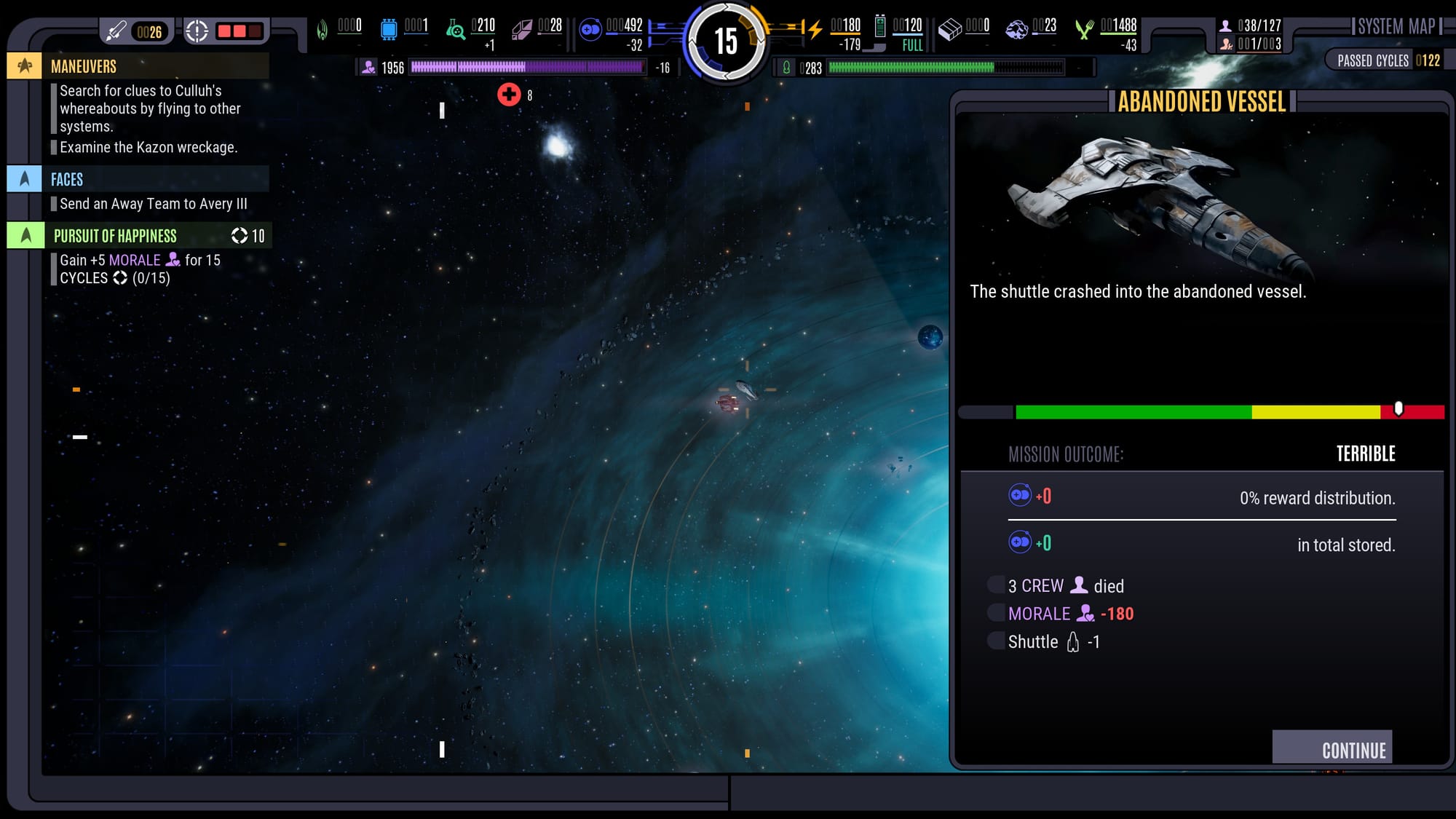
In games like Frostpunk, another survival /tactical series, your citizens will ask you to satisfy specific conditions in a matter of time. For example, you might be asked to raise morale by switching from emergency rations to higher quality replicator food for a certain amount of time. Successfully fulfilling the request will improve morale with the crew or have other positive effects, whereas failing to do so will yield the opposite effect.
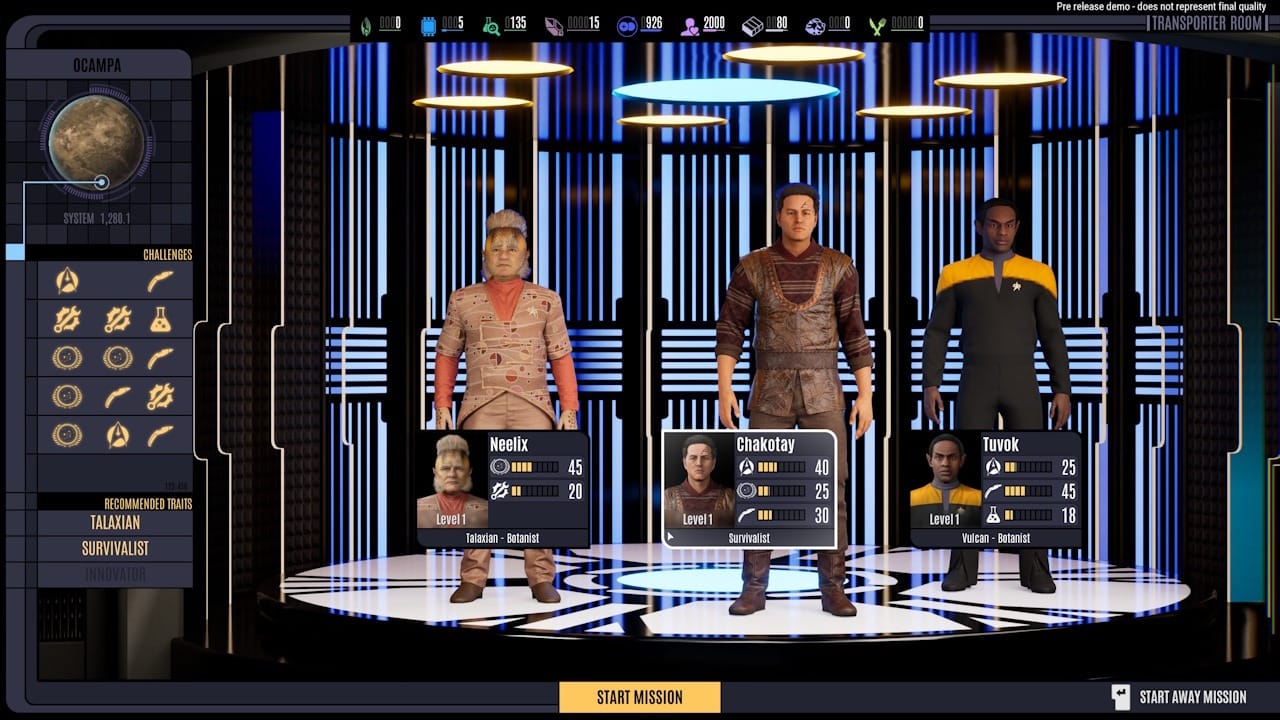
All of these things I've described happen within the LCARs UI. Either you're good with this rather low-tech approach, or you aren't—no in-between. Faces look great, the ship looks great when you zoom in, and the rooms have a bunch of little details based on their function. The hand-drawn painterly-style art representations of the various heroes are spot on. On the other side of the coin, sometimes you'll see characters that look almost PS3-blocky and dead-eyed, such as when you load up on the transporter. Not every game needs to be Unreal Engine 5 ultra-high detail Crimson Desert-level, but Across the Unknown can be a bit of a mixed bag.
As you fight your way through the Delta Quadrant, an indicator shows you the overall threat level for this area. This indicates your chances of being ambushed in the area, leading to combat, decisions, and danger.
Eventually, you're going to end up in combat. The team at Gamexcite, using games like Starfleet Command, Bridge Commander, and Star Trek Legacy as well as the shows and movies as inspiration, built a combat system that is representative of what it's like to fight from the command chair. As such, you do not directly fly the ship—that's the job of Lt. Paris. You don't directly fire the phasers—Lt. Commander Tuvok is responsible as Security Chief and Tactical Officer. You aren't handling shields and repairs—Lieutenant (junior grade) B'Elanna Torres handles those duties. In fact, the only thing you directly have control over is issuing orders—what to target, when to fire and where, and issuing orders to up to three of your officers who bring special abilities to bear in battle.
Like any Starfleet vessel, the shields on Voyager recharge in quadrants and independently. As such, you can command the ship be moved to protect a flank that has taken enough hits to deplete the shield before it takes hull damage. Enemy ships operate and can maneuver the same way. When there are multiple ships (on your side or theirs, as you can enlist help and they can bring friends), they can use their positioning to direct sustained fire on a quadrant. Additional orders to protect a side or subsystem will cause the ship to move accordingly, allowing you to make directed repairs such as reinforcing the hull around the warp core or restoring weapon systems.
Naturally, your combat capabilities can grow as your ship upgrades bring additional capabilities. Technological research brings better weaponry and eventually cloaking, if you head down that path. Overcharging weapons, shield modulation, better phasers, nanotechnology-infused torpedoes, and more await you—often, unleashing these in a specific order to capitalize on their synergy can turn the tide of battle. More powerful or complex weaponry might draw your power quickly, leaving your ship vulnerable if you don't manage it directly. Yes, you can auto-resolve combat (with its own risks, which can be aided by adding consumables like torpedoes), but I have enjoyed it enough to want to handle it myself. Depending on whether you've built a combat craft, a science vessel, a Borg experiment, or a hybrid of all three, you might have a far easier time of it.
There's a tough decision that inevitably faced the team when building out this game—how to handle voice acting. To their credit, they brought aboard Tim Russ and Robert Duncan McNeill to reprise their roles as Tuvok and Paris, respectively, but their voiceovers are limited to ships logs when you transition to a new star system. Everything in between is very, very quiet. Sound-alikes always get a lot of grief, but silence might be worse. When combined with the non-animated crew scenes, it starts to feel too quiet. There are millions of Trek fans, and I bet a broad ask out there would have gotten sound-alikes for anyone not willing to reprise their roles. It might not have been perfect, but frankly I'm hoping that fan-mods can fix this issue as I think the end result would be better for it.
There is one element that is ultimately highly frustrating and could use some balance—the RNG aspects of the game. Just about every situation you find yourself in results in a dice roll against your stats to determine the outcome. There are times where it feels like no matter how tiny the sliver of chance of failure, my crew seems to find it. Once the spiral starts, it's almost impossible to stop. That, and even the middling results tend to err on the side of awful. Your choices are light green, dark green, orange, red, and slight variances in between. You pick up an orange, smack dab in the middle, and somehow you can still end up with zero resources, multiple crew dead, more wounded, and morale tanked. I shudder to think how bad the red outcome would have been. You hit five or six of these right in a row, and something awful I didn't expect happens—apathy.
The whole thing about Star Trek is that you have a whole series full of heroes. Jayeway, Sisko, Sulu, Picard, Riker—you know the names. You become attached, seeing them cheat death, come up with amazing saves, and otherwise deliver outcomes that defy the odds. While you have a few heroes on your crew, the rest start to feel like expendable fodder. You stop caring that they're wounded, or worse, dead. You stop caring about their morale or their demands. The whole point of the game is that this is your crew, and you should care about the outcomes. There's a reason why games like Baldur's Gate III sometimes put their thumb on the scale in the background every once in a while.
I was worried my first hour into the game, thinking "I've seen all this" the entire time, right up to the point where I used the Array to go home, changing everything. While there were some familiar moments and faces, the second I had my hand on the tiller to change the course of the story, the game found its footing. The ability to find different outcomes is a great twist on the genre and on established Trek cannon. A few balance patches will put it right, and based on the responses we've already seen from the developers, they're eager to engage with the community to do exactly that.
Star Trek: Voyager – Across the Universe
Great
Star Trek: Voyager – Across the Universe puts us at the helm and allows us to change the established narrative. While there are some elements that repeat, and it could use a bit more voice acting than it currently has, the gameplay loop is fun and with a few patches, it'll be even better. Failing that, play it on PC—modders are already doing amazing things here.
Pros
- The ability to change established narratives is fun
- Survival /strategy elements feel a little XCOM and I like that
- Choose-your-own-adventure style away missions encourage replayability
- Fun to change the established Trek canon
Cons
- The failure spiral causes crew apathy
- Sometimes, this game is not very pretty
- So very quiet without voiceovers
- Some repetition in missions before long
This review is based on a retail PC copy provided by the publisher.