Is Kirby Air Riders a vindicating work? When considering the mixed impressions and scratched heads greeting this long-awaited sequel’s commitment to a one-button control scheme, that may be a stretch. The original Kirby Air Ride for GameCube was treated to much the same reception in 2003, with games media dismissing its unorthodox mechanics as gimmickry for gimmickry’s sake. With its unfortunate luck in being sandwiched between two other high-class, more traditional Nintendo racers (F-Zero GX and Mario Kart: Double Dash!!), Kirby Air Ride was all but certain to be left forgotten in gaming’s dustbin of experimental duds.
And yet, it endured. A passionate fanbase quickly decoded its opaque Rubik’s Cube, revealing an addictive feedback loop beneath its alleged impenetrability. From embracing its saving grace in the City Trial mode to filling out its ever-addictive checklist system, Kirby Air Ride proved a durable fan-favorite, its dedicated cult extolling the virtues of Swerve Stars, Legendary Air Machines, and countless unlockables. Even from such a self-contained niche of adherents, calls for a sequel persisted over the last two decades, not the least from yours truly.
Hence, my preferred term isn't 'vindicative' but rather, 'miraculous'. Kirby Air Riders is a different sort of miracle than the dream-granting likes of Smash Bros., wherein Mario and Link could meet Cloud Strife and Sonic the Hedgehog; nay, it is a tale of unfinished business, where director Masahiro Sakurai returns to justify his most divisive title not named Super Smash Bros. Brawl. Lessons learned from the original’s troubled development, Sakurai’s decade-long association with Bandai Namco, and a blank check courtesy of Nintendo result in an uncompromised passion project.
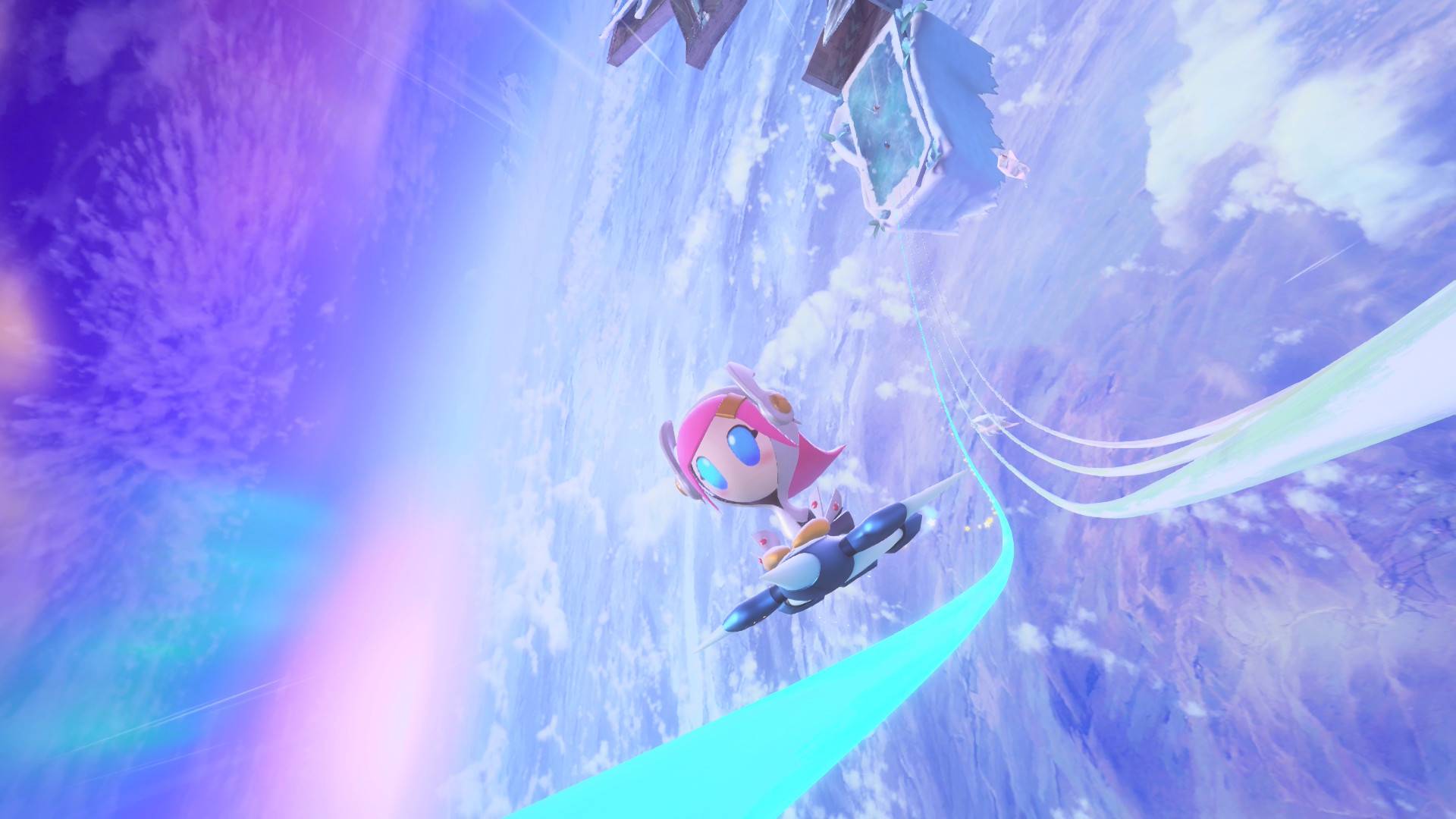
Did I mention Kirby Air Riders is Sakurai’s first Kirby game since leaving HAL Laboratory all those years ago? Only the stars glittering high above Dream Land could’ve aligned to herald the return of Kirby’s father. Who made the wish upon the Fountain of Dreams?
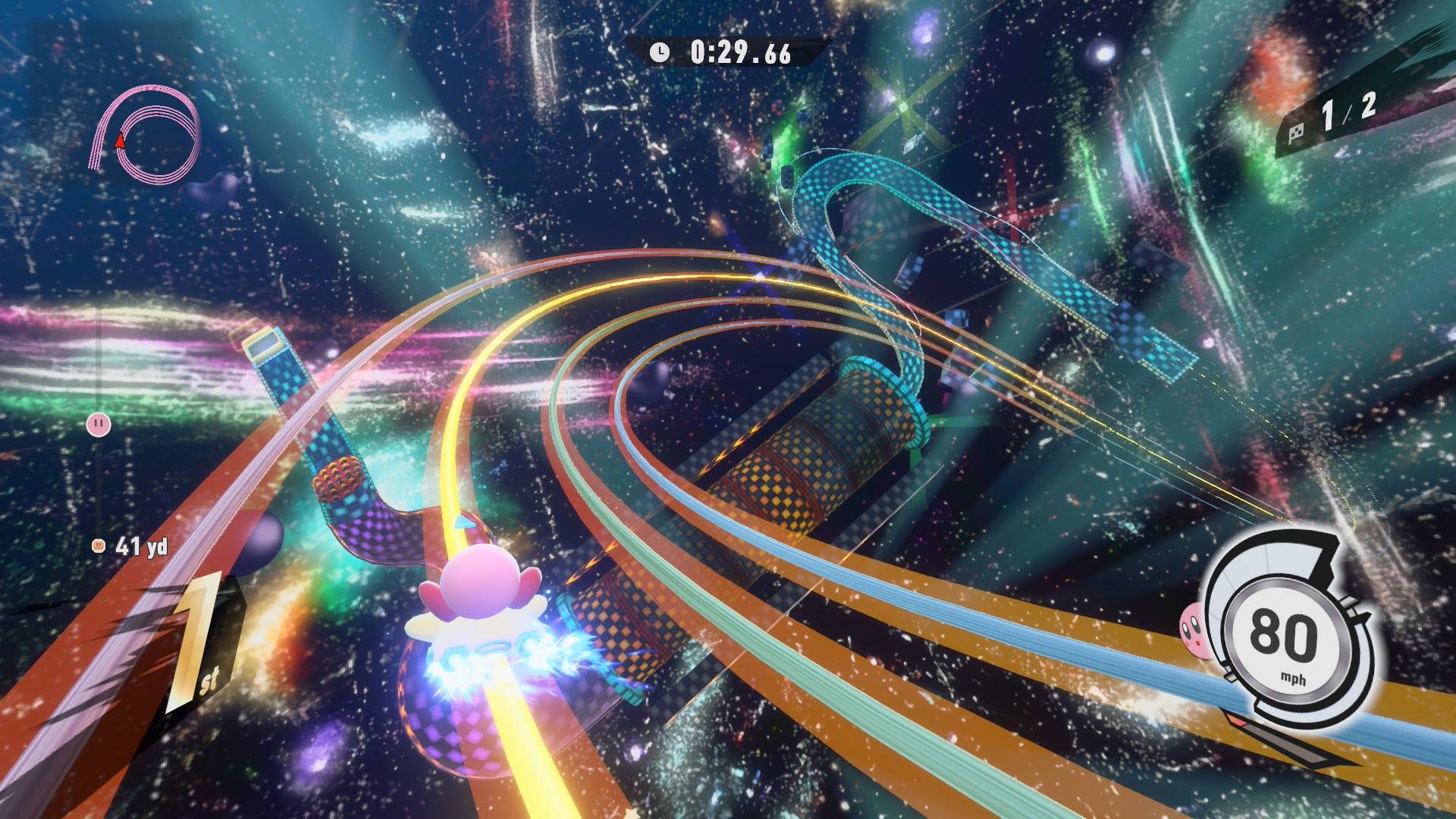
Kirby’s latest spin-off plays like this: adhering to Sakurai’s philosophy of disassembly, Kirby Air Riders dispenses with accelerative input and emphasizes drifting. As your ride speeds along the fantastical courses, you’ll push to brake, hold tight while sliding along the curve, and release to boost forward. There are other inputs—a flick of the control stick for spin attacks and the B Button to unleash a special technique—but the A Button does the heavy lifting as you dodge enemies, play catch-up, and fly off ramps.
It’s akin to navigating a mad game of pinball inside a popping bag of popcorn: stuff is happening everywhere, much of it outside your control, and you must frequently adapt on a dime. Such is to be expected when squeezing the sugar rush of Kirby into a racing model, right down to implementing the series’ famous Copy Ability mechanic, where you absorb enemies to borrow their powers, but it’s not everyone’s cup of coffee.
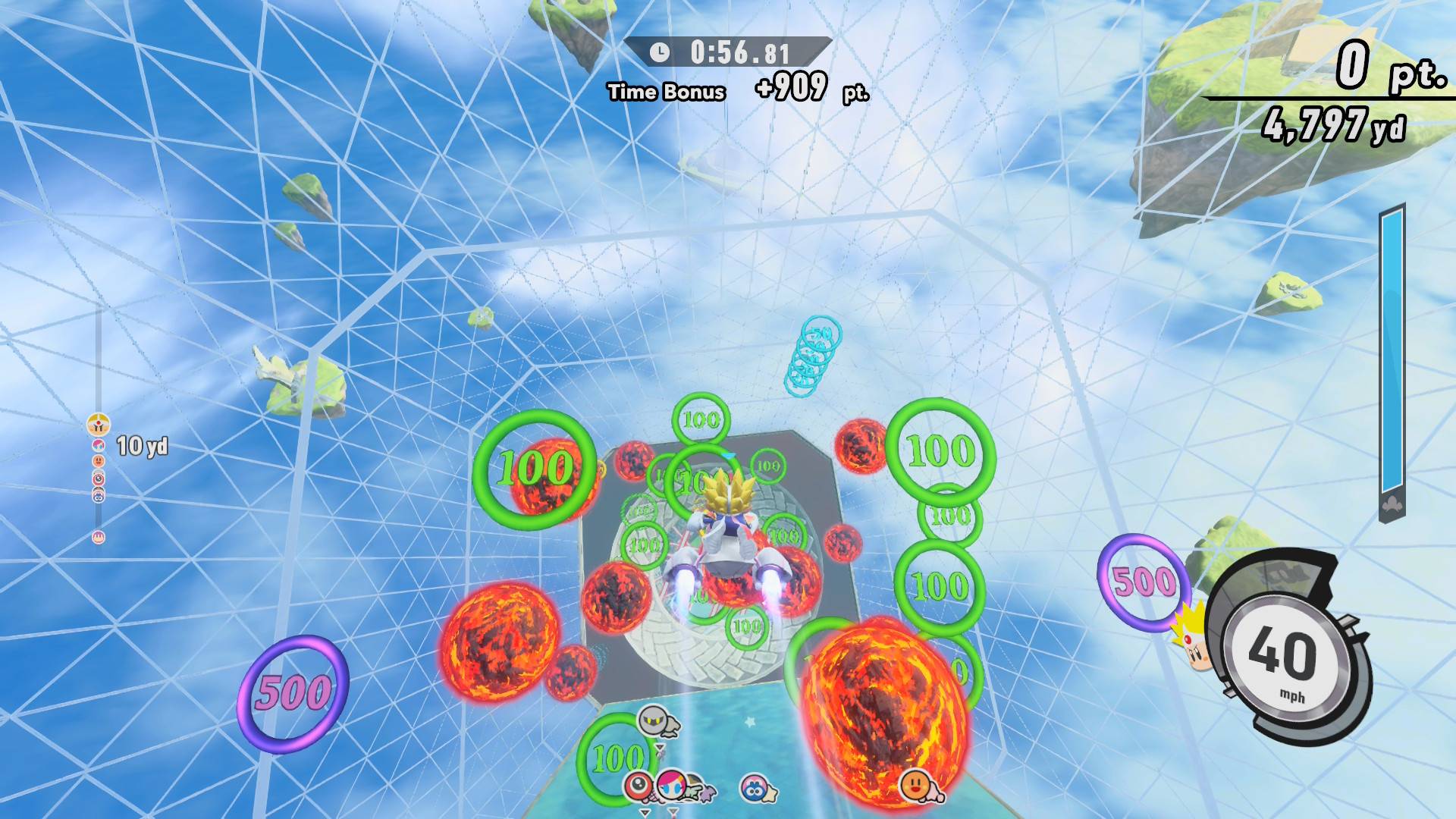
Yet there’s a thrill in deciphering the language of Kirby Air Riders’ caffeine trip. Like how Smash isn’t quite defined as a “fighter”, Nintendo’s taken to calling Kirby Air Riders a “vehicle action game” rather than a full-on racer, playing off the game’s multitude of modes and playstyles. It's like admiring the topsy-turvy perspectives of M. C. Escher: the more you dive into its unfathomable depths, the more it clicks into place.
Right away, there are discernible improvements: take the game’s version of drafting in Star Sliding, where vehicles dispense trails of stardust that players can follow to speed up. Drafting was in the original too, of course, but it was practically invisible amidst all the fireworks; now, visual indicators cut through the chaos to help the player along. It’s empowering as it is delicate: auto-acceleration won’t keep you on a rival’s tail, and you’ll want to heed any sneaky racers exploiting your own exhaust, but skillfully weaving through all the anarchy will prove key.
A feat only possible by mastering the standard Air Ride mode, featuring eighteen courses in all. While not as plentiful as Mario Kart – a drawback owing to the multiple game modes – all excel in subtly training the player. Floria Fields eases the player with broad, plentiful hairpins to master the all-essential boost, but the training wheels come off quickly: Waveflow Waters is a head-spinning endeavor, with its parting seas and cannon-fire ejections threatening to overwhelm even the most hardened racer. Yet observing this rollercoaster’s anatomy unveils cues for gliding, rewarding the player in careful navigation through boost rings and shortcuts.
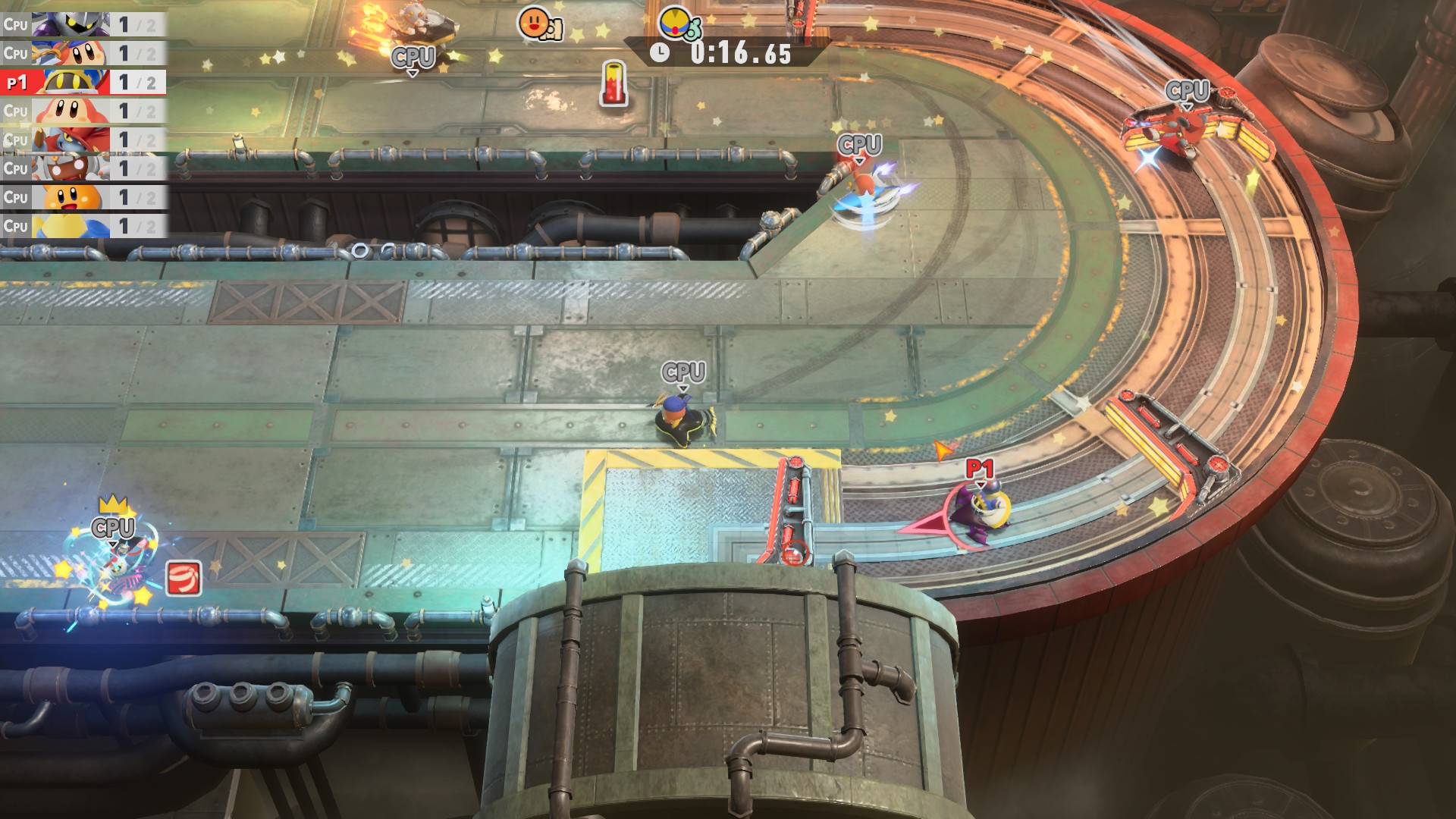
This same philosophy also applies to the itty-bitty Top Ride. A top-down racing mode, its miniature slot car playsets and half-minute laps may seem like an afterthought, yet its claustrophobia is inherently cutthroat: little racers batting each other about in that mad rush for the finish line. The courses aren’t as narrow as before, but the wider accommodation for star sliding and a higher player count never undercut their depth, with the most diligent racers studying, memorizing, and exploiting the anatomic workings of each course beneath all the pandemonium. Top Ride’s small size belies its never-ending shots of adrenaline, perfect for both in-between cooldowns and hour-long online sessions.
The learning process is helped along by its diverse cast: whereas the original was largely content with multi-colored Kirbys, a whole host of series favorites arrive to join Kirby Air Riders’ fracas. All complement the various vehicles with their respective strengths and weaknesses; for instance, the offense-based Shadow Star may seem like the right ride for Meta Knight’s swordplay, but it does nothing to alleviate his low speed; might the speed-heavy Battle Chariot complement both instead? What vehicles play into Taranza’s web-slinging, or Susie’s copter?
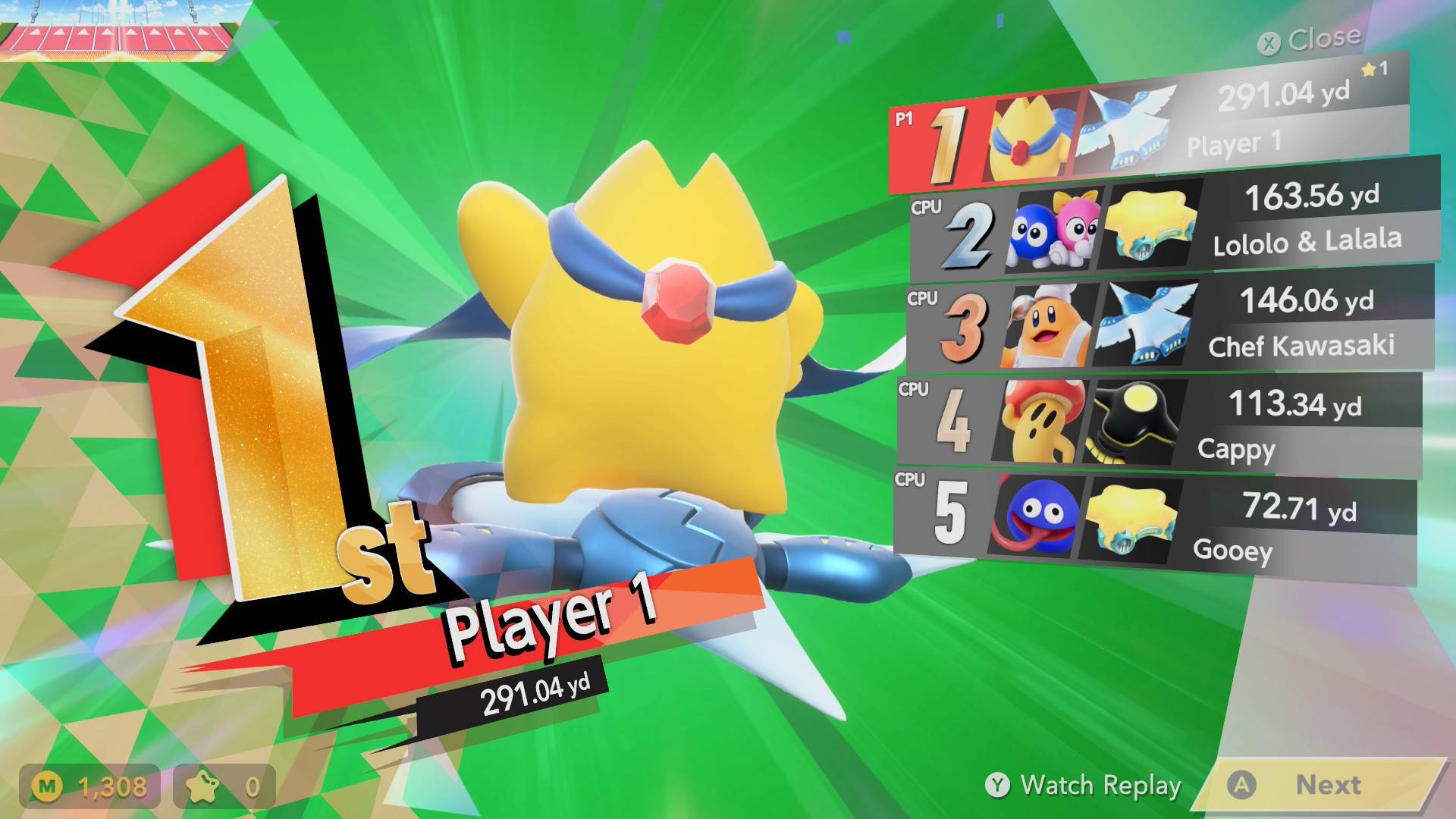
(As an aside, can we talk about how it lionizes the incidentals from Kirby’s rogues’ gallery? Really, I’m still gob-smacked they made me a fan of the oft-forgotten Starman: now playable for the first time, confidently strutting along despite its absent face and stumpy limbs. What a shame virtual belly-pinching technology has yet to become reality.)
This mixing and matching plays into all corners of Kirby Air Riders, not the least in what remains the spin-off’s beating heart in City Trial. Situated in a floating city peppered with biomes, players are given five minutes to assemble vehicle builds in preparation for a competitive mini-game. Collectible stats and prospective rides are littered about, but it’s no simple scavenger hunt: the city’s under frequent assault from boss attacks and raining meteors, vehicles will randomly shrink in size or supercharge their engines, and yes, devious players can snipe your ride to reduce all your hard work into rubble.
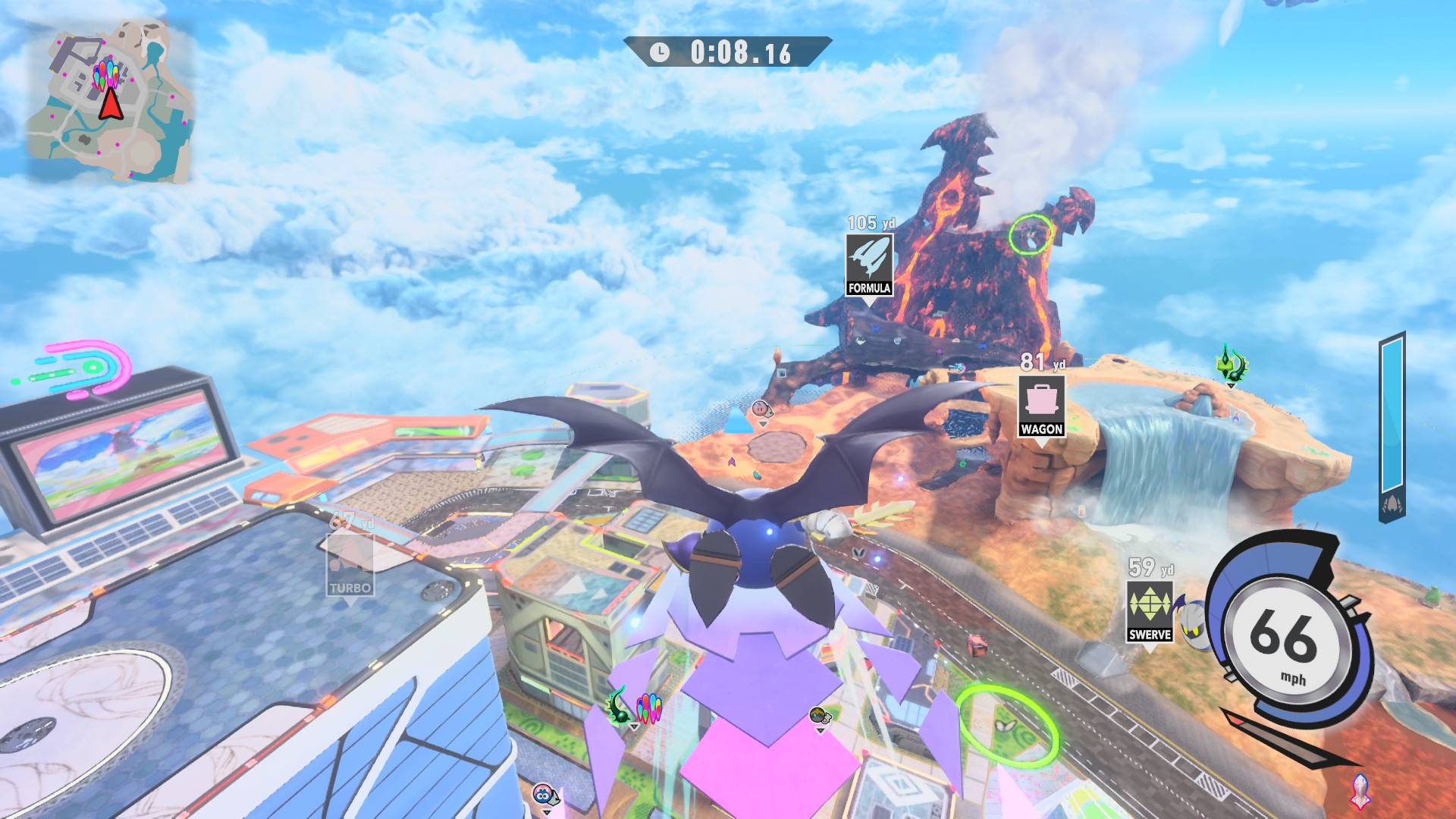
It’s here that the modus operandi of Kirby Air Riders is laid bare, for the blank canvas of City Trial lets players approach it any way they wish. With up to sixteen players from the original’s four, lawlessness runs the streets of this city, pandemonium erupting from Battle Chariots running wild, to giant Gordo spike balls littered about. Even being left to your own devices breeds chaos: you should be focusing on grabbing Flight patches for your Wing Star, but you can’t contain your greed in gobbling up every Top Speed in sight. Soon, you’re rocketing around the city, gleefully breaking the game’s boundaries as you either conquer the subsequent race with ease or drive past all the food in Gourmet Race.
A freeform exercise prime for experimentation, City Trial bends the game’s learning curve for the player to exploit. Take, say, the Hop Star: it initially yields confusion, its emphasis on obstacle-hopping perhaps too situational for spur-of-the-moment action. It wasn’t until I discovered its destructive potential—mid-air braking slamming it down to the earth, not unlike Mario’s Ground Pound—that I felt the Grinch smile stretch on my face, and so began my spree of mass destruction. No one was safe in the city streets, the squashed remains of meticulously-built rides paving the way for an easy Dust-Up Derby victory.
Much like Smash before it, City Trial is host to countless variables keeping you coming back for more. A Grand Wheelie boss tearing down the streets? Sneak up behind the congregation of riders crowding behind it and destroy them in one fell swoop. Spot a floating island in the distance? Risk it all by buffing up the super-fragile Paper Star and soar away to score its trove of goodies. Hunting down the parts of a Legendary Air Ride Machine? Watch out for online players ganging up on you to steal them away. (Assuming, of course, you haven’t flipped the tables on them with a certain doomsday machine I dare not spoil, summoning the very best of multiplayer magic.)
The three modes – Air Mode, Top Ride, and City Trial – are dumped into the melting pot that is the Road Trip story mode. Taking notes from City Trial and roguelikes alike, players collect and build their rides as they navigate innumerable routes to reach the ending. Completionists will challenge whatever missions they haven’t cleared, whereas practical players will aim to complement their riders. Driven to the tune of a ridiculously over-the-top story, Sakurai’s inclination for spectacle is a natural magnet for Kirby’s modern playbook of escalation—that being, of course, gradually welding cuddly iconography to doomsday horror. (No, really, it gets dark fast.) Be it aiming for 100% completion or witnessing the marvel of the true ending, replayability is inevitable.
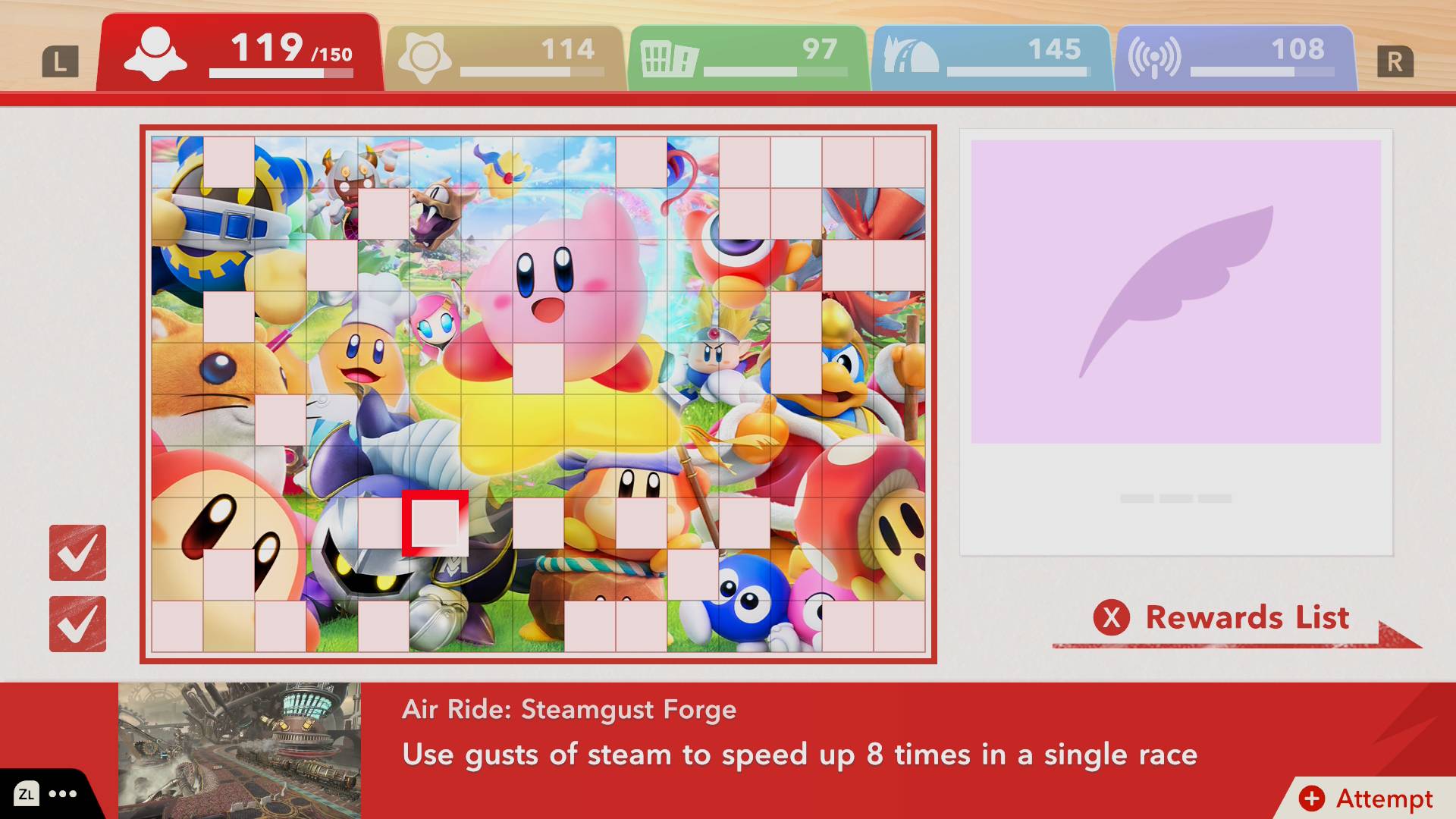
All this and more, tied up in a bow with Kirby Air Riders’ dopamine rush in unlockables, unlockables, unlockables. The checklist is the secret weapon in Kirby Air Riders’ arsenal: every mode is host to challenges of all sorts, from time attacks (Clear this course under two minutes with a ride you’ve never used!) to oddjobs (Glide over the racing banner!) to daredevil stunts (Fly too far outside City Trial and get zapped by lightning! Wait, what?). With 750 in all, you don’t even have to try – you’ll be naturally rewarded with goodies one after another. Hidden characters and alt colors? Check. Obscure music tracks from Kirby’s rich sound library? Check. Name tags for your license? Hey, another for the pile. It’s both a subtle teaching tool and a carrot on a stick: you catch one, another takes its place. Maybe several at the same time, even.
Kirby Air Riders is gleefully generous with its toybox. Vehicles can be custom-designed with sprites ‘n’ doodads and put on sale for the game’s online market. (Provided you don’t dress up Chef Kawasaki in lewd bikinis) Stickers adorn every player’s license, drawing to comedy as much as eye-catching works of art. Collectible gummies shaped in every vehicle serve no other purpose than to smack around like a kitten mauling a string. Playing statistician with vehicles and riders pales in comparison to playing dress-up with our favorite squishmallows; the results as adorable as they are hilariously discordant. (Wanna get feral? Just plop a T-rex skull onto your Waddle Dee, preferably the one wielding a spear.)
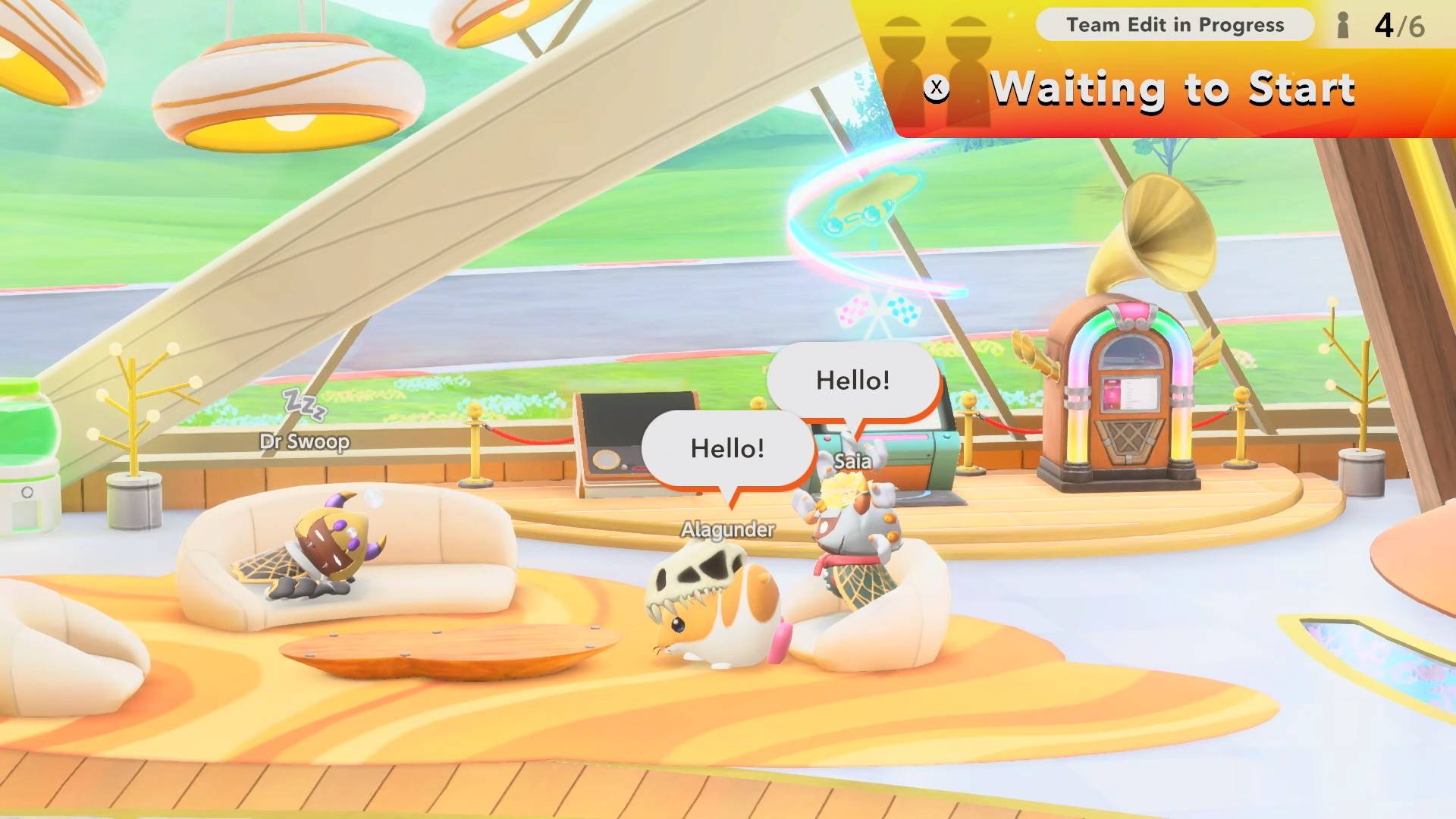
There’s always something to do, each as fulfilling as the last. I’m designing licenses with the sensibilities of a sticker book landscape. I’m drowning in the memories unearthed from Kirby’s Adventure and Kirby’s Dream Land 2 music remixes. I’m snapping and editing shots of the mystifying cityscape of lights beneath Checker Knights’ lakeside—an explosion of visual creativity captivating me since childhood. I’m running around the online paddock watching everyone bounce around, greeting my fellow players by wagging Rick the Hamster’s bum: inching as close as possible to unsuspecting avatars before unleashing my fluffy, oven-warm tush in their face.
Such is Air Riders’ toy chest mentality. There’s a profoundness in its pointlessness; a secret formula to its eccentricity. Its appeal is nebulous, proudly wagging its assembly of baby rattles while inviting anyone to break it wide open. It’s a monument to Air Ride nostalgia everywhere you look, from the classic courses refurbished in HD to young imaginations soaring free in City Trial’s Free Run. (Ever play house in a sunken ship?) Everyone is celebrated as a winner, confetti flying and characters dancing to your landing 4th place.
It's a game that shouldn’t, by virtue of circumstances and public perception, exist. And yet, here it is: speaking the long-lost language of a niche audience from 2003, echoing the siren song from so long ago: One more game. One more unlockable. One more record.
Some may say Kirby Air Riders’ stumbling block in its controls may be the antithesis of Sakurai’s appeal to the fledgling gamer: the directive that not only cemented Kirby’s legacy in Nintendo’s pantheon but defined his career. Yet I can’t help but share everyone’s observation in the DNA spliced from its cousin in Smash Bros: both rewiring your traditional muscle memory while showering players in sheer amounts of stuff. It doesn’t share Smash’s broad appeal, but while it’s certainly not for a lack of trying—the wide array of accessibility options is as good an olive branch as any—it routinely rewards its dedicated faithful all the same. It’s Kirby stepping outside his comfort zone, and no matter how small a step that might prove, I can hardly think of a better guiding hand than the man who brought him into existence.
There are objections I could raise. Like many players, I have no use for timed online events: only six hours a day, divided in two-hour increments, is a hard ask for grown adults with 9-5 jobs. “Then don’t play them”, you may say, yet their exclusive rewards demand the attention of the Kirby completionist in me. Why not just host them all day for convenience’s sake? Let’s hope they do just that in future updates.
There’s other niggles to pick at. Menu loading times lag. Boss fights have weird controls. Eyebrows furrow at Road Trip’s thankfully switchable male narrator. (Just read this. Or skip to the end.) The unsung Kirby’s Epic Yarn is once again left out of the fun. Maybe, having been so spoiled by Smash’s riches, I wish there were more toys for my toy box: maybe some more racers, maybe a bit more in the music department. (My Music for City Trial, but not the racing modes? C’mon.) Alas, there’s no DLC incoming—undoubtedly the consequence of Sakurai being whisked away to make the next Smash.
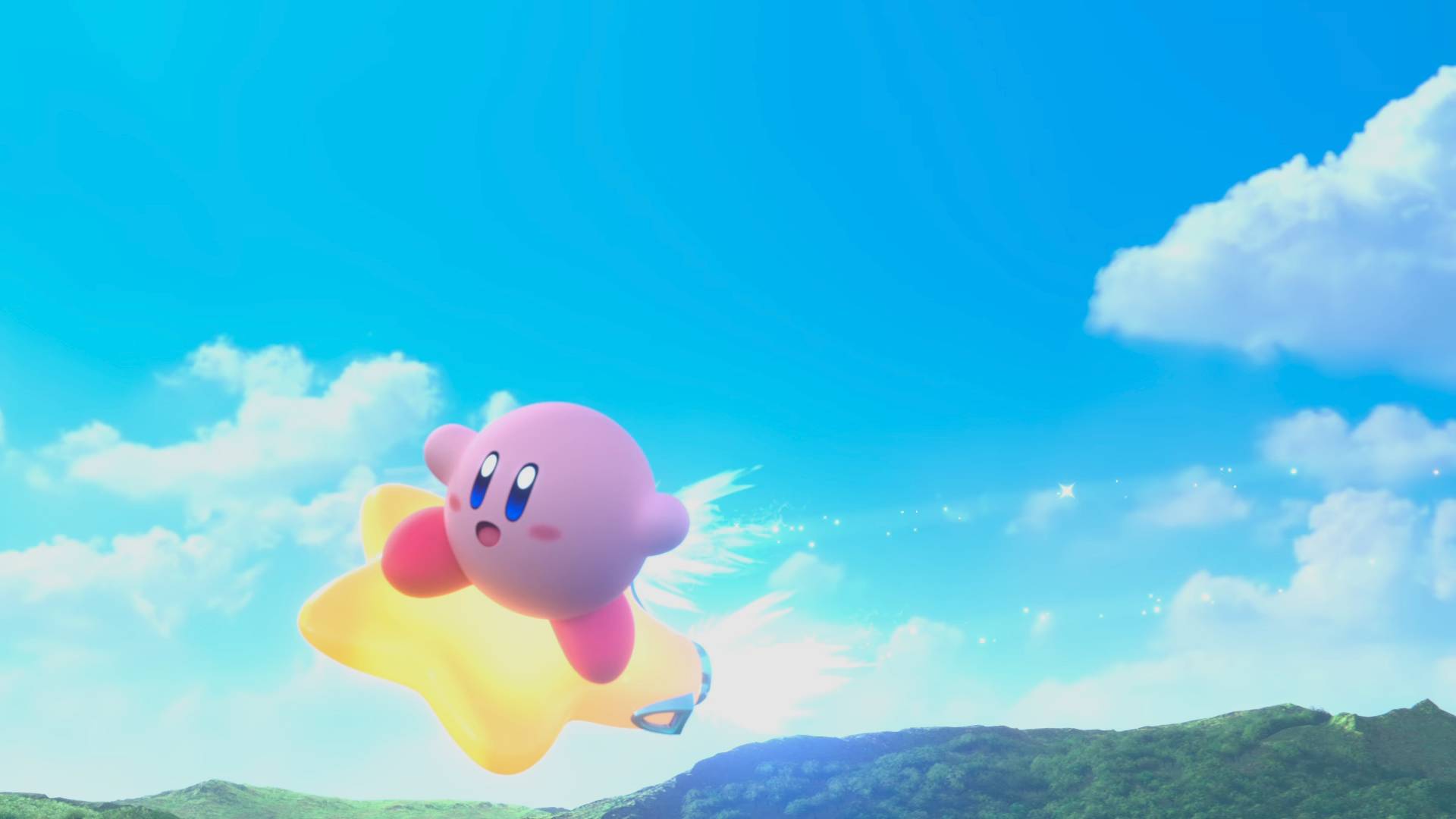
Yet why complain in the face of this miracle? Kirby Air Riders is pure, concentrated video game: unabashed in its identity, marching to the beat of its own drum for a devoted audience. And in this age of overabundant live services, predatory microtransactions, and shameless AI slop, well, thank goodness for that.
Kirby Air Riders
Excellent
Kirby Air Riders isn’t for everybody, but its uncompromised vision produces a winning vehicle action game unlike anything else. For those willing to join its cult, you’ll find an embarrassment of riches that keeps you coming back for more.
Pros
- Esoteric mechanics that click beautifully
- The Checklist's organic addiction
- City Trial remains peak multiplayer
- Bursting with content
- Fantastic soundtrack
Cons
- Controls won’t click for everybody
- Timed events are inconvenient
- Uh, where's Elfilin?
This review is based on a retail copy.