In the Ashes is a work of genius and innovation that sets the stage for a bold new phase of solo RPG books. Taking place entirely in the space of its own pages, the game features branching pathways, tactical turn-based combat, room for choice and exploration, all while burying secrets within its pages. I think a second book in this series could more comprehensively deliver on the ideas that In the Ashes is presenting, but this is a strong opening title and one of the more successful experiments I’ve seen in many years. Building on tried and true elements of choose your own adventure books, it’s a genuine step forward for the genre, and doesn’t need much work to bring its greatest strengths to the fore. Especially if you have a child who’s into gaming and needs some impetus to get off their phone, I highly recommend this book. It’s packed with hours to days of adventure, asking only for a pencil and an imagination to jump into it.
You start with an opening narration and a quick tutorial on the choice-based premise. These decisions come not only in the form of narrative, but in the hex-based combat and interaction system. As with typical choose-your-own-adventure books, you can make certain decisions that prompt you to flip to future pages. These decisions chain off of one another as you pick up items, speak to different people, and succeed or fail at combat encounters. A lot is going on with each of those elements that I will need to explain further.
Where most books in this genre stop at narrative, broken by long blocks of text, In the Ashes goes a step further with its numerous combat sections. Taking place on a hex grid, these sections give you and your enemies cards as available actions. For your actions, you will choose 3 cards at once, making sure never to use any that are in the same row or column as one another, and never using the same card twice. Enemy behaviors are similarly dictated by cards at the bottom of the page. What starts simply quickly picks up in complexity, with status effects, optional equipment, and many, MANY abilities coming into play. It’s in presenting all of these decisions that In the Ashes stakes some of its deserved claim to innovation. No matter what decisions you make in-game, what classes or abilities you choose, and what items you have at your disposal, everything is contained within the behavior page. It’s just up to you to track which decisions you’ve made and which options are relevant.
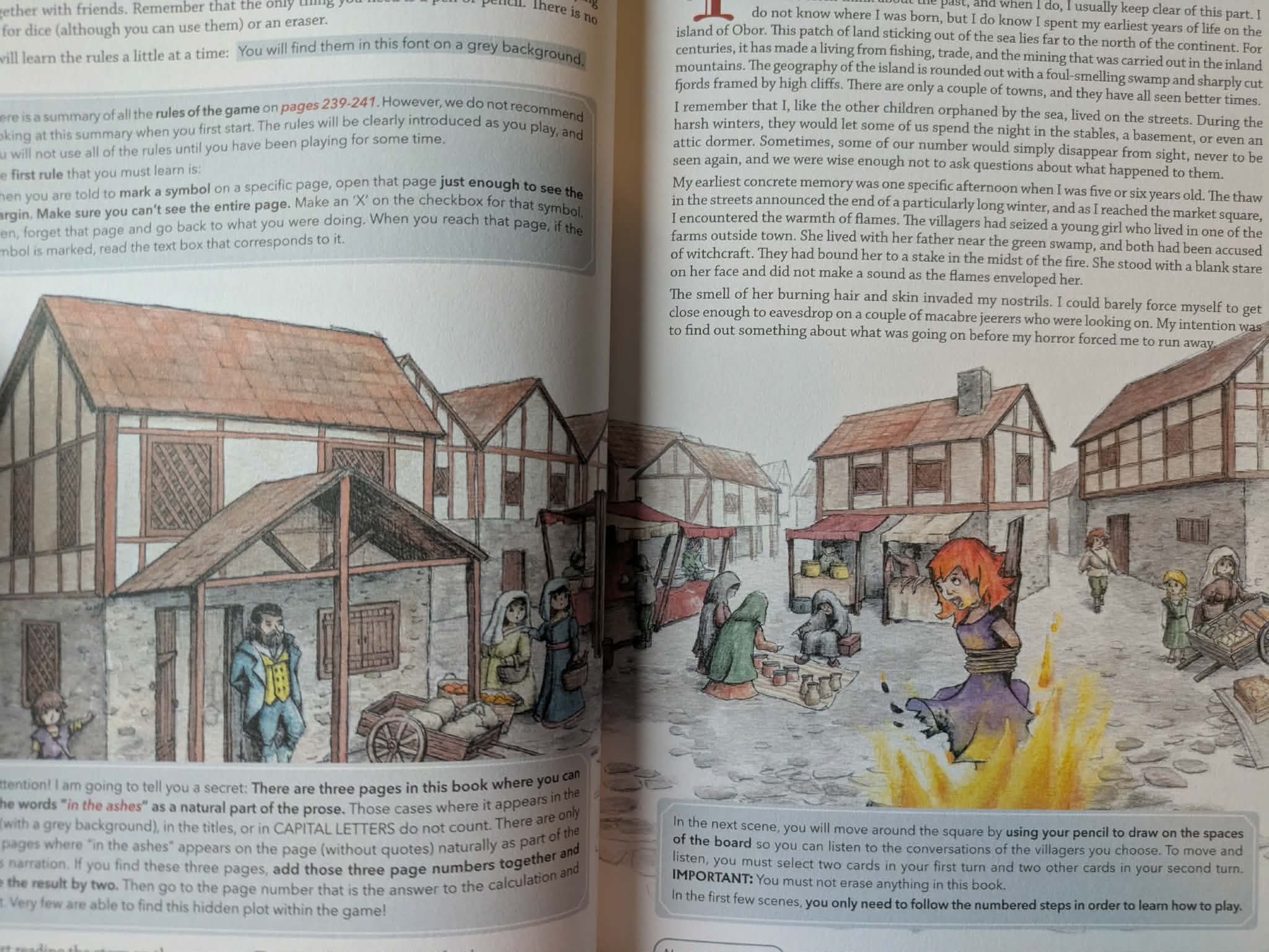
A lot is going on with those choices, and with the mechanics for enemy behavior. I’m a 34-year-old lawyer who has been writing on RPGs for around ten years now, and I have had only a few small issues keeping everything straight. I would like to think the average person could keep things running without issue, but the urge to keep everything within the book doesn’t do it a ton of favors. That comes in a few forms: as you make certain calls, it tells you to flip to a future page without looking at the text and mark down an accomplishment. Usually, this comes in the form of a bonus for succeeding at a particular combat task. Sometimes it comes in the form of optional lore if you spoke to the right NPC at the right time. It’s inconsistent whether these bonuses feel connected to your choices in a real way and build on the narrative, but each of them does give you something to chew on.
The larger problem comes from a Save page in the back of the book, asking you to mark off items and choices. It would be nice if this were a separate resource or some kind of log, just because of the amount of material you’re going to be tracking. There are a lot of items and page markers to track, though I give it credit that the vast majority of this is contained within the book itself.
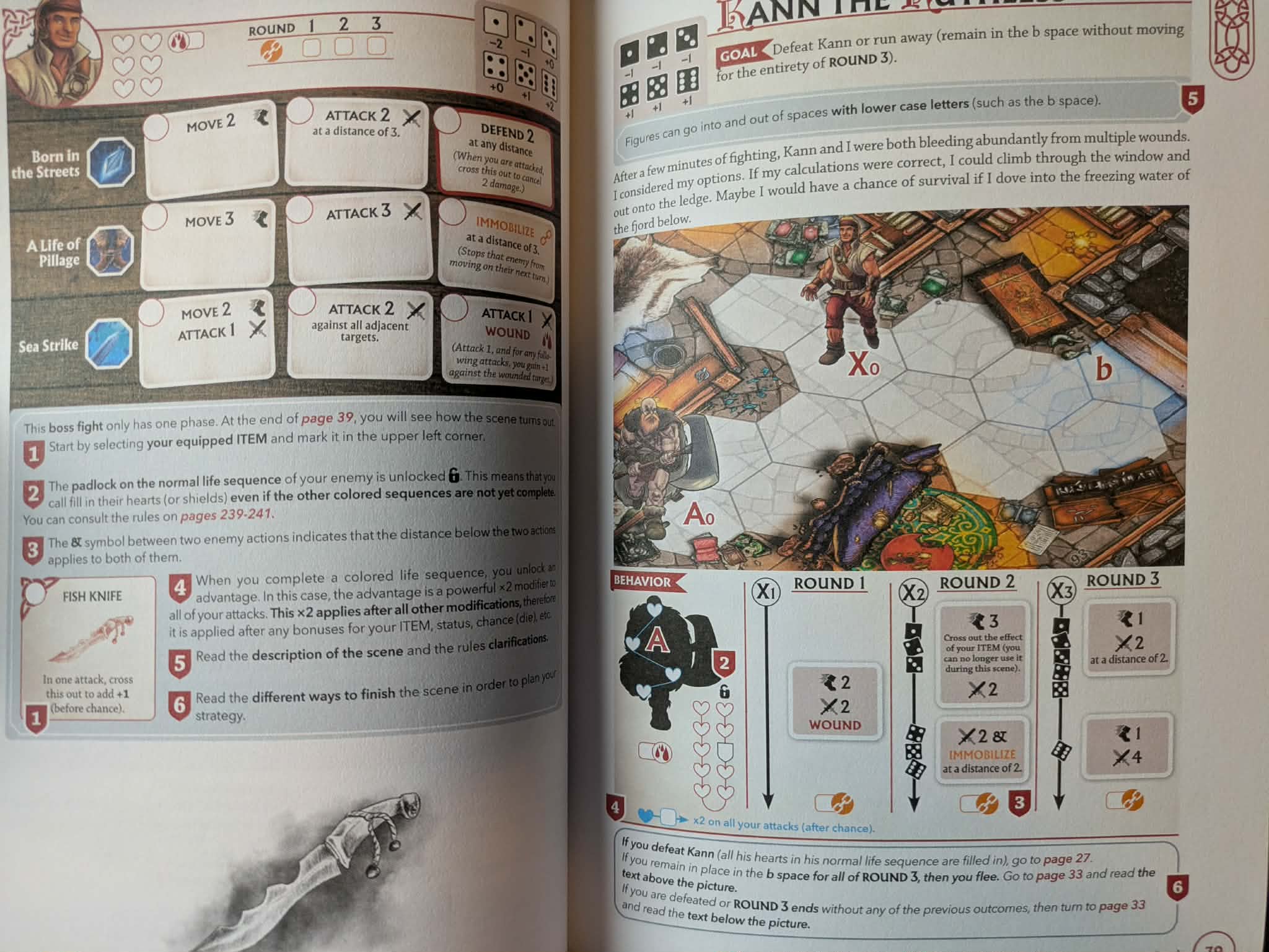
For that matter, the most controversial aspect of the book comes in with that pencil I mentioned before: to play In the Ashes, you have to write all over it. As you’ll note in my pictures of the book, I could not bring myself to do this. I handled it all by memory and finger pointing, occasionally placing my home minis on the pages during combats. I know it’s not in keeping with the goals of the book, but I (and I suspect many of the intended audience) just can’t bring myself to deface a book like this. That asked more of my memory, and I was capable of remembering the important details, but there are some ways this is more than a purely preferential issue.
You see, In the Ashes’ campaign is replayable. Doing so means making different decisions, generally going down different page routes, but some of them will be repeated. Playing the second time means marking symbols in different ways and erasing the Save page or finding a way to make clear which marks are for which game. It’s nice in that you can play a random page or combat once you’re familiar with the rules, in a semi-roguelike fashion, but the need to write in the book does limit its usefulness, and in the worst case, buy a new copy. The problem is compounded because the combat, as fun and intricate as it is, also features a randomness that can make it much harder or easier based on RNG. Pages have random dice figures on them, and when you or monsters make certain attacks or magical spells, you flip to a random page and change the result depending on the dice roll. These could make or break an encounter regardless of smart plays. It further encourages the type of replay or different decision-making that permanent markings make difficult. Especially in a book with so many decisions, it feels disappointing how off the rails randomness can render the flow.
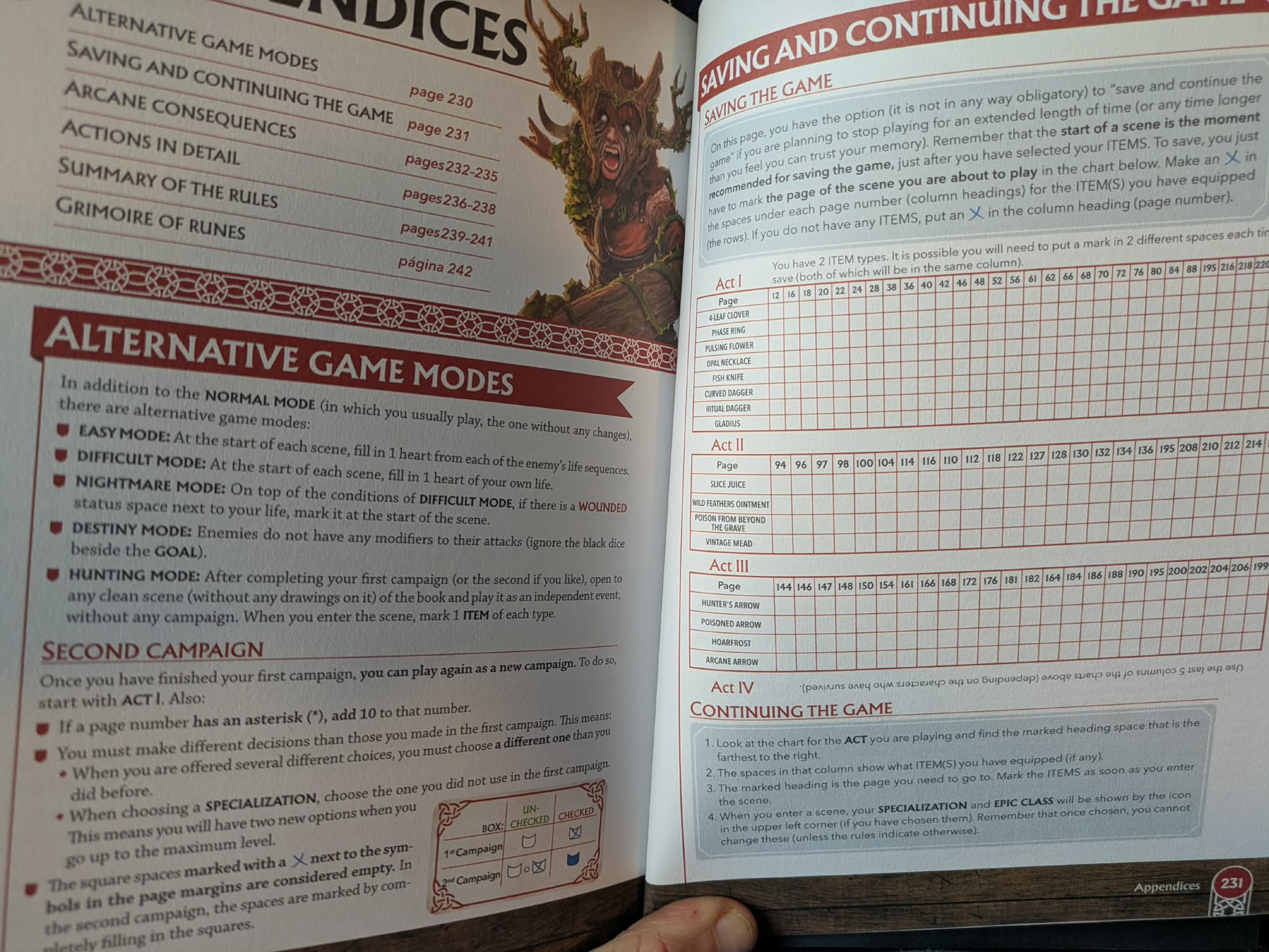
That flow brings us to the most pressing problem with In the Ashes: the writing and presentation. The art is inconsistent. Some of it is truly magical. It can be impressive and evocative, and full of atmosphere. Some of it doesn’t work at all. As one example, the opening narration and encounter feature a girl being burnt to death. This is one of the most harrowing things a person could witness, but the pages where it’s depicted show it as…quaint? Unremarkable? No one around seems to care about the human being screaming in agony as her body is consumed by a fire that’s far too small to serve its purpose. It just doesn’t carry the weight that it’s supposed to. Or is it supposed to matter at all?
In both the moment-to-moment writing and the overall narrative, things just don’t tie together very well. I can give some credit to the fact that this is a translation, of course. That would explain some of the awkwardness in phrasing and presentation. The larger issue comes in with the overall narrative, and its failure to consistently tie in decisions or make the combats matter. Sometimes you’ll be investigating something, and you get stopped in your tracks by a random-seeming mushroom man, who might destroy you because of bad randomness. The unbound nature of a fantasy setting, where anything can happen, leaves you feeling unmoored from the place and people you interact with. Overall, it is a fun, rewarding experience, but without the kind of weight that would make it an unqualified recommendation.
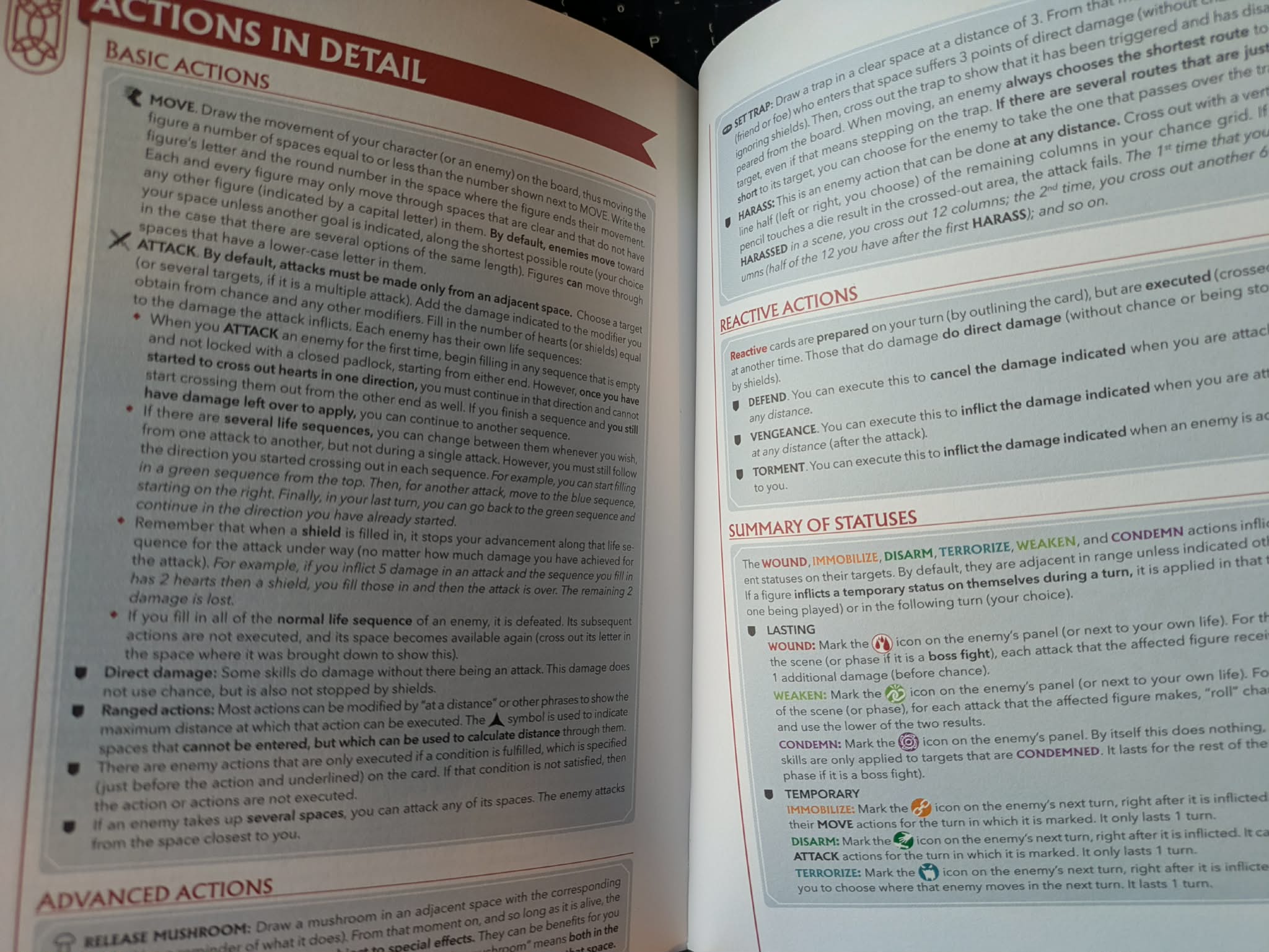
I’m left with the feeling that the next iteration of this should be gothic or cosmic horror rather than classic fantasy. Let me explain what may seem like a strange claim: for one, the book is filled with secrets. Page numbers are hidden in the text leading to secrets, as are several locations in the book where In the Ashes is written. If you find all of these locations, combine their page numbers, and divide by 3, you’ll unlock a hidden plot thread underlying the entire story. On its own, this is a great way to keep the reader engaged and make sure they’re paying serious attention to the text. But imagine if this were an investigative horror story, where the secrets buried in occult texts were the entire thrust of the story. Maybe an epistolary delivery like Dracula, or something with Lovecraftian influences about investigating the Necronomicon. Those stories would still make room for combat and intrigue, but with a more coherent narrative and weighty encounters with the supernatural. You could build up to the strange mushroom men instead of opening with them and leaving the reader confused as to why we occasionally stop by the shore to fight evil turtles.
I respect and recommend In the Ashes, but I can’t say I was all that in love with it overall. The moment-to-moment combats had a lot to offer, and I was impressed with so many aspects of how this came together. With a little polish and focus, a book in this series could be a true landmark for adventure games and do incredible work for solo RPGs as a medium. This book has choices and combats and secrets, but without some of the finesse it would take to make them feel important.
In the Ashes
Good
In the Ashes is an ambitious and innovative solo RPG book that successfully modernizes the choose your own adventure format with deep, tactical hex-based combat and layered secrets. While its narrative and artistic presentation are inconsistent, and its requirement to write in the book may be a hurdle for some, its inventive mechanical design is genuinely impressive. This title represents a strong, promising foundation for a new kind of interactive book. With more polished writing and a more cohesive setting, perhaps in a genre like investigative horror where its hidden secrets would feel more integral, a future iteration could be a landmark. Despite its flaws, In the Ashes is a compelling experiment packed with adventure, offering a refreshing and engaging experience that points toward an exciting future for solo RPGs.
Pros
- Comprehensive adventure and choices in one book
- Choices and replayability
- Deep tactical decisionmaking and character building
Cons
- Inconsistent art and writing
- Defacing the book is close to a necessity
- A mechanical complexity that doesn't translate to the overall story
This review is based on a retail copy provided by the publisher.