Cats of Catthulhu is one of the weirder offshoots from Lovecraft’s Yog-Sothothery, seeing you play as cats who venture out to combat the unknown horrors of the universe. Cats in the mythos are dignified, mysterious creatures who can slink between worlds. Not unlike our reality, they delve into dreams and keep a level of order in the universe, mostly in order to satisfy their familial sense of honor. There’s plenty of potential to build on that perspective of a fierce but small predator in a universe unbound by its horrors. CoC takes a different tack, leaning into an understandably comedic tone. This comes into play in many ways, such as the lack of math for the game and its mechanics. I’m much more a horror fan than someone who likes cut & cuddly games, and I find the juxtaposition here less than helpful to the overall game. If you want something light and silly, this is a great pick (provided you’re willing to work past some of the vagueness of the rules).
Overview & Materials
The anniversary boxed set is $89 at time of writing for, in no particular order: the box itself, with some Louis Wain-inspired surreal art, the core book, a plushie octopus keychain (too large to really serve the purpose, but it’s a nice addition), 10 fish tokens, 2 bookmarks, a cat shaped dice tray, a pack of 25 character sheets, 12 adventures in De Felis Mysteriis (a play on Lovecraft’s De Vermis Misteriis), 5 wooden cat tokens, and 8 specialized dice.
That sounds like a lot of stuff, and in a way it is, but the main gameable material is one hardcover core book and one softcover adventure book. It feels like a hefty price, everything aside, and I don’t know if the bells and whistles of a big pink octopus and cat dice tray are only going to be inspiring to those who are really attracted to this cat-based vibe. The box has a cardboard divider to keep all of these materials held together, but I get the feeling they could have used a smaller box for this collection.
As the rules are generally simplistic, the character sheet has a nice touch by way of a quick rules summary for players. There is very little to a given character, and with most of the page taken up by your notes/description and a drawing of your cat, it’s great to have that information right in front of you.
Core Book, Characters, & Rules
Along with a hand-written signature by author Joel Sparks, the book contains a compendium of prior releases, including the Nekonomikon, Cat Herder’s Guide, and Worlds of Catthulhu. I’m sparing you here, but the book and supplemental materials are bursting with puns that meld feline terms and Lovecraftian references. I can’t stress enough that this is a major, consistent focal point of the writing, and that you should flee from this book immediately if that isn’t your particular jam. Despite the horror influences, the book is very much playful and unserious. That even comes down to the font, with large text and empty pagespace.
The information itself is presented with logical ordering and bolding of important terms…mostly. The text and background look the same in every section, so it can be difficult to tell which part of the book has which information. Luckily, the appendix includes a great reference for rules and game terms, and the table of contents generally includes all important information.
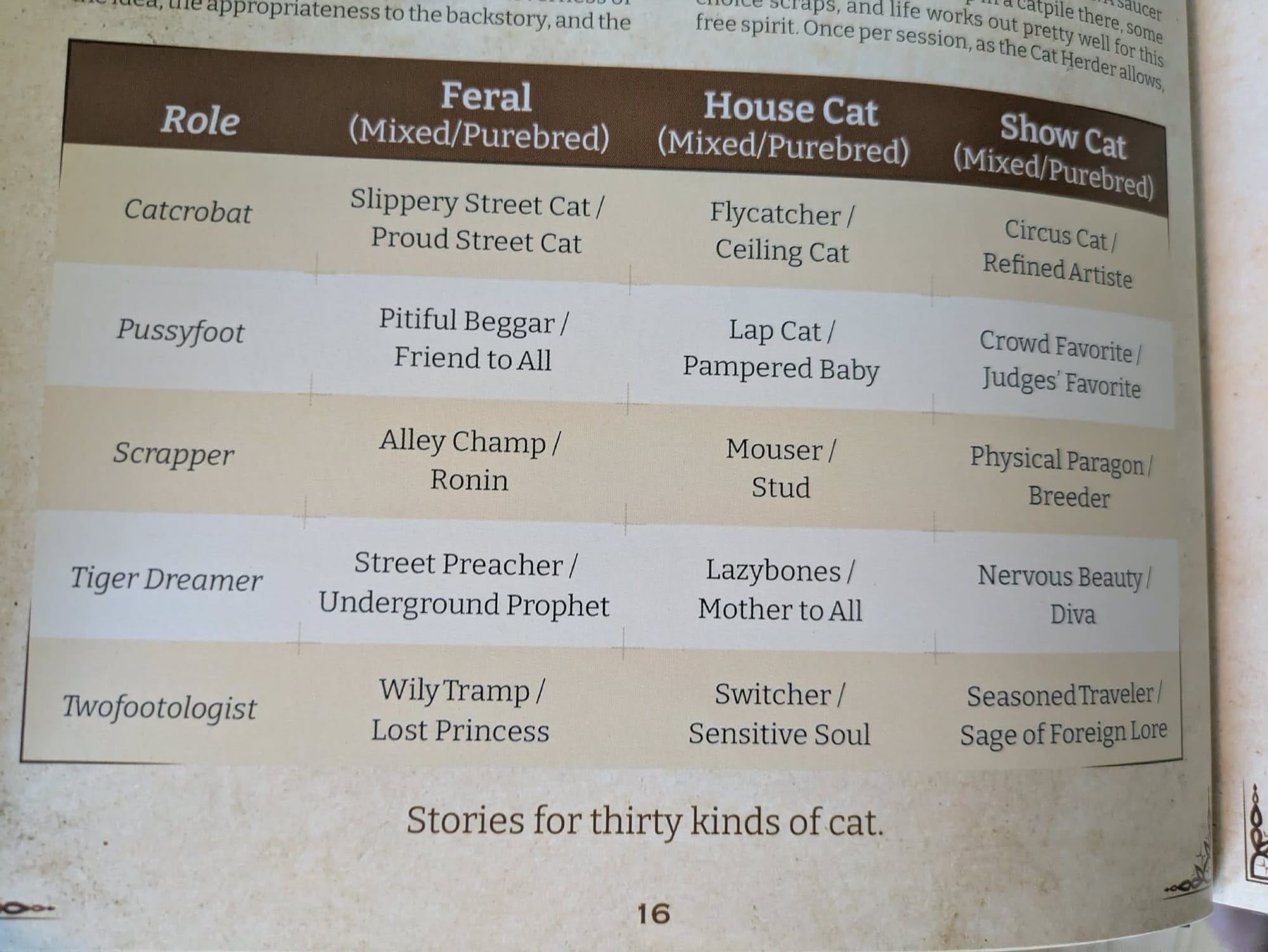
It’s definitely an easier lift to jump into this game than your average RPG, and the rules are anything but granular. Much of the game is mere suggestion, with almost no rules attached to the class-like Roles for characters. You pick a Role, Background, and Description, and have your character. That’s it, really. There are some extremely vague suggestions about how these influence your character, like long hairs doing better in the cold and Roles having some veeeeeeeeery slightly more defined characteristics, but for the most part every character is mechanically the same. I can’t help but think this is a missed opportunity. I know this is meant to be a light, silly, presentable game, but even so there’s almost no need for a character sheet at all with this game. The discussion of breeds and associated suggestions are there purely for flavor, and probably so that you can more easily make a character of your own pet. This is generally nice, but it does mean 20 pages of non-rules text full of bolded terms that are there purely for flavor. Again, this is for cat enthusiasts first and fans of RPG rules second, which is no flaw for something that knows its audience.
The rules section opens by telling you it has a summary on page 214 before getting into the explanation itself. Great, thank you. This is how more books should be written, with a quick, accessible explanation of the rules in front of or alongside the larger writeup. Honestly, I don’t know why RPG writers are so allergic to making their rules comprehensible to their audiences.
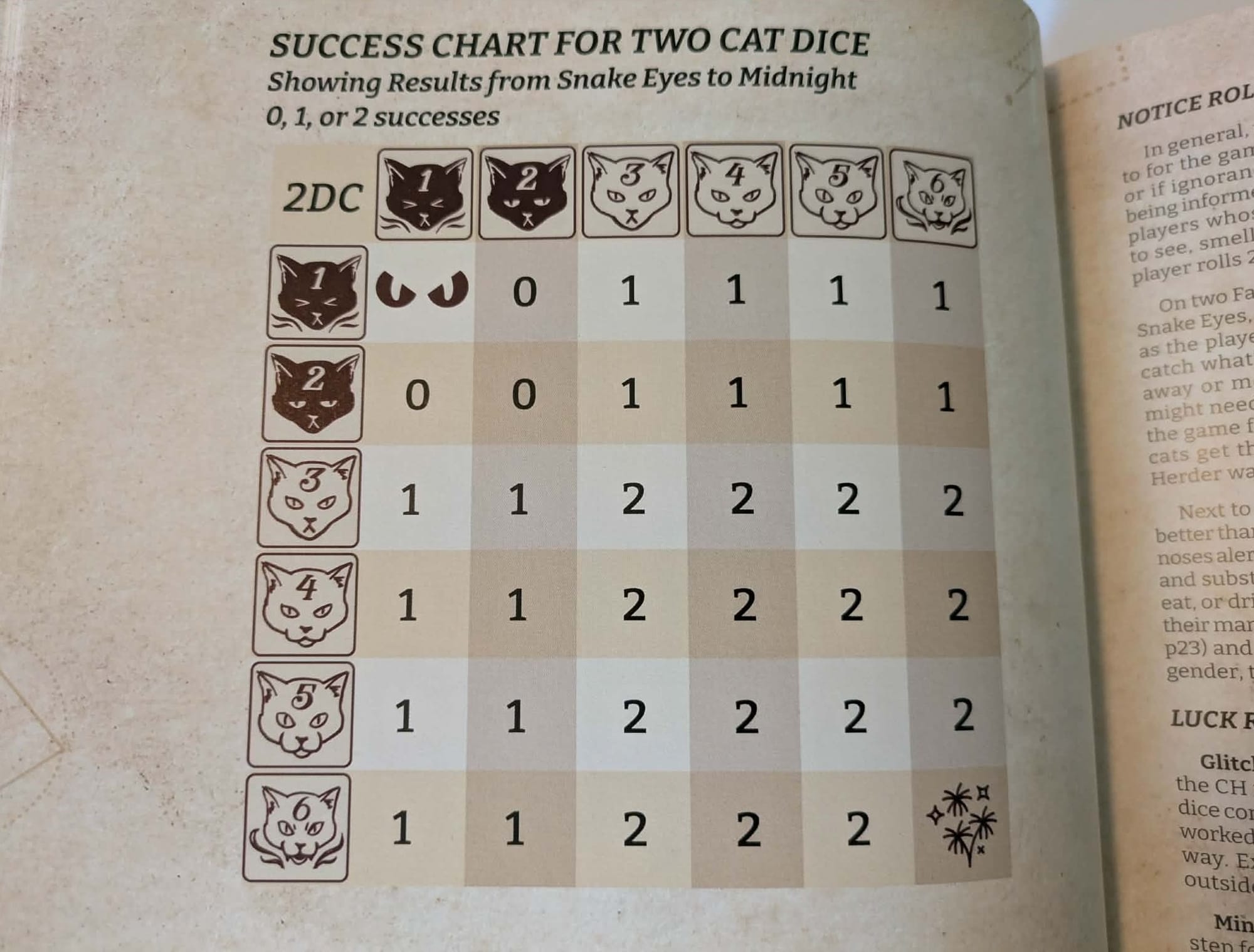
The main mechanic comes in the form of six sided dice: for a given Challenge, you’ll roll 2d6, or 2dC, for Cat Dice, as the game refers to them. A roll of 1-2 is a failure, while 3-6 is a success. Easy Challenges only need 1 success (a 1/3 probability) while Hard Challenges need 2 successes (a 4/9 probability). If you choose the Right Cat for the Job, abbreviated as RCFTJ to add needless terminology to a very simple game, you count an automatic success. This is where the extremely vague Roles and Backgrounds come into play, which will lead to Mage the Ascension-esque pointless arguments about which criteria fit for which task.
Each cat starts with 1 Treat, i.e. fish token, per session. You get these as a story reward and can hold a maximum of 3. If you have 0, you may receive one through pets from a friendly human, modulated by the type of cat you are. Treats let you reroll dice on normal tasks, but can’t be used on Dire Challenges, involving danger or death.
Double 1’s on your roll are crit failures while double 6’ are crit successes. In the rare (1/216) chance that you have 3 dice to roll and they all come up as 1 or 6, the Moewawki occurs (a Cat term meaning “The End of the World as We Know it”). This requires every other player to stop talking and let the player who rolled say literally anything they want for as long as they want, allowing the GM to inflict penalties on any player who interrupts. While extremely rare, this rule is so needlessly complicated and hostile to everyone at the table that I’m sure I don’t have to explain why I hate it. It’s obvious right? I mean it’s self evident that punishing the table for reacting at all or offering any suggestion while one person does anything they want for as long as they want is a terrible rule for a collaborative storytelling game? Comment below if you want a 1500 word rant on exactly why this is a bad idea. We’re moving on.
Combat & Health
These combat rules are the most interesting part of the game, largely because they’re the only one with any actual mechanics. You first choose the effect in order of severity from Dodge, Stun, Shove, Grab, and Hurt. If you fail a contested roll, the winner can only inflict up to one level of severity greater than what you chose. This does mean that no matter what you’re fighting, you could choose to keep the conflict non-lethal, which is very much in keeping with the harmless cosmic horror stories I remember. The ones where monsters politely wait to see how tough you’re feeling before deciding if they want to harm you.
There are advanced combat rules, which I think are essential. They use more of a matrix, where a larger sized creature receives different effects based on intention and size. There isn’t much to this, and it grants Monstrous creatures immunity to any real harm, but it’s a welcome change of pace and one of the only places where the game leans into the horror that it’s ostensibly built around.
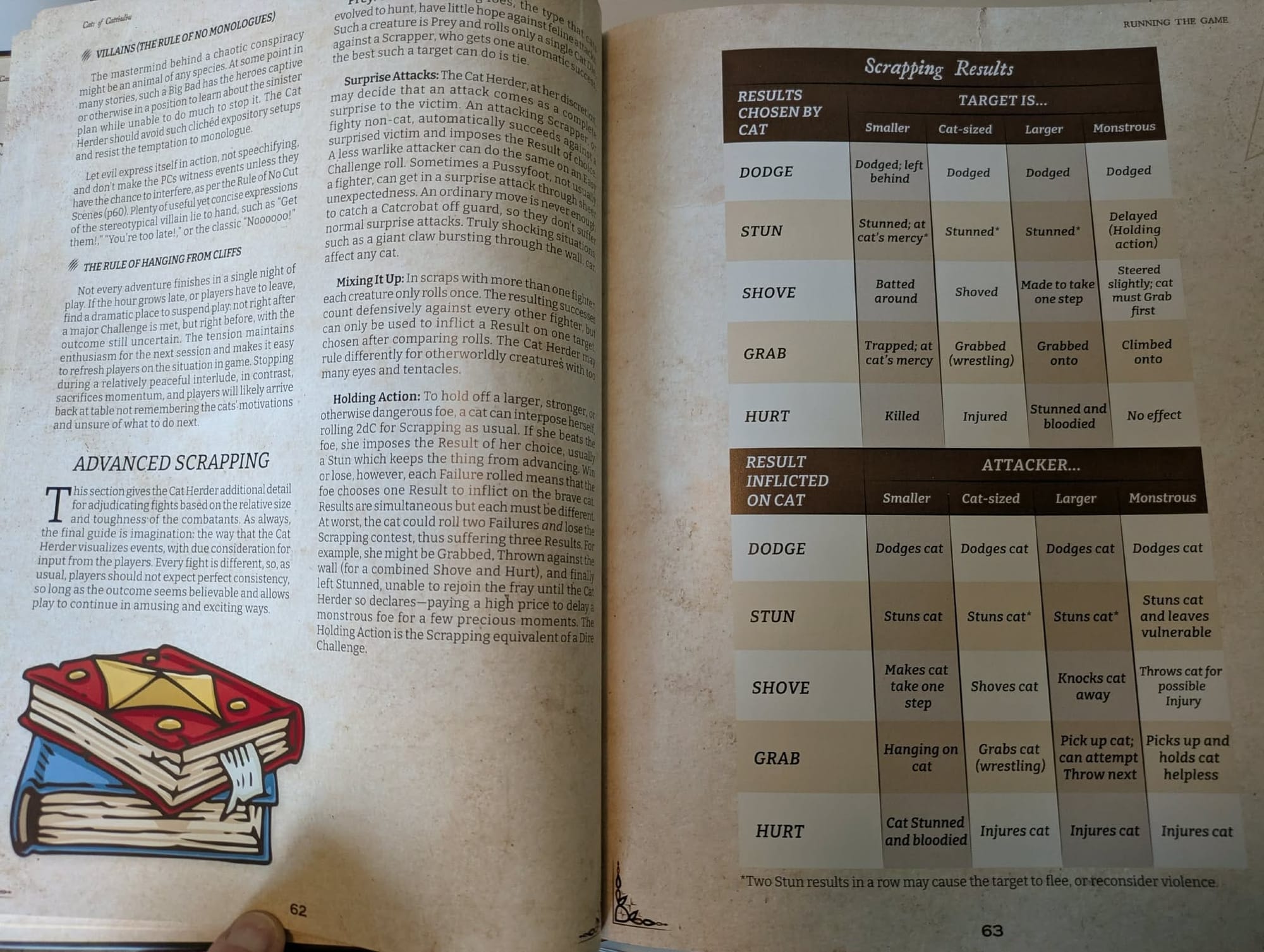
You can receive 1-3 injuries from combat. These injuries are immediately crippling. The first means you are never RCFTJ on physical rolls and need an extra success to do anything. The second means you are mostly useless and mewling for help. The third puts you on death’s door and makes you incapacitated, sure to die by the end of the session if you don’t get help.
Adventures & GM Tools
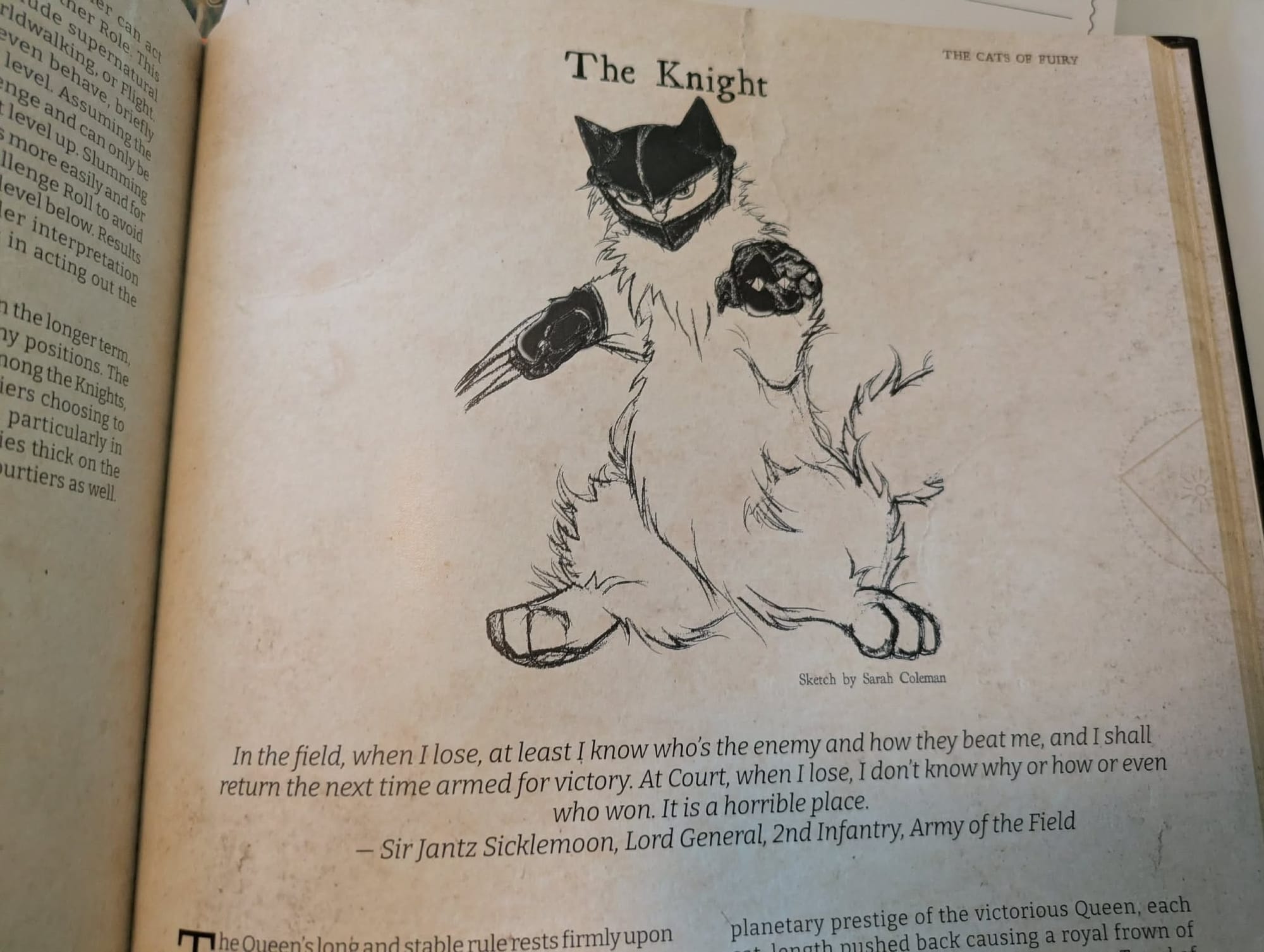
This is where the horror, largely absent from the player-facing materials, shows itself. You get a lot of talk about the weirdness of the universe, and its many cults which seek to bring dark beings into our reality. As the Yog-Sothothery was much bigger than the idea of summoning monsters, the book strays into further territory and plots. We get cat-based versions of the elder gods along with adventures into the collective Dreamspace of living creatures. Those go along with human and post-human gods. Despite the MOUNTAIN of puns, there are some interesting, high-flying concepts put on display here which could support more serious play.
The GM section is particularly thoughtful. It has details on running the game, modifying it for children, understanding or modifying its rules, and a chart of dice probabilities so you know how rolls might turn out. This is very thoughtful, especially for a game geared towards a lighter audience.
All that changes when we get to the latter Worlds of Catthulhu, with a setting in Faerie, or Fuiry, ruled by magical cats. There is where you get more detailed classes, mechanically and socially, and the kind of dark suggestion that I felt the game needed more of. The earlier rules are more of a basic introduction, but these character options and advanced rules round it out into much more of a complete game. Combining this section with the variable adventures, of which there are many, takes this from a nice curiosity to a strong recommendation.
The adventures in the core book have some nice variation, but their presentation is mostly made of less than organized text. De Felis Mysteriis is where things are laid out more appropriately, and the ideas continue to run wild. The rules alone might not impress me, but taken altogether the advanced options and adventure seeds wowed me with imagination and diversity.
Cats of Catthulhu 10th Anniversary Boxed Set
Good
Cats of Catthulhu is a novelty RPG that knows exactly who it’s for: players who value whimsy, accessibility, and feline-themed humor over mechanical depth or sustained horror. While its rules-light approach and relentless puns undercut the cosmic dread it draws from, the game’s imaginative settings, thoughtful GM tools, and stronger advanced options ultimately elevate it beyond a mere gag. If you meet it on its own terms, and especially if you lean into the later material, it offers a surprisingly rich playground for light, strange, and occasionally inspired play.
Pros
- Easy to learn and teach
- Imaginative settings and adventure concepts
- Thoughtful GM guidance and optional advanced rules
Cons
- Humor often undermines the horror premise
- Rules are vague to the point of sameness
- Premium box price feels hard to justify
This review is based on a retail copy provided by the publisher.