Power is a funny thing. It’s the one thing that, no matter how much they accrue, is never enough for the people who already have it. Be it personal ambition, lofty goals for expansions, or sheer envy of their neighbors, if you have more, and I have the means to take it, I’ll always be tempted to do so. During the rise of Rome, we saw this play out time and again as the Roman Empire’s reach extended around the globe. Anno 117: Pax Romana takes place in the year 117 at the height of the Roman Empire, complete with political intrigue, rampant corruption, strategy, historical narratives, and yes, city management. Combining plausible historical accuracy with enough wiggle room to tell a story, this game lets you carve out your own legend within the real-world Roman Empire. Will you be a benevolent ruler or a tyrannical dictator - the choice is yours.
Frankly, I can’t say I’ve been as invested in an Anno game’s history as much as I am in this one. Sure, it can boil down to a number of sequential tasks in the beginning, but once the political struggles begin, things get all sorts of interesting. During a period between 27 BCE to 180 CE, Rome stretched from what we know as Britain all the way to ancient Mesopotamia in a push for what the Romans called “Pax Romana” or “Roman Peace”. This also coincided with a period of great innovation and invention, creating the perfect storm of economic power, cultural achievements, security, health care, leisure, reduced scarcity, new types of infrastructure, trade, the establishment of laws, and the spread of Roman culture, culminating in a shockingly stable moment of historical prosperity. That’s not to say there wasn’t backstabbing, political power grabs, assassinations, and worse, but that’s exactly where Anno 117 tells its story – managing a period of incredible growth amidst an environment of dangerous upheaval.
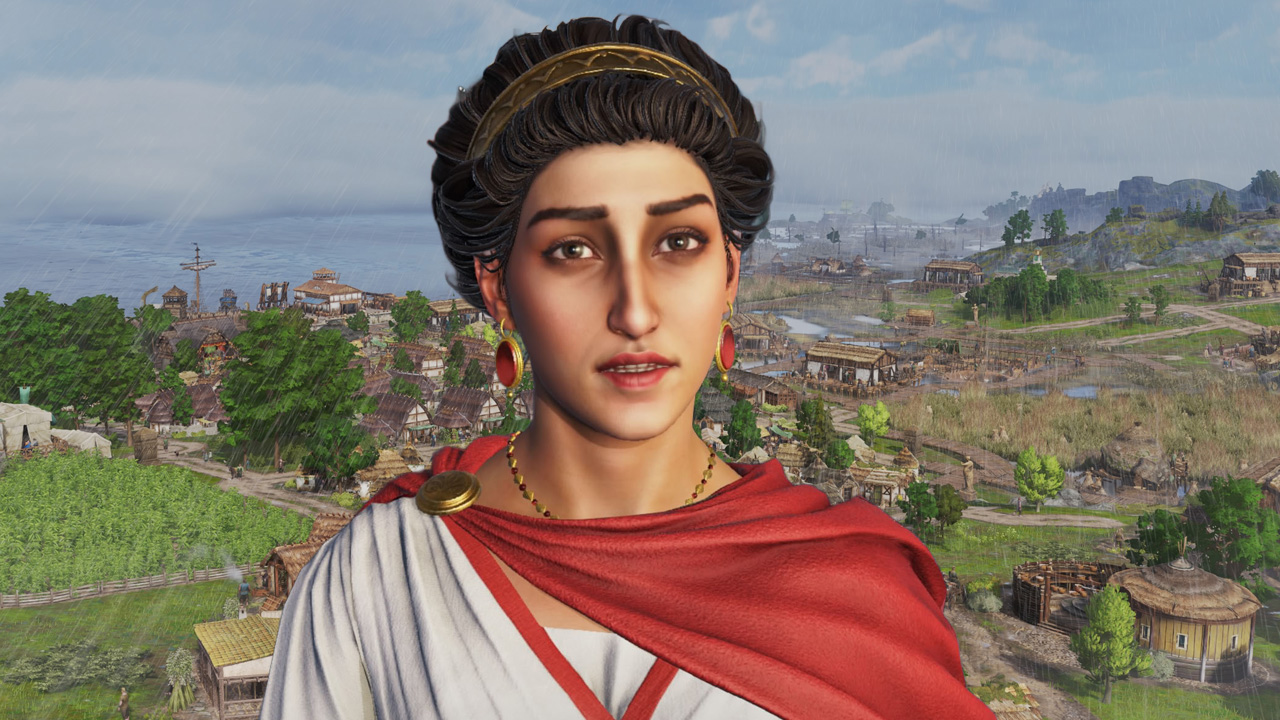
There are two modes to kick things off – a campaign that tells the story of Marcia Titania (or Marcus for a slightly different scenario - your choice), and an Endless mode that enables play without limits. Both can be played in co-op and competitive modes (more on this later) and you can even convert a campaign into an endless mode if you really love what you’ve built in one to carry to the other. We’ll start with the campaign and then talk about the Endless freeplay mode. Don your toga, let’s talk intrigue.
I chose the role of Marcia Titania to start my time with the game – the central story mode. We were summoned to the island of Latium, where we were wed to Titanius, a man thrice our age, in an arranged marriage. Unfortunately, he's also not well, having made the journey across the sea ahead of us. Instead, greeted by Emperor Lucius, we are set to the task of governing this new island in our good husband’s stead. Much of what remains here is in ruins, but thankfully, it's also fertile land with ready access to an abundant amount of resources. We shall build, govern, and rule while we await his return. It is on this island that we will establish the city of Juliana. Thankfully, we have the wisdom of our house slave Ben-Baalion to help guide us.
With little more than a dock, we will need to establish our foothold on the island. The city of Juliana will need people, and those people will need homes, services, goods, protection, and more to enrich their lives while they work the land to improve it. First, we’d need materials, and that meant putting down a woodcutter camp. Placing the camp, I saw a number that indicates how effective that camp will be, based on proximity to the resource they are collecting – wood in this case. My woodcutters went to work, logging the forest and then loading up the wood to send to the sawmill, the second half of the supply chain. Once processed, they stored those resources in a warehouse – a central location for all goods needed in an area. Warehouses only have a certain range, so we’ll need multiple as our little establishment grows.
If you’ve played an Anno title, you’ll be familiar with the primary beats here. Building basic infrastructure and homes for your workers (liberti), then working to expand those services into more complex and expanding ways to serve the needs of those who have risen above that liberti rung of the social ladder. These folks pay more taxes, but they also don’t get their hands dirty. They might staff more complex higher society jobs, but they aren’t going to be your miners, fishermen, or hauling a cart across town. Balancing the workforce, the needs of both rich and poor, and building a stable society is the delicate balance, and that is precisely your job as Governor.
With enough wood, I was able to construct a dozen basic homes, interconnecting the buildings and the houses with dirt roads. Ben-Baalion was kind enough to remind me that those folks might also like to eat. With limited options for our sleepy little backwater, we had the options of sardines or porridge. More than just food, these offer additional attributes – the sardine can provide a +1 to my income, and will feed one household. On the other hand, porridge doesn't provide funds but can feed two families. They may not like the taste (and nobody is buying it), but that'd help us grow more quickly, so that's what I focused on. Unlike the logging camp, sardines would not require a production chain, simply a fishing hut placed on the shore. The production of porridge, on the other hand, would need an oat farm to make it, and a porridge stand to sell it to those living nearby. WIth food and shelter needs addressed, my attention was about to shift to other services, but instead, I was summoned to the nearby palace of Emperor Lucius and his wife, Juliana.
I was surprised that, at this point, I was given dialogue choices. I could talk with my hosts about their time in this new land, ask about my father, inquire about the ruins on our new island of Juliana, get a status update on the health of our new husband, or just eat quietly and keep my mouth shut. I'm not sure how "choices matter" these options are, but it's unique to see story elements like this in a strategic city builder like this.
Like in previous Anno titles, satisfying the needs of your citizens allows you to grow them from basic homes to beautiful villas. You’ll always need both the tax-paying rich, as well as the regular folks who help make the economic engine of goods and services operate. Similarly, you’ll need fire, protection, and if it comes down to war, an army at your back. Alliances with nearby kingdoms can provide some support, as well as trade opportunities, but your empire’s prosperity is entirely dependent on your leadership. Ultimately, it’s up to you to think through the cost of your legacy as you etch your name on the annals of history.
Before long, I was receiving not only requests from the Emperor for various goods, services, and favors, but even hearing from the Senate and neighboring factions. You are far from alone in your new home. Anno 117: Pax Romana follows some real-world historical events, as well as gives the player ways to alter them to carve their own path. Can you rise from the governor of a completely new province to the Senate, or even the Emperor? Only time and your choices will tell.
The challenge of ruling is that the needs of your people are never ending. What started as folks wanting a place to drink after a hard day’s work turned into the want of a church, theater, shrine, paved roads, and exotic foods. Soon the population realized that they can demand things like coal burners be located further away from their social and living centers, and may ask for precisely that. If their request is fulfilled, they may reward you with goods or additional income or other benefits. It’s here that you run into one of my favorite aspects of the game – trade.
You are far from the only occupants of these island chains, and your neighbors might be willing to trade with you. Trade is a simplified system where you can dispatch trade ships laden with goods, asking them to return with goods you can’t find on your island. What’s improved here, though, is that this can now be multi-segmented. They may take goods from your island, take them to an adjacent island to get a more valuable good they can then take to another island for additional profit. You could go straight from home to that third island, but that stop in between makes it more lucrative. Additionally, you might find that the third island doesn’t want anything you have, but they sure do want the goods from that second one – your opportunity to be the go-between can be lucrative, with your boats returning full of expensive or otherwise-unattainable goods. All of this happens with real boats, so it’s not just a hand wave and invisible transports. As such, you can really feel the hand of commerce and transaction. When it’s going well, you get that feeling like you’ve accomplished something impressive.
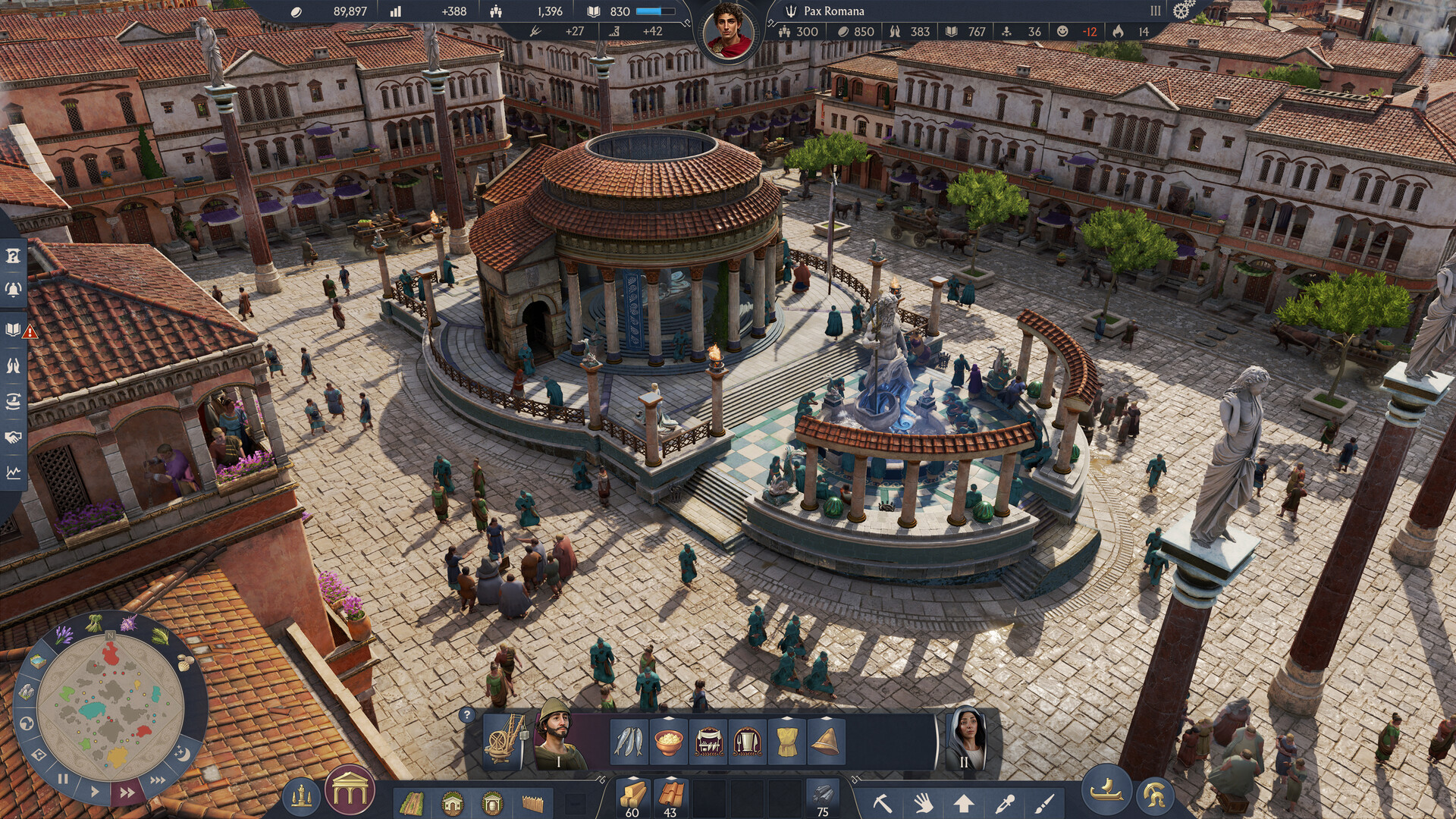
There is no part of Anno 117: Pax Romana that isn’t absolutely gorgeous, and at every level of zoom. Seeing the Emperor march through my streets as my citizens gather around, clapping, viewing the procession from a nearby bar, or rushing ahead in anticipation to be in position for when the parade rounds the corner is a cool level of detail I didn’t expect. Rose petals rain down from the sky, as befitting of a ruler’s visit. Every building is lovingly crafted with an extraordinary level of detail and craftsmanship. Every small detail on the buildings have a purpose, with many of those elements lighting up, animating, or otherwise looking like they function. It’s frankly an impressive amount of work for a game you play from 5,000 feet above, but it adds so much personality to the game. Character models and cutscenes also look the part, albeit with some odd mouth synchronization – it’s as if I’m watching a dubbed movie. It’s distracting during those scenes, but otherwise harmless.
Getting close to your populous reveals that your plebs load the carts, wheel them to the next area in the supply chain, unload the finished goods at the docks, load the boats, and return for the next load. They meet up at the local tavern, enjoy drinks, and walk home. Like the trade routes, these are real simulated people, so their routes reveal much about the efficiency of your city and its layout. Small arrows appear over those paths to help you further optimize your infrastructure. Perhaps you’ve located your warehouse too far away from the location where the goods will be used, extending their work day as they path back and forth. Building a nearer hub might raise productivity significantly. Solving the challenges of my urban centers, as well as the more complex supply chains for luxury goods, kept me constantly tinkering with building layouts and roads. The needs of my people had me placing upgraded roads for faster movement, aqueducts for both farming and water supply for homes, and a forum for debate and entertainment.
One technical note – I truly appreciate it when developers are kind enough to explain the numerous and complex settings that can impact your game’s framerate and look. We can all figure out what Texture Quality is, but if you are struggling with performance, being able to see what the differences are side-by-side before you commit them is a welcome thing. Maybe you can live with a notch below Ultra High, but it’s hard to know what levers to pull. For example, the Shadow Quality setting is nearly imperceptible between settings without a great deal of scrutiny, but it can have a marked impact on your overall framerate. The most stark of these setting comparisons is Anti-Aliasing, where 8X removes a lot of jagged edges and cleans them up in motion. Here we can see those differences visually to see if it’s something you’ll need to even concern yourself with or not.
DLSS, what model you’re using, XeSS, FSR, and many more options get the royal visual comparison treatment and I sincerely hope that more developers take this approach. Best of all – all of these things can be applied without a restart – congratulations to the Ubisoft team for cracking this long-standing irritation. Naturally I’ve captured the benchmark for you to see what this game looks like on a bleeding edge PC with an RTX 5080 in native and upscaled modes with 4X DLSS.
Before long you’ll encounter the second big improvement for Anno 117: Pax Romana – warfare. Previous Anno games have had combat, but the naval warfare here feels more cohesive and balanced. My lucrative trade routes attracted the attention of local raiders. Soon I was building a military arm to not only defend those trade ships, but also some local troops to dissuade those raiders from landing anywhere on my shores. The ships feel like they are massive ships of the line, requiring you take into account the wind direction, how much oars can compensate for an uncooperative wind direction, and how you might use the island layout to your advantage. When those troops (or raiders) land on your shores, you’ll need to dispatch your garrison to handle the bloodier parts of diplomacy. These play out in an RTS-lite fashion with a paper/rock/scissors approach to combat. Auxilla (swordsmen), Archers, are unlocked, but Legionaries, Slingers, and more will require research and time. Higher difficulties might require the latter unit types, but I found that a strong navy kept most nations in check, and a mixed set of Auxilla and Archers took care of everything else.
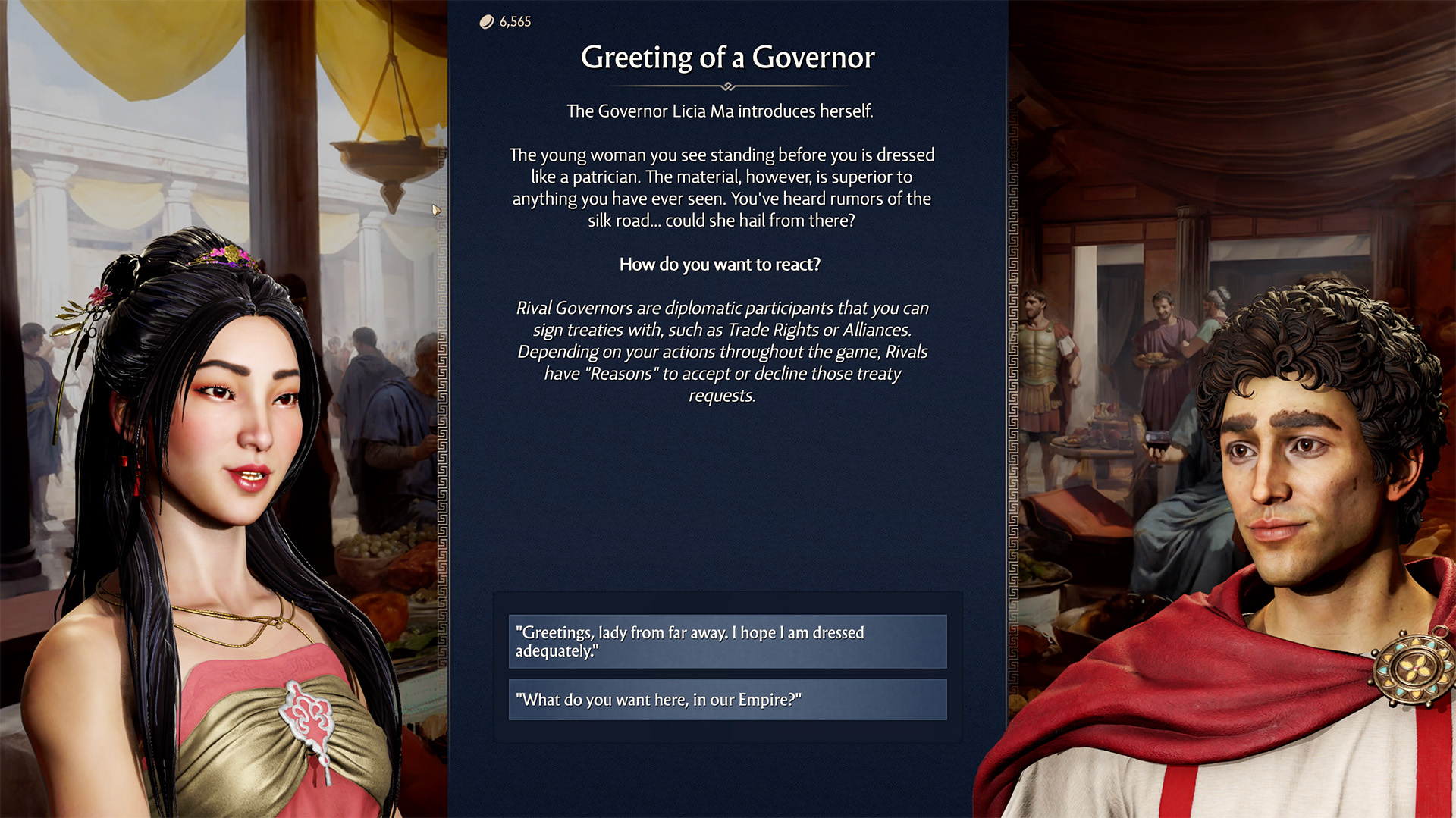
War isn’t as profitable as peace, and trade is almost always better, so engaging in Diplomacy is in your best interest. When you run into other rulers you’ll get the chance to negotiate. It’s basic and there’s little new under the sun here, but there is one ruler you can’t reason with, and that’s the Emperor. He’s very much a one way street, with “requests” flowing in, and penalties flowing in even faster if you don’t meet them. Keep him happy, however, and bonuses like money or better trade will flow your way. On a long enough timeline you’ll see his favor turn into titles and power of your own, though there’s always the other way – Roman Emperors have been deposed in the past – perhaps it’s time for a woman to receive the title of Caesar? Like everything else, the choice is yours, as are the consequences.
Research is a big part of growing your island, and wow is there a lot of it. Once you’ve unlocked higher education facilities to perform research, you’ll encounter a massive amount of it to do. Split between Economic, Civic, and Military, there are 50+ options for each of the three. There is enough here where it’s unlikely you’ll unlock them all, encouraging you to make choices and tradeoffs. I appreciate that as it pushes the player to try new things. Research can fix problems in your city, such as expanding capabilities of your warehouses, agricultural challenges, or military advancement. Frankly, you’d need a whole guide to go over ALL of these things, but suffice it to say there’s a lot to unpack. Thankfully, once you beat the campaign you can play after the credits roll, or switch to the Endless mode, giving you unlimited time to build, research, and play to your heart’s content. Let’s talk a bit more about that Endless mode.
If you don’t want to follow the central thread of the campaign, or you’d like to try it from some different points of view, you’ll want to check out Endless. In Endless you’ll be able to select from 15 different Governors, including the two from the primary campaign. If you ever wanted to see your house slave Ben-Baalion or an unnamed Plebian rise to power, now’s your chance. Even better – address the Emperor as a local blacksmith fresh from the forge – he’ll love that, I’m sure. From there you’ll decide your Banner type, color, and sigil to complete your look.
Difficulty is split into three categories - normal, advanced, and veteran, though you can edit the parameters of each to ensure you have the experience you want. Further into that edit you can tweak how much tutorial you receive, how much your people consume, costs, taxes, maintenance, upkeep and about two dozen more toggles to tweak the way the game plays. You can even make a choice of who sits on the throne as Emperor, which can have an impact on how they approach diplomacy or even war.

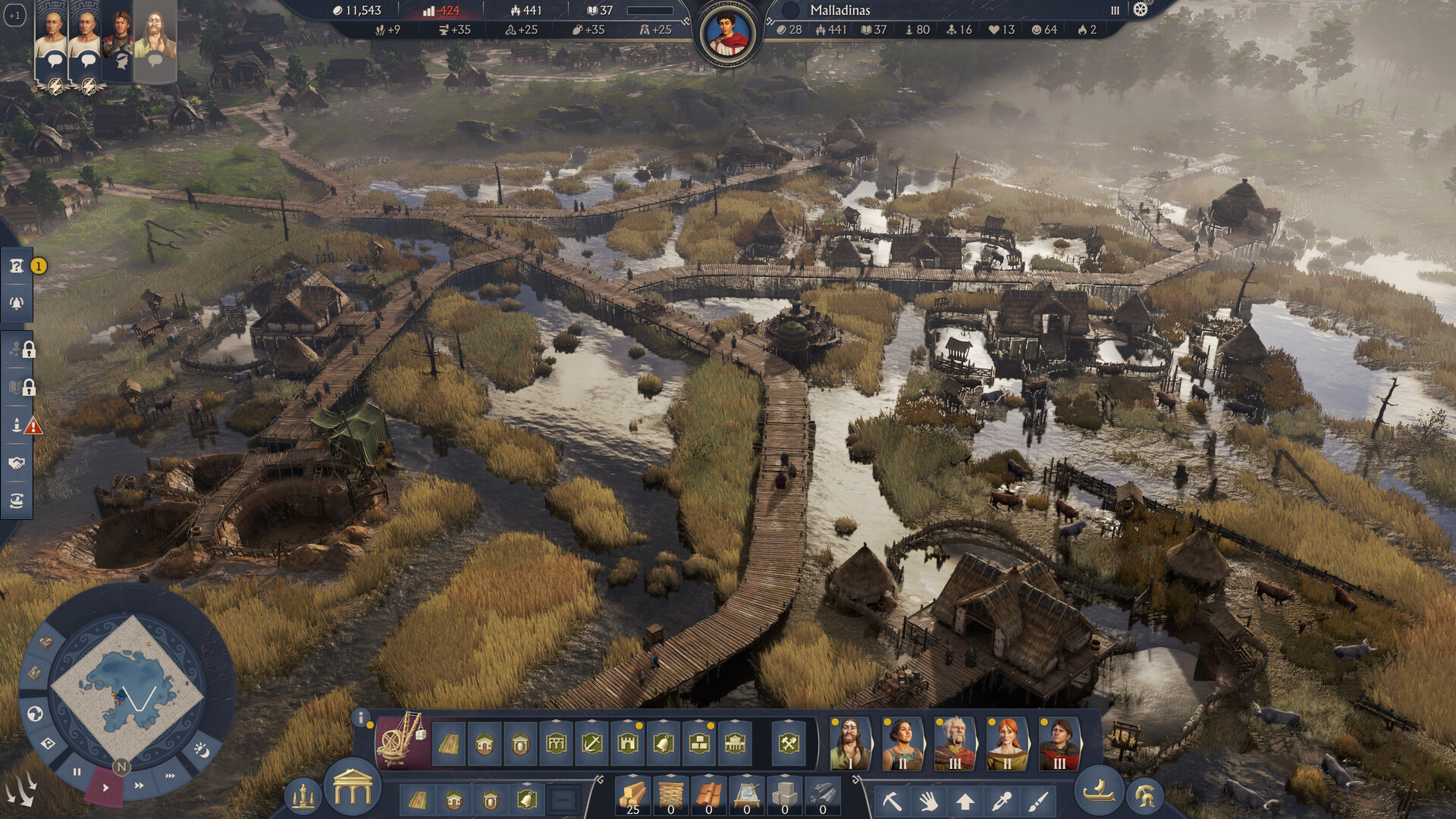
Before you set out in the world you’ll want to populate it, and that means adding up to three more Governors. These can be your friends, AI, or a mix of both. These too are split by their overall AI difficulty level, though you can’t tweak them – they’re fully baked in. If you want the world to yourself you can also drop all rivals, though that obviously has impacts on trade and other items that require interaction. With all the parameters set, you’ll now choose between two provinces - Latium and Albion. Latium is more of a “classic” Anno experience, as the developers describe it. In my experience it’s more forgiving with a great deal of usable and fertile land, and resources that are more abundant. On the other hand, Albion is a rough and untamed series of islands. Raiders are frequent and aggressive, lands can be inhospitable and might need to be terraformed to even be usable. It’s here though that you run into an aspect that might merit a second play through if you started off in Latium – “Romanization”.
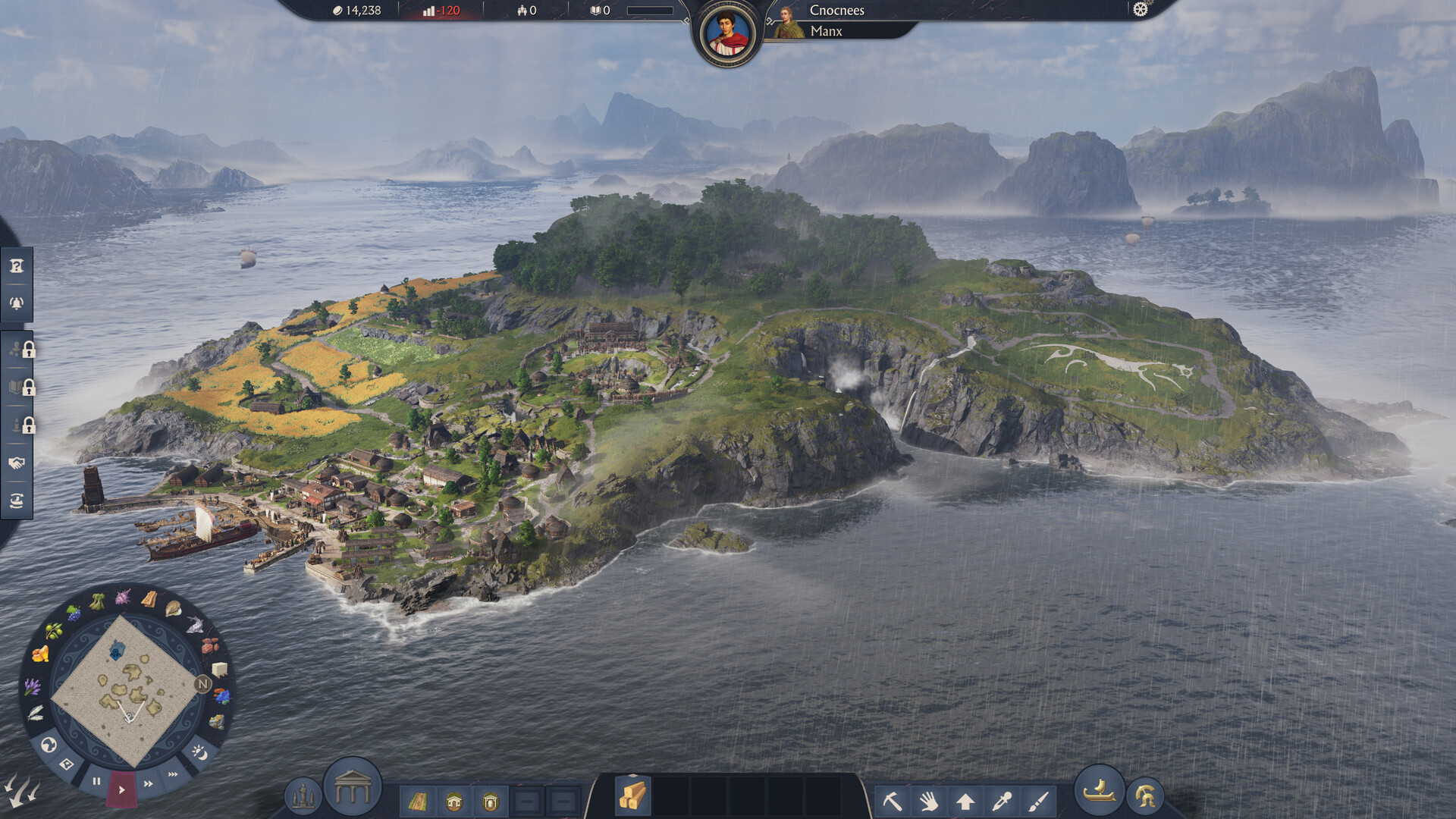
The people of Latium have their own culture and norms. It’s reflected in everything from their carts to their homes. We have arrived with our Roman sensibilities, architecture, art, and culture. When you’re settling Albion you’ll be given more options on how you approach this island – convert them to the Roman way of life, keep their original culture, or blend them. In terms of gameplay it doesn’t have a great deal of effect, but certain characters may react to you differently based on how you’ve chosen to honor Rome, or respect the local traditions. It also has a great deal of impact on the look of your city in the end.
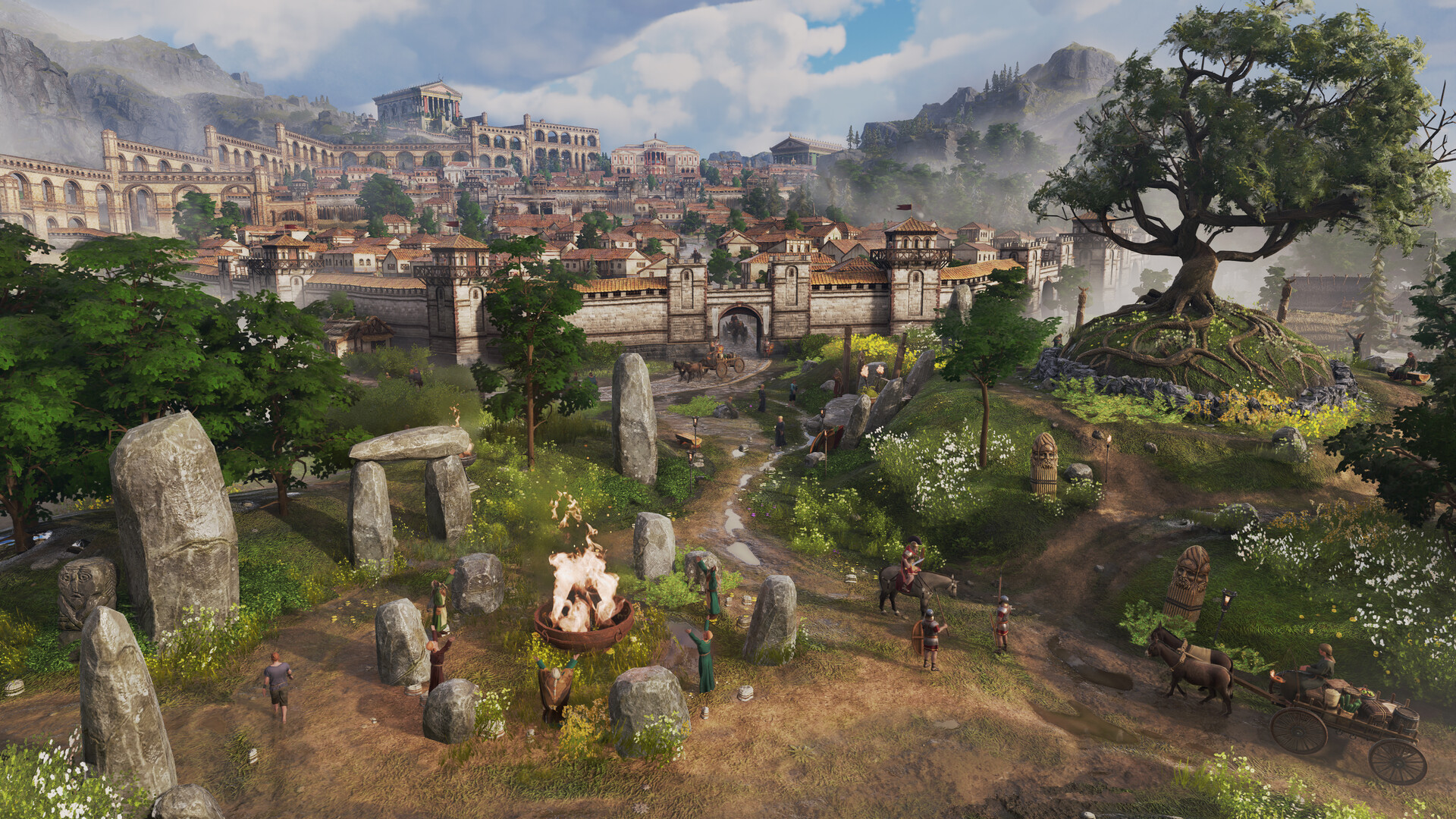
I do have to commend Ubisoft for a new approach to how they’re handling progression and replayability. When you start the game you’ll have three gods you can worship: Neptune, Ceres, and Mars. Gods affect your military might, agriculture, and how well the sea provides. These elements are tied to a Tier of unlocks in your Hall of Fame. You can, optionally, spend your earned fame to unlock additional tiers, up to V, which grants access to new Gods and Governors for the Endless mode, but also weapons, buildings, and decorations for your city. While there aren’t as many gods as I would have expected, given the expansive pantheon of Gods, the ones that are here have a meaningful effect without straying too far into the fantastical. It’s easy to see people convince themselves to move a little faster “as if guided by the wings of Mercury-Legus himself” without literally seeing the God of Swift Transactions. You might better know Mercury-Legus as Hermes, the swift messenger of the Gods.
I was surprised at how much I enjoyed multiplayer in Anno 117. There are several modes to choose from - PvP, Co-Op, Hybrid, and Campaign Co-Op. PvP is precisely as you’d expect - you and up to three of your governor friends (either human or AI controlled) can duke it out, build, form alliances, and otherwise engage in both land and naval warfare. Co-Op, again, as it says on the tin, is cooperative play for up to four people. You can share resources, money, territory, and coordinate your efforts as you expand. The trade gets easier when you know your ally will step up for you. You can also run it “split location,” with one friend in Albion and another in Latium. Hybrid is both – up to four friends can compete against or work with one another in a 4x4x4x4 mode. I haven’t tried this, but up to 16 players on a map in a free-for-all brawl sounds absolutely insane. Campaign Co-Op on the other hand lets you work through the story mode together.

One thing I appreciate, however, is that all modes are cross-platform compatible – as long as you’re friends, you can play together. Similarly, with mods, as long as everyone has the same ones they’re fair game. When DLC hits, the team promises that’ll be the case as well.
The only complaint I really have is that the UI can be occasionally obtuse. Looking at the hotbar you’ll see a stack of wood with a number on it. You’d expect that building a lumber yard would be handled under the construction button, but no – it’s under this chunk of wood, as is the sawmill. Similarly, you’d expect that building a tavern would again be underneath the construction button, but no – it’s underneath a leader icon, then in a sub-menu. The layout can be confusing, especially to newcomers. Once you get used to it, it’s fine, but it never quite becomes intuitive.

Frankly, I could go on for another 3000 words and still not quite cover everything in Anno 117. It’s remarkable how many hours you can lose in the blink of an eye on this game. Carefully balancing the number of houses, who occupies them, delicate trading positions, and financial dealings makes time stand still. I found myself saying “ok, once I get this mining area up and running I’m headed to bed”, and all of a sudden I’d built an entire small village to serve the mine, set up trade routes, and kicked off another venture somewhere else. This is the best the Anno series has ever been, and Anno 117: Pax Romana is raising the bar in so many ways. If you’re even a passing fan of the series, you’ll love this game.
Anno 117: Pax Romana
Excellent
Anno 117: Pax Romana is a veritable feast of improvements over not only its predecessors but the whole genre. There are occasionally obtuse moments, but these minor issues are overshadowed by improvements at every possible turn. If you’re looking for your next city builder, this is it.
Pros
- Excellent graphics and animations
- Campaign is 10-12 hours of fun
- No “right way” to play
- Real world simulation
- Complex and enjoyable city building
Cons
- Occasionally obtuse controls / UI
- Lip synchronization in cutscenes is mouth-flappingly off
This review is based on a retail PC copy provided by the publisher.