I henceforth devote my life to whatever muse sent All Will Rise across my feed a few days ago. I know, that's a bold claim for a game that isn't finished with its Kickstarter yet, but speaking with narrative designer Meghna Jayanth and design director Hugo Bille about the project, I've found myself hopeful and impressed with the thoughtfulness and depth of its conception. A narrative deck-builder, the game sets you as an attorney in Kerala, India, fighting to hold a billionaire to account for the death of a river. While I was caught immediately with its vibrant color palette and deck-building mechanics, the team's care with their subject matter is what's keeping me on the hook for the long haul.
I'll dispense with the basics before I delve into the meatier philosophy and social science at issue: All Will Rise is on Kickstarter now, with a demo available until the campaign ends on March 23rd. Gameplay takes place in two main phases; outside of the courtroom, you travel the community gathering evidence, interviewing witnesses, and building your case. Inside the courtroom, you use those tools to hold the corporations to account...or you try to. The hour length for a given play-through is in flux, at about 6 hours according to the dev team, but the game is intended for multiple runs. You can lose, and they expect you will lose, with a number of dark endings available to players who inevitably make some of the many possible wrong decisions. The setting is a mixture of the real and surreal, in an alternate reality south India. Players will travel Muziris, a town that was destroyed by flood in 1342, alive but under threat of extinction.

All of this came out of a desire to do and be more. Impact Director Joost Vervoort was at a meeting of activists and began thinking out loud about how to use games to harness that energy. What if it was Ace Attorney, but about climate change? Niels Monshouwer, the game's executive producer, had just left AAA and wanted to make something worthwhile. Each of the statements I've made belies deep thoughts about activism in the modern world, and how we can teach audiences through the medium of videogames. We live in a time where it's all too easy to find convenient villains and foist all of our responsibility onto them. I may not have told the team about this, but I was worried that "evil billionaire who kills a river" would a simplistic story of wish fulfillment, playing into modern narratives about power and the convenient helplessness of the individual. What I found in speaking with Meghna and Hugo were people working to dig deeper and work harder than that simplistic premise might imply. I don't know if the final game will deliver on the heady concepts we talked about, but I have no doubt at all that this group is genuine, dedicated, and coming from the right place. If they get enough support, All Will Rise will be the first in a set of games that moves the medium forward and expands the scope of its experiences.
That support is more important than ever for a group that's already proving its sincerity by declining promised funding from Microsoft because of its political stances. I won't tell you how to feel about those politics, but I will tell you how important it is that they're willing to put the success, potentially even the existence, of their flagship game on the line for the causes they believe in. This, first and foremost, is core to the message of All Will Rise: our personal culpability in shaping the world relies on engaging with its complexity and being honest about our own motives and actions.

I'm snidely alluding to a lot of vague ideas here, so let me break down the problem, as I see it, with activist narratives, and why All Will Rise seeks to interrogate those narratives so intelligently. Yes, there are evil men in positions of power who take cartoonishly evil actions to ruin the world. It is documented fact that billionaires maintain a corrupt network to abuse children, manipulate world politics, and destroy the environment. Their self-narratives are so divorced from reality that they see no problem calling their operations Epic Fury or naming their mass-surveillance companies after Saruman's evil scrying orbs. HOWEVER, there's a convenience in that simplistic worldview; a convenience that asks nothing of you or I as the individual, because we can so easily shrug our shoulders and pretend that we have no responsibility to make changes. I'll be direct here: what you buy from Amazon directly fuels Jeff Bezos' plutocratic destructiveness. When you buy EA games, you're the one incentivizing them to mistreat their workers and gouge their audience. You and I owe personal responsibility that can't be foisted off on an evil billionaire. The power they accumulate, whether financial or electoral, comes from you and I. Our decisions to let them take that power and keep it.
All Will Rise hopes to take its examination a step further though, also digging into the dynamics of the frontline activists working to combat global corporate power. As an activist attorney and community organizer myself, I see exactly what ideas they're scrutinizing. That comes in the form of its dual phase gameplay. The game's most immediate comparison will be to Griftlands, with its art design, deck-building, and divergent gameplay, featuring physical and conversation based battles. Where Griftlands' social fights are mostly a realm for (extremely fun) deck-building gameplay to take place, All Will Rise seeks a different tack.
The exploration phase of the game sees you gathering information for the courtroom, building the deck you'll use in the second phase. For narrative encounters, the dynamics at play form a logical and mechanical throughline. The law is more than words on pages somewhere; making it effective means managing your team, the surrounding political players, and your own sanity. Burnout is a real, physical threat to this work. I've seen it take out more people in my time than anything else. In a given battle, you will take turns playing cards on the board. You'll choose a Claim, like The River Burns or The River is Dead, and follow the logic as it flows down, pyramidal, in a chain. At the top of the pyramid are grand concepts like human nature and capitalism, with distinct ideas flowing from there and being built by your evidence.
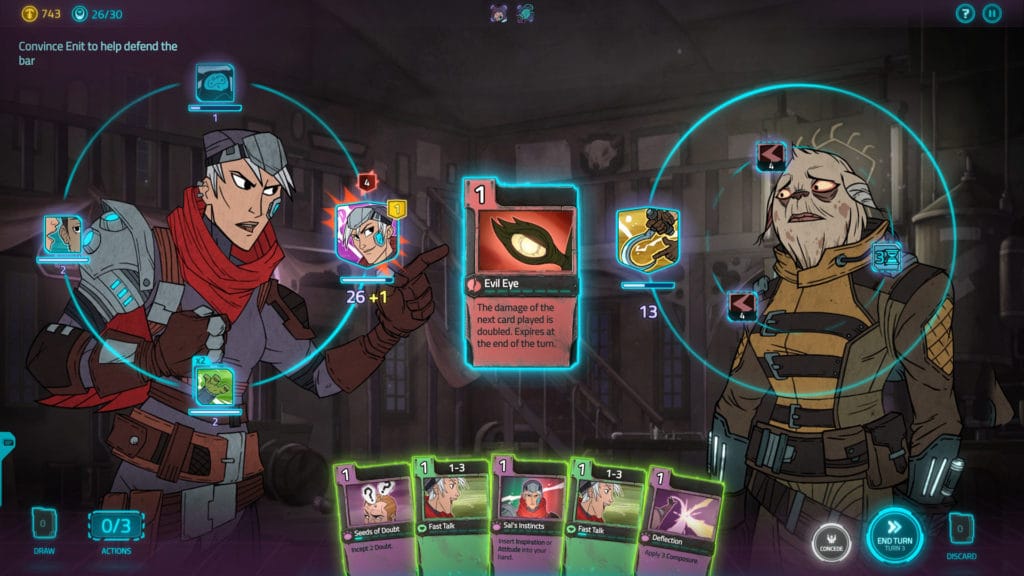
This involves meeting with people affected by the crisis and getting to know them over time. This isn't an easy prospect, as it demands you taking their concerns seriously and earning their trust if you want useful evidence. Your first decision is where to go and what to seek. Over time you can start and stop some of these narrative battles, giving you space to walk away and come back with more tools and a better strategy. Of course, I use the term "battle" inaccurately. In these encounters, you aren't trying to beat down health. Rather you could be trying to reduce or increase an NPC's Hearts, Minds, and Guts to certain levels so that they share their information freely.
On its own, this mechanism has a lot to say about community activism. Being educated and having data doesn't mean you deserve the respect of the people you're trying to help. Even that framing puts the activist in a paternalistic light, as the savior of the ignorant and down-trodden. Morally and practically, you can't see yourself that way. Factions like the leaders of the washer-women are distrustful of authority. They are vulnerable, marginalized women who don’t see justice coming from these actions. The question is how can you engage and interact with them. Is it even right for you to do so?
At first, a farmer in rural India won't trust an educated female lawyer he meets. His reasons might be good: maybe you're being condescending to him, maybe you don't know his perspective, and maybe your metropolitan solutions won't even help his situation. His reasons might be bad: maybe he's a misogynist, maybe he doesn't know what help you can provide or what you're trying to accomplish. Whether or not his attitude and his prejudices are reasonable doesn't actually change the fact that he's a human being who deserves dignity and respect. Not being a billionaire doesn't mean you're necessarily in the right.
The care All Will Rise takes with forcing you to engage with its many communities speaks to me with immense power. I started my legal career working exclusively domestic violence cases. I was a young, unmarried, straight, white man with no children. Sure I had the skills to work the courtroom and the judges, but that doesn't mean the skepticism my clients met me with was unfair. Who was I to these people, mostly but not exclusively women, often older than I? If I demanded respect from them without earning it, I was worse than useless. I was a part of the same system that dictated to them how they should live their lives. Just another man telling them what to do. At the same time, my work would have been useless if I didn't see them as people with their own agency, histories, and mistakes. These people were not purely innocent victims that just needed a wink and a helping hand. They were complicated individuals with complicated lives. Sometimes they contributed to their own problems. Sometimes they were extremely difficult to deal with, and often unsympathetic. Those flaws don't change anything about their rights to personal autonomy and self respect. Community activism means working with, not working for. All Will Rise, I hope, will challenge its players to become a part of the Muziris they work to save. Anything else would be insincere, ineffective, and ultimately worthless.

The story is branching and responsive, and will reward multiple playthroughs. Those experiences will dazzle you with vibrant tropical colors that are true to the area, owing to Yuvraj Jha's Indian heritage. Traditional Kerala instrumentation will set an authentic backdrop to the south Indian setting.
I don't know where the road will lead All Will Rise, but I know I'll be on it. For more information, you can follow the game's progress at the ongoing Kickstarter, the website, Instagram, or Bluesky pages.