One of my Game of the Year picks for 2024 was a small-box game put out by Kosmos called The Gang—this was essentially a co-operative poker game that had players trying to sort out their hands' rank order over the course of several rounds. The Gang was a huge hit at our table that year, resulting in some incredibly satisfying, jump-up-from-the-table moments. There was just one problem…
It didn’t feel like poker.
It would be easy to fall under the misconception that a co-operative version of poker can't be more than just poker-ish, and I was only disabused of that notion myself recently when I got to play Hell of a Deal by Smirk & Dagger Games (currently wrapping up a Kickstarter campaign). Hell of a Deal is essentially a game within a game: everyone’s favorite poker variant, Texas hold ’em, comfortably nestled inside of a whimsical co-operative survival game pitting players against the Devil and his minions; souls are at stake and cheating is required!
Now, if you’re an avid poker player like myself, you might be wondering where the card hits the felt. How much like poker is Hell of a Deal, really? And more importantly, where does it diverge? I found six ways that the game is just like poker, and six ways it isn’t.
Like poker: Everybody plays their own hand
Just like in Texas hold ’em, each player gets dealt pocket cards, forming their hand. Once the river (final card) comes out on the board, each player builds their hand out of a combination of cards on the board and in their hand. Of course, just like in poker, they can also play the board, but as there isn’t a way for the pot to be split in Hell of a Deal, its probably not a good idea to depend on the same hand the boss might be playing.
Not like poker: The amount of cards in play
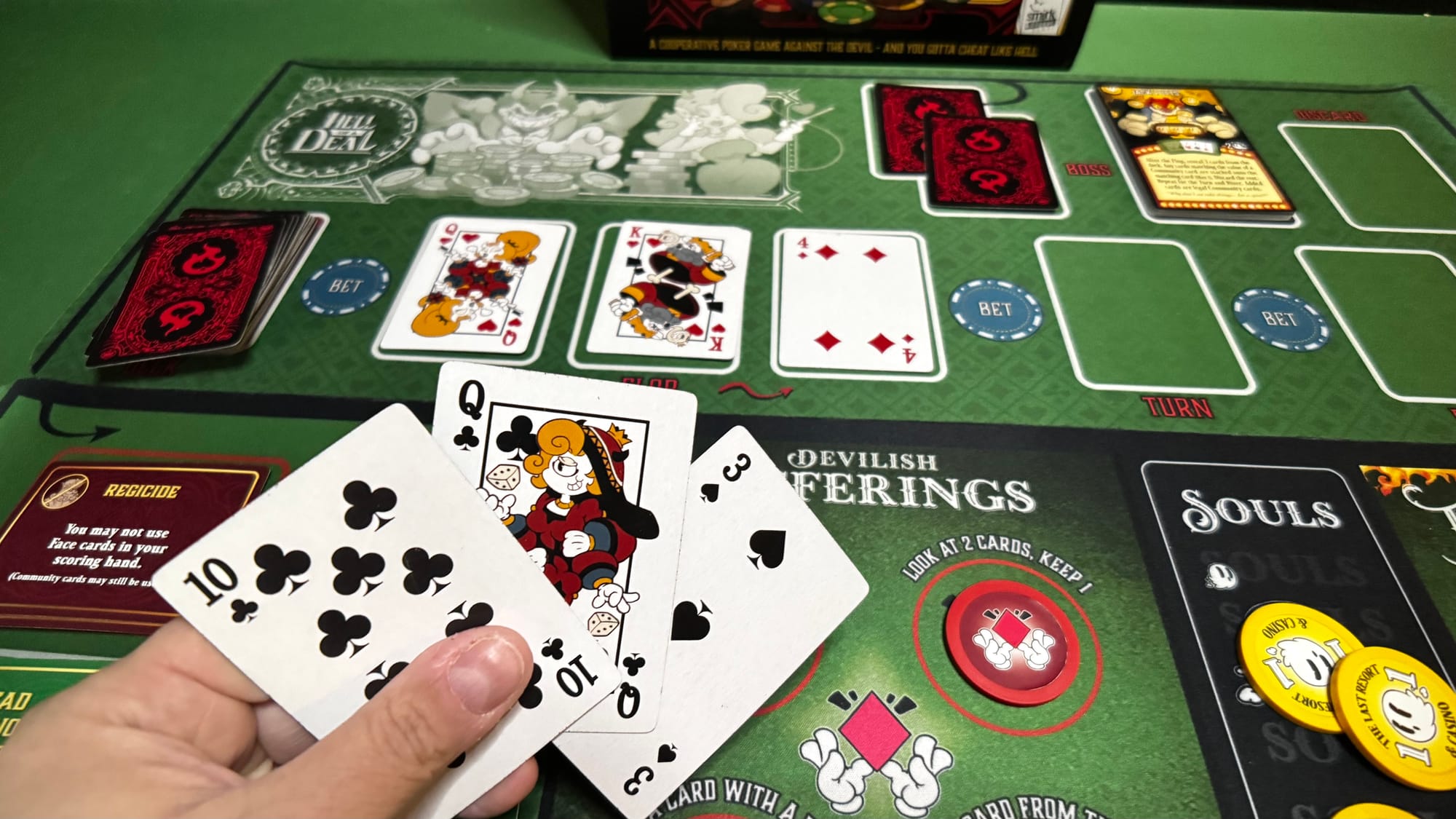
The biggest difference right from the start—players start with three pocket cards, not two, but they can only use two pocket cards in their winning hand (a rule that is notoriously difficult to remember at times, much to my table’s chagrin). There are also ways for players to gain more cards, either through the Favor deck, which provide one-time use cheats that can be played after betting, or via the Devilish Offering abilities shared by the players in a pool. There are even some bosses that have special abilities that either add to their hand or the board (community cards). The fact that there can be much more cards in play during any given hand is a huge part of what makes the game distinct from standard poker.
Like poker: Players keep their hands secret from each other
So this may be a co-operative poker game, but don’t think that players can just tell each other what they have in their pocket! This is where some hidden information mechanics come into play, with strict guidelines on how vague players need to be when trying to communicate anything like what is in their hand or if they need help making their hand better to stave off a loss. Giving each other actionable clues during a hand is crucial to achieving victory over the bosses.
Not like poker: Bluffing isn’t a winning strategy
If you like to bluff your way to victory in poker (and I mean, who doesn’t, right?) Hell of a Deal is going to fall short for you in that regard. Funny thing about co-operative poker, bluffing your teammates definitely won’t get you the win, but just like in regular poker, it might make other players at the table mighty angry with you. It is the only poker mechanic I miss in Hell of a Deal.
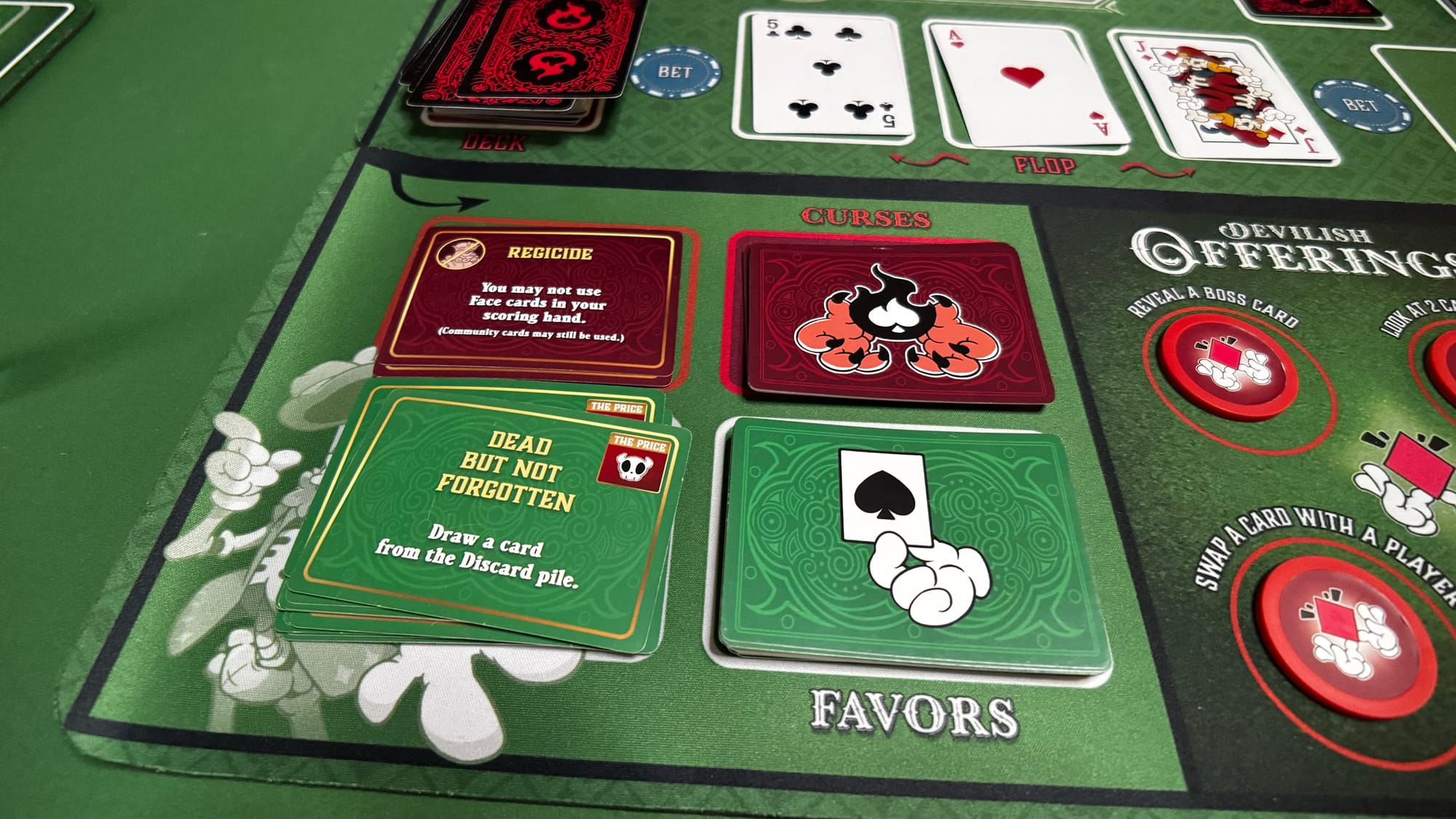
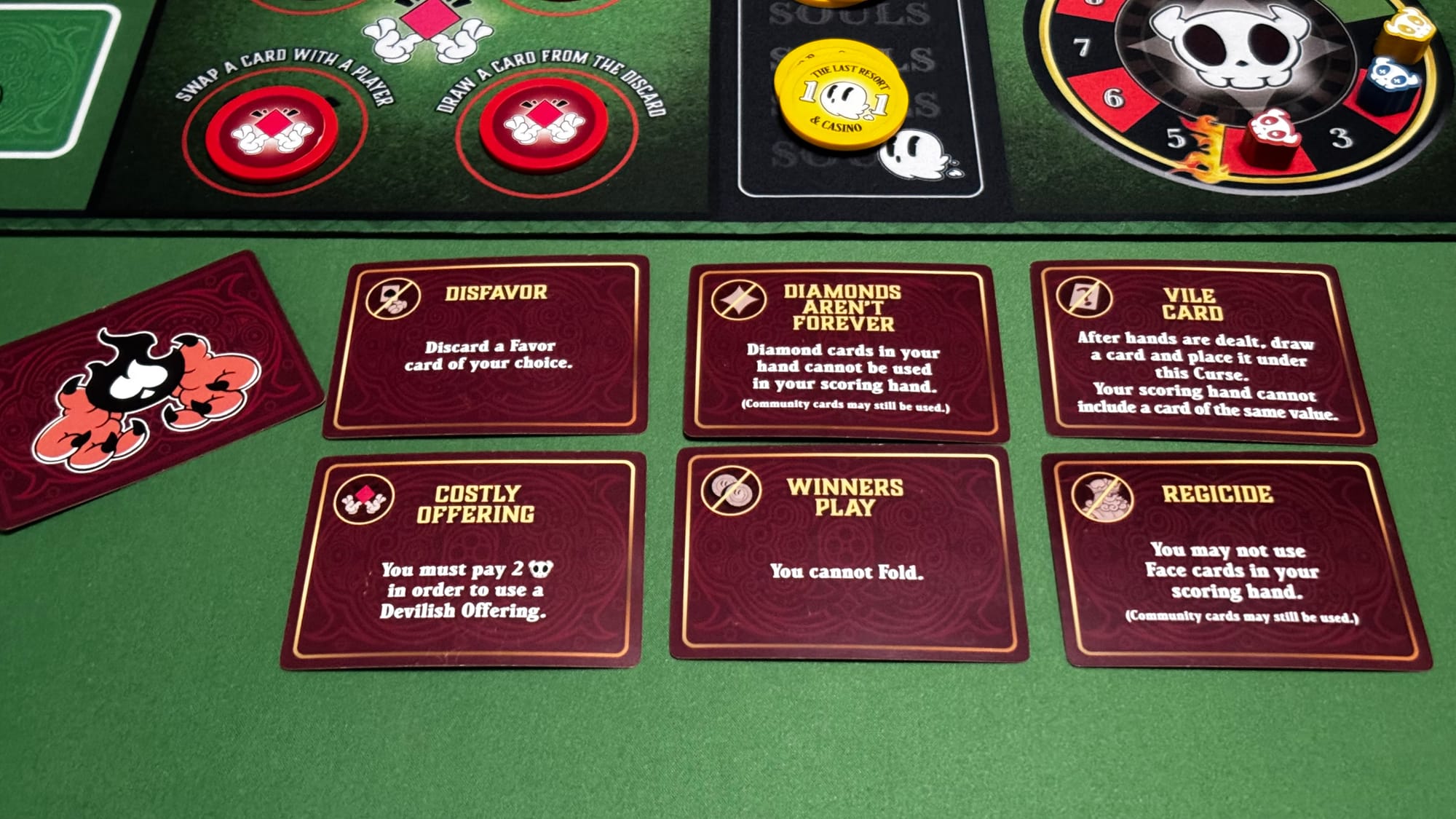
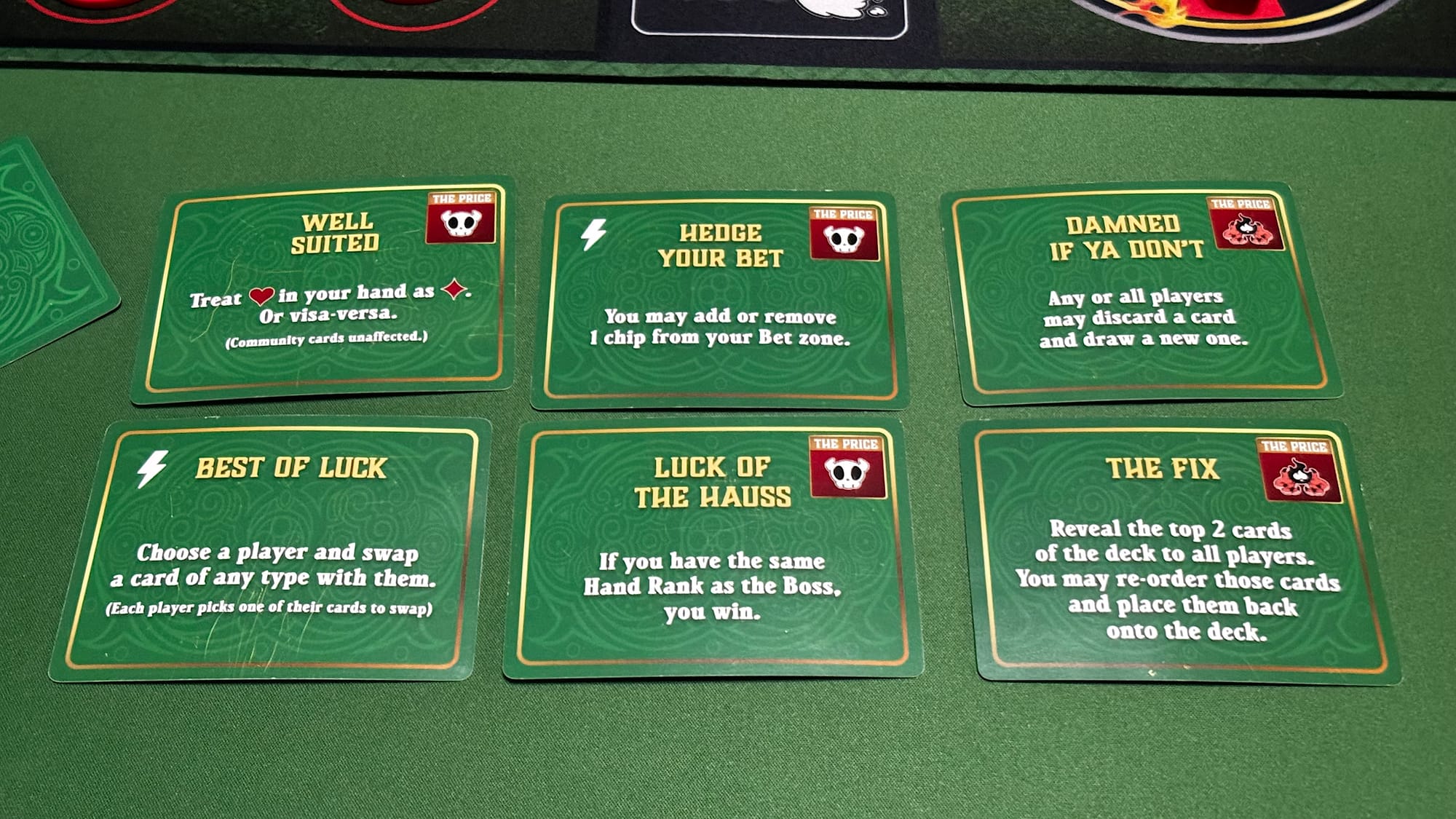
Curse and favor cards can subvert the rules of the game
Like poker: The board is built the same way
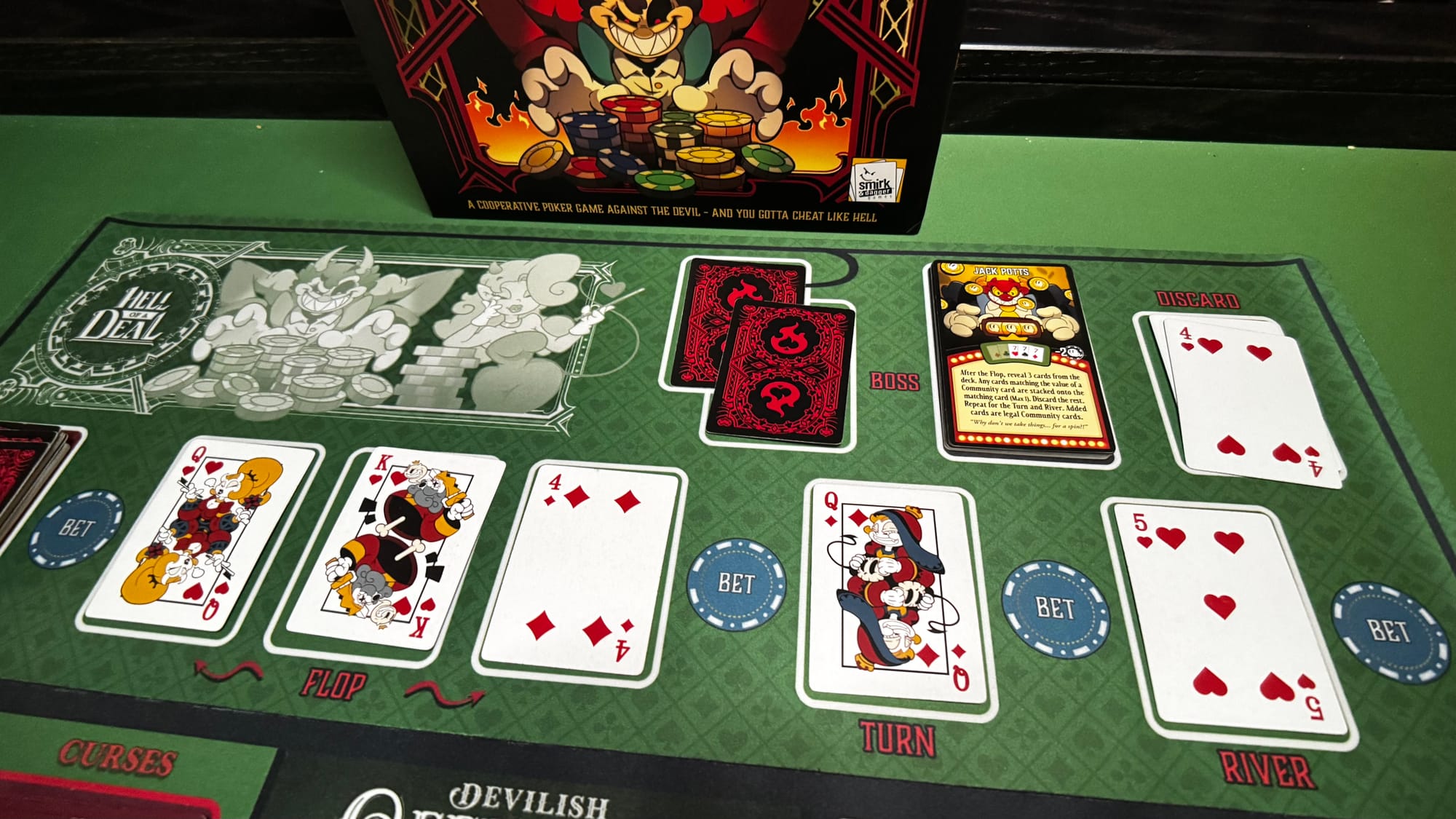
After each player is dealt their pocket cards, hands proceed through four betting phases and five cards are dealt to the board, just like normal poker. After the initial round of pre-flop betting, the top card from the deck is ‘burned’ (discarded), the next three cards come out face up, kicking off a second round of betting. Then, another card is burned, and a single card is revealed: the turn. Another round of betting, another burned card, and a final card, the river, is revealed. These five cards comprise the board, and can be used by any player, even the boss!
Not like poker: The discard pile is public knowledge
Even casual poker players figure out pretty quickly that every card on the table that is face up is actually very valuable information, specifically information about which cards are not in your opponent’s hands, or sometimes regrettably aren’t left in the deck. In Hell of a Deal, not only is the discard pile—which includes every burned card, I should note—face up and public knowledge, there are Devilish Offerings and Favor cards that allow you to take or swap cards from the discard pile. Rarely was there a hand we played that one of us couldn’t spend our Devilish Offering chip to swap a card and make a winning hand. The more likely scenario saw multiple players that could do it, but only one player can use the ability…
Like poker: Betting every phase of a hand
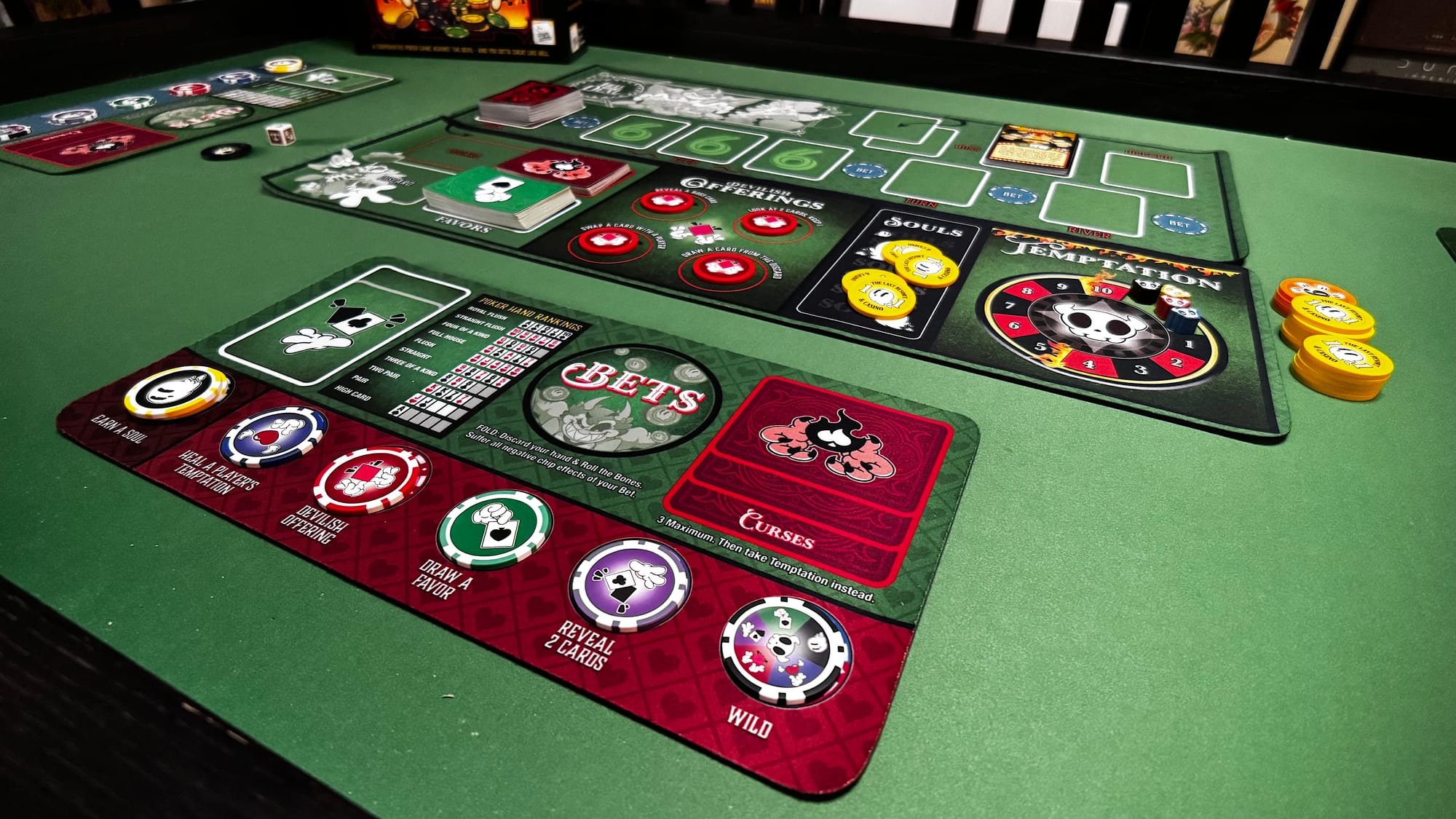
As mentioned above, betting is done in phases according to the state of the board. Hell of a Deal actually comes with a very handy playmat that provides spaces for each card that comes out as well as a visual indicator for when each round of betting occurs. Nothing about that is really different from standard poker.
Not like poker: Wagering for souls and powers, not money
A funny thing about standard poker is that it shines the brightest when money is on the line—there needs to be stakes and the fear of loss driving a player’s decision to stay in the hand or not. It just isn’t the same without it. Designer Cameron Reid set out to make a game that stayed friendly, yet had stakes nonetheless. Each player starts each hand with only seven chips, and instead of representing a dollar amount on the line, they provide benefits when they are used to bet and stay in the hand. The two ‘Earn a Soul’ chips add a Soul to the community pot to help cover any losses in future hands, one chip moves you back one space towards safety on the Temptation track (if two or more players go too high up the track the Devil wins!), another chip allows the player to use one of the four Devlish Offering abilities available to players each hand. The green chip allows the player to draw a Favor card—one-time use cheats to help build better hands or bend rules. Purple allows the player to reveal two of their pocket cards to the table (knowledge!), a great chip to use when combined with the ‘Swap a card with a player’ Devilish Offering to knowingly help a teammate build a winning hand. Finally, there is a the black Wild chip, which immediately costs a Temptation but can be used to replicate the ability of any of the other chips even if they were already used.
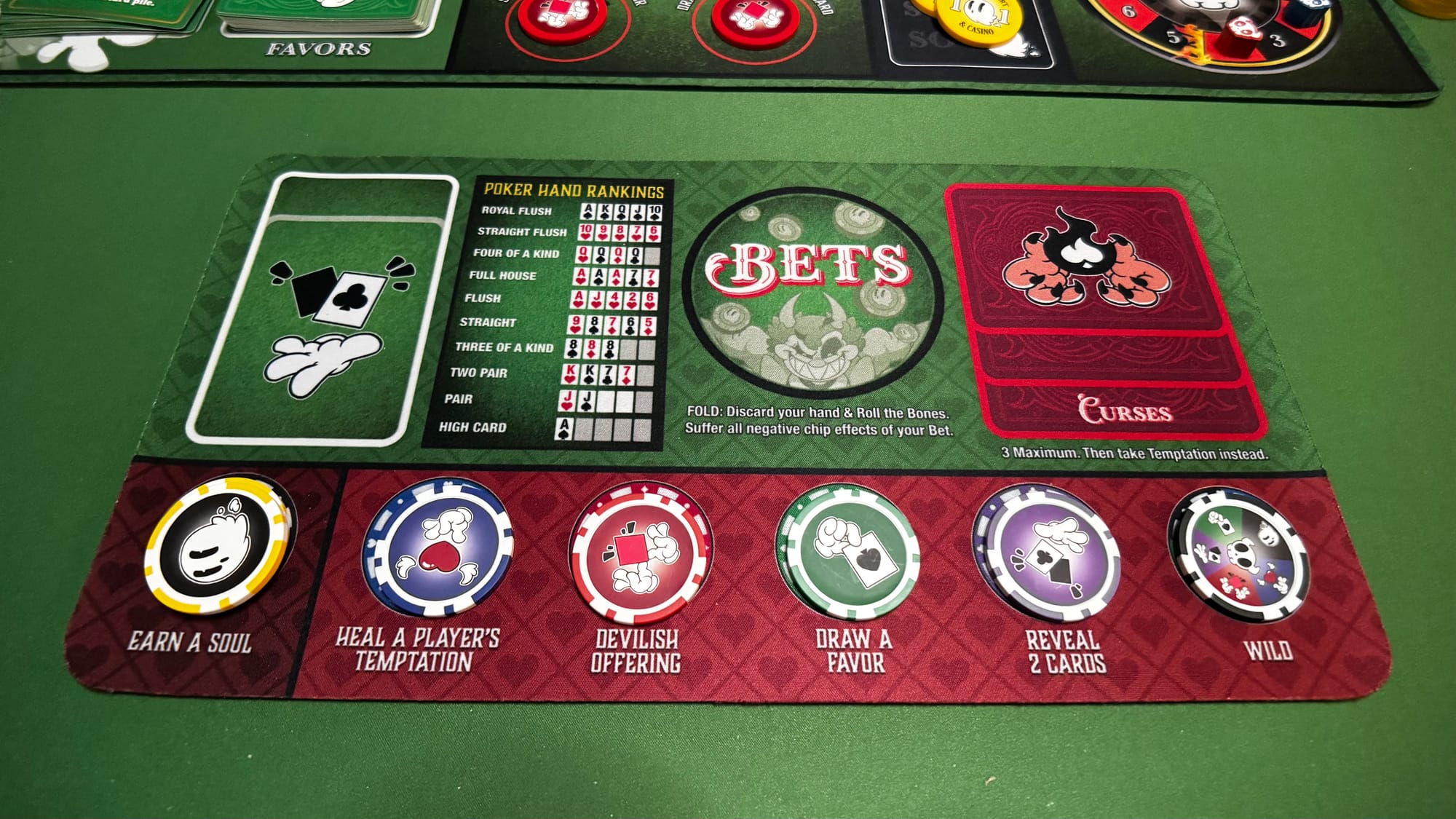
You might be wondering about those stakes I mentioned? Well, if you lose the hand to the boss, not only does the team lose the listed amount of souls from the community pot, they flip over their chips and take the penalties on the back, moving up the Temptation track and drawing Curse card(s) for the next hand. Of course, you can fold your hand and roll the ‘ones’ die for an additional penalty or a chance to win a favor card, but you will still take the penalties on the back of your bet chips; a folded hand is a losing hand, after all.
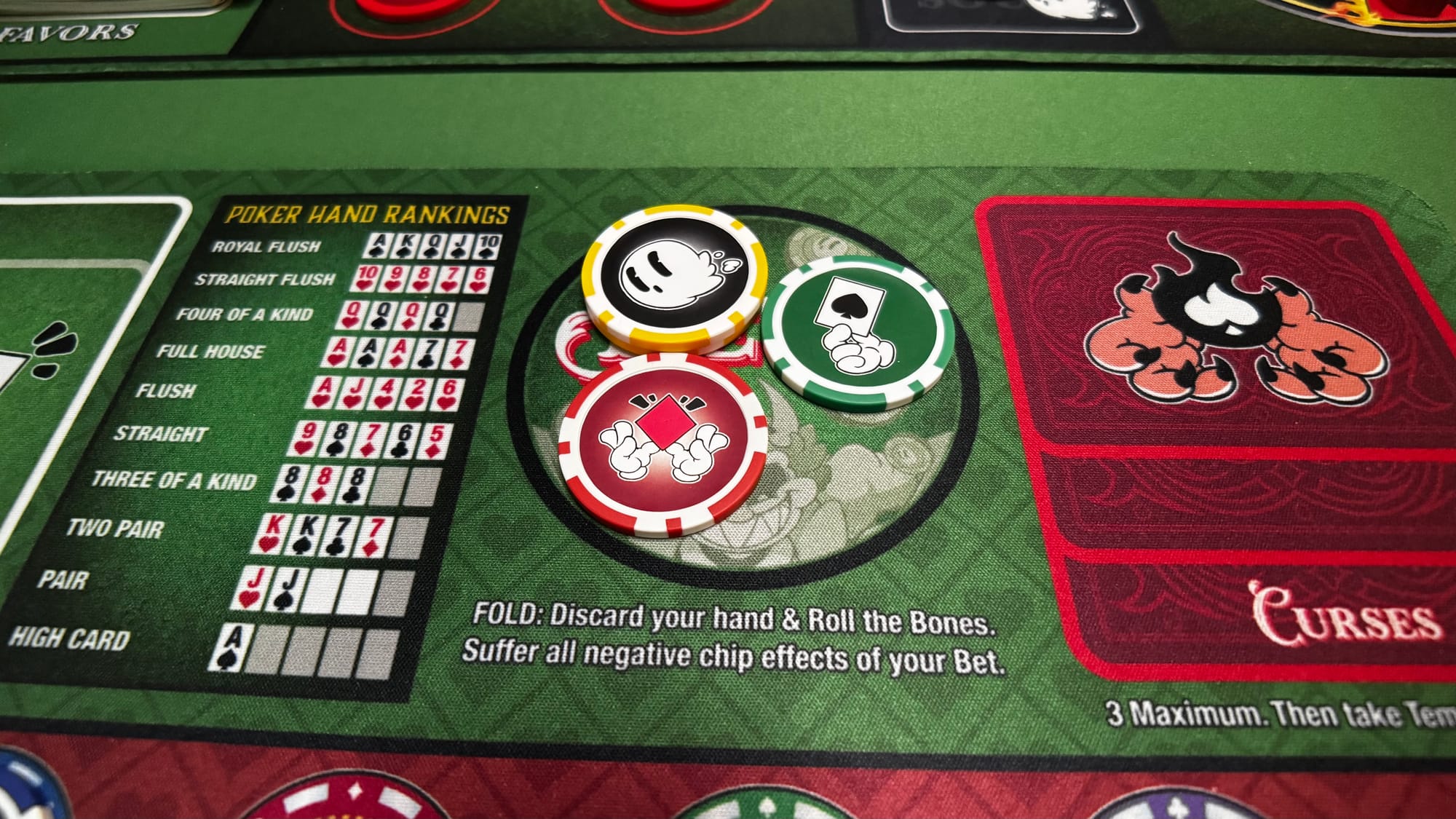
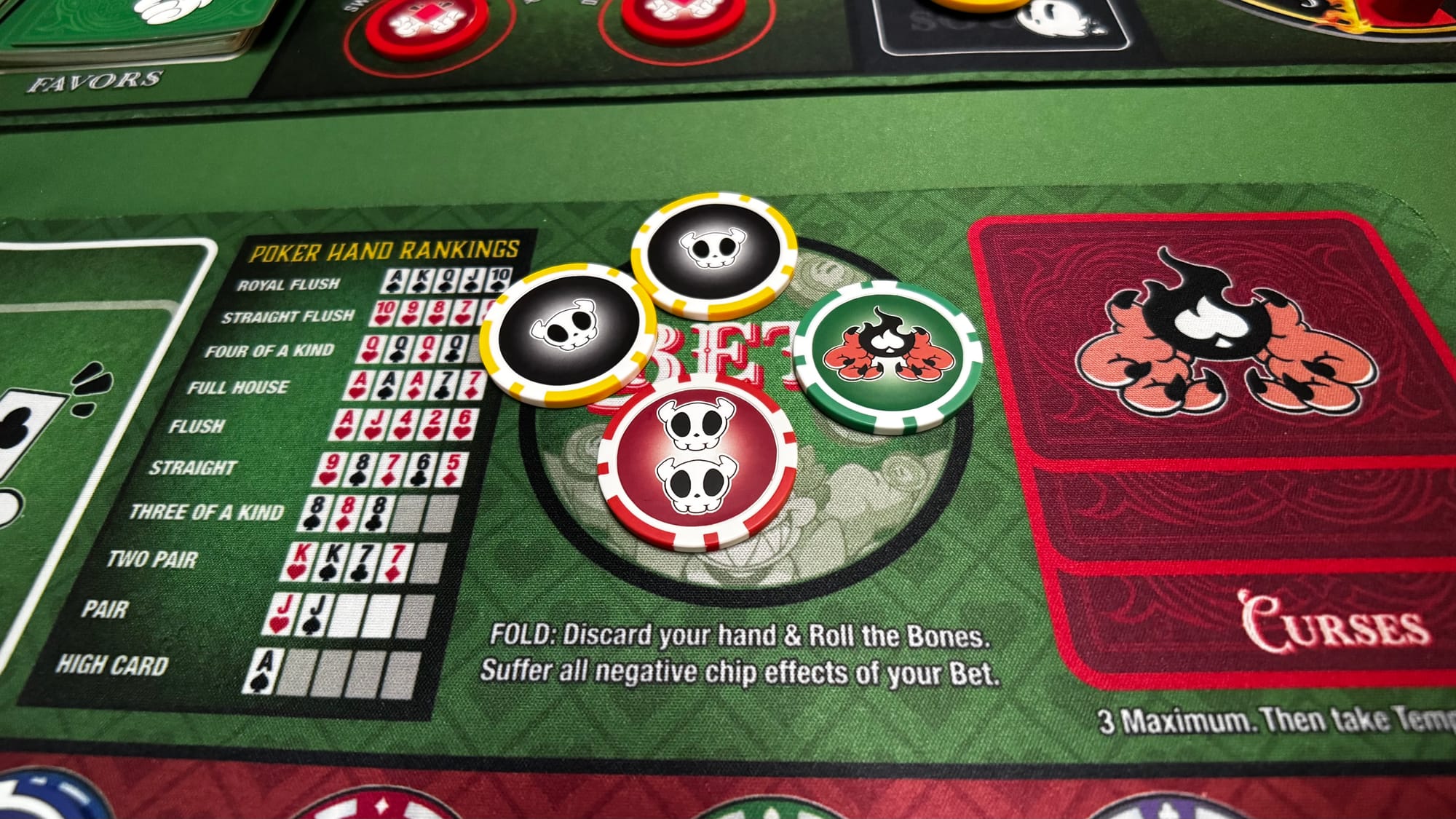
Don't let those chips flip!
Like poker: The best five cards play
Just like in standard poker, each player will be building their best possible hand out of their pocket and the board, and hand hierarchy is exactly the same. In fact, each player mat lists all of the poker hands and their place in the pecking order. While there may be some boss abilites or Favor card abilities that can change or add to this situationally, the core mechanic remains untouched.
Not like poker: You only have to beat one player: the boss
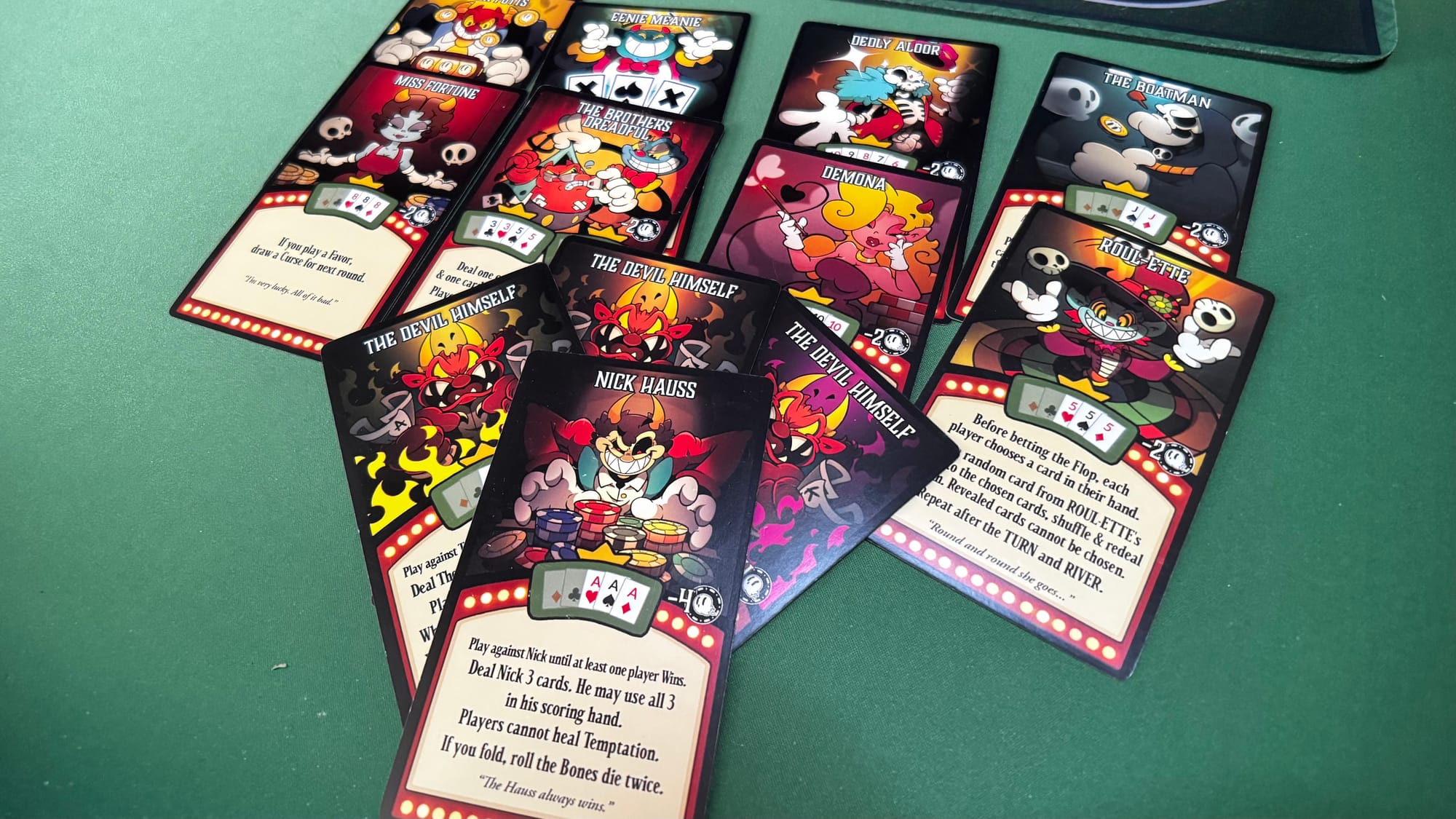
Ideally, each player is able to put together a hand that will beat the boss, who gets dealt two pocket cards with which to form their own hand. But they also have a fallback hand on the boss card (mostly three-of-a-kind or two-of-a-kind), guaranteeing the need to build a big hand to defeat them. The rule-bending and cheating mechanics make building those monster hands easier, but it’s just as easy for the boss, making it more balanced than you might think. Flushes and straights are usually killer hands, but when everyone at the table has one… The flip side of that being, it’s actually pretty ridiculous and awesome when everyone has a monster hand!
Like poker: Winning
Yes, winning a hand in Hell of a Deal feels like winning a hand in standard poker. Puzzling out the right combination of cheats to maximize your hand and help your teamates do the same hits all the same pleasure centers of the brain as pulling off a good bluff with a garbage hand. The difficulty ramps up as well: after the first four ‘Minion’ bosses, you get locked out of healing Temptation and face off against Nick “The House” Hauss and finally The Devil Himself.
Not like poker: Losing
Your wallet will be the same weight it was before you started playing!
Hell of a Deal is on Kickstarter, and the campaign ends tomorrow! Get your pledge in now, they aren’t planning on a lengthy ‘late backer’ period.