The Tales of Remastered project has been a pretty mixed bag so far, especially on the Switch. Tales of Graces f Remastered and Tales of Xillia Remastered both got their games off of non-backwards-compatible consoles, but were locked to 30 frames per second at all times where their original versions ran at 60 in combat. The original Switch (there're no Switch 2 patches for these games) is a bit more powerful than the PS3 as far as I know. Regardless, let's be charitable and assume enhancements like texture quality were a little too much to get a consistent 60 out of the little tablet that could. Maybe there's some emulation going on in those games that makes them a bit harder to run.
Tales of Berseria Remastered, meanwhile, really has no excuse. It looks worse than the original, it runs at half the framerate, and it was already available to play on most modern consoles and PC. The original game was a cross-gen title in Japan, releasing on both PlayStation 3 and 4, but the rest of the world only got the PlayStation 4 version a few months later, coinciding with the PC port in 2017. I played the game on PC, and it looked and ran great. Loading it up on Steam Deck was also a decent way to play the game, despite it's badge saying the game is unsupported on the platform. It had some issues there, but by adjusting the Deck's refresh rate you could get it to run at a locked 58 fps while still looking pretty good.
Why, then, does the Nintendo Switch version both lock itself to 30 fps and look way worse than any original version of Berseria? It's not just that some environmental textures look blurry and pixelated now or that the resolution—especially in portable mode—causes constant visual shimmering, but this remaster also introduces what feels like a full second of input lag at all times. It's comparable to playing a game through a streaming service, like the various Nintendo Switch Cloud Versions, but somehow running right in front of you. For an action RPG, this is very, very bad, and I felt like I had very little control in combat. The perfect dodge tutorial took me a lot longer than it should have as I basically had to anticipate when the enemy's attack animation would start instead of just, you know, dodging right before they hit me.
I'm a bit tired of being so negative, so let's move on to talking about something that's actually good: Tales of Berseria itself. The game's predecessor, Tales of Zesteria, felt super generic in terms of plot, placing you in the shoes of a plucky chosen one out to save the world. It was just going through the motions, even if the combat was still enjoyable. Because of this reception, Berseria, a prequel to Zestiria, flipped the script and went full edgelord. You start out as a plucky heroine, Velvet, just living her life in a small village alongside her little brother and older brother-in-law, Artorius, but things take a turn for the worse when Artorius seemingly murders your younger brother, turns you into a daemon, and then stands by as you slaughter all the villagers who have also turned into monsters. After three years of total solitude in prison, Velvet has exactly one goal: kill Artorius.
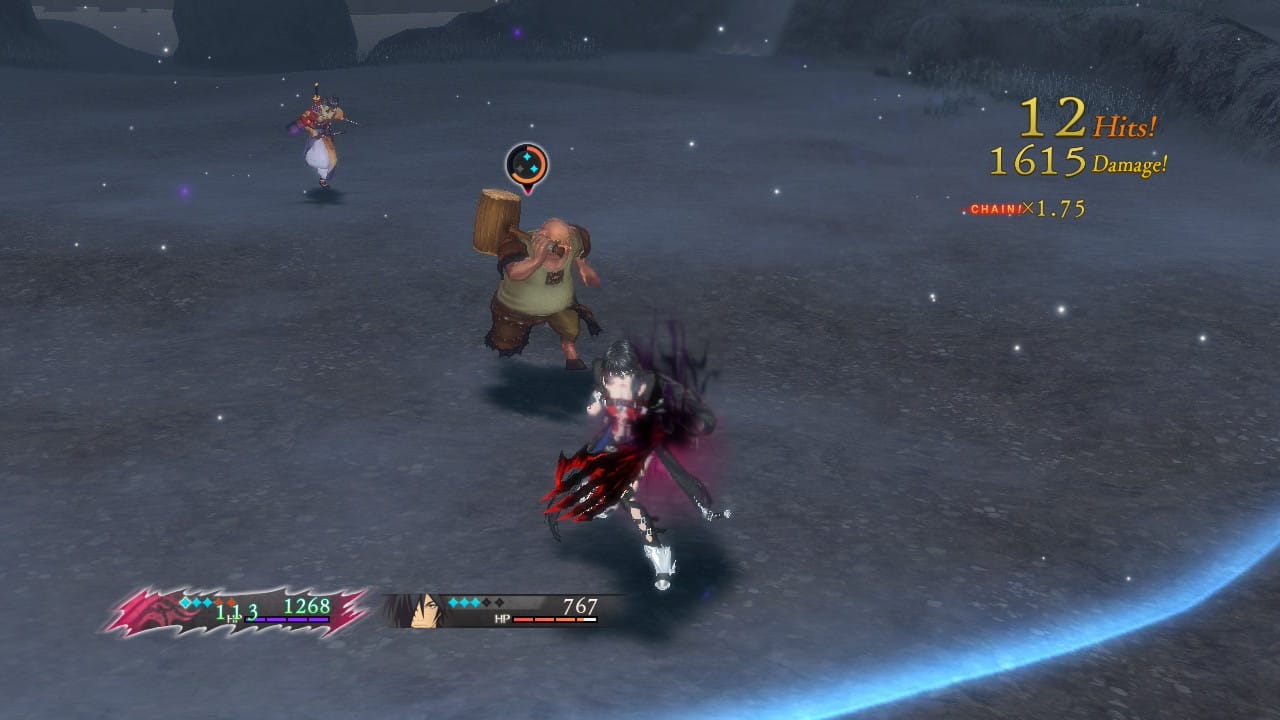
From there, you've got a lot of the usual RPG trappings but through an anti-hero lens. A colorful cast of party members, various areas, towns, and dungeons to explore, and overcomplicated mechanics to ignore or exploit at your leisure. It's far from my favorite Tales of game, but it's certainly a good one and stands out amongst the rest of the series. Combat likewise mixes things up a lot, normal attacks are totally gone in favor of four customizable arte combos assigned to each of the four face buttons.
You shouldn't just attack willy-nilly though, as your actions are limited by the Soul Gauge, five icons above your health bar. You begin each battle with three filled blue icons, and can earn more by stunning an enemy, inflicting status effects, or defeating them; stealing one of their SG icons. Each arte you perform will drain the Soul Gauge, first the white outline of the icon, then the blue filling. The blue fill means that attack can't be fully guarded, while the white represents how many times you can attack in a single string. You can still attack when the icons are red instead of blue, but you run the risk of getting blocked and thus made much more vulnerable on top of dealing less damage overall. You may still want to risk this occasionally to exploit an enemy's weakness while they're stunned.
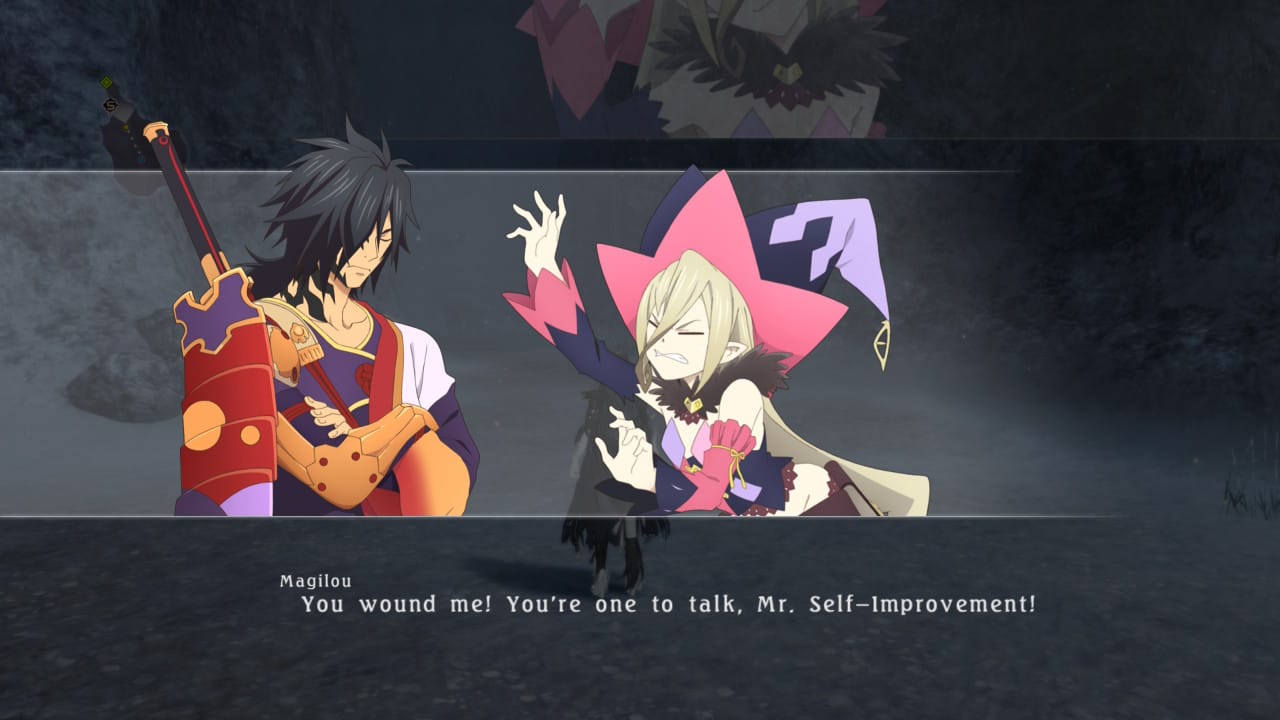
Where things start to get really interesting is with Break Souls. You can use a character's Break Soul, once unlocked, by pressing ZR to spend one unit of the SG. Hitting an enemy with a Break Soul will allow you to temporarily ignore combo limits, reset your current combo, and heal you significantly. If you don't manage your Souls properly, however, you might find yourself struggling with only two icons on the Soul Gauge filled, leaving you with a very limited combo and unable to use Break Souls. Using it wisely and with a bit of planning will allow you to totally dominate the battlefield, mitigating the reduced SG and constant HP drain. It's best used when you know you're about to gain a Soul, as, if you use a Break Soul to defeat an enemy while the SG is full, you'll instantly regain the Soul you just spent. It's a very fun mechanic and keeps combat feeling interesting even if your normal combos are mostly just mashing the "Decide for me" button.
There's a great game buried here, but this remaster makes it universally worse. The game is virtually unplayable on Nintendo Switch with the input lag, and with no Switch 2 patch for any of the Tales of Remastered project games on the horizon, I'd stay far, far away from this platform if you're looking to play Berseria. You're better off looking for the original, non-remastered version on other platforms too. Even if all the DLC is included here, it's mostly costumes you're not gonna miss.
Tales of Berseria Remastered
Bad
Tales of Berseria is a great game, but Tales of Berseria Remastered feels pointless on top of making the game unplayable on Switch. The significant input lag makes both combat and exploration unwieldy, textures look muddy or pixelated, the low resolution causes constant shimmering, and the game is stuck at 30 fps. All previous DLC being included is basically the only thing this release has going for it.
Pros
- There's a good game somewhere in here
- All DLC included
Cons
- Tons of input lag
- Some textures look awful
- Constant visual shimmering
- 30 fps
This review is based on a retail Nintendo Switch copy provided by the publisher.