Star Trek has a long and varied history with board games. It has some of its own designs, like Star Trek: Ascendancy and Star Trek: Five-Year Mission, along with re-skinned games of Star Trek: Catan, Star Trek: Panic, and the old Star Trek Decipher CCG. Regardless of which ones you enjoy the most, it's commonly accepted that one of the most difficult aspects of any Star Trek game is finding a way to balance combat with diplomacy. While diplomacy tends to make great dialogue in the show, it doesn't always work in board game form. Combat is super engaging and exciting for any well-designed game, but Star Trek isn't always about that either. So where's the balance?
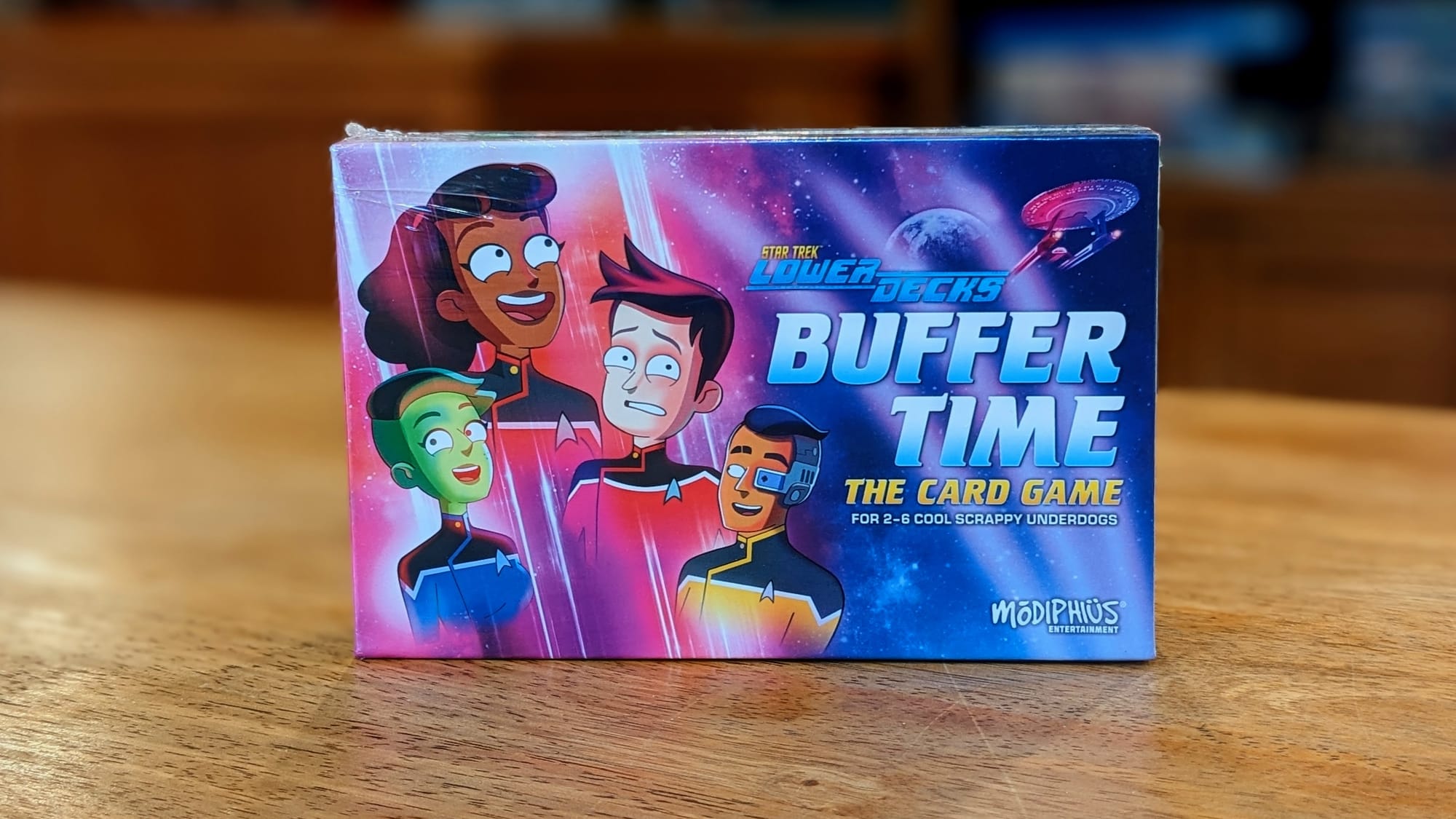
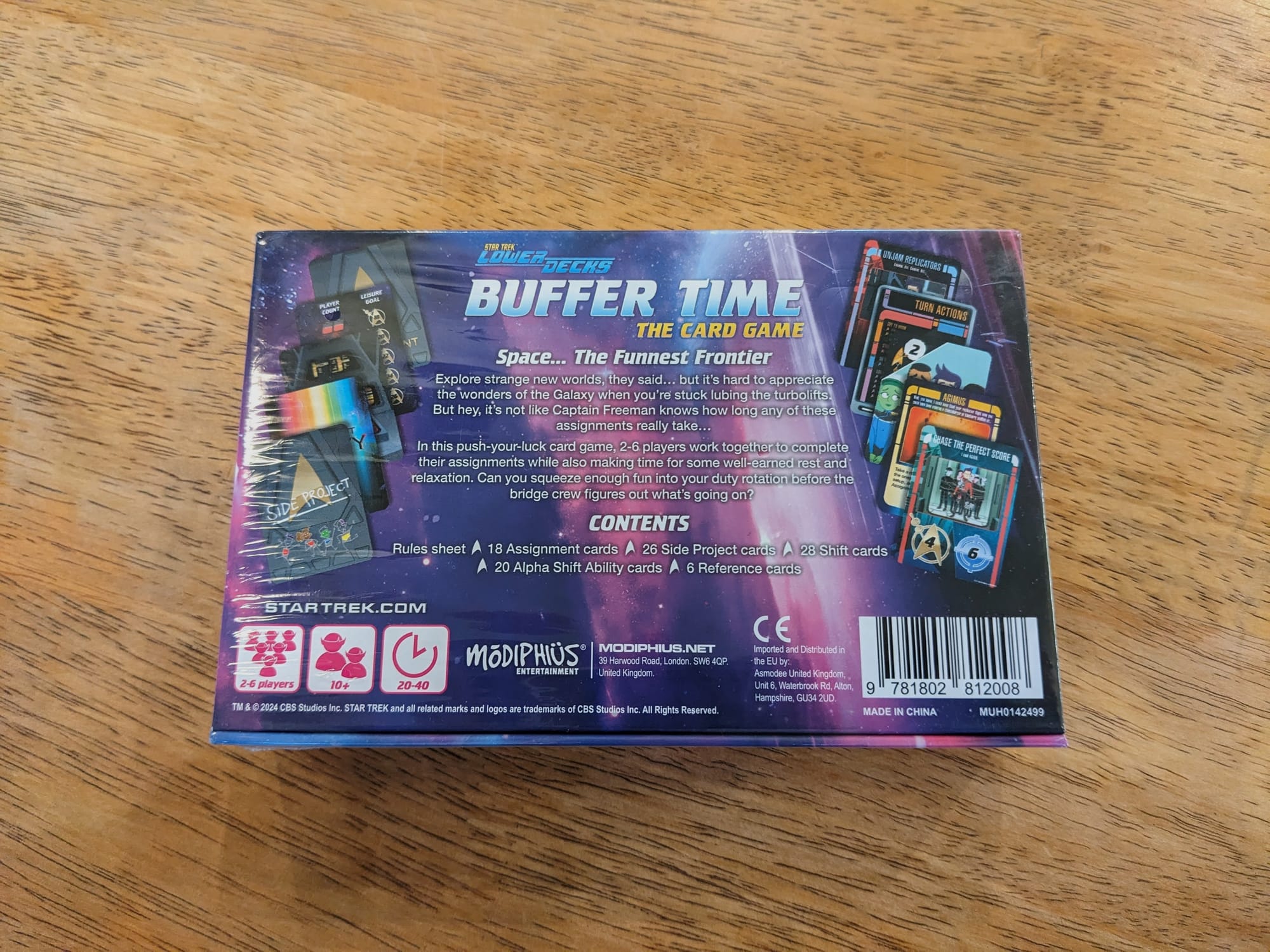
Enter Star Trek: Lower Decks Buffer Time! Based on the canonical and tongue-in-cheek cartoon of the same name, Star Trek: Lower Decks Buffer Time puts 2-6 players (scrappy underdogs) together, not to engage in space combat or wheel-and-deal at the negotiating table, but to instead complete menial duties and work on side projects aboard the USS Cerritos (the mid-level Starfleet ship from the show). Rather than try to capture the entirety of the Star Trek mantra in an overly complex game, Buffer Time circumvents the expectations and gets down to brass tacks (or self-sealing stem bolts), creating a simple and light push-your-luck card game.
Unboxing & Contents
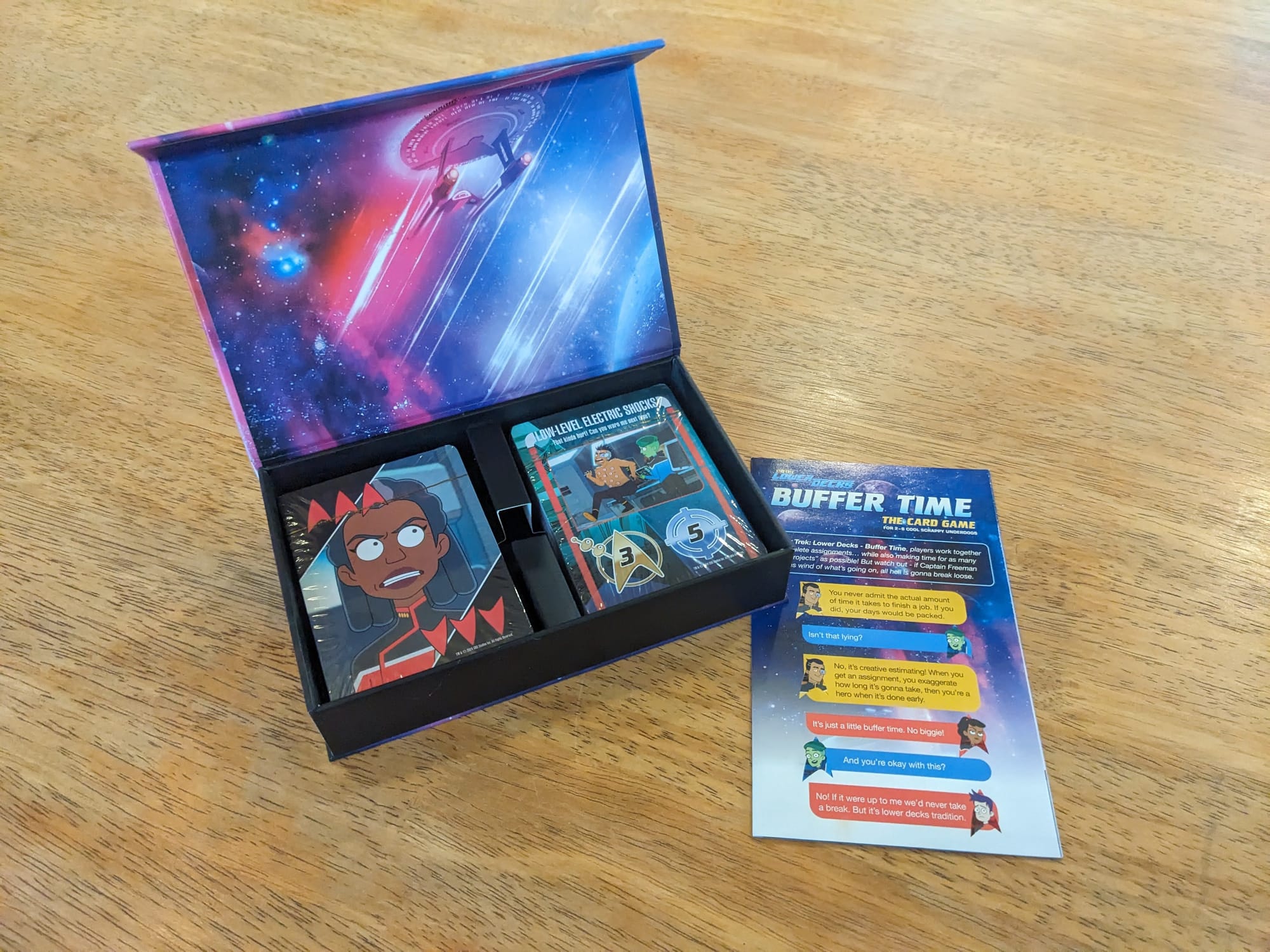
Star Trek: Lower Decks Buffer Time comes in a nicely packaged box that stores everything you need. If you are inclined to sleeve the game, you have a tiny bit of wiggle room within the box for sleeved cards, but I wouldn't get thick ones. Unlike some other card games out there, this one truly only has cards; no tokens, no board, no markers, etc. Once you separate out your various cards, you're ready to set up and beam out!
Gameplay
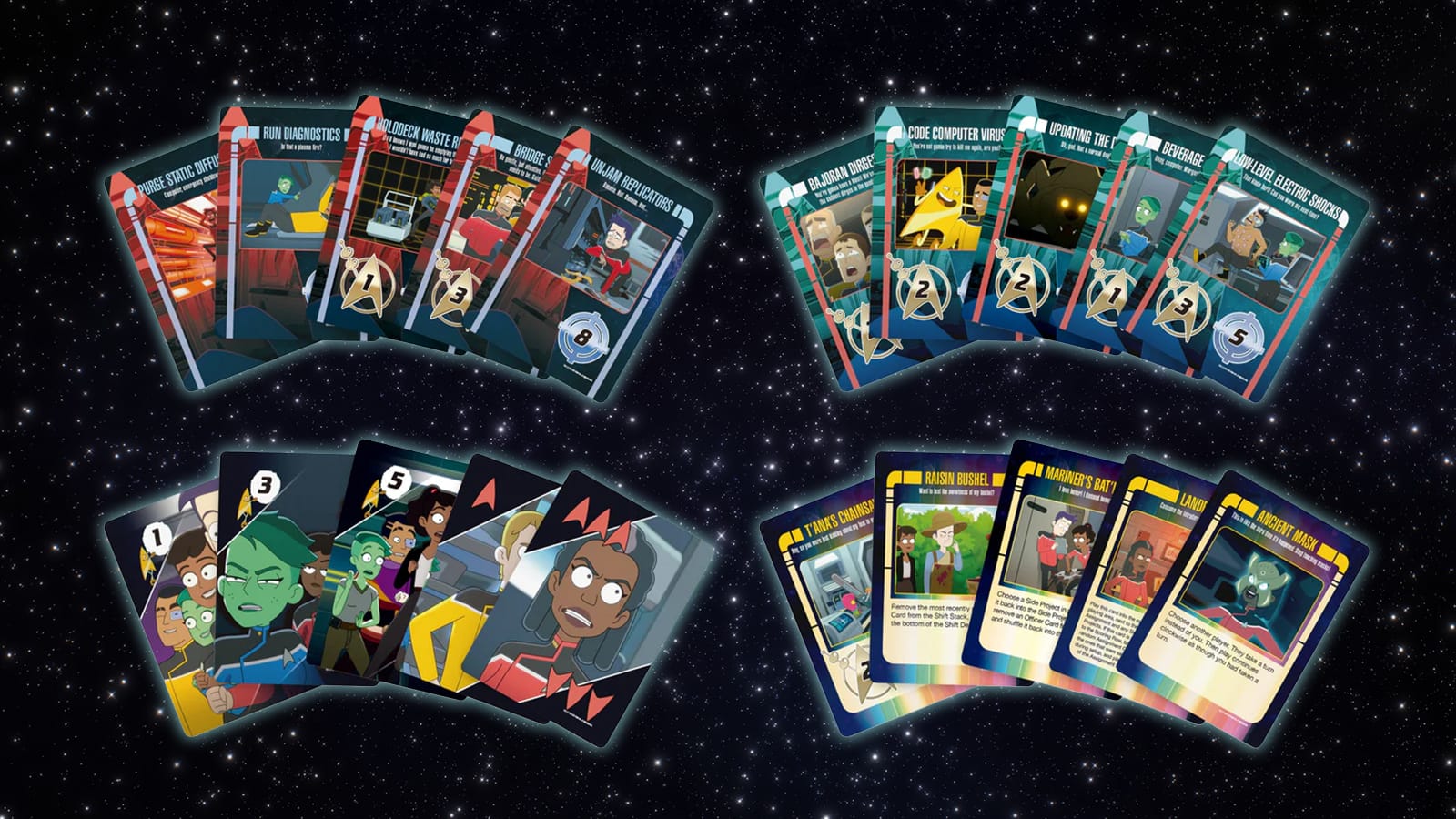
The game plays pretty quickly once you get used to the turns and rounds. There is not a whole lot of complexity to the game, and the games should go pretty quickly if you're communicating.
Setup
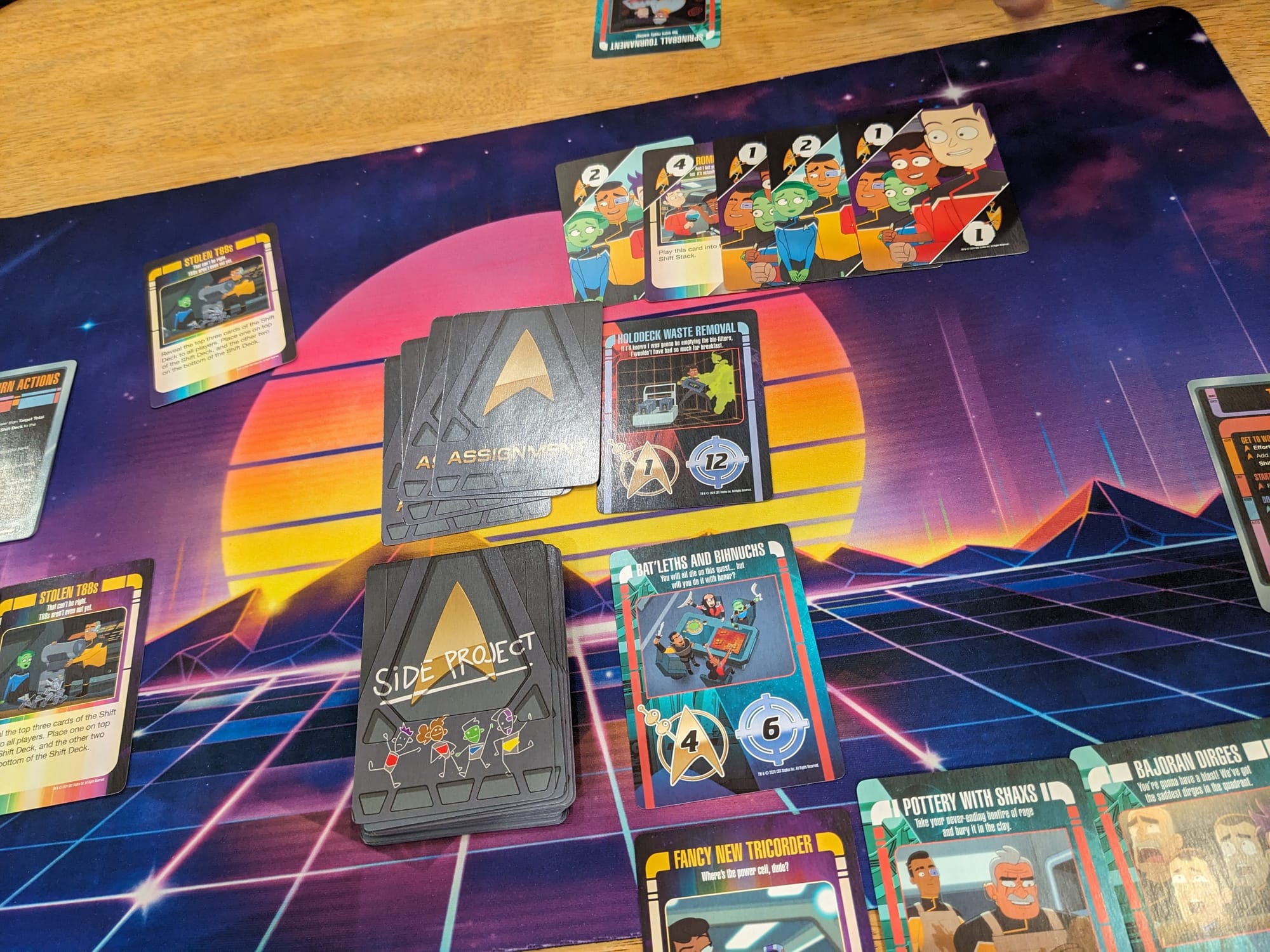
There isn't a diagram in the rules for how to set up the play area, just some descriptions of the cards and where they go. My recommendation is just to set up the play area so the cards are accessible to each player. We ended up moving stuff around on the table once we get into playing to help make the game flow a little easier. We chose randomly who started because we both complained about work equally and recently (check it, it's in the rules).
Rounds & Turns
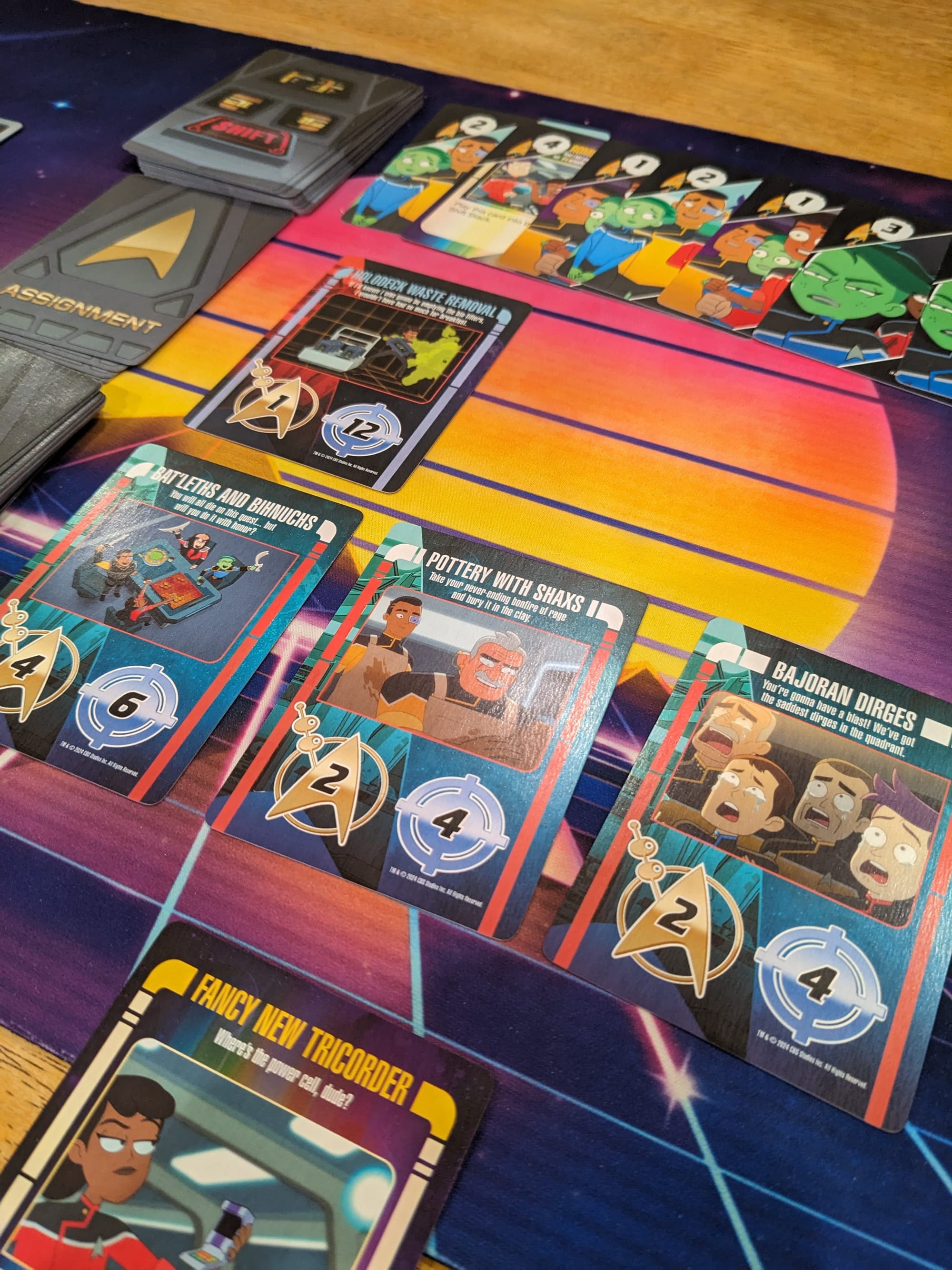
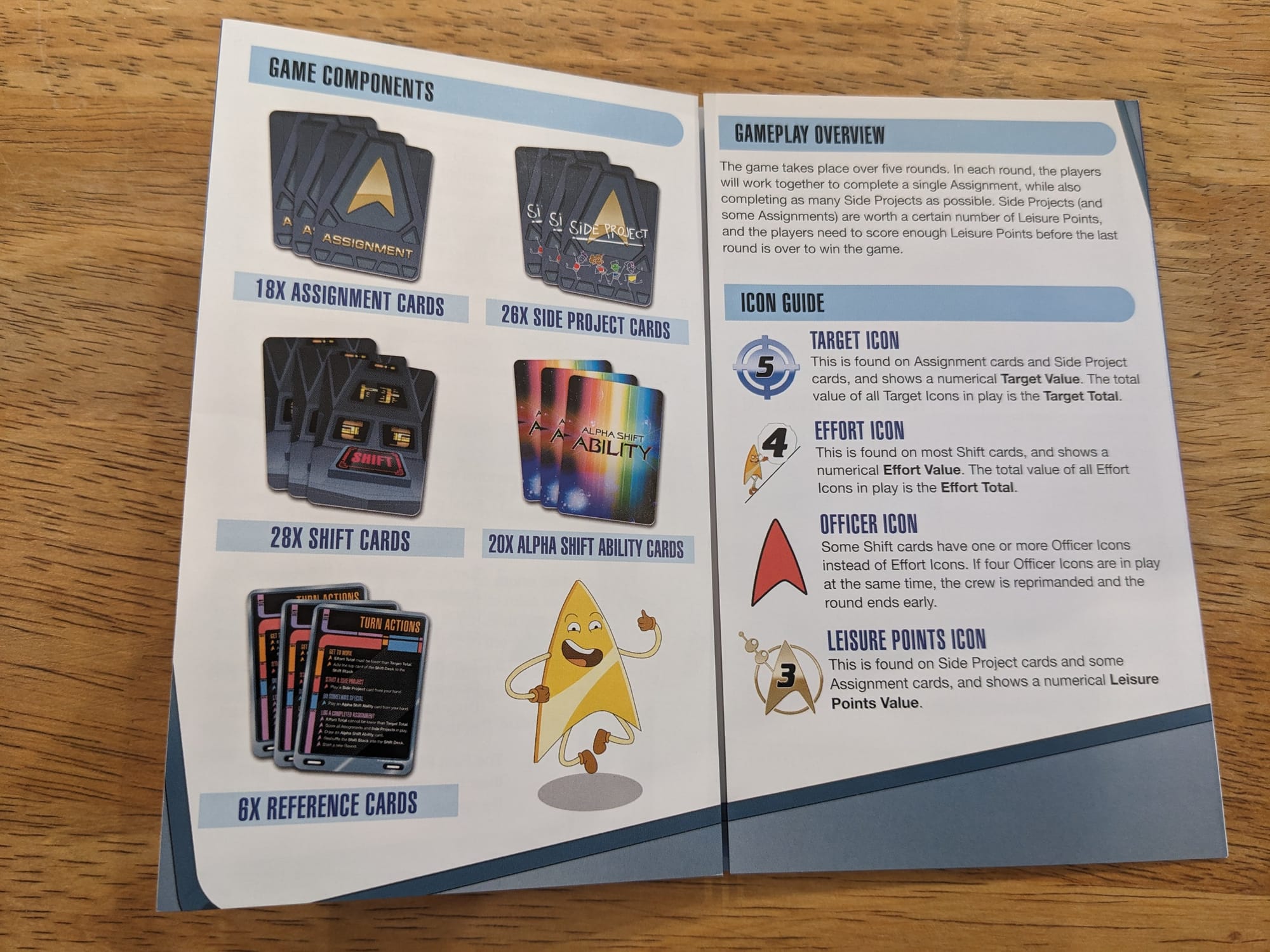
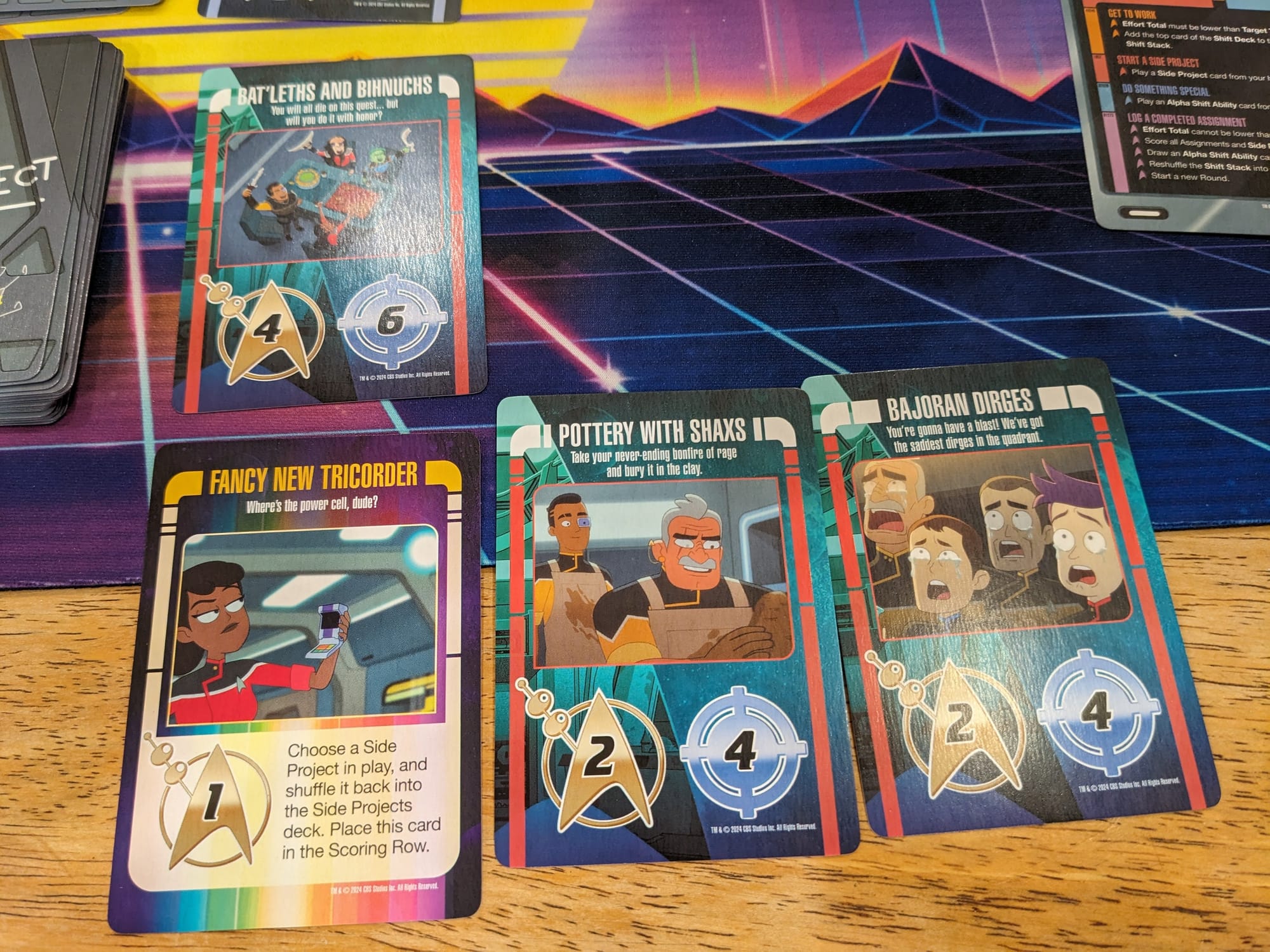
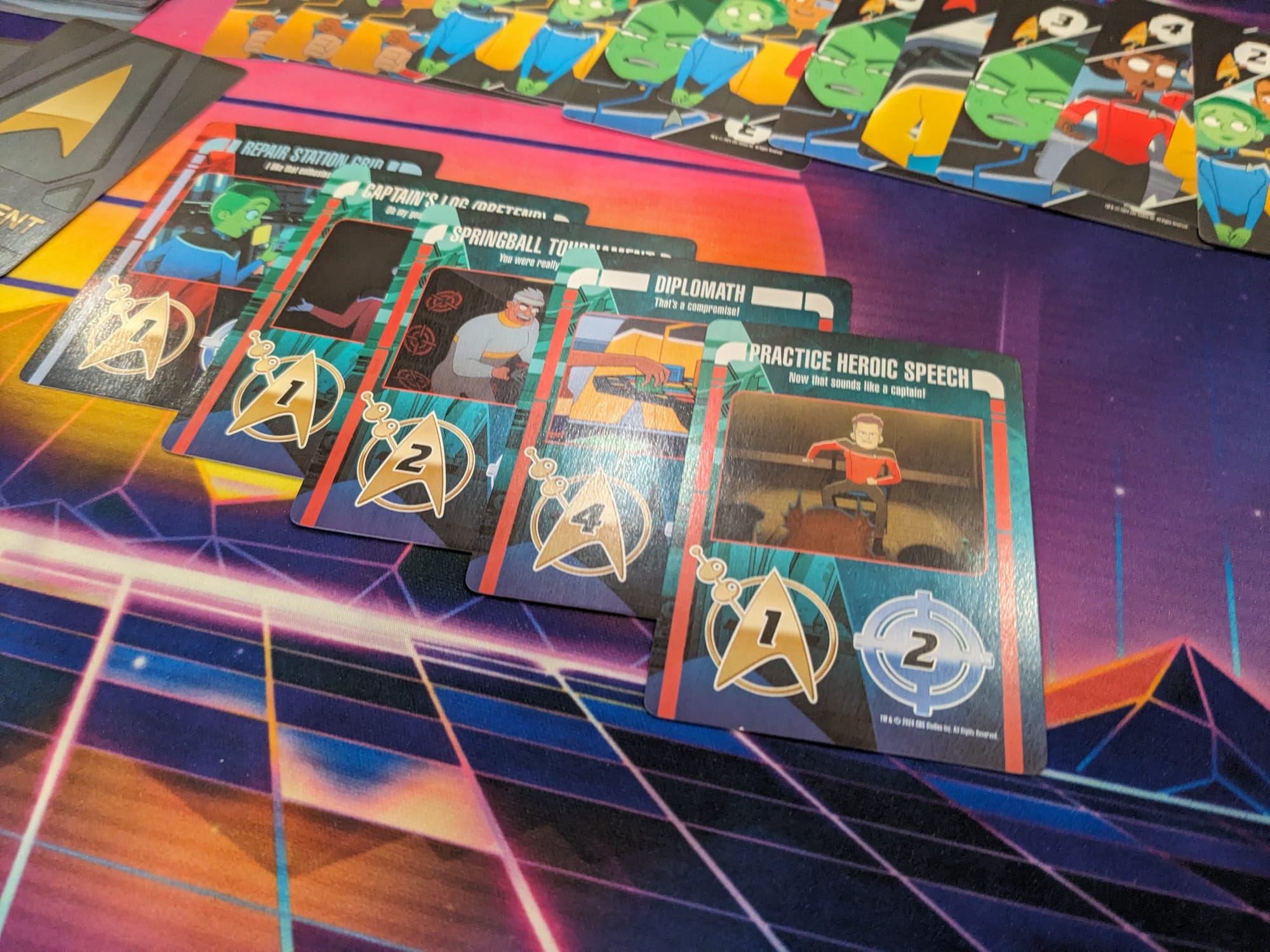
Players each take their turn going clockwise, performing one of the listed actions. Once all players have taken their turn, the round ends, so fewer players means faster rounds. The goal of the game is reach a certain number of Leisure Points (the Starfleet icon on the Assignment and Side Project cards) based on the number of players in the game; once you do that, the game is over and everyone wins! Leisure Points are obtained by completing Assignments and Side Projects by playing cards from the Shift deck onto a stack of Shift cards next to each assignment. There are individual Shift stacks for each assignment. As you play cards from the Shift Deck, you add their Effort Numbers (indicated by a number in a white circle) together to try and meet (or exceed) a Target total on the Assignment and Side Project cards (the silver target icon). A player's action can be to 'Log an Assignment,' which is to move the Assignment/Side Project to the score pile and shuffle all of the Shift cards back into the deck. You can have multiple Assignments going at a time, but you can only use your Shift Points once, applied to each active Duty Assignment, to score before they get shuffled back into the Shift Deck. If there are no cards in the Assignment Deck at the end of a round, everyone loses.
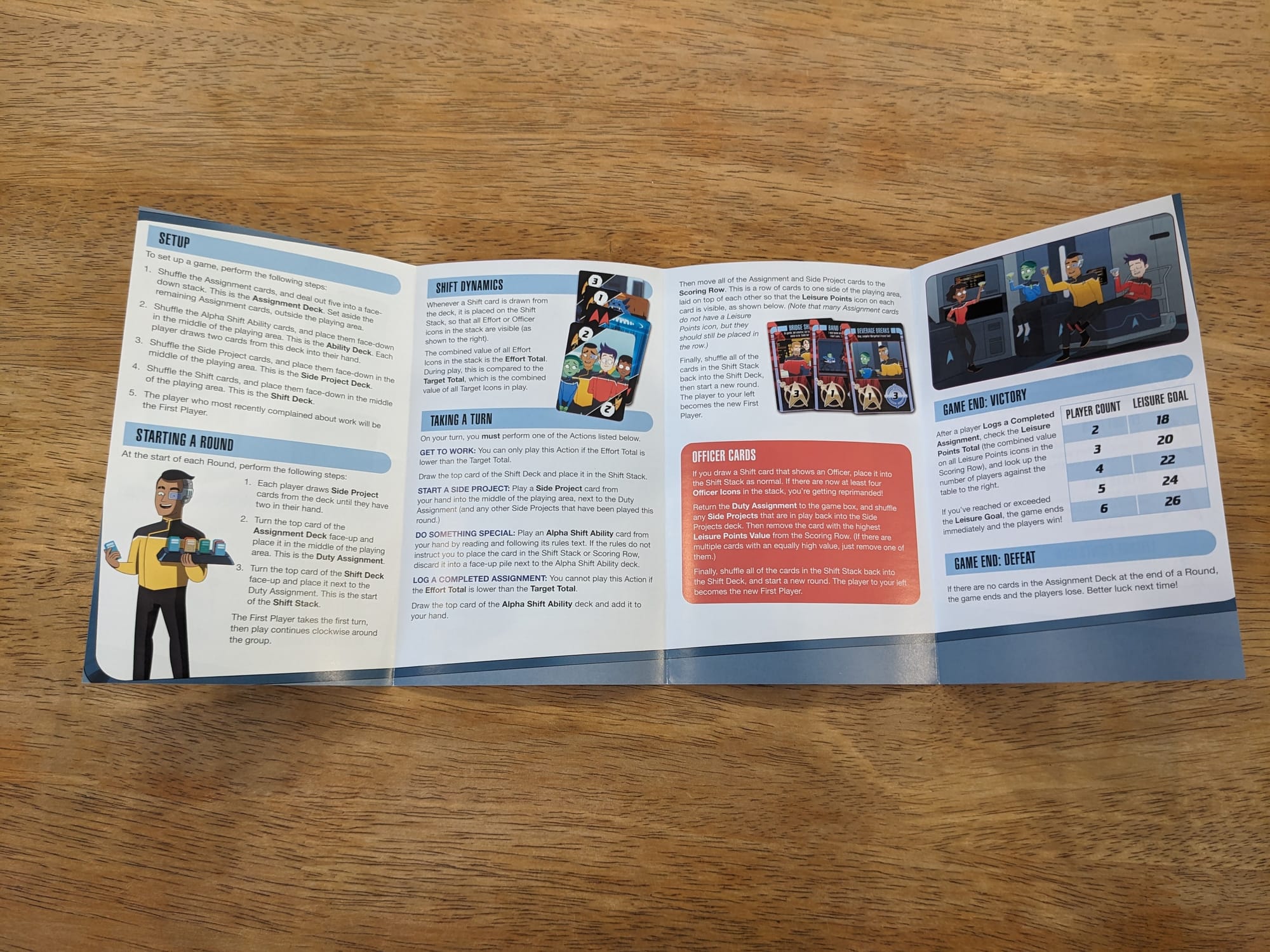
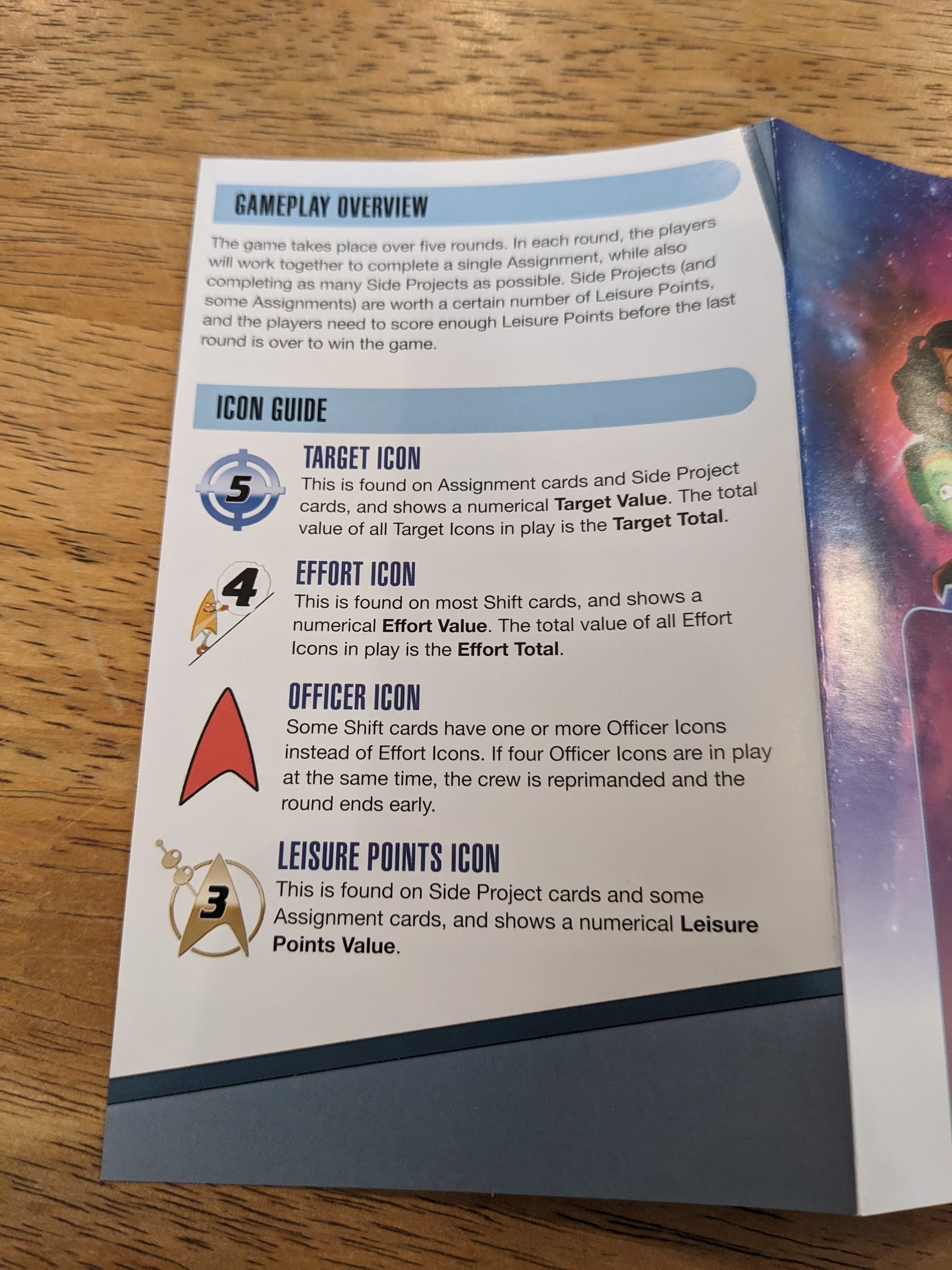
There are some cards in the Shift Deck that negatively affect your play. Officer cards add a red Starfleet icon to the Shift stack, and if you get four of those icons, the Duty Assignment gets shuffled back in, Side Projects are discarded, and you remove the card with the highest number of leisure points from the scoring row. This is where the "push your luck" aspect comes in because you may end up drawing cards that set you back, especially if you have a high Target total of an Assignment or Side Project card.
Impressions
This game differs from other Star Trek game in that the game throws out the diplomacy and combat challenges. That's as complicated as this game gets. Even though it's a co-op game, there isn't really any kind of engagement with other players, other than discussing what Ability cards you might have in your hand to plan ahead for completing either an Assignment Deck card or a Side Project card. The Ability cards have some cool effects that can change up the monotony of drawing and playing cards, especially if you draw something not so great from the Shift deck, so those are worthwhile to discuss and wait to play at an opportune moment. Each player is simply flipping over a card, placing onto a stack, and trying to have that stack's Effort total exceed the total on the Assignment target value. It really does feel like Blackjack, only you have multiple stacks you're playing, and the house doesn't always win (in fact, we played a few games and we didn't lose once).
The rules are a little clunky, especially with tracking the terminology, but clear enough once you start playing more and run into interactions that may require players to reference the rules sheet. The addition of reference cards helped tremendously as opposed to having to pass around a rule book.
Due to the unexpected simple nature of the game, we were definitely overthinking the game when we first started, so that didn't help. After we got into it, though it really did play quickly. I can see where more people will add more chaos, which feels a little more in line with the show. With two players, it felt very antiseptic and just played super fast.
Star Trek: Lower Decks — Buffer Time: The Card Game
Good
A fast-paced, easy-to-learn card drawing game that doesn't require knowledge of Star Trek or other games to play. This is a great game for Star Trek fans, as it offers a different way to enjoy the universe in game form while respecting player's game time.
Pros
- Simple rules, simple win condition
- Easy set up
- Lots of replay value
- Great for Star Trek Fans!
Cons
- Rule book and terminology are a little clunky.
- The co-operative aspect is limited
- The box doesn't quite fit fully sleeved cards.
This review is based on a retail copy provided by the publisher.
If you're a fan of Star Trek, and you want your non-Trekkie friends (and/or kids) to be able to enjoy a game based in the Star Trek universe, then Star Trek: Lower Decks Buffer Time is a great option to have in your Ready Room.
Follow GamingTrend for more board and card game reviews, news, and gameplay articles!