Most of the time, when people talk about dexterity games, they mean flicking games. Usually it's flicking discs and sometimes dice. Or they’ll mean real-time games that pit your speed against your opponents. Squirrel Away, however, focuses on a different type of dexterity: sleight of hand (Bards and Rogues rejoice). I’ve played my fair share of bluffing and “cheating” games, and Squirrel Away is definitely one of my favorites.
Rules & Components
Squirrel Away is an incredibly simple game; if you've ever played the classic game Bullshit, then you're already 90% of the way there. But in case you haven't, the rulebook has a clean layout with plenty of graphics to make the rules even easier to learn. The box advertises itself as suitable for ages 10+, but I suspect that even kids a few years younger could read and learn the game on their own.
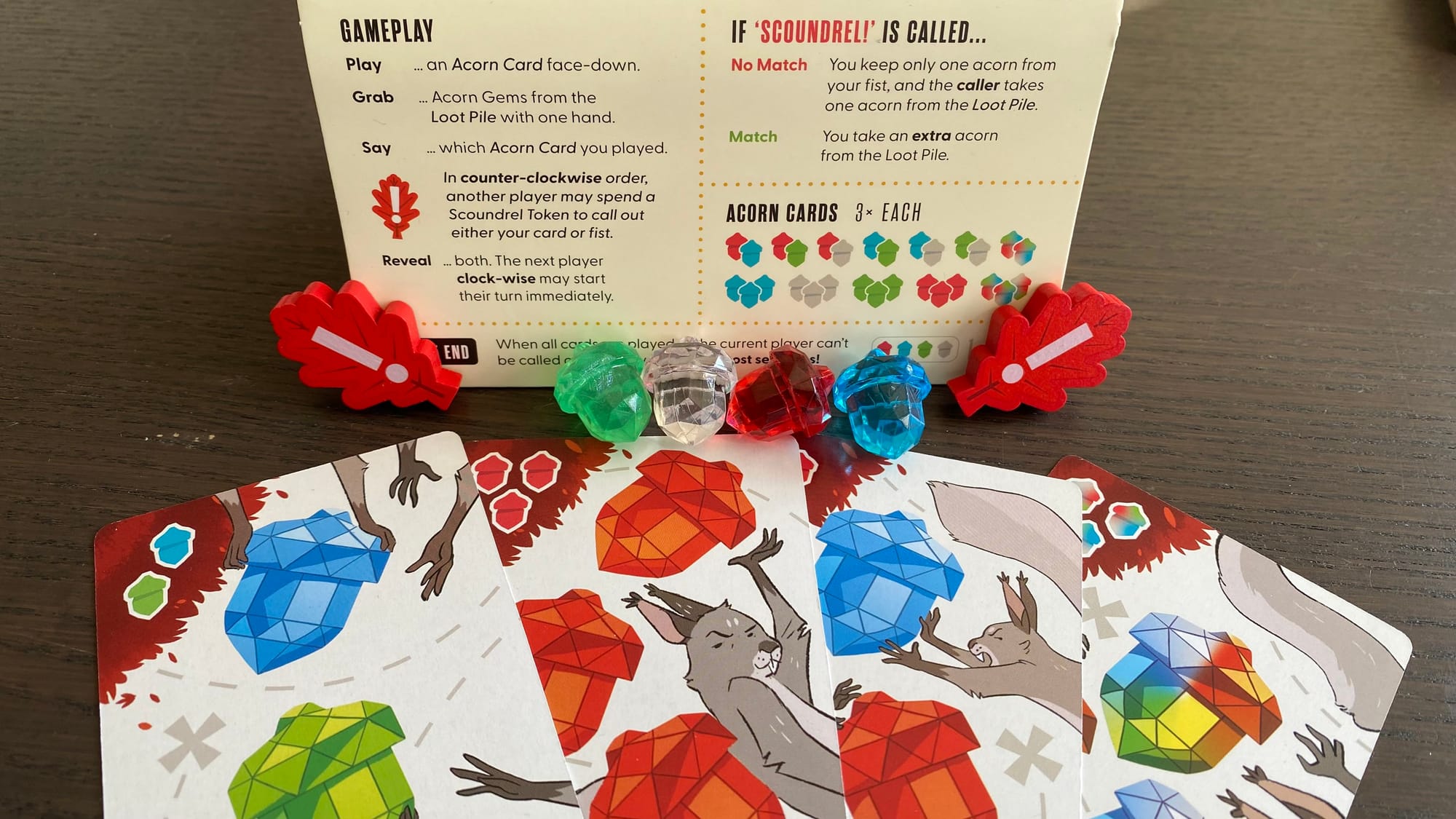
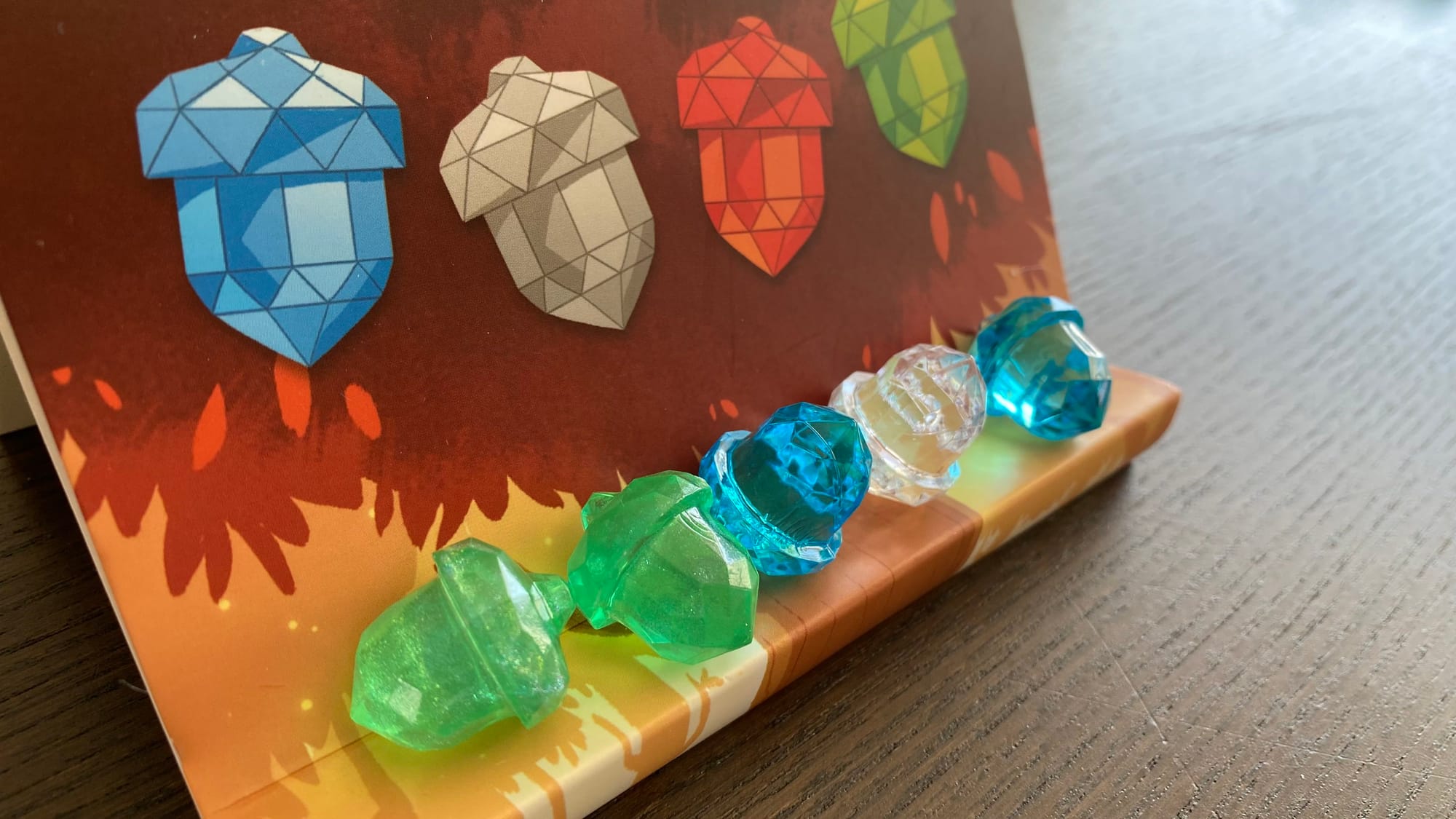
The player screens not only provide a place to both display and stash your nuts, but also have a nice reference to the rules and the card distribution. The cards and player screens are sturdy enough that they'll hold up to repeated plays, but the spotlight is mostly on the acorns. Nice and chunky, the vibrant plastic nuts are molded to have gem-like facets, which helps connect the two seemingly disparate themes of squirrels stashing nuts and thieves distributing loot. The size of these nuts has a major impact on gameplay as well—while a player can fit several in their hand, you can only grab so many before your grip starts to bulge like, well, a squirrel's cheeks. I haven't had this issue yet at my tables, but it's worth noting that players with particularly small hands (e.g., children) may have difficulty grabbing too many at a time, which could actually hurt their score.
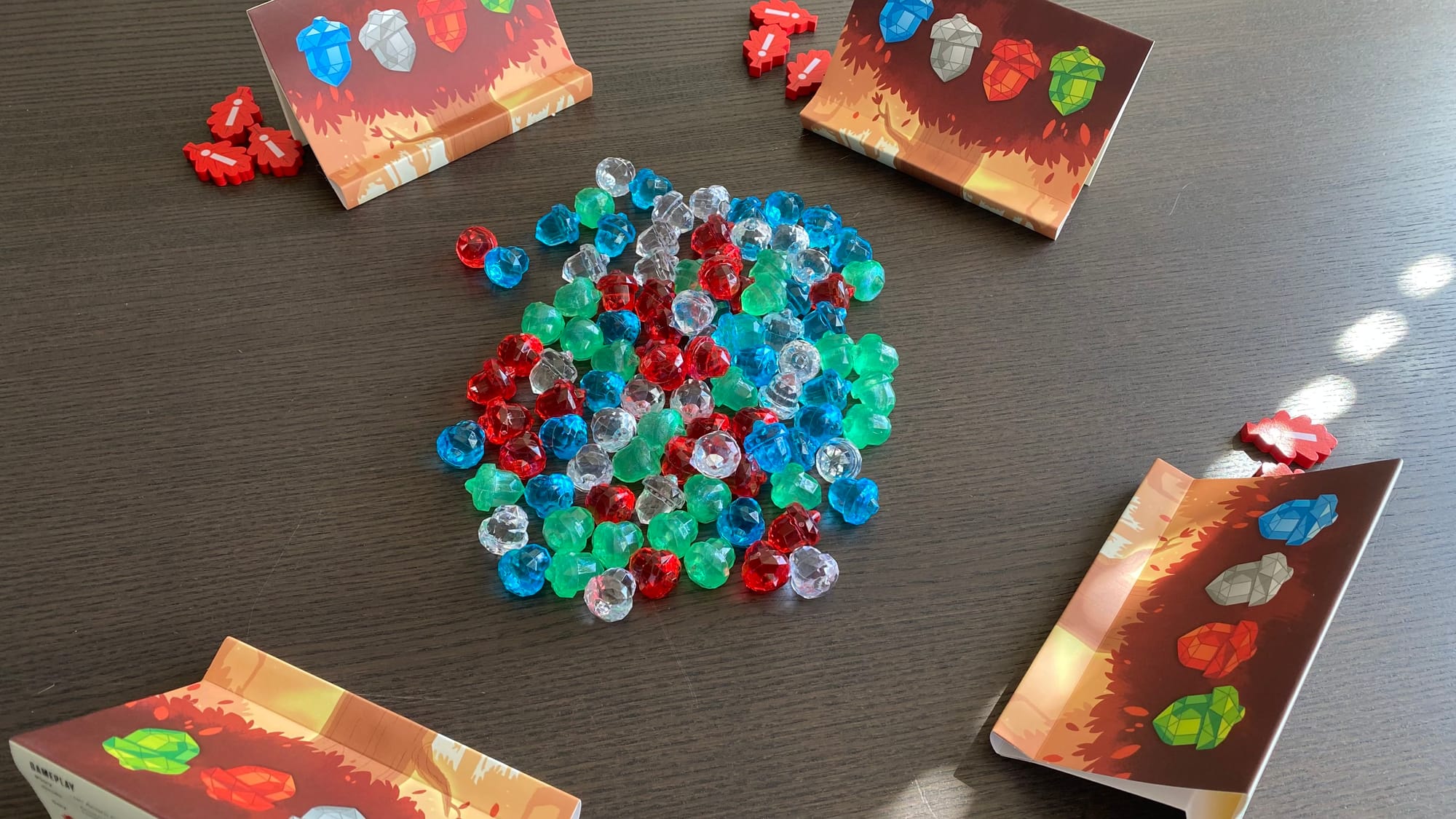
While not a component that comes with the game, it's worth noting that your table size will play a part in your experience as well. Too big a table will make it harder for players to slip extra nuts into their hands or sneakily start their turn while everyone else is focused on the previous turn's resolution (more on that later), which will lead to more "honest" plays. Typically, any game is fine as long as the table fits all the boards and bits, making larger tables preferable, but a bit more intimacy works better here.
Gameplay
As I said, Squirrel Away is super simple. In the middle of the table is a pile of acorn-gems in four different colors. Your goal is to collect as many sets as possible. On your turn, choose a card from your hand to play face down while simultaneously grabbing whatever acorns you like before declaring what the card allowed you to take. Going clockwise, your opponents have a chance to call you a Scoundrel, which is where the game gets a bit interesting.
First, calling Scoundrel—whether right or wrong—costs a Scoundrel token. Each player starts the game with three of these, and there's no way to regain them, so players need to be careful about when to use them. Second, the accuser needs to declare what they think you're lying about: your card or the nuts in your hand. You could be telling the truth about what's in your hand since you only needed a few specific nuts to complete a set, but perhaps you had no actual cards that would let you grab a green. You'll then reveal both your played card and your hand of nuts. If the accusation was correct, you only keep one of the gems while your opponent gets one of their choice; incorrect accusations leave them with nothing while you get an extra gem.
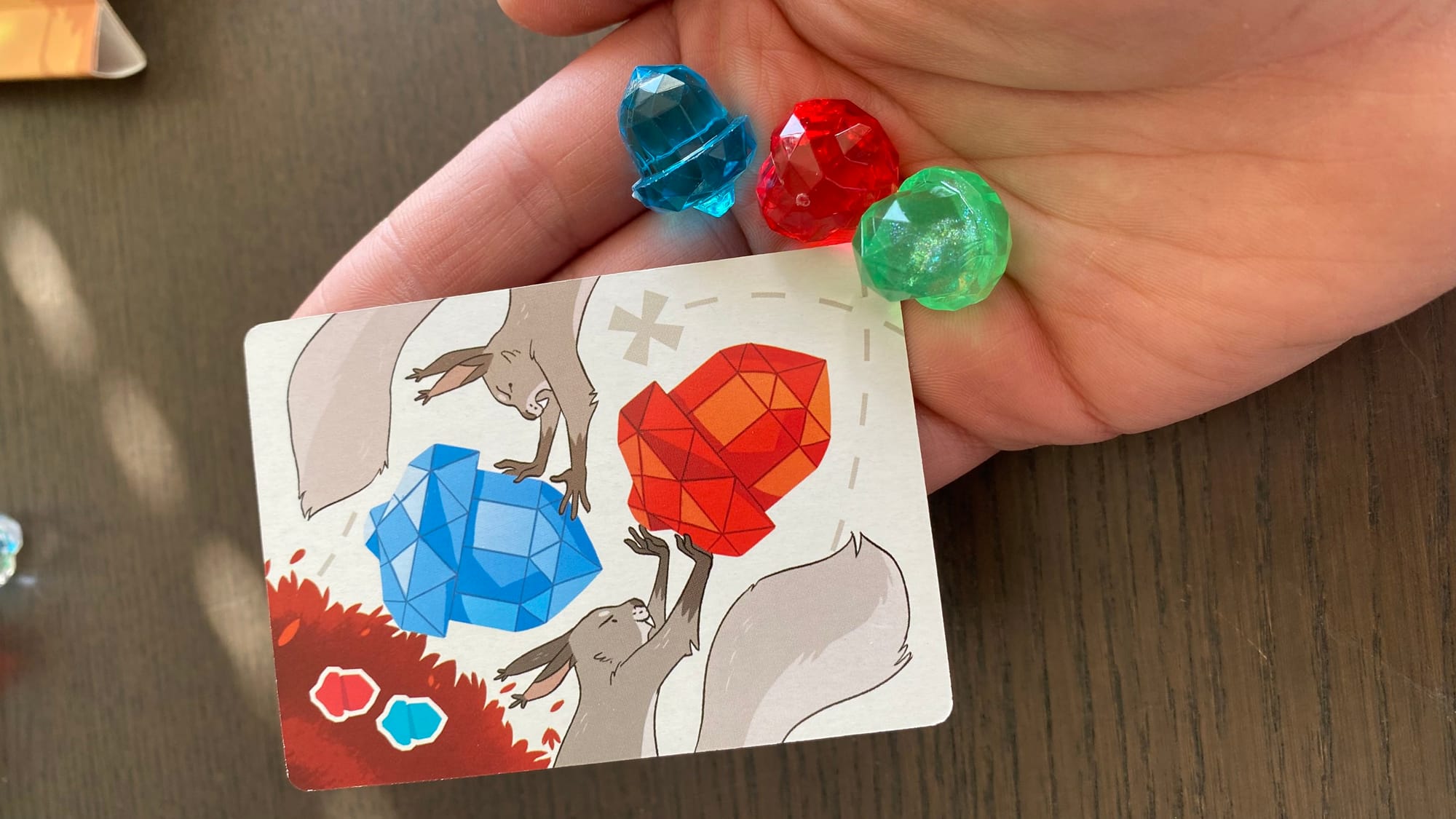
If there's no accusation, you still reveal both the cards and your gems before adding the nuts to your display and scoring any potential sets. Regardless of any accusation, as soon as your card and hand are revealed, the next player can start their turn, potentially slipping an extra nut into their palm while everyone else is distracted. Once everyone's played their last card or nobody has a token to potentially call out the active player (no uncontested turns allowed), the game's over.
The game plays quickly, and the scoring of sets adds a nice bit of strategy to the mix. If my display is missing a particular color, I'll need to grab one to score. I obviously grabbed some just now, but am I lying about what the card actually allowed me to snatch? On another turn, maybe I told the truth about a card letting me grab more nuts that I don't need, but did I slip an extra green in there to finish my set, or do I want you to call me out so I can be rewarded with one for free?
I love dexterity games, and I especially love unique/odd games; Squirrel Away checks those boxes very satisfyingly and has definitely earned a place on my shelf. Like all bluffing games, it does need a particular type of group to be fun (I've had some rough Sheriff of Nottingham tables), but if you have a group for it, I'm sure you'll have a good time.
Squirrel Away
Great
There aren't many "sleight-of-hand" games on the market, but Squirrel Away easily takes the cake nut. The set collection and card distribution take the game beyond just "how much can you get away with" and add a layer (albeit thin) of strategy to the dexterity game. While table and hand size may impact your experience, the game is prone to fun moments and will surely be a hit with bluffing fans.
Pros
- Nice, chunky gem-nuts
- Two-part bluffing mechanic
- More strategy than just "grab as much as possible"
- Simple, easy-to-teach mechanics
Cons
- Smaller-handed/less dexterous players will suffer
- Larger tables lead to more honesty
- Your ideal moves (and thus, likely bluffs) are somewhat obvious
- Box could have been larger to fit components better
This review is based on a retail copy provided by the publisher.