Reimagining an older franchise must be one of the toughest ways to develop a game. Do you make a modernized version of the old game for that audience? Does that old audience even exist anymore? If not, do you completely overhaul the idea? But that could mean ditching the original fans. Does that matter? Maybe someting can be done to satisfy the old audience and invite a new one.
Just thinking about it sounds like an uphill battle.
Well, Milestone’s Screamer definitely chose a direction: ignore most of what the original Screamer was. The original 1995 Screamer was an arcade three-lap circuit racer with rock music. This new Screamer returns as a dark cyberpunk anime. It’s unrecognizable.
I’ll be blunt: I hated it for the first three-quarters of the 17 hours I spent playing it. It relentlessly frustrated and confused me. I had to walk away from it at least three times.
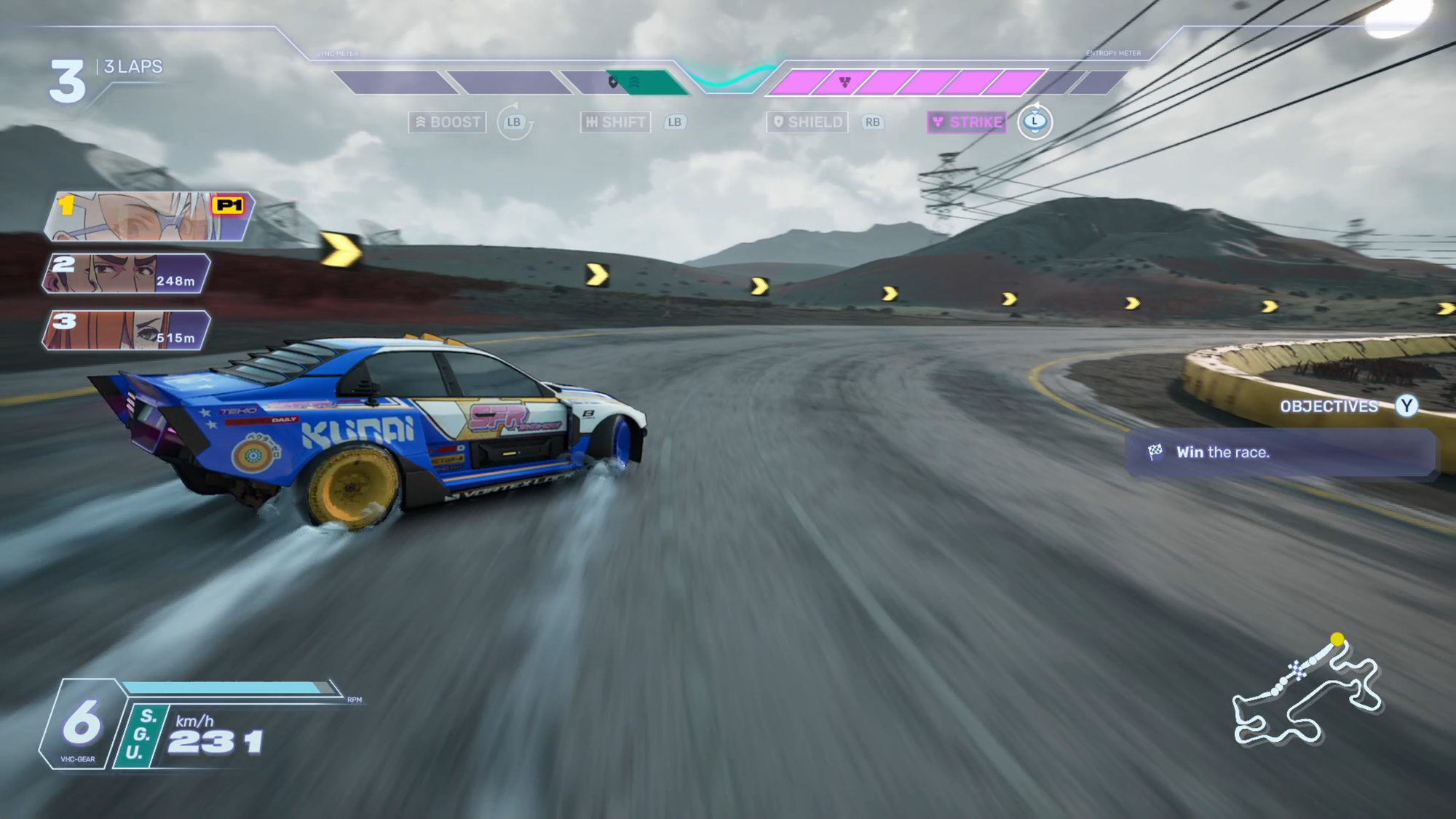
I love racing games, but drifting has always confounded me. Every once in a while, I’ll give drifting the good ol’ college try in Forza Horizon and remember why I always drop out—drifting defies my more logical brain. It’s the epitome of driving abstraction. It’s unnecessary, but captivating. It’s art.
I have immense respect for those who can do it, and for the craft. I haven’t watched Initial D in decades, but I vividly remember the character trying to whip around corners without spilling a cup full of water. The audacity stuck with me.
I know what you’re thinking: Then why are you reviewing this? Because I adore arcade racing games. I remember the original. It was more prone to drifting, but in the past, I wouldn't have considered it a drifting game. So I wanted to know: Could Screamer make me a believer?
It did. I want more.
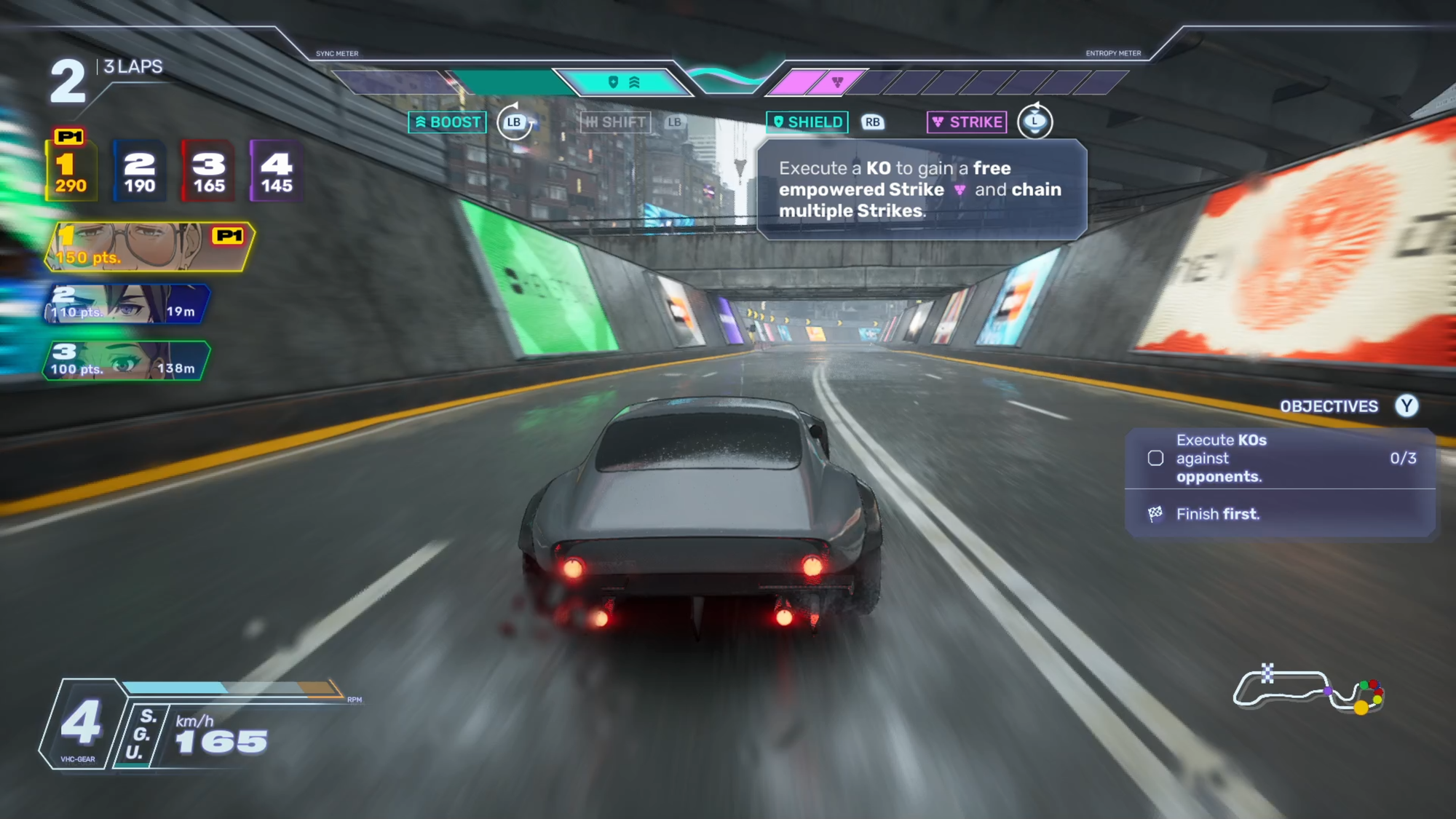
Plenty of obstacles littered my path to enlightenment. During the campaign, called The Tournament, I had to complete objectives during races. Most were simple: use a boost X number of times or win the race. The worst ones were circumstantial: Destroy one specific racer three times and win the race. Excuse me?
Objectives like that force me to focus on something other than the whole point of a race—to win. Everything else, boosting, exploding other players, is part of how you win. Now, I need to slow down or change what I’m doing in order to satisfy this specific objective? And failing either one means starting the race over? I have zero patience for any game that includes objectives that steer players away from the reason why you’re playing in the first place.
The AI racers suffer from what I call Mario Kart 64 syndrome. They could take off, and you’d never see them again. Or you could perform a perfect run of boosts that would put you far ahead in an online race, but the bots stay with you. Only on the easiest difficulties could one create comfortable leads. Otherwise, I always fought for my life.
Beating these kinds of AI is similar to the classic arcade racers: use the best cars. But it’s 2026. We’ve seen great strides in bot racers. Catch–up AI is antiquated. Besides, I like playing the way I want, with the characters I want. I expect my car choices to be limited at the highest difficulties. I shouldn’t have to make those kinds of compromises on medium difficulty.
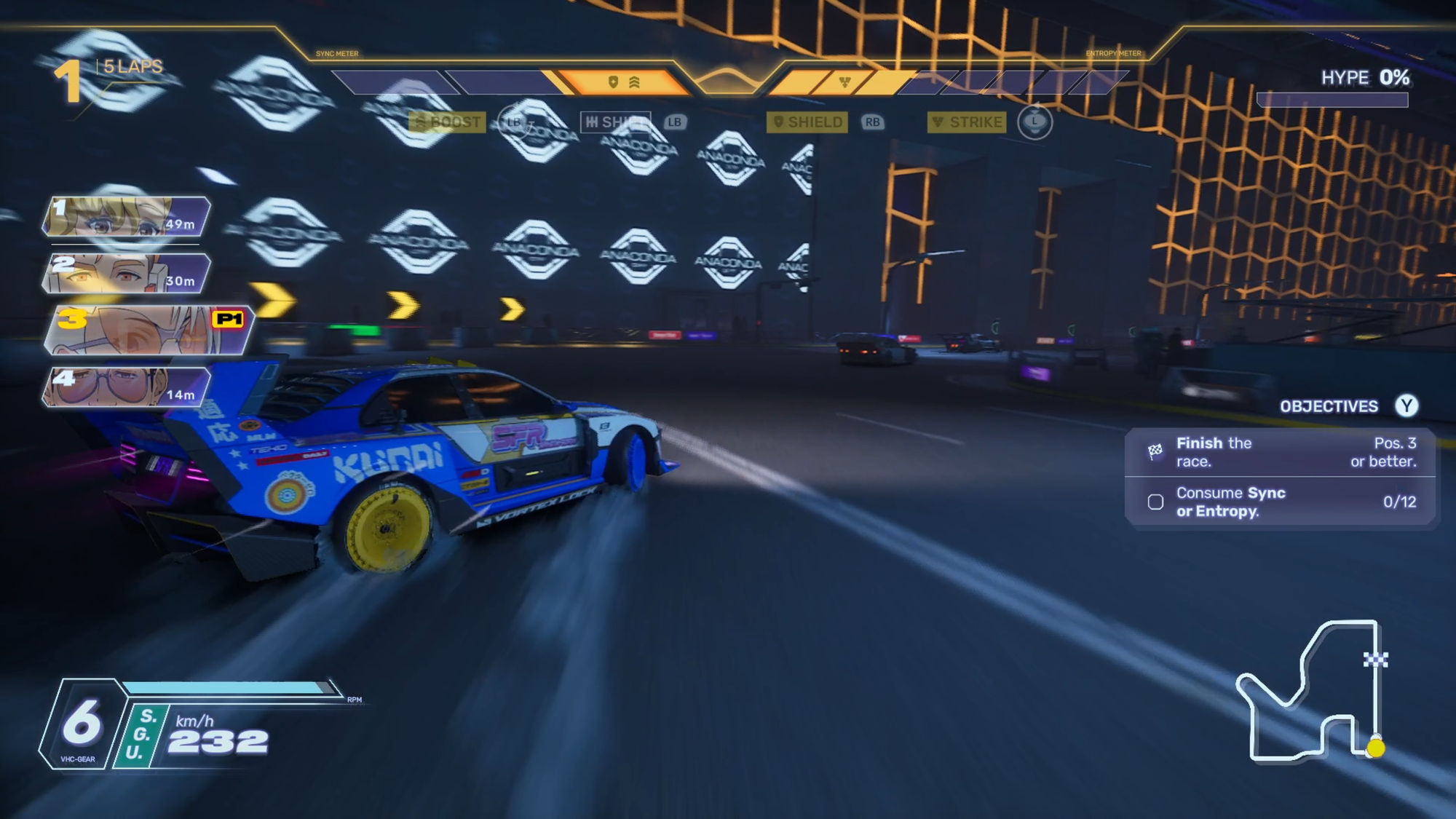
Drifting is where most of my frustration came from, as you would expect. The probelm starts with steering. I realized basic steering is not a thing. Turning a car is like trying to turn a cruise ship. I kept slamming into walls until I realized drifting is how you turn, similar to Inertial Drift. And then I still kept hitting walls. I’m used to giving myself a head start into a bend by turning the car, then whipping the backside through the curve (again, not that I was ever good at drifting). Screamer removes all the mechanical baggage and makes drifting the de facto method of turning. It’s incredibly off-putting—at first.
To make this kind of whippy drifting work, Milestone uses twin-sticking. The left stick is used to steer (barely), and the right stick is how you initiate a drift. This function gives a lot of control over the degree of drift you want to use. Most racing games only need one stick, so it’s initially unnatural to use two sticks unlike transitioning from Goldeneye 007 to Halo, but the effort to learn is worth it.
So, for hours, I’m still slamming into walls. Most of those hours were spent in The Tournament—an introduction to all the mechanics, cars, skills, and tracks. I use the word introduction loosely. It’s beefy. It’s about 20 hours, mostly because of the anime, but we’ll get to that. The tracks always include some kind of intergalactic industriousness; it’s just a matter of what scenery surrounds it. Cities, forests, deserts, etc. Some are more beautiful than others, but none are picturesque. It hardly matters when you’re going 350km/h (the gallery’s track artwork is very cool, though).
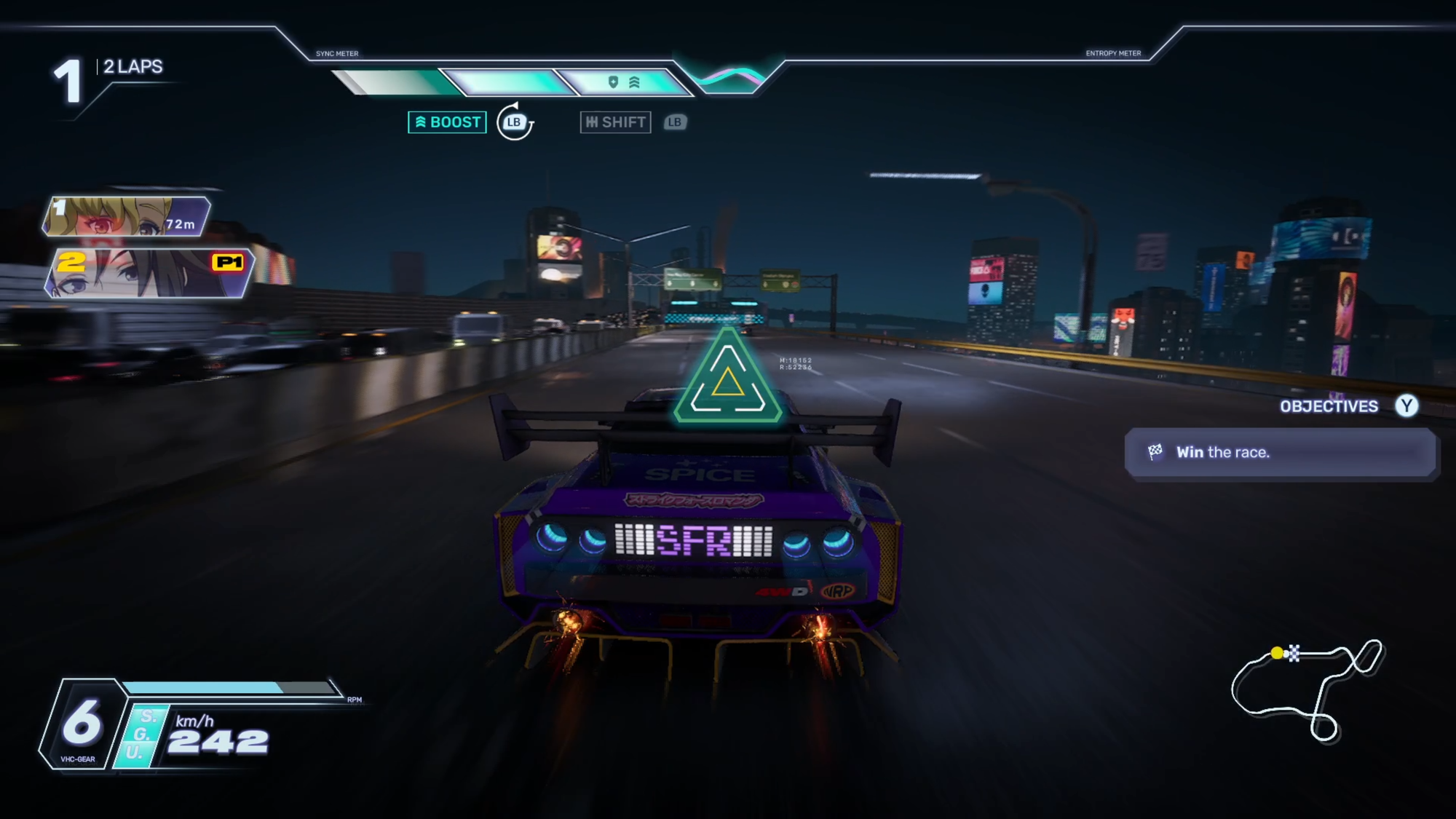
But I remember certain track designs that ranged from excellent to infuriating. The worst ones felt F-Zero-inspired, with hard 90-degree turns that required slowing down in ways that doesn't fit with the emphasis on speedy drifting. Arcade games don’t always need to be pedal to the metal for a whole race, but drifting through these turns lacked the elegance that many other courses preserved.
Even though most of the campaign felt like a slog, it was my perspective that created most of my problems. Somewhere along the way, after all the restarts, the increasingly difficult tracks, and driving different cars, I felt like I learned the meaning of Christmas. My heart grew three sizes too big. The Tournament, perhaps by design, didn’t just teach me how to play; it guided me to competent drifting. I started hitting fewer walls—a lot of walls still, but less. I could successfully drift through consecutive snake turns. But that one curve I kept slamming into? I found the correct line and entry to hit the apex. Screamer is an arcade game, much more than Forza Horizon, but it still requires skill. Once I realized that, my frustration gave way to delight.
Mastering drifting is the bulk of the challenge in learning Screamer, but skill in Screamer also manifests in managing boosting and striking. It’s a multitasker's dream. Screamer takes Gears of War’s active reload mechanic and creates active shift. Shifting to the next gear at the right time earns Sync, your boost meter. Use boost to go faster, but time it correctly, and you can boost for longer. Boosting awards Entropy, which allows you to turn your car into a fiery bullet that destroys other racers. Keep in mind, other racers are performing these skills, too. You’re constantly pressing buttons and under pressure. Staying engaged with your meters while avoiding other drivers makes each race incredibly tense. It’s the thrill and danger of F-Zero, but the chaos of Mario Kart.
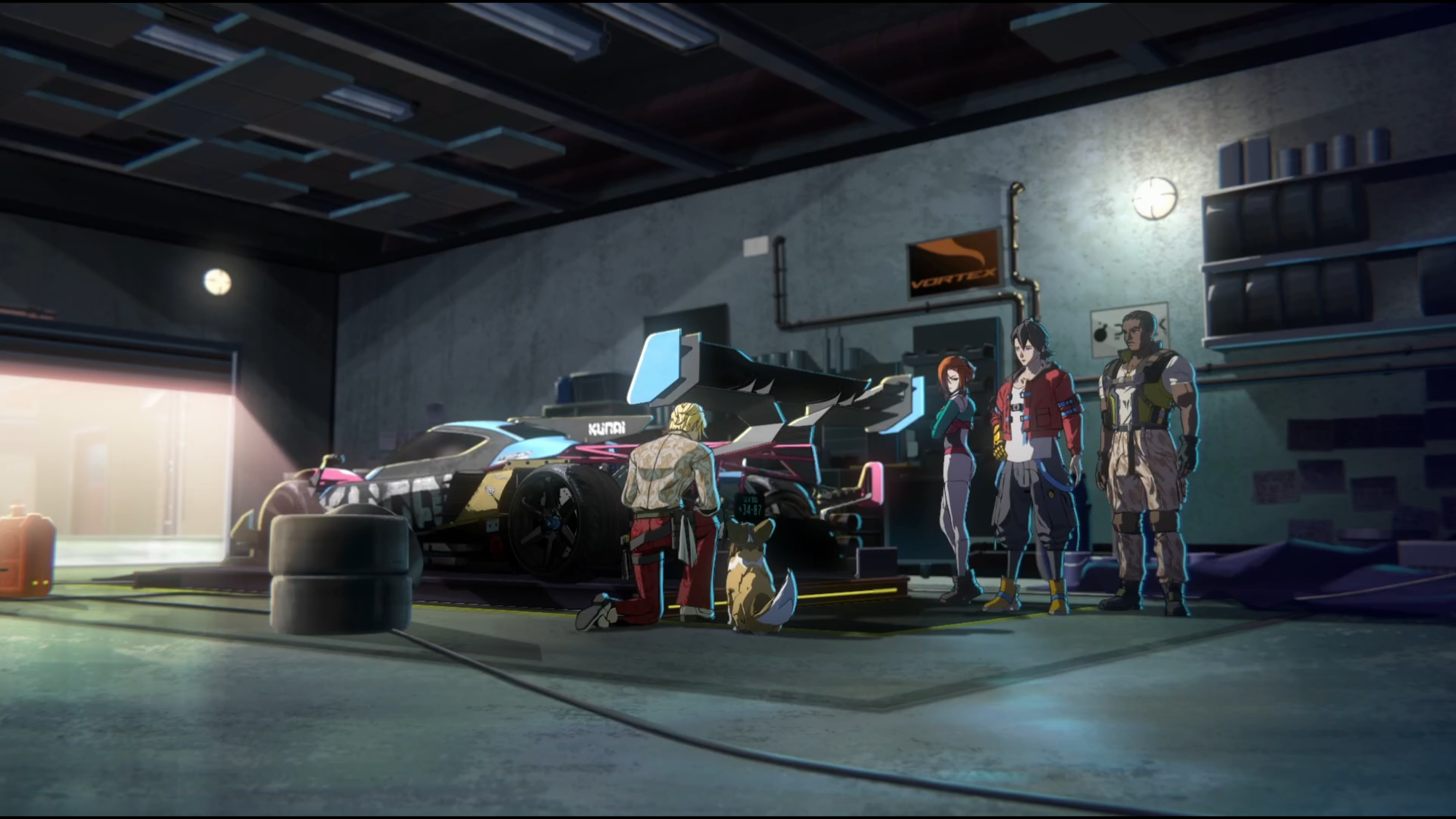
Chaos is one word to describe the racing, and it’s equally appropriate for the anime. Its runtime is far less than your average anime, of course, but the impact feels like an entire season. It has a main plot, and—like your favorite animes—meandering sub-plots. Each episode carefully develops each character, which is why it takes 16-20 hours to finish and why it takes a long time to get going.
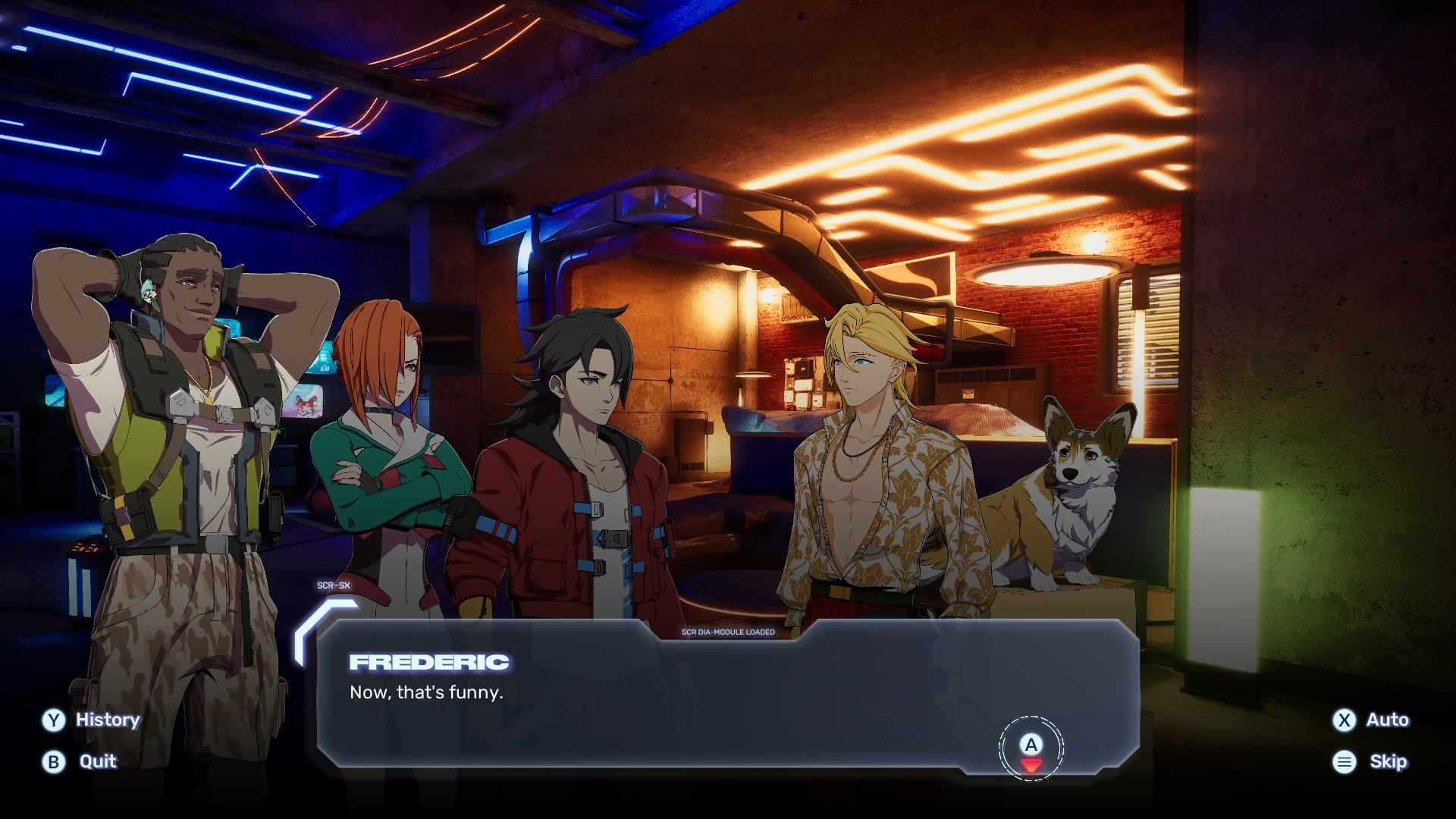
The story follows characters invited into The Tournament, competing for 100 billion dollars. What transpires over the course of this tournament pulls on every emotion. Most of the narrative is told through Fire Emblem-like dialogue scenes, but they’re fully voiced with excellent voice acting. When it's not dialogue scenes, you’re treated to cutscenes created by Polygon Pictures who have worked on projects such as Ghost in the Shell, Star Wars: The Clone Wars, Transformers: Prime, and The Sky Crawlers. This is premium stuff. If you’re wondering why an arcade racer is $60, this is why. It’s justified.
With that said, most characters spend a lot of time being one-dimensional. They’ve all been traumatized by something, and all of them wear it openly. Only a few carry any charm. The unrelenting emotional intensity and melodrama are off-putting, but by the time revelations unfold, they become multi-dimensional and much more engaging. My favorite characters, Frederic (Gregory Lerigab), The Announceer (Mara Junot), and Dirk (Ash K-B) put on some of my favorite performances and provide relief from the onslaught of anguish.
I have to mention the most fascinating part. Each character speaks their native language (the characters have implants that help them understand each other). When dubs tend to be inferior, you can feel the comfort of expression in the actors' language. There isn't a way to turn on all English speaking, so I had to enable subtitles, which was important while driving, as I couldn't understand what they were saying (still dangerous because I had to take my eyes off the road). But if you wanted to know, for example, what a Russian character sounds like in an anime, this is the game. And they all do a great job of giving the type of performance you’d expect from a great anime.
Screamer
Great
Screamer started as a frustrating reimagining of an arcade drifting racer, with a downtrodden, slow-moving plot. By the end, I wanted more, and I became a drift racing believer. I’ll never win an online match, but I’ll take losing for another chance to race in this universe.
Pros
- Excellent cinematics and voice acting.
- The racing and drifting are fun and skillful.
- The Tournament helps you learn to play better.
Cons
- Some tracks don’t fit this style of drifting.
- AI racers are unfair many times.
- Story takes a while to reach its peak.
This review is based on an early PC copy provided by the publisher. Screamer comes out on March 26, 2026.