You walk across the beach, sand warm beneath your toes. Something catches your eye, and you pull a snail shell from the coast. It’s a lightning whelk, which you haven’t seen yet today. You add it to your sack, smiling as your friend excitedly waves yet another shark tooth in the air before adding it to their own growing collection. The red lighthouse shines in the distance, marking both the shoreline and the end of the beach. When you reach it, you’ll have to turn around and head back, but you’re in no hurry. There’s plenty to collect already at your feet.
Sanibel is a relaxing shell collection game where players stroll along a beach, placing their findings on their boards and competing to build the best collection. Each of the shells scores slightly differently, and players will need to figure out not only what to pick up but also how to place it. While there is some competition over particular shell tiles, the game is very laid back and creates a soothing experience.
Rules & Components
The rulebook for Sanibel is pretty light, since the game itself isn't exactly a complex one. Still, there are plenty of examples and visuals for each aspect of the game, along with an explanation for both the typical tiles and each of the special Lighthouse tiles, so even less experienced gamers shouldn't have any issue learning the game on their own.
The many cardboard tiles, while not as thick and chunky as I prefer, are perfectly fine and will hold up to repeated plays. The folding boards that make up the shoreline are a nice touch, as they could have easily been a cheaper cardstock mat. I'm not entirely sure why it wasn't just a single, large board instead of three trifolds (maybe this specific size was harder to achieve?), but it doesn't really impact gameplay in any way.
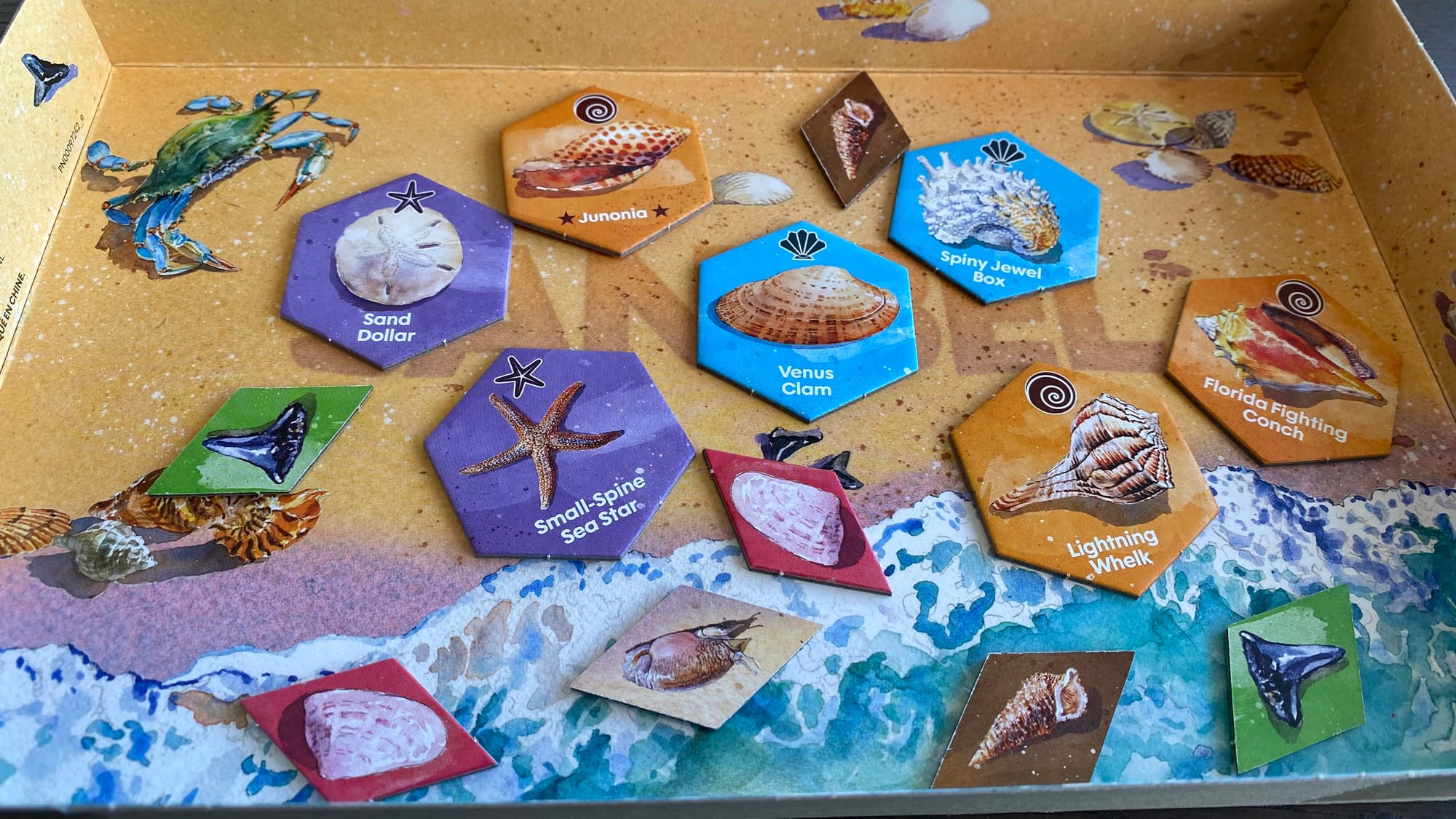
While the physical components are just "fine", the artwork is really something special. Dahl Taylor's watercolors remind me of my grandmother’s “beach room,” which had—along with her own collections of seashells—watercolor paintings of shorelines and umbrellas. Taylor’s depictions of these shells build a soothing atmosphere that fits well with the mechanics of the game, and I can’t imagine either working as well as they did without the other.
Gameplay
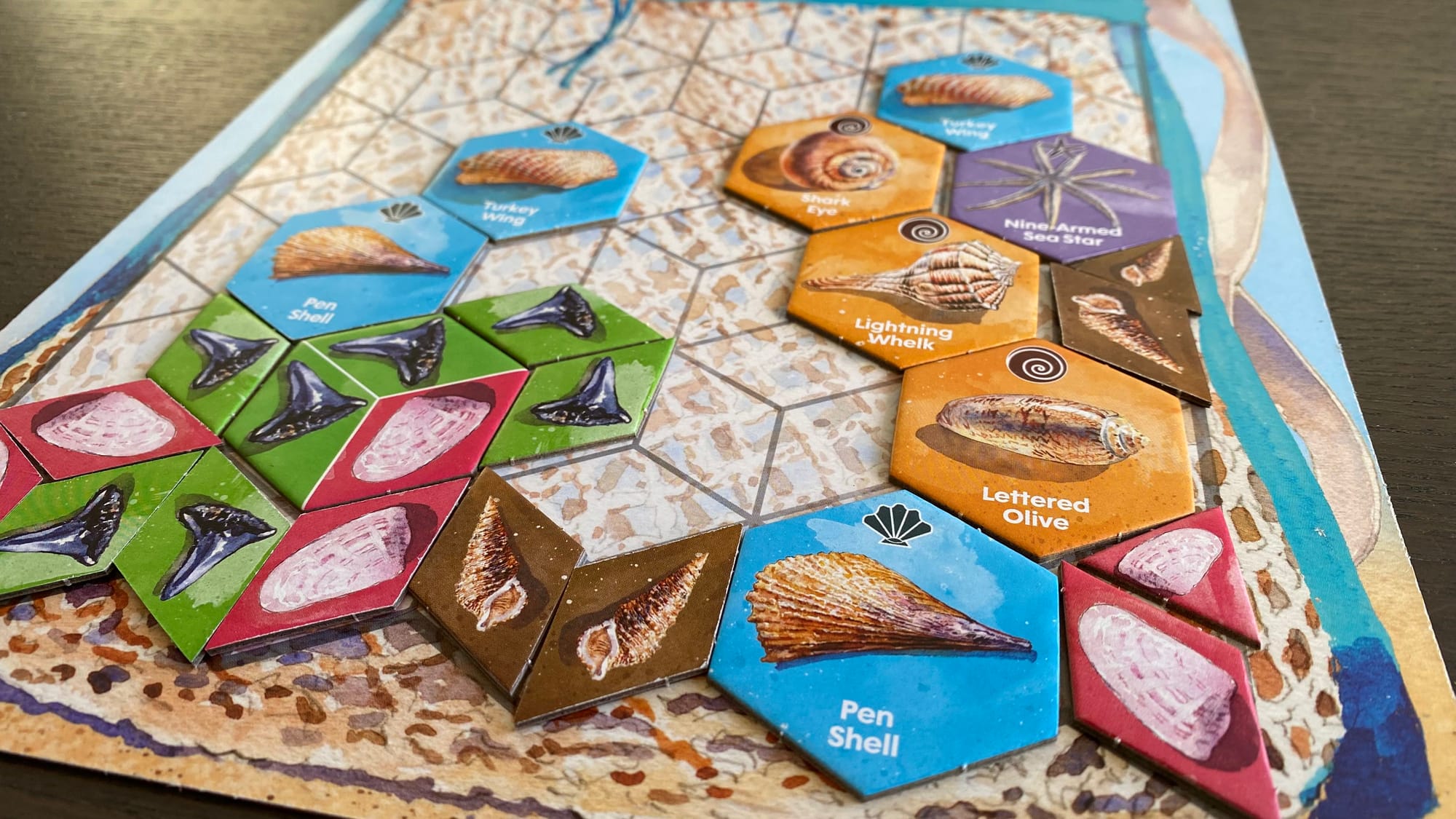
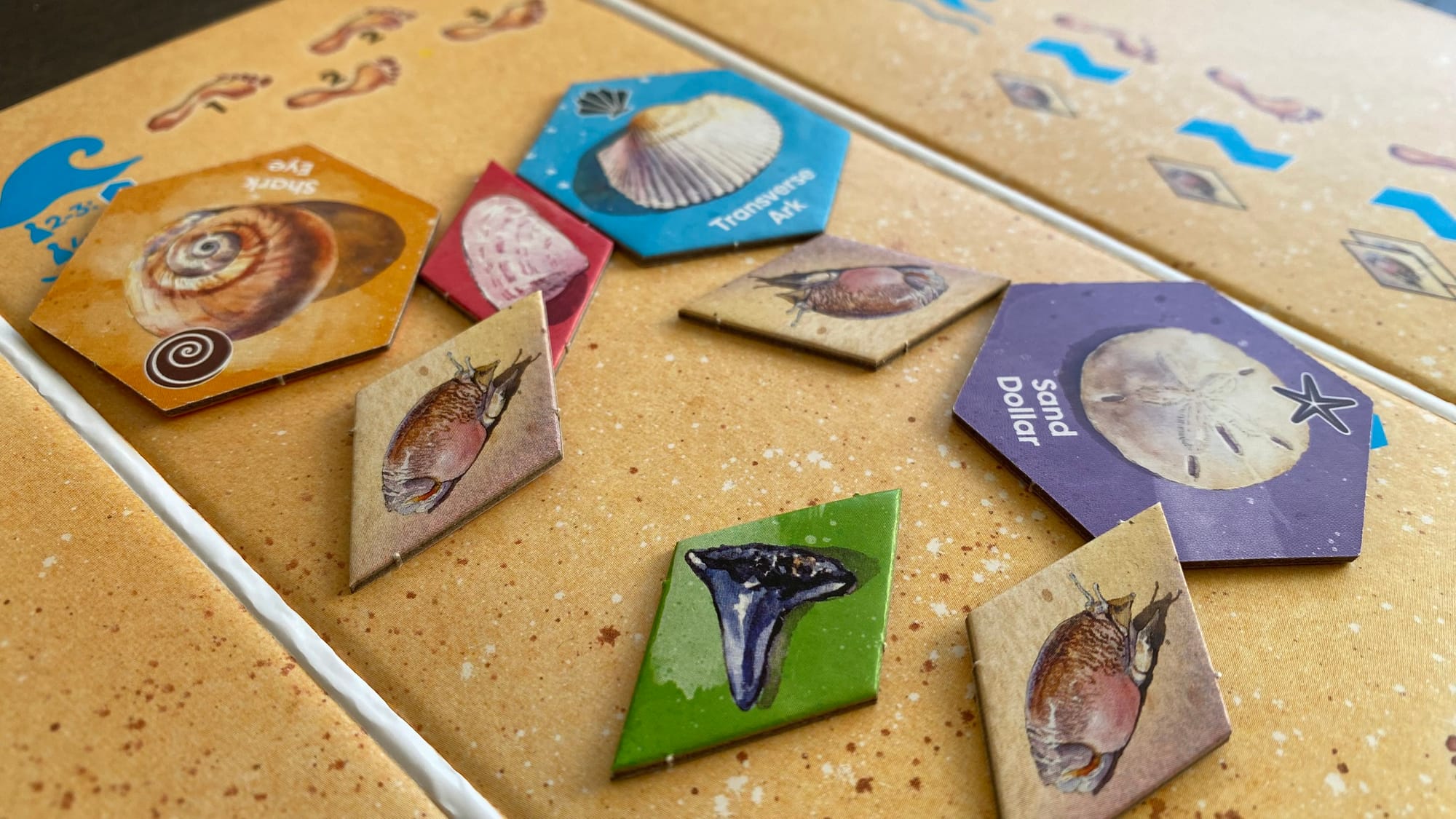
Sanibel is a very casual game. On your turn, simply move your pawn to any open footprint past your section and grab the indicated number of tiles of your choice from your new section. Because the turn order is based on whoever's farthest back (think Tokaido), earlier spaces will grab fewer tiles, but let you get first pick of the next section (unless someone just skips over your section, which is pretty rare). There are six scoring tile types (plus sand crabs, which just let you grab a tile from another section) in two sizes: hexagons and diamonds. The three hexagon types are all worth 1 point, provided you can meet their different scoring conditions. The three diamonds each work differently, but generally give you increasing rewards the more of them you collect. Tiles placed on your bag board need to be supported by either the bag's bottom or another piece adjacent to it on the bottom. If an empty section becomes surrounded, it's no longer accessible. Along the sides of the bag are five triangle spaces that, when supported underneath, allow the players to immediately and freely place a triangle tile (they’re the same types as the diamonds) in that space.
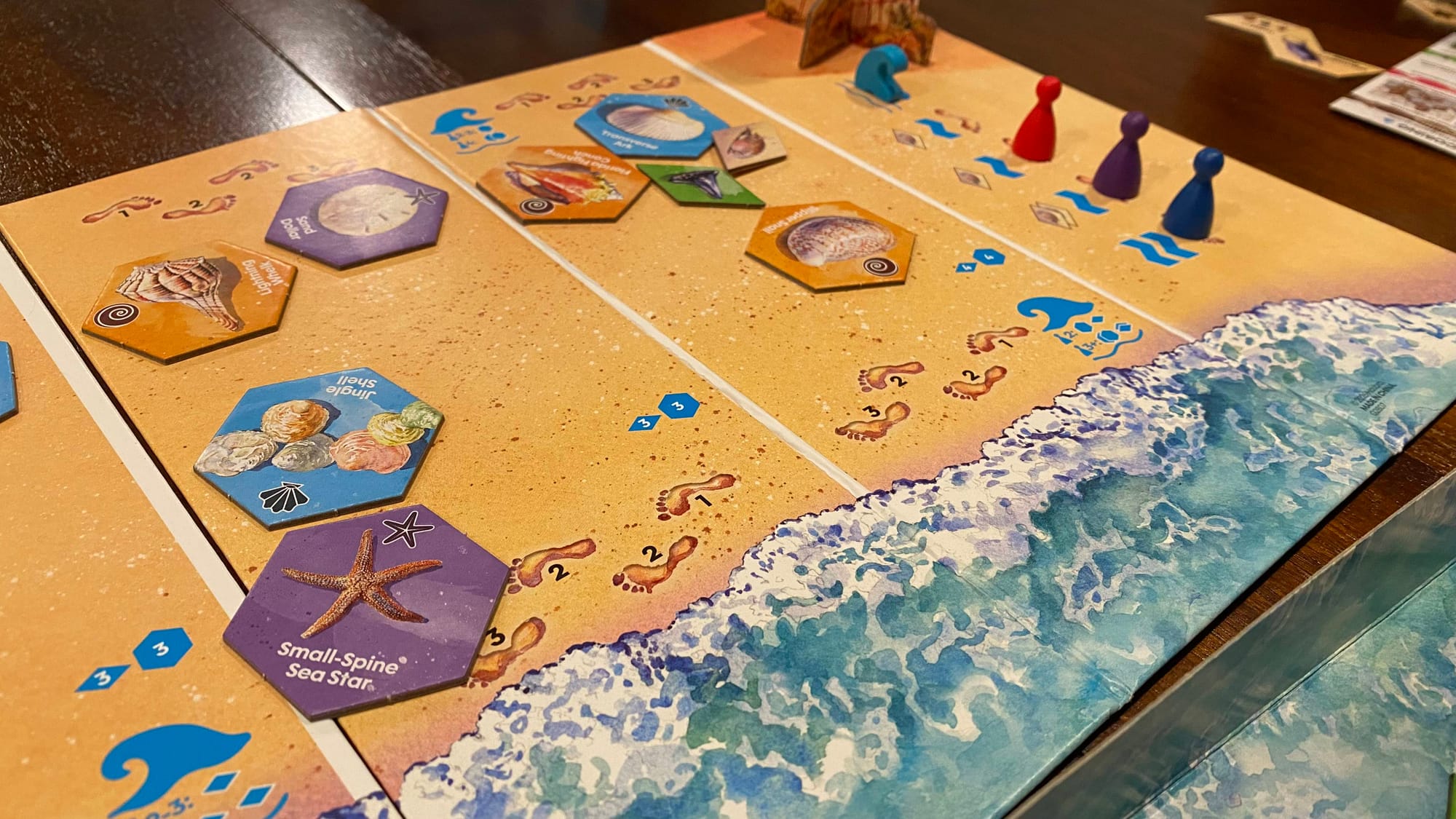
While there are some optimization decisions to be made, most of the time players will simply decide between a couple of equivalent tiles. A unique Echinoderm scores 1 point just like a unique Snail, so long as I place them apart or connected to the others on my board, respectively. The smaller diamond pieces tend to be what players fight over, especially the few hex tiles which contain three diamonds (but only count as one tile when taking from the beach), with the hexes more or less taking up space while still scoring. This leads me to my only real complaint about the gameplay: that a lot of your options end up feeling the same, and your choices don't feel very impactful. Because this is a short, light, and very casual game, I don't mind it so much, and the Lighthouse tiles do help alleviate that by giving you something to build towards/around.
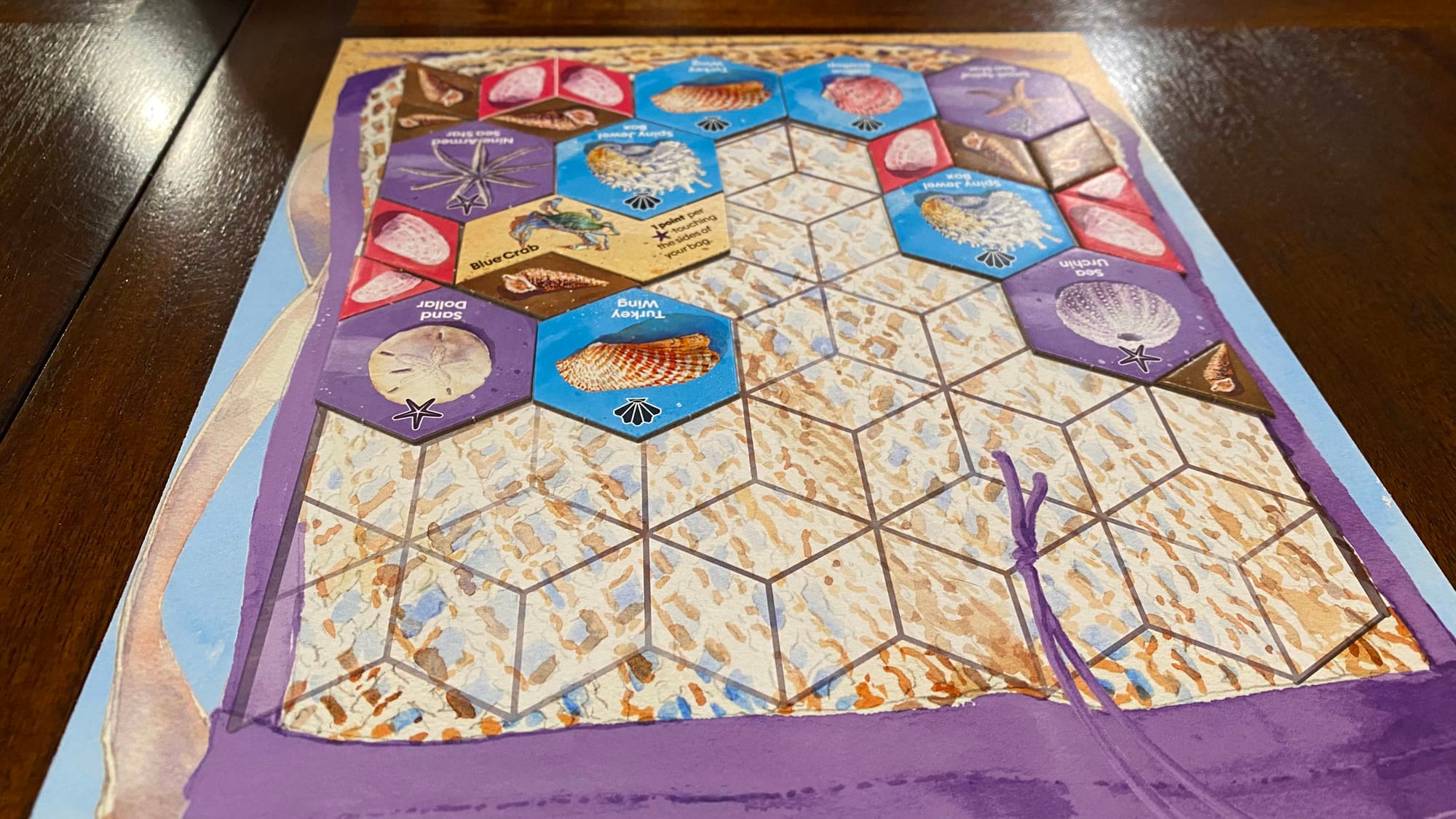
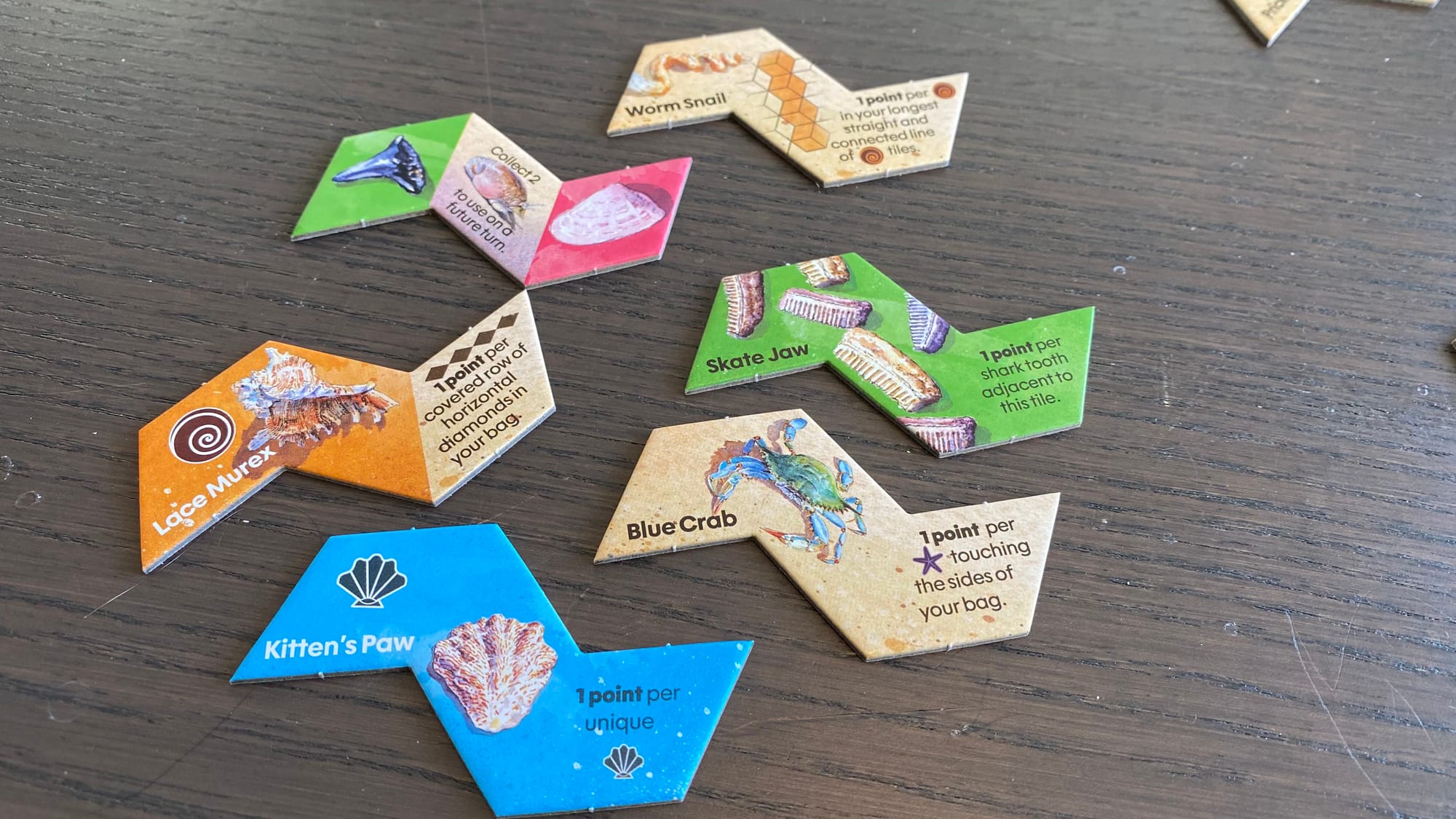
At the start of the game, each player receives two squiggly Lighthouse tiles that will sit off to the side of their board. Halfway through the game, players will stop at the Lighthouse, then double back across the board and place one of their special tiles (unless they take the single space that allows them to place both). These tiles all have unique scoring conditions, from awarding bonuses for surrounding them with a particular type of tile to scoring if the player can make a pinwheel of Cerith tiles (as the rulebook notes, no extra points are awarded for multiple pinwheels, but they look pretty). I appreciate that you get to see your options for these at the start of the game, but don't have to make any real commitments until the halfway point. If one requires you to go all-in on Shark Teeth, but other players are snatching them up, you can just pivot to your other Lighthouse tile.
One thing I don't appreciate is the Skate Jaw tile. Every other tile with a colored background does so because it counts as the tile of its color (e.g., the Murex has an orange portion that counts as a unique Snail). The Skate Jaw has a green background like Shark Teeth, not the neutral sandy beach background, and scores based on surrounding Shark Teeth, but it does not count as a Shark Tooth. Which sucks when Shark Teeth need to be connected to score properly. The rules do clarify that the Skate Jaw doesn't count as a Shark Tooth, but then why give it a colored background like all the other Lighthouse tiles pulling double-duty as a standard tile? It's surprisingly unintuitive in a game with otherwise solid visual design.
As players make their walk across the beach, occasionally the Wave token will be next up in player order, triggering the Wave's Turn. The Wave refreshes the board, adding either diamond or hex tiles to each section of the beach. It really captures the feeling of a wave crashing against the shore, depositing more goodies for everyone to collect. Even as players make their walk back, the Wave continues to add tiles to sections that players will never return to, adding an enduring, cyclical sensation to the game.
Thanks to the calm vibe, simple gameplay, and pleasant aesthetics, Sanibel is a great game to play while having a conversation with friends and not taking the game itself too seriously. I generally prefer deeper, more intricate experiences to spend my game time on, but that doesn't mean there can't exist a space for lighter fare. Which is to say that, for what it is, Sanibel is a very pleasant game, and you shouldn't use its numerical rating to compare it to other highly rated games like Dune: Imperium or Ark Nova.
Sanibel
Great
Sanibel is one of the most relaxing games I’ve ever played. It features both set collection and tile placement that don’t heavily punish players for misplays. Winning scores are built on a multitude of tiny decisions, which can make the individual decisions feel less meaningful to some. While the Lighthouse tiles give some variety, there isn’t anything else that really changes. Nonetheless, its pleasant artwork and calm atmosphere make it perfect for playing with new or more casual gamers, or as a light filler.
Pros
- Very easy to teach and play
- Simple, casual gameplay
- Beautiful watercolor artwork
Cons
- Some decisions don't feel consequential
- Skate Jaw tile has unintuitive visual design
- Low variety between plays
- Components themselves could have been nicer
This review is based on a retail copy provided by the publisher.