The brambles are thick, choking out the life of what was once verdant farmland. The brambles didn’t come first, oh no. First was the drought, then the blight. Then came the dragon, and with it, the thorns. The land was ailing, sure, but it could recover. But not with that thing still there. Drake looked at his party, his huge hands clasped around the massive axe, Heelcutter, taken from an ancient tomb, its previous wielders not needing it for centuries.With his party at his side, he knew they could do this.
It didn't start with the brambles, oh no. First was the drought, then the blight. Then came the dragon, and with it, the thorns. The land was ailing, sure, but it could recover. But not with that thing still there. Drake looked at his party, his huge hands clasped around the massive axe, Heelcutter, taken from an ancient tomb, its previous wielders not needing it for centuries.With his party at his side, he knew they could do this.
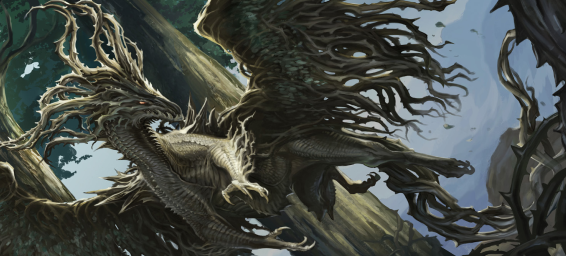
The thorn dragon was ready for them, waiting in a clearing in the bramble thicket it had turned into its nest. Virusilax looked appalled that such tiny beings would dare challenge it, roared, then charged Drake’s team. The ground shaking under its scaled claws, it opened with a volley of pale green breath, dousing the party in the same poison that seeped from the scales of the dragon. Drake broke from his party, ignoring the poison with a shout at the top of his lungs and slammed the mighty axe into its hide. He’d dealt damage, but not as much as he’d like. Worse, getting so close left Drake vulnerable to the spines on the beast's body, driving them into his skin with the mere act of pushing back against his strike. With a malevolent glare, the dragon’s claw glowed with virulent energy and it slammed the claw into the ground. Like sprouts seeking sunlight, sharp brambles burst from the earth, grasping each of his party members, their blood feeding the parched ground. This wasn’t going to be easy…
Scenes such as these can be found all throughout MCDM’s Draw Steel: Monsters. The above exchange isn’t even 3 full turns into a combat with one of the beasties in Draw Steel’s bestiary. The thorn dragon, in this case, which has at least 5 more interesting things it could do with its turns, without mentioning its other passives and smaller abilities. And this, this is a mere 3rd level monster.
For those not in the know, Draw Steel is MCDM’s newly released table top role playing game, released as two books: Heroes and Monsters. MCDM’s founder and head of writing and design, Matt Colville, unveiled Draw Steel on Kickstarter 2 years ago. The promise was a game designed around 4 keywords: tactical, heroic, cinematic, and fantasy. They had big ideas, such as removing missing from combat, movement and interaction happening constantly, and heroes that feel like heroes, even at first level. Did they succeed? Why yes, I think they did.
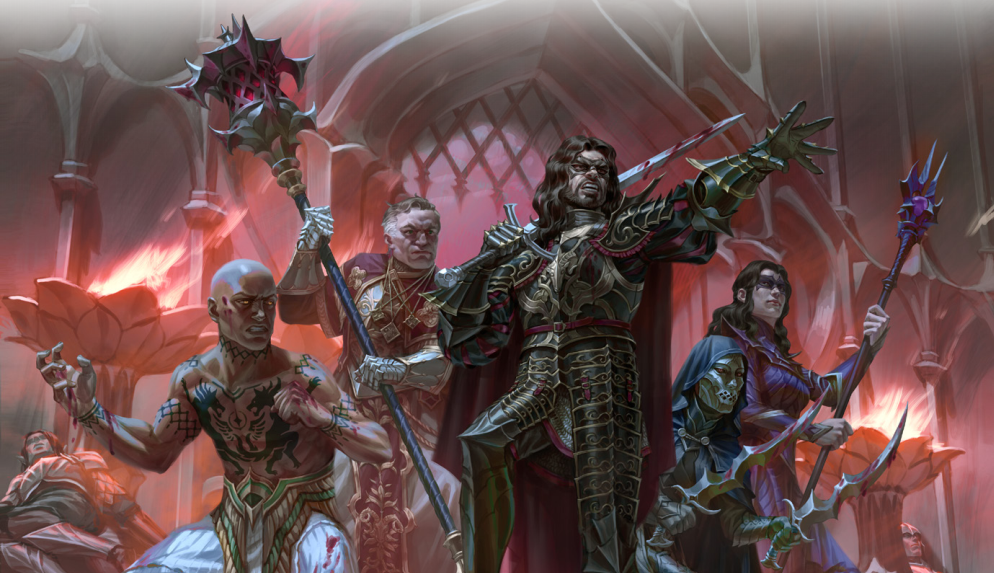
If you have not seen our review of Draw Steel: Heroes, allow me to go over the basic tenants of the system before diving deep into Draw Steel: Monsters.
Those keywords I mentioned before are the lifeblood of Draw Steel. The game is designed to be tactical, meaning each action in combat (and outside of combat) has meaningful choices. Heroic, meaning the players play heroes, and the director puts them up against foes fit for heroes. Cinematic, meaning you can imagine things happening like a big old action movie. And fantasy, meaning elves, magic, and yes, dark dungeons and evil dragons.
To hold up these keywords, there are some unique design decisions that make Draw Steel stand out. First, there are no missed turns, just less effective ones. You still roll dice, but you never miss an attack in Draw Steel. Instead, every action in combat has 3 possible tiers of success. The higher the tier of success, the more damage you deal, or the higher impact you have on the enemy. This applies to the monsters the players face as well, so every turn, combat moves forward.
Finally, the second core mechanic of Draw Steel’s design is resource management. Heroes get heroic resources, such as a Tactician’s Focus or the Elementalist’s Essence. These are spent on their big ticket powers, the more points spent, the larger the impact. They get these resources every turn, as well as when certain things in combat occur, like Troubadours getting a point of Drama when critical hits happen. Directors, the game masters of Draw Steel, get Malice. Malice represents the opposition’s own pool of resources, and how they spend it is the director’s prerogative, but Malice is always bad news for the heroes.
The last important design decision is the idea of Victories. Heroes gain victories for every major obstacle overcome. Bypass a trap filled corridor? That’s a victory. Defeat a group of goblins? Victory. Convince a dragon to stay out of an upcoming battle? Victory. Maybe 2! Each victory gives heroes a heroic resource at the start of a combat, but each point of damage, which as noted above is almost unavoidable, brings those heroes closer to their demise. Heroes can only get stamina (read: Hitpoints) back as long as they have recoveries, and recoveries don’t come back until the heroes rest. And if they rest? Those victories become experience, bringing them closer to their next level up, but bringing their building momentum back to zero.
This means that pushing forward makes the players feel more powerful with each victory, like a snowball starting an avalanche. They can start a battle dropping massive, tide-turning abilities, but they ride a fine line between power and death, as when the heroes run out of stamina, they die. There’s a metagame going on here where players choose whether to push their luck or choose to take time to recover. Pushing forward means heroes risk their lives, but also might have that much more of an edge in the next combat.
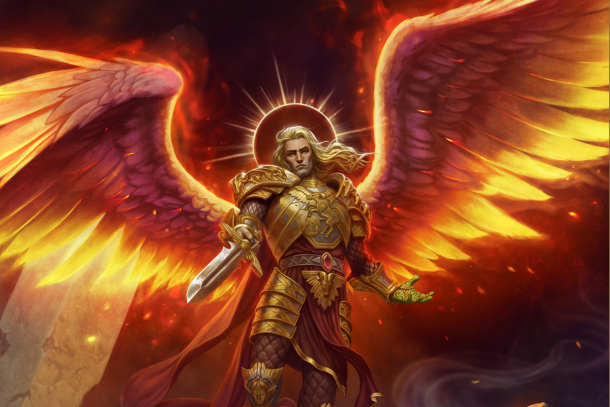
So with that brief overview of Draw Steel’s core mechanics, we can dive into Monsters. Monsters is exactly what it says on the tin. Roughly 300 pages of beasts, villains and undead, starting with Ajax the Invincible, the ultimate boss of MCDM’s default world, and ending with Xorannox the Tyrant, a beholder like overmind conniving to control the underworld, and filled in between with everything from goblin hordes to griffons to dragons. But before those monsters comes advice on how to use them.
The first 30 pages of Monsters are devoted to rules on how to use the rest of the book. It starts with what a monster is, including a brief blurb about how some of the monsters in this book are sentient creatures that happen to oppose the heroes, like the orcs, dwarves, humans, goblins and other peoples represented in the book, and how some of the monsters are just that, monsters, like zombies and arryx (gigantic mantis bugs).
It then breaks down how monsters work in Draw Steel. MCDM has a history with monsters, in fact. Before Draw Steel, MCDM published content for Dungeons and Dragons. One of those books was Flee Mortals. Flee Mortals was a monster supplement designed to make DnD monsters more interesting using a philosophy Matt Colville called action oriented design. Each monster gets a bunch of unique abilities that make each of them flavorful in their own right. For example, an ogre doesn’t just hit you, it grabs you and throws you like a bowling ball at your party. These actions are split up amongst several monster types in groups, so instead of a bunch of goblins, you get front line tanky goblin fighters, long range but squishy goblin snipers, sneaky goblin assassins and glass cannon, suicidal spine cleavers. Each will have a different impact, so heroes have the opportunity to take out threats based on their impact instead of just cutting down the closest goblin.
This mentality is carried forward into Draw Steel: Monsters, though of course each monster from Flee Mortals is converted into the proper rules for Draw Steel. The monsters you fight are more defined by what they do than what they are.
In order to provide the fantasy of mowing down dozens of monsters, Draw Steel provides minions. Minions are groups of creatures with a shared health pool. When enough damage is dealt, the attacked one goes down. If an attack deals enough damage to take out another, then a second or third might go down in a single hit. They all move at once, and roll only once, and so their turns are lightning fast. However, despite their frailty, they can deal a lot of damage if they gang up on one hero, and can jam up the battlefield if not dealt with quickly.
Other monsters are organized into different groups and different roles. These are shorthand for how a monster is supposed to behave. A hexer stays at the back and debuffs the opponent, while a brute gets in the heroes’ faces and pushes them around. Platoons are organized and try to stick together for some strategic benefit, while hordes break ranks and swarm their foes. These keywords are useful, if somewhat redundant to the actual rules of the monsters. I’ve found that if you try to maximize what a monster is good at, it will typically fall into those roles naturally, a testament to the design of Monsters. Even better, as you use these abilities, mixing things up from turn to turn, you feel like a genuine threat to the enem- I mean players while only following the script laid out for you.
That feeling is best exemplified in the solo creatures available in the book. Each solo monster gets 2 turns a round, instead of the standard 1, and also has access to Villainous Actions. I treat these as mini-turns, though a villainous action could also occur just before the monster’s turn as well. Each villainous action alters the battlefield in some way, causing real problems the heroes must overcome. The first solo I ran was the Arryx, the previously mentioned giant mantis monster. The Arryx is a burrowing, acid spewing insect the size of an elephant. My heroes had just braved its maze-like nest, finding it in the depths of the earth. The walls were covered in sharp bones from its previous meals, so getting knocked into them could deal real damage. However, the real traps were below the heroes’ feet, as hidden sinkholes dotted the battlefield.
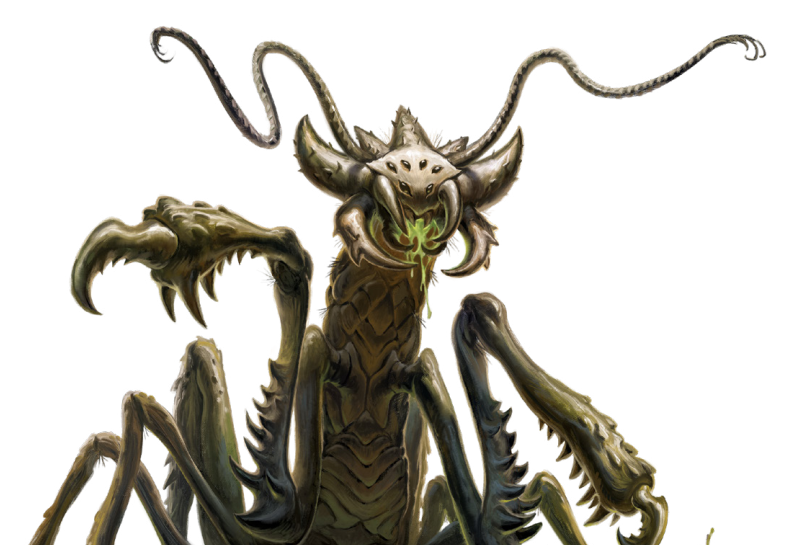
My arryx wasted no time in causing problems, dividing the arena with its first Villainous action, causing a bunch of damage with a line of acid it spewed forth. That line remained for the rest of the fight, effectively causing the heroes to split up between each side, lest they take damage from standing in the acid. The arryx then proceeded to use the sinkholes to its advantage, picking up heroes and dropping them into the deep holes, dealing more damage and further separating them. My players were on the edge of their seats trying to put the bug down, and I was having the time of my life, cackling madly with each hero I chucked into a hole. I didn’t go into the session with this as a plan, it just felt like the best thing to do at the time, and it turned into a massive success.
The second half of your combat toolkit is Malice. Malice is the director’s resource, a dark mirror to heroic resources, and it has an interesting impact. Each category of monster has thematic actions related to the category of monster, as well as many monsters having specific malice actions that are typically cheaper than the big ticket theme items. The above mentioned ogre using a person as a bowling ball is an example of a specific malice action, while the arryx fight had geysers burst out of the ground as a thematic arryx malice action, representing the instability of the battlefield caused by the arryx' digging. The director can only spend malice on those big ticket actions once per turn, but the specific malice actions can be used over and over if you have the resources for it. Directors get a lot of malice, too. They get one malice per hero at the start of each round, as well as an additional malice for each round that the combat has gone on, and get a bonus infusion at the start of combat for each victory the heroes have, just like the heroes do. They can also use malice as a punishment for failure, giving the next enemy the party faces a small bonus for failing a skill test. This means that you can start a combat with upwards of 7-10 malice, and you get more each round. However, some malice actions are quite expensive, like the goblin swamp-bombs that make all the heroes sick and cover the entire battlefield. If you spend your entire pool on that, you can’t make those same goblins swarm their foes and stab them in the shins.
After going over all of that, Monsters goes over how to use all these pieces together to build an encounter. Start with a theme, and then figure out how many encounter points you get to spend. You get points based on the player level and number of players, and then you’re ready to spend your encounter points on monsters and hazards. Put your purchased monsters into initiative groups, and you’re almost done already. All the monsters in a group take their turns at the same time. This means you make a bunch of monsters go at once, usually all of the same type, allowing you to make use of strategy and speeding up gameplay, as well as preventing heroes watching the director play solitaire with his monsters at the end of each round. I use standees (the ones Paizo used to put out) with colored bases to denote all my creatures. Each color represents a different initiative group, with black bases and unique standees representing the heavy hitters in an encounter. I've never had any issue tracking combats with even twenty or more monsters running around with this, so I recommend something similar.
Once you have your monsters, you put in hazards and interesting terrain features. High terrain, boxes, pillars, trees, pools or traps. These things aren’t just set dressing. Because combat in Draw Steel allows for a lot of dynamic movement, especially forced movement, it’s almost a done deal that things (like goblins) will get shoved into other things (like spikes), or off things (like cliffs), or through things (like windows, or walls, or trees, or other goblins!).
Perhaps the best piece of advice in the book is to create an objective for a fight. Instead of simply killing all the monsters, which is still a valid objective, the game suggests escape, saving villagers, driving back the main villain, grabbing the McGuffin, etc. The idea is to have something other than elimination in mind, so combat doesn’t become a slog. In fact, it suggests that most fights should end once the biggest threat is done. Each different objective listed also has a few paragraphs to give suggestions over what kind of maps, monsters and hazards to use for each, all great advice.
This section on director advice ends with some general tips about changing monsters around, using reinforcements to keep combats feeling fresh without bogging things down with long monster turns, and some very basic guidelines on buffing monsters for higher levels. This last is something I wish they had a more robust system for, but before we make judgments on its usefulness, let’s take a look at the meat of the book: the monsters.
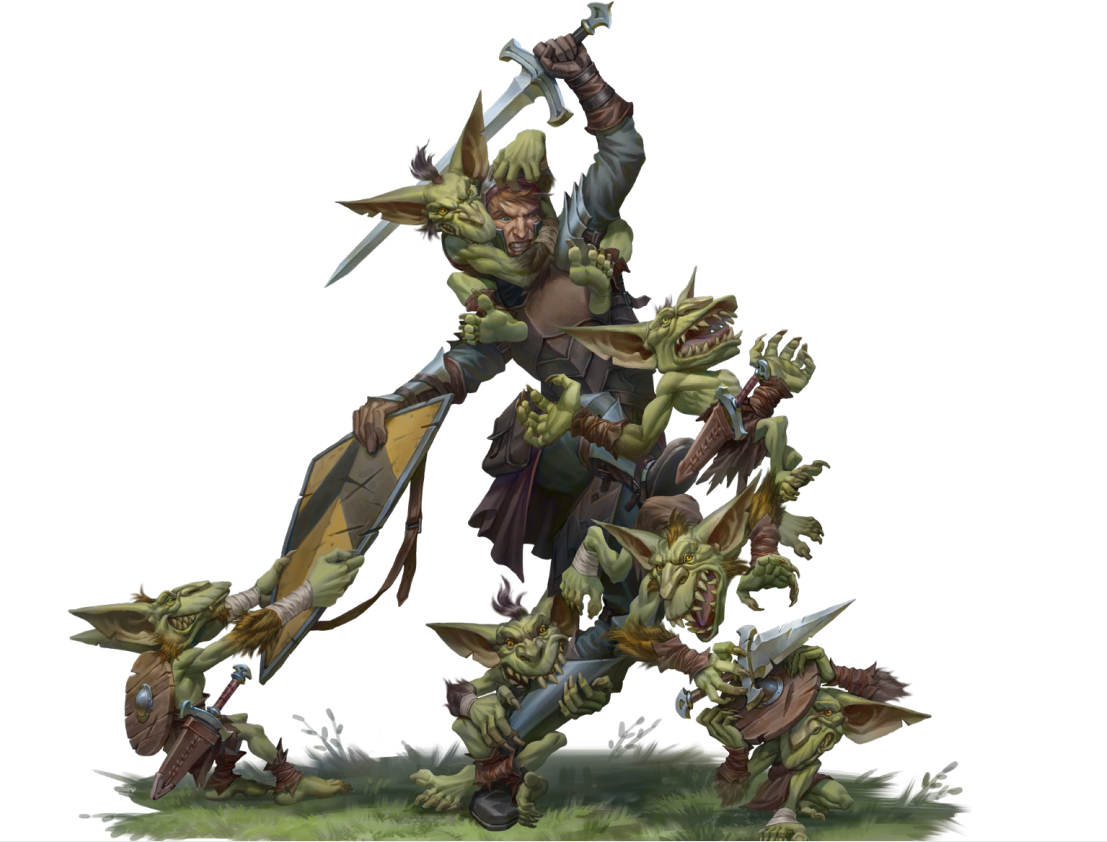
The next 300 pages of monsters is exactly what a new RPG needs. Every single monster sounds rad as heck to fight. Each monster is organized into bands, which represent a potential army of monsters. Goblins aren’t a single stat block, instead there are 9 types of goblins, ranging from snipers to assassins to curse spitters. Goblins also come with War Spiders, Wargs, and Skitterlings, their barely domesticated beasts of war.
Each monster band feels unique. While Goblins are weak, but have a lot of powerful swarm tactics, Kobolds bring shields and every shield they wield can be formed into a shield wall, making them tougher to kill as long as they’re together. Gnolls are brutish, and each one that falls spurs their allies onward into a bloody frenzy.
Nothing feels more unique than the solo monsters. Bredbettles are giants who lost their heads, and want yours. They introduce a kind of minigame where they can remove the heroes’ heads (non-lethally) and use them to empower themselves. Losing your head is a bad time, so getting it back becomes an interesting side objective, and in the worst case, can become a long running chase to get a party member’s lost head back!
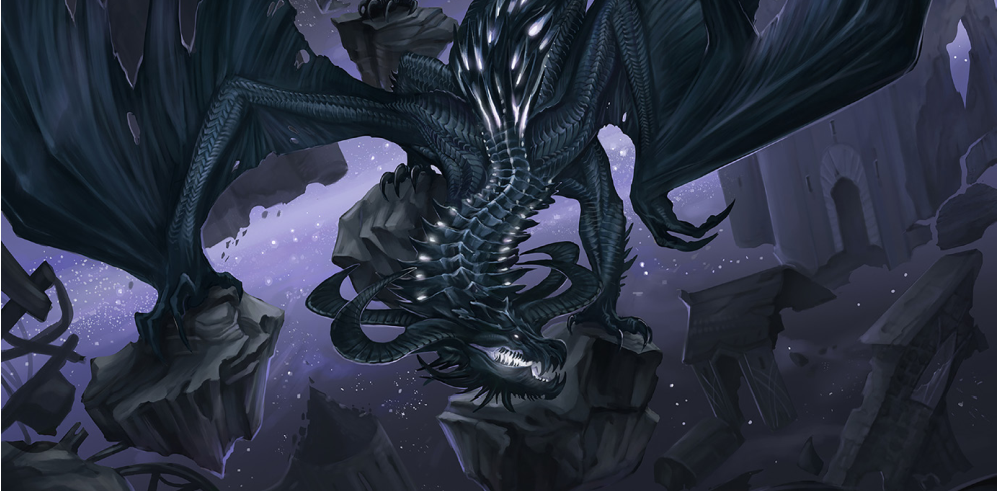
Dragons represent a conceptual form of grief and pain, from the above mentioned Thorn Dragon, representing drought, famine and blight, to the steel-shod Crucible Dragons which is born from abandoned projects and shattered ambition. The largest, meanest dragon in the book is the Meteor Dragon, a creature that abducts entire cities for their hoard deep in the middle of space, and represents civilizational downfall.
Obviously, I’m not going to gush about every single monster in the book, but the fact that I’m having to choose my favorites should tell you about the quality of what’s in here. Draw Steel: Monsters has so much stuff, so many monsters… Yet strangely, I feel like there’s not enough.
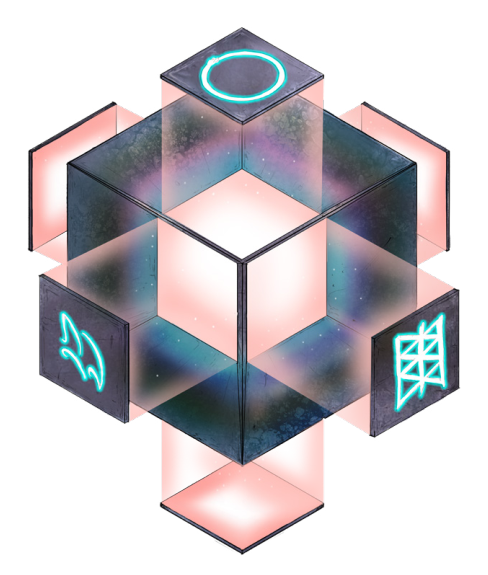
There’s a few classic monsters missing from the book, like slimes or drakes, the equivalent of a bullette, and a few others. Maybe this is because they expanded the existing monsters as much as they have. I hope to see more interesting baddies in the future, but I also understand that many of the missing baddies are dungeon weirdos, like the gelatinous cube, hook horror, and such. Those might be missing because dungeons aren’t really a focus of Draw Steel.
My biggest complaint is the less than stellar customization options. The best way to make your own critters are the animal templates, but scaling those into later levels is not really supported. The scaling options in general are not great, outside juicing a monster with more health or increasing damage here or there. This isn’t to say these aren’t options at all, but unlike its contemporaries, Draw Steel’s critters are much more complex. Even a basic goblin does more than just deal damage. That’s not to say you can’t make your own, but it does mean a kit-bashed monster probably won’t hold up to the examples in the book. The book suggests simply reskinning a monster that does what you want it to do with a different visual. With that in mind, you can probably justify almost any missing creature, even mixing and matching critters from different factions into a new faction, but I’m still interested in what other beasts MCDM has cooking.
The book continues into hazards. Hazards have an encounter value, just like monsters, because they complicate the battlefield. There is a wide array of toys for directors to play with, from bee hives to bramble patches, frozen ponds to explosive traps and flame-throwers to mystic crystals. None of the hazards actually scale to later levels, but even a level 1 hazard could trip up a higher level party, though I imagine things like flight and teleportation might obviate many of these hazards.
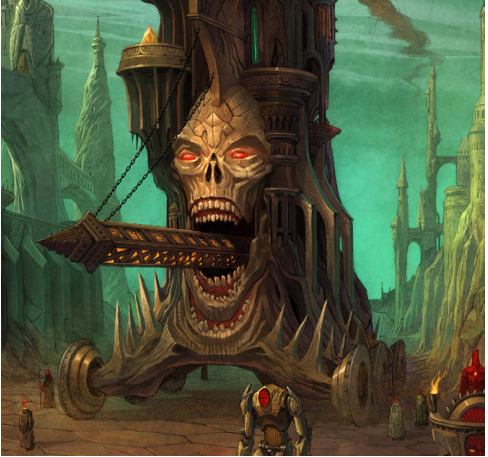
Next, the book goes into retainers. Retainers are followers that will actually follow your heroes into the fray. Simply replace some bits and bobs of a normal enemy’s kit, and you get a retainer. It’s a simple process, and heroes wind up with a powerful ally that is relatively simple to run for the player in charge of them. I went through the process with an ogre, and the result is essentially a tactical bulldozer in the party’s hands. Monsters has a bunch of examples of retainers like minotaur enforcers, dwarven mortar teams, and wode elf snipers.
The final pages of Draw Steel shows MCDM’s long view on its flagship product. The Draw Steel Creator License might sound boring, but anyone that was paying close attention to Dungeons and Dragons over the last 2 years knows that licenses are critical to the wider ecosystem of a game system. Tabletop RPGs live and die with their wider community. Thus, it’s great to see Draw Steel’s license take that into account. To sum up, it says “Feel free to make stuff for our game, make money doing it, and freely use our rules and text. Our art is ours, but the visual stylings can be used as inspiration for your own works. Include a few things saying that this is Draw Steel. Don’t do anything that could get either of us in trouble, and don’t tell anyone that you are us.” The text is very permissive. It means that many of my gripes with customizability will likely have a crowd sourced solution in short order.
Though another of my gripes is with some of the organization of the two books. For some reason, the director’s section is in the Heroes book. The director section of Heroes is awesome, for the record, filled with advice on how to build a campaign, build scenes, and how to run the other cool core systems that aren’t combat, such as negotiation and montages, as well as how to build convincing villains, world building, and other important parts of directing a game. My gripe is that all this director-facing info is in Heroes, and not Monsters. Monsters could have been the big director book, while heroes was the player book. On game night, you only need one copy of Monsters, while you might need multiple copies of Heroes running around. If the director needs to take a gander at the sample negotiations or other info in this section, that’s one less book for the players to peruse.
However, it’s still pretty minor. My guess is that the director bits were separated this way to give players a small taste of what the director sees. See how the sausage is made, and maybe some of the players will choose to become butchers, so to speak. It means that players can answer their own questions related to starting their own campaign. MCDM is pretty keen to get people into directing instead of just playing, so perhaps this is the reasoning behind this decision.
With that in mind, I can’t exactly recommend Draw Steel: Monsters to every tabletop player. The obvious start is Heroes instead, or even the Delian Tomb adventure. However, Monsters is a necessary book if you want to direct the game. It’s too important a resource to go without. The entire way the game works relies on having interesting foes for heroes to fight, and that is not something that is easy to come up with on your own. And if you’re interested in RPGs, you should be interested in Draw Steel. Even if you never get to play it yourself, there are a number of things you can pull from the system for yourself, from negotiations, to montages, to the way it suggests organizing combat. Of course, I would be remiss if I didn’t mention that many of the rules and information are available online. I am still a book-in-hand kind of guy, but if you can’t afford the book, the text is legally available in places like steelcompendium.io. I don’t think Draw Steel: Monsters is for everyone, but I do think that for those it is for, it’s one of the most important RPG products in the last decade.
Draw Steel: Monsters
Excellent
Draw Steel: Monsters is full of monsters, unsurprisingly, but also full of other advice and ideas. More importantly, its monsters are designed to act interestingly, not just look interesting. If you want to direct Draw Steel, you gotta have this book.
Pros
- Lots of monsters with tons of variants that work together.
- Action-oriented design, so monsters are defined by what they do, not how they look
- Hazards, retainers, and advice on how to set up combat
Cons
- Lack of monster customization with the existing monsters.
- Weird that there’s a big chunk of director advice in the other book.
- Despite its great monster selection, still feels like some stuff is missing.
This review is based on a copy provided by GamingTrend.
Be sure to check out our review of the other Draw Steel core book:
 Chas Turner