In a world covered in endless water, there exists one sole bastion from the briny depths: the island of Estard. The islanders live in peace, there are no monsters, no wars, no conflicts outside of childhood's rebellions. But... this can't be all there is, can it? One lonely island, in the middle of a vast ocean? The mysterious shrine on the eastern side of the island says otherwise, as contained within are tablets that transport the viewer to another world, or perhaps simply the distant past, before these other islands were sealed away by darkness. Piece by piece, tablet by tablet, the world can be restored to its proper form, but what sinister force splintered the land in the first place?
Dragon Quest VII is my least favorite Dragon Quest. When I first played the 3DS remake back in 2016, I found it tedious, meandering, overly verbose even for a Dragon Quest game, and Kiefer (one third of your original party) was insufferable. When I unlocked the job system over a dozen hours in and realized I had to level every character back up anytime they changed jobs, I dropped it. And I say that as someone who usually enjoys grinding in RPGs. It was still a Dragon Quest game and, like Pokemon, there's a baseline level of quality that every mainline title at least meets, if not surpasses most of the time, but VII just really rubbed me the wrong way.
When Dragon Quest VII Reimagined was announced, I felt a few things: first, a bit of confusion as to why this DQ title in particular needed two fully 3D remakes; second, a fear that I still wouldn't enjoy the game a second time around; and third, excitement at giving the game a second chance. If you know me or have read any of my work here, you'll probably know I LOVE Draogn Quest. I might be more excited about the prospect of a new Final Fantasy or Xenoblade than a new Dragon Quest (especially since XII was announced going on 6 years ago now), but Dragon Quest is one of the most comforting series out there. Not many games can match its cozy, fairy tale, bedtime story vibe, with enormous levels of whimsy, and even if the heroes face tragedy you know they'll eventually come out on top, every time. Having now finished Dragon Quest VII Reimagined after about 50 hours, I understand that VII is trying to be the most like a bedtime story, somewhat improvised by a loving parent over the course of months or years, but that's also it's greatest downfall.
Reimagined is trying to be a sort of middle ground between the original PS1 game from 2000 and the 3DS remake. This is made evident in the game's infamous introduction, where the PS1 game took about 2 hours to reach the first combat encounter and the 3DS version cut that down by half an hour. Reimagined brings this back up to 2 hours to get to that fight, but now there's another battle added at the 1 hour mark. The overworld is also a lot smaller, so you're not spending as much time trekking back and forth between the Shrine of Mysteries, Pilchard Bay, and Estard Castle. I actually enjoyed the slow pace of this opening, especially its focus on puzzle solving and using various clues to find all the tablet pieces you need to unlock the first island. It makes the game feel like a proper adventure, rather than a series of combat encounters with a story attached. There's nothing wrong with the latter (it's actually what makes Final Fantasy XIII so good), but the former makes the game feel very unique in the series.
Unfortunately, that feeling basically disappears as soon as you leave Estard, with puzzles only returning two or three more times over the course of the game. Instead, for the next 48 hours, you'll fall into a very familiar pattern. Go to a new island in the past, figure out what their problem is, solve it by defeating a boss, head to that same island in the present to find new tablet pieces, repeat. This is essentially how every Dragon Quest is structured, with each town having their own story, but VII really fumbles this. I found it difficult to get invested in most of these storylines seeing as they all take place in the distant past, and any characters I might get attached to would be long dead when you return to the present, their names and impact usually completely forgotten. There's a few exceptions to this, but even then the plots were never that interesting. They're all just so similar, with a big monster causing problems that you need to take out to instantly solve all of those problems as you get to know maybe one or two characters.
It also doesn't help that VII is really lacking in the plot department. What's actually going on is slowly revealed over the course of the story, which would be really interesting if it wasn't the most bland, obvious answer imaginable. Most Dragon Quest games don't have much going on in the plot department though, and rely on their charming cast of main characters to keep you invested. While I love VII's cast (I even grew to tolerate Kiefer this time), they really don't get to do much, spending the majority of scenes just as silent as the protagonist. You get small sprinklings of their personalities through party chat, but that's still more of a reminder of where you need to go next rather than actual character development. From what you do get through, Maribel is far and away the best character, she's rude and snarky, but cares a lot more than she wants to let on. There's a great bit later on in the game that actually does focus on her, and it's easily the most engaging and memorable part of the story.
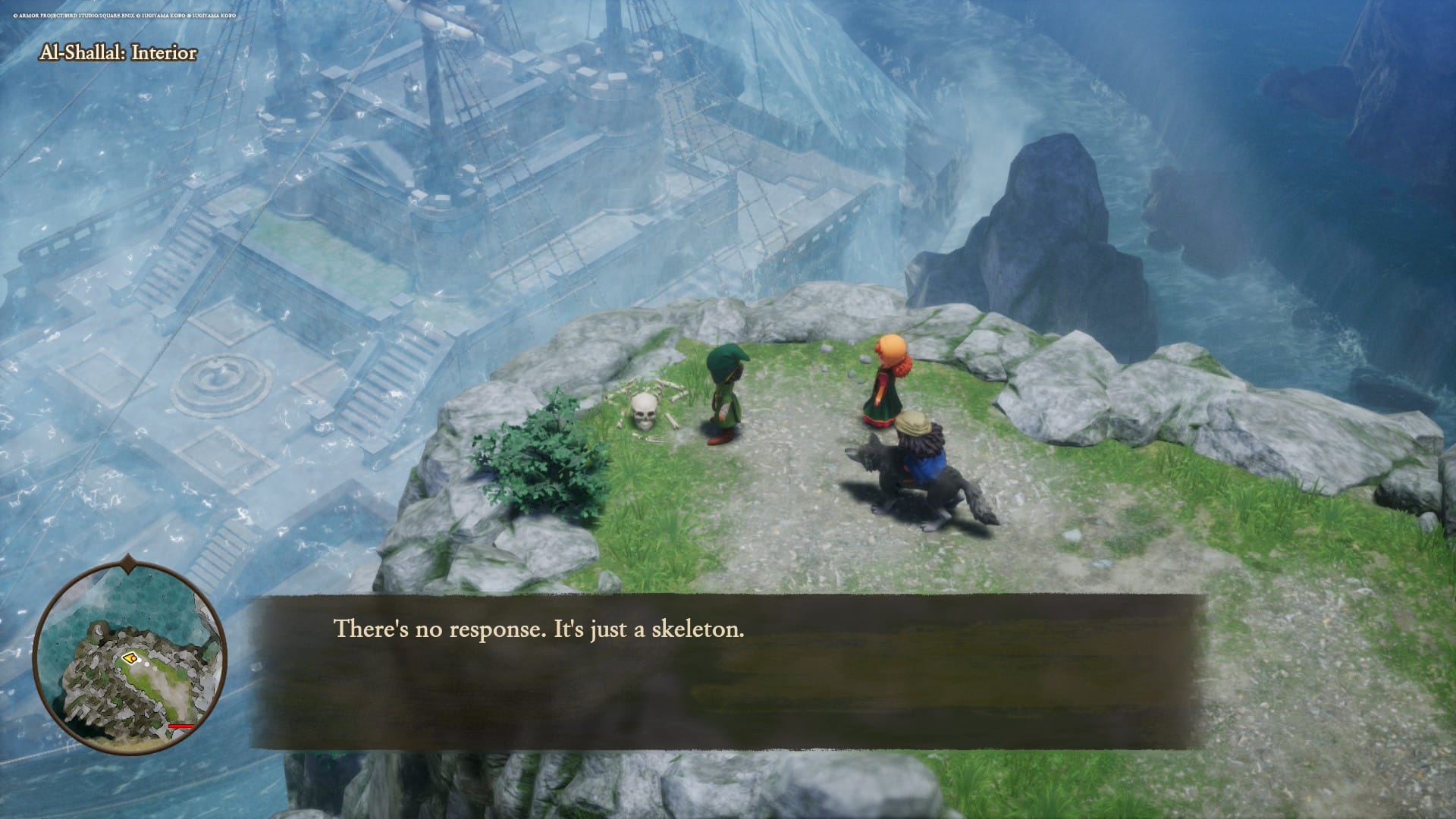
As for the rest of your party, talking about why I don't like Kiefer would be a spoiler, Sir Mervyn seems really cool but only gets to do things off-screen, Ruff is adorable and I would die for him, and Aishe has a great design but lacks personality outside of wanting to do her duty. The protagonist, whom I named Auster, is basically a blank slate for you to project on. There are a few seemingly important questions asked of him at certain points in the story which I thought would slightly alter the ending, but nope it's always exactly the same. Dragon Quest has a history of creating complex and interesting protagonists who don't have to say a single word for you to be invested in them, as seen in III, V, and XI most notably, but Auster is kinda just there for you to pilot around. He's kind, a bit scatterbrained and tends to get distracted, according to Maribel's party chatter, but that's about all I could glean from him.
Overall, the story and characters, much like Auster himself, feel scattered and unfocused. Like a dad telling their kid a story but forgetting to tie things together in any satisfying way. It's very much an "and then this happened" kind of story, which is exactly the opposite of what you want in any kind of plot. Don't get me wrong, I like the broad strokes, but it needed finer details to be interesting, like what the remake of Dragon Quest II added just a few months ago. It's disappointing to see, especially with the Reimagined moniker. Even the brand new bits of story feel like a footnote, with what I thought would be a big change given it's been a heavily advertised element amounting to maybe half an hour of new plot ending in an extremely limited, self contained way. It comes right before the end of the game too, so if you're hoping for any sort of change to the story, you're not gonna get it here.
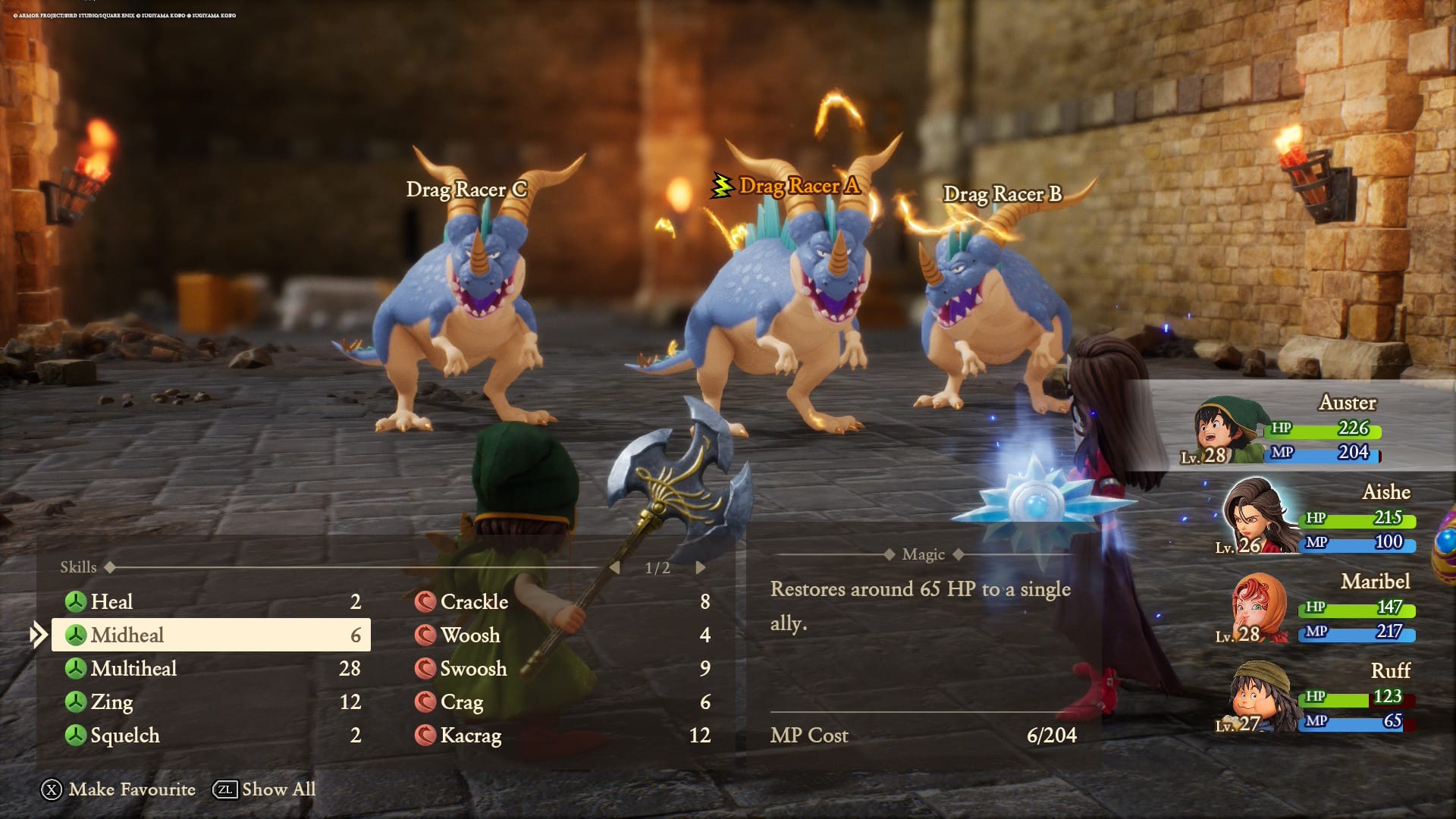
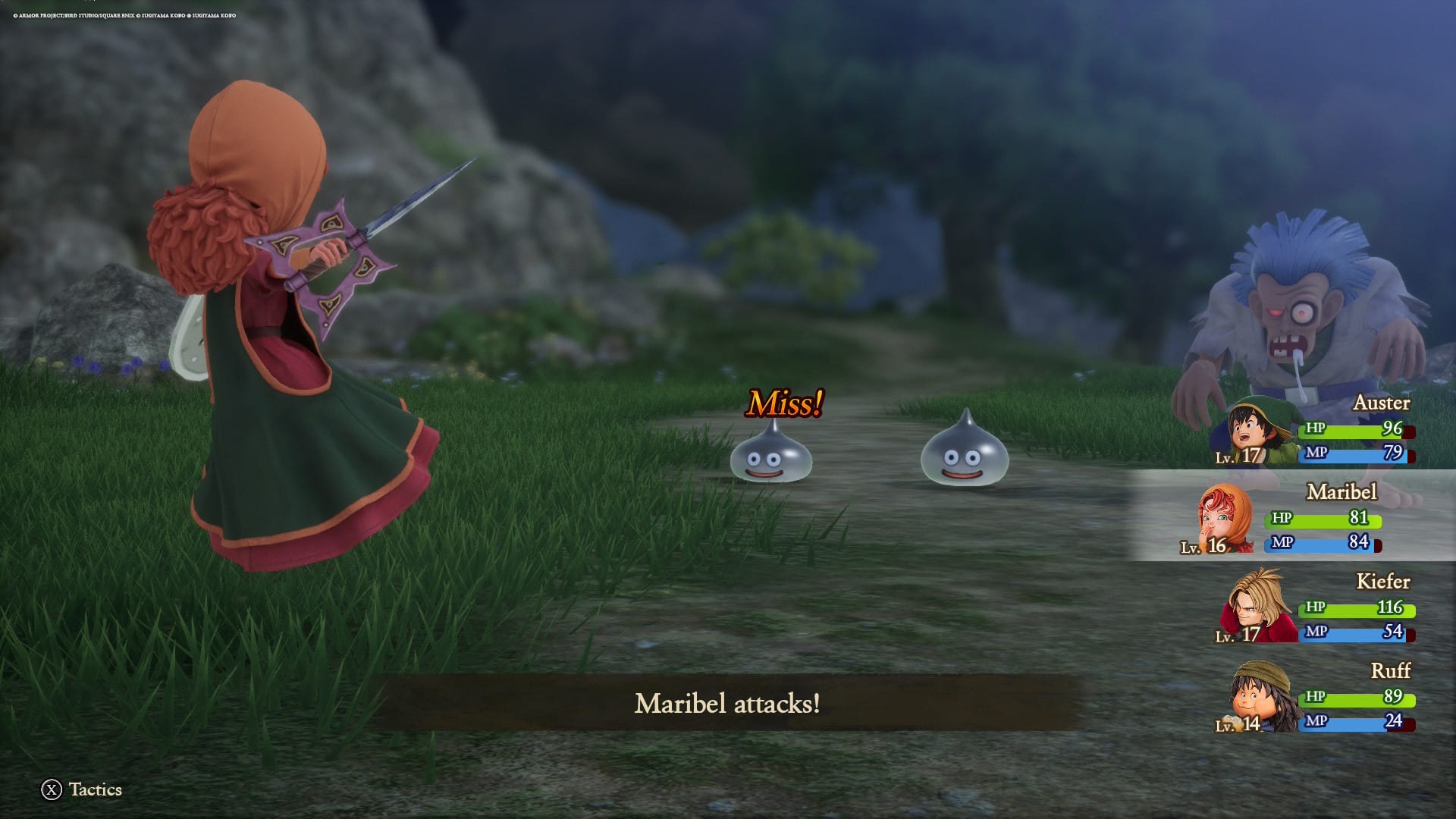
Battles in Dragon Quest VII Reimagined also feel lacking, though not nearly as much. Since this is a game for all ages, including children, it's pretty easy, but gets more fun and interesting if you head into the options menu and crank the Monster Strengths up to max (I'd also recommend setting Proficiency to More so you can see the extents of the job system, but more on that in a bit). With this setting, it's high damage all around, so some bosses might actually be able to down a party member or two before they succumb to their biggest weakness: tragically low HP. Fights really don't last long here, with the only battles that gave me any trouble being the final phase of the final boss and one Vicious Monster, unique baddies that drop special accessories upon defeat, near the end of the game. Nothing can really stand up against your assault with you constantly spamming your most powerful attacks and, rarely, healing spells. In other Dragon Quest games, you'd have to worry about running out of MP even in successive normal encounters, but there's literally no danger of that here. Even with the final boss, my AI companion restored everyone's MP to max for free when Maribel had about 1/3rd of her bar left.
Any time you might think about using an MP restoring item just to top yourself off, you'll encounter a Statue of the Goddess which heals both HP and MP to full when you interact with it to save the game. These things are everywhere, at the beginning, middle, and end of every single dungeon. In the older games, you'd need to conserve MP on the way to the boss to get the best chance at defeating them, often running through each dungeon once to gain experience and open any shortcuts, teleporting to an inn to heal up, then making the journey a second time just to face the boss. Even in more modern entries, you might leave a dungeon at a checkpoint to rest up, but here there's absolutely no friction on your journey whatsoever. It's still enjoyable, but I think even a baby could sleepwalk through this game. I don't need or want Dragon Quest to be super difficult, I just want it challenge me in any sort of way, to make me think even a little about how to face a particular foe or scramble to revive a downed party member. You don't even need to go back to a church here to resurrect fallen allies, as they'll get right back up after the battle ends.
I started to feel this way with the HD-2D remakes and struggled to articulate it in those reviews, or didn't mention it at all because the thought wasn't fully formed yet, but VII Reimagined really put that into focus: Dragon Quest is sanding too many of its edges off. The first thing that made me think this, funnily enough, was the removal of a joke. In most Dragon Quest titles, using the Zoom spell to fast travel while in an enclosed space or under a roof would cause the user to hit the ceiling and crash back down. It was a little, tiny bit annoying, sure, but it was also hilarious every single time. Removing that gag isn't the worst possible thing, but it's also emblematic of the shift in design that led to Dragon Quest VII Reimagined.
What seem on the surface to be quality of life changes are actually harming the overall experience. Quest markers will always show you exactly where to go, so there's no need to talk to NPCs or use deductive reasoning from what's been going on in the plot. Party Chat will always remind you of your objective, which removes a lot of potential flavor dialogue to flesh out the characters. The new battle in the opening may get you to combat earlier, but it lessens the impact of finally encountering monsters. Seeing enemy weaknesses to spells and abilities removes a lot of the guesswork, but there's no need to do anything but spam your most powerful abilities now. The job system is a lot more freeform and easy to use, but now it feels more like checking off boxes than intentionally growing your characters.
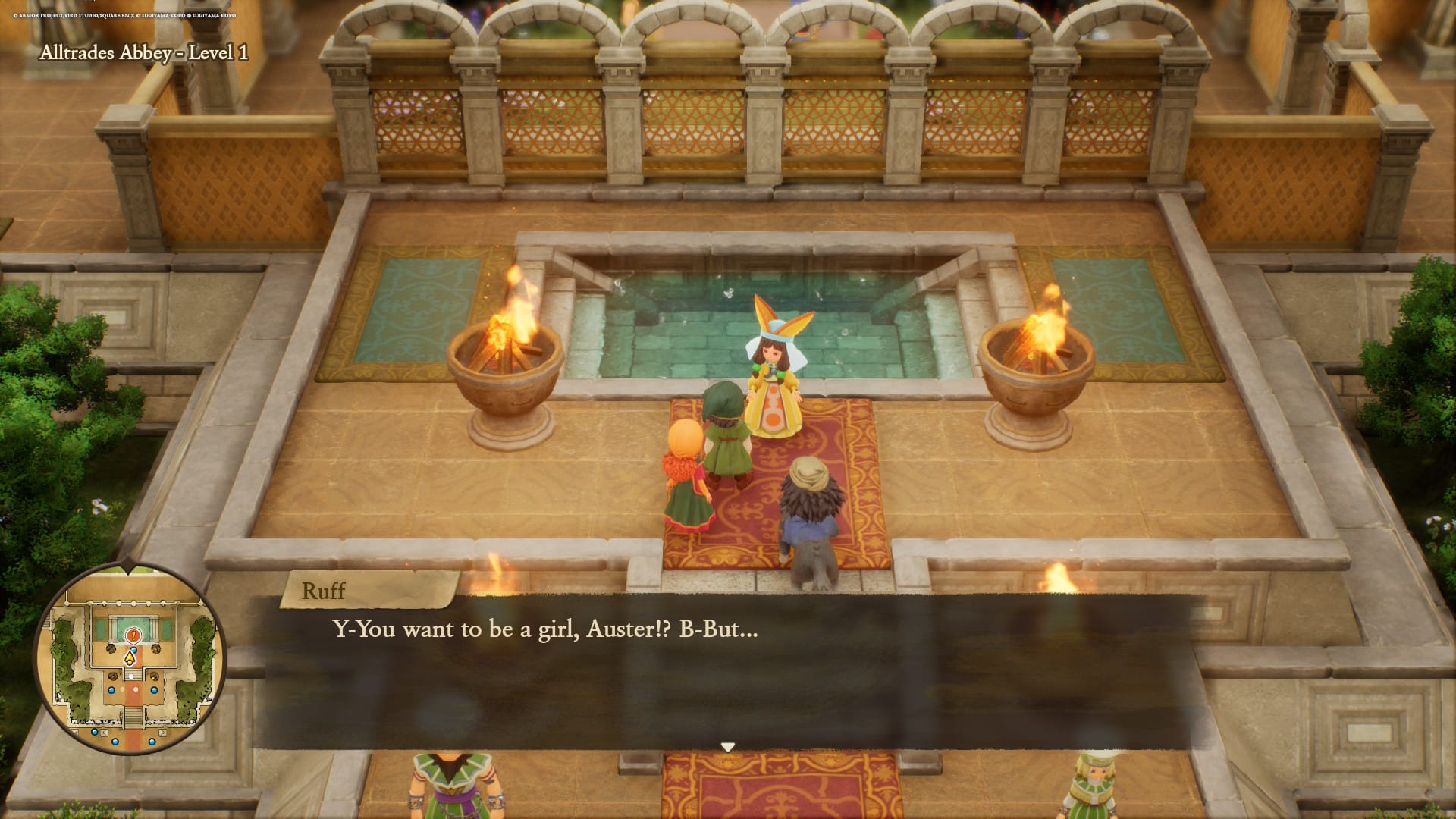
Each member of your party in Reimagined does have a designated role. Maribel is a caster, Ruff and Kiefer are physical powerhouses, Sir Mervyn dabbles in both casting and swordsmanship, Aishe buffs the party with her dance moves, and Auster is the best at literally everything. Once you unlock All-Trades Abbey (and meet the best character in the game, Jacqui), you can swap vocations around whenever you want with the press of a button. You could lean into each character's strengths by, for example, giving Maribel the Mage and Priest vocations to make her the ultimate spell slinger. Conversely, you could give her some more physical oriented jobs like Gladiatrix to balance her a bit more. Regardless, to unlock more advanced vocations you need to learn a variety of jobs, so you're going to have everyone master pretty much every vocation anyway.
It feels like the game is trying to be both types of Dragon Quest here. Games like III, IX, and X which give you total control of your party makeup, and games like II, VIII, and XI where each character has bespoke skills but there's still a little wiggle room for customization like weapons, accessories, and skill points. Here, you have total control over vocations, but each party member's basic stat spread won't allow for much wiggle room in what makes them useful and they're all stuck with whatever weapons are fit for their initial role as well. You might want to make Maribel a powerful Martial Artist, but she'll still only ever be able to use weaker weapons like daggers, whips, and staves. (Vocations disappointingly won't change your characters' outfits either, with the only costumes available as an early purchase bonus or from playing the demo.)
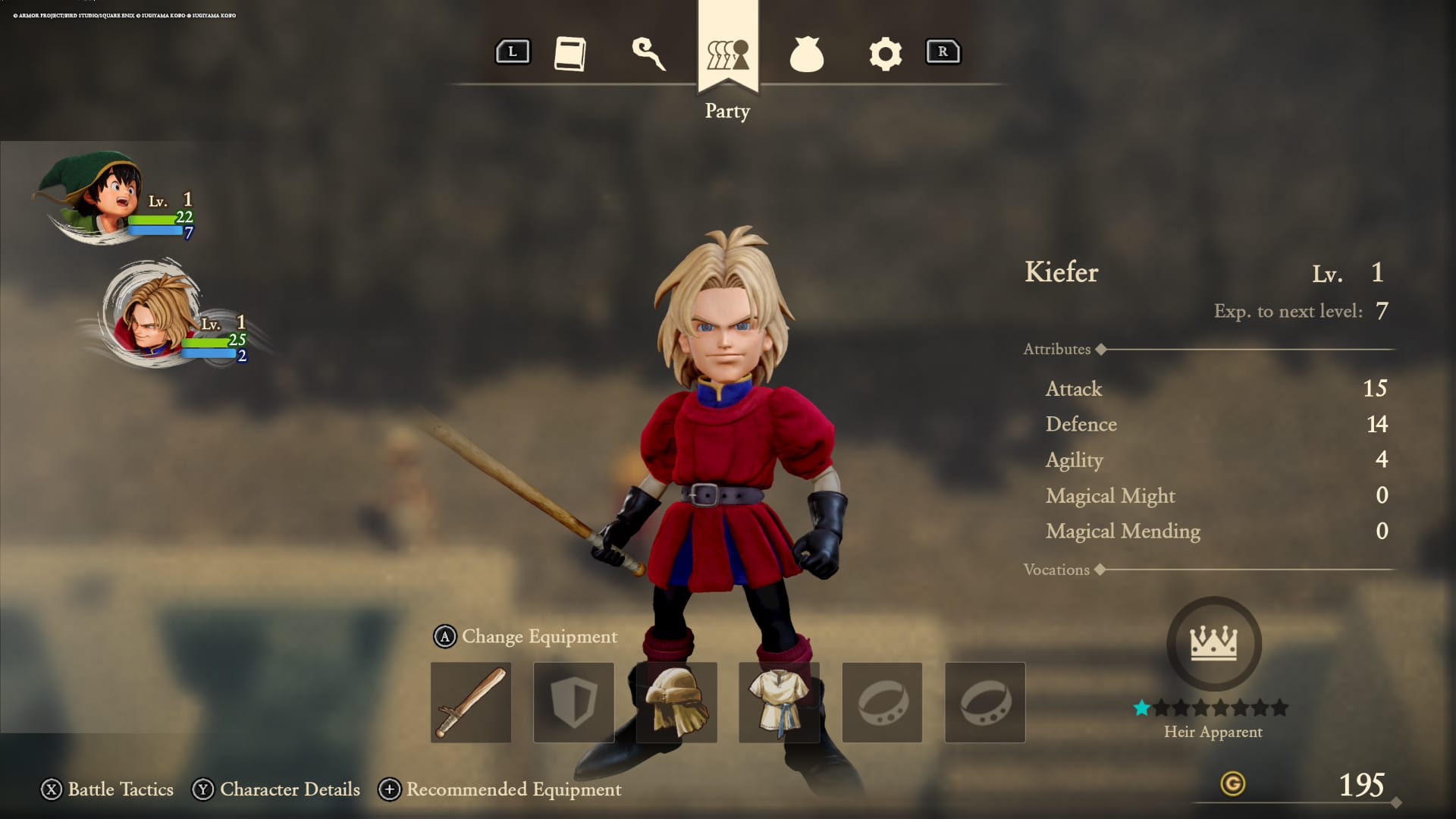
One last example of the game trying to be more player friendly but ending up with something a little worse overall: the UI. Reimagined tries to make menuing a lot quicker by putting Spells and Abilities both in the Skills tab in battle, removing the bag system and giving every character access to the full inventory, or streamlining the equipment menu. In reality, I actually spent more time looking at my skills because the spell or ability I wanted would get lost in the list, or I would spend time remembering how to navigate this weird XMB style menu. I also ended up not really using items, because the most useful items in Dragon Quest are usually weapons that, when used in battle, activate a free spell, and you can't do that here unless that weapon is equipped.
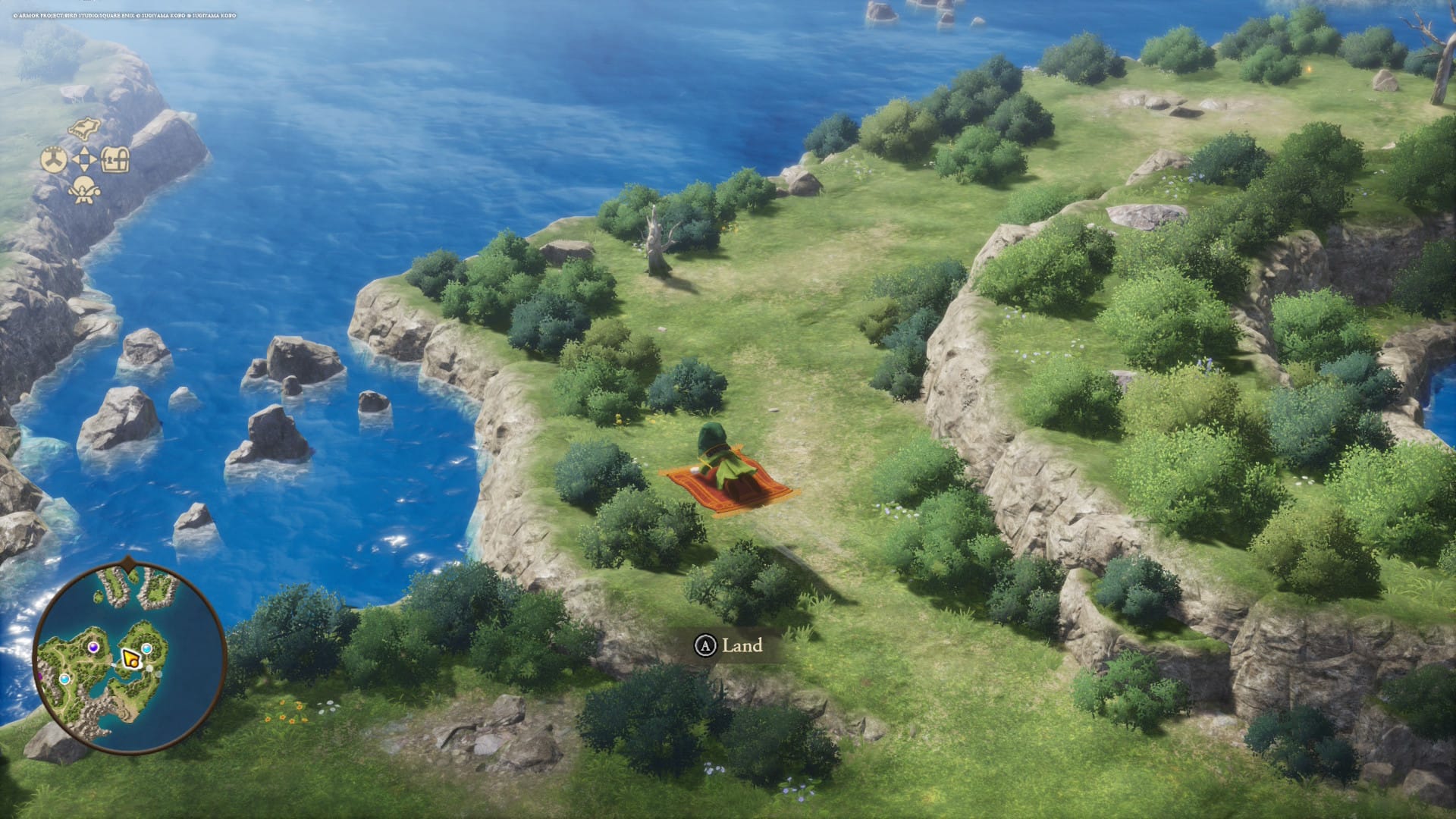
I played the Switch 2 version for this review, but I also had access to the PC version via Steam. It's also very pretty and the higher possible fidelity results in a clearer image, but I'm personally fine with sacrificing that for portability. The game runs great on Steam Deck too, but has a very weird issue where all the graphical settings will default to their lowest possible option every time you boot up the game, making the Switch 2 version a better experience. All versions have some weird shadow detail draw distance issues too, though it's improved from the demo.
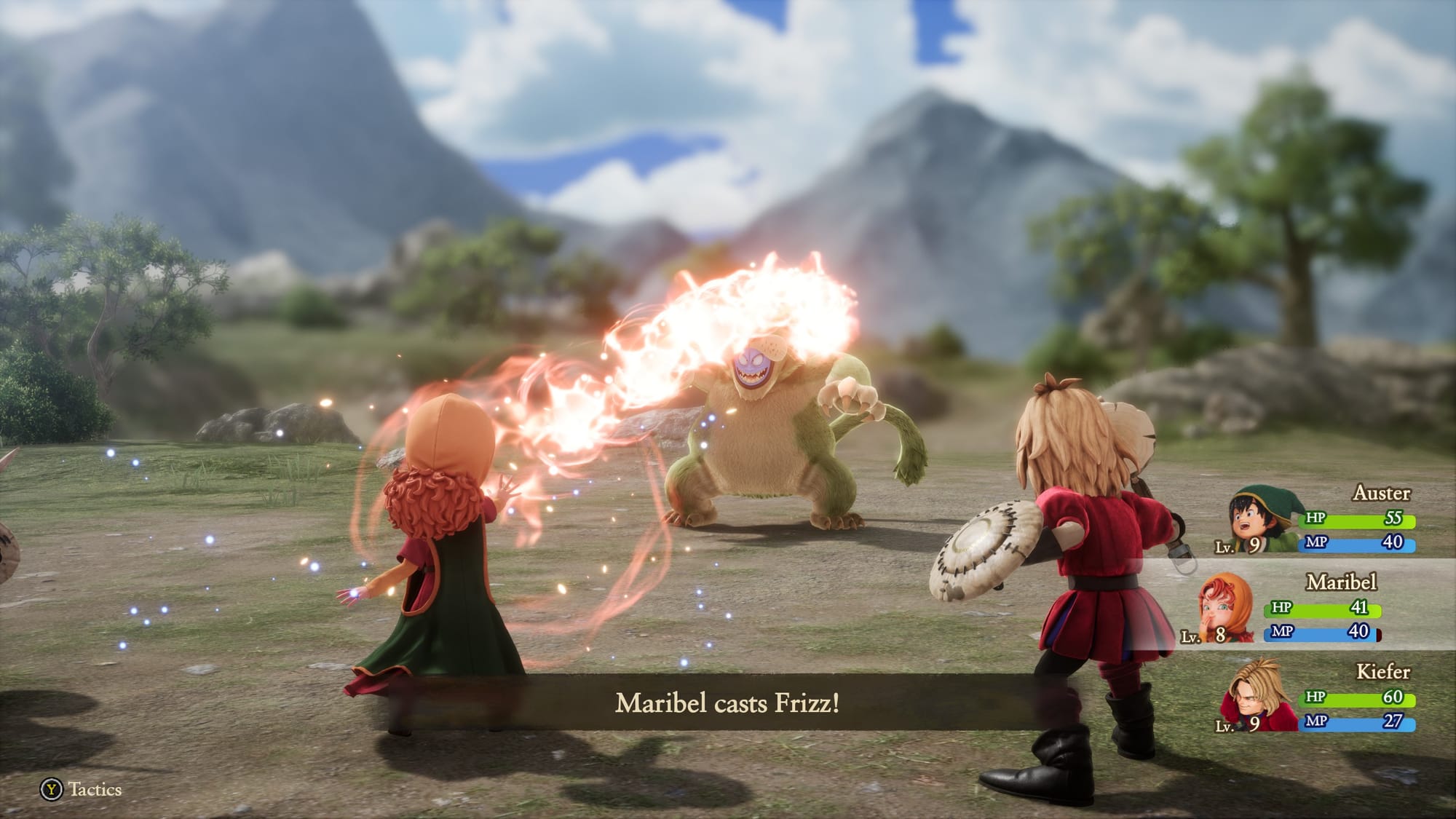
While it's still an enjoyable game, Dragon Quest VII Reimagined feels like it doesn't want to be Dragon Quest VII. It wants to appeal to people like me who bounced off the game because of its unique qualities, and in doing so it loses what made people love the game in the first place. It becomes a weird, Dragon Quest shaped blob that, while looking and sounding amazing with the gorgeous wooden doll style and iconic soundtrack, goes down so easy you won't really remember it after. In chasing broad appeal, we've lost what made Dragon Quest broadly appealing in the first place. It's like what Sonic was doing in the 2010's: trying to fix the common criticisms and win over the haters, when what it should be doing is leaning more into what made it special to the people who already loved it, flaws and all.
The copyright of the images used on this page is jointly owned by SQUARE ENIX CO., LTD. and other co-owners. The unauthorized reproduction and distribution of the images is prohibited.
ⒸARMOR PROJECT/BIRD STUDIO/SQUARE ENIX
DRAGON QUEST VII Reimagined
Good
Dragon Quest VII Reimagined wants to have its cake and eat it too, but ends up feeling incredibly bland in most aspects. It's still a Dragon Quest game and is fun to a point, but in sanding off the edges of the original game it loses the charm of a time traveling adventure and becomes a rote, forgettable RPG checklist of a game.
Pros
- Gorgeous visuals
- Great soundtrack
- A few fantastic puzzles
- Maribel
Cons
- So easy you don't have to think
- Character customization lacks impact
- Incredibly generic plot
- Party members are mostly silent
This review is based on an early Nintendo Switch 2 copy provided by the publisher. DRAGON QUEST VII Reimagined comes out on February 5, 2026.