Nearly a decade old at the time of writing, Dead by Daylight has remained a popular video game and the most successful one-vs-many experience. Players love the thrill of both sneaking about as Survivors and chasing those Survivors down as Killers. Level 99 Games has attempted to adapt this experience to one that can be played on your tabletop. Dead by Daylight: The Board Game maintains the lone Killer vs four Survivors dynamic, but shifts the hide-and-seek gameplay into action programming to make it work as a turn-based game. While the resulting game is both fun and simple, it’s not without a few faults.
Rules & Components
The rules for Dead by Daylight: The Board Game (a bit of a mouthful, so I’ll use “DbD” from here on out) are easy enough to both read and teach. There are plenty of helpful graphics throughout the book, and the hardest part of teaching the games to others is just going over what the different Prop interactions are for both Survivors and Killers, which isn’t so much difficult as it is time-consuming. And that’s partially alleviated by the plentiful reference sheets, since the backside of each Survivor/Killer board (they’re called boards, but they’re just nice cardstock sheets) is a reference for how they interact with Props. There’s also a nifty Game Overview sheet that succinctly summarizes everything aside from the Props for both teams.
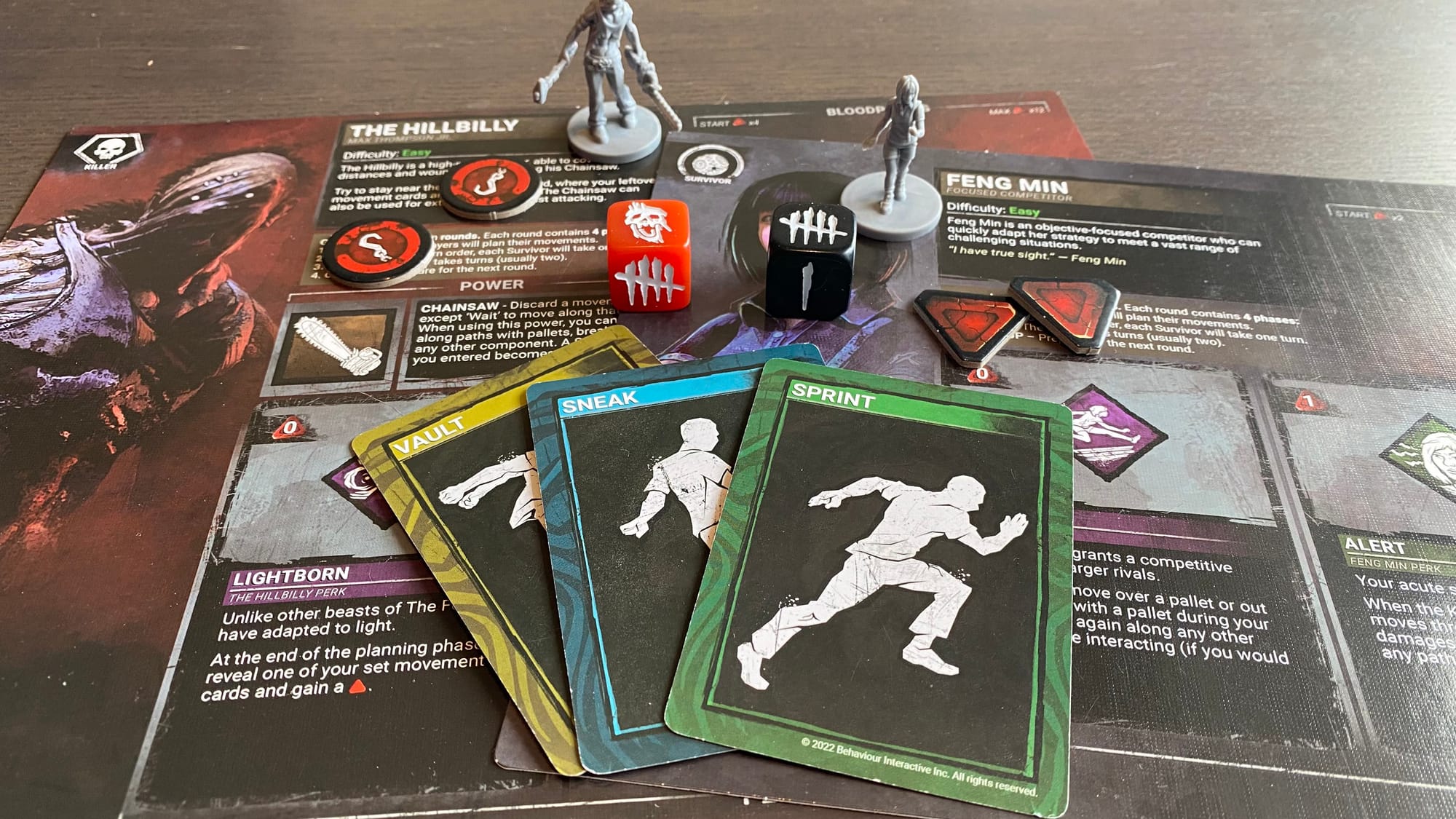
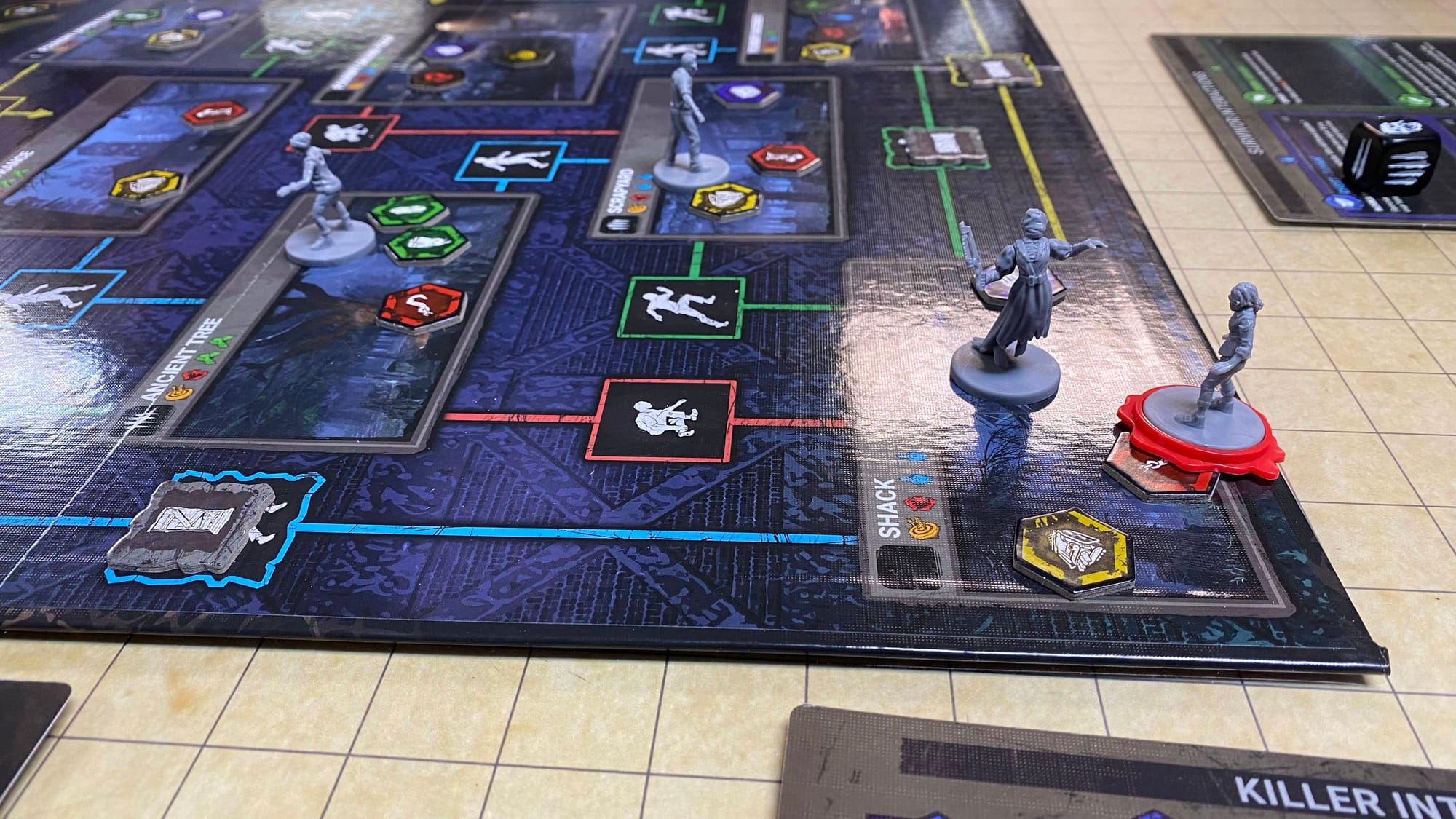
The cardboard tokens are all sturdy enough to handle repeated plays, and the cards are similarly nice quality (though not as tough as the player boards). What will stand out more on your table are, of course, the miniatures. The Killers are all slightly larger than the Survivors, for the most part (poor, short Hag), which helps emphasize their danger and makes them easily noticeable. The poses for everyone are interesting and help show their personality. Even so, I had more than a few instances of people grabbing the wrong Survivor mini; I would have liked to have some way to better differentiate them, but some typical colored rings wouldn’t have worked due to the bloody Wound rings, which I do like quite a bit. Overall, not bad for Level 99’s first set of miniatures in a game.
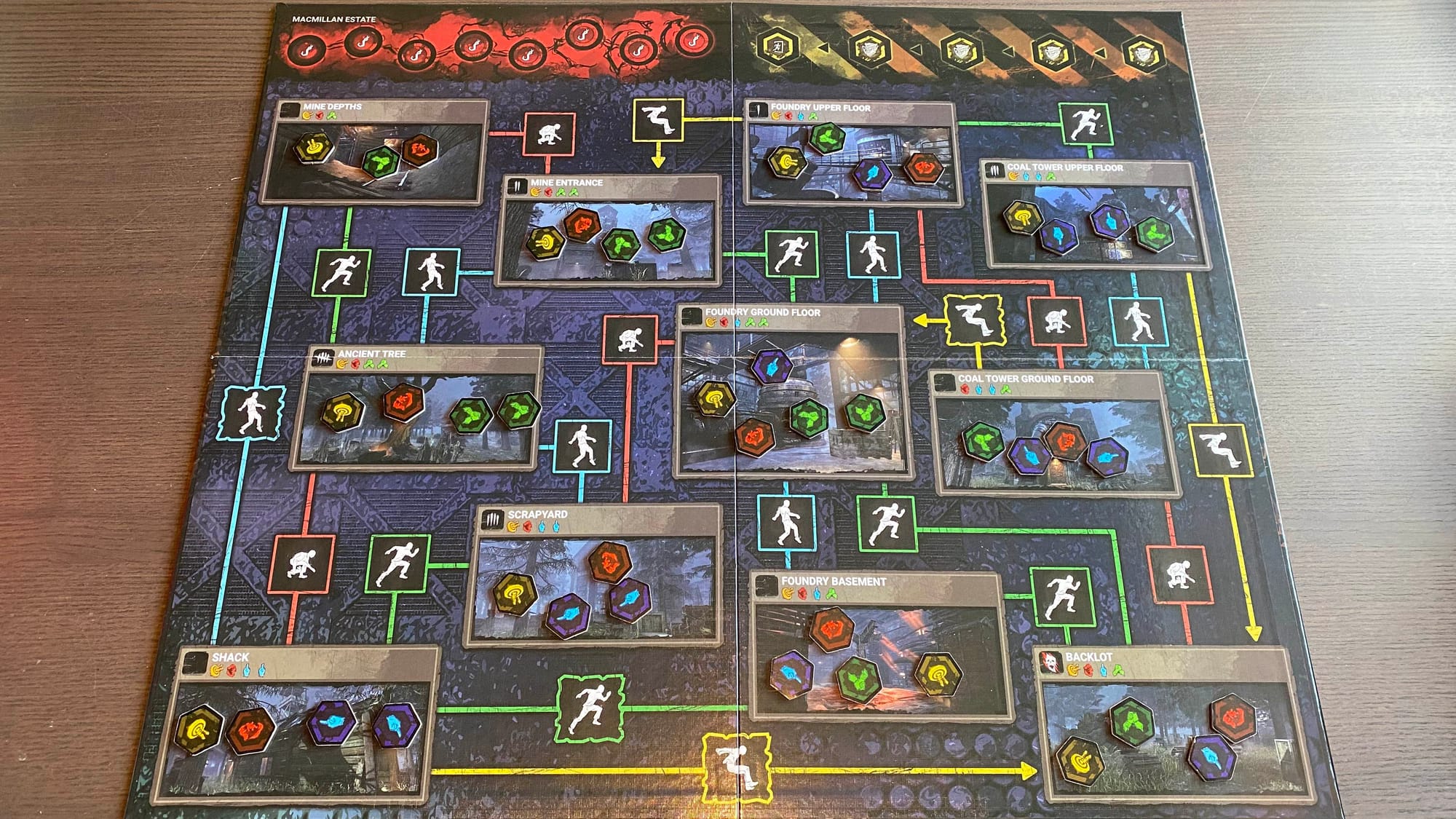
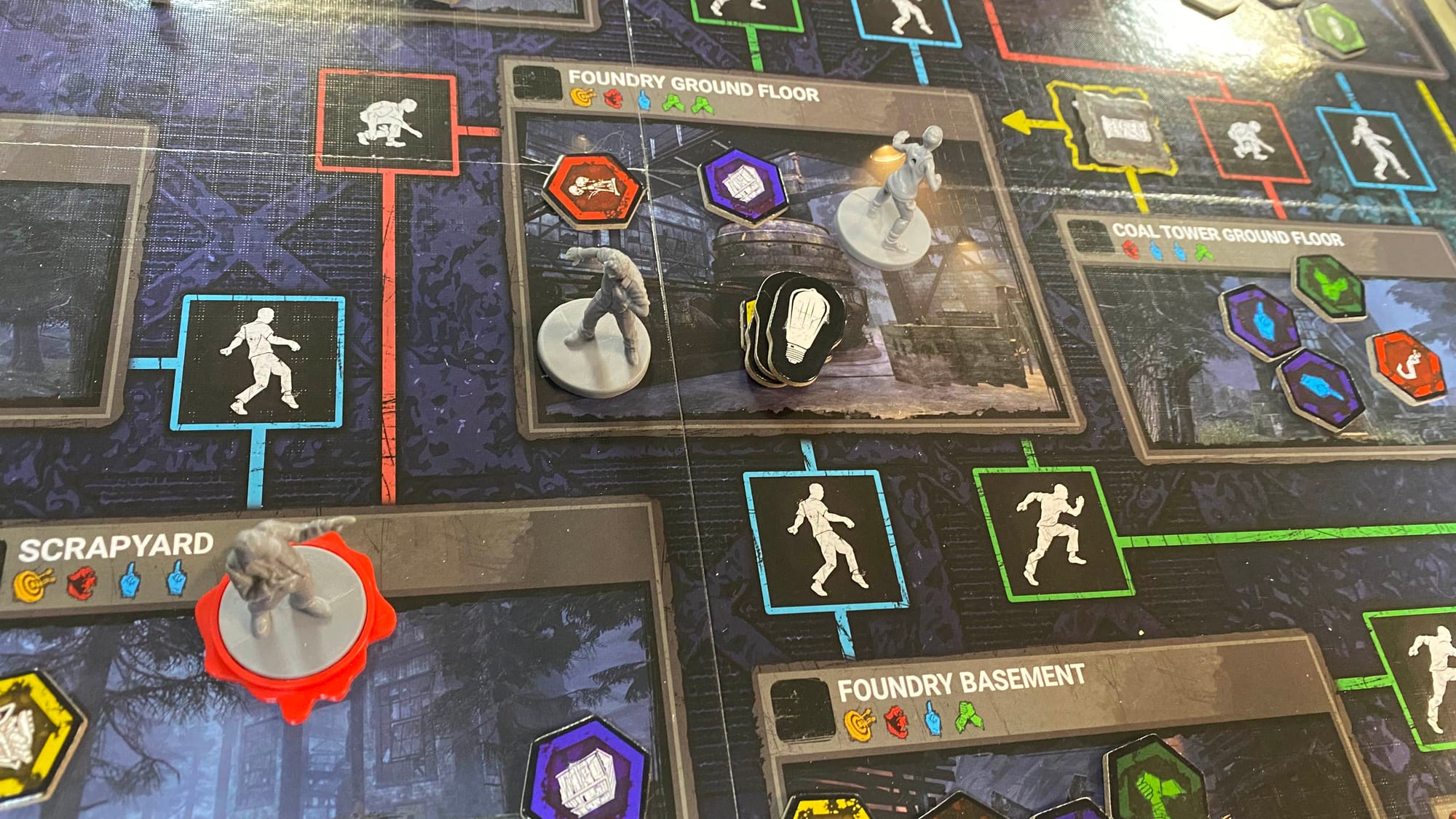
I have some mixed opinions on the game board. On the one hand, it’s very easy to read from across the table with its obvious paths differentiated by both color and iconography. The small icons next to each location's name are easy to use when setting up the facedown Props and are small enough to be ignored afterwards. However, the smattering of game locale screenshots in boxes with just colored arrows filling the dead space between them doesn’t make for an especially pretty board. Replacing the screenshots with nice art and allowing it to bleed onto the rest of the board instead of some abstract filler in the dead space would have been preferable
Gameplay
The action programming in DbD is interesting, since you only program the first half of your turn: movement. Everyone simultaneously decides on which movement card they’ll use, then reveals and resolves them in turn order. After moving, players will also reveal one of the Props in their space, then perform one Interaction (typically with a Prop). The Killer has two benefits here to help counter the four Survivors’ strength in numbers: access to a Wait card, which allows them to stay in their space without penalty, and they take two turns each round, programming two different movement cards in order.
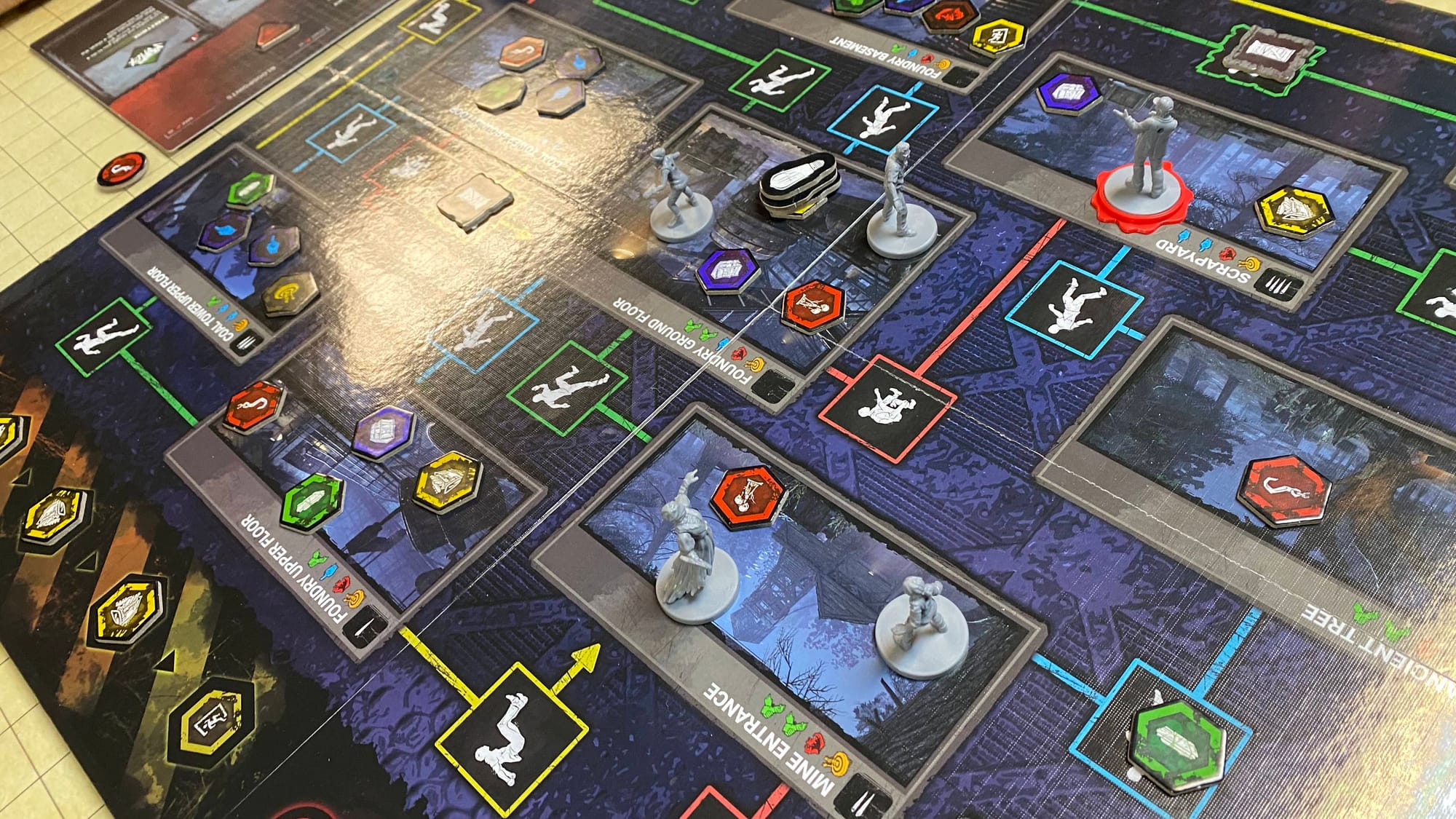
The Props represent all the different elements in the video games, from Chests containing items to Pallets that can be dropped to block paths (no dropping them on top of Killers). Most important for the Survivors are the generator Props, which need to be repaired before the exit gates can be opened. Repair 4 generators, then an exit gate, and the Survivors win. These Props are all split into pairs that share the same color (e.g., generators and exit gates are yellow, while chests and lockers are blue), so there’s some strategy on what to reveal when you enter a new location. Should you flip the blue Prop to look for items or a place to hide? Or do you focus on the objective and flip the yellow Prop? The Killer pretty much always flips the red Props when able, since they’re the hooks and hex totems—which grant Bloodpoints, more on those later—but that’s fine, since the Killer should be focused more on hunting the Survivors rather than exploring the map.
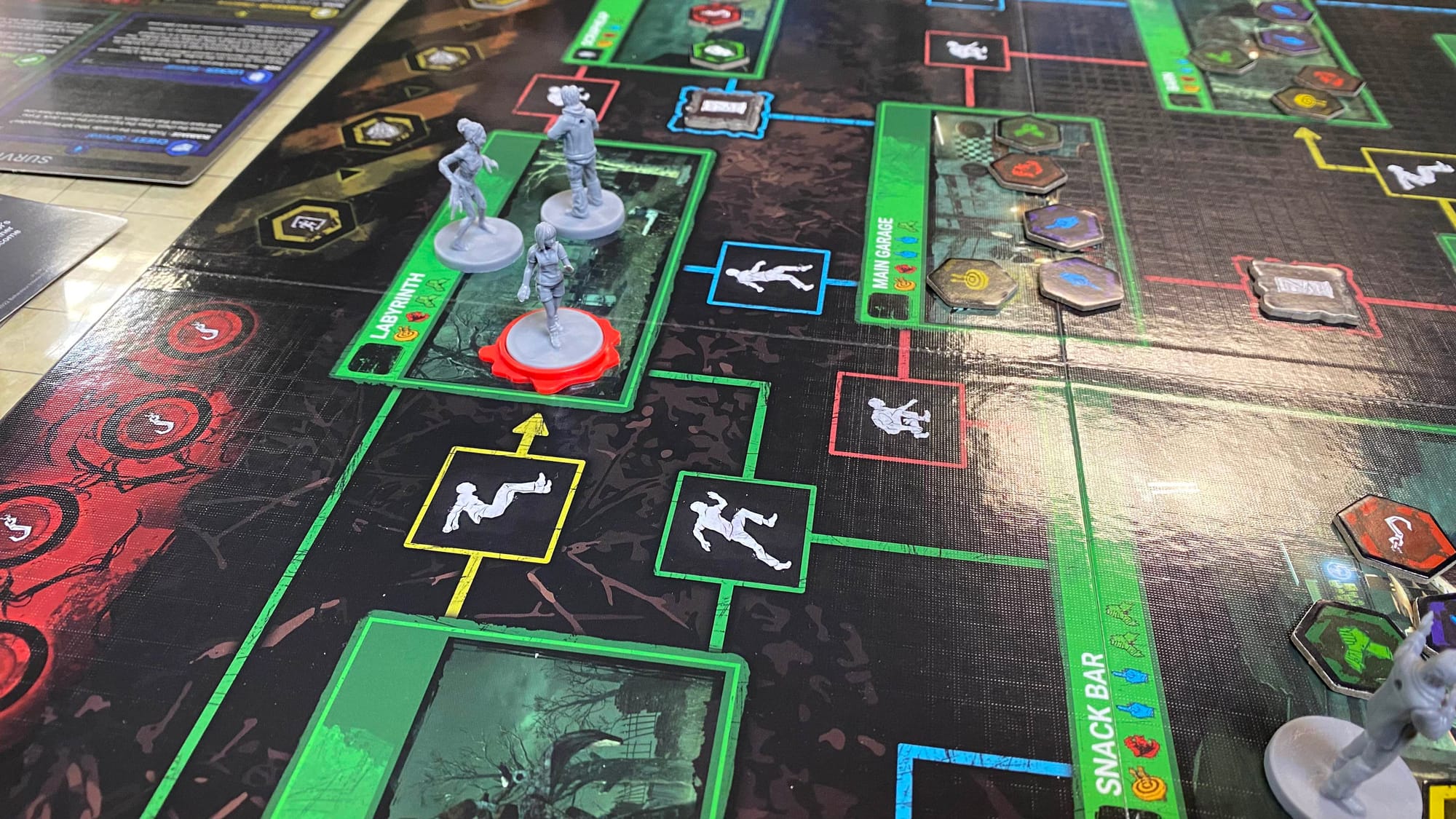
In addition to evading the Killer, the Survivors need to work as a team to locate and repair the generators. And occasionally help each other heal or escape from the hooks. Coordination is key, and Survivors are free to discuss their plans during the movement programming phase. However, all their communication needs to be public to everyone, Killer included. Occasionally, this can lead to Survivors trying to be vague or cryptic about their plans, which often leads to either the Killer interpreting it correctly anyway or another Survivor failing to interpret it correctly. Good fun either way. In a way, this acts as a balancing mechanism to prevent the Survivors from being too coordinated (lest they risk the Killer perfectly chasing them down). This has the unfortunate side effect of making lower player counts noticeably less favorable for the Killer. In a three-player game, each Survivor player controls half the team and can perfectly coordinate those characters without providing any communication for the Killer to listen in on. Playing a game where the Survivors perfectly evade the Killer round after round, winning without ever being hooked, feels bad for the Killer. Suffice it to say, this game is far better with more players.
Actions like repairing a generator or dragging a Survivor to a hook are abstracted into skill checks, which are simply rolling one die and getting anything except a 6, which both fails and gives the Killer a Bloodpoint. 5’s are Great Successes which occasionally provide benefits, like giving 2 progress towards repairing a generator. I appreciate that this translates both the video game’s Quick Time Events and scrambles to escape a Killer’s clutches into something fast and simple. Even the more intricate turns in DbD are pretty quick as long as everyone knows what they’re doing. The longest action in DbD—barring special abilities—is picking up a wounded Survivor and moving to a different space to hook them. Instead of the Survivor mashing keys on their keyboard while the Killer struggles to navigate, the Killer declares how many spaces they want to move and rolls that many dice. Any Great Successes means the entire move fails, and the Survivor is dropped. No Great Successes? The Killer moves up to the declared amount following any paths they like as they look for (or head towards) an available hook. Even though all of these are simple die/dice rolls, they’re still plenty tense and exciting.
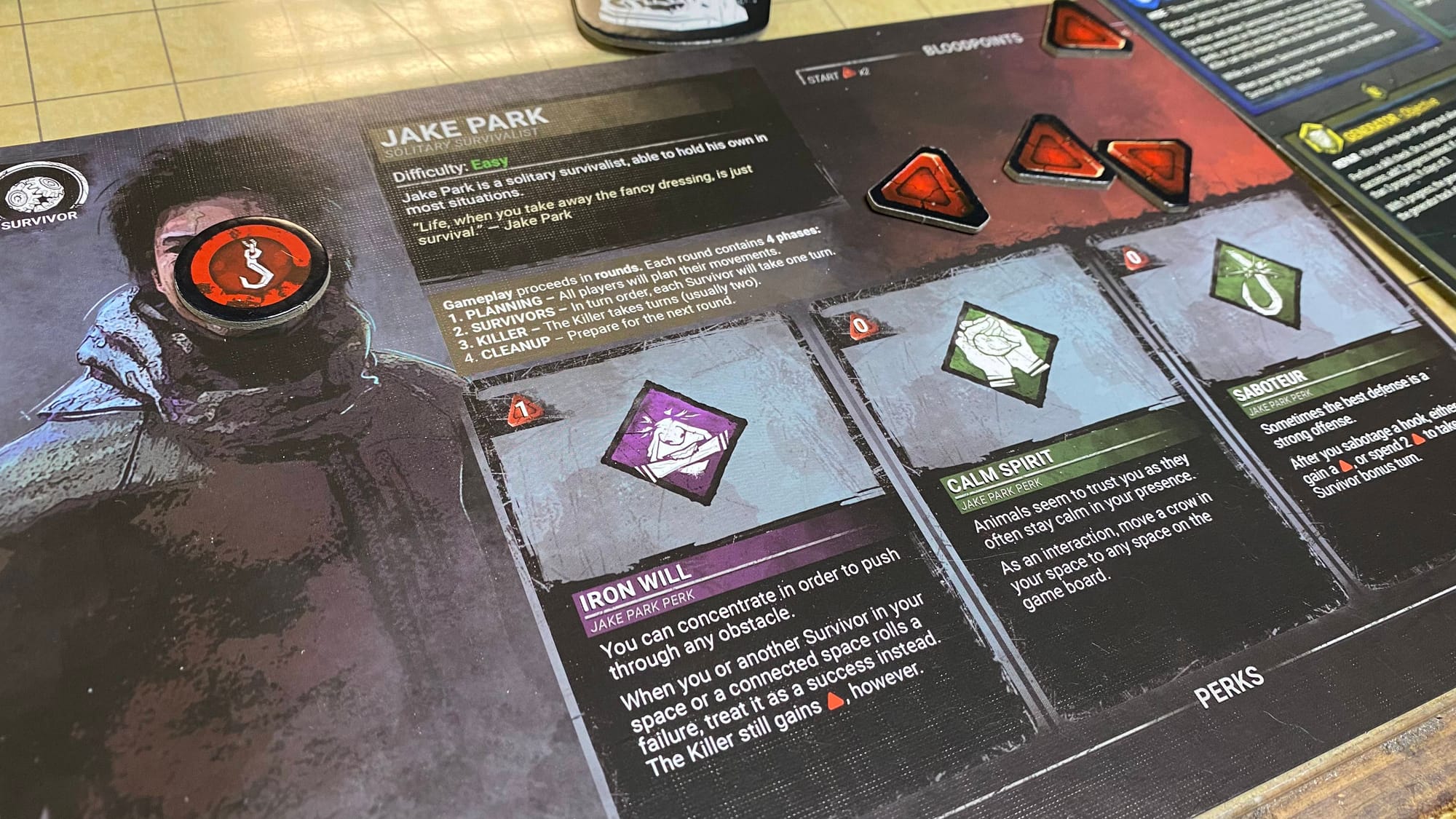
DbD’s shining feature is its asymmetry and variety. The base game comes with 7 different Survivors, 6 different Killers, and decks of Perk cards if you want to further customize them. Perks typically cost Bloodpoints to use, which Survivors gain through destroying hex totems and Killers gain in quite a few different ways (venerating hex totems, whenever crows are used by either team, and any time a failure is rolled). Every character has three different Perks (which can be replaced in an optional Bloodweb variant using those decks), which do plenty to distinguish them from each other. While Dwight does a great job using his Bloodpoints to empower his teammates, Nea can utilize her Perks to bound across the map and evade the Killer. This actually presents the largest learning curve for the Killers, rather than their own kit. Killers need to keep track of the three Perks held by each of their four adversaries, and account for them when planning. This can be helped slightly by using the Perk cards as references for the Killer, but there’s still the issue of identifying which Survivor is which; it’s not fun to charge through a breakable wall, thinking you’ve caught an unsuspecting Survivor, only to realize that it’s Feng Min, and you just triggered her ability to move away from you.
To counter this, Killers have even more going for them. On top of three Perks, they have a Power that can be used instead of Interacting after a move, and the innate ability to spend four Bloodpoints after their second turn to take a third turn—though this can’t use any of the movement cards they’ve already played this round. Some Killers even have a passive effect to go with their Powers. For example, the Doctor has Lightning Spark as a Power, which gives Survivors Madness or wounds them if they’re already afflicted; then the Doctor’s passive further punishes Survivors with Madness by forcing them to roll the more volatile Danger Die, which only has Great Successes and failures. While all these base game Killers’ passives just relate to the tokens from their Power, that may not be the case for later expansions.
The Killers feel like they have a lot more variety in their playstyle compared to the Survivors, which helps make up for the harder game that they’re playing. If the Survivors work together well (or if there’s just two players), the Killer is going to face an uphill battle. Dice rolls tend to favor the Survivors, and action programming can be an unforgiving mechanic. There are tools at the Killer’s disposal to help with all of this, of course, but it will take some experience to know how to use them effectively. This is on top of needing at least some awareness of the Survivors’ Perks. I would caution that Killers are unlikely to win their first couple of games while they really learn the ropes.
Dead by Daylight: The Board Game
Good
Dead by Daylight: The Board Game is a solid one-vs-many action programming game with a few issues that unfortunately keep it from being very accessible. There’s some nice variety to each play with the different Survivors and Killers, the randomized Props, and the double-sided board. The game is easy to learn and teach, but it takes a bit to start playing well as the Killer. The board is incredibly easy to read, but it accomplishes that by sacrificing visual appeal.
Pros
- Quick and simple to learn/teach
- Plenty of variety between characters, especially Killers
- Action programming and skill checks make for exciting moments
- Fast gameplay and low downtime
- Easy to read board…
Cons
- …which looks rather boring
- Bit of a learning curve for the Killer
- Doesn’t play as well at lower player counts
- Survivor minis aren’t as easy to distinguish without painting
This review is based on a retail copy provided by the publisher.