Every once in a while a game comes out of nowhere that doesn't just raise the bar, it reinvents it. It resets the field and redefines a genre, giving players something so far beyond expectation that it sparks debate about whether the whole thing is a sham as it's such a leap forward that people can't believe it until they've seen it for themselves. Crimson Desert, Pearl Abyss's second game and first single player title, is exactly that. It's so far ahead of other action RPGs that the entire conversation will change. It joins a short list of games like Baldur's Gate 3, The Legend of Zelda: Breath of the Wild, Star Wars: Knights of the Old Republic, and Mass Effect. Crimson Desert is the sort of game that changes the conversation. Brace yourself — this review, much like this game, is going to be packed.
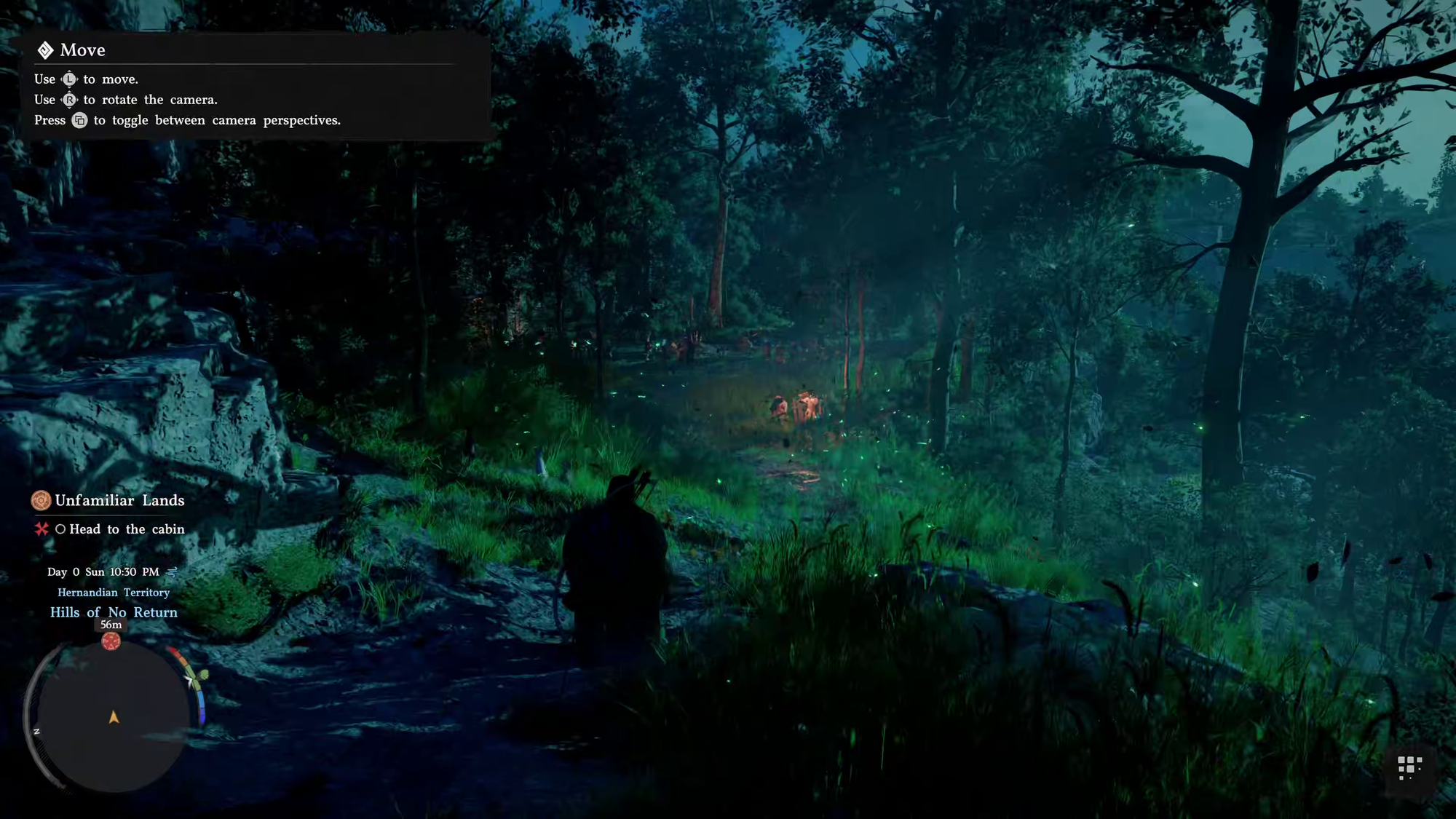
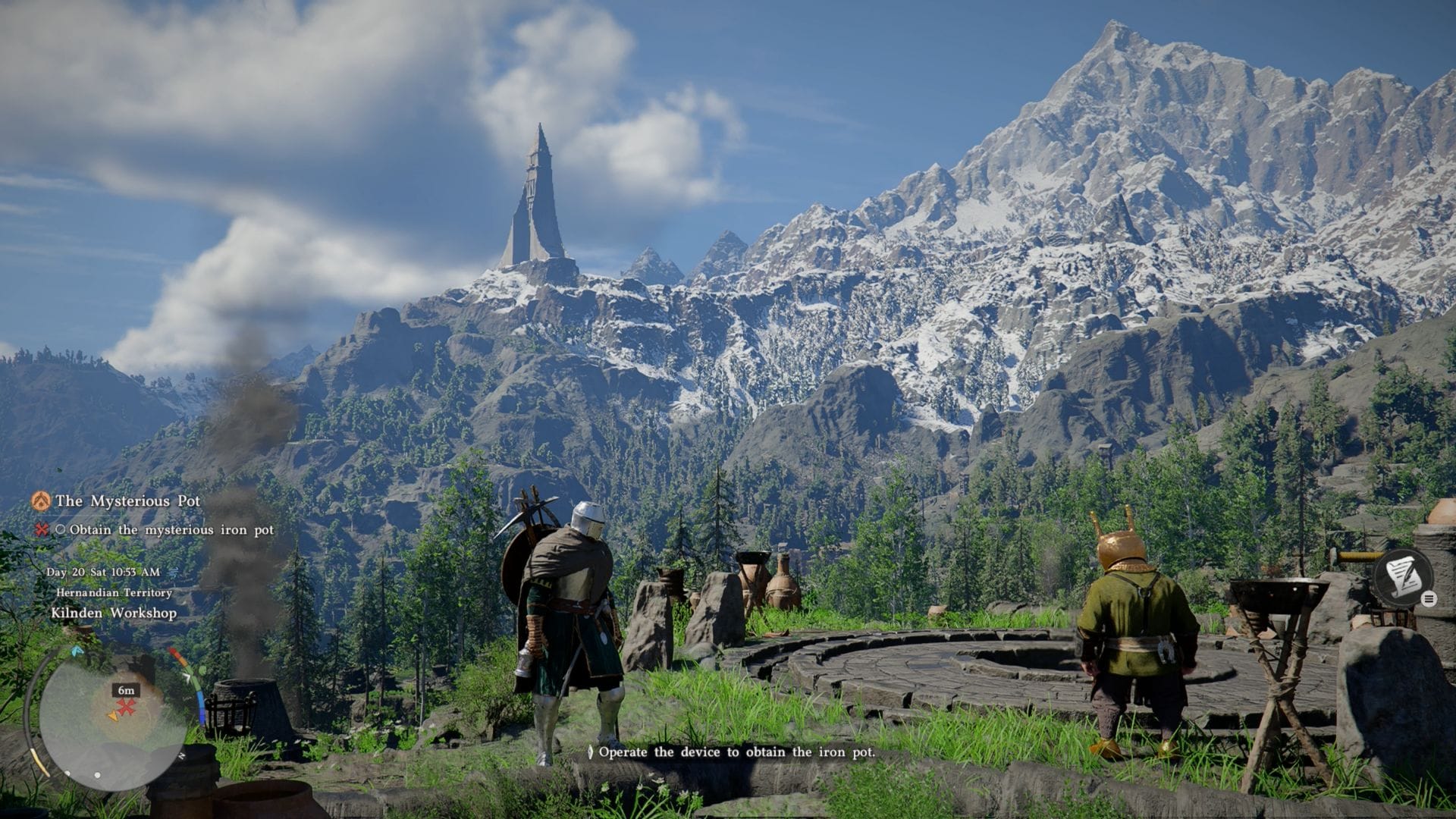
Crimson Desert starts...well, I'd describe the story, but the first thing it's going to hit you with is some incredible mind-blowing foliage. It's odd to start an RPG review talking about trees, but this isn't your typical RPG. Powered by the team's own BlackSpace engine, the foliage in this game is the best I've ever seen. Not the best in any RPG – the best EVER. Wind realistically tugs at trees, sending motes of pollen into the air, grass shifts realistically under your feet, and leaves dance on the breeze. We'll talk a lot more about the engine and graphics as we go, but Crimson Desert starts its story with an unbelievable visual, and it only gets stronger from there. Below you can see the first chapter of the game — I could describe it, but you need to see it for yourself.
Want to see Crimson Desert running on an RTX 5090 with max settings? Now you can!
The story of Crimson Desert revolves around Kliff, a member of a ragtag group of protectors called the Greymanes, affectionately called the "Protectors of Pailune". Kliff and his compatriots are encamped, preparing a meal as they mourn the passing of their beloved leader, Jian, when they are beset by their mortal enemies — the Black Bears. Caught unawares and vastly outnumbered, the Black Bears not only scatter the Greymanes with ease, but kill a great many of them in the process. Kliff is repeatedly stabbed and tossed unceremoniously into the river. The Greymanes are no more. Inches from death, Kliff suddenly finds himself somewhere...odd.
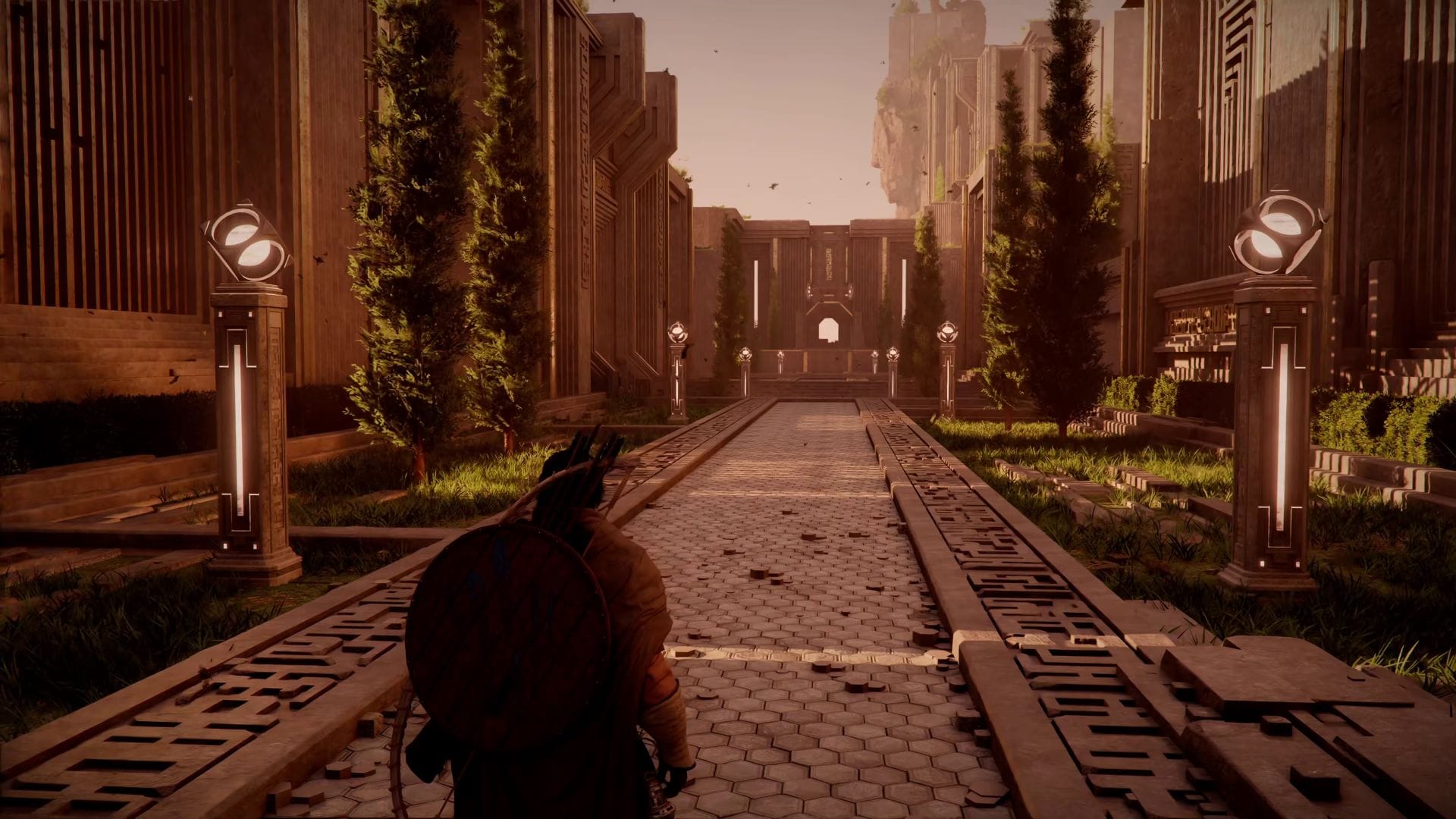
As Kliff awakens, an odd magical bracelet has locked itself on to his wrist. His eyes struggle to adjust as he finds himself standing in some sort of advanced technological or magical floating city in the sky. Pressing forward, he finds an exit from this odd place and is back in the water. Was it all a dream? The answer comes in the form of rescue – the new bracelet pulls him to the surface where he's pulled from the water by a local map maker and some fisherfolk. On the mend but very alone, Kliff makes his way to the nearby town, and that's where his story truly begins.
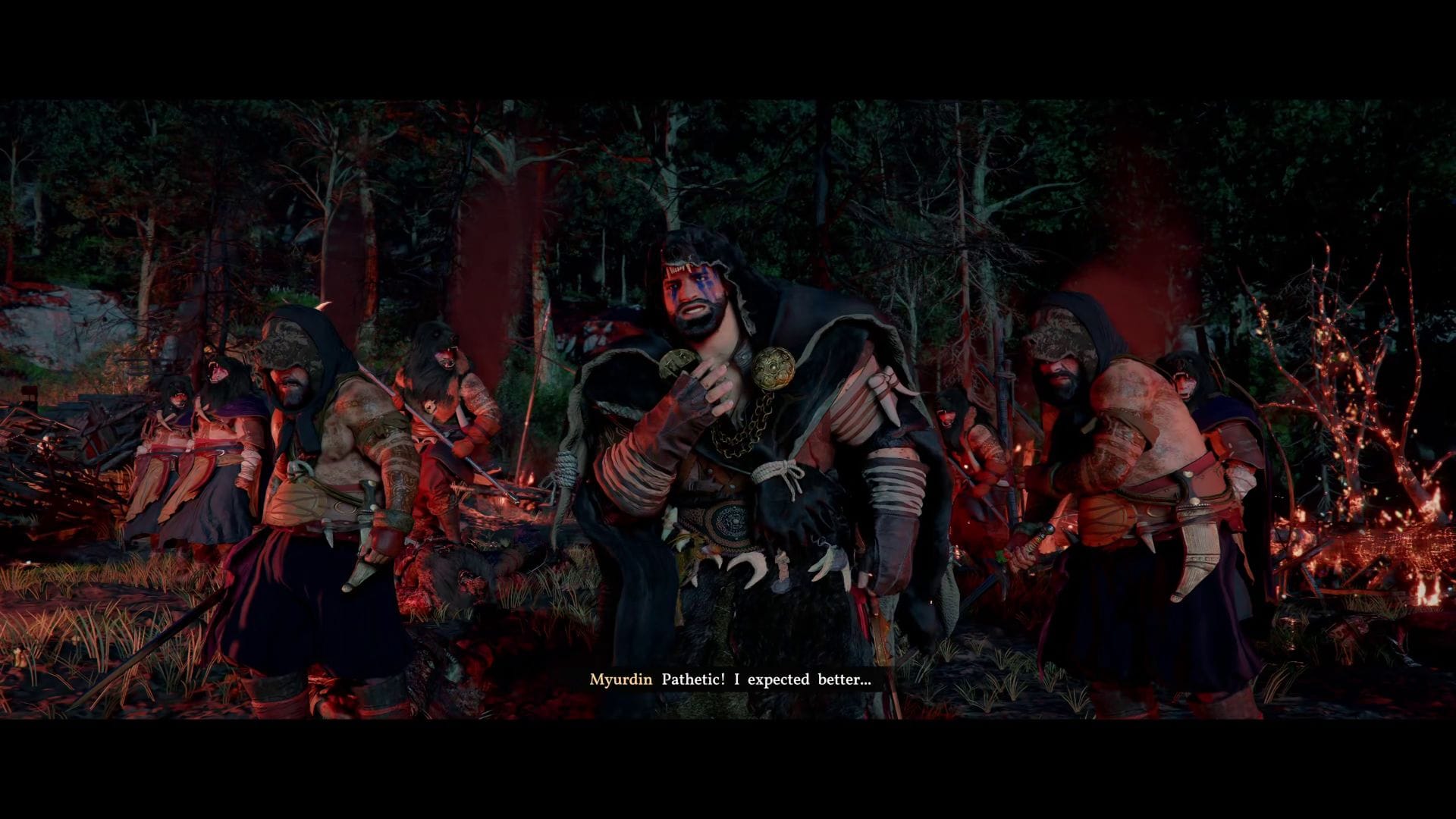
Once he gets his feet underneath him, Kliff sets off to reassemble the scattered Greymane clan. Scattered, there are a handful of folks that survived the Black Bear's assault, and before long, Kliff has done enough favors for local leaders to be granted a small strip of land to encamp his newly-assembled coterie. Kliff is eventually joined by a woman named Damiane from the neighboring nation state of Demeniss. From there, the world is yours to explore.
Want to see what's inside the Collector's Edition of Crimson Desert? Take a look!
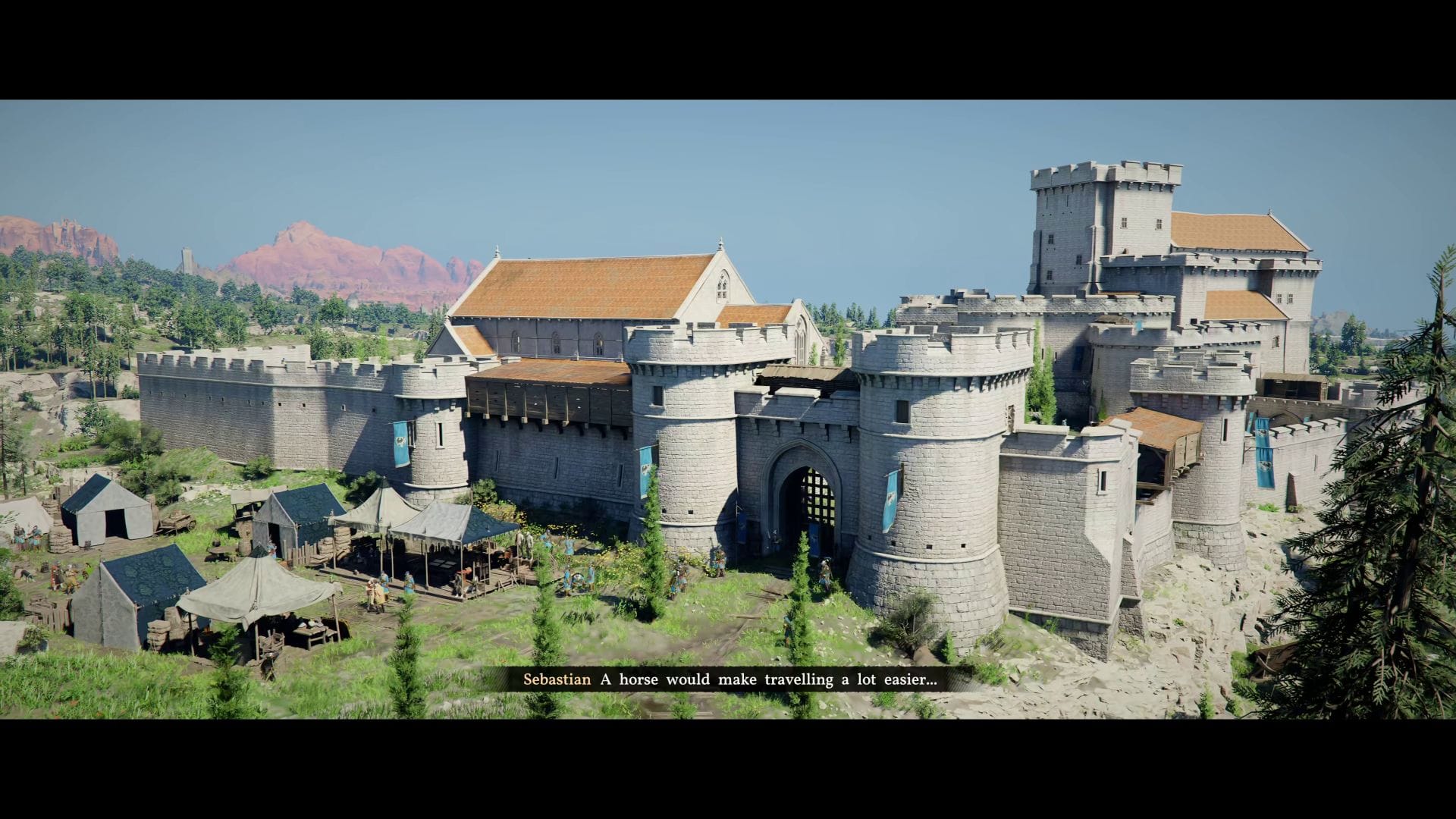
There are five regions in the world of Pywel. Hernand is where your adventure begins – a lush and mountainous region, unfortunately beset by bandits. Demeniss is a major military and political power, akin to medieval France, complete with massive sprawling castles and heavy armored knights. Pailune is to the far north. A mountainous region, it's a frozen tundra, difficult to navigate, and even more difficult to survive. To the far east is the kingdom of Delesyia. Delesyia is a scientific powerhouse, filled with strange and wondrous mechanical marvels beyond imagining. Last but certainly not least is the most unforgiving of all — the titular Crimson Desert. This massive red sand desert is largely unknown, but what is known is that it's unsafe, but far from uninhabited — tread carefully.
Back to Kliff's story, it'd be easy to look at an MMO like Pearl Abyss's other title, Black Desert, and assume that Crimson Desert will be thin on the ground in terms of meaningful storylines and quests. You couldn't be more wrong. Yes, this game was originally intended to be a sequel to that MMO, but the pivot was a full direction change. Every mission feels like it builds on the world you're experiencing. You have fetch missions, bounties to hunt, and your usual delivery stuff, but that's just the appetizer.
The story of Crimson Desert will take you all across Pywel, involved in everything from deep-seated political kingdom affairs to the bizarre and magical. Even more impressive, the characterization and world-building remain high-quality even through the side quests, of which there are many. Few games have had the feeling that side content was worth as much punch as the mainline, but Crimson Desert delivers with aplomb.
Take a tour of Crimson Desert's multiple fun systems. For fun!
Regarding side missions, just know this is where you'll likely spend so much of your time. For those of us who get easily distracted by shiny things, Crimson Desert could be a problem. Each kingdom has factions, and each faction typically has a chain of storied side missions to pick up. The Greymanes, your primary faction, will have dozens of missions to take on, and as you build up your camp, you'll be able to assign folks to different projects (from mining or farming to security detail for local nobles). Let's dig into that system - it's deeper than you might think.
Your camp starts off as three tents and a dream. A handful of Greymanes are there licking their wounds, but nobody is rebuilding anything in this state. As you get your footing, recruit more crew, and build up your social standing with the locals, you'll get a chance to expand the camp. This will happen several times throughout the game. When you expand, you'll find things like farriers, a camp cook, a sundries salesperson, and other vendors you would have otherwise had to trek into town to find. Expand it further, and you'll have a blacksmith, somebody to make furniture, a ranch to raise animals, and even a farm. You go from having to go into town to buy supplies to being able to construct, raise, or grow them at your camp. Food is a central part of this game, so building out that supply chain is crucial to your bank account health. You'll also be able to put the other parts of the crew to work.
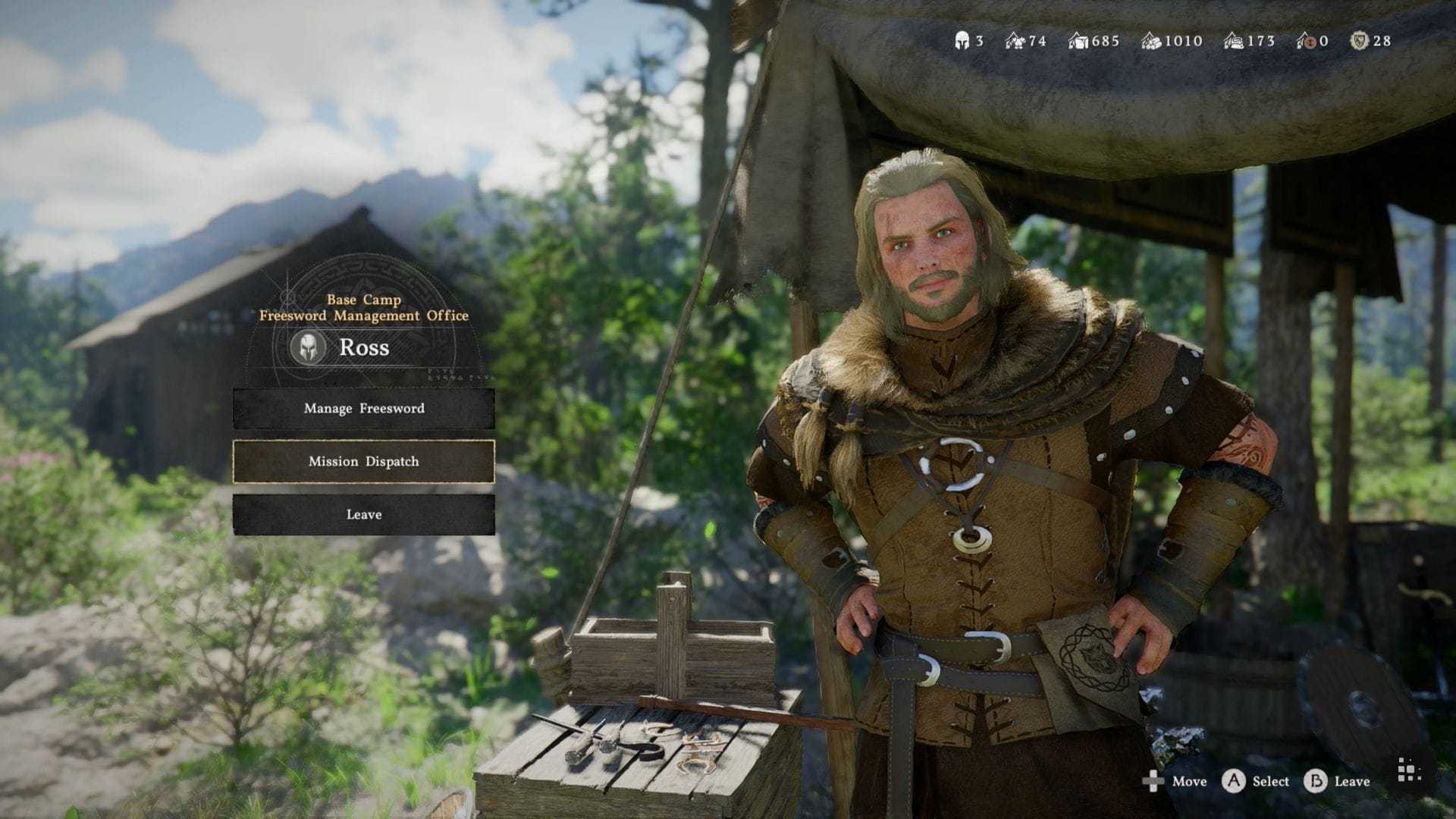
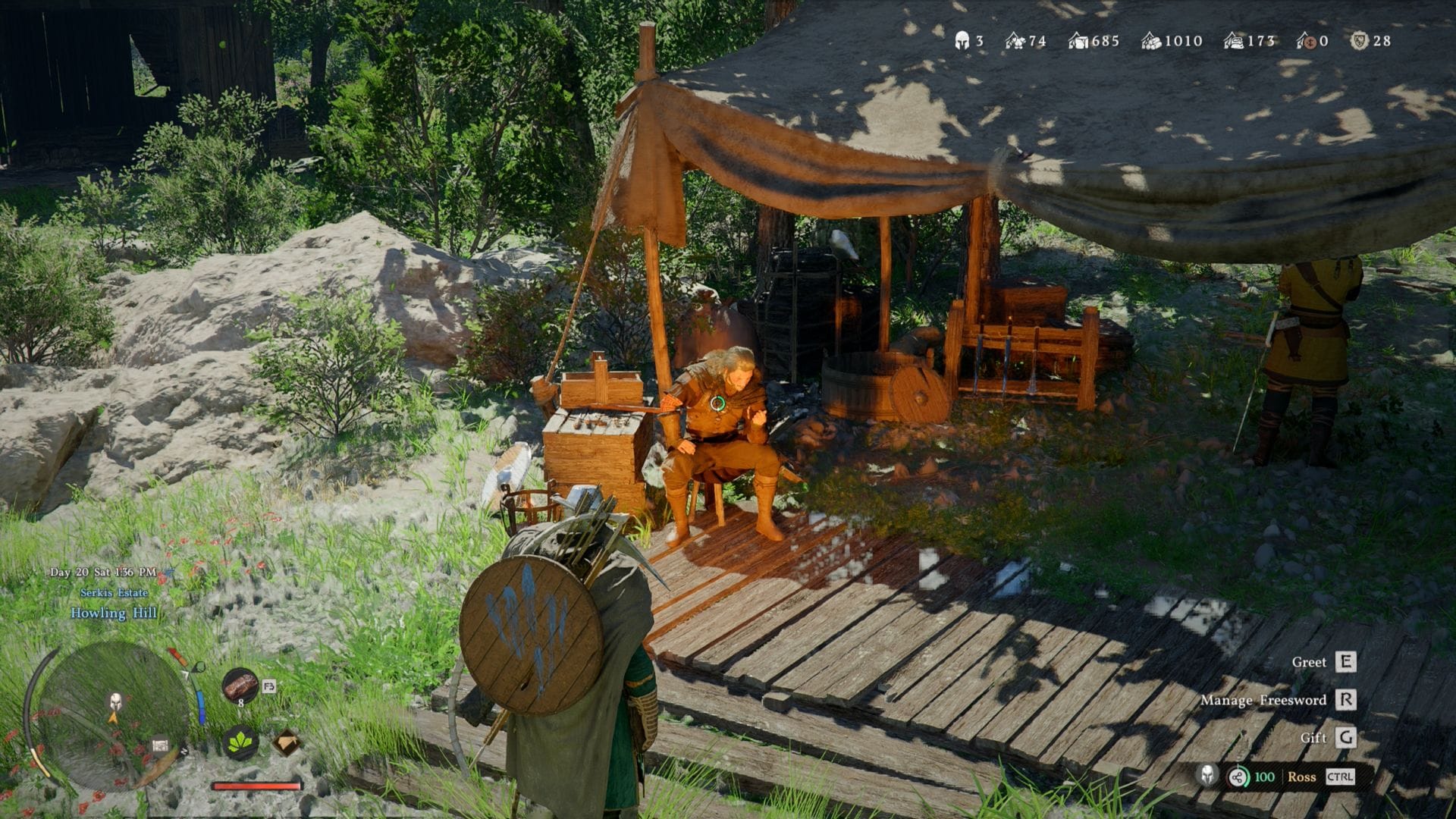
Camp management is an integral part of Crimson Desert's ecosystem.
One of your crew minds the overall health of the team. Talking with them you can send them out to do work on behalf of the Greymanes. Each of them has a specialization; farmer, construction, guard, engineer, and more. Assigning them to a task has a cost — you'll need to pack a lunch for them, they'll need some materials or tools, etc., but they also come back with a product after a period of time. That could be 1700 food for the camp, but if you assign specialists or brute force it with multiple people, that could jump up dramatically. It's a fun minigame that puts all these layabouts to work, and it ties into one of the mechanics that frustrated us — carts and trade.
Once you get access to build a cart (there are three sizes), you can start to load up goods and carry them around to the five cities for money. The hitch is that they deal only in volume, so you'll need a quantity of 25 of whatever you'd like to trade. Loading up 25,000 food (each quantity is 1000 units), you'll pack up the cart and drive it to its destination yourself. When you arrive, you'll find a market that changes every 7 days — buy low, sell high. Or, they may not take that item at all. Unfortunately, there's no way to tell until you arrive. I'm hoping the team will continue to flesh this out post-launch as the friction on this system is a bit high.
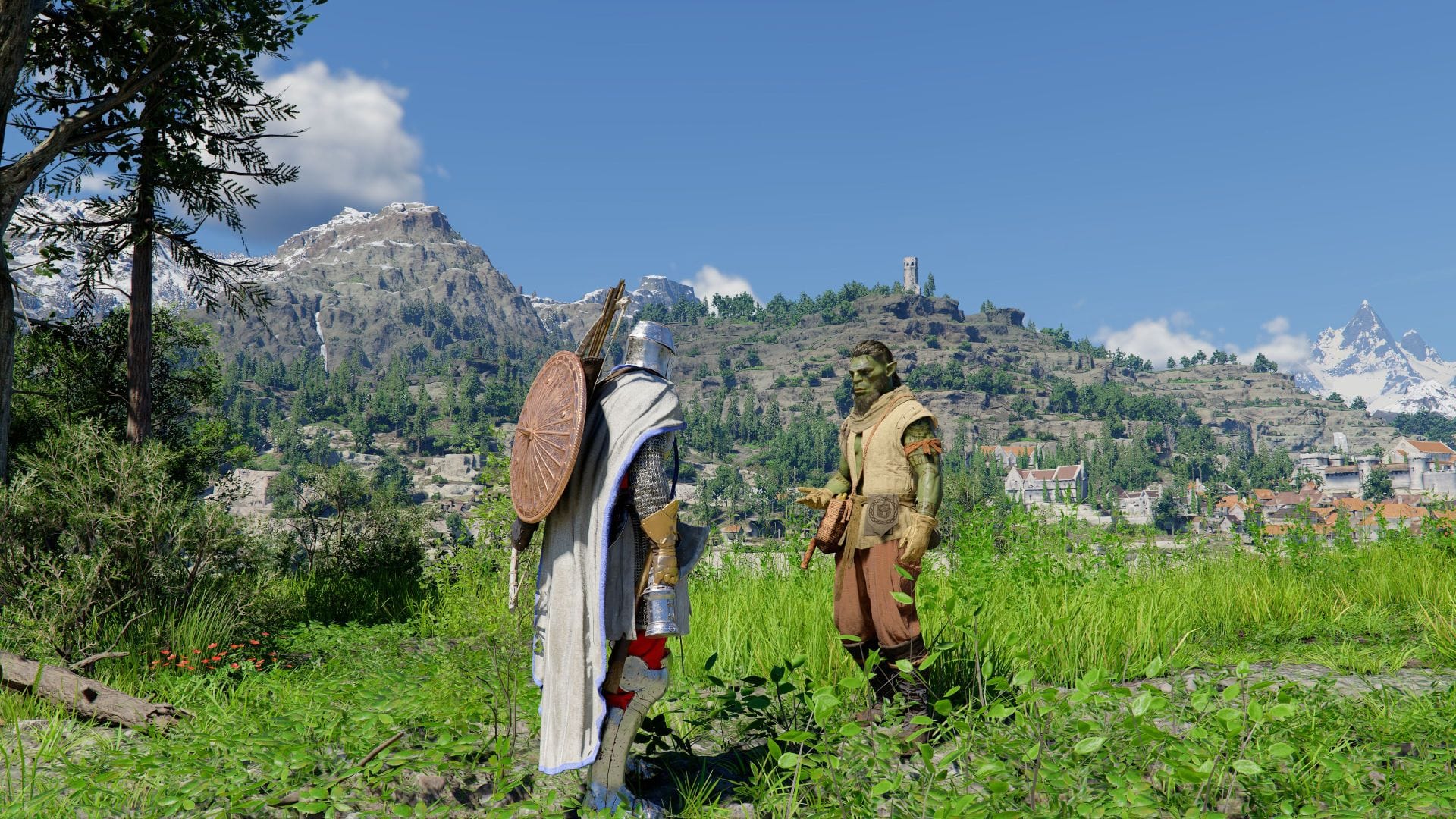
Back to camp, you can take on a great many more activities. Farming means going out and dropping seeds into holes and then harvesting the results (sadly, the rake, hoe, scythe, etc. don't have a purpose we could discern). Capturing a wild horse, riding it around to level it up (they gain a number of new abilities like instant acceleration, higher speeds, etc.) and then selling them for money is an easy revenue source. Crafting up new gear and upgrading it at your smithy is equally as rewarding. Cooking, hunting, logging, mining, fishing, and blacksmith work are just a fraction of what you can do to keep yourself well-stocked and meet the needs of those around you. Of course, you could always just steal what you need and try to fight your way out of it. Your approach is entirely up to you.
If all of that, the side missions, the main missions, and two additional characters (more on that in a few) isn't enough, there are also 15 minigames (including arm wrestling, archery, boxing, and Rock, Paper, Scissors). If you prefer to spend your time in a gambling den, knock yourself out. Just be mindful of people at the table trying to cheat (and hey, if you catch them, you can call it out and a nearby guard will crush their hand with a pole hammer)! The card game is a real-world Korean game called Seotda. While it's spelled out in detail in the game's instructions, it can be a hard hurdle if you've never played it before. I found this primer which helped me a great deal. Hwaiting!
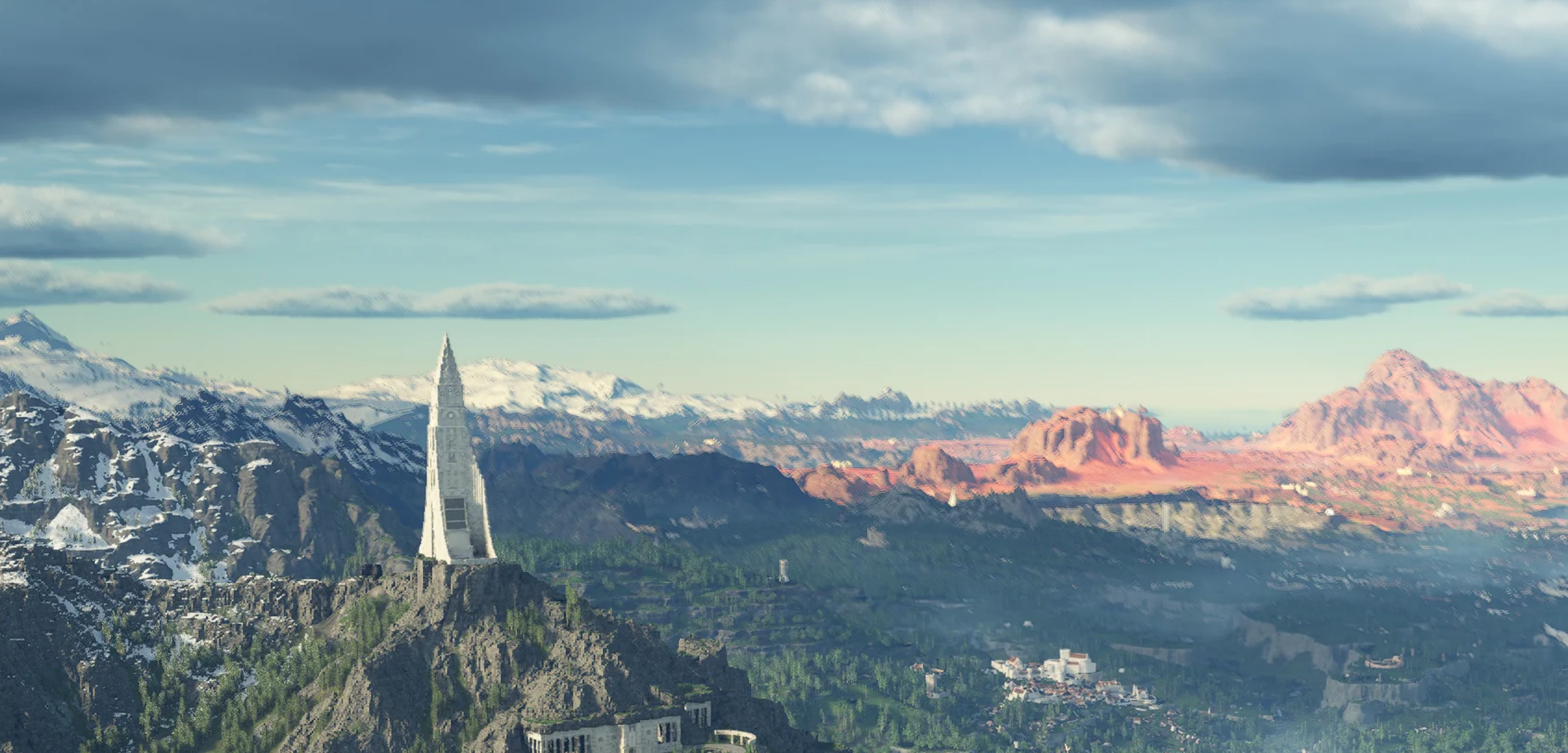
One of the favorite pastimes of Redditors and YouTubers alike pre-launch was arguing over how long this game is and how big the map would be. Whatever they told you, it's wrong. It's so much bigger than whatever they said. Frankly, it's difficult to determine how long this game really is. The main thread looks to be around 100 hours, but it'd be almost impossible just to do that. There's so much around every corner, just begging you to explore. This is a game about moments, and there are more than I could reasonably begin to express if I spent triple this document doing so. Want to know why you got darted in the neck when you went into the forest that one time? That's on you to find out. Are those hot air balloons on the ground? What's in that massive tower in the distance? Some of what makes Crimson Desert special is its unwillingness to answer any of this for you — get on your horse and go discover for yourself. That's also the one area of caution I might add.
If you are the type that needs yellow paint to figure out where to go, this game might not be for you. There are over 300 tutorials (again, not a typo) for all the systems in the game, but they are more guidance than hand-holding. You might be shown that you can light an arrow with a nearby brazier early in the game, but it's on you to remember it 50 hours later when you run into a vine-covered door — there's no pop-up reminder here. If you, like us, are frustrated when a game presents you with a puzzle only to have a main or side character immediately spout off a hint or the answer, then you might appreciate the opportunity to figure it out for yourself. It's also one of the few problems with Crimson Desert.
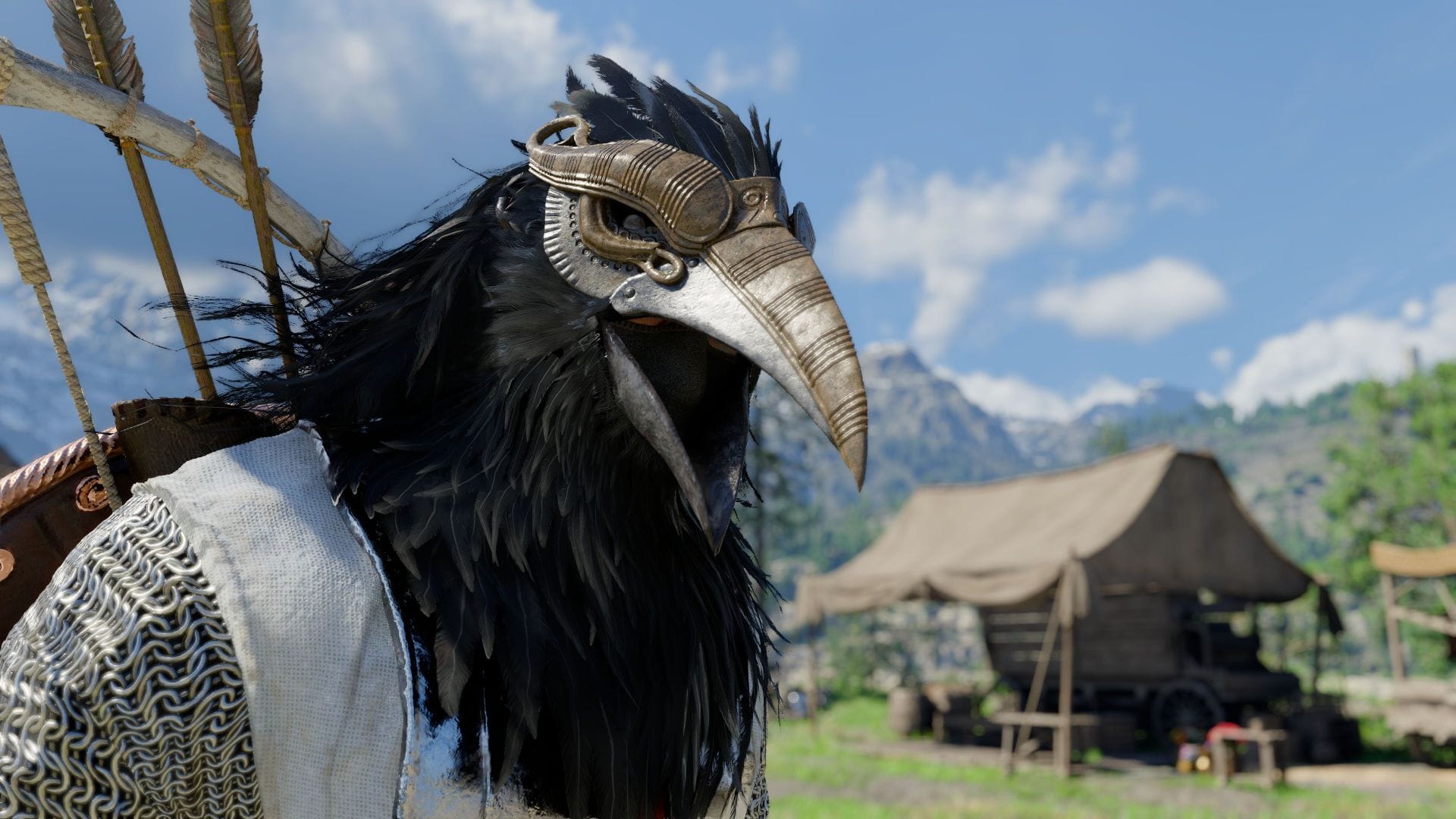
When there are instructions, they can be obtuse or counter-intuitive to the point of frustration. A fun minigame suddenly becomes friction when it doesn't operate the way the instructions suggest. It's not a hand holding problem as much as it is a clarity issue. Refinement of the instructions or a short video tutorial would help. The game is yours to discover, but sometimes it can be rather obtuse to know what it wants from you. This is only made worse when the feedback is equally as obtuse, telling you that you failed "due to lack of control".
All of that said, I should tell you what this game isn't. It isn't a soulslike or a musou. It isn't Devil May Cry, and it's not Dragon's Dogma. It's somehow all of these games, and none of them, simultaneously. Thankfully, Crimson Desert does an incredible job giving you a toolkit for destruction. As with any fantasy game, you'll have your standard medieval weaponry and early firearms - swords, hammers, daggers, polearms, muskets, etc. - but it goes well beyond that. Upgrading these at the smithy means harvesting minerals and other mats from the world around you. These are augmented by a robust skill tree that'll keep you busy through the course of the game.
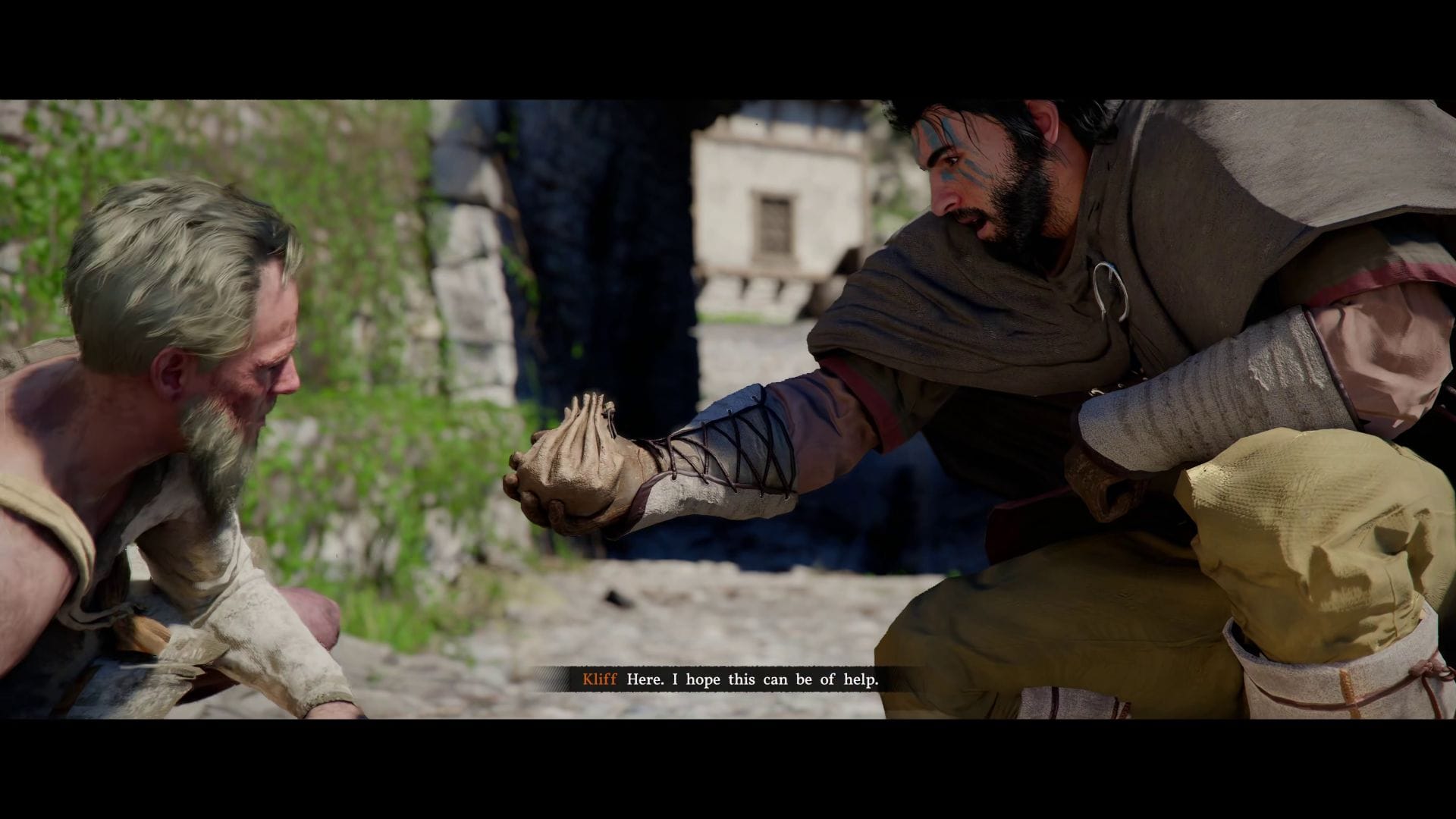
There are whole sections of the skill tree dedicated to fisticuffs and grappling, and those maneuvers are a blast. You can go full martial artist, delivering a hail of punches and kicks, or you can tackle, clothesline, and RKO like a WWE superstar. Even cooler, it all flows dynamically, so you can exercise everything in a span of seconds if you want. It's empowering, satisfying, and addicting in a way few games are. All of these things, and that's without even getting into the four elemental augments you can throw into the mix. There's even more, but I'm not going to run a bunch of huge surprises that come later in the game.
Combat starts off rather difficult, punishingly hard even, but as you find your rhythm, or more accurately once you settle into the rhythm the game is trying to teach you, and you'll suddenly feel it click into place. Wading into a dozen troops used to be deadly, but once you get the hang of things, running into hundreds just turns into a murder-Katamari Damacy as you obliterate everyone around you, destroying the buildings, barrels, and baddies aplenty. The game never stops being dangerous, and occasionally, it'll put you in your place, but it fully embraces the power fantasy every RPG player craves. Now let's talk about the exclamation point that can suddenly punctuate any fight without warning.
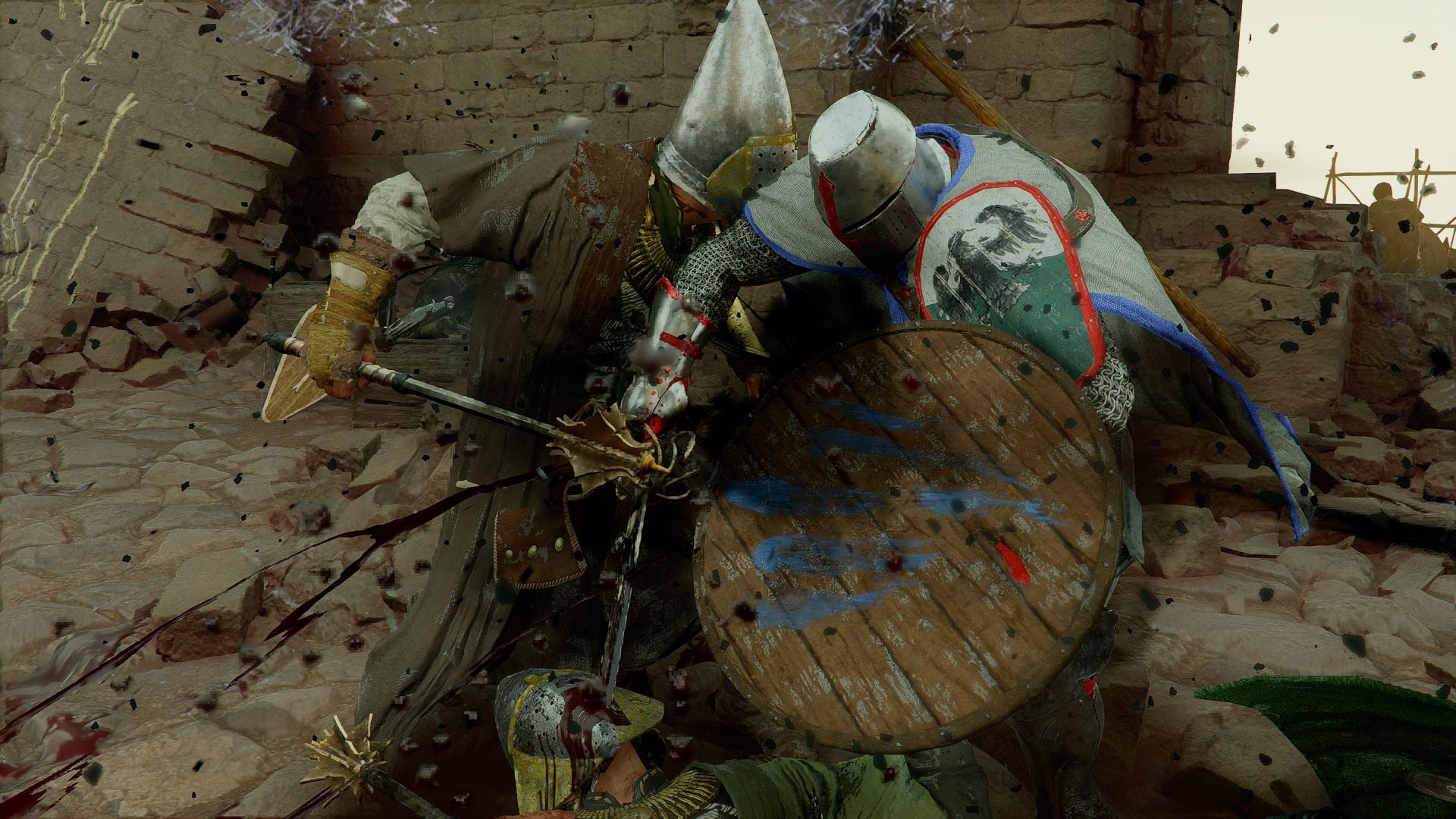
There are 75 bosses in Crimson Desert. That's not a typo - that's over six dozen bosses. These can show up at any point, and frequently do. One early boss shows up in the middle of town and proceeds to throw you a beatdown. Squaring off against this armored Knight who took a moment in our fight to demonstrate how to do a flying knee, and ultimately thanked me,arrived without warning. In other games, bosses are waiting, lonely, at the bottom of every dungeon. Here they appear without a moment's notice, creating a sense of danger that never quite goes away. These bosses are brutal and can kill you easily if you're unprepared. Keep a bag of food and healing equipment handy — you never know when they'll become suddenly crucial to your progress (or sanity). Bosses can be a serious ordeal, too. While you may be able to beat a few on your first try, there will be encounters that take players a couple dozen attempts to conquer. Or at least that's what you might think — let me elaborate.
There are plenty of bosses that will turn you into paste in the blink of an eye. They seem insurmountable on first contact, and maybe you're struggling no matter how hard you try. You're burning all of your consumables, and you just wonder if this was how the team expected you to tackle this skill check, right? I'm telling you something right now — you're missing something.
During one sequence, some professional-level idiots decide to bring a chained beast into a crowded banquet hall and proceed to shoot it for sport. Naturally, this turns out precisely as you'd expect, and you suddenly find yourself trying to kill the beast. This fight is no joke. Multiple phases, a boss that can club you to paste in seconds, and one that will likely stop you dead in your tracks. With the right skills, you can persevere, but it's going to take patience, timing, a lot of food, a handful of your Palmer pills (for revival) and upgraded gear. Or...it might not. If you happen to have the right equipment, you can hit this boss just a few times; it'll do a tremendous amount of damage, and it'll be over in the blink of an eye. Similarly, if you're struggling to escape his almost-impossible to dodge attack, you can grapple to the ceiling. If you don't know these things, or haven't figured it out yourself, this might be a brick wall that just frustrates you beyond reason. That's Crimson Desert in a nutshell, though. There IS a way to tackle a thing. You can brute force your way through it, and with enough food and healing resources, it's possible to grind your way through it, but there's also an excellent chance that there's a silver bullet out there that makes it trivial. Finding it, on the other hand, is a whole different kettle of fish. Knowing this going in changes the context a bit, which is why I'm telling you all this right now — don't bang your head on the wall if you find that it's a sheer cliff and not an escalation.
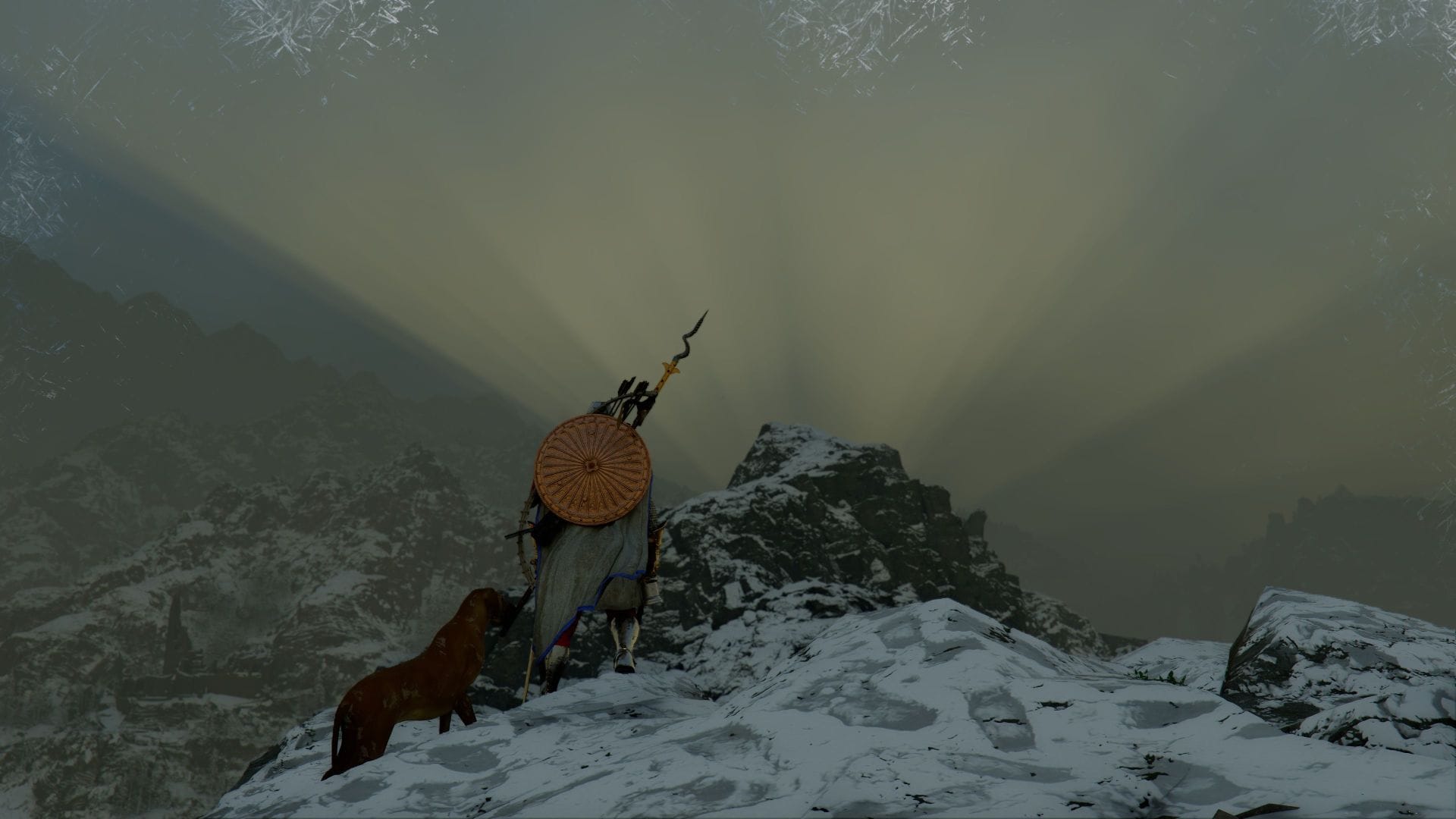
So much of Crimson Desert is interconnected in a way that games like Skyrim and Breath of the Wild, fantastic as they both are, only ever scratched on the surface. The game often feels like a perfect amalgamation of both, but that description only begins to describe this game. Crimson Desert has a physics system that plays out in some fantastic ways. You can body slam a foe into a nearby tree, watch the tree crack, split, and fall on their friends. Jump forward and drive your knee into a nearby bandit's chest and zip him off a cliff, then turn around and unleash a torrent of arrows into the chest of a charging troll. Snatch up his support buddy with your Axiom Force ability and slam him into the stone at your feet. The same Axiom Force also applies to how you solve puzzles. Maybe you need to turn some dials to specific places based on other places you've found in the world – and yes, I'm being vague on purpose as these puzzles are a real treat. Perhaps you have to move some circuit board-like objects into what looks like sockets, slam them into position with your Force Palm power, and then use Axiom Force to turn the "knobs" to tune the machine. Or maybe it's a traditional platforming challenge where you move objects in the environment to make circuits, opening up new pathways as you leap through the sky on floating islands. No matter what challenge is in front of you, it interconnects with some element of the game's many mechanics – the same ones you used for hunting, fighting, and opening new paths. The game is not going to tell you what to do, ever, but it will almost always allow you to handle things your way.
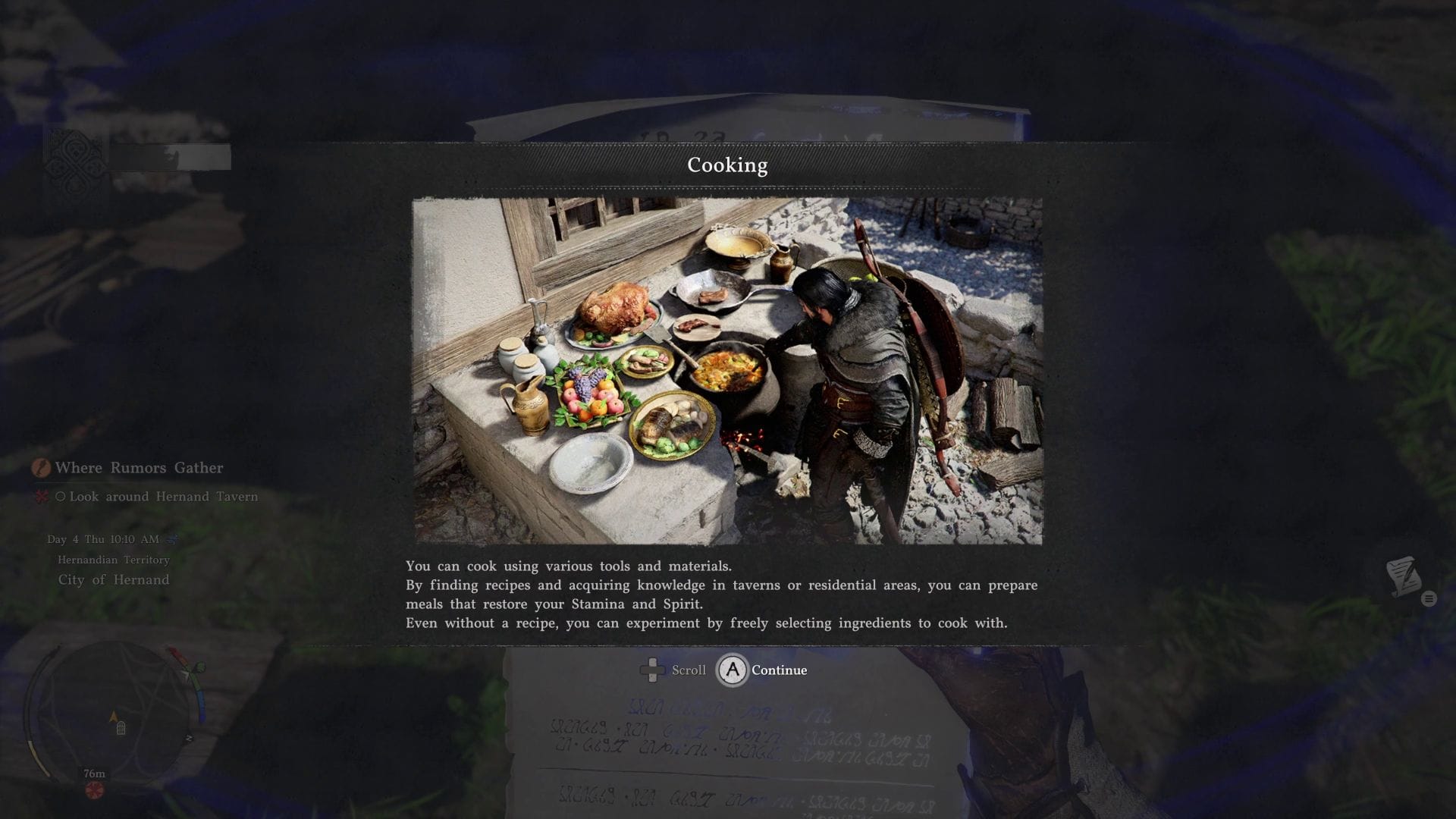
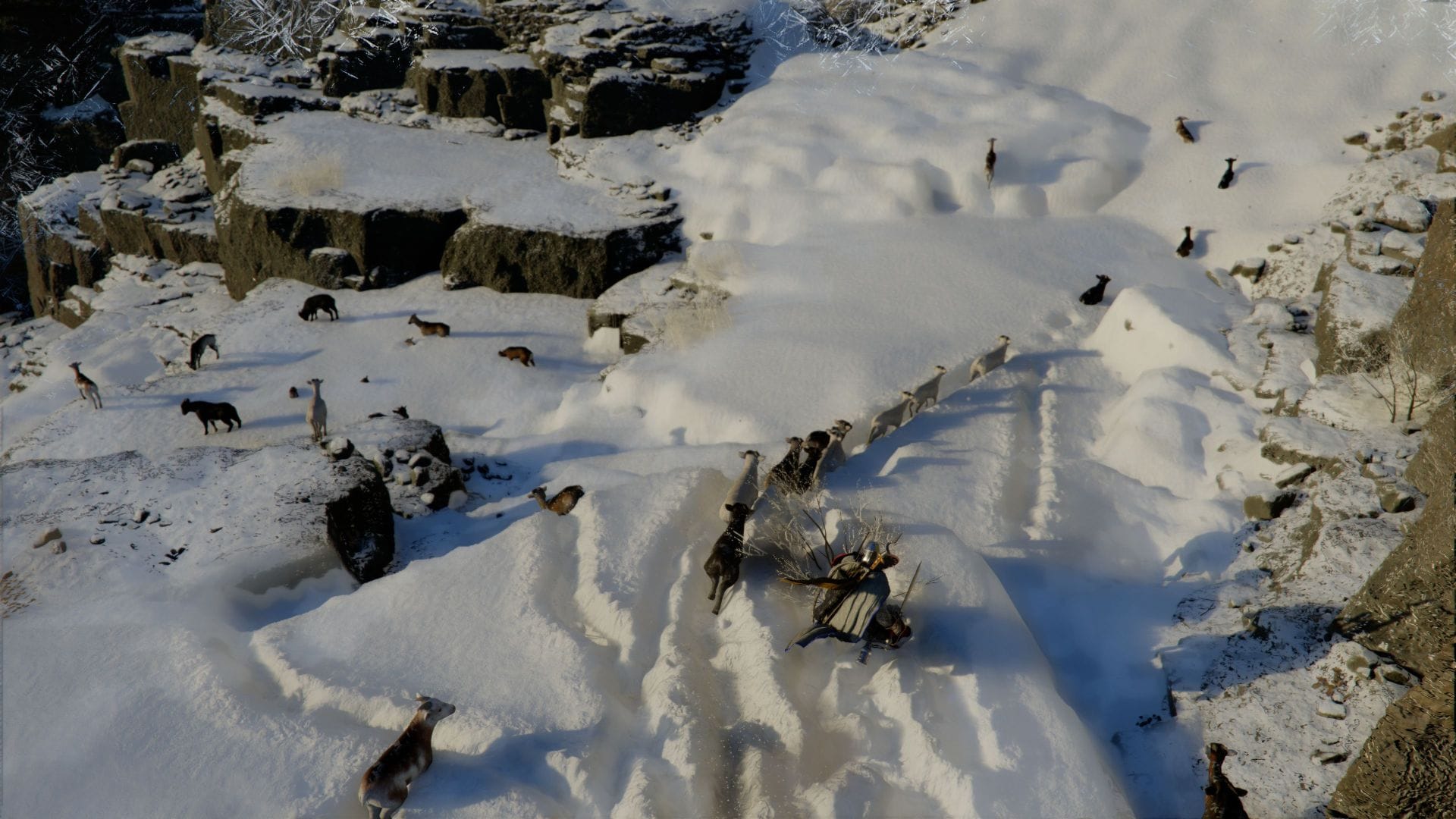
This feels like a good time to bring up the game's hunting and food economy. Meals are going to be your primary form of healing. You'll continually pick up and learn new recipes as you play the game, but knowing much of it is meat-based will be a solid starting point. You'll either spend your money or time obtaining food. Catching fish, shooting birds, and hunting deer or goats will all be valuable ways to spend time, so they can be harvested for meat and cooked. The land of Pywel is rich with hundreds of real-world animals (again, not an exaggeration). You can raise your own critters on your ranch, you can hit the nearby streams to pull fish out with a pole or with your hands (it's sometimes easier), you can hunt deer, and otherwise supplement your food supply. You'll need it, too — sometimes you'll need two dozen meals in your pack to survive their onslaught. Beyond food, you can even ride or tame more than a few of them. You can have up to 30 pets, nearly as many mounts, including a bear or a cow to ride into combat. It all makes Pywel feel like a viable living ecosystem.
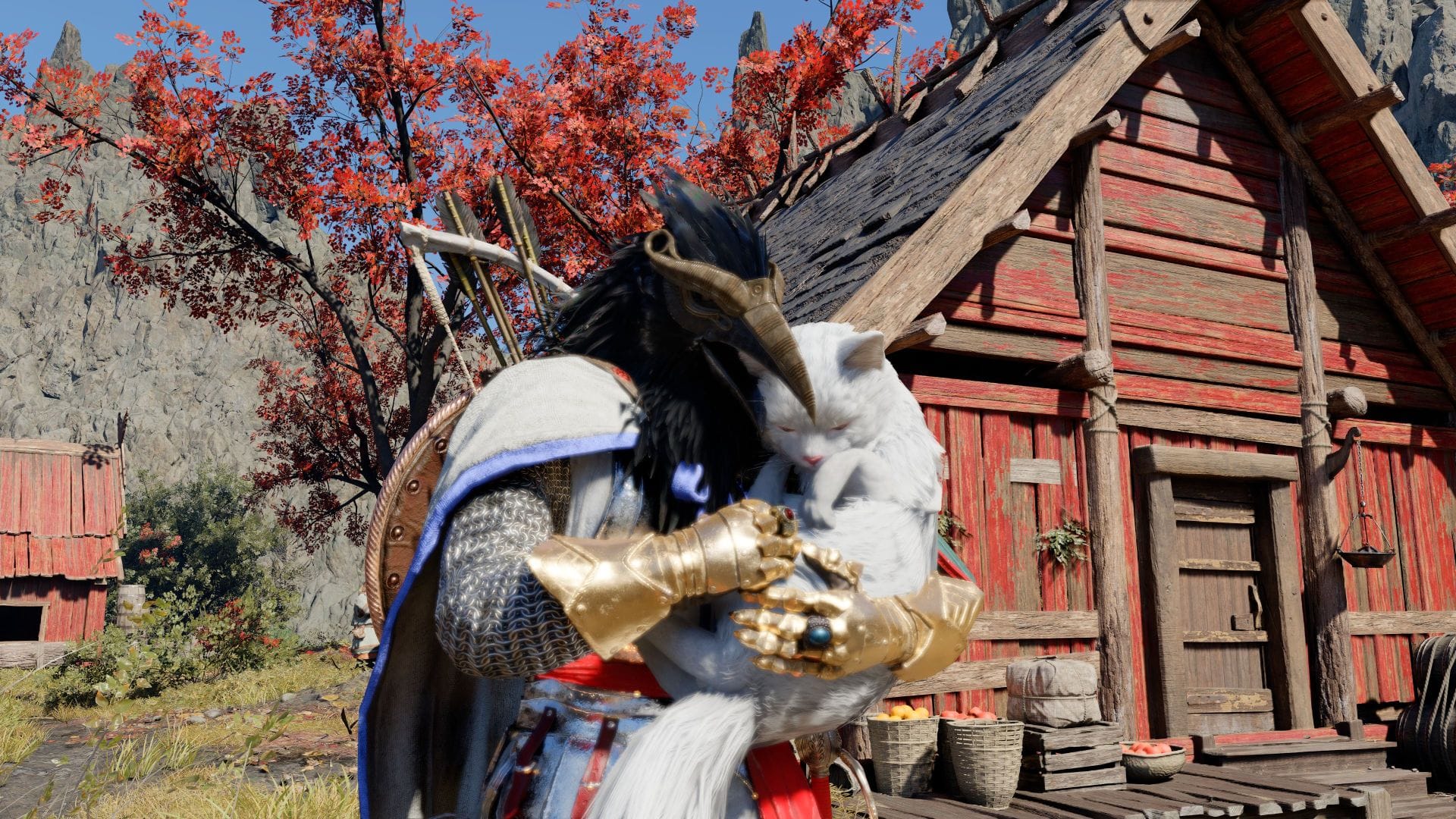
Much debate has gone into the size of the map, but more important than size (yes — it's accurate to say it takes upwards of four hours or more to walk from the starting area to the titular Crimson Desert — it really is that big), the map is not just overstuffed with icons and repetitive tasks. Instead, there are puzzles, caves, mysteries, and more dotting the map no matter where you turn. Some are simple, asking you to pick up and move a rock in a game that looks similar to the board game Go, and others require some real deductive reasoning skills. Too often, when a game is merely big, it fills the space with meaningless and repetitive tasks — here, I genuinely felt like there was always something interesting to do.
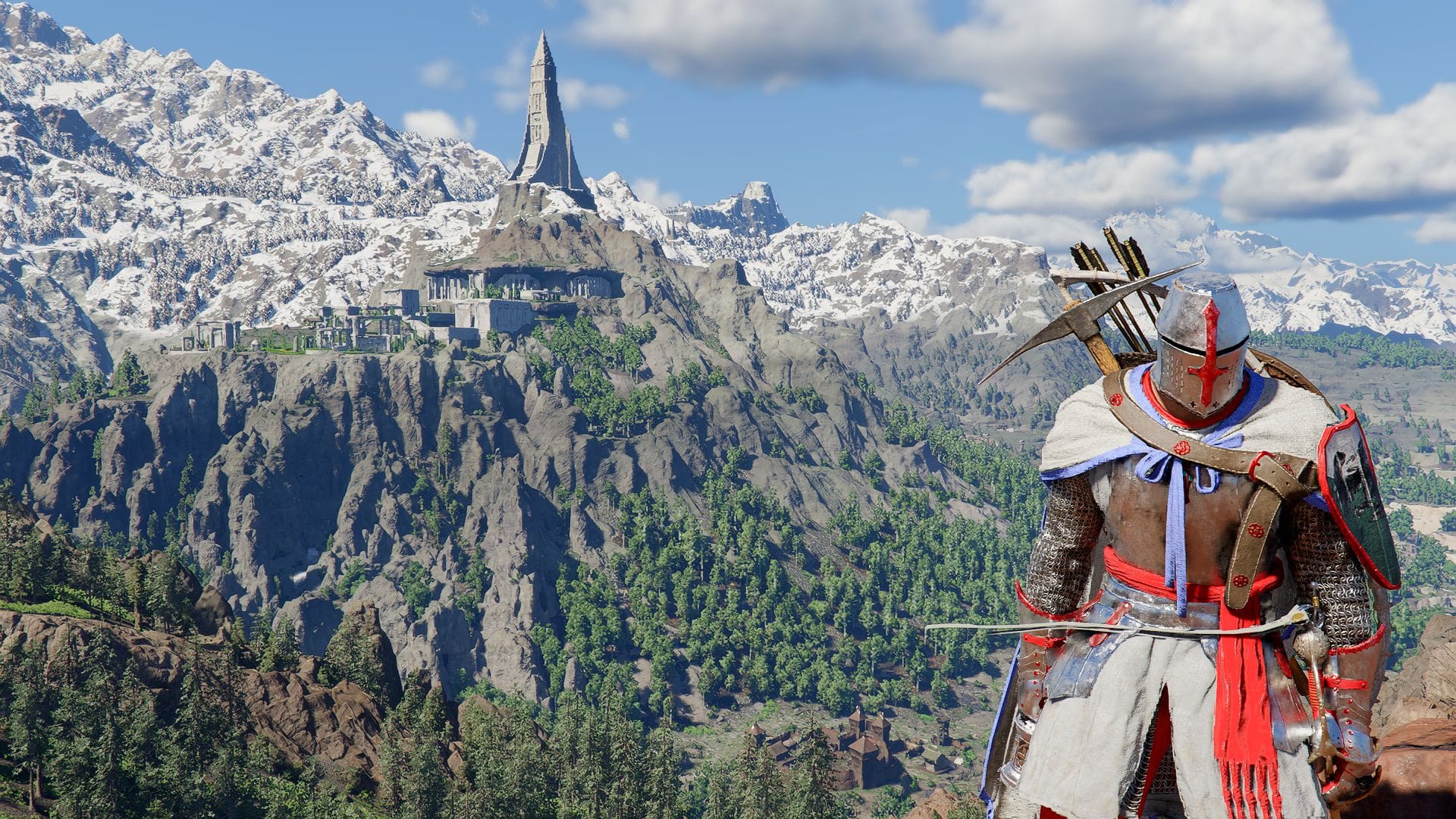
Progression in Crimson Desert is a little different than you'd expect from an RPG. You avoid all of the "kill 20 rabbits" to level up nonsense, instead focusing on mysterious artifacts that help you expand your skill tree. These unlock new powers, attacks, skills, and more, and also allow you to upgrade the health, stamina, and spirit of all three of your characters. The last three items are shared, as are a handful of basic skills, but for the most part, you'll need to build out the three protagonists to make them effective. You can, for the most part, switch between the three in a manner similar to Grand Theft Auto V, with the target character carrying on in their world while you're elsewhere. That means you might come back to Oongka in the middle of a massive fight, or you might find Kliff at the gambling den, or Damiane might be catching a bite to eat, or anything in between. It's another nod to the incredible sense of world building the team is putting on display here. Beyond these skills, however, your progression comes from two things — upgrading your equipment, and your own personal mastery of that character's combat skills. It's not quite "get gud, scrub" level, but some time and effort investment is required.
Normally, when I list off how a game has attention to detail, I try to make it into a coherent story of some kind. Here, there are so many that it's just going to be a disconnected explosion of examples.
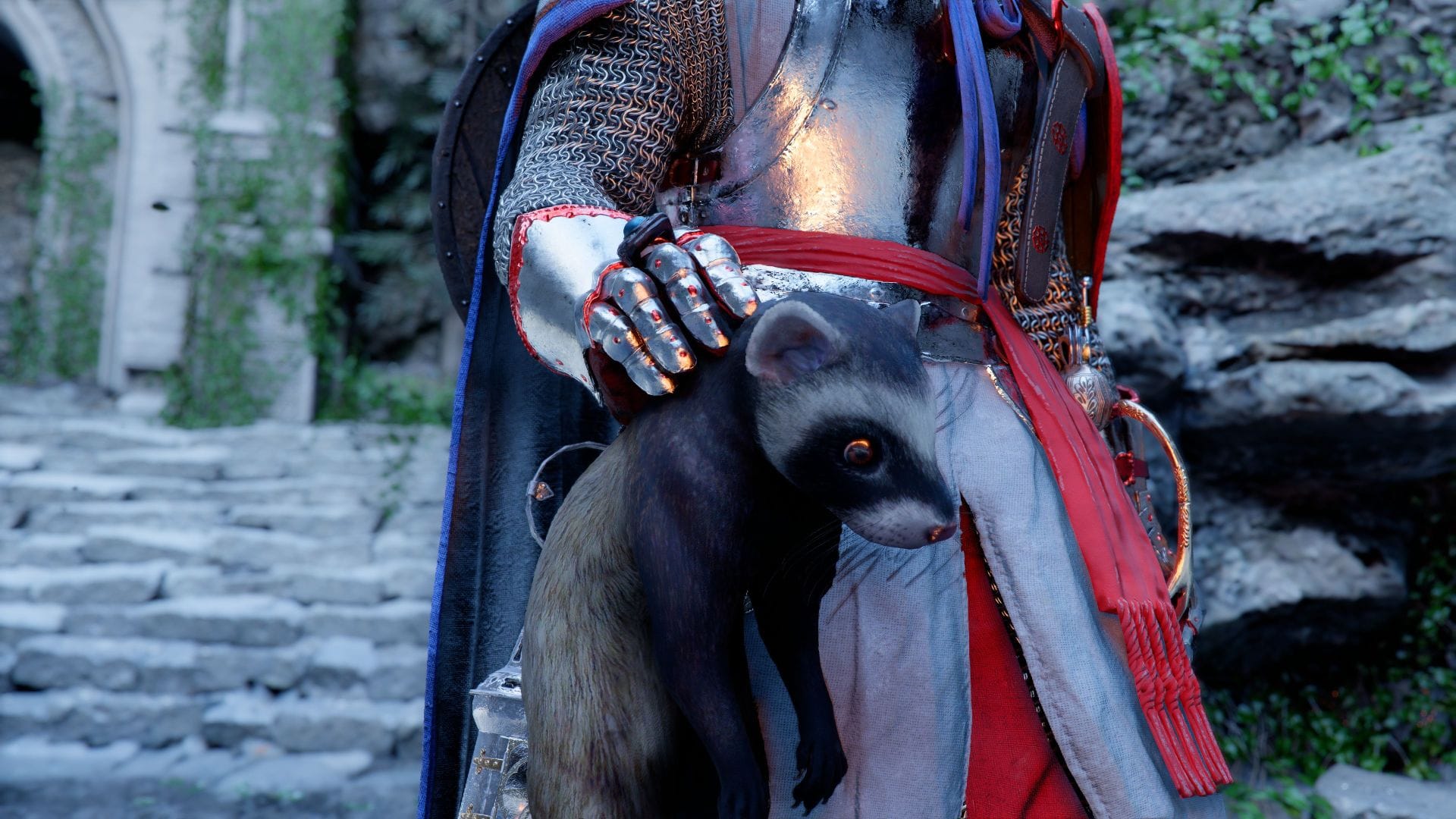
Muscles flex realistically when weight shifts from the rear leg to the front for a strike, and you can see the definition in thighs. Kinematics on horses and other creatures are similarly complex and wildly detailed. Bugs climb up trees, rabbits scramble over terrain, and lizards climb walls. Those same trees have deformation when you hit them with an axe, sending splinters of wood and bark when you hit it with an axe. Every object you can see on a desk, in a cubby, on a bookshelf, and throughout the environment are not only interactive, but physical objects - if you clamber on top of a table, you can send the contents scattering. The buckles on my armor are detailed at any viewing distance. Towers explode into shards when you hit them with artillery. Picking up Fluffy the lost sheep and carrying her bobbing, goofy little self back to her owner as she brays in our arms had me rolling laughing.
The rain in this game is absolutely stunning. It not only looks like rain, it looks cold and miserable to boot. It also impacts the environment in ways I've not seen a game do, even hand coded, pooling on surfaces, making cloth look wet, muddying up the environment, and putting reflections everywhere. Seeing the sky in the reflected pool after a hard storm, or looking part of the way through the water to see the fish zipping around under the surface is one thing, but seeing the water cascade down a stream, conforming to the rocks and hugging the landscape is another. This isn't a water texture, this is fully physics-based water that reacts to things around it. Like so many things in Crimson Desert, the water makes for some jaw-dropping stop and watch moments.
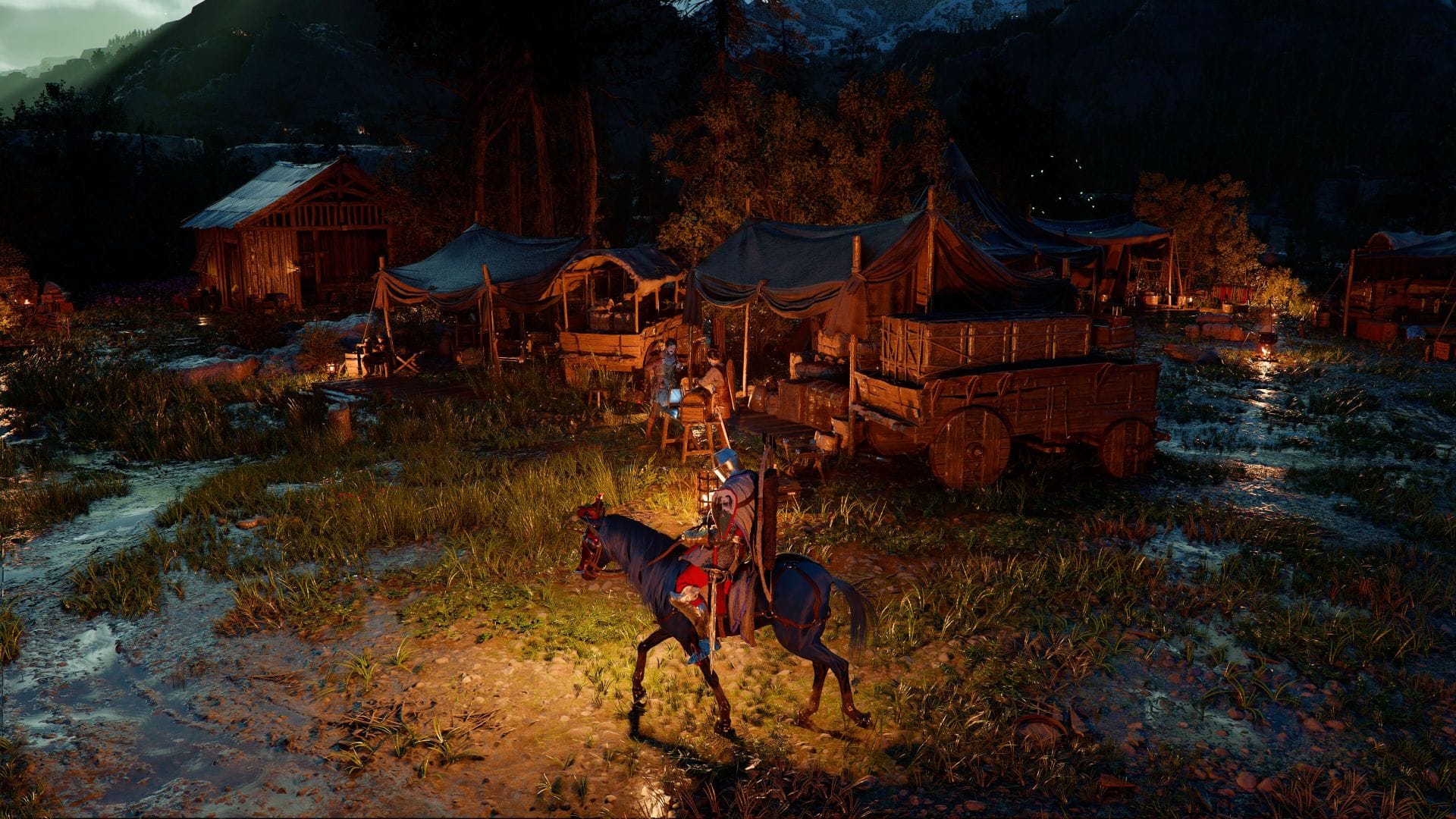
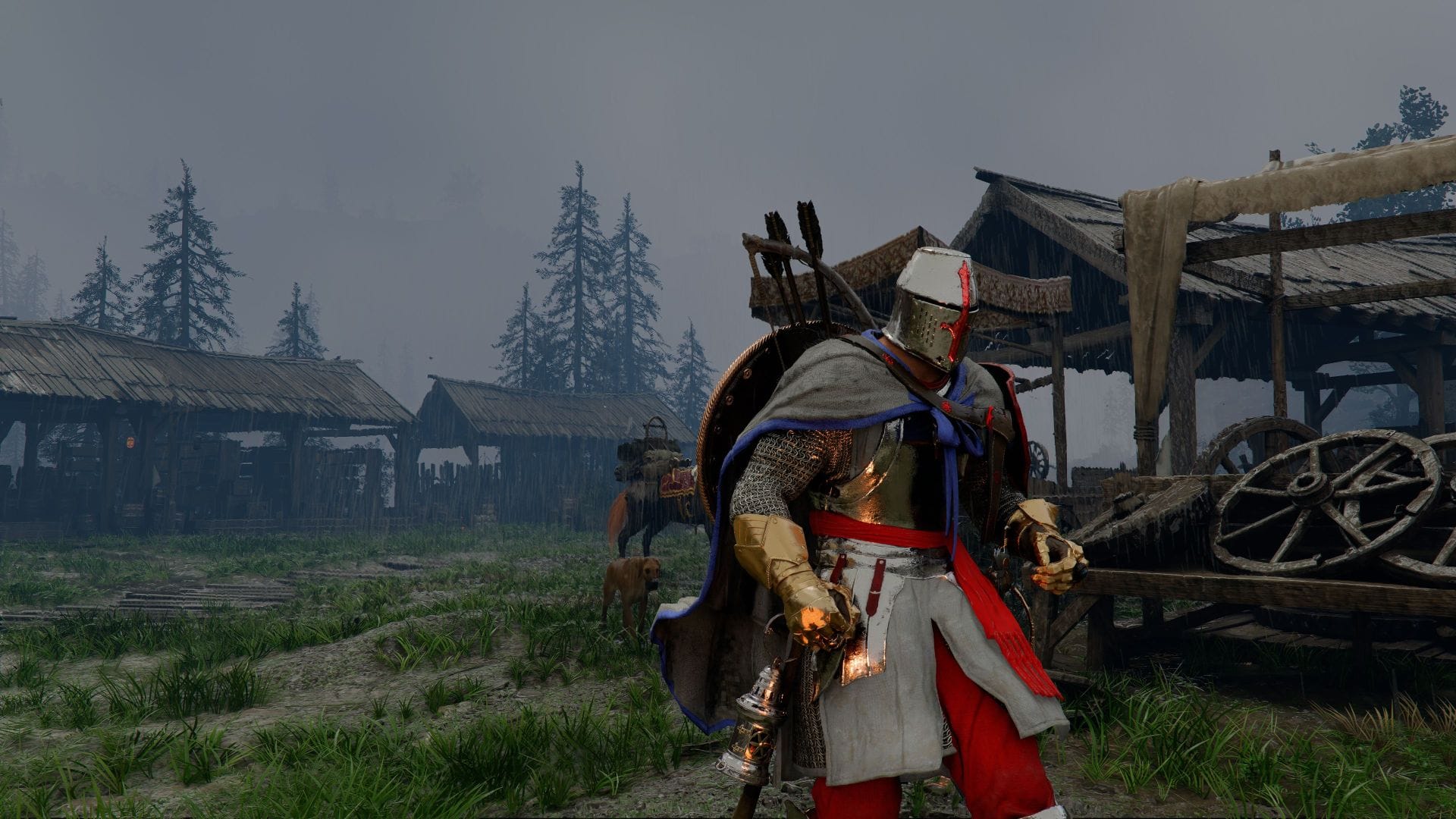
Crimson Desert has the best rain and water we've seen in any game to date.
The variety of landscapes across Pywel impresses, too. Of course, you'll have the Crimson Desert and its sands, but the world is also full of snowy mountain peaks, lush forests, hamlets, spires reaching to the sky, and so much more. There's rarely a boring view, especially with such an enticing aesthetic. Every biome is unique, and the team has spent a great deal of time shaping them to be more than reskinned versions of one another. Rolling hills versus jagged mountainous regions. Gently rolling sand dunes and smaller outcroppings versus a verdant and luscious landscape punctuated by castles. There's so much to see, and it's very clear the team wanted each of these areas to feel like a character unto themselves. You feel the change when you cross over from Pailune to Demeness, and I appreciate that.
For everything there is to love about Crimson Desert, it's not without its issues. It feels inevitable a game this big will have some open-world jank, but Crimson Desert keeps it to a minimum. Still, there are some things to keep in mind. As previously mentioned, the difficulty spike of boss fights can be a source of frustration, particularly if you aren't prepared for it. Being forced to rewatch cutscenes between boss fight phases each attempt can get irksome, too. Fishing feels like it had the potential to be a top-notch relaxing pastime, but it's completely unwieldy, and you can just jump in the water and grab the fish by hand. Breaking horses can be equally as obtuse at times.
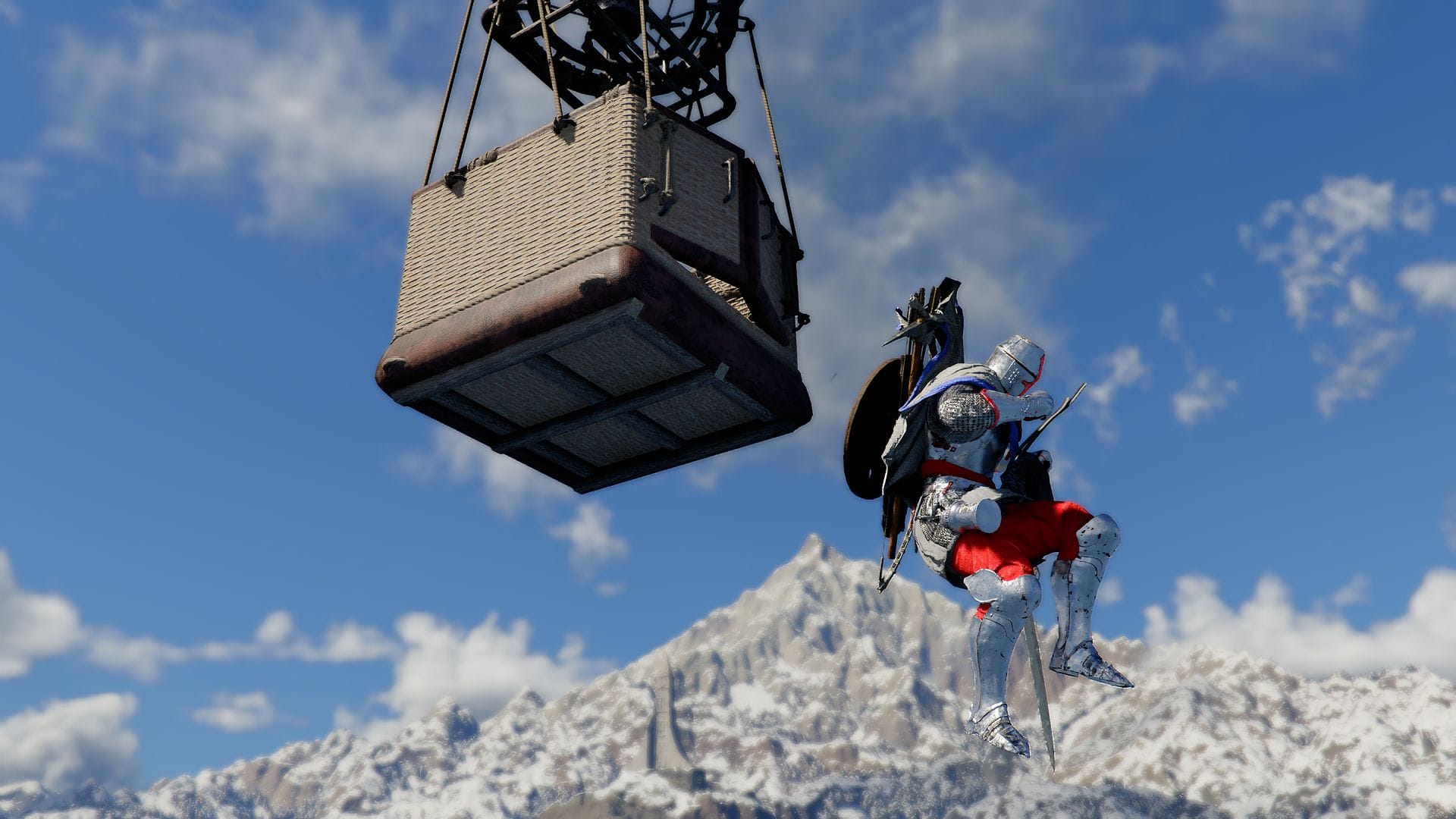
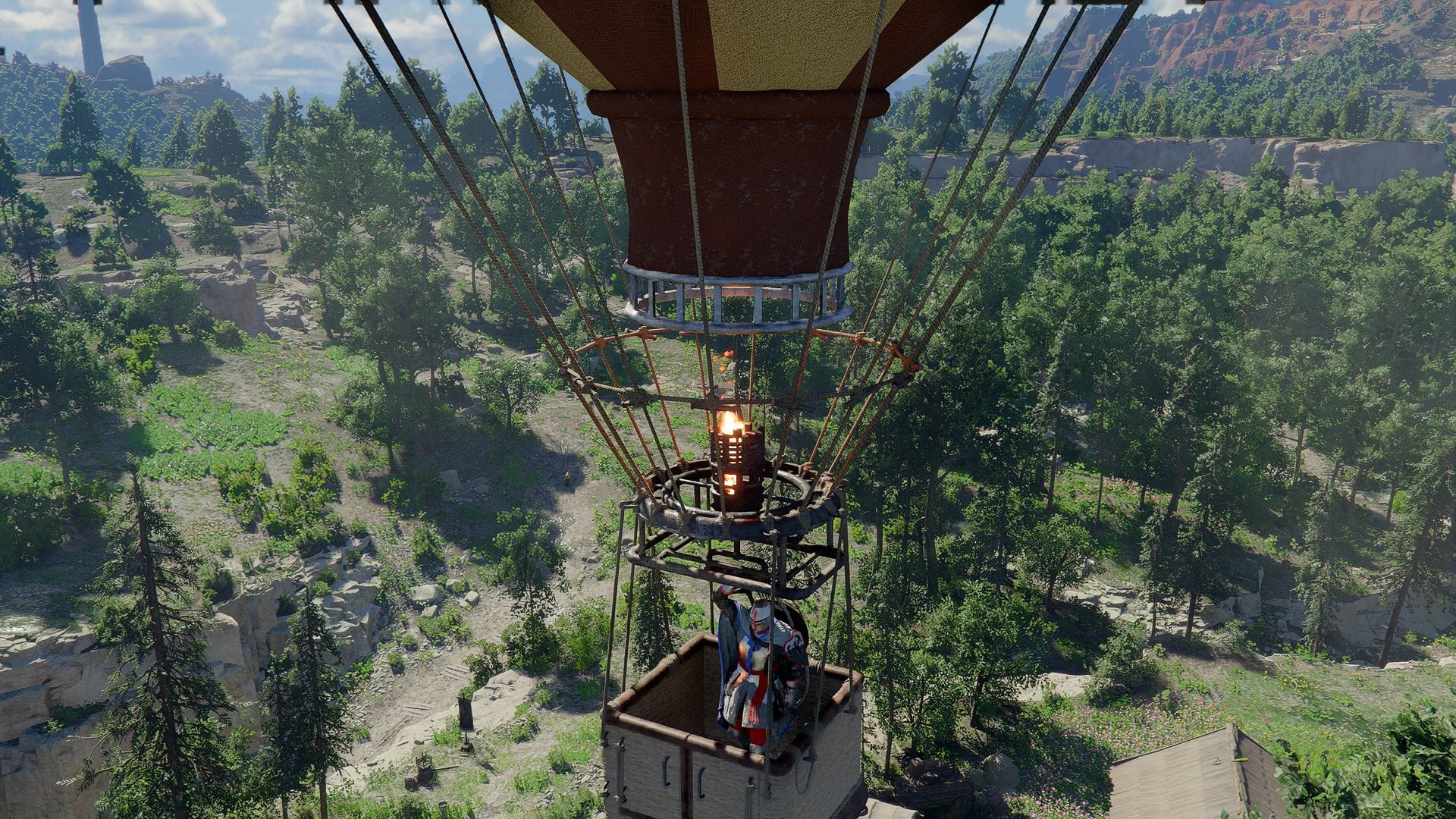
How you get around is incredibly varied in Crimson Desert
There are a handful of technical bugs, too. In our time with the game, we encountered a story progression-ending bug. Joe went to a location, solved a puzzle, and got an item. Several hours later, it became part of the main story to go get said item, but I already had it, and the game wouldn't recognize that, effectively killing my story progress until they can (hopefully) issue a patch to fix it. I ran into a minor quest bug where I solved the fourth objective before picking up the third, soft-locking progression on that one quest. These are thankfully few and far between, especially amidst the sheer avalanche of content, but when they happen to you, it can be somewhat demoralizing if you lose progress.
Thankfully, the team has already shown dedication and savvy with their patches. In our time before launch, they released updates that both solved major issues and introduced entirely new features. There were even overhauls to major systems that other teams would have taken weeks or months to build and test, but the Pearl Abyss team knocked it out in a matter of days. Assuming the team at Pearl Abyss can keep that momentum going, it shouldn't take too long to shave all the burrs off an otherwise excellent experience. It's impressive to see in action.
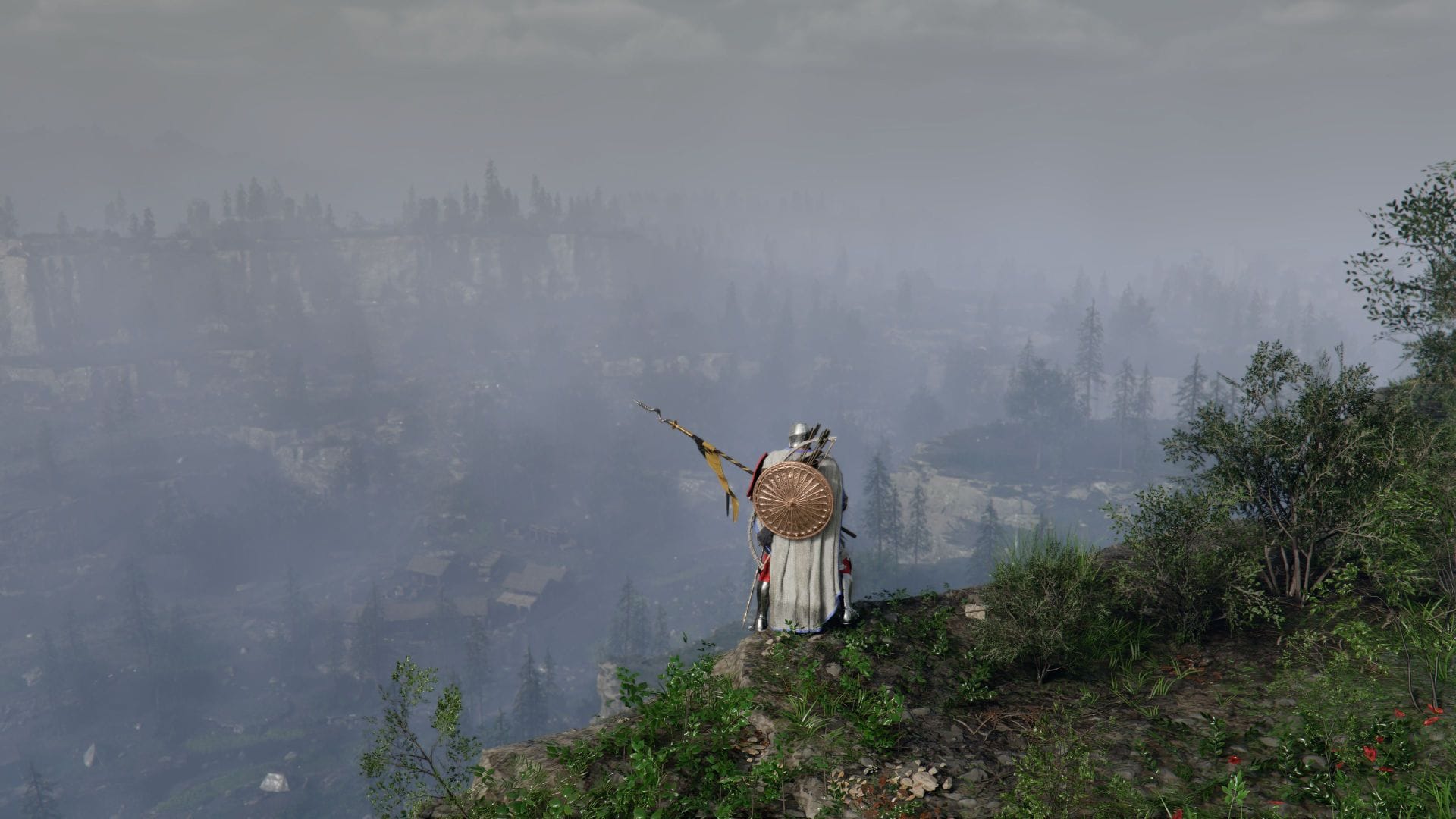
The voice acting and music in this game are both top shelf, and everyone turns in a rock-solid performance. More than once, I found myself just listening to the music in the background — it's that good. The NPCs on the other hand are fully voiced, but you're going to be awash in some line repetition. It's a bit of a nitpick, but after a while, you'll stop laughing at the nameless bandit declaring that he's going to skin you alive.
Saving the best for last, let's talk about the Abyss. The strange place you wake up in during the opening moments is a floating, hidden world that resides above the world of Pywel. These floating islands hold many secrets well beyond the ken of the folks that inhabit the world below. Mysterious mechanical objects, bizarre magical powers, and much more await the soul brave enough to explore these tricky puzzles, but they are also among the most satisfying head-scratchers Crimson Desert has to offer. I can't ruin this for you as it's too cool to find out for yourself, but if you find yourself needing a break from the intrigue of the surface world, pop up to the Abyss and see what challenges lie in that realm.
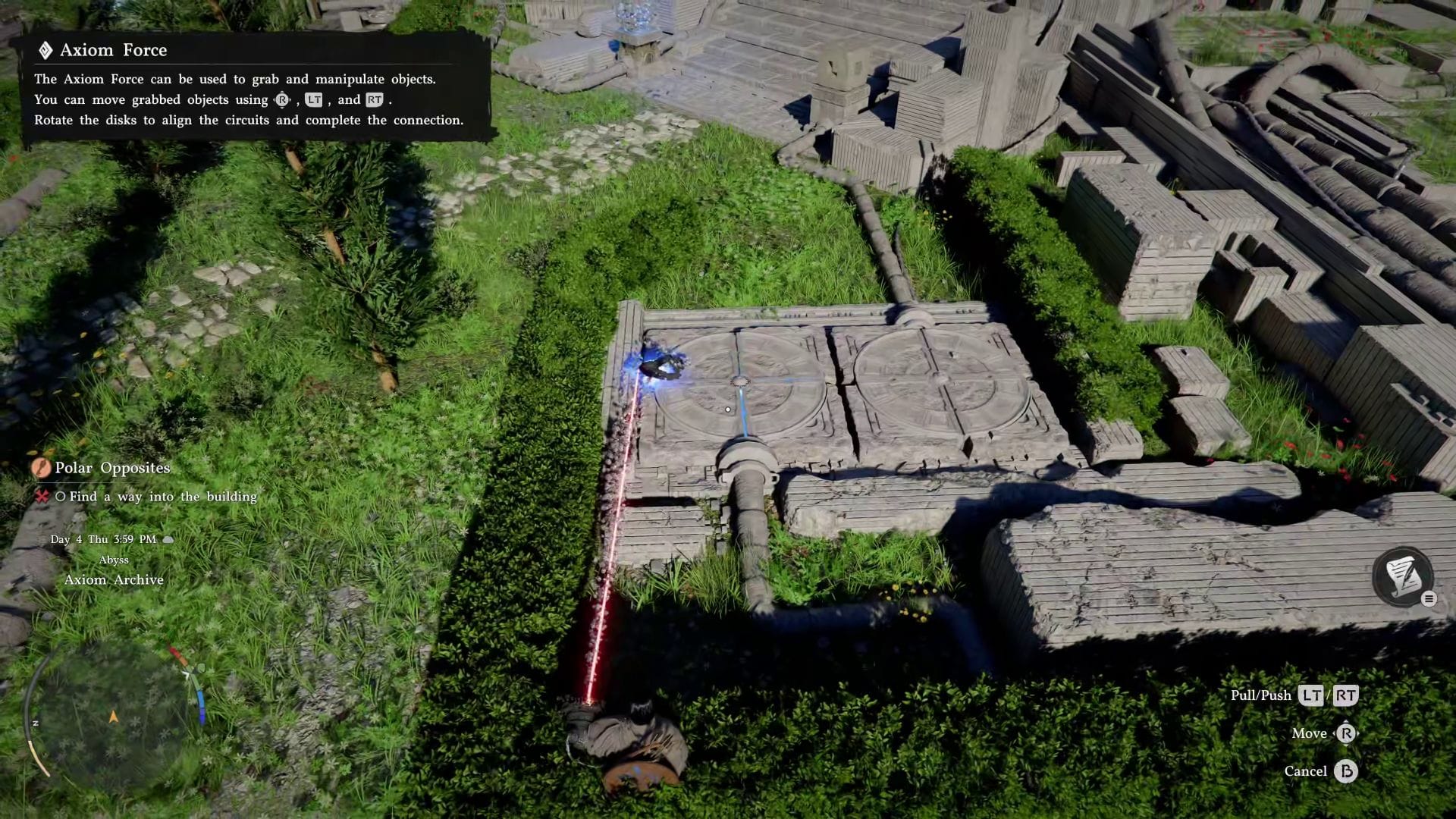
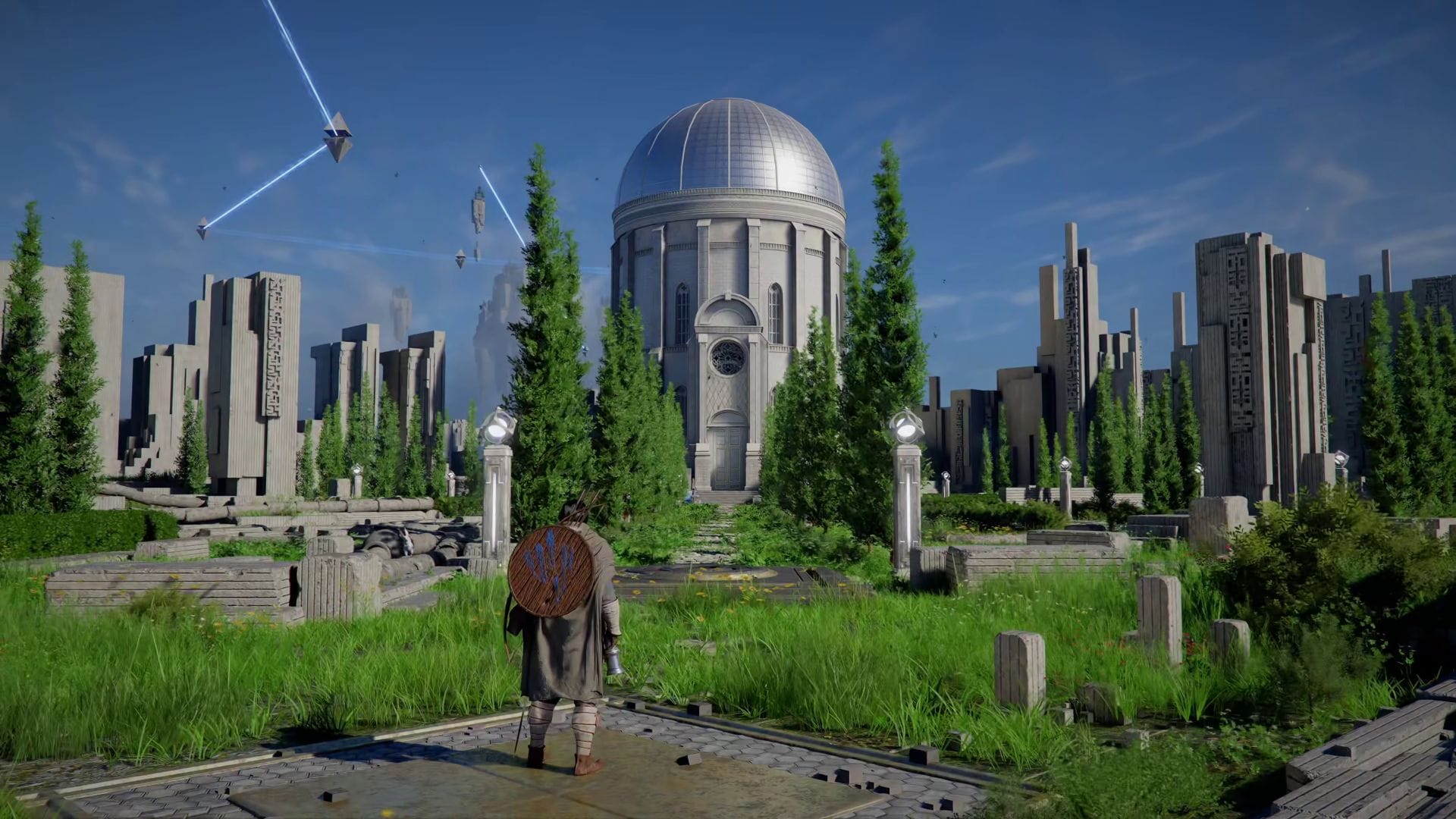
The world of the Abyss is as mysterious as it is challenging in Crimson Desert
As we bring this review to a close, I want to return to where it began — let's talk about graphics. The BlackSpace engine is an absolute marvel. It's able to bring all of these incredible systems to life, but it does so at a visual fidelity that is unmatched at this scale. The draw distances are infinite — if you can see it, you can reach it. On a clear day, you can stand on a tower on one end of the map and see almost to the other side, despite being more than twice the size of a massive beast of a game like Red Dead Redemption 2. When rain falls, it looks realistic in a way I've never seen. Individual drops make the scene look cold and gloomy. Throw in a rainy night and you can add truly dark in a way I've only seen in the Dragon's Dogma series. That brings me to lighting.
The lighting in Crimson Desert is hard to describe. It arguably surpasses heavyweights like the recently-released Resident Evil Requiem's incredible implementation, with water pooling on the ground, but somehow still showing the scene around it in a semi-reflective surface, complete with light bounce, scattering, and more. I'm sure the likes of Digital Foundry will spend an inordinate amount of time analyzing this to death, but suffice it to say it's gorgeous. That said, this game is shockingly well-optimized. It runs well on my 5090, as you'd expect, but it also runs remarkably well on Joe's 2080 RTX. The team has taken this engine apart on a yearly basis to ensure it's fully optimized to run on just about any reasonable hardware, and yes – that includes consoles if you're headed that direction. Here's a quick look at the official specs for PC and console, and what sort of results you can expect for a wide variety of hardware:
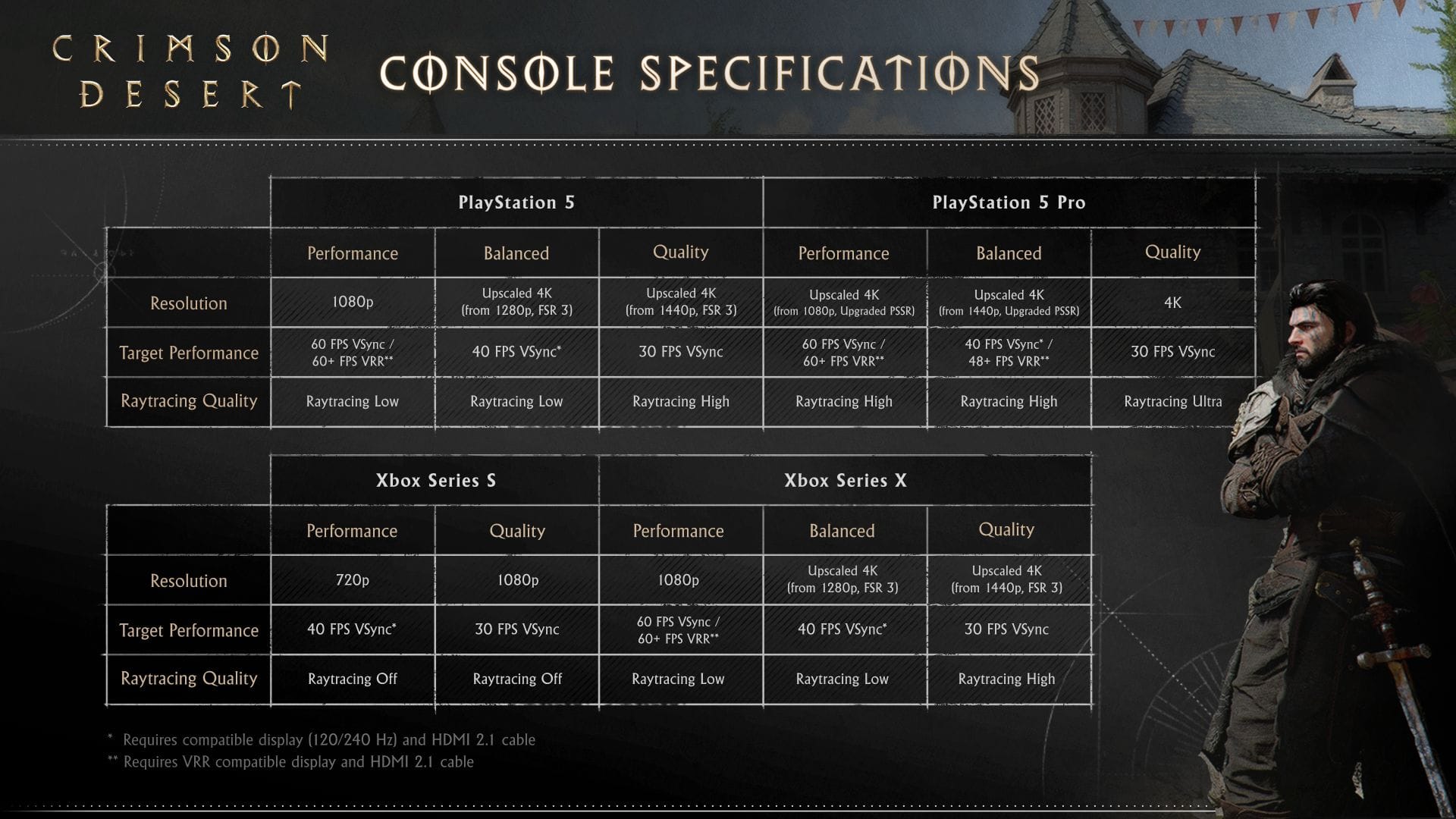
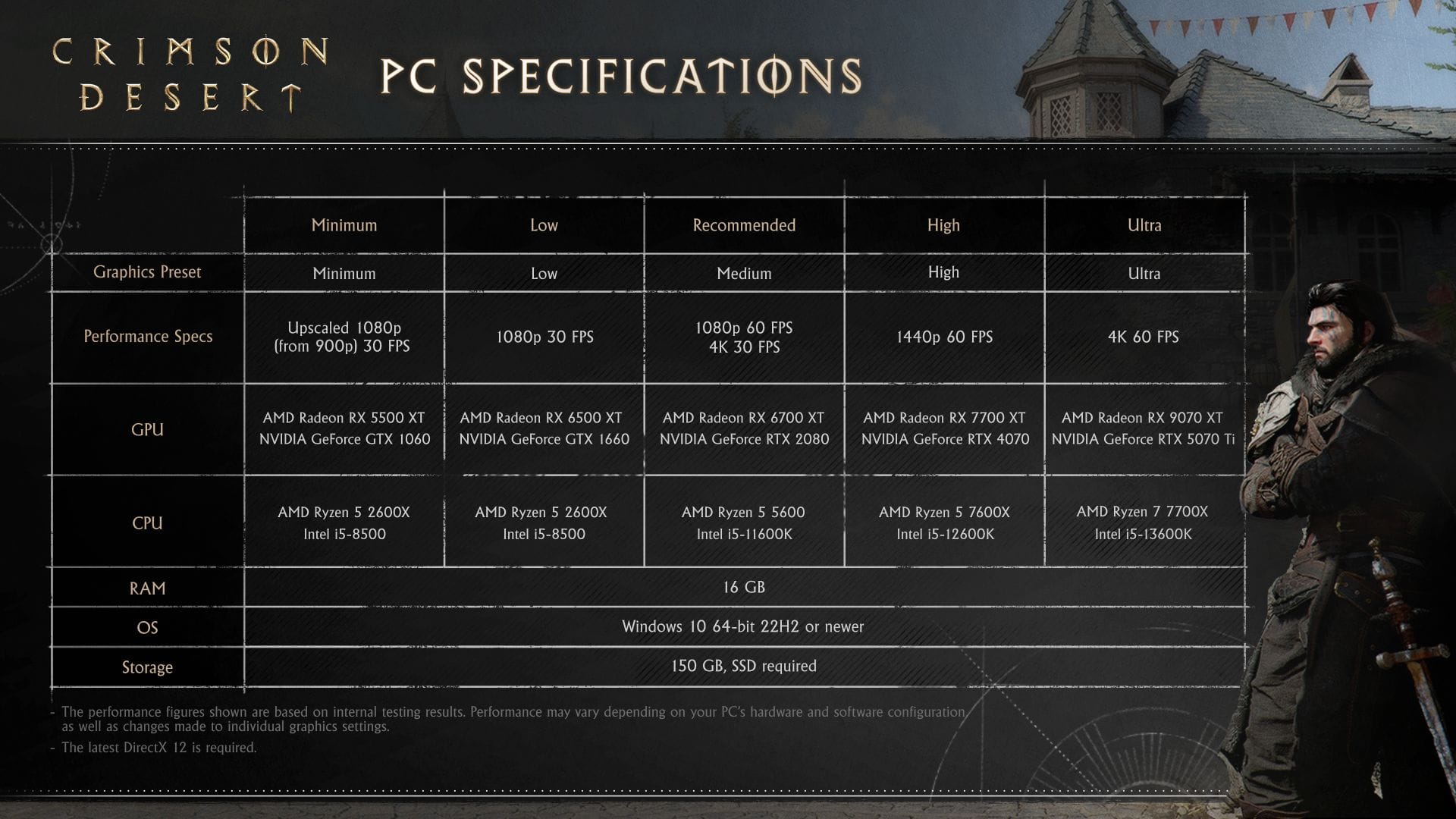
Remarkably reasonable minimum specifications for Crimson Desert
Crimson Desert
Excellent
This is a once-in-a-generation action RPG that redefines the genre, providing hundreds of hours of incredibly varied gameplay that never stops giving you new things to do. There are a handful of bugs to hammer out, but don't let that dissuade you — you're looking at your likely RPG of the year.
Pros
- Graphics are absolutely mind blowing
- Voice acting and soundtrack is fantastic
- Side missions are almost as satisfying as main missions
- SO many puzzles, caves, and mysteries to discover
- Incredible worldbuilding
- A wealth of things to do beyond the story
Cons
- Some bugs remain
- Instructions can occasionally be obtuse
- Not every mechanic or activity is a home run
This review is based on an early PC copy provided by the publisher. Crimson Desert comes out on March 19, 2026.