If you were to discover time travel, what would you do? Discover Earth’s mysteries? Re-live history? Form a dinosaur tourism company in competition with up to three others? Surely, nothing could go wrong!
Cretaceous Rails is a worker placement and engine building railroad game for up to four players developed by Ann Journey and published by Spielcraft Games. In Cretaceous Rails, players are running a tourism company who send local tourists back in time to the Cretaceous era to see the most famous extinct animals: Dinosaurs.
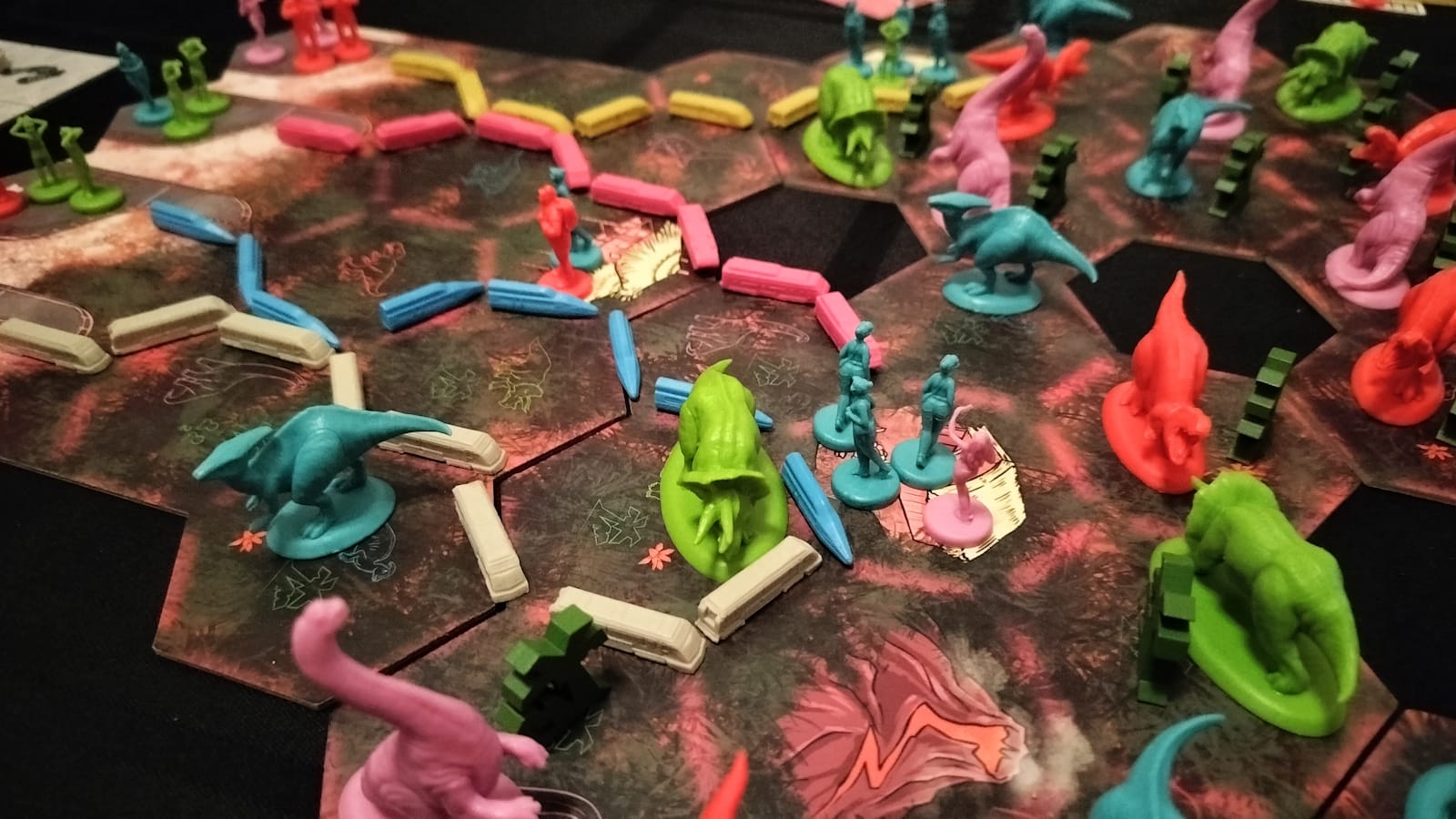
Each turn, players will place one of their four executives between two tiles on a 4x4 grid, which gets randomized between rounds. The player then takes both actions indicated by their chosen two tiles. There are seven different actions, which let you lay track, chop down jungle, give tours, capture dinosaurs, draw building cards, build those buildings, and empty the train into your home base. The general goal is to start by building out the track out from your tourism center using the track laying action. These tracks are placed between the hexes making up the map, and give players access to the goodies adjacent to their tracks. The next step is removing the jungle. Clear cutting the jungle loads up one of their train cars with wood, which is useful in building buildings later, but also allows players to access the dinosaurs on the tiles, both for capturing and for tourism.
After clearing the jungle, players can either give tours or capture dinosaurs. When giving a tour, players count up all the dinosaurs matching the color of the tourist they’re touring with. This increases the tourist track on their player board, which increases the scoring of captured dinosaurs of that color. Volcanoes are a big favorite, so they count as a dinosaur of any kind. There’s only so many tourists available, but you can gain access to more by building rails out to tourist huts out in the jungle. The tourist will then stay on your train until you unload it. Capturing a dinosaur is simpler, just snag that dinosaur that’s been exposed and bring it onto your train as well.
Since you only have so many spots on your train, 2 to start, you have to take the time to unload it into your base every so often. On any turn, players could sacrifice one of their normal actions to completely empty their train cars into their base. Players also get a free unload between rounds, once players have used all 4 of their executives. This means that players should try to always have a fully loaded up train just before the end of the round to make the most of things.
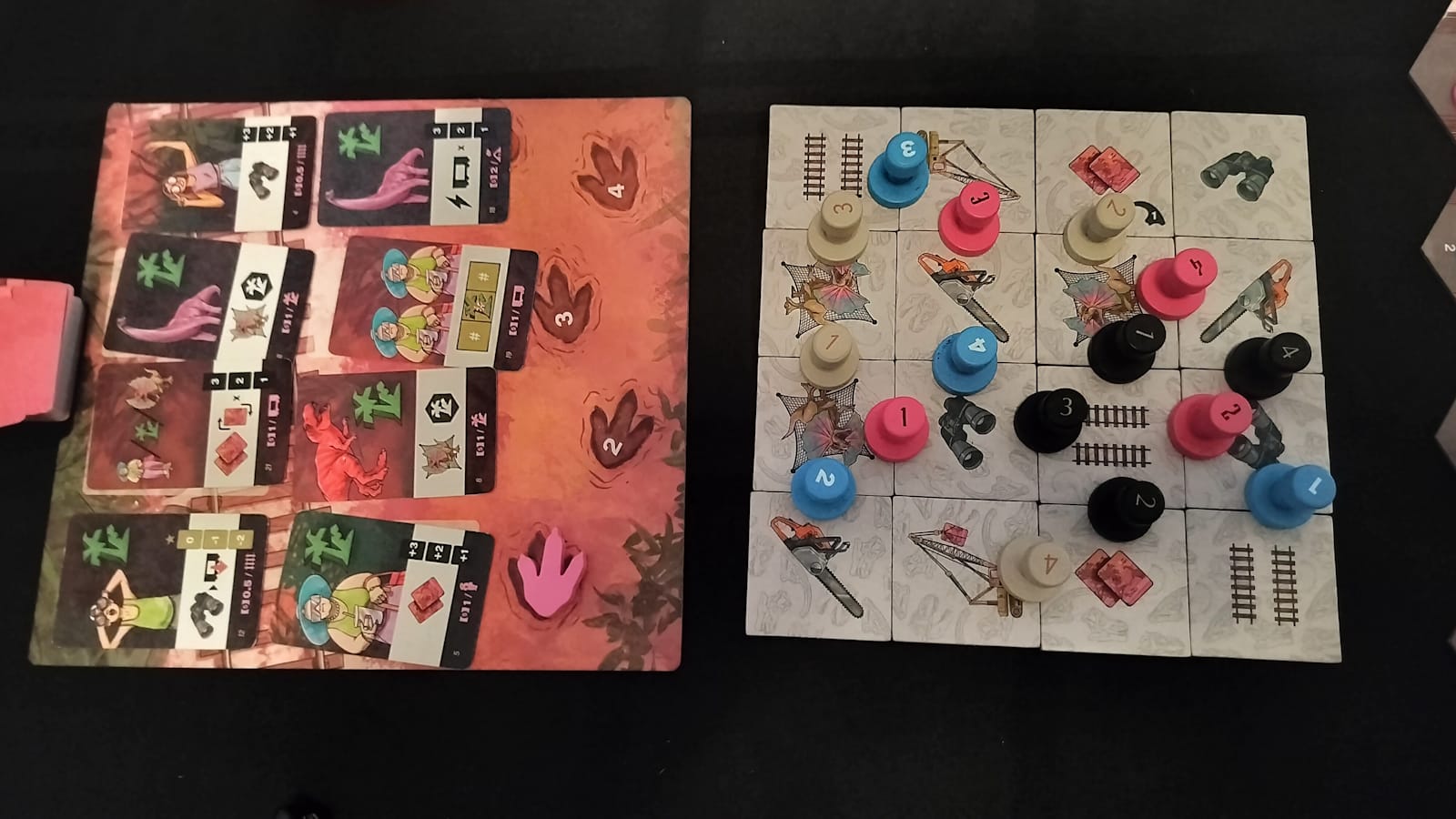
The last two actions are to draw building cards from the shop and use those cards to build up their tourism center. Buildings require the resources pulled in from the jungle to build, using the tourists, dinosaurs, and trees to build and improve their engine. Players can build any number of buildings they can afford, but only on the same row. See, the tourist center can be built up to 3 floors high, and the cards become better as cards are placed higher and higher. A building card might add an extra railroad placement to the build rails action on the first level, but on the second level it can add 2, or 3 on the third level. There are some actions that get added to the player’s options through buildings, but cost the player tourism points, the cost of which is reduced by building them on a higher level. The problem is that you can’t build a building on nothing, so players have to build a first level, then a second level, and finally can build on the third. Each building also provides a small number of endgame points based on other actions taken, such as huts and volcanoes connected to, train tracks placed, or the length of the train.
This makes up the overall playscape, but the balancing act is really where the game thrives. There’s so many choices each round, but limited by the layout created by the randomization of the action tiles. The best way to get points is to raise your tourism points, which is multiplied by captured dinosaurs of the same color. So if you have 15 red tourist points, and you have 2 captured T-Rexes (which are red) you get 30 points, but ONLY if the T-Rex was used in a building. Dinosaurs not used in a building are only worth half points.
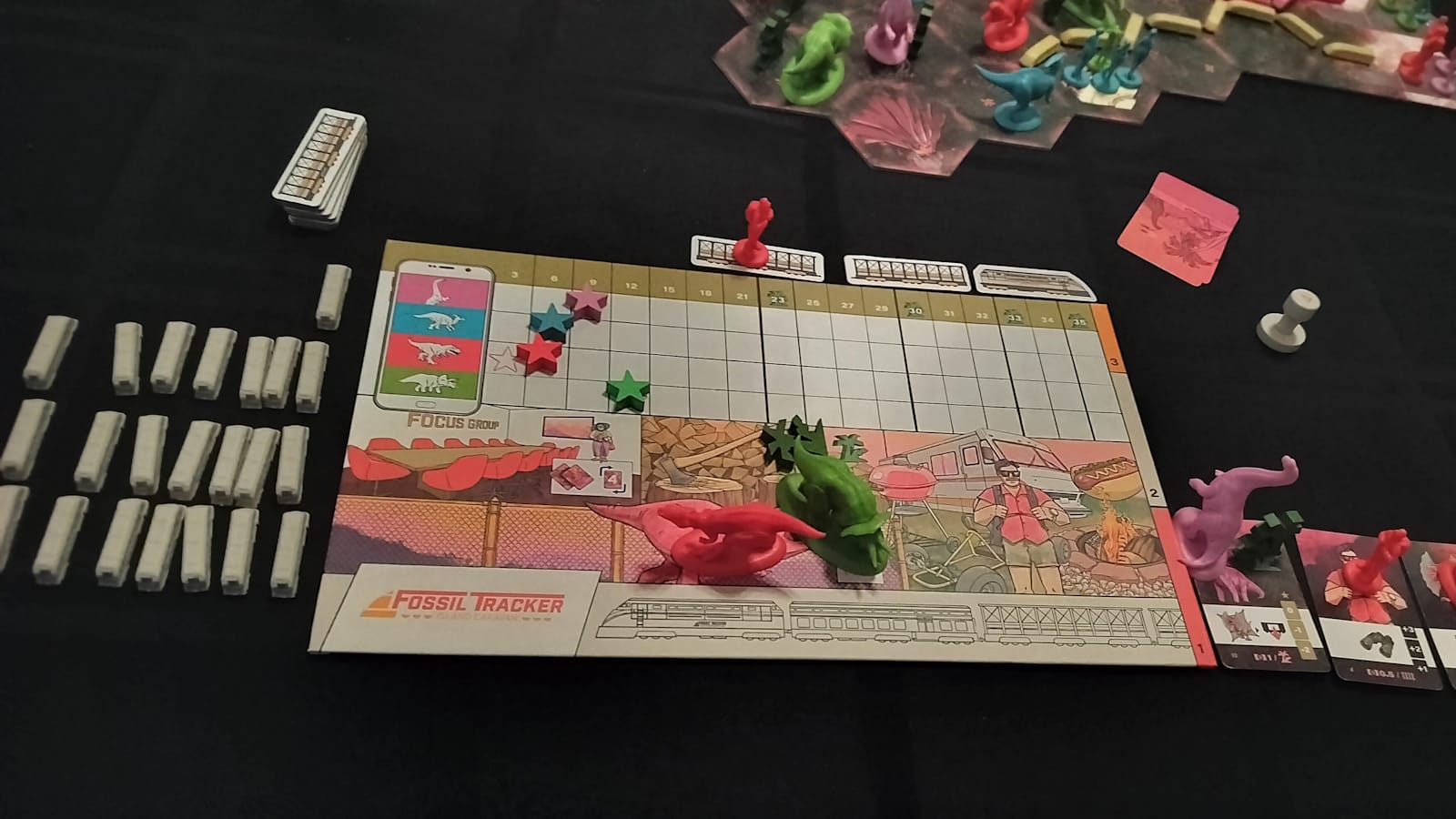
Players are incentivized to partake in every single mechanic available, because to get the most points, players have to first build their rail, then clear jungles, then give tours then capture the dinosaur, then build a building with that dinosaur. Everything fits together like a big puzzle. All the while, players have to manage the space on their trains because there’s not much space on the train for all of the stuff you keep picking up. You also find that you will very rarely have enough resources for all the things you want to do.
This balancing act is further complicated by your competitors. Rail spaces can only hold two railroads, so in a game with three or four players, the map gets very congested very quickly. Worse, the resources on the map get hoovered up by other players. That tourist you were planning on using? Well, the player next to you just captured the dinosaur that matched their color. So do you use that tourist now? Or do you pivot to another action instead? You'll often find yourself in a race against other players to reach untapped jungle spaces so you can build buildings because the other players have already cleared the board leading up to that point.
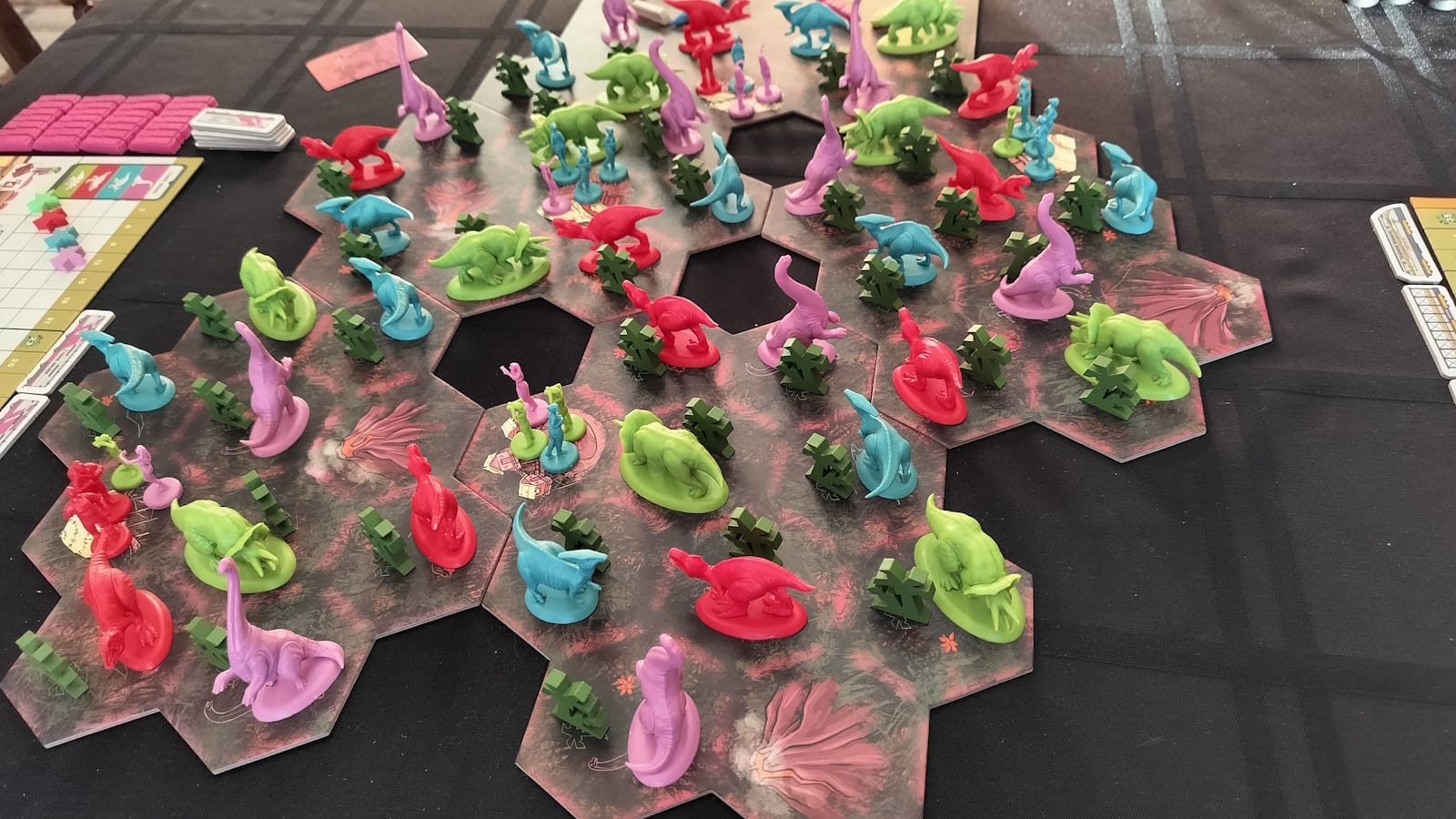
The game has an interesting lack of interest in telling you how to set up the board. There are 4 similar shaped board tiles, along with a base starting tile. Each player you add means using another one of these tiles. The first two have to touch the starting tile, and the second 2 have to touch each other, but NOT the starting tile. Otherwise, you can set it up however you want. There are basically no ways to set them up without putting holes in the board, which are dead spaces. Thankfully, the manual does have a first-time setup, so it’s not completely without guidance for those who prefer a guiding hand.
Cretaceous Rails has an amazing board presence. The theme in and of itself is basically Jurassic Park meets Ticket to Ride, which makes it an easy sell to new players. The trains are unique to each player, from the Japanese tourism company having a Shinkansen-style mag-lev train, to the American-Midwest camping company’s old school box-car looking trains. Each faction’s board also has a different vibe, such as the Vegas high life styled Dino-Lux company. The plastic dinosaur and tourist pieces are very cool, as well, and at the start of the game, the board is bristling with these gorgeous pieces, and are gobbled up as the game goes on.
There’s a ton of building cards, and you’re not going to see them all even after several games. They provide all kinds of strategies, like ignoring jungle tiles or adding train cars, so you don’t have to unload as often. You can also build buildings based on the dinosaurs they cost, or the bonus points they provide, since both can be very lucrative. You might focus on building out your rail network, since you have 4 railway point cards. In that situation, each railway you place would give you 2 points. Or you might focus on building out a large network first, then rushing tourists during the last round, increasing your dino-points for the end game. Of course, if you aren’t careful, your opponents may have snapped up all the goodies, or effectively blocked your paths of expansion.
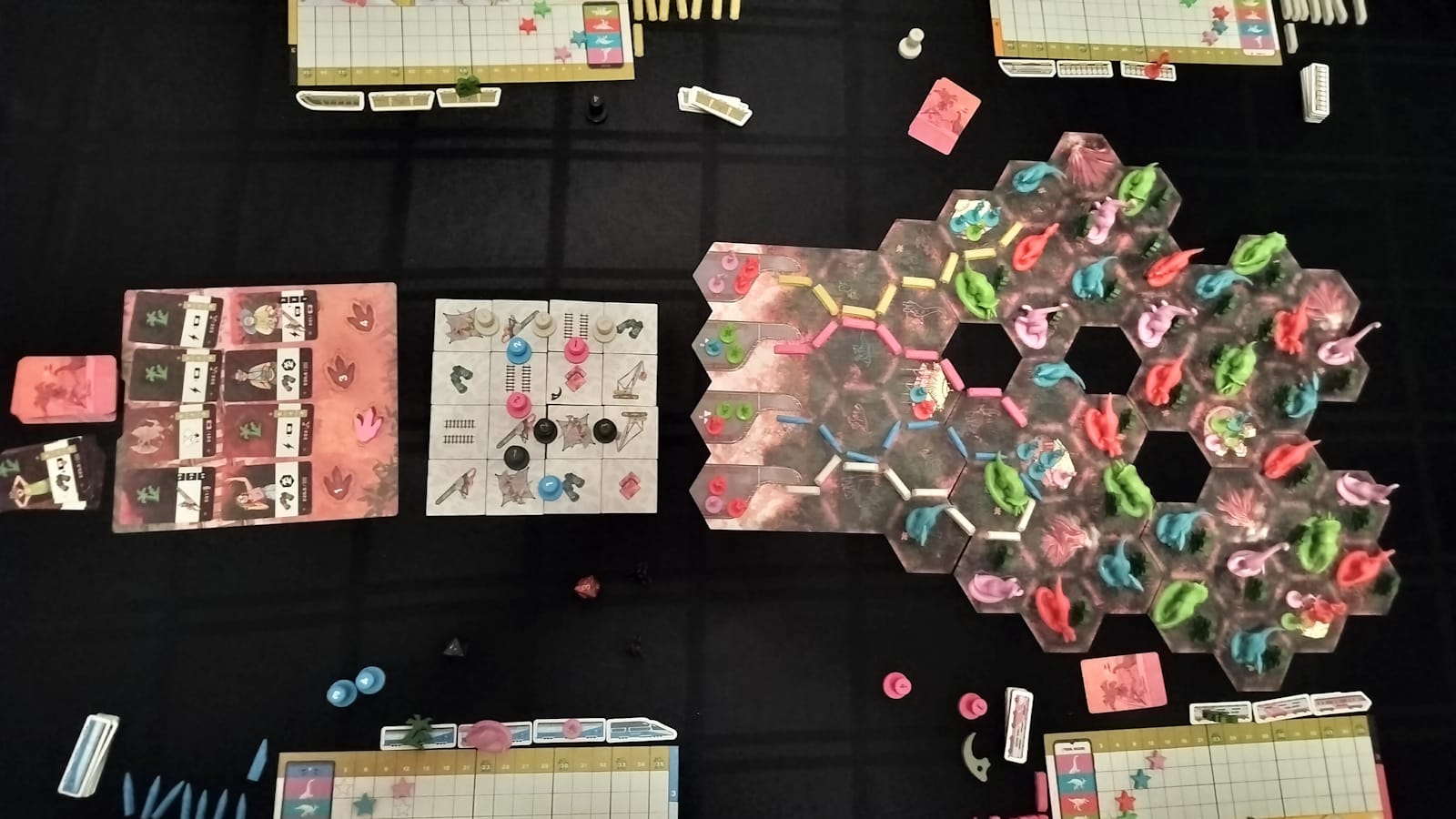
One of the greatest strengths of the game can also be its weakness, however. Because there’s so many cards, and the action tiles are shuffled between rounds, some strategies are just not available to some players in some games. We’ve had games where one type of card simply does not show up at all during the entire game, and often the exact pair of actions you want will not be available. However, because there’s a grid of 16 tiles, it’s more likely than not that some action pair will be useful, even in a 4 player game deep into a round.
So is it good? Yes! Very much so! It’s one of my favorite worker placement games. It’s easy to teach, and runs at a pretty decent clip. Things can be slowed down in the later turns of any given round, as players have to choose to settle for worse actions, and the last round is as crunchy as any good Euro game tends to be.
While the game and box have an obsessive level of detail with great options, great components and a nice storage solution built into the box, it still has a few pieces that I’m not a fan of. First, the game has a lot of components you have to place on the board at the start of every game. On the one hand, this allows the board to pop with components, making a 3d jungle in front of the players. On the other hand, it’s a pain in the butt! The biggest sin is the wooden trees. The trees are small, made of wood, and don’t stand on their own very well. I think I might have preferred plastic minis for these as well, in the same style as the plastic tourists.
The other part is something I have less forgiveness for: micro expansions that aren’t included in the game. The game has rules at the back for individual player powers, adding a nice asymmetric kick to the game. However, it’s not included in the game, it’s a promo. I don’t mind promos being extra buildings, but asymmetric powers feel like too big for a promo, even if it’s 4-8 cards. I would have liked it to be a part of the base game, especially since it’s covered in the rulebook.
Regardless, it’s a good time to play. Mixing dinosaurs and railroads is like a childhood fantasy, but the game is built on heavy duty planning and gameplay. While things can definitely go off the rails if you don’t pay attention to all the parts of the game, there’s enough diversity in cards that each player will have unique, game breaking abilities towards the end of the game.
Cretacious Rails
Excellent
A mix between train game, engine builder, and worker placement game with a lot of heart and a beautiful table presence. If you like dinosaurs, trains, and games with a tight action economy, Cretacious Rails is probably your thing.
Pros
- Dinosaurs and trains! It’s the dinosaur-train game!
- Great components, great table presence, great storage solution.
- A lot of replayability with a large stack of cards and willy-nilly board set up
- Deep action economy-based gameplay with lots of tough decisions.
Cons
- Initial set-up is quite intensive. Especially the trees.
- Asymmetric promo is not included.
- It’s easy to fall behind if players don’t pay attention to all of the parts of the game.
This review is based on a retail copy provided by the publisher.