I'm a sucker for flight simulation, having spent a ridiculous amount of money and time embracing my love of flight, and virtual reality only deepens that addiction. It doesn't matter if it's ultra-realistic games like Flight Simulator 2024, or arcade action flight games like Everspace 2; if I can fly, I'm happy. When I saw that warfare veterans Gaiijin Entertainment were building a realistic dogfighting sim with an emphasis on virtual reality, how could I not be interested? Jumping in on both the PlayStation 5 and PC, it was time to see if this War Thunder spin-off could thread the needle of simulation to deliver an experience that's challenging and still rewarding. Suit up, pilot — we've got a war to win.
I'd love to stop here and show you capture and talk through the tutorial, but bafflingly, there isn't one. That's right — this realism-leaning flight simulator features zero training for new pilots. I don't need my hand held, but knowing how to raise your landing gear might be important, no? Let's talk about controls for a moment.
Aces of Thunder has two control mechanisms — using hand controls (Sense controls on the PS5 and your standard controllers on PC), or embracing HOTAS — hands on throttle and stick. Regardless of which you choose, the flight model leans heavily towards simulation, with aircraft carrying the weight and temperament of the aircraft you're flying. You aren't just yanking these craft around, instead having to worry about redout (that's your blood rushing to your head), blackout (that same blood rushing out of your head and to your feet), stress on your airframe, flat spins, stalls, and more. As such, the game unapologetically embraces these more complex and unforgiving controls, which may or may not frustrate you. In the beginning, you'll likely accidentally crash more often than you hit your target, stalling out or putting yourself into an unrecoverable spin. Play more and you'll start to earn your chops. It is a miss that this doesn't have some sort of basic tutorial to help new players overcome this initial hurdle, but those who stick with it will be rewarded.
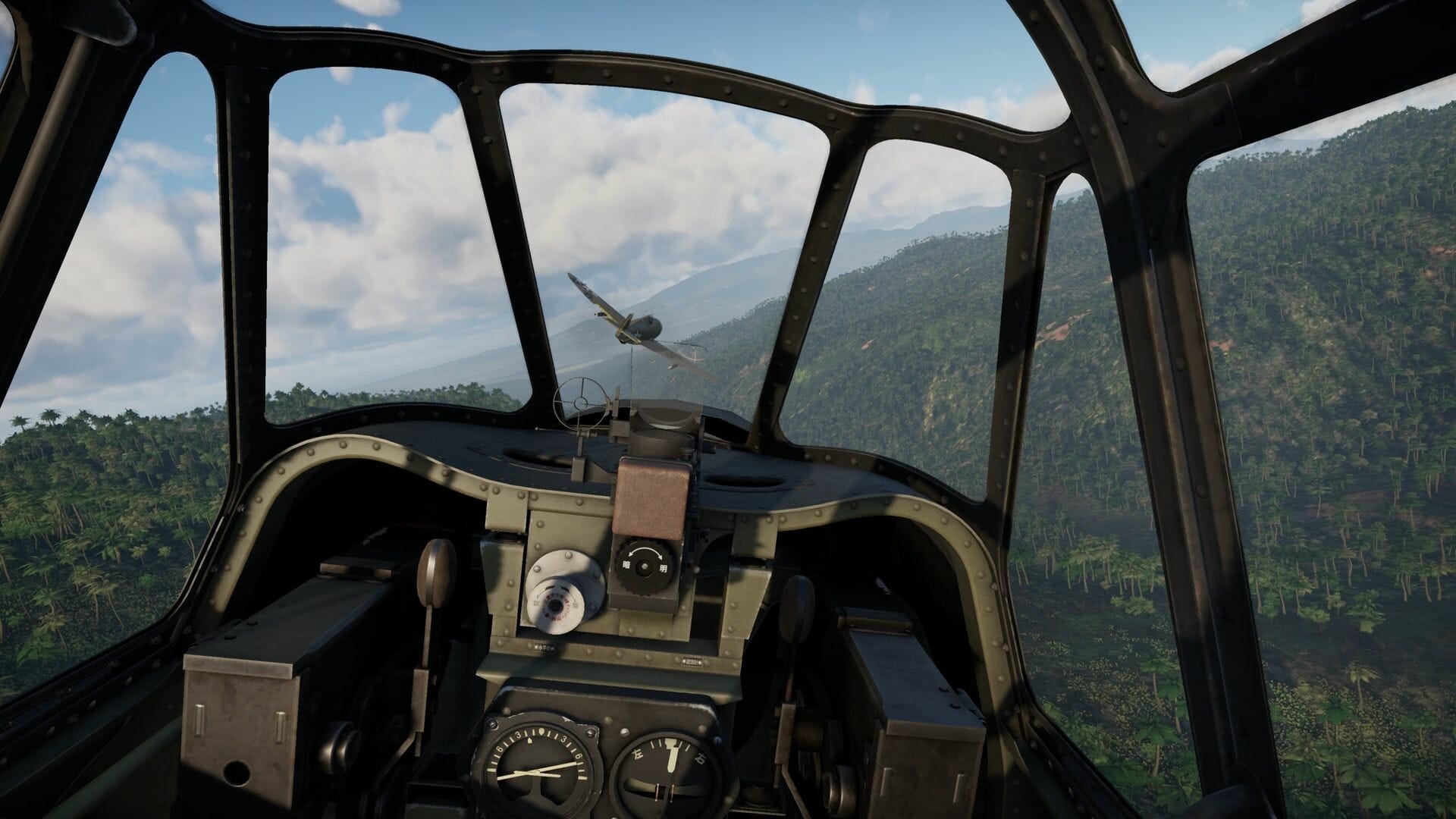
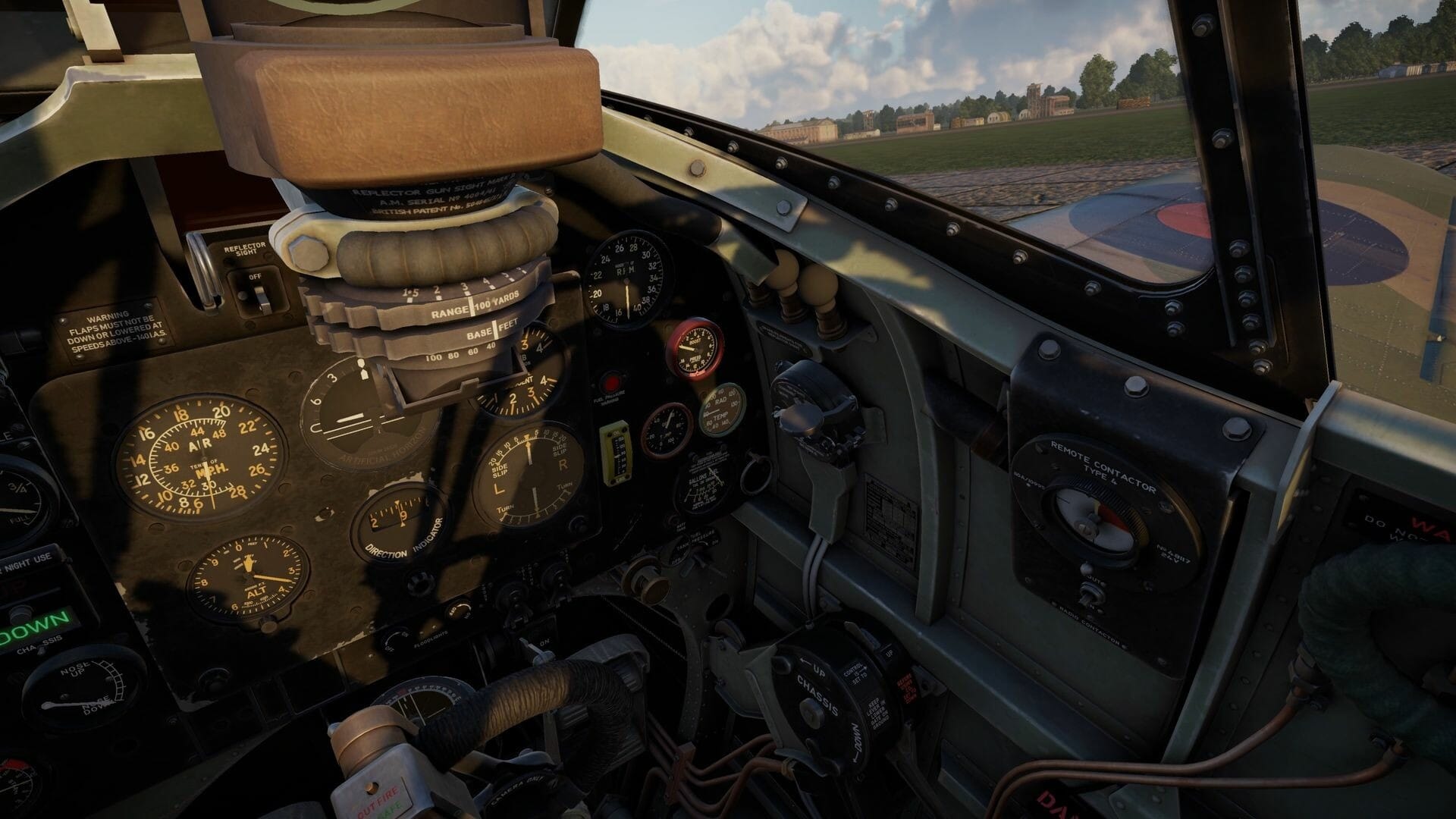
The biggest allure of Aces of Thunder is its VR focus. The cockpit is a confined space full of working gauges and instrumentation. This means you are constantly scanning your controls for telemetry, physically twisting and leaning to track your foes, and yes — practice. The learning curve for Aces of Thunder is more steep than its bigger War Thunder brother. The tutorial you have is text on a card, and they aren't going to give you much of a foundation — this is one you'll have to figure out for yourself.
One thing to note, the Gaijiin team has been patching frequently since launch, tweaking difficulty, adding quality of live improvements, and generally improving the game. My review will be at a point in time, but there's a very real chance that some of the things I say will change over time. For example, when I started playing, the map was static and locked to one spot in your lap, meaning you had to crane your neck down to look at it. Now, it not only shows where the action is occurring; the kneeboard-map can be dropped anywhere in the cockpit where it will stay. Somewhere there's an article for the future for "Games that improved dramatically after launch" with a spot for Aces of Thunder already reserved.
Using the Sense controller as an example (though the result is the same on all controllers), you can either clamp onto the yoke, or you can use the stick on said controller to direct the plane. I do wish I could toggle the grip, releasing if I let go of the trigger, but that's not supported...yet. Using both sticks, you will bank, yaw, pitch, and climb, with the triggers handling your weapons. It works reasonably well, and will do the trick if you don't have the second option – HOTAS.
There aren't a lot of options for HOTAS on PS5, so I popped over to PC for this where I have a Virpil setup. It's a bit of overkill for a plane with all of five controls in both the real world and the game, but it mapped easily enough without complaint. Other Gaijiin games have struggled a bit with my hardware mapping at times, so it's great to see that this was a focus for them. I was up and flying in under a minute, and no fussing whatsoever. I could set items individually (throttle up and throttle down as two actions) or map an axis, and both were recognized and worked on the first attempt. Better still, there's a "test flight" you can run now, meaning you don't have to ruin somebody else's online game to test your flight controls.
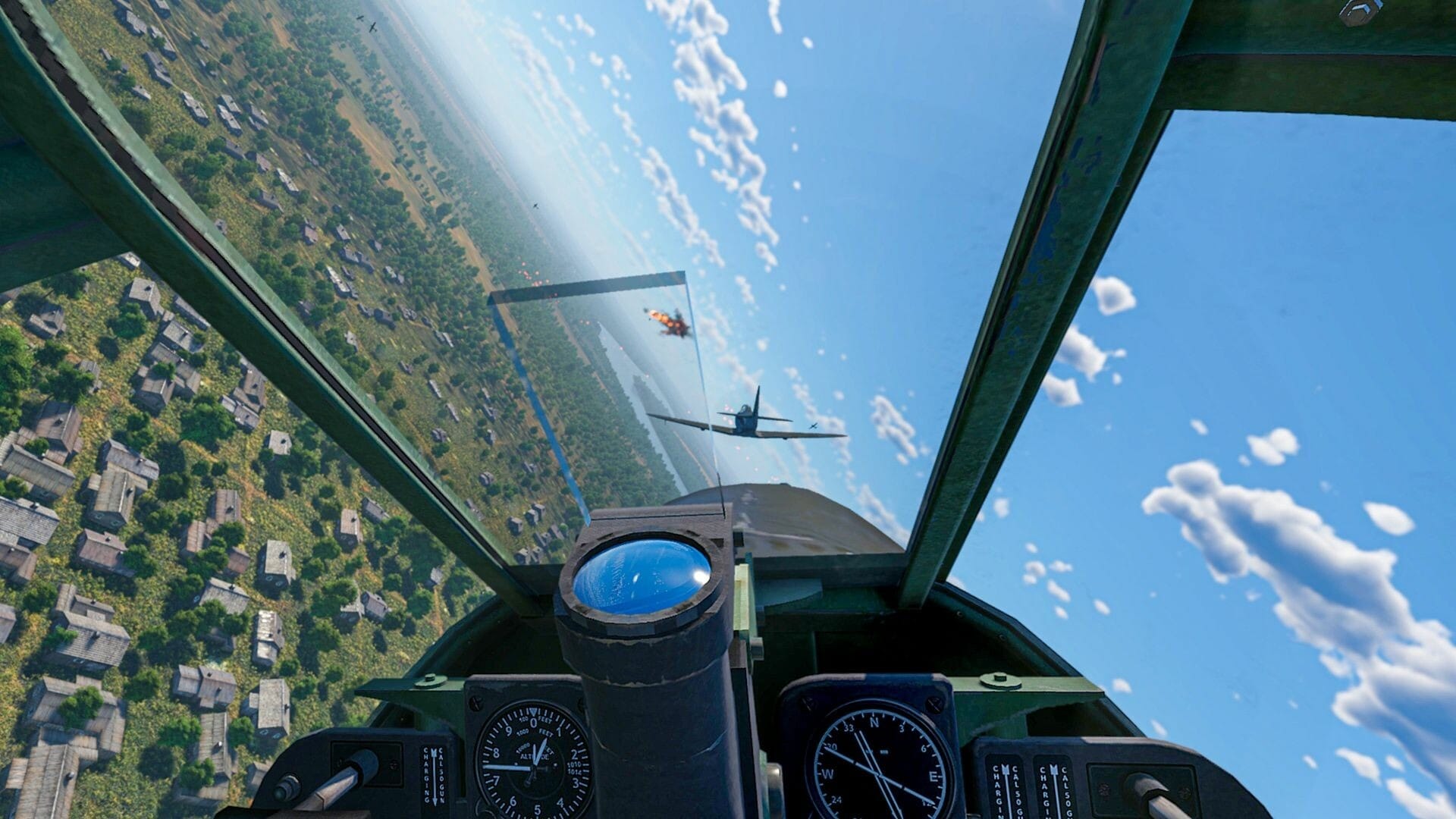
If you love Force Feedback and the realism it brings, you know that Force Feedback comes in a variety of flavors. A game controller can buzz in your hands, called haptic feedback, but when the stick pushes back at you, now you're getting something interesting. I'm happy to report that Aces of Thunder not only supports Force Feedback, but it aggressively supports it. As you throttle up, you'll feel the stiffness of the stick change, then release as you take flight. As you come in for a landing and feather your throttle, you'll feel that too. Come in dead-stick for a landing without fuel? You will VERY much feel that. Better still, it has a variance in the pushback, so it might be light as you bank, but if you attempt an acrobatic Immelman turn (the first half of a loop, rolling to upright position as you correct to flat and level, pushing 3-4X gravity), you'll feel several levels of push and pull. While my Virpil gear doesn't support Force Feedback, my MOZA gear does. Given how aggressive the game is about providing that pressure, it had me swapping some gear around — if you have access, try this out for yourself as it's a true game changer.
Realism and rough landings
VR is a little different than a flat screen experience because the artwork can be viewed at a much closer distance. That means every cockpit has to be built at a level of fidelity that stands up to that scrutiny, and wow has Gaijiin done exactly that. On both platforms, every screw, rivet, dial, and lever is rendered to realistic perfection. If you look up at the canopy, it's not just transparent; it has a slight distortion at the curve points on the glass, and upon closer inspection, you'll see there are small scratches on the surface. Every inch of the plane is built to this level of fidelity, and combined with an awesome sense of scale, it's impressive.
Taking to the skies, you'll have to navigate the way we used to — with landmarks. Looking out into the distance, you can spot things like radar towers, specific buildings you have to defend, and other important objects. Pop-in is a little more present on PSVR2 than it is on a well-equipped PC, but both have low-poly assets when you're tackling a low-altitude maneuver. Meanwhile, when you spawn in, you're on a muddy runway out in a field — highly detailed and gorgeous. The team spent their time and art assets well on the bulk of things which only makes the times when they didn't that much more obvious.
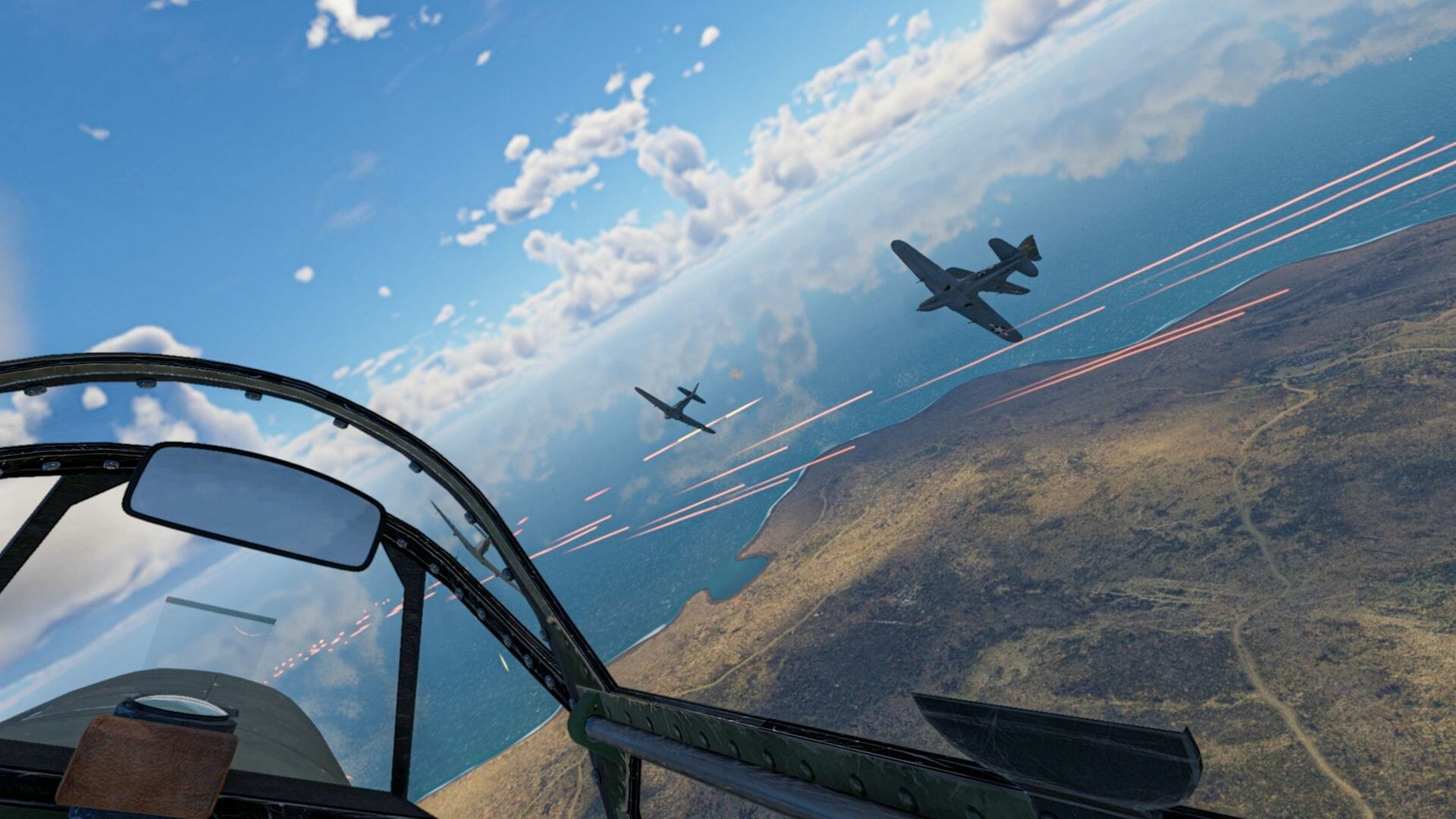
On PC, the volumetric clouds and smoke look great, but on PlayStation 5, anything volumetric is, frankly, awful. Hitting a target, they'll start spewing gray and black smoke. The skies you're flying through are made of puffy clouds you can fly through. Both look jagged and low-poly to the point where I have to wonder if it's a bug more than a technical limitation. I know volumetric clouds are expensive in terms of rendering, but the PS5 is more than capable. When flying over the water, the problem is worse as the clouds have a reflection on the water's surface, doubling the jarring juxtaposition between the high-resolution planes and cockpit and the rough clouds.
There is a tiny bit of shimmering at the edges of some objects like distant trees, but frankly, it's so minor that other than me mentioning it just now, you'll likely forget it within the first two minutes of playing.
I did run into a handful of bugs on both platforms that I imagine, based on their continued work on War Thunder, will get ironed out over time. They aren't often fatal, though occasionally they can be; gear not retracting on some planes, a carrier launch that had me explode when I hit something invisible at the edge of the ship, freezing up on load as it interacts with NVIDIA's overlay, and a few crashes to desktop. The stability issues seem to be mostly resolved, but they do happen occasionally on PC. This is another area where I suspect subsequent patches will iron the problem out, but for now you might see a wobble or two.
Sound and fury
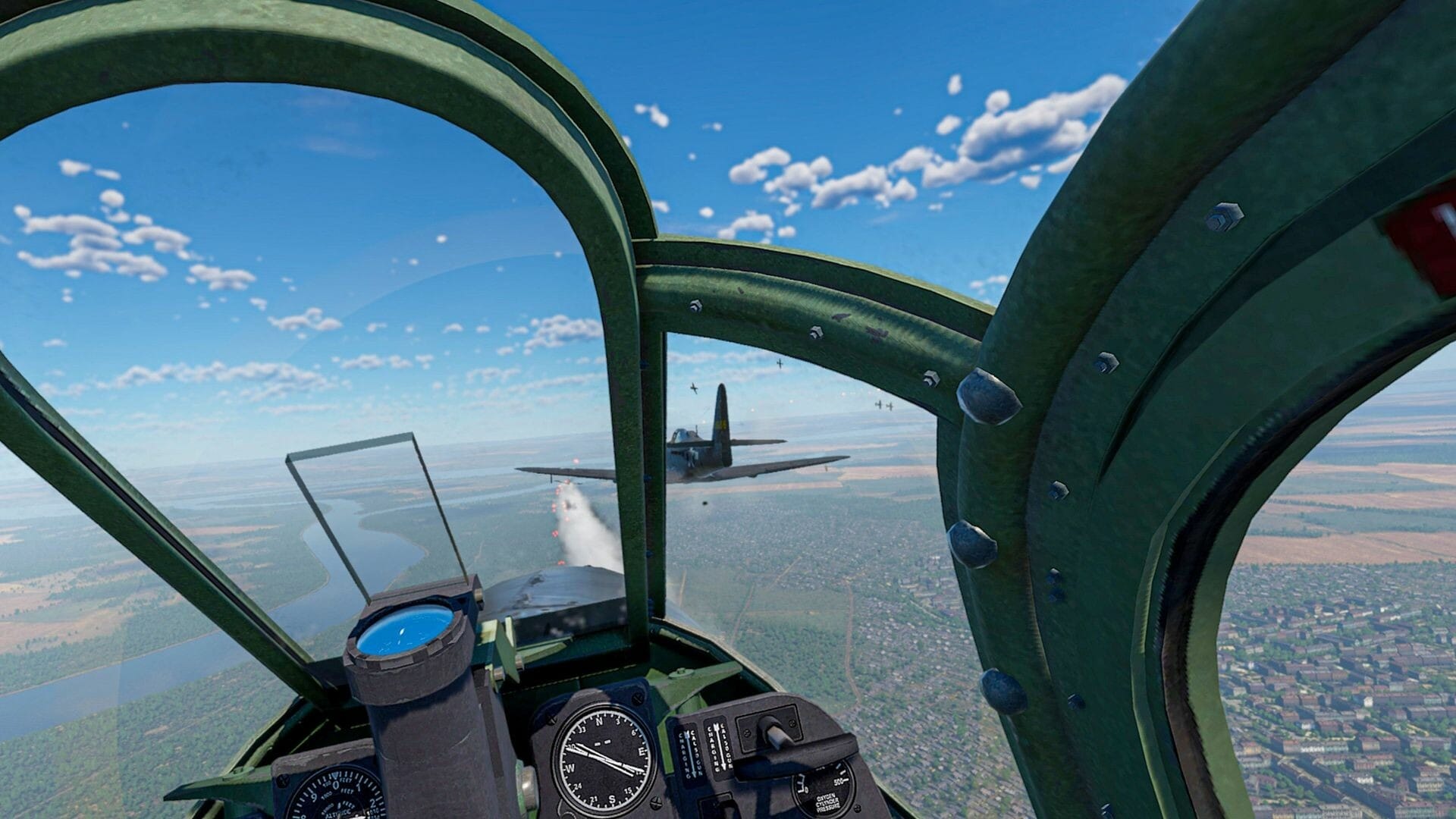
The audio in Aces of Thunder is fantastic across the board and without exception. Wind whistles past the canopy, and your wings rattle and groan as they strain against the controls. As you do high-G turns, the airframe strains and pushes back, straining against the added tension. Overspeeding the engine to the point where it sputters or eventually blows is jarring as it's a huge explosion (you are, after all, sitting practically on top of the thing). Firing the guns has a chunky sound that you'd expect from a Browning AN-M2, adding a visceral layer to combat.
Smaller audio cues are as subtle as they are effective. You can hear, positionally, where other planes are, meaning you don't have to rely solely on visual cues. Those groans from the aircraft tell you when you're pushing too hard, and often you can hear bullets whizzing by long before you see the tracers. The engines are, rightly, the stars of the show as they roar to life on takeoff, take on speed in a dive, and bleed it off in a climb. The audio in Aces of Thunder is a real treat.
Planes and Progression
There isn't a sprawling tech tree or some crazy power up system in Aces of Thunder, instead asking the player to 'level' up and earn skills through practice rather than points. This not only prevents power creep, but also keeps the playing field fair in multiplayer. Instead, progression is limited to cosmetic upgrades, with historically-inspired liveries and minor personalization options. My only real complaint comes from the aircraft selection.
The game ships with 24 aircraft available from the word go, and five available as add-on DLC for $4.99 each. There are four craft for each country, with another pair going to the Axis and Allies more generically. As this product is heavily multiplayer focused, I'd expect we'll see the roster grow like we have in War Thunder, ultimately leading to a wealth of options. At launch, the hangar already feels fairly complete, and each plane is incredibly detailed and fleshed out.
Progression isn't like you'd find in games like War Thunder, where you're earning some small cosmetic goodie more than a power grind skill. You won't be loading in new engines, advanced wings, or some other similar thing. Instead you'll unlock carefully-balanced options for things like different ammunition belts, bombs, heavier guns, and rockets. All of these have trade-offs in terms of range, speed, and especially available ammunition, so even a player who has unlocked everything won't find any advantage that can't be overcome with skill-based focus on the other side.
The biggest challenge Aces of Thunder faces is the hardest to fix — adoption. Getting into a snarl online can be difficult as there just aren't a lot of players taking to the skies yet. Sometimes you'll match immediately, other times you'll struggle to find enough to fill out a roster. Bots can fill in a bit, but the thrill of fighting against other players can't be beat.
Missions and Multiplayer Mayhem
There is a campaign, of sorts, you can use to build your skills. It's laid out in independent episodes, without much of a through line to build a connection. They fall into three mission types — shoot some dudes, bomb something while you shoot some dudes, or defend something while you shoot some dudes so they don't bomb the thing you're defending. There are no bombing missions, strafing missions, or other varieties, so most of it comes down to dogfighting. Thankfully, that's where this game shines brightest.
The single player campaign, or "War stories" are a series of loosely-connected historical battles in and around Normandy and the Battle of Britain. These serve as training for the real thing, and that's intended. The reward is that you become a better pilot – there is no currency to grind or purchase, and your weapons don't level up. If you're an ace, you're going to be an ace in whatever vehicle you're used to flying. Time spent mastering the flight mechanics of your favorite aircraft leads to high-level play. The reward is to feel like an absolute badass when it clicks, as well as a chance to snap up a handful of achievements.
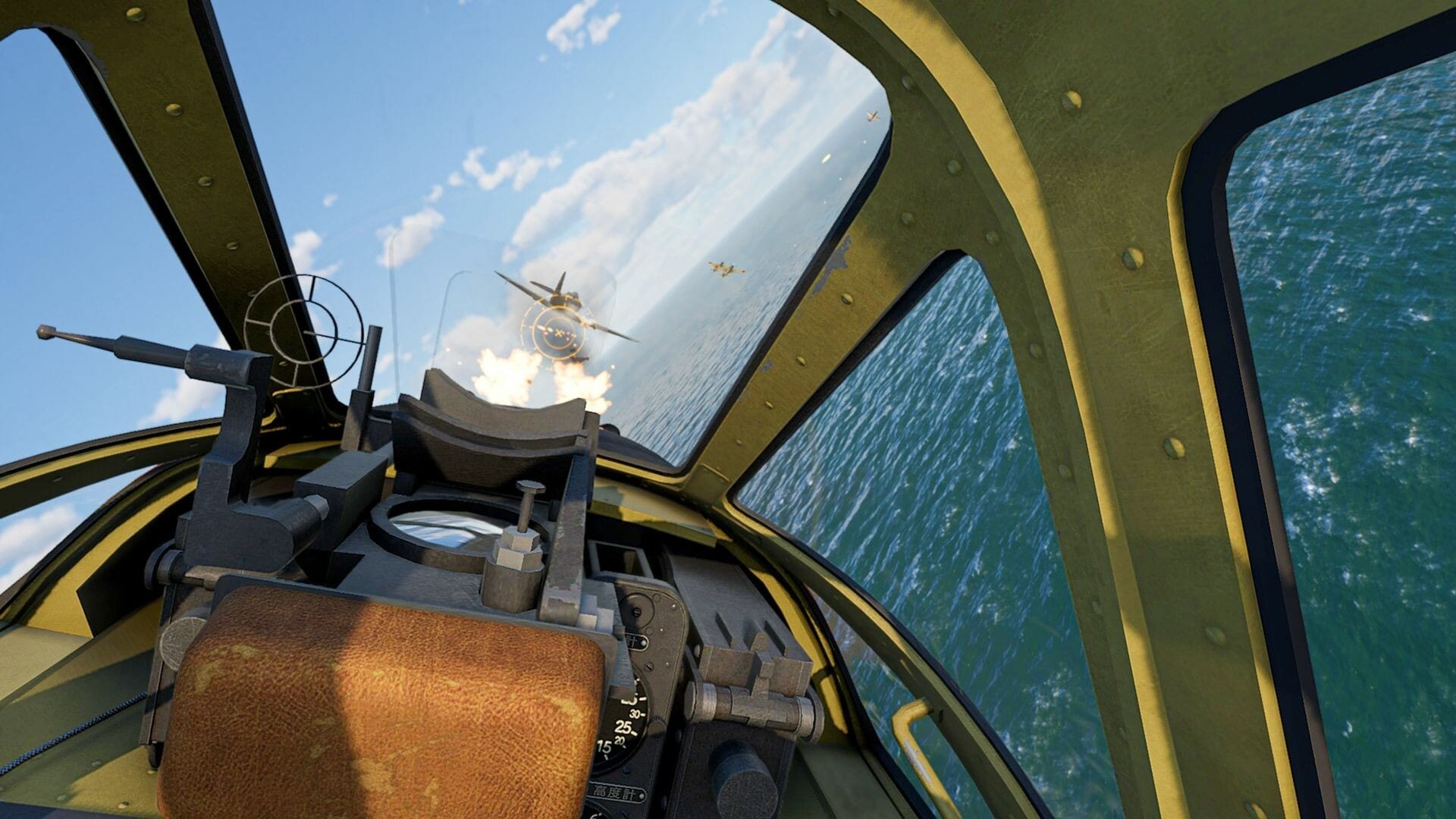
Mission variety may be lacking, but the AI is fairly competent. They can be aggressive and coordinated, and they will shoot you down if you aren't careful. If you are myopic in trying to chase down bombers, you'll give them a chance to get in behind you, tearing off your wings. If you are shot down, you'll respawn into the plane of another member of your squadron without consequence other than being out of position — your enemies might succeed in their mission before you get back to where you need to be.
The real star of the show is, of course, multiplayer — not a surprise given the game developer's pedigree. Taking to the skies against real foes is going to put your skills to the test, and frankly, it's some of the best flying you'll do. Whether you're flying with a HOTAS or the hand controls, you'll appreciate the visceral feeling of having a real human chase you through the skies. It also exposes another point in the realm of realism — scarcity.
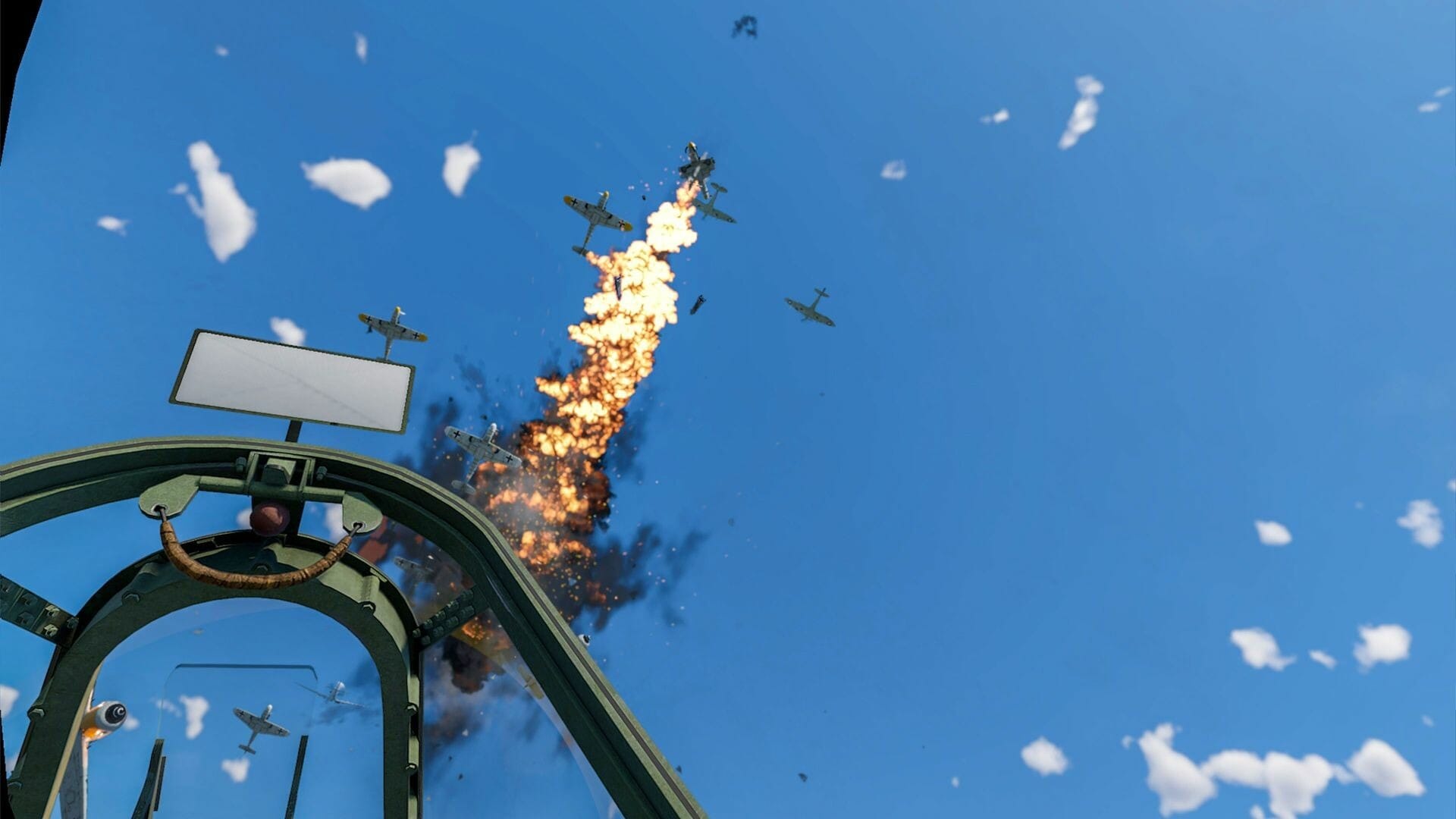
Your plane is fragile, and your ammunition is limited. If you lay in on your guns, you'll run them dry pretty quickly. When your foes do that, expect that they just might turn their plane into an improvised missile to clip your wings. Every moment is dangerous, and every duel turns into a true test of skill. I've not fallen into the "circles until somebody dies" trap in this game the way you often do in arcade flight simulators. You feel like every kill is earned, and that's how it should be.
I did run into one issue with multiplayer that I couldn't seem to shake — I often didn't know why I won or lost. I imagine that parallels the real world where fighting far away could decide the outcome of a battle long before I got there, but even the upgraded kneeboard offers only a small clue as to how your objectives are going. One example that readily comes to mind is a two-objective simple mission that tasked me with taking a bomber to a nearby island and then bombing the runway and any planes that might still be grounded there. I flew to the objective, got the notification that this portion of the mission was complete, and then couldn't figure out what to do next. I bombed runway after runway, I blew up every plane I could see, and no matter what I did, I never did actually complete this mission. More patches will help with the clarity of missions and their objectives, but sometimes it's hard to know who, what, or even where you're fighting.
Aces in the Sky
Dogfighting in Aces of Thunder is electrifying. The combination of VR immersion, realistic flight physics, and cockpit-only visibility creates engagements that feel personal and high-stakes. Every kill is earned, every mistake is punished, and every duel becomes a test of nerve and precision. What happens when you get thrown into a tailspin in VR? Let's talk about comfort.
I suffer greatly from VR positional nausea, and the first time I overcorrected a banked turn, heard my engine overspeed and explode, and my plane launched into a flat spin I thought I was done for. I was certain that my game time was about to be over, with a headache and nausea to follow. To my surprise, it wasn't.
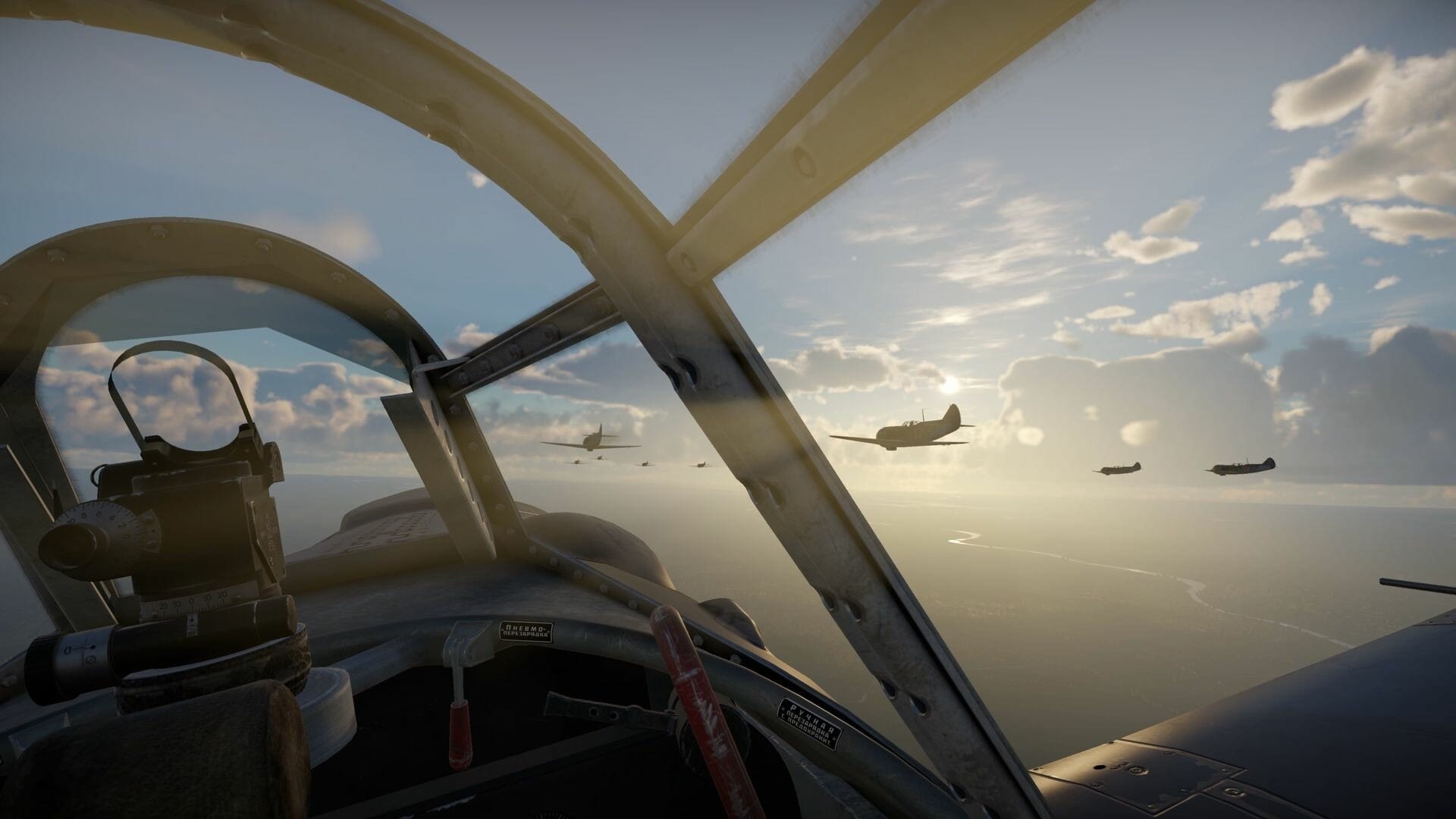
Performance in Aces of Thunder is a crisp and unflappable 90fps on PlayStation 5, even a base model, and with a PC it can push higher than that (or seems to, but never less than 90). Reprojection is minimal, and latency is imperceptible. There are a handful of comfort options like vignetting and others, but frankly, I didn't need them. I suspect due to the ever-present nature of the cockpit frame as an immovable constant, I never felt a touch of nausea despite how violent and aggressive the flying got. Motion sickness can be a real issue, but I'm happy to report that despite my susceptibility to it, I didn't feel that. This is very clearly a well-optimized, VR-first, technical flight simulator, and it shows in many ways.
I think I'll be playing Aces of Thunder long after this review is complete. The game is a dogfighting simulator through and through, with a heavy emphasis on player skill understanding the individual airframes at play. These are temperamental weapons of war, capable of delivering danger to the enemy, but also prone to suffering greatly under the stress of combat actions. While the single player missions are a bit lighter than I'd like, and there are still a few bugs to squash, all of that evaporates into the clouds when you find yourself battling it out for aerial supremacy over the skies of Britain. Now we just have to hope that Aces of Thunder can find its audience while Gaijiin helps make it everything it could be.
Aces of Thunder
Good
Aces of Thunder won't hold your hand, but will reward your hard work with skill and capable combat prowess. While Gaijiin works to grow the audience and slay the last remaining bugs, what's on offer is already a great deal of semi-simulation fun.
Pros
- HOTAS Force Feedback is TOP SHELF
- Performance is rock solid
- Airframes all feel distinct
- Most of the graphics are gorgeous
- VR nausea is non-existent, surprisingly
Cons
- Online audience is a little thin
- Mission variety is a bit lacking
- Some bugs remain
This review is based on a retail PC copy provided by the publisher.