I have a soft spot for games with physical gimmicks, like Carcassonne’s Catapult expansion, but only when the gimmick is done well and meaningfully adds to the gameplay. Okay, the Catapult is neither of those things, but it gets a pass because it’s so stupid that it’s fun. 12 Rivers’ gimmick is a large 3D board for pearls to roll down and players to slot tokens into (catching the pearls). Unfortunately for this light euro-ish game, the board doesn’t really add much to the gameplay itself, and rather than being dumb (like a catapult in a tile-placement game) it ends up just being rather dull.
Rules & Components
The rules for 12 Rivers are pretty simple, and the rulebook itself is plenty easy to follow. I do wish, though, that all the Camp card explanations were in the same place. Instead, they’re placed in the rules after either the Exploration or Collection phase, depending on when the cards can be used. While fine for learning the rules for the first time, it’s just a bit annoying when looking them up, since both the Villager tiles and Fairy tokens are referenced in full near the end of the rulebook.
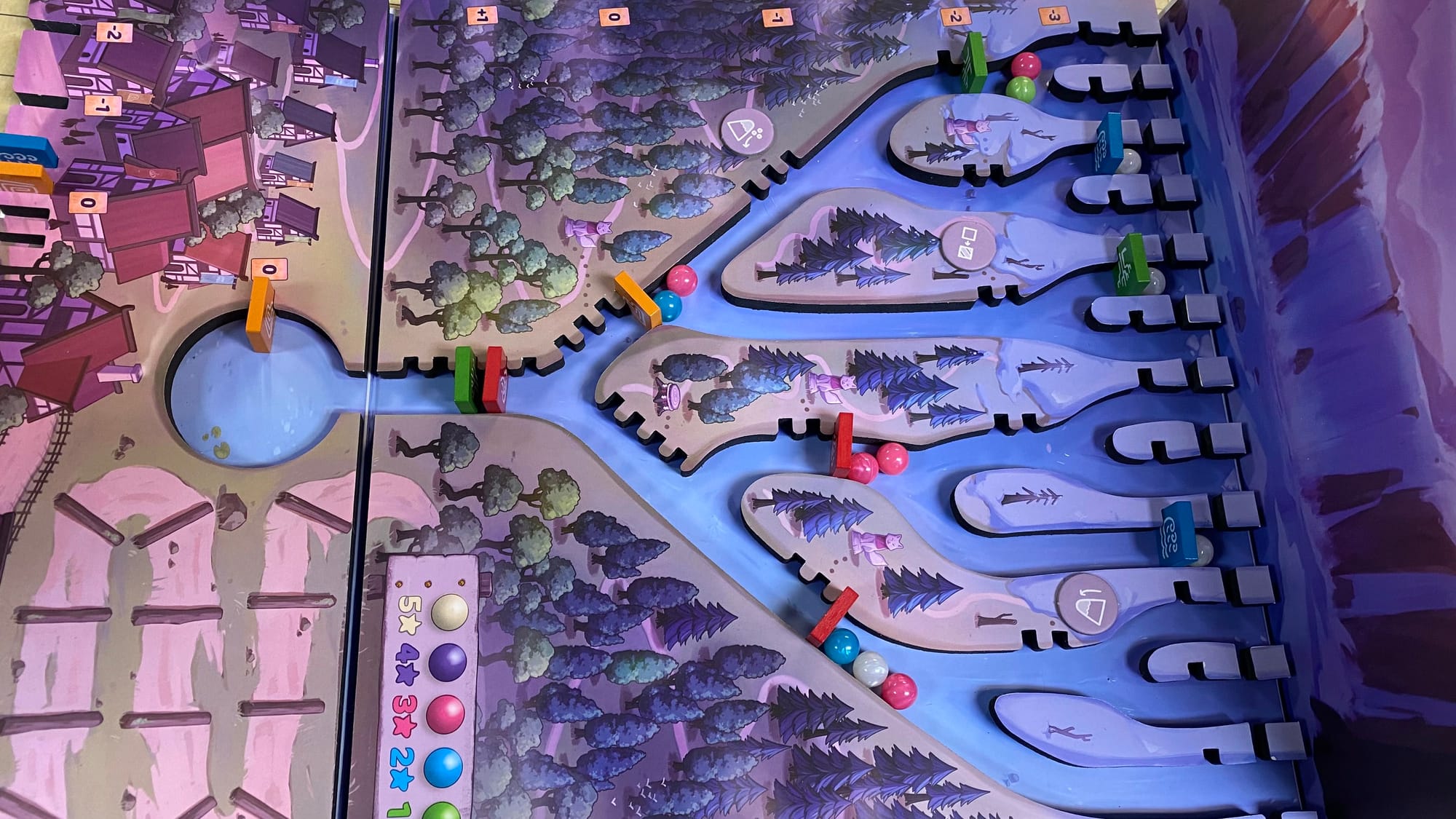
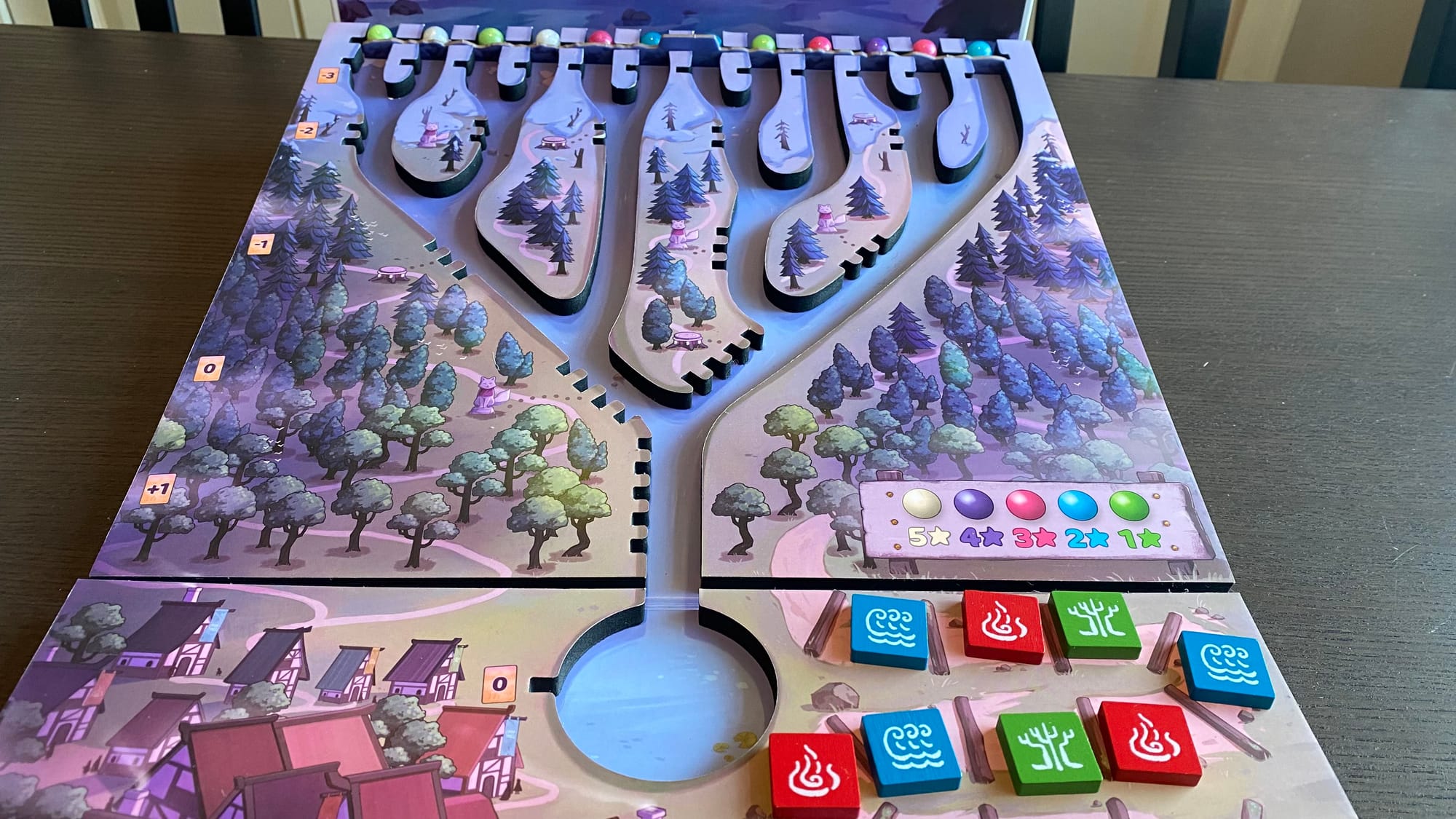
I was actually impressed by the large game board, as it’s quite sturdy and durable. One of my initial concerns was that either the printed layer or the foam itself would be poorly secured and would quickly wear as the game is played, but luckily, that is not the case. The foam itself is nice and stiff, so it won’t be warping any time soon. The slots for player tokens are just tight enough to hold them in place without causing any board-jostling when removing the tokens. The pearls will occasionally get into a traffic jam when rivers merge, but since the order they fall in doesn’t matter, it’s easy enough to give them a little nudge and fix it.
There are two quality-of-life features that I really wish had been included on the board. First, there’s nothing to track which round you’re on. Five rounds isn’t much, but neither would be adding a small track somewhere around the village artwork, and it could also have some graphics to indicate whether you’re adding Fairy tokens to the stumps or fox statues this round. Second, the turn track does not have any indication for player count. Because the track is filled from the bottom up in the Collection phase, it would have been nice to know where the first token should go in two- or three-player games. Just two and three rocks in a clump on the path would have been sufficient.
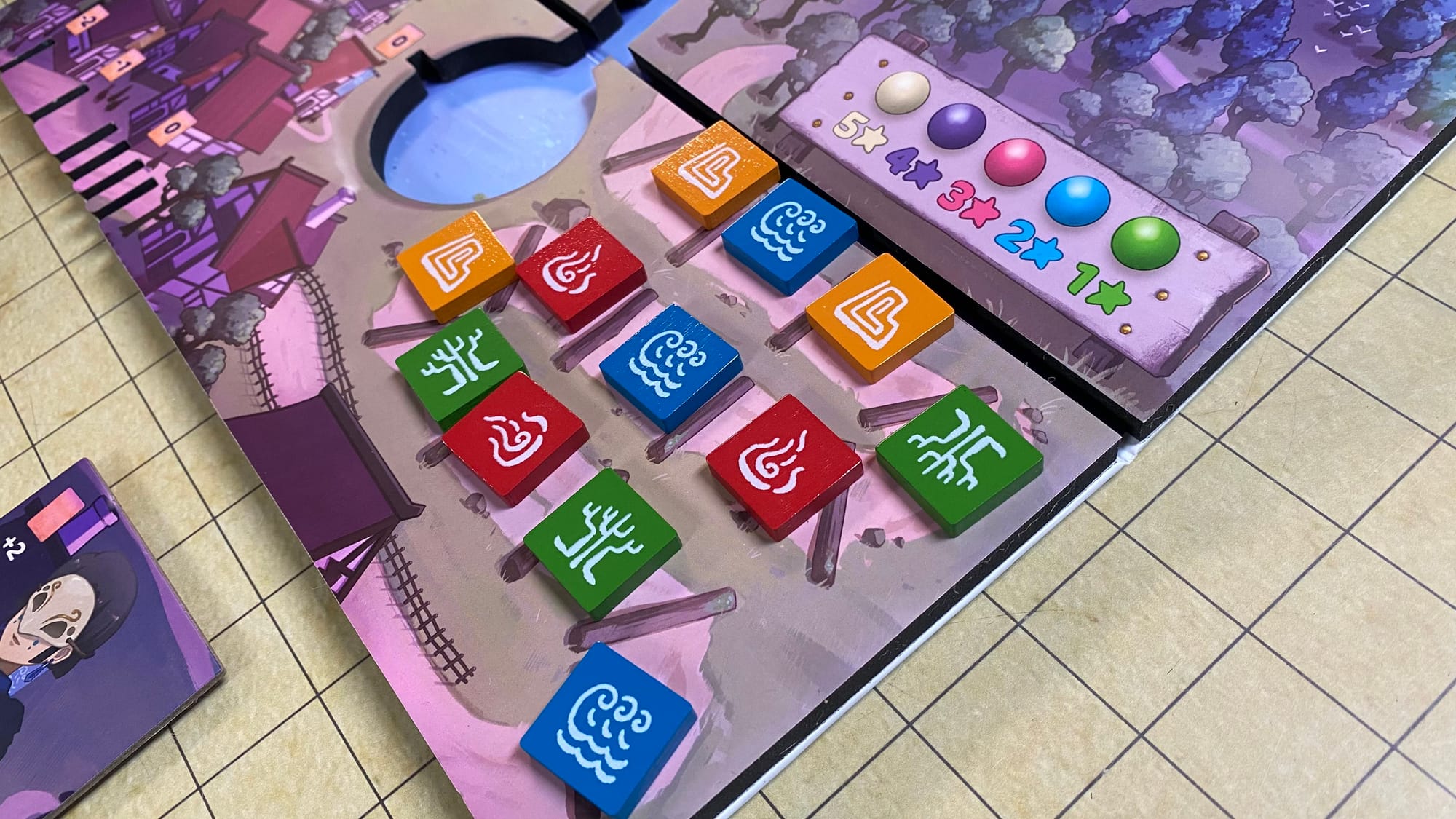
The pearls themselves are fine. I wish they could have been bigger and chunkier, both so they’re more satisfying to fidget with, and so they’re less likely to get scattered and lost when dropped. But I realize that this would require making the entire game proportionally larger, and the box is already quite large for what the game actually offers.
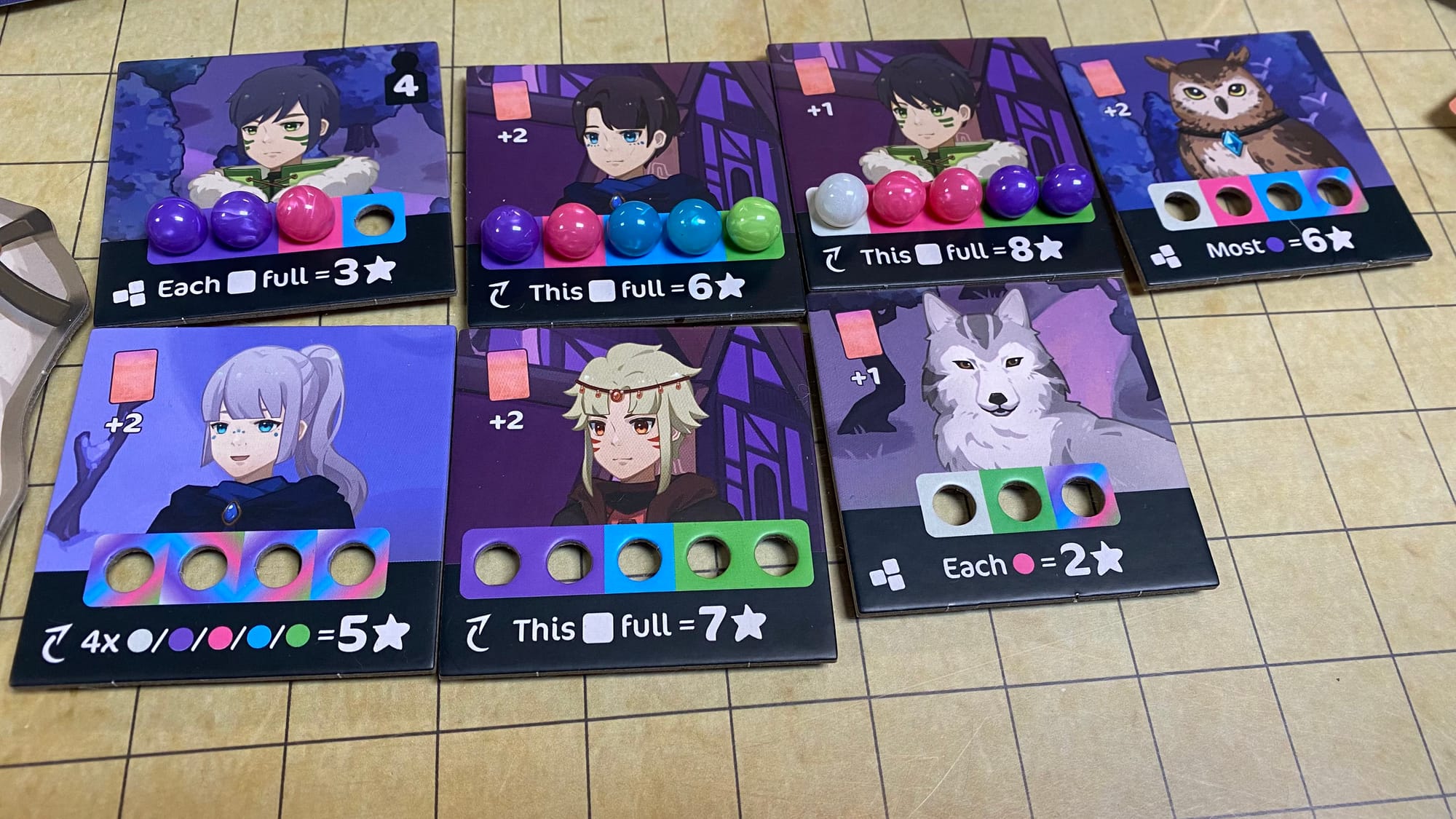
The art is similarly fine. The Camp cards are actually somewhat charming, but the Villager tiles all feel rather bland. They all use the same color palette and depict either a rather generic anime-esque character or an animal (some are anthropomorphized, others aren’t, there’s no explanation for why). Regardless of who they depict, the subjects are all just standing for their headshot, looking slightly off-camera (except the non-anthropomorphic animals; that deer stares into your soul). There’s no flavor text, no interesting poses, nothing to make these characters anything more than a place to put your pearls and score points.
Gameplay
12 Rivers, boiled down, is a worker placement and set collection game. Players place their Tribe tokens either along the river to stop and claim pearls or in the village to claim Villager tiles. After the floodgate releases the randomly drawn pearls, Tribe tokens are resolved top-to-bottom and left-to-right, with the first token resolved going to the end of the turn order track. Better spots cost more Camp cards to claim, but cards can also be played in matching pairs to use their abilities. Villager tiles let players draw more cards when claimed, but also provide both scoring conditions and storage for pearls.
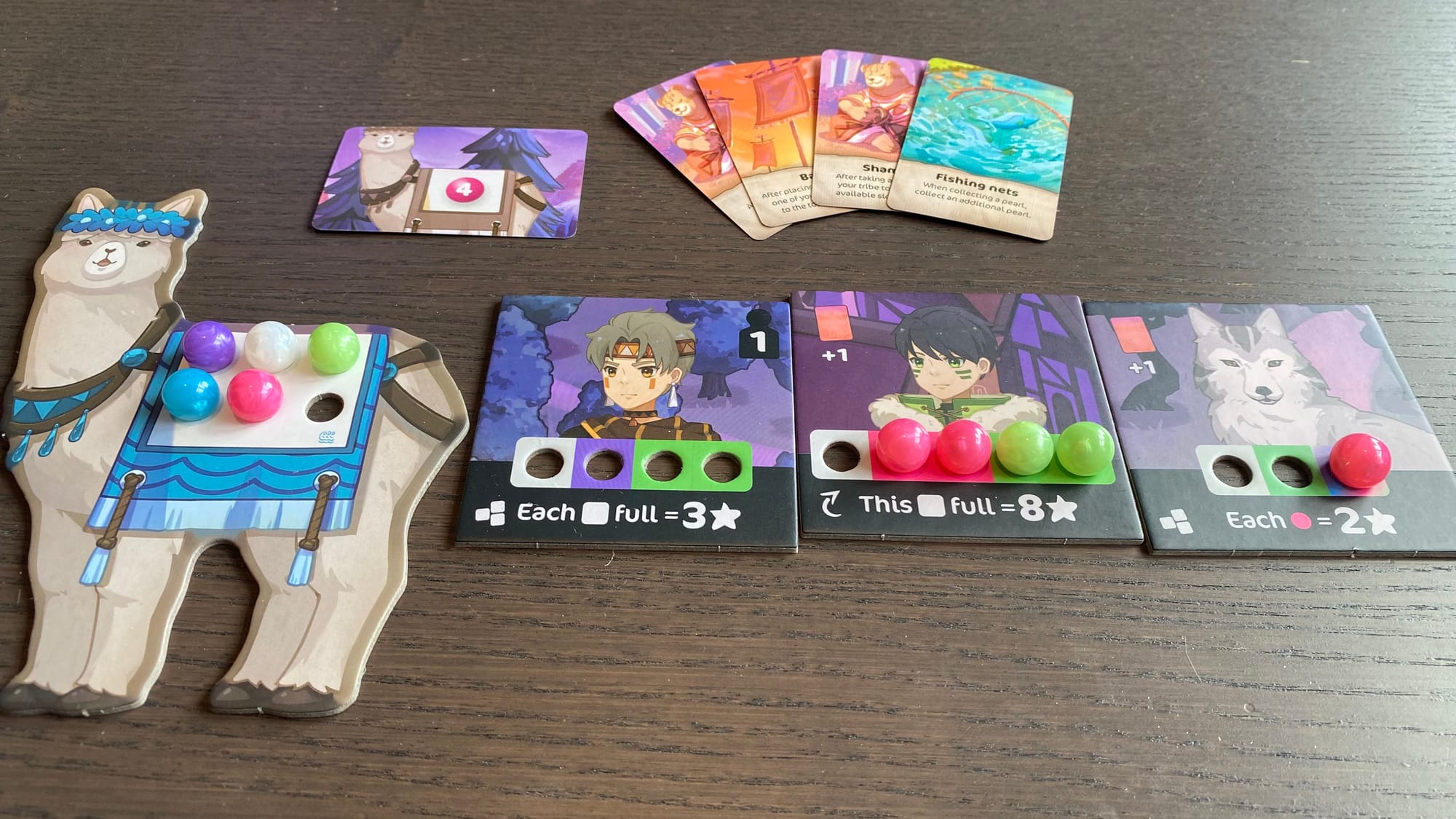
Pearls are each worth points at the end of the game based on their color, but only if they’re stored on Villager tiles rather than your alpaca, which holds the pearls between claiming them and unloading them onto Villagers. Because you unload at the end of each round, the only way you’d end up with pearls still on your alpaca would be if you simply didn’t grab enough Villager tiles. You don’t lose points for unfilled Villagers, so there’s really no reason not to grab plenty of them. In fact, you don’t even need to fill a Villager to gain their scoring condition, so for the most part, their pearl slots are just so you have a place to put the pearls. Granted, every player has a starting Villager that scores a few points for each tile they fill, and some Villagers’ scoring conditions are based on filling themselves, but there are plenty that don’t care.
Alpacas may fill up when players are trying to complete an “alpaca goal card”, which requires some amount of one pearl color be on your alpaca at once. Getting four blue pearls on the alpaca leaves only two spots for other colors, but that’s not really an issue as long as you don’t accidentally grab too many pearls, which can be avoided anyway by either planning ahead or using a Fairy token.
The game is already incredibly forgiving with how the Villager tiles work (i.e., no need to actually fill most of them, and you’re paid for taking them), and the Fairy tokens just add even more of a safety net. These tokens are placed in varying spots along the rivers each round and grant a variety of single-use benefits, from ignoring Tribe token placement costs to immediately unloading/rearranging some of your pearls. They’re useful, but usually not so useful that I would go out of my way to claim one (unless it was a choice between two spots for the same color pearls). The Camp cards felt similar, with them only occasionally being worth spending two of your resources—since you need to spend them for better Tribe token placement—for whatever their ability is. The exceptions to that are the Shamisen and Fishing Net cards, since they just give you more stuff (especially the Shamisen, as the Villager tiles are quite valuable).
While forgiving gameplay isn’t a problem on its own, especially for family games, 12 Rivers has just a bit too much going on for it to feel like a proper family game. There’s a whole point salad of scoring conditions for each player from all their Villager tiles, along with the economics of managing your Camp cards for both their abilities and placing your Tribe tokens. Despite that, as long as you play the game even semi-competently, it’s impossible to make a wrong move. Everything you do is worth points, and if you make a mistake, then there’s likely a Camp card or Fairy token that can correct it for you.
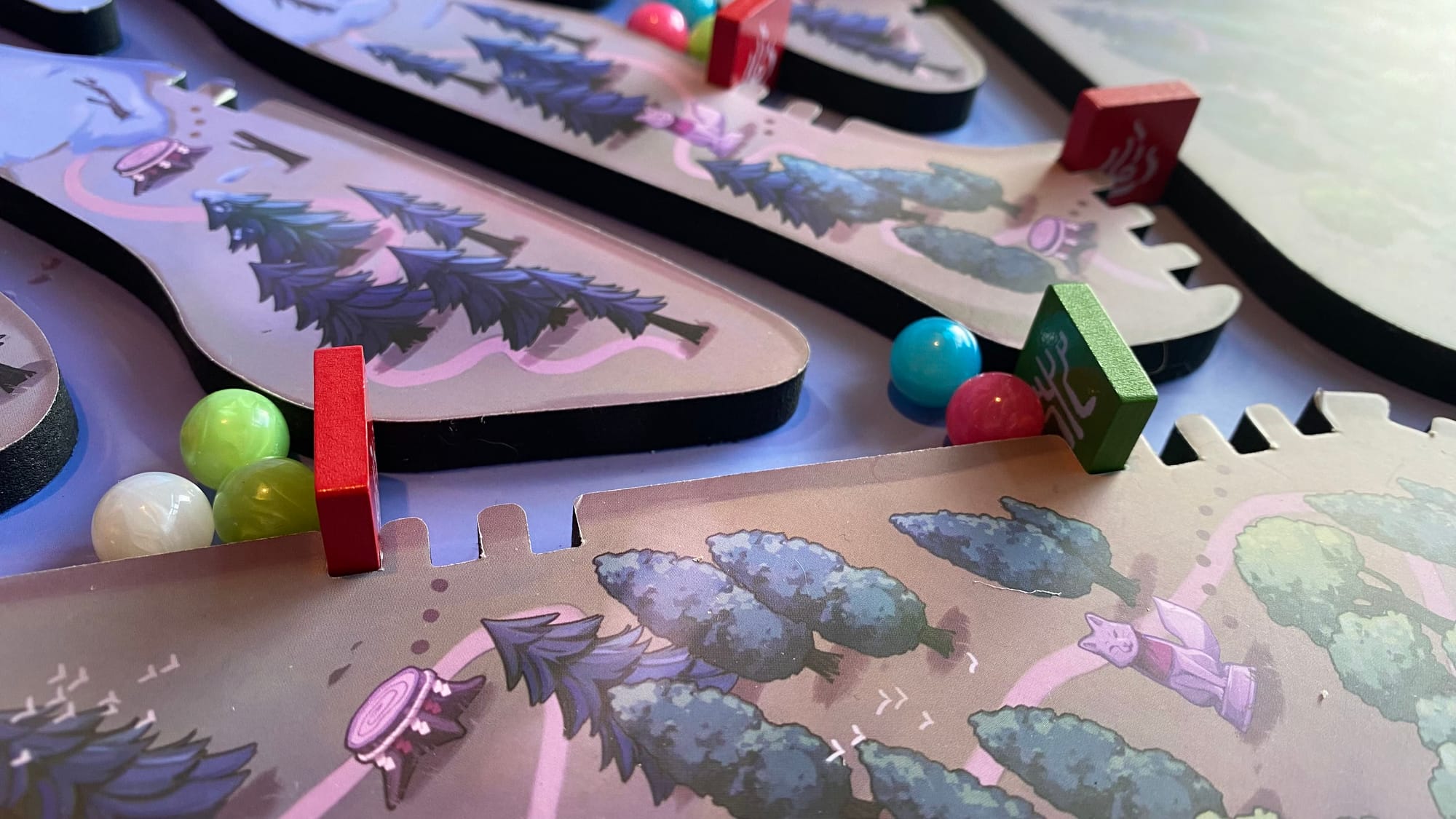
Now, the 12 rivers themselves. This game’s entire identity is based on the large, 3D board that works like reverse pachinko: funneling pearls from 12 different spots into a single lake. While it certainly adds some table presence that will draw people over to ask about the game, it doesn’t feel like it’s doing anything. The rivers aren’t randomly redistributing anything once the floodgate is removed and the pearls begin their descent; all randomness is resolved once the pearls are drawn from their bag. You know exactly which pearls you’ll have access to when you place a Tribe token, depending on whether anyone places a token above yours. Really, all the large board does is automate a sort of trickle-down market. Potion Explosion is another game featuring marbles on a 3D board that you collect to fill out tile requirements, but unlike 12 Rivers, players actively interact with the marbles on the board to set up cascading effects while they interact with the game’s gimmick. There’s no interacting with the pearls or their paths here; they’ll just roll until someone’s able to collect them. I would have been much more interested if the game allowed you to actually influence the pearls, maybe by diverting their paths. Something to make the gimmick feel more than just a pretty gimmick.
12 Rivers
Mediocre
12 Rivers features an eye-catching 3D board and pretty little marbles, but that’s pretty much all that it offers. The gameplay itself is as bland as the character art, and is so forgiving that it removes most of the satisfaction of playing well. There are some interesting things present in the game, like the dual-use Camp cards and the fluid turn order, but nothing that makes the game any more than the sum of its parts.
Pros
- Lots of table presence
- Board is thick and high quality
- Cards used as powers or a resource is interesting
- Dynamic turn order
Cons
- A tad too simple for point salad game
- A tad too complex for a “family” game
- Bland Villager tile art
- Gimmick feels underwhelming
- Some Camp cards are objectively better than the rest
This review is based on a retail copy provided by the publisher.