I recently attended PAX East where I got to go hands-on with DREADMOOR, a first person fishing horror game. While my time with DREADMOOR was short, it hooked me nonetheless. This horror fishing game reminds me of a few different games in terms of theme, gameplay, and artstyle, but it comes out feeling utterly unique.
DREADMOOR takes place in the Submerged Lands, a coastal area devoured by the sea. What few settlements remain are in peril; a strange corruption is spreading, and night brings constant danger. This is all to say, the world sucks to live in; the worldbuilding is awesome. Players step into the fishing boots of Malcolm, a gruff, weathered fisherman. The game opens with the voices of a woman and child talking to Malcolm, but we don’t get many details. The child seemingly discovered something that led to disaster, and then we come-to on a small shanty area, complete with a shack and a dock. Our dinghy hangs suspended above the water, so we have to free it and refuel the vessel. This game is highly interactive; you’ll need to put in a little elbow grease to just about every important mechanic, which adds immersion to the game. Your dinghy won’t just refuel near a fuel source; you need to manually pick up a jerrycan or fuel pump and fill ‘er up for a few seconds.
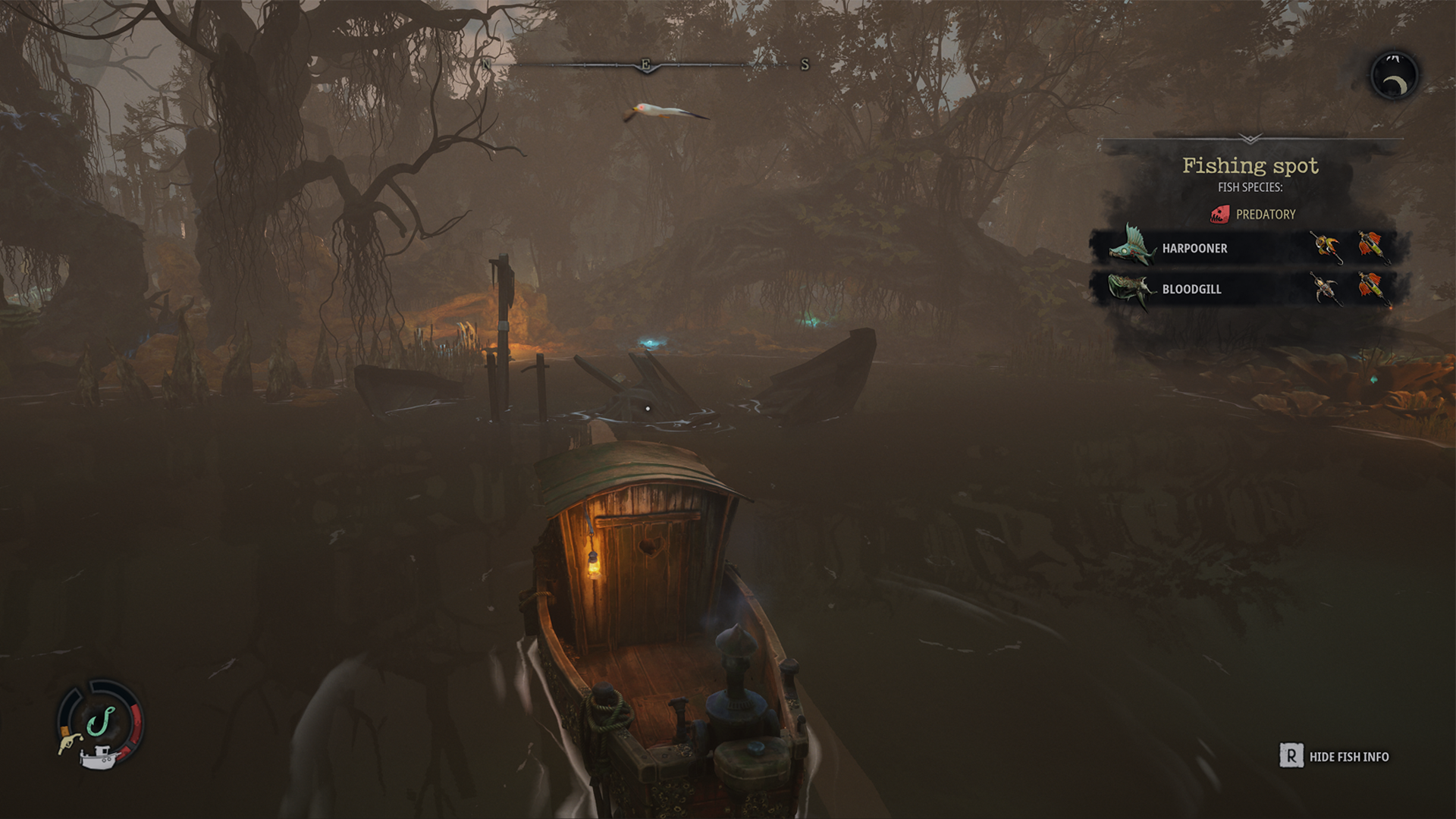
Once your boat is fueled up and ready to go, you’ll hop on and fiddle around with the radio. This too will need to be manually tuned using multiple dials, adjusting until the signal is gained and the voices are clear. On the other end of the line are Gill and Bozur, who inform you of a gate ahead of your location. We’re also introduced to a cool gadget: a harpoon gun that can be used to skewer and reel in boxes of supplies that are trapped in the water. We can fix up our boat and head out, getting some practice with the harpoon gun before we reach the gate.
Taking a second to look around, the art direction of DREADMOOR is amazing. There’s so much visual depth. Thickly settled foliage crowds the background, illuminated by the occasional torch—the light hinting at intrigues just out of reach. Other aquatic plants sink into the murky waters beneath you. The art style reminds me of Dishonored and Dredge, with thick, gritty, almost clay-like visuals. When we enter our vessel for the first time, Malcolm gets frustrated that the door handle falls off of his dinghy, and so he rips the door open with force and audible frustration. The animations bleed his mood into visuals, which I appreciate.
It’s at the gate where we’re hit by a small, easy puzzle using the harpoon gun. There’s a wheel with bucket-like water collectors, but no water is flowing. We have to use the harpoon gun to pull some glowing blue pivot mechanisms, thus moving wooden planks into position to let the water flow, thus filling the buckets on the wheel and opening the gate. As we do, a large sea creature ominously exits before we can. What have we unleashed? Doesn’t matter, because the first thing we see after exiting the gate is a giant metal crab, which immediately skewers and beheads the sea-beast. It’s a fast, brutal opening that threw me off in the best way possible. That giant metal crab (named Betsy) stands near a dock where we park and head on into the odd structure. We’re met by Gill, who is… a corrupted fish-like being protruding from the neck of Bozur, who looks like he’s straight out of Innsmouth. Whatever is corrupting these waters has potent, gnarly effects.
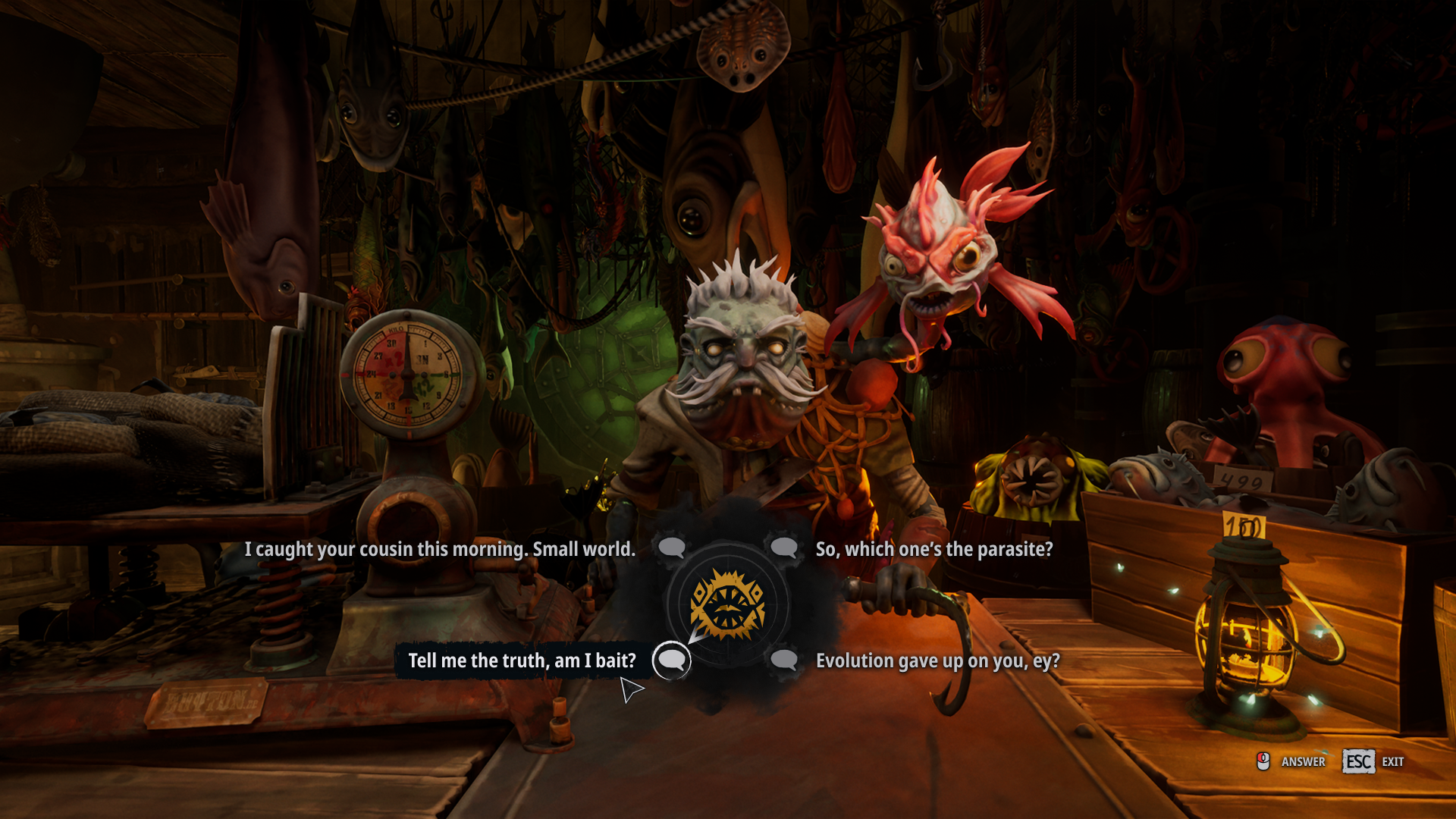
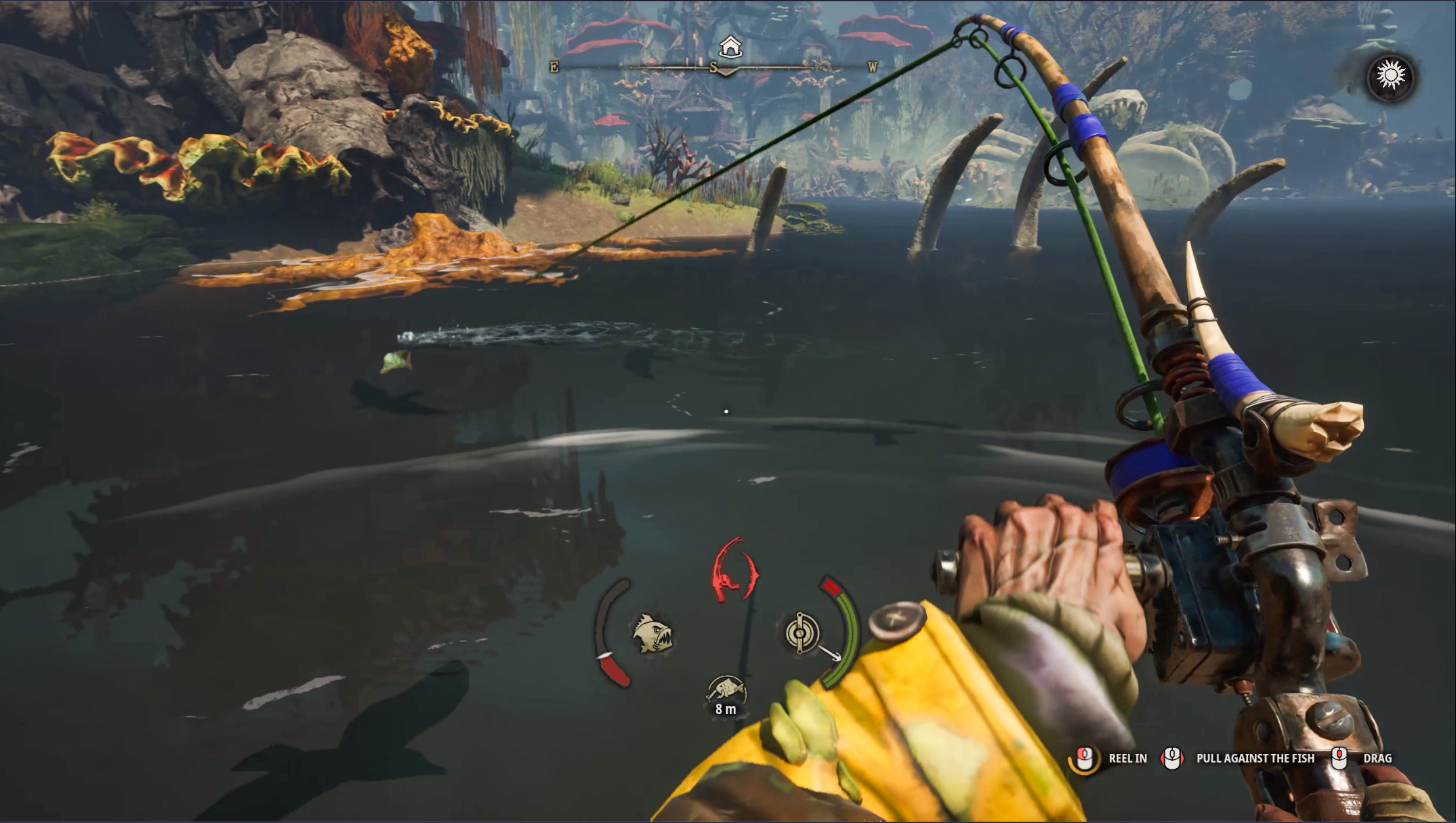
Regardless of his looks, Gill helped us out by telling us about the gate, so it’s time to repay him in fish. We go back to the dock, sleep through the night to avoid dangerous monsters, refuel the boat, and head out to catch some fish. The mechanics behind fishing are engaging and unique, with players managing multiple systems to ensure a successful catch. First, you need to find a spot of disturbed water and look for bubbles. Once you’re all set up, you pick which bait you’ll use (fish have preferred baits that make it easier to catch them) and start casting. Then there’s the minigame, where a fish will dart left and right while you counter by dragging your mouse or pressing the A/D keys in the opposite direction. This will drain the fish’s stamina meter, and once it runs out you’ll have a window to pull it in while it recovers. It’s possible to reel in a fish in one go, but they can also regain their stamina and start darting around again. Pulling the fish while it’s darting will put strain on your fishing rod, possibly leading to it breaking and the fish escaping, though I never stressed my line enough to find out. A successful capture will add the fish to your glossary and tell you its rarity rating on a 3-star scale, if it’s peaceful or violent, and the fish’s weight, and whether or not it’s a new personal record for heaviest fish.
Heading back to Gill, he tells us that the fish we caught aren’t fit for anything other than guts, so we throw them in the grinder to make bait. However, bait is locked behind the skill-tree, which uses torn pages you find on your adventures as upgrade points. The game started us off with two pages, which was enough to unlock the wound bait that attracts small, peaceful fish. Now we can craft them at the workbench, given we have the right supplies. You need to place the right ingredients in the right quantity to complete the recipe, manually clicking on each one. Once they’re combined, the item is yours. It’s interactive enough to add immersion but not so complex or involved as to be annoying. It’s around here where my time with the game ended.
What I played was only a demo, but it felt remarkably polished, and with a high level of cohesion to boot. This game absolutely hooked me with its odd, sunken world and interactive mechanics. I’m quite excited to start uncovering the lore of this sunken world, and I would recommend anyone who’s a fan of Dredge to check it out.