I've been saying for the past two years that we're reaching a technological nadir where once-complex activities like 3D printing are becoming downright turn-key. Most printers started off requiring a great deal of assembly by the end user, followed by complex and near-constant leveling, calibrating, and frustration. More recent printers on the market come either fully or partially pre-assembled, can self-level, and in many cases, can be up and running in less time than it takes to bake a batch of cookies. We truly are in the age of the creator. Creality has been delivering high-quality printers for a while now, including the enclosed K2 line and their bed slinging Ender 3. Now they're ready to announce their next iteration – the Creality Spark X i7, and it's very much born from that relentless drive to make the complex into something reliable and simple. We're working on a review in the near future, but let's hear from the Creality team on how they brought this device to life.
The team started out with a simple guiding question as the foundation -
"Why make users learn 3D printing when the product itself can handle complexity?"
To that end, they worked with creators, the public, social media, and more to understand where people struggle with the complexity of 3D printing. What was it that causes them to fail and give up on the hobby? What would need to be automated to make their next printer one that is ready to use, right out of the box? It will come as a surprise to absolutely nobody that the solution to that problem was a tight integration with AI.
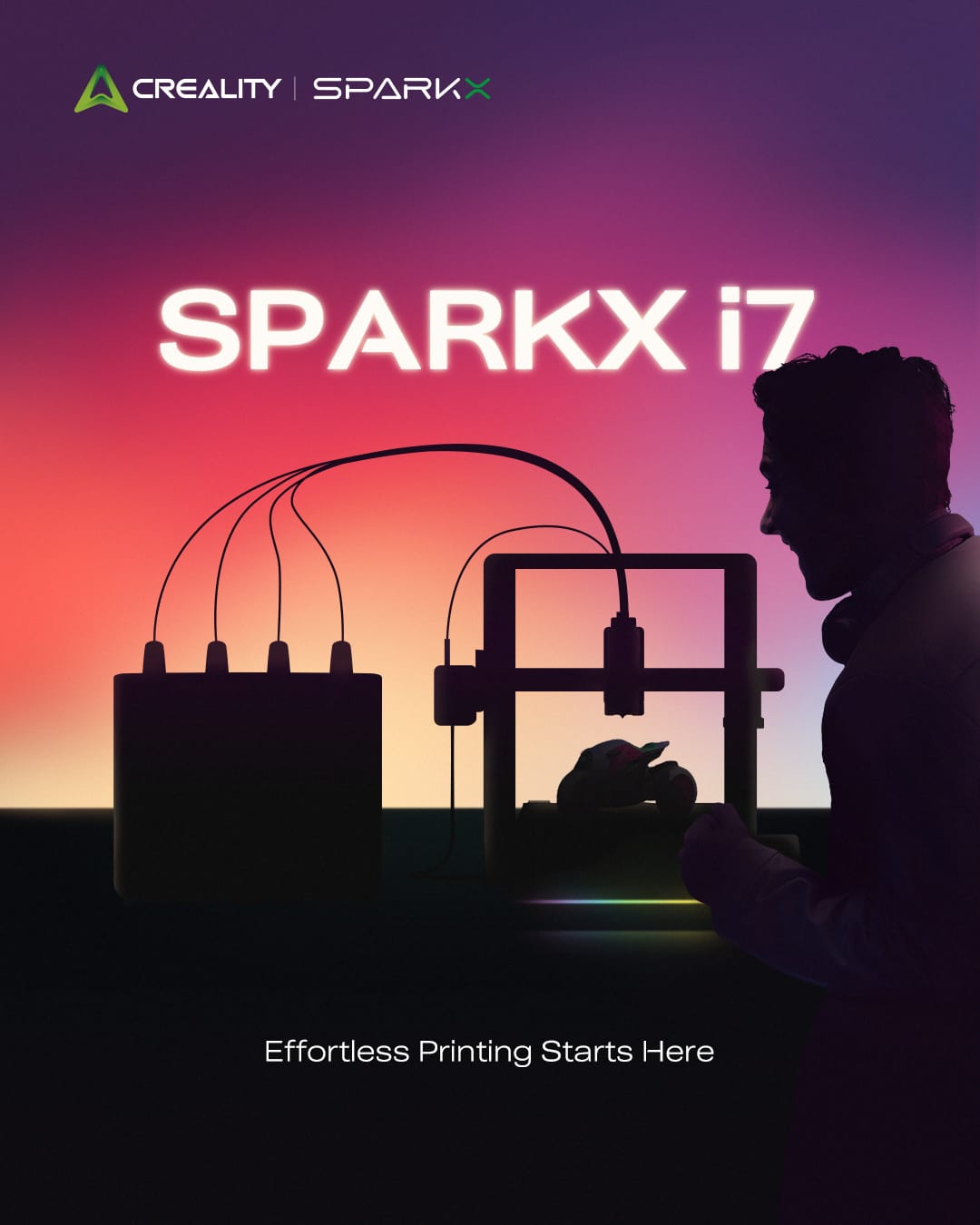
Ready to Use: The Principle Behind Every Spark X Decision
True “ready-to-use” experience comes from understanding exactly where beginners struggle. Every potential sticking point, from unboxing to the first print, is anticipated. Complex calibration, repeated tests, and confusing setup are removed, letting users focus on creation immediately. Intelligent algorithms reduce multi-color waste by 50%, so beginners can experiment freely without worrying about materials, while experienced users retain advanced options for precision and control.
AI acts as a creative partner, taking over tasks that once required experience. It searches globally for models, generates 3D designs from text or images, monitors prints in real time, and intervenes automatically when issues arise. Frequent updates integrate the latest AI capabilities, ensuring the printer grows smarter over time and every print remains reliable and inspiring.
With the mundane being handled by artificial intelligence, the other issue users face is the hotend. It's not overly complex, but if you don't know what you're doing it can be a scary proposition if you wanted to change materials, or print at a different size and speed. The Spark X is looking to make that easier to handle as well:
The hotend is one of the most frequently handled parts of a desktop printer, but traditional replacements are risky and intimidating. Users often need to swap nozzles for wear, material changes, performance needs, or troubleshooting—but conventional designs involve heated disassembly, screws, wires, thermal paste, and fragile parts. Many users avoid it entirely, limiting flexibility and efficiency.
Spark X’s quick-change hotend was shaped through eight full design cycles and a complete structural rethink. Early prototypes still relied on threaded retention and partial wiring, which solved speed but not reliability. Later versions explored magnetic coupling, multi-point latches, anti-rotation keys, and finally a floating alignment system capable of repeatedly positioning within 0.05mm. Each iteration exposed new failure modes—from thermal creep affecting connectors, to repeated insertion loosening tolerances, to material expansion shifting alignment. By the final rounds, the team rebuilt the module from the inside out: relocating stress points, isolating heat, reinforcing the datum surfaces, and designing a locking motion that is intuitive yet mechanically robust.
The result is a mechanism that lets users replace a nozzle in three seconds—no tools, no wires, hot-swap supported up to 220°C, and over 500 verified insertion cycles. Maintenance becomes instinctive rather than technical, allowing anyone to change materials freely, recover from issues quickly, and treat the printer like a dependable tool instead of a fragile device.
The Creality team isn't wrong – all of the issues they've identified have been well-known since we got our first changeable hotend, mostly solved by just replacing parts. This new method sounds a lot more simple, but we'll have to get into testing to find out if it truly is as easy as they describe.
3D printing has opened the door for my household for a number of things that help us in our daily life. Replacement parts, obviously, but also helping my mother with her daily life. Her arthritis make simple tasks difficult, such as sealing bags, opening jars, handling small things like keys, and more. Something as basic as replacing the bottle top for a water bottle with one that has a larger lever she can twist makes the simple act of drinking water something she doesn't have to think about. Same with printing brass knuckle-looking hooks that allow her to easily grab and carry plastic bags. There are a number of things that I appreciate about 3D printing, beyond making amazing cosplay items and statues. While there is obviously a lot of marketing in any release, this one bit resonated with me:
Technology removes friction and respects the user’s feelings, and creativity becomes a natural part of life. Spark X continues to evolve, combining user-centred design, AI-assisted printing, and effortless maintenance. Our goal is to make 3D creation universally accessible, reliable, and inspiring, so anyone can turn curiosity into creation, today and in the future.
There are only a handful of details to share with you at this point. The Spark X will have a build volume of 260 × 260 × 255 mm. It will be "fully automated", produce 50% less waste when printing multi-color, has some sort of AI photo-to-3D printing function, and will feature an LED set underneath that indicates various status conditions via lights.
Stay tuned – we'll have a lot more to share about the Spark X early in the new year. This looks like it could be a solid step up!