Back in 2024, PCIe Gen 5 drives were just starting to hit the market. The predecessor to the drive we will be talking about today, the PNY CS3150, was one of the first ones on the market. Able to hit upwards of 11,500 MB/s read and 8,500 MB/s write speeds, it was a massive evolutionary leap. The cost? It took up a large amount of space thanks to a cooler that stacked on top of the drive to keep it from overheating. It absolutely hit those advertised speeds, and with room to spare. What if I told you that not only has PNY beaten those speeds by a large margin, they've done so while somehow conforming to the established M.2 2280 form factor, and without that active cooling fan? Well, that's precisely what the PNY CS3250 does. Hard to believe? Let's benchmark it and find out what's hype and what's real.
PCIe Gen 5 is now fairly ubiquitous on any current motherboard, with at least one slot (the one closest to the CPU socket) carrying that standard. As this generation literally doubles the PCIe lane width from 16 GT/s to 32 GT/s per lane, there is a lot of headroom to take advantage of, with speed to spare. The challenge, as expressed by its predecessor, is controlling all the heat going that fast generates. That's where the new Phison controller comes in.
Under the hood, the PNY CS3250 has a new E28 controller from Phison. This brand new controller is built on a 6nm process, bringing with it vastly improved power efficiency, and thus (with a touch of thermal coating to help), keeping the drive cool, despite the drastically increased speeds. This is critical for things like laptops and handhelds where power efficiency and heat management are paramount. Using an advanced 3D 218-layer (BiCS8) TLC NAND, the drive is able to deliver the speeds PNY is touting, with a bit of headroom to spare. For DRAM Cache, PNY loaded 2GB of Hynix LPDDR4-4266 onto the CS3250. I was surprised to see what else PNY had hiding inside.
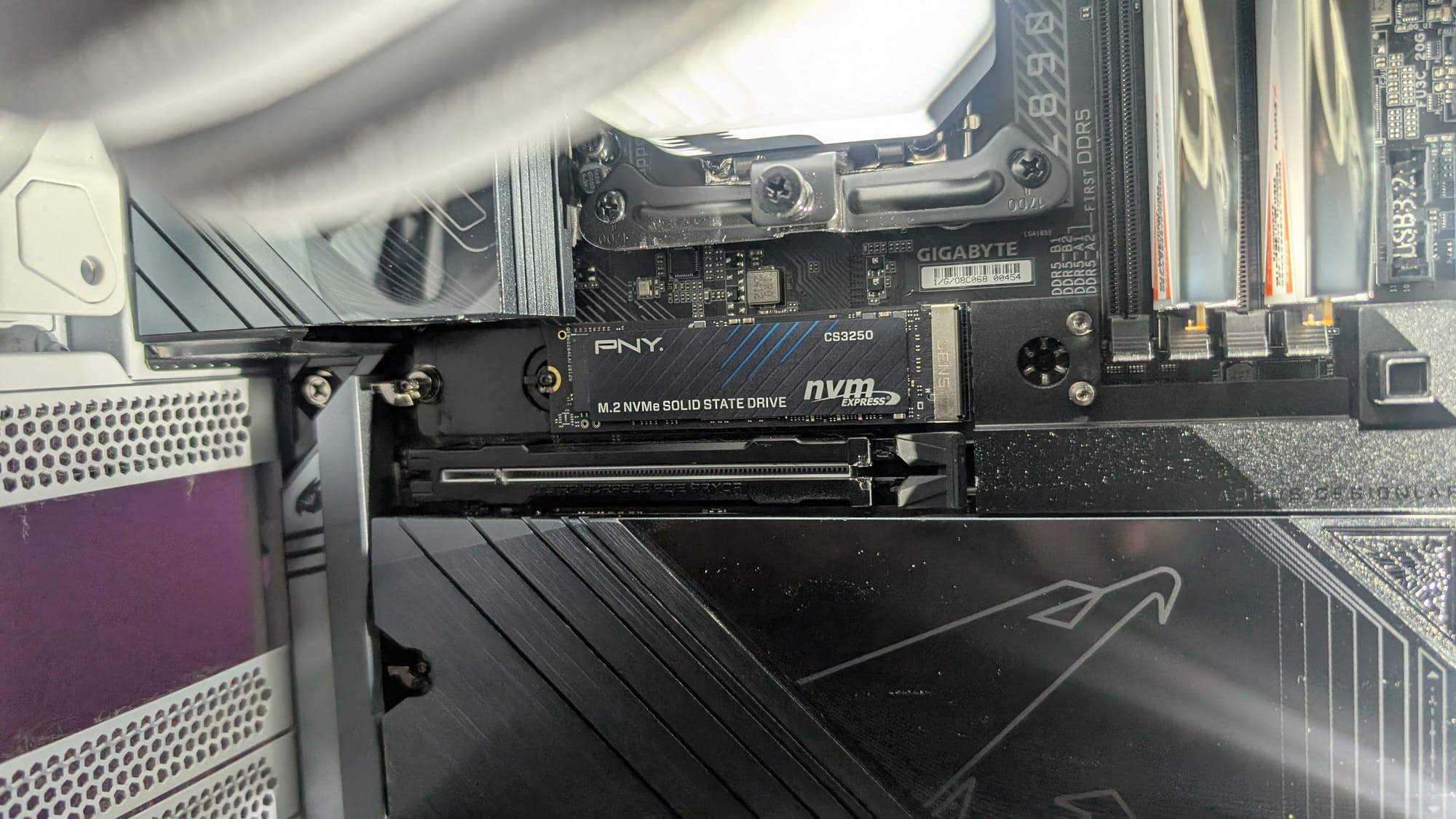
The new Phison controller in this drive is marketed as the first 6nm SSD controller with built-in compute capability for AI data processing and local Large Language Model training capabilities. All I can do is report on that one as I don't have a clear way to test that capability, but it's clear that both Phison and PNY are both thinking about the future and where the world seems headed.
The test platform I use in the lab is current – a GIGABYTE Z890 AORUS Master with an Intel 285K and an RTX 5090, coupled with V-Color DDR5 Manta XFinity 48GB (24GBx2) 8800MHz CUDIMM – more than enough to handle anything current and likely well into the future. Despite that, when I connected up the CS3150, I was shocked at the benchmarks.
I typically use a handful of synthetic and real-world tests to quantify speed improvements. Crystal Diskmark is great for theoretical maximums and to check the claims on the box. ATTO is a similar test, but sliced and displayed a different way. It gives us a look at performance longitudinally across a variety of ever-increasing block sizes. You’ll recall that this drive is rated for 14,900 maximum Read and 14,000 maximum write — let's start our tests.
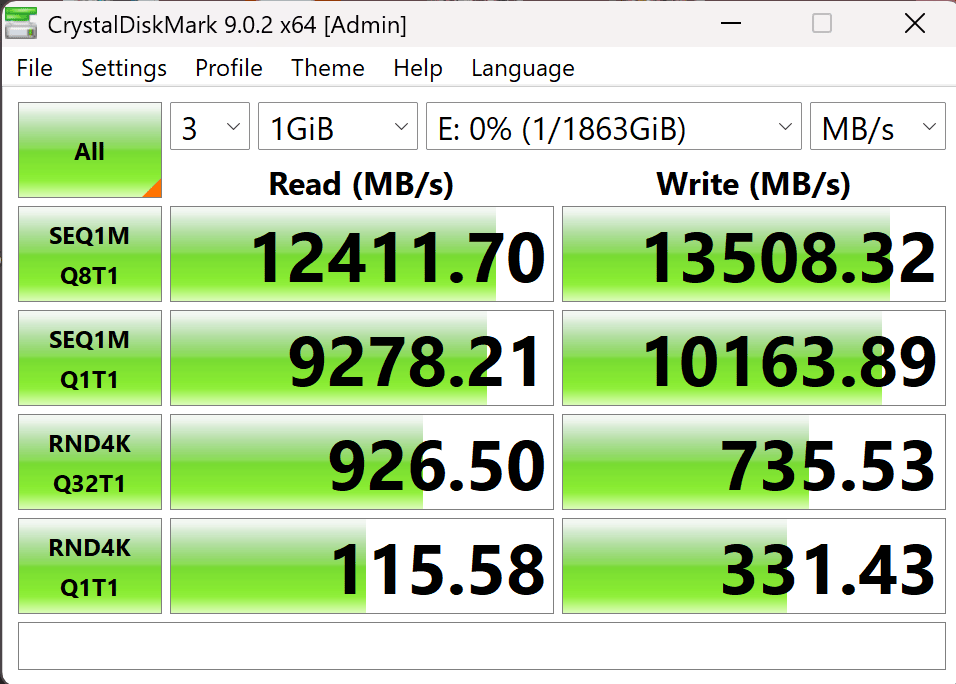
It's amazing to see numbers like this. While the read speed came in underneath the max for this synthetic test, but to see the write speed almost hit the maximum is insane. These sorts of speeds were unheard of outside of the commercial space. Seeing it in a consumer drive is unheard of, but that's precisely what PNY is delivering here. Let's jump to ATTO for that block-by-block breakdown.
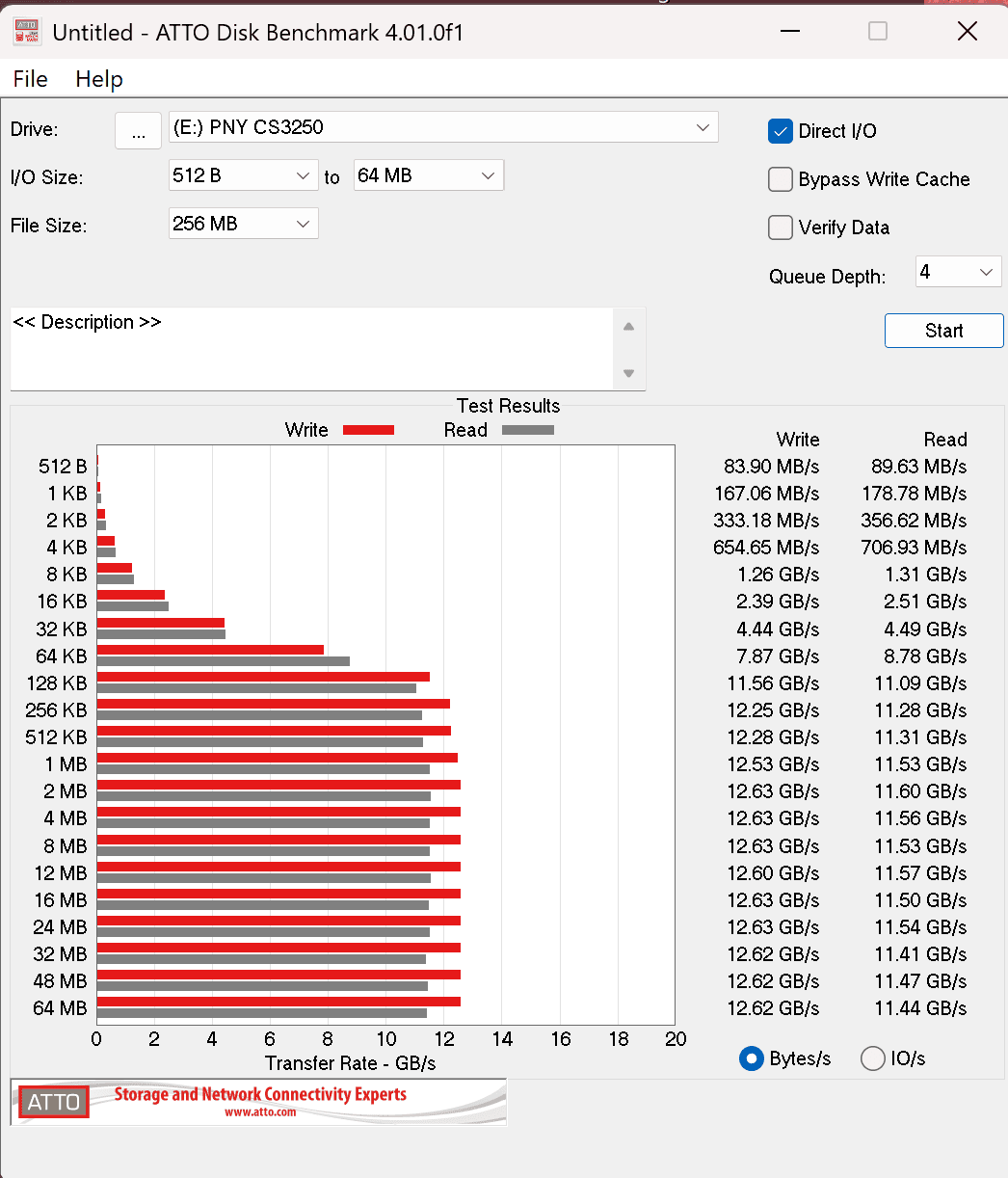
Once you reach files around 64 KB in size, you see incredibly consistent results that carry all the way down the line. Every one of these synthetic tests operates a bit differently. What's more important is that the drive performs well at all speed blocks. What's more important is how it delivers in your particular use case. Let's do a drive to drive copy.
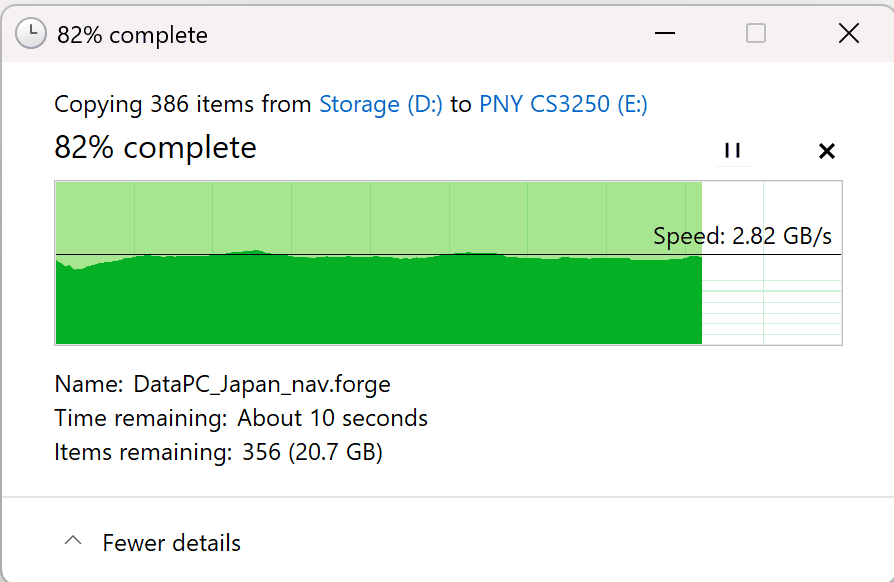
The drive to drive copy you're seeing is from a Gen4 to a Gen5 drive as my board only has a single Gen5 slot. As a result, it's throttled to the maximum speed of the source, as you'd expect. This is probably the best time to talk about why this isn't showing 14 gigs per second, and when you could potentially see that speed.
Once the CLS cache fills, the drive levels out, mostly seen in mixed files and long sustained writes. You'll see speeds we see above — around 3 GB/s, give or take. If I were able to do this same drive copy in a Gen5 to Gen5 scenario, I'd likely see these same mixed file drive copies hitting closer to 7-8 GB/s range. So how do you get those vaunted 14,000 MB/s that's on the box?
The best case scenario, under ideal conditions, is a copy from another Gen5 NVMe of similar speed. The files would be large and sequential, the drive is cool and not being thermally throttled, the PCIe 5.0 x4 link is fully stable and not being throttled due to other PCIe lanes soaking up too much bandwidth, and the drives are keeping up and not filling the SLC cache. It's not an impossible scenario by any stretch, but you can see how it might be hard to see that same number in a real-world test. That said, I do have exactly the test you came here to see – how it performs in a game. Let's load up Crimson Desert (our review) and showcase just how much time you're wasting if you aren't using a high speed drive like this one:
PNY CS3250 NVMe speed test in Crimson Desert
In this real-world test, you're shaving off 10 seconds for the initial load, and 3-4 seconds off every load in the game when you use a teleporter (which is often). Those add up quickly, and soon you've recovered minutes. In a game as long as this one, you've literally reclaimed hours of valuable game time where you were playing instead of staring at the loading sequence. That's what is important to me as my time is precious, making this drive a must-have improvement.
The last stop on every hardware review is always the same — warranty and price. As with its predecessor, the drive carries a five-year warranty, with lifetime technical support should you need it. I have been using PNY drives for years (and likely far longer than I'm supposed to keep them) without a failure. I have a pair of PNY NVMe drives that run 24/7/365 as a cache for my NAS platform. I have yet to need technical or warranty support, but it's great to see a 5 year instead of a 3 year warranty as you'll likely upgrade your PC around that time, if the industry average holds.
Pricing is a hard one to predict, not just for this drive, but for any NVMe SSD. AI and massive data centers have been gobbling up supply, driving prices for RAM and drives through the roof. The current price on the 1TB version of this drive is $249, with the 2TB variant coming in at $447 at the time of writing. Despite the price hikes the entire industry felt in January of 2026, this drive is not only a remarkable value, even at that price, it's also come down in price by $50 in the last 30 days, making it the lowest price since the price hike. It's not often I say this, but PNY is working hard to push their prices down to levels where they make sense for consumers — a rare move since higher prices net them higher margins. Big thumbs up to the PNY team from all of us. This is the way.
Ultimately, a drive like this, just like its predecessor, is largely dependent on your overall use case. If you're doing video production, extra drive speed means smoother scrubbing through video footage and potentially faster render times. If you're gaming, you can see above that it has a real-world effect on load times — something that can reclaim time you can spend enjoying the game instead of staring at it. If you're building out a new system, your free time demands you grab this drive!
PNY CS3250 NVMe SSD
Excellent
Delivering remarkable speed without the need for an external cooler, the PNY CS3250 is a significant, generational upgrade over its predecessor. The price is still high, but if your use case supports it, this drive is delivering value enough to make it worth the extra cost.
Pros
- Fantastic speeds in synthetic tests
- Real-world improvements are tangible and significant
- No more external cooling system
- 5 year warranty
Cons
- It's still expensive, so purchase timing is critical
This review is based on a retail version provided by the manufacturer.